Tuesday, February 3, 2026
This is starting to be a habit, but I’m not complaining. In my old age I’m finding it harder and harder to get up early in the morning. I’ve gotten to where I really enjoy sleeping in until 8:30 or even later. That gives me time to stay up later at night to watch movies and such, but that is not really productive time, and it does leave me feeling rather lazy. I still don’t want to get up early in the morning though. That is where the current weather has really come into play. If you have been following these blogs for the last couple of weeks, you will remember me going out to shoot a barn at sunrise because I was taking Toni to work. That system was pretty much only ice and was no fun to drive in. About the time that the roads started to get cleared off from that, we had another system move through that dumped around a foot or so of snow over most of the state. That brought with it another week of transporting Toni to work and yesterday, I took the opportunity to go and check a photo shoot off the bucket list. It was brutally cold, so I didn’t stay long, but I finally got to photograph Outlawed Restorations in the snow which is something that I had been wanting to do for a while.
Looking back over the history for this part of the state, having two different winter storms happen and being able to get out to get some photos is pretty incredible. I didn’t shoot for volume on either of those days because working in the snow is not the easiest thing to do. I was just happy to have been able to do it, and that was only because I was taking Toni because without that motivation to get out on the roads, I would have happily stayed at home, sleeping in. I was honestly very happy with what I had captured during both treks, but looking ahead to Tuesday, the weather was looking promising for a sunrise with high and medium level clouds coming in over Yadkinville right at sunrise. With our road still a bit dicey with the ice remaining, I convinced Toni to let me take her to work which would put me back in Yadkinville once again well before sunrise.
I needed to figure out what I wanted to shoot that would work for a sunrise. This was not all that easy because I was quite literally running out of ideas for sunrise photos in that neck of the woods. Normally, when I think about sunrises, I am thinking about landscapes and that usually takes me out to the Blue Ridge Parkway. I would be nowhere near there, and most of it will be shut down from the snows anyway. I could go back out to the Outlawed Restorations, but that was not really a great sunrise spot and if there was going to be color in the sky, I wanted to be able to capitalize on that. My last session with the barn at sunrise had gotten a lot of positive feedback and several folks suggested that I shoot more of these. I’ll admit, barns look really good at sunrise, and I’ve had some pretty good luck with those over the past couple of years. Ironically, those times were thanks to taking Toni to work as well. Between the two communities that she has worked in, I’ve been exposed to some different rural areas that I haven’t really paid much attention to in the past. I just didn’t really have a specific idea of where to go, and it is not very easy to scout out a location for sunrise in the dark using only headlights. Of course, with the road conditions, I was also having to pay attention to the road.
That got me thinking about things that I had seen in the area that might look good at sunrise. Most of what came to mind I had shot before and kind of knew what to expect. I considered going back to the old mill that I had shot towards the end of 2025, but decided against that because there was really only a single composition to use here and that one didn’t really excite me. I considered a barn that I had shot shortly after Toni had started working at the Yadkinville location which she had suggested. That one was facing the right direction and would likely look good in the snow, but there was a real good chance that the composition would still be rather cluttered because the barn was right in the tree line and behind some overgrowth. That was my best choice though, and what I was suspecting would be the barn that I would end up at. I spent some time on the maps looking for the location as I only remembered the general area that it was in. I wasn’t going to be able to spend too much time looking for the barn in the dark when I would be hard pressed to find it within the trees.
When morning came, I got up about 45 minutes before Toni was wanting to leave. I got things ready to go and loaded up the camera before we headed out. The roads were better than they had been, but there was still a lot of ice over the two miles or so to get to the main road. I was glad that she didn’t take herself as I do worry about her when she is out on the roads this early in the morning with conditions that aren’t great. While we were enroute to the job, I was thinking about different places that I could go if the barn didn’t work out. I was starting to see some color on the horizon that indicated that there was likely going to be a pretty good sunrise. I didn’t want to be left in a lurch trying to find something to put under the sky. One of the alternates that came to mind was an area that I had ended up in going out to change the tire of one of the nurses that works with Toni back in the Summer. I had been out there a few times since looking for barns and had successfully shot a few of them but knew that there were some that needed different light from what I had seen. There was one in particular that every time I had been by it, the light was too strong and the barn was backlit. I wasn’t sure exactly where it was, but knew it was on the direct route to get to where the flat tire was located.
Toni didn’t remember exactly where she had left the car, but between us, I was able to piece the directions together in my mind. After I dropped her off at the door, I pulled out the phone and looked at the map. There was no way to determine exactly where the barn was but remembered it standing out from the trees which was going to be very beneficial when spotting it in the dark. I knew the way to get out there now and decided to abandon the barn that I had already shot once before in favor of finding a new one to shoot. If my estimations were correct, the sun would be coming up behind the barn and off to the side which should make for a pretty dramatic look to the photo if I could get the exposure balanced well enough.
I was driving slow, but not because of the ice on the road this time. I was scouting a barn that I only knew would be on the right side of the road. I had no other information than that as to where it was on the route. I had a bit over two miles to get it figured out though. Every structure I could see off on the side of the road, I would stop and look. There was one barn that I saw but wasn’t able to see enough detail to really know if that was it or not. I got turned around and went back by it. It wasn’t the one that I was thinking about, and it was not all that pretty at all. I turned around again and continued on my way. About a mile further down the road, I saw what looked like two barns on the side of the road. The one that was set off by itself was a simple corn crib it appeared, but there was no denying the colors in the sky in the background. I got the truck turned around and gave it another look. I was pretty sure that this was the barn that I had been thinking of, but even if it wasn’t I was needing to get set up as the light was already starting to look good.
Pulling onto the shoulder of the road is nothing strange to me when it comes to getting into position for a photo. I pulled off the road like any other time knowing that I was going to be driving through snow and ice, but I had no idea that it was as deep as it was. I could feel the truck sinking beneath me, so I instinctually shifted into 4WD to avoid getting stuck. The truck transformed in that instant and I was able to maneuver in the slush that was nearly a foot deep. Now that I was safely out of the road, I went back to get the camera built as I was looking at the two barns to determine what lenses I might want to consider.

One of my goals for the year is to get more proficient with the wide-angle lens options that I have. Looking at the scene, I knew I wanted to get the sky above, and there wasn’t much in the way of distractions in the immediate vicinity. The biggest thing that I was going to have to worry about was a house on a cross street to the right. That was going to be easy enough to mask with the barn even at a moderate focal length. However, I saw this as a great opportunity to go fully wide and get the barn well above the horizon which can only be accomplished by the scaling provided by the wider angle. With all that in mind, I committed to the 16-35mm lens when I usually would have gone with the standard zoom as it gives a moderate wide end.
I decided to skip adding any filters to the camera because I was going to be shooting into the sun which would negate the polarizer. There was no need for a grad filter either since the barn was going to be well into the sky. There wasn’t enough movement in the clouds to justify a long exposure, and the sky was generally soft anyway. This was going to be pretty simple and it was down to the composition that I chose.
For those of you who have been with me for any real length of time, you will know that I am a proponent of the idea that there are three things that come together to create a photo. You have a subject, light, and composition. As long as you are successful in two out of the three, you will have a decent photo, and if you get all three of them in a single frame, then you will have a great photo. Of all of those considerations, a natural light photographer only has control over the composition. With that in mind, I try and pick interesting subjects, but in this situation, it was just a small corn crib. I was counting on my composition to make it more interesting which left the light. I had no control over that at all but had stacked the odds in my favor by picking today to try the photograph. The light was still in question which meant that everything was hinged on my composition.
Not knowing what the light was going to do and only seeing a sliver of color at the horizon, I chose to include only a little bit of the sky with the majority of the frame being the snow-covered ground. To make that sheet of white a bit more interesting, I incorporated some tall grass that was poking through the surface of the snow. This gave me a bit of a foreground to help balance the composition and the grass pointed at the barn. The problem was that the grasses were getting lost in the frame because they were down at the lower right corner. With the brightest part of the sky near the upper left and the main subject in the upper right, the grass was getting lost. The sky was also taking attention away from the barn which I didn’t want. Looking at things in the viewfinder, I realized that this was going to be an image that I would flip in post to make it read a bit differently in order to have all of the elements feel more balanced with the luminance that was developing.
I fiddled with this composition more than I probably should have as I moved the tripod around inch by inch to make sure that the house on the other side of the barn was covered. I also had to pay attention to the traffic in the distance because I didn’t want to have any lights streaking across the frame in the background. I was liking the composition, but it wasn’t quite one that I felt committed to. I kept moving things around because I just wasn’t happy with it. The more I looked at the photos coming in on the image review the more I realized that the inclusion of the foreground was forcing the barn to become smaller in the frame and that made it lack the imposing view that I wanted it to have. I was currently at 19mm which was really wide, but I needed the barn larger in the frame which meant that I needed to close the gap.
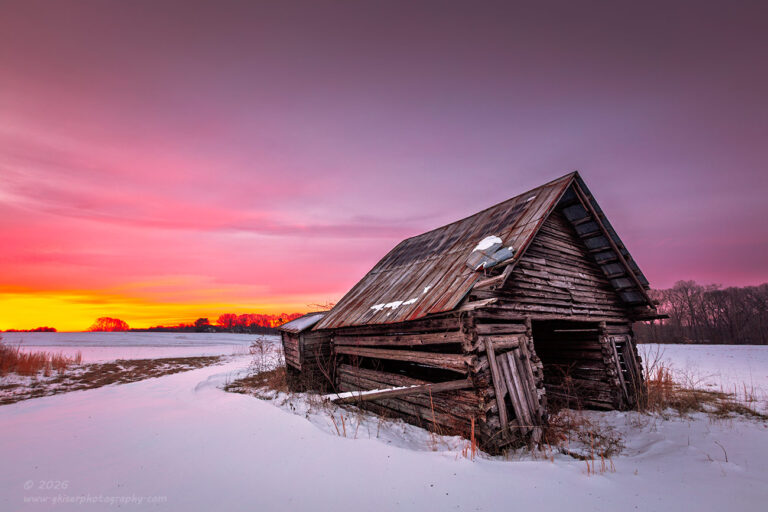
I walked right on through the tall grass which pretty much ruined that shot from that point on, but I needed to get closer to the barn. The closer I got, the more impressive this little barn became. It was still hovering well above the horizon, which was what I wanted but it was now dominating the frame. I really liked this view of the barn and with the new composition, I didn’t believe that it would benefit anything to flip it which allowed me to frame it exactly as it would be seen which simplifies things. This composition was much stronger and that strong composition made the subject much more interesting. I now had two of the three criteria met and was waiting on the third which was looking promising.
I would have loved to have had the actual sun coming into the frame right at the horizon, but the sun was just a bit further out of the frame to the left. That put it behind the barn that was neighboring this one. I could have moved to change the angle on the barn to get the actual sun in the frame, but that would have included a large house just beyond the barn which was a huge distraction with the snow-covered roof. The best compromise was to leave the sun out and get the glow on the horizon which was pretty impressive. In fact, the color was starting to catch the clouds further into the sky. There was a wonderful rosy hue that was developing while the horizon itself was glowing orange and yellow. It was beautiful to see in person but seeing it through the camera was rather bland.
You might remember how I set my camera up to get the full dynamic range of the sensor when shooting RAW. It seems counterintuitive, but I use a color profile that is very basic and then reduce the contrast and the saturation. This leaves me a very flat image that never does the scene justice, but it allows me to get sometimes a full stop more exposure without cooking the highlights. That was what I was doing here as I knew I needed detail in the barn as well as color in the sky. This meant pushing the exposure as far to the right as I could without clipping. This created a very washed out photo on the back of the camera that would leave most people wondering if I knew what I was doing with a camera. I knew that I was going to be able to pull all the color back into the image as well as having plenty of detail in the barn by the time I was done with the processing. It is all about shooting with how you intend to do your edits.
Unlike the previous composition that I kept adjusting and fiddling with, this composition was solid and required no adjustments as the light was changing. There was much more sky included in the frame as the barn had been moved down to the lower third and I was now shooting at 16mm which was fully racked out on that lens. Everything was looking fantastic and the light just kept getting better and better. I would press the button every 30 seconds or so as the glow in the sky would change. I wasn’t sure how it was going to look when I was finished with the photo, but I had a feeling that everything that I wanted to be in the photo was there. It was just one of those times when I was pretty sure that I had nailed it while I was still capturing exposures.
Even though I was totally happy with what I was seeing in the camera, I still wanted to look around to see if there were other compositions that I might be able to shoot. The background changed and became cluttered when I shifted to the other side of this barn which meant that the angle that I was currently photographing was probably the best one. There was another barn that I had been looking at the entire time I was out here. It was a larger barn off to the side. It was a pretty barn and certainly looked like something that I would want to photograph. The problems that I saw with it included a large boom that was pointing up to the sky that cut across the front of the barn. It was also situated in a grove of trees that took away the structure of the barn for a backlit situation. Those were the reasons that I hadn’t really worked on anything with that barn up to this point. Now that I was really happy with the one barn, I was starting to look around for other options. I considered photographing both barns together, but the exposure latitude would be too great to do that, and I felt that they both needed a different approach to color which would make it difficult to include in the same frame.
When I started to see that the colors in the sky were fading a bit, I decided to leave the most successful composition that I had found and I turned my attention to the barn to the left. Looking at the positioning of the boom, I figured that I could effectively shoot underneath it by using the same wide-angle lens that I had been using up to this point. My little New Year’s Resolution is already paying dividends because I am more readily seeing as a wide-angle lens would see. I had to move in closer to the barn than I already was which meant walking through the snow that I had just photographed with the other barn. It paid off because I was able to separate the boom from the barn quite well. I also found that the boom and the edge of the roof were at similar angles for a bit of an extra visual treat. The base of the boom was at the bottom of a tree that was a good deal brighter than the surrounding trees which helped to give it a visual base on the left side of the frame. There was still a good deal of color on the horizon as well which I was excited about.

I started to play the dancing game with the tripod as I looked for that perfect spot to place the camera. Unlike a telephoto lens which will give pretty much the same composition while moving around, the wide-angle lens is a lot more finnicky about positioning. A change of a centimeter can alter the relationship between subjects greatly. I had to keep all of this mind as I found just the right spot for the camera. Once that was figured out, I fine tuned the composition and started to look at the exposure values.
This barn was in a very dark portion of the scene thanks to the trees. The sky at the horizon was very bright even though the sun was now behind the clouds which was giving me some concerns with the dynamic range of the scene. There were no filters that would help here, it was all going to come down to what the camera could capture. There wasn’t much wind, so I might have been able to do an HDR blend, but I’ve found that any time I do that with fine details like the bare trees that I am grossly disappointed with the artifacts that show up. I doubt that anyone would actually notice them in a print, but I hold myself to a higher standard than that. This was going to need to be a single exposure image which meant really pushing that exposure to the right, just to the point of clipping the sky at the horizon. When I did a test shot and zoomed in, I was really impressed with the amount of detail that I had in the shadows of the barn. Looking at the histogram, I had plenty of shadows, but not much near the black point which meant that I would have sufficient image data to recover the detail in the barn. This was looking like it was going to work out as well.
The sky had pretty much faded out as far as color at this point, so I was thinking that this was going to be a black and white photo as there were some interesting textures in the sky. The only real color was there at the horizon which was hanging on even though it was well after sunrise. After about ten minutes of working exposures with this barn the sky started to get a slight bit of color to it with a very bright spot right above the barn. It honestly looked as though I had adjusted the sliders and applied a few local masks to the sky, but I was looking at it in real time. I made a quick adjustment to the exposure and tested out the “Landscape” color profile just to see if the camera was capturing the colors. It was, but the histogram was clipping the highlights in that profile, so I changed it back to my standard one to show a more accurate histogram. Now, nothing was blowing out, and I could push it as far as I could to the right.
There were a few more frames done as the sky held the color. In addition to watching traffic on two streets in the background, I was also having to deal with large groups of birds flying through the frame. Everything had to be timed so that I didn’t have those distractions in the frame. In the end, only a fraction of the time spent on the other barn was dedicated to this one. The light was about over when I had started working with it, so it didn’t take long for all the color to leave the contrast to get too much to deal with.
When the last frame had been shot, I had been at this location for 45 minutes and had shot 63 frames. These photos were divided up into three different compositional ideas which you have seen in the photos above. The high shutter count came from waiting for the best light and not wanting to miss the best light. It is very easy to come away with a lot of frames when the lighting is changing rapidly and there is a difficult lighting situation that is being dealt with. I’m certainly not worried about the hit rate for this trek because I really think that the images that I came away with are all very strong and well worth the time spent on them.
I really do hope that you have enjoyed this trek and the photos. It was a very satisfying day for me, and I’m really liking the short treks that I can work through in just a few hours. I would say that I might be back out tomorrow for some more photos, but there is another chance of a wintery mix falling and I really do need to start getting my mind wrapped around doing an engagement session for a client this weekend. I’ll need to shift gears a little bit, and I am about ready for a break. We shall see what happens tomorrow though.
Until next time…