Wednesday, December 17, 2025
Just in case you really need to catch up, here are the other chapters in this blog series.
It was just supposed to be a quick morning trek to give me a little something to do that afternoon and through the rainy weather on Thursday. Here we are on Friday, and I’m just starting the fourth chapter of the blog series while the second part was just published earlier this morning. While I was going through the photos and culling them down to a whopping 29 images, I couldn’t help but think to myself, “Here we go again!”. The first time I visited this location, I came away with a lot of photographs, and after looking back on that last chapter, I found that number to be 29 images as well. I also found it rather ironic that the first time visit was on a day that I was only looking for a few photos and a single blog entry after a string of multi-part blogs. Because I missed that goal by a mile, I titled that blog series simply….”Not” with the various parts listed. Now that you can see that I’m in the same boat this time as well, it seemed only fitting for the series title to be “Not Again” because it would appear that oops, I did it again.
In the past three chapters, you have seen a mix of familiar subjects from the first visit and a couple of new ones that I finally figured out how to capture with the camera. It all came down to understanding the area and the subjects that I was working with. On the first visit, I was overwhelmed and was feeding off the newness of everything. Everything jumped out at me, and I felt like someone with atomic level ADHD. I was obviously able to come away with a lot of photographs that time, but they were all pretty much the low hanging fruit and the expected compositions that I could put together quickly. This was the visit where I was going to take my time, not worry about the rain that affected me the first time, and look for the deeper images. I wanted to capture the essence of the location, not just the vehicles present.
This will be the last part of the trek as I finish out the photos from the day. Again, you will see a mixture of familiar subjects and some new ones that I started photographing on this visit. Among the new ones will be one that really surprised me as I didn’t even want to photograph it until I had walked by several times and all of a sudden it was looking at me with those sad German eyes just begging for a bit of attention. Who was I to deny a car with a rusty fender and streaks on the hood a few minutes in front of the camera? Nicht Ich!
When we last spoke, I had just finished working on some compositions with an Imperial and a Super Bee tucked behind the buildings on the property. This was where I had spent the most time during the first visit, and I’m pretty sure I had about the same amount of time invested back there as well. There was more room to move around, and better options on angles for those cars, especially the Dodge which was kind of set off by itself. I was starting to look at the time during this stage and thinking about how long I would be needing to work on processing the photos and what the schedule was going to look like for doing the blog. It was looking like I was going to be working through the evening and most of the day on Thursday. This was kind of what I had planned, and I was fine with that, but I think I was underestimating what I had been doing. I didn’t have a very high shutter count by this point with only something like 85 frames which should equate to around 8-15 keepers. What I didn’t really take into account was that I hadn’t really been lingering on any particular compositions. I had shot a frame or two and moved on to something else which tends to really up the hit rate for the day. These are the days that I will forget that fact and will find myself drowning in different compositions during the culling and processing. Yeah, that was about to happen after this trek as I was looking at 21 keepers up to this point, and I had no idea that was the case.
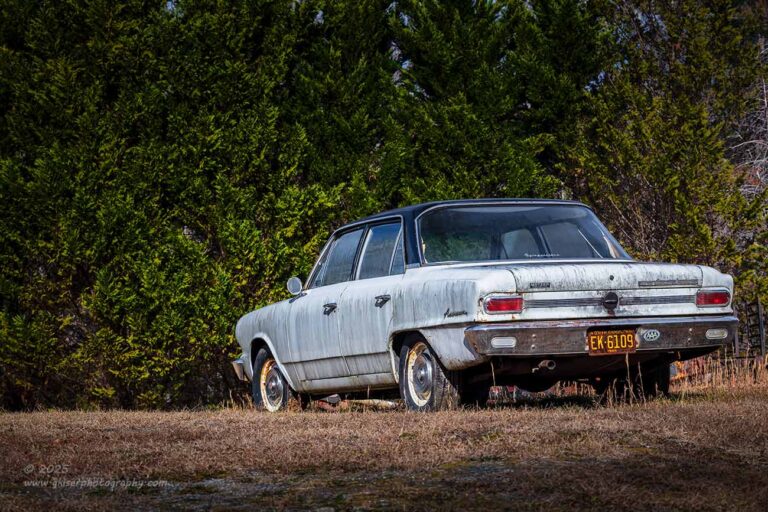
You might remember that during the Summer’s visit here, I had packed up the camera and was walking back to the truck sweaty and tired. I was spent but then remembered the Rambler and the fact that I wanted to photograph it. Because of the strong draw of that subject, I pulled the camera back out and set up a few photos of the car. They turned out better than I would have thought considering how tired I was, and I was really glad that I had stopped to do it. This time, I had not forgotten the Rambler but was less drawn to it than before since I had some pretty darn good photos of it already. My goal was not to revisit old compositions, though I had done that with the Super Bee for what I felt was a good exception to my self-imposed rule. I saw no reason to work the same angles on the Rambler though and wanted to get something different if I really wanted to shoot the car.
I looked all around the car to try and find some decent angles that would flatter the little nondescript sedan. Ironically, it was the view from the back corner that struck me as the most interesting. There was a trailer or something on the other side of it, but I knew that with some careful positioning of the camera, I could get the car to mask that easy enough. I still had the long lens on the camera which had proved to be very useful for the vast majority of the photos that I had shot out here. That lens, once again, was going to give me the right perspective on the car and enough scaling to cover the distractions beyond it. I just got down very low and used the line of trees as a nice clean background for the car.
This was where I started to look at the subject and environment to make sure that things were going to go well together. There was really no coloration to the car since it was white with a black top. What color was there was some warm tones for the taillights and the characters on the tag. An argument could be made that the black top and glass reflected the blue from the sky because the clouds were starting to clear up by this point. That gave a nice balance to the colors there, but the car in general was primarily a cool tone. The grass that the car was parked on was brown and dormant thanks to the season which contrasted with the surprisingly vivid greens of the trees. That entire background gave me the right mix of warm and cool tones to go with the car while allowing the car to pop against those colors.
It was a very simple composition once I figured out the position to allow the car to block the distractions while another enclosed trailer was hidden just out of frame to the right. The photo just makes the car look like it is there all alone and facing away. It supplies a mood and an air of shyness which I thought suited the car quite nicely. It was a completely different way of seeing the car than what I had done previously which included the building behind the car and it was done in black and white. This one had a softer feeling to it, and a real sense of isolation. The colors supported that emotion and helped to tell the story which wasn’t as clear in black and white. At least that was my opinion on it.

Not wanting to get too caught up in capturing the overall look of the car, I started to look at the details. Things like lights and emblems I had shot the last time, with a surprising success story being a headlight shot done in black and white. That one still hits me and impresses me which also meant that I didn’t need to try and redo that one. I still think it is perfect the way that it is, and just can’t imagine messing with that. I did look at the passenger side headlight with something similar, but it felt like a straight up copy of the idea done slightly different to avoid being accused of plagiarism. Yeah, I know that isn’t a thing when the first shot was my idea as well. Anyway, I didn’t feel like anything with the headlights was worth spending too much time with. It was the door handles that I ended up wanting to work with this time. Well, not so much the handles as it was the shadow from the sun that I liked.
With this being a white car, the shadows came in as the best contrast considering the handles were chrome and were quite similar in luminosity to the paint. I first located a door handle on a rear door that had a lot of streaking from age and dirt. This added a good bit of contrast and texture, and I knew what I could do with it recalling a Thunderbird that I had shot a couple of years ago. I framed up what looked to be a very dull photograph in the camera. The focal point was the door handle, but the shadow under it gave it depth and life. There was a seam from where the door mated up to the quarter panel that gave the negative space structure. The rest of the photo was filled with subtle shading from the streaks of dirt. I wasn’t able to see it very well in the camera, but I knew almost exactly what it was going to look like when I got it into Lightroom.
When that moment came, I wasn’t as convinced by the original photograph. Once the Adobe color profile was applied during the conversion from RAW, the streaks were all but invisible. I was having a hard time remembering what I had seen and how this photo was supposed to look. I knew how I had wanted to process it and just started with that series of steps. In short order, I was looking at a completely different photograph. I could finally see what I had envisioned with it and the more I worked with it, this high key photo of a door handle was becoming a low key and very moody abstract photograph. there was just one thing that needed to change, and that was flipping it horizontally because of where the focus was set and because of the seam between the panels. It made more sense for the panel line to kind of introduce the handle because otherwise, the handle was pointing to the seam which didn’t make any sense. This way, you saw the handle and the shadow and with the blurring that happened to the handle as you looked into the photo, you tended to let your eyes explore the streaks to see the entire photo from top to bottom. It was much more effective in this direction and came out much better than I would have imagined.
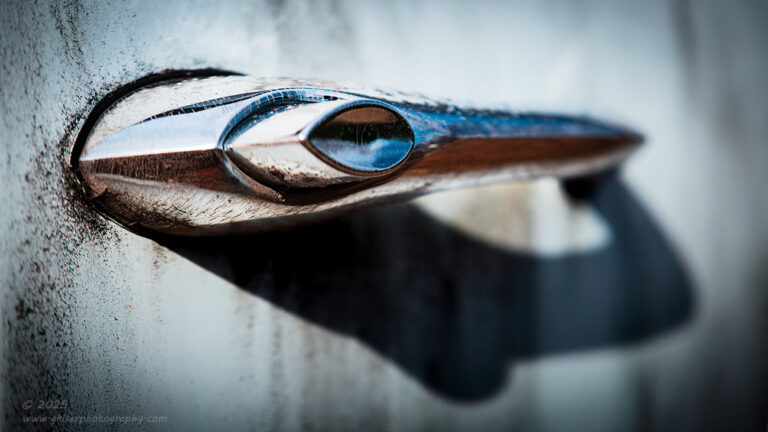
While I was working on the door handle, I decided to get in even closer to it and really focus on the shape of the handle and the shadow that was cast beneath it. I was still working with the long lens, so I was having to be really careful not to get closer than my minimum focusing distance. I was still able to get the frame filled like I wanted with that minimum focusing distance, so there was no reason to change lenses to one that allowed me to get closer. With this one, the frame was going to be filled with the handle and shadow with nothing else being important. The reason for this was that I could see the reflections in the handle alternating because of the concave and convex surfaces. The colors were warm and cool toned which were perfectly matched to each other. With the car being white, I liked the color being reflected in the handle and this tight crop allowed those colors to be an important aspect of the photo. That fact alone drove me to process this one as a color image when a very similar photo had demanded black and white. Each photo tells a different story, and I have to choose how that story is presented.
As you can tell comparing this photo and the one previous, I had to flip this one horizontally as well. The reason that I did it here wasn’t to match the other one, but it provided some visual tension that I liked with the handle essentially pointing back out of the frame to the left. The shadow, on the other hand, pulled your eyes to the right because of the contrast. Because of that fact, your eyes are kept in the frame very well allowing you to explore. With the photo in the original direction, the shadow became less important, and the handle just pushed your eyes out of the frame to the right as your eyes would have entered on the blurred portion of the handle and they would have followed the handle looking for something sharp. Once they found the sharp part of the handle, they eyes would already be accelerating to the edge and would have nothing to stop them. The same processing decision was made for two different reasons on these two photos.
There was one other composition that I shot that showcased the “220” badge on the rear pillar, but there really wasn’t enough natural contrast around that badge to make the photo work. I tried it in both color and black and white, but in the end, I’ve done much better with less and felt that it just wasn’t worth pushing to get that composition worked out. I might try something different with it next time if it is still there. That pretty much wrapped up my time with the Rambler, and I was really thinking about calling it a day at this point. It was getting late and I was already thinking that I might not be able to get the photos processed before the evening was out. I still didn’t know how many images that I had, and I wasn’t sure how long it was going to take to process them. I was a little out of practice with decay photo editing after so much portrait work, so it was going to take me a little longer to work through these more than likely. The concern that I had was this was the first time I had been here with the sun shining. The different light would offer some different opportunities thanks to the shadows that are created. I had just proven that with the Rambler, so there was a chance that I might be able to get something else that I hadn’t even considered before.
The first place that I went was back over to the Imperial that I had started the day off with. This was the very car that had baffled me on the first visit, and I had come out here with the intention of getting something worthwhile of this car. I had shot a bunch of compositions and was pretty sure that some of them would work out just fine. I didn’t know that I had an entire blog entry’s worth of photos from that car which would be keepers. When I got back over there, the car was still looking interesting, but finding points of interest to shoot on it was not all that easy. I had already tried the Instagram special composition where I just take a vertical shot with the grill cropped in half, showing the length of the body. That felt cheesy and far from an artistic representation of the car. That just wasn’t what I was after, so I started to look for details to shoot again.
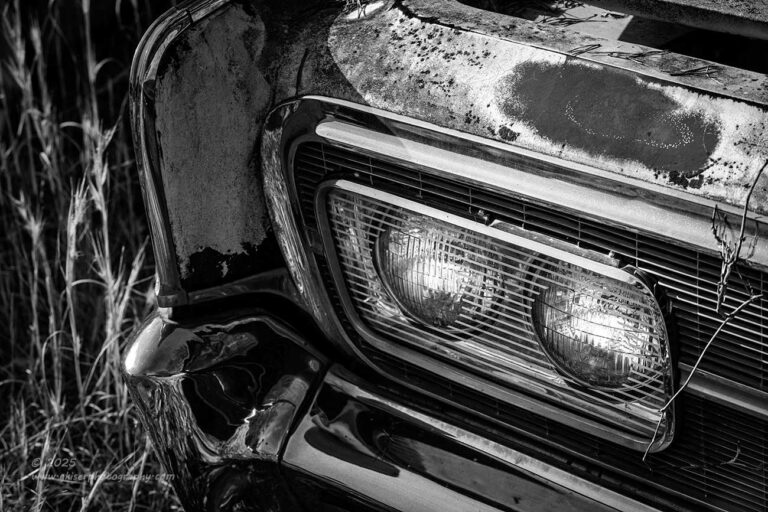
Something that I have found over the years is that I need to photograph what I love about a car when it comes to details. In the situation of this land yacht, it was the interesting headlights that I really enjoyed. This wasn’t my normal love affair with lights on older cars; there was something more interesting about these. The headlight covers that were over the lights just intrigued me the way that they were etched showing the lines continuing from the grill. I had tried to capture these back in the Summer but wasn’t able to get a composition that I really liked. I had finally worked through the composition issues earlier in the day, and now that the sun was creating some extra contrast, I felt that it was a good chance to try for a slightly different version of the earlier shots.
I started to work the driver’s side which was the side that didn’t seem as strong earlier, but the light gave it some new dimension. The issue was also because of that light which was causing the fender extension to overexpose unless I grossly underexposed the headlight area. I didn’t like working with that light, so I moved back to the passenger side and started to work through some of those compositions. They all turned out to be not nearly as effective in the light, and I was just not capturing anything as I moved the camera around.
The idea eventually hit to go a little wider to the outside of the car now that the light was stronger. With more shadows present, the Hyundai wasn’t nearly as problematic in the composition. From the level that I was shooting from, the only thing that was visible was the wheel anyway. The backlight on the Hyundai put most of that into shadow and I felt that with a little help in Lightroom, that wheel would just go away in the darkness. The resulting composition seemed to be pretty strong, and I liked it possibly better than the original ones that I had shot a few hours before.
With the high contrast and the lack of important colors in the frame, it made perfect sense to do this one as a black and white image. Everything just really started to sing when the color was removed, and the tones shifted to show the contrast where I wanted it. Even the rusty spot above the headlights became a more interesting part of the story without color. The grasses off to the side introduced a new texture to the photo and a strong vertical component that contrasted with the largely diagonal component from the grill and the headlight cover. It all just worked so well, and I really started to wonder why I didn’t see compositions like this the first time I was out here.
The answer is simple though. I didn’t give myself time to really listen to the car and hear how it wanted to be photographed. This time, I had the time and was prepared to really try to find the souls of these cars. It was paying off, especially with this car. In a way, this Imperial was my Moby Dick and was probably just as big as the whale was. It had been haunting me for months and I was finally able capture quite a few meaningful photos of it.

Speaking of meaningful photos of the Chrysler Imperial, there was still one more photo that the car had yet to present me with. As I looked around it one last time, my eyes landed on the front left tire which was not only flat but was twisted around the rim. I had seen this and paused earlier in the day, but for some reason my eyes did more than pause on it this time. I was studying the tire, just as I had studied the headlights on this car. Was I really looking at a flat tire and considering photographing it? Yes….yes I was. I would like to present two pieces of evidence to support that this was not a crazy idea. I’ve worked a flat tire several times on a Chevy pickup at Outlawed Restorations with a great deal of success. If you will visit this blog entry and look down for the photo A New Purpose, you will see that example. The other example is from another recent trek closer to home where I shot a Ford sedan. If you visit this entry, and scroll down to the photo Been a Minute, you will find that one. There are other examples of times that I have shot a flat tire in a creative way, but those were the ones that came to mind here.
As I looked at the mangled tire in front of me, I started to really appreciate how the tread was so easily seen in the same plane as the face of the wheel. The sidewall was also there, and it just made for an interesting shape. There was also a bit of tall grass growing up through the tire tread which gave a nice contrasting element there to link the tire with the scene. I started off with a horizontal frame that included parts of the car and then moved in closer to just show the tire, and then a bit closer to just show the wheel. None of these really expressed what I needed the photo to express, so I moved in once again and flipped the camera vertically. I cropped through the wheel, leaving just enough to know what it was, but the frame is obviously concentrating on the way that the tire is shaped.
There wasn’t much variation in the color with everything being an earth tone, so it was a natural decision to make this one black and white which really forced the attention on the tread and the wheel. There might have been a little bit of tonality adjustment to get the brightness where I wanted it for the eyes to look exactly where I needed them to. This photo turned out much better than it should have, but it now cements the idea of composing images around flat tires, and just the flat tire. Could AI do that? Not in this way I bet. This is one of those odd photos that I can just look at for hours and hours. Maybe that makes me crazy, or maybe you are seeing the same thing. If you are just as crazy as me, let me know. Crazy loves company which is why I keep Toni around.
At this point, I realized that I was completely off the rails in my photography and was just capturing images of the really off the wall stuff. I had shot around 100 frames at this point, so I knew that I had some decent photos to work with already, so I chose to embrace whatever came next. It was experimentation time, and I was now actively looking for something to shoot that I would not normally think about. This is a fun place to be in, but it is also a little scary. Not only am I saying goodbye to the safe images, the low hanging fruit if you will, I’m also leaving the concepts that I know fit within my normal realm. These times of experimentation are done with the intention of sharing the photos and putting things out there which might leave folks scratching their head and wondering if I let somebody borrow my gear. I’m ok with that though, because it is times like this that I often see the most personal growth as a photographer.
With an introduction like that, I know you are on the edge of your seat to hear what comes next. Hopefully, that seat isn’t on a ledge, because I would hate for you to fall off that ledge out of anticipation. At any rate, I had picked up my camera and was walking back into the main part of the property in search of something truly unique. There were a lot of cars that I wouldn’t usually consider photographing like the Hyundai next to the Imperial. There was a Volvo wagon, a Honda Accord, a Mercedes CL, and another sedan…..wait a minute, what about that Mercedes?
If memory serves me, this car was here on my last visit, but I don’t really know for sure. I know that it had been here all day and I had walked past it at least a half dozen times without it drawing my eye. Only this time, I was looking at the embedded streaks on the hood and the fully rusted passenger side fender. This Benz was truly in a state of decay. I paused and considered this for a moment. You don’t usually see Mercedes Benz….es in this kind of shape. That was the dichotomy that I was after. It was quirky and different. It was something that immediately caught my eye because it was rare. Not the car, but the condition, especially as new as it was. As I’ve found over the years, my definition of a decay subject had to grow beyond vehicles up to the ’70’s. I mean those cars are 50+ years old at this point. There are plenty of cars newer than that which are now well into the decay realm based on age. The fact that plastic doesn’t rust has kept me from really seeking these newer cars out, but decay is decay and takes on many different looks. I might have been a little creatively fatigued, but I was liking this Mercedes…a lot if I’m being honest with myself.
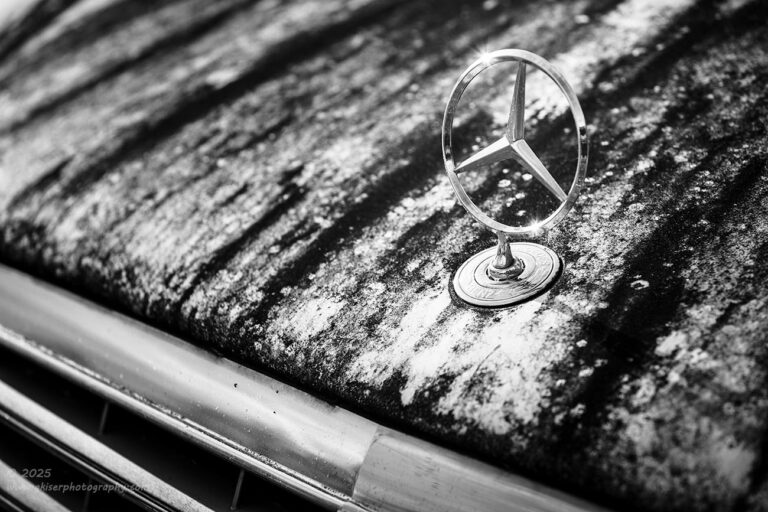
I started to look around the car which was surrounded by other vehicles in all directions. There was no way to get a good clean shot of it in its entirety, but that didn’t really bother me. 80% of the car was in decent shape. It was just the front clip that interested me, and that was where I started to focus my attention. I allowed myself the opportunity to go for the low hanging fruit to get started with. I mean, I don’t photograph too many Mercedes…es, and I wanted to kind of grow into it gradually. I started with the hood ornament which I have tons of experience composing around. This one was still glistening in the sunlight with chrome that was in great condition. The hood, however, was not in the same good shape. That juxtaposition between gleaming and patinaed made for a perfect setting for a composition. I knew that going at this from straight ahead was going to be boring at best, so I went straight for the angle shot to bring in some diagonals for visual interest.
I started on the passenger side but didn’t like how the image was reading from left to right. Now, someone out there is telling me that I could just flip it vertically like I have done with a number of other images during this trek. I hear you, and you are on the right track, but there is a detail here that prevents that. If you look at the base of the hood ornament (or necklace pendant if you are from the ’80’s), you will see words. These words, while subtle, would cause the image to fall apart if a mirror image was shown. Think about all of those influencer videos that you see where their graphic tees and ball caps with writing show up backwards. You look at them and wonder if you are having a stroke until you realize what is going on. In order to avoid this hazard of carelessness in the visual arts, I chose to fix it in the field rather than fix it in post. The difference is, by fixing it in the field, I was able to move to the other side, and frame up the same composition, but with the lettering in the right order. I also found an additional benefit that the sunlight was looking better on the hood ornament allowing it to show up better against the dark parts of the hood. With one movement, I was able to fix the composition, improve on the lighting, and have no adverse effects thanks to having to read text backwards.
Now that I had all of that figured out, I needed to get the exposure worked out for the effect that I was going for. With the hood being an important part of the composition creating the contrast that I needed and introducing some textures, I generally would have wanted to keep it all in focus. However, I wanted the hood ornament to be the main subject, and it was kind of hard to see in a complex environment, so I chose to limit the depth of field to showcase the chrome more than anything else in the frame. I sacrificed the textures in order to focus on the main element. I also included the grill as a bit of a balancing element. Even that was carefully considered as I included exactly three of the slats. The rule of odds in photography is one of those rules that I do try to pay attention to, and I’ve found it to be rather helpful in figuring out different elements within a composition. Essentially, you want to bring in elements in odd numbers for interest. Two slats would have seemed accidental, four would have been too many, but three was just right. Hey, I was experimenting here, but not going way off in left field when it came to things that I knew would work. I know that the resulting photo was well worth the time it took to figure it out.
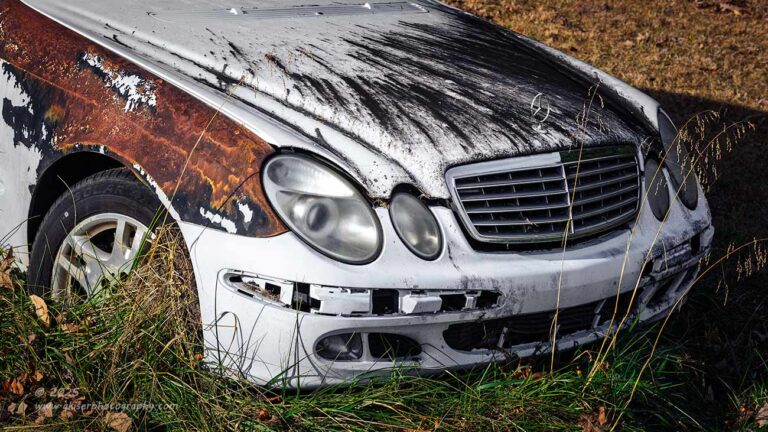
From here, I backed up and started to look at that rusty fender which had caught my eye from 50 feet away. The fender was showing a completely different kind of decay than the hood was, but the overall effect was a very unique look to the patterns of neglect on this car. I’ve never cared for the bug-eyed design language of these cars as they remind me of an old Ford Taurus, but with it looking all disheveled and such, I started to see a bit of beauty here. Maybe this is what beer goggles look like after drinking a German Lagger or something. I wouldn’t know, as I don’t drink, but I was now finding this German car rather beautiful looking through my rust-colored goggles.
I still had the issue of all the cars that were parked around it which kept me from finding a single clear view of the entire car. Knowing that it was just the front clip that was interesting, I started to look just at that portion. It was all for the best because taking the whole car in, the fender just became a rusty fender on an otherwise upscale car. With the fender and hood taking up more of the frame, you are left to imagine the rest of the car looking very similar. By reducing the scope of the image to just that front clip and by elevating the camera to show off the hood, I was able to crop the frame just under the nearest object beyond the car which I think was a trailer.
There was also something else that was going on with this composition that I hadn’t considered but I was seeing now. The grass on this side of the car was green which helped to set the rusty fender off quite well. The grass on the far side of the car was dormant and brown. That color matched the fender but was separated by the hood. That gave a perfect color balance to the image that worked so well. The deep shadows from the sun to the right of the car also helped to bring out the streaks on the hood linking the car once again to the surroundings. This composition just fell together like it was staged. I loved it, and something that surprised me the most was when I was letting the owner know I was leaving. I told him, almost apologetically that I was most excited about the photos that I had shot of the Mercedes, knowing he was a fan of the older cars, especially the Mopars. It was true though; this Mercedes was speaking to me in a way I never would have expected. Would I like the photos as much when I got home, or would they just appear like the experiment that they were. Well, here we are a couple of days later and the photos are still among my favorites from the day because of how unique they look. There is just something about seeing a Mercedes in this condition, and it really is a case of decay being decay, without the age mattering a bit.

After the Mercedes was all finished up, I took one more look around the property and spotted a Dodge Coronet which I had spent a considerable amount of time with during the Summer. I hadn’t even looked at this car seriously this time because without the benefit of the vegetation all around it, there were too many distractions in every direction to really photograph it. There were no isolations that I felt should be shot that would come out any better this time, so I just walked on by without giving it much thought. Now that I was in experimentation mode, I happened to look at the broken windshield again. This was one of the elements that I really loved about the car during the Summer, and it had played a part in one of the compositions I had shot. Now, I was thinking that it deserved its own composition.
I’m no stranger to photographing broken windows and have done it quite a few times over the years. I love how glass looks after the cracking sparks the delamination process. That clouding is intriguing to me, and it offers up some neat abstract views. I figured that I might as well take a few moments to see if there were any compositions that I could shoot of the glass. I actually tried a number of ideas, some of which included the front bumper, some included the hood, and some were just of the windshield. Most didn’t really work out any better than what I had already shot, but the idea where I just included the windshield seemed to be the most effective. The sunlight was causing some limbs to cast shadow on the roof which kind of mirrored the cracks in the glass for a bit of unity between the surfaces. The top of the windshield also had a line that matched the lower crack in the glass for a bit of framing in the scene that I liked.
I allowed myself a good deal of creative liberties with the processing of this image. I really pulled in the blue that was being reflected from the sky to balance out with the rust on the roof. I also underexposed the image a good deal to retain the detail in the highlights and really deepen the shadows. It also helped to saturate the colors a bit more. It was looking really good in the camera, and I knew that I was on to something with this composition. I played with the depth of field to make sure that I had everything in focus that I wanted while the background seen through the glass was a little soft in comparison.
Everything worked out well and I was able to enhance those aspects in post to really pull out what I had been excited about in the first place. Had it not been for that blue sky above, I am sure that this photo wouldn’t have made it at all, or it would have been done in black and white. That blue reflecting off of the cloudy portions just makes this photo work in my opinion. It also shows just how important the sky is, even when the composition doesn’t include a single pixel of the sky.
That was pretty much the end of the day. I had shot 113 frames, although at the time I was thinking that I was somewhere between 90 and 100 frames. I was figuring that I might have about 20 keepers out of the collection, and that was way more than I had considered when I went out there earlier in the day. Of course, when I saw that the total number was 113, I knew that I was going to be in trouble when it came to which ones to process. It took three rounds of culling to get it down to 30 frames and I just wasn’t able to reduce it any further than that. After going through the processing, I was able to eliminate one more, leaving my total at 29 keepers, the same number as the last time I was out here. I’m going to have to be careful the next time I visit and make sure that I have a cleared calendar afterwards to allow me to work through all the photos and blog entries. This is apparently going to be a habit of mine, not unlike the luck that I have at Outlawed Restorations.
I thanked the owner once again for letting me spend some time out here with the camera. He mentioned again that I was welcome back any time, and even if I got the urge to go out there in the middle of the night. While I would never just show up and assume I could access the property, it did plant the seed for doing some light painting out there at some point. Of course, I would set that up before heading out there because there is just nothing more suspicious than a guy deep into a piece of property waving around a flashlight on some old cars. Yeah, I would want to clear that with the owner long before, if for no other reason so he could watch me on the many video cameras that he has out there and get a laugh at me doing the dance of light in the middle of the night.
Thank you for joining me for this trek and I do hope that you have enjoyed the adventure as much as I did during the experience. This is quickly becoming one of my favorite places to shoot. It is certainly one of those where I can easily fill several hours of working and come up with some pretty cool photos. I know that there are more photos to be had than what I’ve captured over the two visits. Each time I go, I see things differently and understand more about the property. I know that there are many more possibilities out there, but I’m going to have to let those ideas rattle around in my head a little longer before I can creatively express them with the camera.
Keep your eye out for my 12 most significant images list which will be published late in the month. There are a few photos in that list that caused me to change the way I see different things and prompted me to be able to create some of the photos here. Who knows, there might be a last-minute substitution on that list with one of these images because I feel that they are just that good. However, I try to avoid including brand new images on that list because every new photo feels like something special because it is brand new. I like to live with photos for a bit before I really decide what qualities they possess. I do know that I am more happy with this trek than I have been with most of my recent ones. This Fall has been a bit of a struggle for me in terms of my landscape and decay work, but if this trek is any indication, I’m going to bounce back stronger than ever, just like I usually do after lull.
Until next time….