Friday, September 9, 2022
So, you are probably wondering about the title to this blog entry, and I don’t blame you. It kind of sounds like I flushed the day away, or maybe things just aren’t going well. That isn’t the case at all as things are going quite well here lately. I’ve been doing some portraiture as well as a good deal of mentoring over the past three weeks or so. Mixed in with all of that I’ve also been expanding my own knowledge in the areas of all things photography. That is kind of where the title came from for this entry because as I was culling and editing, I realized that each of my photos fell into the Golden Spiral theory of composition. This is not a new concept for me and is actually one of the concepts that I have taught in various composition workshops and classes. Here lately, I have wanted to distance myself a bit from the rule of thirds which has been my starting point for a very long time when composing my images. From that point, I have usually tweaked the composition to achieve a better balance, but it usually starts with the rule of thirds. One of the books I am currently reading has a very in-depth chapter on composition and composition theory. After making it through Mastering Composition several years ago, I felt like I had a solid understanding of composition. Boy was I wrong! Exquisite Curves takes what is already a pretty involved topic and brings it up to graduate level. I learned the history behind the Golden Ratio, and how it applies to all forms of composition. I learned about figure/ground relationships in a way that I had not really considered before. When it was all said and done, I had gray matter flowing out of my ears and was pretty sure if I took any more in, I would suffer an aneurism. It did get me thinking about composition and things that I was already doing with my photos, as well as some different ways of thinking about the organization of elements. The Golden Spiral is one of those concepts that has fascinated me for quite some time, and I’ve found that it applies to many of my adjusted compositions that start with the rule of thirds.
It just really struck me that when I got home and started to go through the images from the day that each one that I wanted to keep fit that Golden Spiral almost perfectly. It wasn’t something that I necessarily did on purpose when composing the images, but it was a by-product of me thinking more about the relationships of the elements within the frame. You probably won’t notice anything different about the photographs that I am going to feature here because they are true to how I usually compose my images, but there was a different thought process applied this time when I fine-tuned the crops.
I’ve really gotten ahead of myself here because I haven’t even talked about what brought me to the point where I had images to edit. As things are calming down a little bit, I am having a bit more time to go out and capture my own photos. I started the other day with some studio work dealing with smoke photography. That got my juices flowing for being creative without a purpose. Looking at the weather, there was going to be a few hours of low clouds and possibly fog around home, and to the North on Friday morning. I was really hoping for some fog in the area of Lenoir because I have a location there that I am wanting to shoot. That forecast was mostly clear though, so I was having to look at working between Wilkes County and points North. Looking at having about three hours or so after sunrise to work with, I had time to shoot a few locations which was good. I just needed to figure out what I wanted to work with. The low clouds and fog could very well work for landscapes, but the smart money was going to be rural subjects. It had been a while since I had gone on a rural road trip through Allegheny and Ashe Counties and that was going to put me right in the path of the good weather.
Not wanting to miss out on any good light, I decided to get up at 6am so that I could be on my way right around sunrise. With the low clouds, there wasn’t going to be any color in the sky so there was no need to wake up any earlier. I just needed to be in position to get started by 7:30 or 8:00 when the light was good. When I woke up, I had checked the weather as I will always do before a trek. I was very happy to see that the clouds were going to be stretched out a few more hours and the fog was looking to be pretty thick until 9am or so. That was all I needed to get rolling and ready to head out. I ended up leaving at a quarter till 7 and was on my way up Hwy 16 into Jefferson. I wasn’t seeing any fog and the clouds were not quite as detailed as I had hoped. The sun was still very low, so I wasn’t expecting a lot of definition in the clouds just yet. It was the lack of fog that had me worried because one of the places that I was hoping to photograph was a lone house atop a hill that was flanked closely by trees. The fog would help to soften the contrast and make the photo work, or at least that was the hope. With no fog, I was going to be in the same shape I was in for the other times that I had been to this location without getting a photograph.
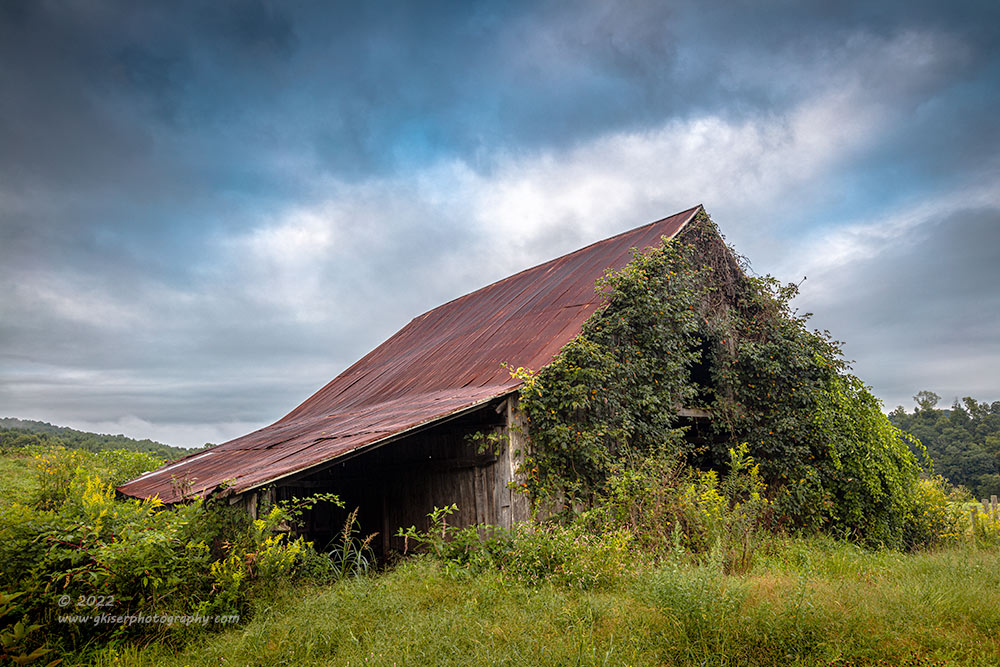
As I started to get into the area that I intended on operating in for the morning, I came upon an “A frame” barn that I had passed many times over the last two years. It was interesting to me, but the roof pretty much started and ended at the ground level with the face of the barn covered in vines. Usually there was a big truck parked in front of it, but in every case I had stopped, a composition wouldn’t come to me. There just wasn’t enough visual interest to the barn to carry a photograph. For reasons that I still don’t know, when I came to the barn this time, I felt a twinge of possibility with it. There were no trucks in the gravel parking area and the only obstacle that I had was long I-beams laying on the ground to the left of the barn. The clouds were starting to get some detail to them which I felt was going to be very important to the image. That gave me hope, and I went ahead and parked the truck.
I got out and started to look at the lay of the land and get ideas for compositions before I got the camera out. I started on the right side and found that there was nothing but a roof to look at. As I came to the left, the roof transitioned into vegetation that pretty much obscured the character of the barn. Looking at the barn from the front, there was not enough visual information to make a compelling image. I needed to have depth as well as enough of the barn being visible that the viewer could fill in the missing elements in their mind. That was another concept that I had to work through in the book I’m reading which really helped me get a composition here. As I moved to the left, I could make out the shelter part of the roof which opened up into deep shadow while showing a bit of the siding of the barn. The roof gave the right clues as to what I was looking at as well as the age and condition of what was behind the vines. The problem that I had from this angle was that there were teal green I-beams on the ground which didn’t have anything to do with the story I was wanting to convey. In order to avoid them in the photo, I was going to have to shoot very wide, essentially placing the camera on top of the beams.
I had a feeling that this would work out well enough, so I went back to the truck and grabbed my camera. I fitted the 16-35mm lens along with a polarizer to get started. I placed the camera approximately where I thought it would work best. I had a lot of problems with the edges of the frame because odd weeds were creeping into the frame along the bottom due to the angle that I was having to shoot. I eventually climbed up on the beams and placed the camera on a few of them at the edge. It was stable enough, but I could tell that any movement that I had would cause the camera to shake a bit. I just had to be very still and watch the spirit level until it stopped jiggling before I would make an exposure. Once I finally had the composition worked out, I started to look at the exposure. There was a good bit of dynamic range in this scene with the bright sky and the barn which was not well lit. Not wanting to miss detail in the sky, I decided to go back to the truck and get a 3-stop soft edge ND Grad to pull the exposure back a little in the sky. That did the trick, and it was just a matter of waiting for the sky to change in a way that worked for the composition.
I started off with the composition that I have shared above, but I moved to another composition after this. Not wanting to have a static image (just one main element), I decided to include the tree that was on top of the hill to the left. It was just out of the frame so there wasn’t much that I needed to do other than open the lens up a little bit and pan to the left. I was able to keep roughly the same composition only with the addition of a tree and more sky. In the LCD this looked like the winning ticket as there was a lot of balance to the scene with the tree included. I spent some time with that composition figuring that it was going to be the one that I kept from here. I was thinking that both would make good black and white images because that would allow me to get more detail out of the sky and really focus on the textures of the vines.
When I got the images home, I had shot a total of 24 frames of this barn as the sky changed. I culled those down to two that I liked and started on the second of those with that tree included. I quickly decided that I wanted to do it as a color image instead of black and white. The edit didn’t take long, and I was really happy with it. It was well balanced, and the sky looked great, but I wasn’t convinced that the tree was the best element to include. I ultimately, decided to process the other, more simple composition as the intended black and white presentation. I went through the entire process and came up with an image that I liked of the barn. I had really dialed in the contrast to the scene because black and white allows you to do just that. Before I committed to the final image, I went to my color profiles to see if there was another B&W profile that might make it subtly different. When the options came up, I saw the color version of the image that I had edited as a black and white. It just grabbed my attention and I started to explore color profiles with a monochrome edit. I found one that I liked better than the black and white and converted the file to color. I just made a few tweaks to the colors but left the overall contrast choices in place. I then started to go back and forth between the two images to determine which was the strongest because I didn’t need two that were so similar. In the end, I determined that the one with the tree was more about the sky and the landscape leaving the barn to get lost. The one without the tree forced you to look at the barn and fill in the missing details behind the vegetation. The sky was also a bit more dramatic which I liked. Even though this one was a simpler image, it had more pop than the other one and I thought it was a stronger image overall since my main desire here was to capture the barn, not the landscape.

Once I had finished with the barn, I loaded my gear up and was back on the road again. Just a few miles up the road I found myself back at a location that I had tried to photograph at least a half dozen times. There was a VW Bug by an old barn along with another VW sedan in the weeds nearby. There was also something else that might have been a 40’s sedan in the woods that I could barely see from the road. Each time I had stopped there, I had knocked on the door with no answer. The tag on the truck out front was current last year, and according to the neighbors across the street was the owner’s daily driver. This time, the truck was still in the same place it had been every time. There was grass grown up around it now though, and I had a feeling that the tag was no longer current. The house looked the same as it had each time I had knocked before. I looked around and saw no signs indicating that there was to be no trespassing. The Bug that I was interested in was right off the driveway and I could probably have it shot in about 10 minutes, give or take. I don’t like to do things this way, but all indications were that this was now a vacant property, and I had no way of getting in touch with the property owner. With no signs indicating that I couldn’t remain there, I decided to take a chance to get the photo. I really felt as though I had done my due diligence to make contact with the owner and since I was not needing to go terribly far into the property (about 40ft from the driveway), it was worth the gamble to give it a try.
I didn’t even turn the truck off before grabbing the camera and tripod. I knew that this was going to be a job for my 24-70mm lens so that was what I fit to the camera. I added a polarizer as well and got set up for a quick shot of the rear which I could do less than 10ft from the driveway. It was a fair composition, but not as good as I was hoping for. Seeing that I wasn’t rousing any concerns from anyone, I got a little braver and went to the front of the car and set the camera up once again. This time, I really liked the composition with the barn wood providing a great backdrop. There was a broken chair in front of the car which I had a quick debate about. I wasn’t going to move it since it would disrupt the leaves, but I had to decide if it helped to tell the story or not. I decided that it really did help tell it, and the legs were pointing to the Bug which was a nice little element to have. Since the Bug was a pale green, I knew that this was going to be a black and white shot because the colors through the scene were too closely related. I was going to concentrate on luminance rather than color contrast for this image. I shot a couple of frames at what was around 8 seconds each due to the heavily shaded area I was shooting in. With that, I was happy that I had two different images which would probably work. I had been here for seven minutes at this point, and I was done. I loaded the camera back in the truck and off I went.
When I started to edit the images, I really felt that the one from the back of the car was too forced. There wasn’t a good story, and the lighting didn’t really work for the scene. I went with the one that I captured from the front because it told a much stronger story, and the lighting was much better with this one. I had a lot of fun working with the textures and getting the tonal relationships right. There is just something magical about these little Volkswagons…you just can’t help but smile when you see them.
By this point in the morning, I was feeling pretty good about things. I had two successful stops in the bag and the clouds were only getting better. Maybe a mile down the road I came to a church that had a view of the Alleghany Mountains in the distance. It was there that I saw the fog that I had been waiting for…only it was probably 3 miles away wrapped around some mountains. There was enough detail in the mountains to prompt me to want to try and capture something, but there was going to be some major reach involved to get the isolations that I was after. I almost passed it by because I knew that if I was going to have a chance at getting something I would be using my teleconverter and probably going to every bit of 400mm. Since it was the only fog that I had found thus far, I decided it was worth a chance. I parked next to the church and put together the camera with the 70-200mm lens and the 2x teleconverter which would give me the desired reach I needed. Sure enough, I was able to get the areas framed that I wanted right at 400mm.
I spent about 10 minutes picking areas of interest with the fog and figured that I had a shot or two that would be interesting. The fog and the clouds were moving around slowly and revealing different parts of the scene which gave me different compositions. Sadly, when I got home, none of these 40 frames made the cut. It is rare that I will shoot that many frames and decide that none of them are any good, but that is the case with fog and clouds. You can set things up hoping for a specific look and that look never really materializes. I figure that my catalog is full enough as it is without adding images that I don’t think have particular merit to them. I don’t regret stopping because I did have fun working the different compositions and it is always fun to play around at 400mm when I’m used to a much more normal field of view.
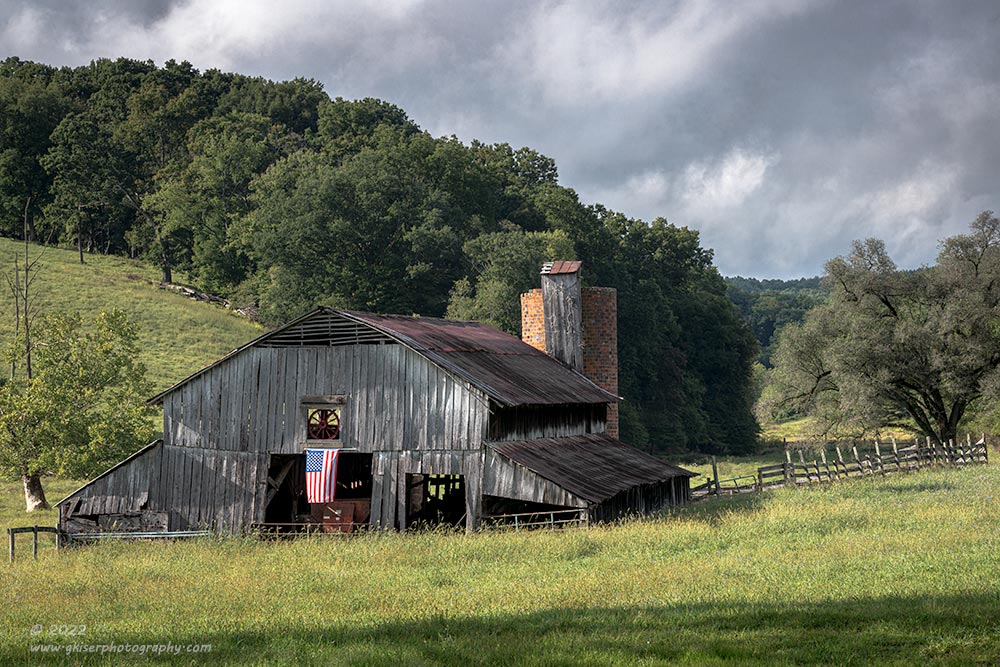
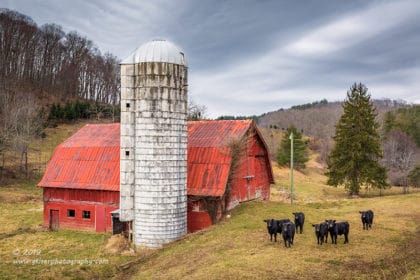
After my failed attempt at capturing the fog on the mountain, I decided to continue on down the road as it got closer and closer to Virginia. I had been on this bit of road many times over the years, even when I was based in Winston Salem. I knew that there was a barn here close to the state line that had been the subject of one of my favorite barn photos of all time. I had shot it back in 2018 for the first time and ended up with a color and black and white version. The black and white one, titled Timeless View, was the one that was made into a print and framed. It is still part of my personal collection and available for sale should anyone wish to purchase it. Feeling that I had already captured what I thought was the best view of this barn, I have been reluctant to photograph it again. Since I was feeling kind accomplished with my morning of arriving at a working composition for a barn that had stumped me for so long, I thought that I might want to try this barn again. The sky was interesting enough to pull it off and the light was better than the first time I had shot it as well.
When I arrived at the barn, I noticed that there was still an American flag hanging over the door. I noticed this last year when I would drive by, and it represented a minor annoyance for me since the stars were on the wrong side technically speaking. It is probably one of those things that very few will recognize but it was drilled into me when I was in JROTC in High School, and I still catch so many flags backwards to this day. I decided to put that concern away and just concentrate on the photograph because I was feeling inspired to create another photograph with this barn. Once I got pulled off the road I decided to take a walk around to see what angles would work. I knew the basic locations that I had used before, and I knew that they would work fine should I decide to use them. The problem with shooting from the same place all the time is that you end up with images that look very similar to what you already have. I wasn’t looking to improve on the original photograph from four years ago as much as I was looking to do something entirely different with this attempt.
Looking at how the light was falling on the scene; my best light was going to be on the flag side. With that in mind, I wanted to go further down the road and see if I could use a completely different angle to emphasize that side of the barn. I walked about 400ft or so back down the road and found a nice angle that placed the barn between two trees with a lot of depth going off into the background. The only problem here was that I was going to have to shoot between two trees which had no place in the composition. I pulled out my phone and played with the zoom until I had a rough composition that would work and allow me to shoot between the two trees and under the power lines.
I went back to the truck and got the camera. I fitted the 70-200mm this time as well as a polarizer. I grabbed my bag because I wasn’t sure what I might need as I put the shot together. I was already on a different route than what I had done before since I believe I had used my 24-70mm lens that first time. I got back into the rough area that I had done the test shot from and set the tripod up. I worked on framing the image so that I didn’t have any parts of the two near trees but was still able to get the two trees that framed the barn closer to it. It took some doing to get it to work, but I ended up finding the sweet spot for the composition I had in mind.
After the first couple of exposures, I realized that I needed to pull the sky back just a little bit so that I could maintain detail in the shadows of the barn. Since I had my bag with me, it was a simple task of grabbing a 3-stop soft ND Grad which was placed right at the top of the frame at a slight diagonal to follow the natural horizon. It didn’t arrive at the full 3-stops, but it pulled enough of the exposure in the sky back to allow me to boost the exposure by a few clicks of the shutter which was just perfect. I did my normal thing of waiting for the sky to move around so that I had a pleasing mix of light and dark clouds with attention to where they all fell. I then altered the composition slightly in an attempt to fix a few little problems and then did the wait for the sky game once again. I ended up shooting a total of 17 frames of this barn before I was certain that I had something that I could use.
When I got the images home, it was one of the first composition that I decided was the best. It had the best light and the best sky. What I had moved to correct was a power pole that was behind the silo which was just barely visible beside of it. While the second composition fixed that, the light wasn’t inspiring at all, and I had lost my foreground shadow which was so important. In order to deal with the power pole, I just used a healing brush in Photoshop and removed it along with the power lines that it held. As I was going through the edit, I was really liking the colors that were coming out and this represented my current style of edits much better than the color one from 2018 which was a bit oversaturated for my current tastes. That flag was still annoying me though and I wanted to fix it. It would have been easy enough to flip it in Photoshop, but that would place it upside down on the pole which would be even worse. Yeah, I am in really in tune to the details in my photos. With that in mind and realizing that to fix the flag would result in a domino effect of issues, I decided to leave it as it was.
Then I started to look at the photo in a different way altogether. Was the photo reading correctly from left to right? Well, the more I looked at it, the more I realized that the hill was really not an important part of the composition because the eyes stopped at the barn. The little stub of a tree was also getting lost in the composition. In order to make the photo read better, I tried to flip it along the horizontal axis. At first it looked odd, but that was because I was so used to seeing this same barn every day in my studio. My brain was programmed to see it in a certain position and orientation. I decided to come back to the new photo after doing some more tweaks on other edits. I wanted to try and look at it with fresh eyes to see how my eyes pursued around the frame. In about 30 minutes or so, I came back to it and decided that it was a much more effective composition when flipped, and I got the added benefit of seeing the flag in the correct orientation which truly made me happy. I just did a few more little tweaks with dodging and burning and that was that for this image. I still love the original black and white image of this barn, but I think that this one is slightly better overall and will print even better than the other one ever did.
It was this stop that made me feel like I had really accomplished something for the day. Even if I only got one good photo, I knew that this was going to be that one. There is just something that clicks my head when I know I have that shot. After all of these years, I was finally in a position to be able to improve on one of my all-time favorite photographs and I was pretty sure that I had done just that. It would have been fine to have called it a day right then and there, but I was on a creative high at this point and knew that I could do more.

I made it into Virginia and decided to turn around. I didn’t want to go straight home though so I picked another route that would eventually get me in the right direction. I ended up on a road that I have spent some time on in the past as well. This was going to take me through Sparta and back into Wilkes County. I knew that there were several places of interest along this stretch of road and I was on the lookout for targets of opportunity. I found a few automotive shops that had some interesting cars in the lots, but nothing that I wanted to photograph unfortunately. It wasn’t until I came across what looks like an ice cream shop tucked to the side of a large gravel parking lot that I saw an old Chevrolet that had caught my eyes several times over the years. It was situated just inside of a split rail fence with a bench on the other side and a picnic table at the front. The shop was just to the right of the bench and there was another building behind that with an awning that stretched out kind of far. I really liked the truck, but I had never really found a good composition for it that wasn’t just a snapshot.
Since I was feeling pretty capable at this point, I went ahead and got out of the truck for the first time to really look at the scene. I was able to get inside of the fence and since this was a commercial location, I had no problem being in the public area. All of the angles that I would want to shoot the truck from would include one or both of the buildings beside of it, or the house across the street with a lot of power lines. If I got far enough away to use a long lens, I would end up with the fence in the shot which would obscure the details of the truck. I was going to have to get in close to avoid the fence, and that meant that I was going to have to use a wide-angle lens. I love a wide-angle approach to automotive photography, but that makes it all too easy to include background elements that I don’t want in the photo, like the business. I was here, so I might as well give it a try.
I went to the truck and grabbed my camera with the 16-35mm lens on it as well as a polarizer. Since I wasn’t sure that this was going to work, I grabbed my bag so I could make changes as needed. I started to play around with the angles inside of the fence, but that was causing too much of the buildings to be included. I ended up going back outside of the fence and getting the camera set up with the tripod going between the rails of the fence essentially putting the camera right on top of the fence. I was still having issues with a pipe that was behind the truck right past the small embankment. I had to lower the camera further than I wanted to make it go away. This caused the bench to drop beneath the hood of the truck which wasn’t a problem and it actually lined up with the edging of the walkway which was quite nice. I didn’t like the way that the truck had no nose room with the horizontal orientation, so I decided to flip the camera to portrait. This allowed me to get the truck placed with appropriate breathing room on both sides. It also allowed me to get a good deal of the sky which kept this from looking like a snapshot.
What I ended up with had just over a third of the frame filled with the sky. There was a sliver of the awning on the building to the rear that was encroaching into the frame on the right that I was going to have to clone out. That was no big deal and since I was shooting knowing that was what I was going to do, it made it simple. I knew that I was going to crop this to a 4:5 ratio so where my top and bottom fell was not important as long as I had the right breathing room on either side of the truck.
Before I made my first exposure, I could tell that the truck was looking a little dark on the histogram and I needed to darken the sky a bit. Since the horizon line was basically straight, I opted for a hard-edge grad this time. Since I was using a hard edge next to the tops of trees, I didn’t want to go too far, so I stuck with a 2-stop for a less noticeable effect. I knew that I would be blending the effect in Lightroom, so I positioned it accordingly. That got the exposure to look really good and I was on my way to making about a dozen exposures as the clouds moved overhead. As with the other scenes I had shot, the clouds were moving from side to side which would make a long exposure less than optimal. I would have loved to have tried doing an exposure of several minutes, but unless the clouds are tracking towards or away from you, the sky will look kind of odd with the long exposure.
At the end of photographing this truck, I was at 110 exposures for five locations that I stopped at. The frame count is very high because I spent a lot of time clicking differences in clouds in the hopes of getting the best combination of clouds. There was also that stop for the foggy mountain that ate up a lot of frames for nothing. The end result was about a 5% keeper rate, but I’m very happy with the ones that I have here which is much more important than how many I ended up with. That is one of the things that is so hard for new photographers to understand. They all think that every time they click the button magic will happen and you will have your next best image. The truth is, if you are living right, your overall hit rate will only be about 10% of what you shoot, and about 10% of that will be truly special images. Any photographer that tells you otherwise is fooling themselves and either has not seen their own potential or they have no ability to determine what is good or bad. We are going to talk more about that concept in the next Behind the Camera, so stay tuned for that.
As I mentioned earlier in this entry, every one of these images falls into the concept of the Golden Spiral. This is a vastly underrated tool in composition and one that I have stumbled on accidentally more than once. It was a surprise that while trying to tweak my compositions this time that they all ended up using that tool. In some cases, it would apply in different directions on the same photo which was really cool. Of course, I was able to do this by instinct without actively trying for it. I’ve often said that if you are careful about how you organize a photograph, you will find that your composition actually falls into one or more rules whether you plan on it or not. I’m becoming a fan of the Golden Spiral because it is a fantastic compositional application for single elements within a frame. It also works when your main element might not be so easy to separate from the rest of the image. At any rate, I owe it to myself to learn as much as I can about composition and even though occasionally it makes me feel stupid, the more I can learn the better I perform and teach.
Speaking of teaching, don’t forget that I have several workshops coming up in the next few months. I’ve been talking a lot about my upcoming Fall Foliage Workshop which is next month, but I also have a Decay Workshop going on in East Bend, NC, in November. This is always a lot of fun and everyone that has ever attended has left with the rust bug. These workshops are your chance to let me work with you to help you achieve your goals with photography. These are always very hands-on workshops, and you are the one doing the photography. I’m too tied up with questions and tips to even attempt to do any of my own photos. I encourage you to get signed up for these workshops to ensure your spot and give me time to get the reading material out to you well in advance of the date.
Thank you so much for joining me on this trek. I hope you enjoyed it as much as I did. As always, if any of the photographs speak to you, I would love the chance to match you up with a print of your very own. There is just nothing quite like holding a photograph that started out as a concept and is now a tangible piece of art. I look forward to hearing from you and getting your print done and ready for delivery!
Until next time…

Remember to use the code KISER10 to get 10% off your purchase