Saturday, October 1, 2022
I’ve been having some issues with post notifications going out for some reason. We are working on the problem, but the chances are there won’t be a notification on this entry for about a week or so after publication. I do apologize but know that there are likely going to be four parts to this entry done over the next couple of days. I will have links to the next blogs at the end of this one for those that want to continue reading about the adventure and continue to see the new photographs.
Speaking of photographs, I shot a total of 133 frames at two different locations over the course of about three and a half hours with camera in hand. Of those 133 frames, I have 24 fresh images to show you here, and a good many of them will end up in the galleries here. I would love to just hammer them all out in a single entry, but I think that will just be too much to digest, and I don’t want to do that to you. I’m going to break things up depending on what area I was working with during the day which brings about four different sections that I can easily break up the story with.
So, how did this all start out? Well, with Hurricane Ian passing through NC on Friday, I had my eyes on the weekend ahead for some majestic skies that can follow a major storm. My goal was to get up to the Parkway and do some landscape photography where the sky is so important. Looking at the weather for Saturday, there was going to be rain in the morning, followed by dry conditions with a thick overcast sky over the mountains. This wasn’t going to give me the dramatic look I was after so I started to look to see what else might work out. As I browsed the hourly forecasts, I found that the clouds might be breaking up to the South around midafternoon which would work out great for me. I could head out after the rain passed by and go back into the area of Taylorsville to take advantage of the nice and even lighting of an overcast day, and if the sky popped off, I could start to look for barns. That would leave Sunday for a day going to the mountains for some grand landscapes possibly.
When Saturday morning rolled around, I checked the current weather after I woke up and found that the rain had stopped earlier than expected. The clouds were still looking to be a little too thick for landscape work that relies on a bit of light usually. Things were still looking favorable for going down South and finding some decay subjects to photograph. Once I got my morning routine taken care of, I loaded up the truck and bid Toni a farewell so that she could continue working on her Nursing degree. She is still doing very well, and nearly acing her tests, but it takes so much of her time to sit there at her desk and read through all of her books, and work on the computer. It helps her when I am out of the house and leaving her alone, so my treks work out quite well for that break.
Anyway, I was on my way around 11am which was just an hour or so earlier than I had expected. I was heading back into Taylorsville where I had spent most of the day last Saturday as well. Since I was starting to understand the rhythm of the area, I wanted to do more exploring, and there was also the matter of following up with a neighbor from the last location that I had shot that day. I knew that there were several great subjects right along the roadside that I wanted to get permission to shoot. If luck would be on my side, I would be able to make contact with the neighbor and get to work.

The entire way down into Taylorsville I kept my eyes open for any targets of opportunity that might pop up. Nothing was jumping out at me, but I was very happy with the light. The sky was pretty blank as the low clouds weren’t giving any definition at all. I was noticing that there were very few shadows which was great for what I was hoping to get accomplished. I impressed myself with finding the property without having to refer to a map. There are several turns to get there directly which I haven’t been using the past several times out to this area. When I arrived, I did a slow drive-by just to check that I was sure that I could do something with the property. It was looking like I might be forced to work on isolations again because everything was pretty well packed in tight. There were a few really great subjects that I wanted to try, but if I wasn’t able to get permission, I didn’t think I would be out much at all. I got turned around and pulled into the driveway by the house that I knew was the owner’s.
I went up to the door and knocked. I heard nothing inside and sensed no movement. I started to walk away and saw some movement coming from further into the property where I could see many more cars parked. The owner and a friend were walking towards me, so I greeted them and introduced myself. To my surprise, he said that he had been expecting me. Well, that takes all the awkward explanations out of the equation. He was fine with me photographing his vehicles and said that the gentleman that I had met last week was his cousin, but they were more like brothers. We talked a few minutes, and I was on my way. I had been given permission to photograph anywhere I wanted on the property, and he took the time to point out where the cars were all hiding. Making a good impression on property owners pays off big and this is just why I treat the property owners like I do. Obviously, my reputation from the previous week made this trek much easier to accomplish.
I was almost overloaded with subjects at this point. I had parked my truck on a different driveway so as not to be in their way. I was now walking along the roadside picking out my first subject. I was having a very hard time finding anything that I could shoot as a full subject because of how things were all parked, but there was too much potential to give up too quick. The first 15 minutes or so was just me walking around identifying what I wanted to shoot and finding out where the very large spider webs were so that I didn’t accidentally walk through them at a later point. This was a serious concern of mine because 4 out of the five webs that I found were currently occupied by spiders that were as large as my pinky finger. There was no chance that I wanted to tear down a spider web to have something that big crawling on me while being upset.
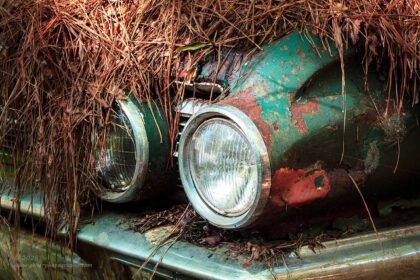
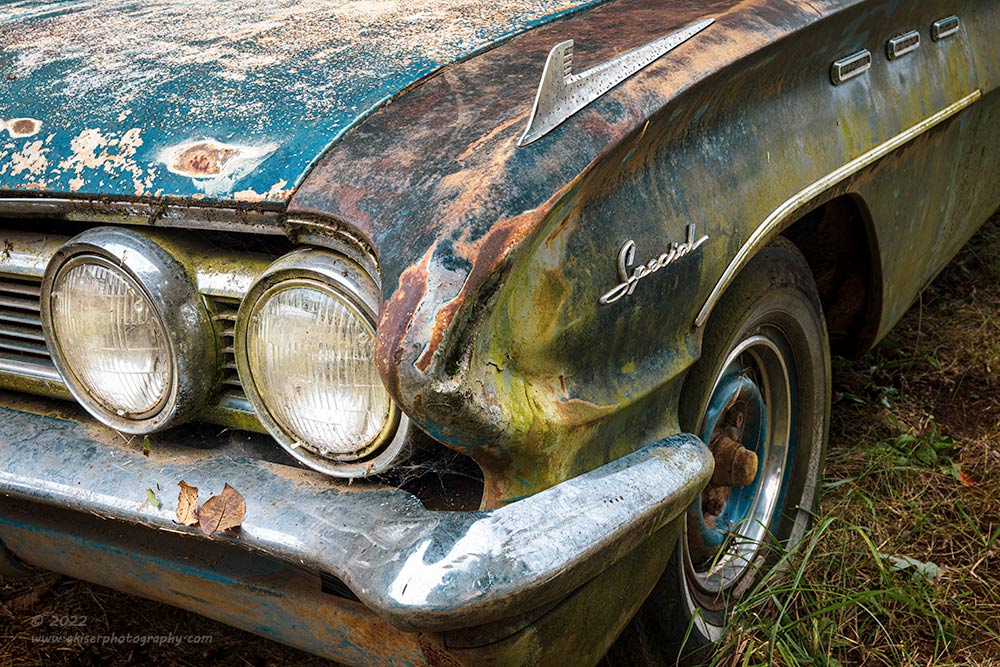
When I had settled down a little bit, I started to look for compositions. The first one that I went with was the front of a ’60’s Buick that caught my eye. I loved the curve of the fender, and the way that the dents had happened at the front. Of course, the “special” emblem made me think that this was going to be a special photo, but there were also the signature Buick portholes along the rear of the fender that I liked. Oh yeah, there was another spider camped out between the two headlights where the web was built. He came out to watch me get set up, but fortunately crawled back in when I started to make images with this car. I tried different levels to get the perspective right, but finally decided that I liked a lower point of view that included the headlights and all the way back to the portholes in the back. The crop was tight all along the edges, just giving a hint of the ground beneath, which I thought made this a stronger image than omitting the ground entirely. I also liked how the wheel balanced out the headlights while the “special” emblem worked well with the portholes and the fin on the top of the fender.
That was the first image of the day, and I was quite satisfied with the intimate crop that I made of it. That kind of set the tone for the rest of time here in a way. Because of the close quarters, I really had to get creative with compositions to capture the essence of the subjects without creating an overly complex image. I’ve said it many times before, photography is a subtractive art where the success of an image comes from what you don’t include more than what you do.

The next subject that I really wanted to capture was the old bus that was parked over by the shelter. This was where two of the larger spider webs were, so I had to be mindful of where I was walking. I would have loved to have gotten a full-on photo of the bus because it was probably as interesting an example as I had ever seen. However, there were cars parked to the side of it, and in front of it. On the other side, was a shelter housing tractors and other cars just to the rear. The bus was literally right in the middle of it all which made for a lousy photograph. However, the patina was wonderful, and I saw the remains of a decal on the door which caught my eye. You could make out the state seal in and amongst the rusty patina. I knew the angles that I wanted to capture because I’ve done this type of composition many times on pickups from the ’50’s. The fender, hood, cowl, and in this case the leading part of the door all came together to form some very interesting lines.
As with all isolations, it was all about picking the right camera position to get the elements placed in the most appealing positions within the frame. I was limited as to where I could stand but managed to get a couple of locations that seemed to work rather well for the capture. I wanted that state seal as part of the image because it was still readable, even though none of the decal was left. It was all about the degree of rust from when the decal had started to peel up. You might be looking at this and seeing where the framework of the seal looks to be cropped accidentally, but that wasn’t the case. I didn’t really care for that buffer boundary, and chose to crop through it, while leaving breathing room for the main seal because I had cropped through the vent on the hood which put an element very close to the edge. By cropping both the seal and the vent, I was able to restore balance to the image overall while keeping the visual of what was being seen intact.
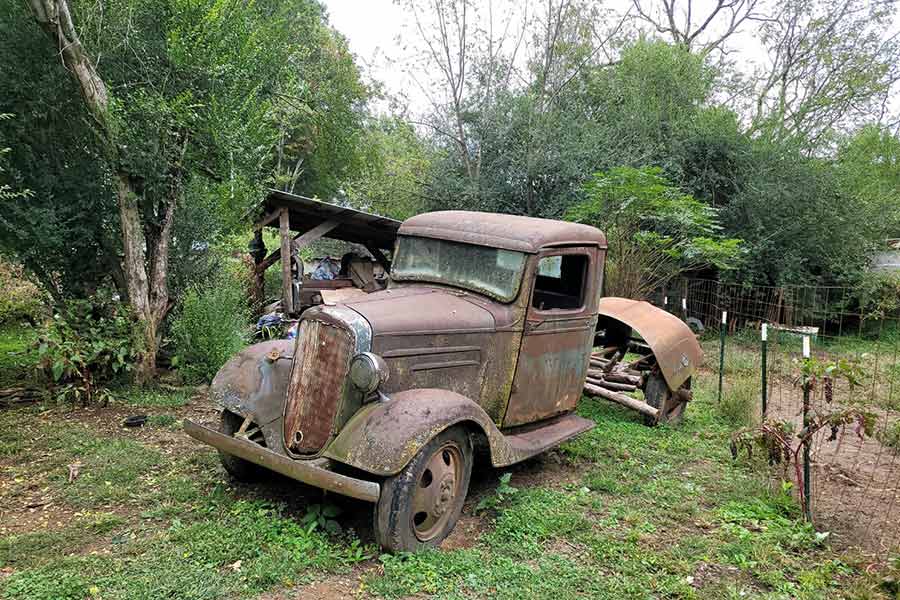
Feeling pretty happy with the photos from the bus, I moved my attention over to the side of the property nestled in behind the other property that I had worked. There was a very old truck, possibly a late ’20’s model nestled between a small shelter and a fence that housed a very large pig that I met later in the day. I loved the truck and wanted to capture it in some form or fashion. The patina on it was so monotone that I didn’t really see an isolation that I wanted to capture. The thing with isolations is that there is some sort of pattern or shape that is included for the visual interest. There was very little I found photo worth in the details of this truck. Getting an overall image was going to be nearly as difficult because the sky was doing me no favors as you can tell from the cell shot above. I try to avoid capturing skies that are this kind of blown out and bright. There was no definition in the clouds to work with either. Not only was the sky a problem, I had to deal with the fence to the right, the hood of a COE truck on the rear frame, and a small shelter built on the opposite side. The only thing that was around that I liked was the tree that was growing to the left that gave me a nice framing element to the scene.

What I ended up doing for this photo was elevating the camera as far as I could without changing the perspective of the truck too much. That allowed me to get rid of the sky for the most part, but not entirely. The one little sliver of sky at the top wasn’t really a distraction because it was at the center of the edge and blocked in by greenery on either side. It wasn’t ideal, but it was the best that I could hope for on this one. The use of a wider focal length allowed me to separate the cab of the truck from the hood that was sitting on the frame to the rear. It somehow fits, and with the close crop on the framing tree, I was able to get a similarly close crop on the hood at the rear. The focus of the image became about the shape of the truck and the textures of the body. The shelter to the rear was left in because, well, I had no choice. It does provide a bit of leveling for the image though since the truck actually is sitting on a small hill and is leaning to the driver’s side. The shelter helps to establish a point of reference for being level.
At this point, I was thinking that I had all that this section had to offer because of the limitations on compositions. I knew that couldn’t be the end of it though. I just had to dig deeper and find something else that appealed to me. I slowed my process down and started to walk back and forth looking for the details within these vehicles. I slowly started to see other compositions jumping out at me and I started trying to get the camera positioned to capture what I was seeing. Most of the time, I wasn’t able to get the camera in the right place, and things just didn’t really come together. I spent a good deal of time working with a really nice Ford truck but couldn’t make anything at all work out. I did eventually come back to it, but that will likely be in part 3 of this series, so continue reading to see what I ended up with on that truck.

As I was getting a little frustrated, I came upon a Dodge that struck me. The finish was largely monochromatic in appearance and there was no way that I was going to be able to get a full on shot of the car because it was jammed in with so many others. However, I was so in tune with finding contrasting chrome trim that I was able to identify the handle as a great visual anchor. The panel lines between the door and the body, as well as the fender had a beautiful simplicity to them. I got the camera in to position and framed up a composition that thought would work. Feeling pretty good about how this was going to turn out, I sent a picture of the setup to Toni.
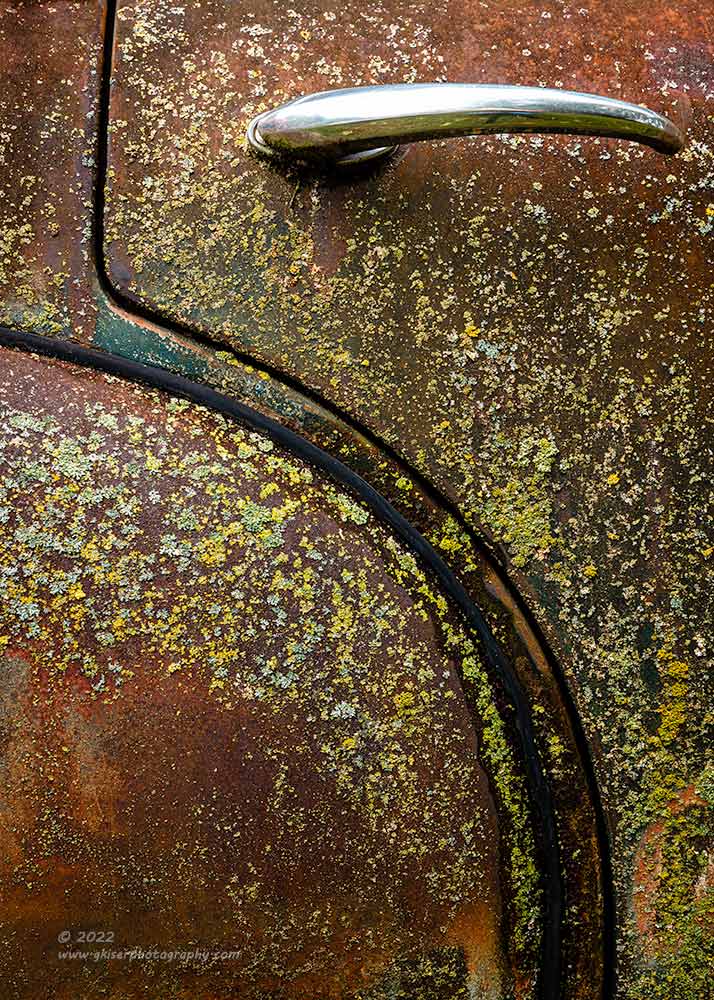
Sure enough, this one was one of my favorites from the day. I loved the simplicity of the composition matched with the intricate details of the patina. I have found that I look at this photo in two different ways, and neither of them are in relation to this being a car. In one way, I see this as textures and my eyes are set to look at the textures in blocks of distinct shapes. The second way I look at this is as a geometrical image where the curves and the shape of the handle are the subject while the textures are just the background. It is one that I could look at for hours and enjoy which is what I want from each of my photographs.
If this is a concept that you are having problems within your own photography, consider this shameless plug for a moment. Figuring out how to shoot isolations and still be able to tell a story isn’t the easiest thing to do in photography, but it is something that I teach in my Decay Workshop, which I happen to have one coming up in November. This is just one of the techniques that I will be covering during the day. In fact, all of the techniques that I am using during this trek, I will be sharing with the group. There are still spots left as of this writing, but I fully expect this one to sell out, so don’t wait too long before getting your spot reserved.

Now that the shameless plug is over, let’s get back to the action. By this time, I was firmly focused on the bus once again and trying to make another image of it. I wasn’t able to make anything work on the nose which I found interesting, but there wasn’t enough of a visual anchor to hold the interest in the image. I just kept coming back to that area behind the front right fender which had the best lines to work with. I decided that I would do another composition similar to what I had already done, but this time, I wanted to just keep it simple and focused on the lines. Essentially, I was doing this one in the say way that I would have the trucks of the ’50’s. I set up a nice vertical composition that included what I wanted to capture. As expected, the lines all fell into place, and I was able to focus on the wonderful patina. It was similar to the other composition that showcased the state seal, but this one had a different message to it, and as such, is its own image.
With that composition done, I decided that I was satisfied with this section of the property. I had been out here for quite some time and wanted to see what was further into the property while I still had time and the light to work those subjects. As it turned out, I wasn’t done with this section at all. I came back and spent another long period of time, but with a different lens which opened up some new possibilities for me. Keep reading to find out how that all went.
As always, if any of these images speak to you and you would like to order a print, you can do so directly from the website, or you can talk with me to custom order a piece in the size and media that you would like. In either case, you will receive a high-quality art print that represents exactly what I was trying to showcase with the photograph. There is no better way to enjoy photography than in the way the photographer intended with something tangible.
Part 1 … You are here

Remember to use the code KISER10 to get 10% off your purchase