Saturday, September 25, 2022
I have just finished telling you about a trek where I was actually told to leave a property which doesn’t happen all that often. That has prompted several discussions where my methods for accessing properties have come into question. I assure you that I treat properties with utmost respect, and I weigh the options in the event that I can’t make contact with the owners. In the recent trek that I shared with you, I tried to make contact with the owner, but wasn’t able to. I ended up talking to a neighbor that was acquainted with her and didn’t think that it would be an issue for me to photograph on the property. Not seeing any signs up, I decided to go ahead and get the photos since I was going to be in the front yard for all to see. That was a totally different set of circumstances from many locations that I never get to photograph because I just don’t feel comfortable going deep into a property without permission. The trek that we are going to talk about here in a minute is all about those places that I don’t get to photograph because I choose not to enter the property out of respect.
I’ll go ahead and preface this blog entry and trek by saying that I ended up with 16 keepers out of 101 images shot for the day. That is just too much to include in a single blog entry, so I am going to break this trek up into two parts. As it turns out, I shot two different locations, and each one yielded eight images, so that makes for a very easy intermission point for the blog. Both of the locations have something in common with each other in that I have been trying to photograph them both for about two years now. I think that the first time that I ran across the second location was on a morning after shooting an old Esso station in Taylorsville for a client of mine. I was all through the area since it was my first time visiting and I was amazed at all the potential there. One of the areas that I saw had a bunch of old cars tucked in behind the trees around a couple of garage buildings next to a house. The light wasn’t right for any images at the time, but I remembered the location. I ran across it several times again over the next few months while I worked the area. I never was motivated to shoot the cars because of how they were packed in, but there was something there that was interesting to me, and I kept pondering it.
The other location was one that I had passed by maybe a dozen or more times over the last two years. I’ve stopped and knocked on the door of the house more times that I can count. I’ve even tried to talk to the neighbors but haven’t gotten anyone to come to the door. At some point last year, I decided that I was going to write this location off. I wasn’t sure if anything would work out anyway, so I felt that it wasn’t worth trying any more. What I had found interesting was that there was an old tour bus parked at the back edge of the property and there were several old tractors parked on the side of the yard by a barn. It was just interesting enough to draw me in and make me want to give the location a try. Nothing ever really changed with the house, but I noticed that the truck in the garage had a current registration and I actually saw it get renewed at some point. The doorways were clear which indicated that they were still used regularly. I left a couple of business cards over the months that I visited, and they were never there upon my return trips. All indications were that somebody lived there, but I wasn’t able to ever get anyone to come to the door.
This was not actually the setup for this trek. I just shared the information because it became pertinent later on during the day. It all started like so many of my treks. I was looking at the weather around the middle of the week. I saw that the weekend was going to have some clouds potentially and that was going to be something of a rarity over the last month when we have had more than our share of clear skies. I spoke with one of my mentorship clients to see if he wanted to go out and do some photography, but he had other plans for the weekend. Not having to worry about teaching photography, I chose to go where the clouds took me and just wing it more or less. As the weekend got closer, I was able to see kind of where the clouds were going to be situated. It seemed that I was going to have very good clouds around the area of Taylorsville which is a place I hadn’t been in quite some time now.
Recently, Toni had gone through the area on the way to Hickory and had sent me some quick pictures of places that she had seen. She had made it further South than I had gone on that route, so I was interested to investigate further. With the clouds looking good, I decided to head out that way and see what I could find to photograph. The trip down Hwy 16 is one that I have gotten very familiar with over the years, and I’ve stopped and shot many a scene along that roadway. I still keep my eyes peeled for targets of opportunity though because you just never know what is going to pop up.
As I got close to Taylorsville, I thought about the old bus and wanted to see if there were any signs of movement on the property this time. I slowed down as I got close and started to look. I could still see the tractors parked by the bar, and I could see the large RV that was blocking the view to the old bus. I then could see a tractor sitting in the front yard with a driver, and two other guys on a ladder by the chimney. Wait a minute, I was seeing people! It took me long enough to process that information that I had passed by the house. I ducked into the next parking lot and got turned around to return. I pulled in and went right up to the guy on the tractor.

I introduced myself and alluded to the plight that I had been having trying to make contact with the owner. I was informed that the owner was 92 years old and that was why he didn’t come to the door when I would knock. I totally understood that and hoped that I hadn’t bothered him. A quick discussion later, and I was granted permission to access the property to shoot some photos. I was so excited to finally get the access I needed that I didn’t know where to start. I hadn’t been thinking about any compositions because I just didn’t really know how things were going to line up once I got back there.
My first inclination was to go with a wide angle shot down low, so I mounted my 16-35mm lens along with a polarizer and ND Grad to control the sky a bit. I worked on getting the camera placement correct so that I could capture the trees as I needed to for framing. It was coming together nicely, and I was liking what I was getting. Surely it couldn’t be this easy, but it was seeming to be that way. After I had a handful of images from both sides of the front of the bus, I turned my attention to a yellow tractor in the brush by the barn. I tried to get in close and use the same lens, but I didn’t like the perspective and knew that I needed to pull back a bit to get the right look for the tractor. I swapped out my lens for a 24-70mm which was a more normal focal length. This allowed me to frame the subject in a way that made sense. However, the image was just not exciting and there wasn’t enough story to it. After a few failed attempts to capture a composition that I liked, I gave that one up.
At this point, I was looking through a different lens, and thought that I would once again try to capture the bus with a less distorted viewpoint. I slid the ND Grad back in and went to work. As luck would have it, I found that 24mm was the sweet spot which I could have shot with the other lens but had opted for the 16-20mm range for most of the shots. That difference in 4mm changed the look of the image and landed me my first keeper of the day. I actually shot several frames here as the sky was moving slightly so I wanted to get the most complementing look possible.

What I loved about this was the fact that the blue accents on the bus matched the sky above which gave the image an overall cool tone. The greens had a more or less neutral tone to them, but I shifted them to the warmer end of the spectrum in the edit so that I had a good color balance to the image. The GM badge on the front added another warm element that I accentuated in post. The open panels added to the visual interest and to the story of the bus which I really liked. It is kind of hard to see in the low-resolution web version of this photograph, but there is a NC tag on the dash that says “Buckle Up with Jesus” that adds just one more little element to this image. The mood set by the sky was perfect for this one, and I was totally happy with what I had gotten after waiting for so long to get a chance to shoot it.
I wasn’t done with the area though. I had the low hanging fruit of the bus that I had been lusting after for so long, but it was time to really get to work and work the scene that I had. I looked for some isolations on the bus, but my brain wasn’t quite able to figure anything out on the bus, so I decided to move to the tractors for a while. I looked at the three tractors lined up by the barn. The outer two were the most interesting while the middle one was equipped with a shovel on the front and all of the rigging that went along with it. That was too complicated of a subject to use in the photos, so I had to be very careful about including it when shooting the other two.
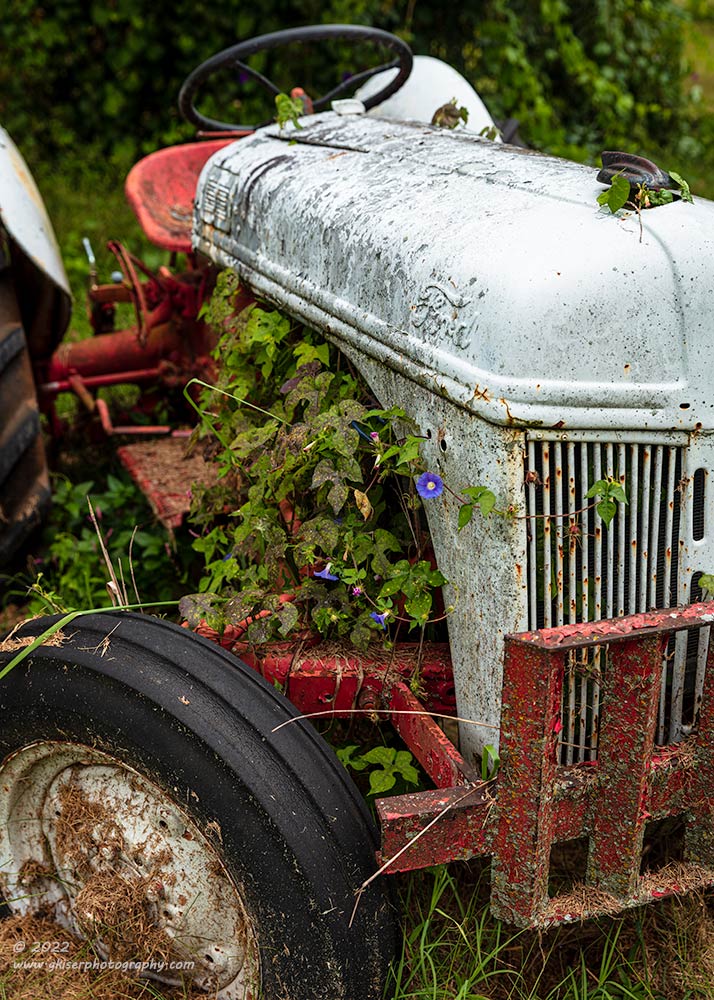
I ended up having a lot of problems finding compositions that included the entire tractor, so I started to look at the details that interested me. Ironically, after meeting with a dead end for isolations on the bus, it was the intimate details that really spoke to me with the one Red Belly Ford. I was able to pick out points of interest and decided that I would just make this an experiment of sorts with compositions. I have plenty of photos of these tractors in better locations, but the condition of this tractor was what interested me the most. It had a full season of grass clippings thrown up against it adding to the textures, and there were lots of weeds and vines growing through it as well. These were the elements that I tried to capture, and it only made sense to work that way since the background in every direction was cluttered with either a complicated tractor, an RV, a neighbor’s house, the roadway, or just a blank yard. My goal was to come up with different ways of composing an image that showed an intimate view of this tractor.
I started out by coming in close from the angle that I would have shot the overall image from. I flipped the camera up on its side for a vertical image and then started to frame it up. Normally, I don’t like to cut into things like wheels and grills, but it just made sense to do it this time. I used the tractor itself as a frame for the vegetation that was growing out of the engine compartment. The curves of the hood fell right into place with the Golden Spiral and the composition just worked. This set the stage for trying interesting crops around the entire tractor. I just had to make sure that nothing looked accidental that I would crop through. Since I really don’t like cropping after the fact, I made sure that these crops were done correctly in camera which added to the difficulty in setting the shots up. It is easy to crop on the computer after the fact, but I don’t like giving away resolution like that. I prefer to think it out in the field as I am shooting and that way, I can make those small camera movements to get things to line up just right. Different crops require different camera positions, and once you click the shutter, you are committed to the composition, even if you can change the crop later on.

The way that the front wheels were turned on the Ford dictated certain angles for the camera to be located. I could shoot from the front right of the tractor as I had done, or I could move to the left side and shoot from the rear taking advantage of that wheel direction. That was where I went next and found a nice overall view with a large bush blocking most of the shovel tractor in the background. Even though I had managed to eliminate that element as a distraction, I still had a lot of power lines at the roadway to deal with, not to mention a ragged tree line. I just didn’t like the shot as a whole, so I started to look for alternatives in how I cropped and framed the image.

You can see from the above BTS photo what I was working with for a background. It was just too cluttered, and then oddly empty at the same time. What I ended up doing was building on the composition that I had just shot of the tractor where I cropped through the wheels and body to concentrate just on what I wanted to capture. That was what I did here, and by cropping out most of the back wheel and seat, the shovel tractor was no longer an issue. The tread on the tire made for leading lines into the frame, and I cropped in close on the front wheel to keep the balance. The end result was I had the front wheel, rear wheel, and steering wheel as opposing elements framing the bright hood as a visual anchor for the scene. It felt right to look at it in the camera and it was one that I was really happy with early on. Even after the edit, I am still just as happy with how it turned out.
It really was an eye opener to be looking at compositions this way. I’m not usually one to crop in like this on multiple sides, but I was certainly seeing the benefit that it was giving me in terms of capturing the essence of this tractor. Not wanting to hover too long on this one Ford, I wanted to go and give the tractor on the other side a little love too. I had already tried to photograph it from the front as it was nosed in towards the barn. I didn’t like the background at all, so I didn’t even make an exposure from there. Now, I was looking at it from the rear which is not really a great location to photograph a tractor in general. However, I kind of liked what I was seeing happening here. I had the barn and a lot of vegetation as a background which really worked for the color of the tractor. It was a faded pink tone, but I knew that I could massage the color more to an orange to go with the greens better. I loved the shape of the hood on it, and from this angle that really showed well.

I started to play with the different focal lengths to find out the best perspective for this tractor. I ended up racking it out to 70mm for this view. The compression of the background really helped, and I was able to get just enough of the barn to tell the story of the tractor without including the power pole that was right outside of the left side of the frame. I struggled with how to compose the tractor since it really seemed like I was putting it smack bang in the middle of the frame. The more I thought about it though, the more I was considering different compositional theories. I thought about the placement of the things like rear wheels, steering wheel, and front of the tractor. All of these elements were considered individually and placed in line with where I wanted elements in the frame to go. What I ended up with was a relatively centered subject, but there was a visual path to follow through the scene. The wall of the barn gave some needed depth and dimension to the frame as did the angle of view. Because of the barn, I have two implied diagonal lines in this frame that add visual tension to an otherwise stagnant composition.
I wasn’t sure how this was going to turn out because to be quite honest, I figured that I had overthought it. Usually when that happens, I get home and hate how the photograph turned out. I was surprised when I looked at this one and felt that it made perfect sense, and I really liked it. Once I did a few modifications to the colors to get them to complement each other better, I was sold that this was a very good image. There was actually very little post processing done here, and most of what I did was global adjustments. I love it when I can get it that kind of right in the camera.

Not seeing any isolations on the pink tractor, I decided to go back to the Red Belly. Part of doing isolations on these tractors was that I needed some color contrast to work with for visual interest. Having a tractor completely painted in a single color makes that kind of difficult. The Red Belly had the red core with light gray accents that worked so well for defining the space within a frame. I was actually excited to get back to this tractor once again and decided that I wanted to focus on the seat for this next photograph. I’ve never really done a photograph that was built around these rather uncomfortable looking chairs. I began looking at the elements that I had to work with and found that I had to include both rear fenders to frame the red. I had originally done a tighter crop, but it felt very unbalanced with the red filling up the entire lower right corner. By opening up the composition a bit and including a sliver of the left fender, I achieved a visual balance that worked to frame the core of the tractor.
There are many who might remove the grass clippings for a photo, but I am a stickler for shooting it as I find it. The grass clippings help tell the story about how long this tractor had been sitting there. It works well with the weed that is growing over the hood to let you know that this tractor has been sitting idle for an entire season of warm weather. I don’t’ even need to show you the condition of the motor for you to know that this tractor hasn’t moved in a very long time. The photograph just captures that essence of what this tractor is, and I love how it presents itself.
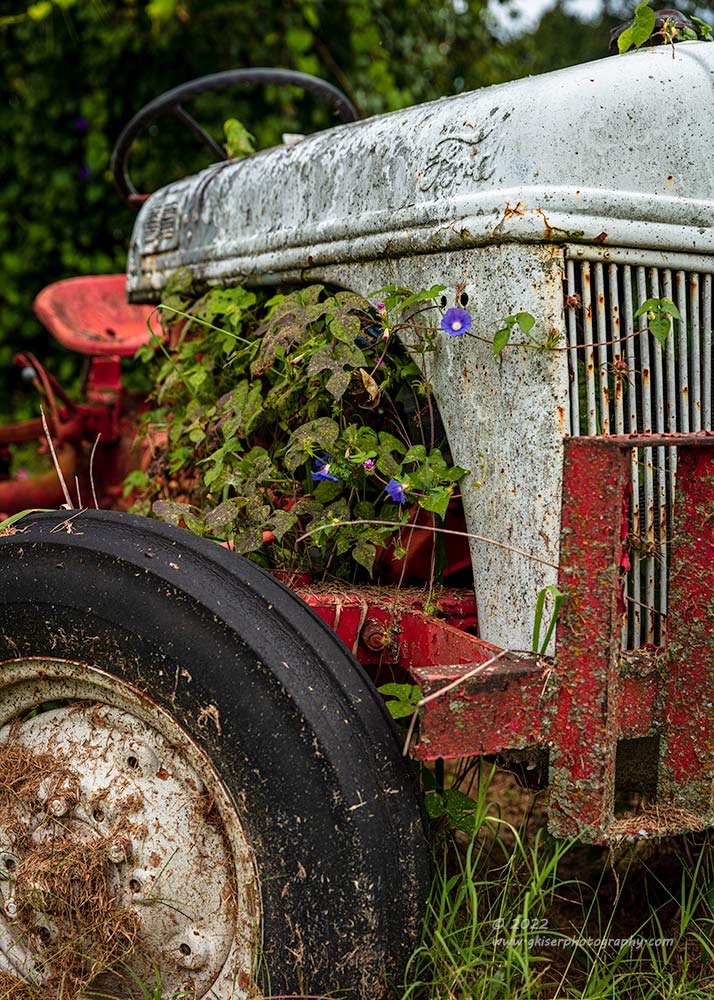
Before leaving the tractor for the last time, I again went to the front right corner where I had found so much interest in the overgrown motor. The angle that I had shot it before hadn’t really shown the true dramatic curve of the hood. I wanted to showcase this curve matched with the front wheel for this composition, so I got down lower than before in order to strengthen the arc of the curve. Again, I chose to do a very close crop and eliminate a portion of the wheel as all I really needed was the section from about 12 o’clock to 3 o’clock. With that in place, I used sections of the steering wheel and seat to introduce more similar curves to the image. The curves were contrasted by the healthy portion of straight lines found throughout the image. The vegetation in the engine compartment was still the highlight of the image, but it was framed in a totally different way. I loved both of these images, so I ended up keeping them both.
I was feeling quite good about what I had captured with the tractors at this point. Having had so much success with the intimate crops made me want to go back to the bus and try again with a new understanding of the possibilities. I started to walk around the bus once again, but immediately started to feel hard pressed to find the compositions that I felt should be there. I concentrated on panel lines, colors, lights, windows, and anything else that I could find. Nothing really jumped out at me though. None of these details defined the bus’ essence which was what I was going for.

As I was getting close to giving up, I started really thinking about what the essence of the bus actually was. What I came up with was that it was no longer in service, showing signs of not only use, but of neglect. The weeds growing up around it showed how long it had been stationary which was important to the story. As I started to put those elements together, I started to see a composition developing. I was wanting to bring all of those elements into a frame together that tells the viewer about this bus. I found my answer at the front left corner. I had the driver’s location that had a steering wheel and a fan showing through the widow. Below, where the wheel should have been, was a bunch of weeds covering that wheel. The problem was with the colors of the scene. The greens were too dominant and there really wasn’t much interest in the color palette for me. That was an easy solution for me. I just started to see in black and white. Once the colors were gone, I had a whole different view of this bus. The age became the focal point more than the tones. This was going to work.
I took a page out of the tractor photos from a few minutes before and started to form up a composition that was cropped tightly on three sides allowing just one side to breathe a bit to show depth. I focused on the shapes with the windows and the ribs in the siding of the bus. It was not a composition that I would have normally thought about, but I was kind of anxious to see how this one would turn out. I was into full experimentation at this point and was having a lot of fun trying things that aren’t my normal style of compositions.
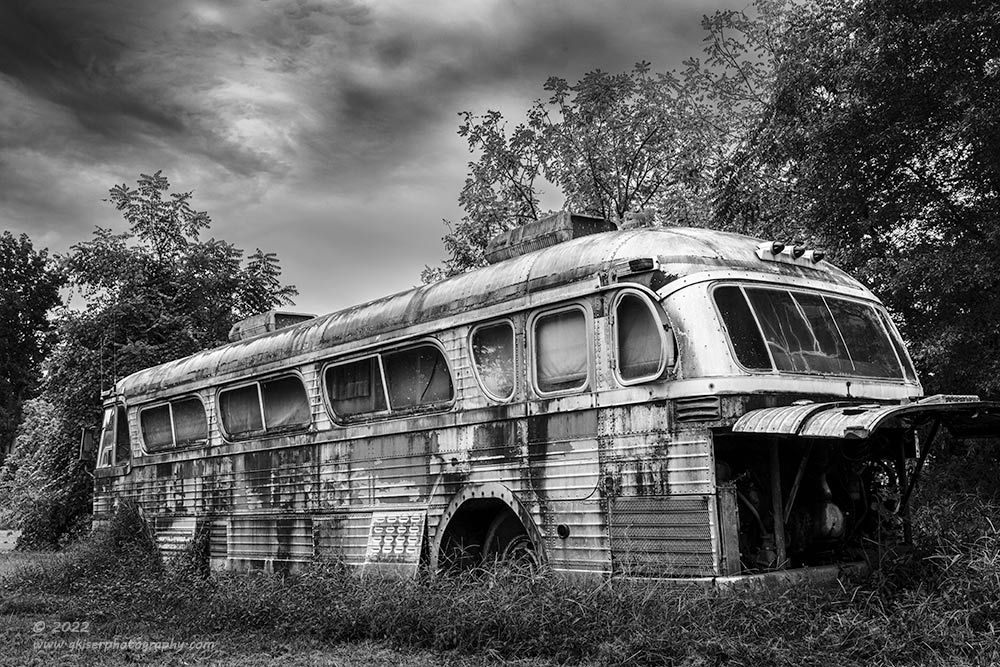
Thinking of the bus in terms of black and white now, I moved to the back end of the behemoth and started to work another composition. I didn’t have a lot of room around the bus because if you will recall, there was an RV parked right in front of it. That limited the amount of nose room that I could give it. There was another complexity that was added in with the rear of the bus that had to be addressed. The hood, or boot, or engine cover was propped open. Not wanting to touch it, or move it, I chose to leave it open. However, if I was to include the entire panel in the composition, it would through the balance of the composition off in a bad way. I had to figure out how to minimize this panel as best I could. I again fell on creative cropping with this one. Knowing that I was going to be doing this as a black and white image, I found where the panel went into shadow which would blend with the darker trees to the rear. By cropping at the division point between light and dark, I would have the illusion of a completed panel which was all I needed. If you look closely, you can see that the panel is cropped at the edge, but it is done in a way that doesn’t form a distraction. This is the key when cropping through elements, you just always want to do it with intention and not accidentally.
With this final image of the bus shot, I made one last look around the property that I had waited for two years to photograph in case there was anything else that I wanted to capture. Feeling pretty confident that I had everything that I could want I decided to pack up my gear. It had been a great time here, and I think I had spent a total of an hour and a half here. I had a total of 67 frames shot in that time, so I had been moving through compositions with a quickness. I was pretty sure that I had about four images that would be keepers from this location which was pretty good considering that I had only really shot three subjects. Of course, you can see that I missed that estimate by quite a lot. I have a total of eight keepers from this location which is surprising considering the amount of experimenting that I had done with most of the compositions.
I was happy that I had finally got to shoot this location and have to admit that it was worth the wait. I couldn’t have asked for better conditions, and I had all the time in the world to get the photographs that I needed. I still wasn’t quite finished with the day though as I still had a bunch of creative energy left in me. I packed up my gear and made my way South so I could start exploring the area that Toni had introduced me to through pictures on the way home from Hickory.
I’ll have to get into that portion of the trek next time as there are eight more images to talk about. The next phase of this trek was as involved as this one was, and I want to give you some time between the two. In reality, there was a lapse of about two hours between packing up from this location and actually starting to shoot again at my next location. I spent those two hours riding around and exploring, not finding anything that excited me. I was actually thinking that I was going to be done with the day after all because the clouds were bringing rain now, and the light was failing a bit.
If any of these images speak to you, I would love to talk with you about getting a print. You can order stock sizes directly from the website here, or we can discuss other sizes and media like metal and canvas if you wish. No matter the size or media, there is just no comparison to holding an actual physical print in your hands. A computer monitor and web resolution just can’t hold a candle to an actual print. I would love to talk options with you on this.
Also, keep in mind that I am doing a decay workshop in November where you can learn some of my methods for finding these scenes as well as how to capture them where you find them. This isn’t always as easy as it looks. The workshop will be a full day learning experience on location with you shooting your own images. I’ll be there to instruct and to help you achieve your own visions. Get signed up today because this workshop is already half full.
Stay tuned for part two of this trek which hopefully will be published tomorrow.
Until then….

Remember to use the code KISER10 to get 10% off your purchase