Monday, August 24, 2026
Welcome back everyone! I hope you enjoyed the first entry in this series and are ready for some more photos from this surprise location in Booneville. For those of you who haven’t had a chance to read through the first installment, I’ll give you a few minutes to catch up real quick. Now that we are all caught up, if you haven’t done so, be sure and subscribe to the blog to make sure that you get notified with each new entry and all of the new photos as they get added into my collection. It is a great way to stay up to date with everything that is going on with my photography in real time because this is where I share things first.
When we last left off, I had told you about how I had found a veritable treasure trove of old, rusted vehicles. The pattern went like it had so many other times before with things starting off innocently enough at first. There was a ’32 Ford sitting on the side of the road that I had been eyeballing for about a year but hadn’t really figured out how I wanted to shoot it. Then there was a ’50 Chevy coupe that was added close by that made me really want to stop to get some photos. After posting about the session, I was given some information about the owners of the vehicles by a friend of mine. A couple of phone calls later and I was being given a tour of the property that included a couple hundred old cars all tucked into the woods. It was a fantastic location, but the timing was not great for photography with the sun out in full force and the vegetation very much grown up here in the latter stages of summer.
The conditions didn’t stop me from giving it my all while I was here. I tried to use the existing lighting as much as I could and I formed the compositions around that lighting. I had to let many good compositions go because the dappled lighting was too distracting, but there were other situations where the strong light actually came in pretty nicely. I just rolled with what I had and knew that this was more of a scouting trip than anything else after having been given permission to return at a later date for more photos. I’m really looking forward to a return trip out here in November or possibly December when things have died back a bit and hopefully the mosquitoes will be gone by then.
I didn’t mention the mosquitoes in yesterday’s blog because I had so many other things to think about and talk about. However, my first thought this morning was that both of my elbows itched. From there, it was the areas behind my knees, and eventually the entire back of my head. I then remembered that while I was out there, I could look down at any given time and count at least a dozen mosquitoes on me or my clothes. I knew that I was going to regret that part of the adventure but decided that a little discomfort was worth it for what I was able to see and photograph here on the property.
I can hear you all saying that I could go to Old Car City USA in Georgia any time if I wanted to have a lot of great subjects in one location. You probably can’t understand why I’m getting excited about this little hole in the wall in a little community in Yadkin County. Well, this is something that I’ve talked about many times before but still holds true to this day. Sure, I could head down to Old Car City and know exactly what I would be experiencing. I could schedule my time through their website, pay my admission, join others in search of rust and just make a day out of it. I’m sure there is a gift shop on the property as well and just the thought of hundreds or more that have been through the same area would just make me feel all warm in cozy inside. On the other hand, I could spend years hunting and occasionally finding these little treasures in unlikely places. I can spend the day walking around these old cars knowing that for the most part, I am sharing paths that were created by deer and other wildlife. In many situations, I am seeing cars that haven’t been seen in years as things get so grown up around them that it is just not practical for the owners to continue walking around them. In essence, I am making discoveries and seeing things that very few people have seen. This is the exciting part of what I do and finding these old, time capsules in their current states makes it all worth it for me. There is no comparison to a tourist destination like Old Car City which is kind of like going to a zoo because you want to see animals. Sure, you will see animals, but they are not in their natural habitat, and you are there on an observation platform watching the tigers along with 30 of your closest friends. Of course, the habitat is one that has been curated to give the impression of where they would live, but somehow it just isn’t the same.

Being a decay photographer is something that I take pride in because part of the “art” of doing these photos is to give the sense that the subject has been left abandoned for many years. There is a great little Chevy sedan that might be a ’53 which can be found about three miles from home. The car looks great and the first time that I saw it, I wanted to photograph it. However, it was towed out to this property from wherever it was originally found and was strategically placed in a front yard. The car didn’t fit the scene with the grass nicely cut around it. The car had also been cleaned and looked cared for despite the rust and age that was apparent. Over the next year, the area around the car was landscaped and there was an antique gas pump placed beside it. There was a skeleton inserted into the driver’s seat and lights were placed around it for better visibility at night. This car now looked officially like yard art, and while I think it looks great, it is nothing that even interests me as a photograph because of how “put together” the scene appears. Conversely, what I look for is photographing the subjects where they have sat for years. I want to see the new relationships between nature and manmade objects. I want that sense of forgotten in my photos, that mood that just screams neglect. These things are instrumental to my decay photography and why I geek out on finding locations just like this.
Sure, there are concessions that I have to make because of how I find them. In this situation, there were so many vehicles packed in that I had a hard time finding larger compositions. The lighting and dense vegetation also played their parts, but I knew that coming back on a different occasion would yield very different results. Having done this kind of photography for many years, I have ways of working around these little hurdles and find the small successes even that much more rewarding.
One of those techniques that I use is working the details on these cars. I can trace that idea back to a conversation that I had with another photographer around 2013 or so. Randy Rogers and I have kept in contact through the years and when he lived in NC, he even attended a workshop of mind dealing with decay subjects. The conversation that we had was about how he learned to photograph decay from his dad when they would go to junk yards. They faced many of the same issues that I was facing here, and what he was told was to look for the details on the cars rather than trying to always photograph the entire car. I had been doing that to a point before having that conversation, but I found it to make perfect sense, and I started to do it more often. Eventually, this became part of my style and then I developed a name for it after another conversation with another friend who was into Haiku Poetry. Dave Russo had sent me some information about how Haiku and photography shared some concepts and one of those concepts was that of synecdoche. After learning about that term and what it meant, I ran with it and have been embracing it ever since.
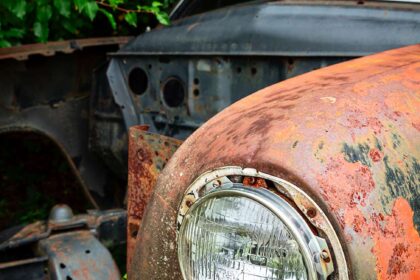
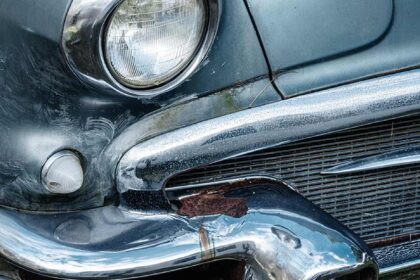
It was the concept of working the details and that of synecdoche that I leaned on through much of this trek. In fact, the photo that I am opening up this entry with is the direct result of those ideals in photography. I had just finished photographing the extreme front clip of the Ford Fairlane which had caught my eye as I was walking around the car. The car itself wasn’t in a position that would allow me to get an overall photo of it, but I felt that the isolation that I was seeing would speak well for the entire car. While I was capturing that portion of the car, I started to realize that I was being drawn into that isolation even further. The way that the bumper and grill came together at the lower corner struck me as oddly beautiful.
I moved in much closer and started to work out that composition and realized that I was removing much of the identity of the car with this close-in crop. However, this tight detail was very expressive in its own right while capturing the essence of the car without identity. Of course, those who are familiar with the car will very likely know exactly what car this is from the clues that are present, but the car is not really that important here. What I was responding to were the curves and the textures of this part of the car. This brings me to another one of the concepts that I like to introduce into my photos.
I love finding juxtapositions and dichotomies within my compositions. Simply put, I like there to be two elements at odds with each other. In the case of this photograph, you can see very clearly the elegant design of the car. The way that the shapes all play together speaks very highly of the design team. The design elements still hold value today and look very upscale. However, in their current state, you can see that this car has been left to rot in the woods which was never visualized by the designers who anticipated the owners waxing their cars regularly and taking them on trips where others would look in jealousy wishing that they too could have a Ford like this. Here we are looking at that great design language as it languishes in the woods after being long forgotten. I really love setting tones with my images like this, and I’ve found that the simpler the composition, the more effective that the dichotomies will appear.

While I love working the details on these subjects, there is really no substitute for being able to get an establishing composition which shows the environment that the subject is in. This is usually much easier with isolated subjects, but occasionally I can find ways of making these images work in more crowded situations. I spotted an opportunity with a coupe that was stuffed into the woods just off of the clearing. It was the fact that it was kind of off on its own that grabbed my attention first, but eventually I saw that I liked the teal paint that was remaining and being surrounded by the rusty tones. The roof was also an interesting design feature that I had not seen before. There was a lot of uniqueness to this car, and I felt that it deserved a frame or two.
Ironically, it wasn’t in a good position for any isolation work as it was pretty well buried in the brush. However, there was one angle that I could shoot the entire car from while only getting a small section of the car that was parked next to it. The brush that was grown up all around the car helped to mask the neighboring car while becoming a framing element for the entire image. Since there was a Virginia tag on the front bumper, I chose to elevate the camera to show that little detail in the image as well since I felt that was an important part of the story here.
Part of the effectiveness of this composition turned out to be that the passenger side headlight was masked by the brush changing the mood of the photo dramatically. Without the brush, this would have been the postcard shot with the subject pretty well centered in the frame. However, by having the one headlight covered up, there was a sense of mystery and even shyness to this car. It was as if it was hiding from the first human that it had seen in a decade. It looked scared and that added to the story in my mind.
Here we have started off this blog with two wildly different approaches to composition with the same kind of subject. The really funny thing was how I had chosen to use the same long lens for both compositions. This shows the versatility of that 70-200mm lens which I have come to rely on greatly over the last few years. It might be my most frequently used lens these days which is in stark contradiction to when I had first put this kit together. In fact, I had to send that lens off for a warranty cleaning since there was a bit of debris stuck inside and had planted itself on the inside of the front element. While it was gone for repair, I didn’t even miss it. It was just not a lens that I used that much, nor really even understood. These days, I use a 70-200mm f/2.8 lens for both my landscape and decay work as well as my people photography. It is right at that perfect focal length for just about any subject and if I only had one lens that I could carry for all the work that I do, this would be the lens that I would choose.

As we change gears once again, I go back to shooting extreme details on another car. This time, it is a Ford sedan that is sitting under a tree with the brunt of the sun baring down on the passenger side. This car offered a ton of options for detail shots and even some abstracts, but the lighting wasn’t working for the vast majority of what I saw to shoot. The dappled lighting was just too complex over the car and the details of the car got lost too quickly. The exception was the hood which was covered in pine needles which formed a consistent texture. There were little bits of greenery growing up through the needles and the long hood ornament was showing through those needles as well. This became the foundation for the next composition that I shot.
I really liked the abstract nature of the scene as I was looking at it. The dappled light helped to break up the general shapes of the hood which brought even more of an abstract element to the photo. I remember thinking to myself that the touches of green really stood out and I thought that they made the photo which kept the idea of working in black and white at bay while I was in the field.
However, when I got home and finished with the culling of the images, I started to look at this one in an unexpected way. I wanted to lean into the abstractness of it all even further and to do that, I needed to remove the color which was an effective way of grounding the image in a type of reality. It made the different elements easier to pick out for what they were, but I remembered being drawn to the textures of the needles and the way that the dappled lighting broke up the shapes. Without color, even the hood ornament would start to appear a little less recognizable.
After looking through the color profiles and picking a black and white one which had the tonal relationships pretty close to what I was wanting, I started the processing from that point and found that the resulting image was quite effective as a black and white. It really fit the abstract quality that I was looking for, and I forgot all about the colors that I had noticed in the scene during the actual capture of the scene.

A couple of hours after making that call on the photo things started to get interesting. By the time that I was finished with the initial edits of the images, I realized that around half of what I had processed had been done in black and white. This wasn’t really surprising because the colors were giving me a hard time because of the lighting that I was in during the session. Without getting into the science of things, I was faced with direct sunlight and shade as being my primary lighting sources. Sunlight is actually the baseline white balance for an image and is what all neutral light is geared around. However, in the shade, there is no direct light and what is producing the light is actually reflected light which is picking up a lot of the blue from the sky. That is the typical way that shadows are shifted in color temperature. To counter that, we warm the white balance in the camera to counter the extra blue, but this overly warms the daylight which is hitting the scene. In this specific case, there was also a lot of green being reflected into the shadows from the trees that were providing the shadows. This threw another wrench into getting a white balance set in the camera for accurate colors. There still wasn’t a good way of balancing the different colors due to the light which made it much more practical to do these compositions in black and white.
However, I had figured out a way to accurately address the colors in many of the photos that I felt needed the colors. This involved some pretty in-depth color grading both in the calibration panel as well as the color grading tab and occasionally through the color curves. I had to treat each part of the image separately in order to get an overall balanced look to the lighting. This is important because our eyes are great at shifting the colors on the fly so that we don’t really notice the differences in light. However, when we look at a photo, the camera sees it all and displays it all. When looking at a photo under a constant light source, our eyes balance to that light source and now we can see all the oddities in the colors that the camera picked up under the different lighting. The goal is to get the colors to look balanced as if looking at the scene through our own eyes in the field.
I managed to do that successfully with many of the color images and I started to look at the ones that I had done in black and white to see if possibly I had missed an opportunity for a color photograph with any of them. In the end, there were a total of three black and white images that I decided to also do in color. This was the first one that I made that shift with. Normally, I will process an image based on how I think it needs to be done whether in color or in black and white. That decision is pretty much a covenant that I make with the image, and I don’t usually go back and change that decision. If I do, I will forego the original edit in favor of the one that I might find to be better
In the case of this photo as well as the other two, I found them equally as effective as color and in black and white. Now, the change in presentation altered how the image was viewed and I had to take that into consideration. In the case of this hood ornament, I found that I needed to change the aspect ratio a little bit to concentrate the attention more on the way that the greenery appeared through the image. This was my original concept for the shot, and you can see by directly comparing them that one is much more abstract than the other while the other focuses the attention much more on the plants that are growing up through the needles. The exact same photo with different presentations says two very different things.

Once I was pretty sure that I had everything that I could manage from the Ford that was more in the sun than out of the sun, I decided to go back towards the front of the property to check out some of the cars that I had seen during the initial tour. I knew that there was a Buick convertible that I wanted to work with because it was a unique car that I had not seen before. Of course, the top was shredded and falling in, but the body of the car looked to be in pretty decent shape considering. It was also largely complete which was a nice plus. When I got back to the car, I could tell that I wasn’t going to be able to get an overall composition of the car at the moment because of the heavy dappled light that was falling on it. That was going to have to wait for another time. There were some details that I could shoot because the light was more forgiving over smaller areas.
The first place that I went was the rear of the car because I really loved the lines of the quarter panel and how the taillights looked on top of the rear bumper. The car was backed right up to a tree which made it kind of difficult to get a clear composition. However, in my search for juxtapositions in my photography, I really liked the idea of having the tree with the growing vegetation kind of mimicking the way that the bumper corner swept up at the rear of the car. The shapes all worked together and after I found the right angle to capture it all from, I was locked into this composition. It was simple, yet very effective.
The car itself was a blue green shade that didn’t really play nice with the surrounding vegetation that was more of a yellow green. It created a jarring color palette for my eyes and was my main reason for wanting to do this in black and white. The other reason was that by losing the colors, I was able to concentrate more on the shapes within the frame which was my main motivator for the composition. This is one of those cases where choosing black and white was the only choice and the color image was simply not effective. This is how I usually choose between color and black and white and typically never look back.

While still on the theme of juxtaposed elements within the scene, I started to get pulled into the front corner of the car for many of the same reasons as I had at the rear of it. In fact, the situation was pretty much the same. There was a tree growing up right at the end of the car. The difference was that this tree had started to grow around the front bumper and headlight. This was an interesting part of the story for this Buick as you can readily tell how long this car had been sitting here. You can almost feel the decades moving past as the seasons wash over the car in a repeating pattern that never stops.
The photo that I wanted to make was not about the car specifically, nor was it about the tree. What I was wanting to capture was the relationship between the two characters in this scene. In order to do that, I needed to get in nice and tight to the connection between the two. It was all pretty much a jumble at this corner with it being hard to tell where one element started and the other stopped. This became part of the composition and because of that I wanted to leave the color in because it offered a bit more clue as to what elements belonged with which part of the photo.
You can see the color of the car here and can imagine the awkward color contrast with a more yellow toned green there at the back of the car. The front offered two very important differences though. The first difference was that there was less greenery to be seen here and that caused less issue on its own. The other consideration was the type of greenery that was in the frame. What we are seeing here, is a deeper green and one that fits with the color of the car a bit better. At least it is not as jarring as the rear colors had been. After a bit of color grading to make them work a bit better together, I was sold on the overall look of the image.
I just had to decide on the aspect ratio that I wanted to use. It had been shot in the native 3:2 ratio which I really don’t like in vertical images. I tried the 4:5 to start with and found that to work pretty well, but it seemed too crowded at the bottom when I kept the right amount of information at the top of the frame. A 5:7 aspect ratio left it a little too tall and had too much breathing room at the bottom of the frame. I ended up going to a 4:3 aspect ratio that I have found works very well for vertical images but can be a little hard to find standard print sizes for. That was what I ended up going with because it fit the scene the best and I can always do a custom sized print if there isn’t a standard size available that meets the needs for the client.
This isn’t one of my favorite photos from the day, but I feel that it deserves a place in the collection because it helps to tell the entire story of the location. Sometimes that is the motivation for the photos that I shoot. While I do hope that every one of them finds a wall to be hung on to be enjoyed by one of my many clients, I realize that most of my photos will never be done as prints. That doesn’t mean that I might not have a use for them at a later time. I’m always toying with the idea of making a book with my images and I have little doubt that the theme of that book will be related to decay and most likely my rusted cars. It stands to reason that I’ll need some images like this within that book to fully show the stories of these old cars.
If you would like to see me do a book, please let me know. The biggest stumbling block that I am seeing with that project is the part where I get the books to those that want to read them. I would have to self-publish which means that I would be responsible for marketing, selling, and shipping after the effort of creating the book was over. This is the part that really scares me away from doing a book because to get the price down to what I think will be a workable number, I would have to print a whole bunch of books since due to the cost savings of volume. Of course, that means that I could very well be sitting on cases of books for many years and would likely never even see my original investment returned, much less make money on the effort. It is worth testing the waters at times to see if there is a potential for this to happen, so I’m testing it here. I figure those that will buy the books are the ones most likely to still be reading 5000 words into the second part of a blog entry about these old, rusted cars. Seriously, let me know if this is something that you would like to see on your bookshelf, or even better on your coffee table.

While I was still working with the Buick, I moved to the driver’s side and started to look at the other corner. There were no trees blocking the view here, but there was an equally as interesting story developing on this side. It was the pile of pine needles that were covering the top of the car which created the interest for me. Unlike the Ford that I had captured the hood ornament of; the actual shape of the car became more important here. As I had said, this was not a familiar car for me. The design features were all quite unique and I found them compelling indeed. There were little details of the grill between the headlights, and the fender was sculpted in a fantastic way leading down to the headlight. In some ways this car looked more futuristic than the current batch of cars with their LED headlight housings and plastic bumpers. I was fascinated by the shapes and if the car had been out in the open, I would have certainly done a lot of work with these design elements. As it was, the pine needles were creating an element of their own which blocked the view of much of the design language of the car. Instead of taking this as a situational loss, I decided to lean into the opportunity for another shot that included a dichotomy and juxtaposition of sorts.
The more I looked, the more I realized that I did like the futuristic styling with the decayed look of the metal being covered by what can only be described as a blank of time. None of these things went together, yet they all coexisted in reality right there in front of me. The little bit of sunlight that was peeking into the scene further amplified the union. This is the thrill of finding scenes like this in the wild rather than in a curated location that is maintained and seen frequently.
During the first round of processing, I decided that this was better as a black and white image because that allowed the viewer to really focus on the different shapes and textures. Without the color, there was more reason to study the image a bit further and that would facilitate a deeper understanding of what was being seen. I was happy with this as a black and white and felt that it was a very strong image.

As I had mentioned, after completing the first round of edits, I went back through to see if there were any other photos that I missed and also took the opportunity to look at those images that I had done in black and white to see if I could maybe do them in color for a more effective photograph. This was one of those images that I chose to bring back into Lightroom to try as a color image to see if I could get it to work. I knew that the colors would work well together with the paint color, the rust, and the brown of the needles. It was the bit of sunlight that was touching the car that had caused me some heartburn in the processing early on as the color temperatures were mixed. I was able to use some of the techniques to balance the colors a bit better which I had used earlier. That allowed me to get the image that you see here.
While I still think that the black and white is more effective at pulling the viewer into the image and having them ask questions, I also see a very pleasing color palette in this image that brings in more visual interest. Both of these photos are visually interesting, but for very different ways. For that reason, I chose to keep both versions of the image, though they each have a slightly different aspect ratio that supports the main reason for the particular rendition of the photo.
By this point in the day, I had shot a total of 36 photos in just under an hour. Essentially, I had gone through a roll of film and in that time, I had created 14 frames worth keeping and an additional two that were done as both black and white as well as color. I was moving right along and had far overshot my intentions for this location. That is the risk when I have no idea what I am getting ready to find. I might have come away with one or two marginal photos from the time here, especially with the light at hand. I was prepared for that, but that was far from the case. I could probably come out here dozens of times over the course of a year and end up with hundreds of keepers. I still have no idea what is further back in the woods and hope to be able to find out that secret this winter. Oh, and I’m still not finished with this trek yet. That’s right, there is still one more chapter to share with you and the remaining images from the day. I should be back here again tomorrow with that entry, so keep your eyes out. Of course, if you subscribe, you will get an email notification when that entry is published.
Until then….


Remember to use the code KISER10 to get 10% off your purchase