Sunday, September 11, 2022
It would seem like I am on a roll this month with treks, but don’t forget that I started August out the same way and then went silent the last half of the month. I’ll admit that I double dipped a little bit with this trek. You see, this past Summer Toni and I took a ride in the Miata down Hwy 268, and she wanted to check out the Chapel of Rest which is just inside of Lenoir. We spent a little time there and as any photographer would do, I looked around with a creative eye to see if it would be worth returning with the camera another day. I could see some potential for a foggy morning and put it on my list of places to go if and when the weather ever worked out.
The other part of this story revolves around one of my two Advanced Mentorship clients who we will call John. I’ve been working with John since the end of Winter this year. Part of my theory on mentorships is that I try to help the photographer realize their vision and not my vision. John is just getting started in photography and is doing it the right way. He has learned the basics of exposure and how to work his camera. We are now working on composition more than anything. I’ve been paying attention to what draws him into the scene so that I can figure out how to best address compositions with him. What I have learned is that he is drawn to the details, like textures within a scene. When pushed to tell me what he likes about a subject, this is where we end up. The compositions usually start out including far too much which is something that we are working on. Some of his favorite subjects are churches, old structures that are in disrepair, and flowers.
So what does a ride through the country and an ongoing mentorship program have to do with this trek? Well, you see…when I started to look at the weather for Sunday morning, I saw that there was a good chance of fog in Lenoir. You will recall that I have had my eye on the Chapel of Rest for a foggy morning. The Chapel of Rest happens to be a historic church that I have seen photographic potential with, and that is a subject that I know that John would enjoy. Not wanting to keep all the good shots to myself, I let him know the plan for Sunday morning to see if he wanted to tag along and see how I operate with my own photography as opposed to just instructing him through his camera. He was all for it and was happy to get final word on whether or not I was going at 6am.
When the clock rang and I gathered my thoughts for a moment, I checked the weather. The fog and the clouds were still in the area, and it actually looked like they would be hanging around longer than I had expected. I texted John before I got out of bed and let him know that we were on for the morning. The plan that I had worked out was simple. The chapel is opened daily during daylight hours. Logic would dictate that daylight began at sunrise which happened to be at 7:05am. Just to be safe, I had told him to meet me there between 7:45 and 8am. I knew that I would get there earlier, but I wanted to be situated and ready to start mentoring when he got there. Things were going very well, and I was able to get on the road a little earlier than expected. All the way there the rain was holding off and there were little pockets of fog. The closer I got to Lenoir though, the more rain started to fall. This was not the end of the world because I was really wanting the mood that a wet and foggy morning would bring.
I pulled up to the driveway of the chapel under a slight drizzle to find the gate locked. It was 7:30am, and daylight. Instead of just sitting there, I decided to drive around the area to see if I could find a plan B that would work for us. This is why I like to get places earlier than my clients. I don’t want things to appear unorganized for them. I drove around and ended up on a side road which I had been on last year at some point. I recalled an old house that I was pretty sure was vacant, so I continued down that road to see if there was a possibility there.
When I arrived, there was a light on in the living room, the yard was mowed, but there was very little sign of life around the house. I climbed up the embankment real quick and took a cursory look around. It appeared as though the light was a single bulb and there were no signs of anyone living there. I noticed no signs referencing trespassing or anything like that. It was on the side of a church, and it appeared as though the church was taking care of the yard. I saw no compositions right off that dealt with the entire house, but I did see potential with isolations and details within the house and the small shed to the side. It was worth a shot if the chapel didn’t work out.
I got back to the chapel around 7:45 and found that the gate was still locked. This time, I just pulled off to the side of the driveway to wait for John or the keyholder…whichever came first. John pulled in first and I let him know that it looked like we might be waiting for a while to get up to the chapel. I was thinking that 8am would be a customary time to unlock the gate so we chatted for few minutes until 8am came and went. The gate was still locked and there were no signs of anyone coming to open it. We discussed just abandoning the day, but that wasn’t my style. I had an alternate plan in mind and shared that with him. He was game to go and give it a try, so we loaded up and headed back up the road to check out the house.
It was about a 5-minute drive from the chapel, and we pulled into the parking lot for the church. This was going to be an interesting option for a Sunday because I didn’t know when the services would be starting. The parking lot wasn’t that big so we parked on the far end of the lot to be as out of the way as we could manage. John and I went up the embankment once more and checked things out. I had already knocked on the two doors during my first visit there with no signs of life, so I didn’t bother to knock again. The same light was one and nothing had changed. The shed was closed off on the garage side by chicken wire, and the single wide trailer behind the house was overgrown and the door was secured with a piece of paneling. We agreed that nobody was home, and from the looks of the house, it had been vacant for some time. We started to look around to see what excited us visually. John was quick to determine that there was no sense in capturing the entire house and agreed that there was isolation potential throughout the property.
I engaged his mind and creativity and had him identify areas that he liked and wanted to photograph. I then came through and pointed out some compositions that I thought would work. He had pointed out the chimney cap as a distraction that he didn’t like, but I saw a lot of potential there. I pulled out my phone and showed him what I had in mind with it and he changed his mind about how it would work. That was enough to get us started, so we went back the vehicles to get our gear. Normally, I wouldn’t bother getting mine for a mentorship, but I wanted him to see how I worked, and what I would be able to come up with in the same location that he was working. I had him work on the composition with the chimney cap to start with because I had seen another point of interest well below that point that I wanted to work on.
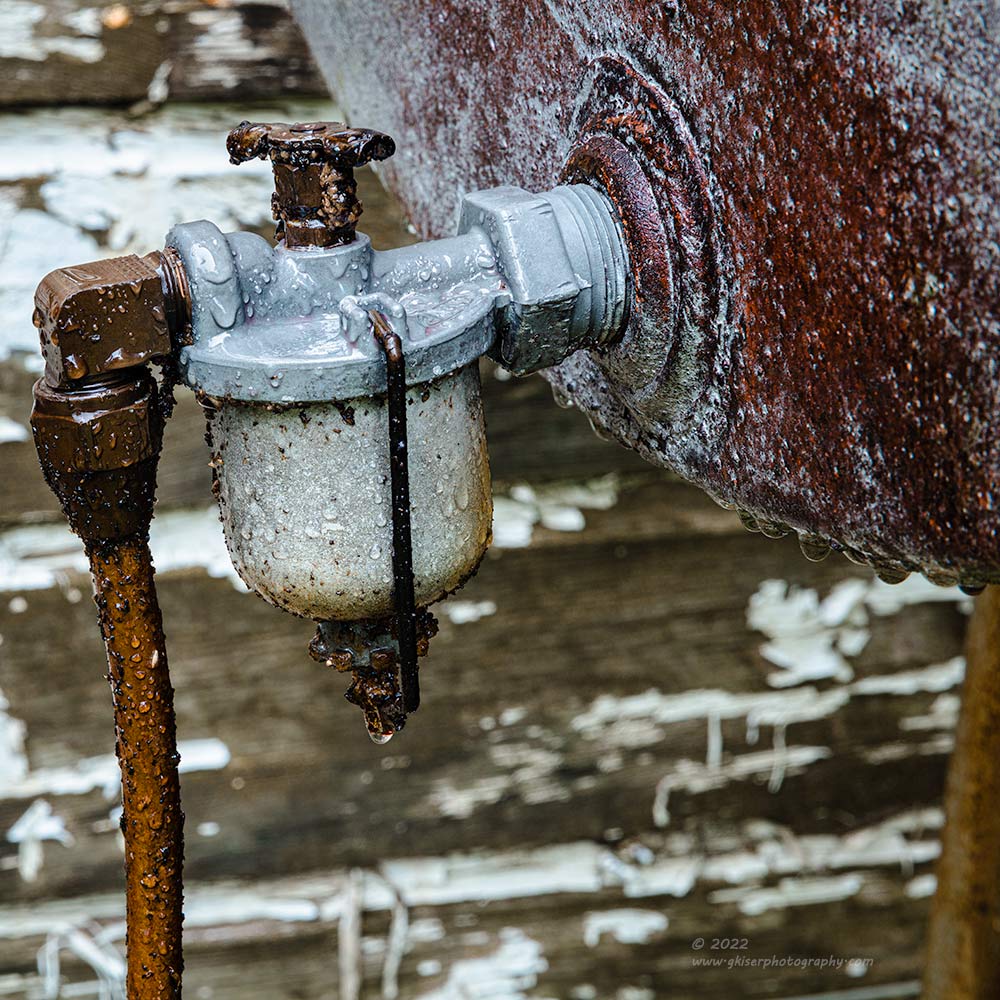
We were both getting set up for our shots and I started to get mine dialed in. It was on the tank set on the side of the house, and what drew me in was the fitting and what I assume was a water filter coming out of the bottom of the tank. It was still beading water from the morning rains which had stopped. I got the camera built with my 24-70mm lens because I wanted the near macro capability of it for this particular shot. I played with the aperture to get the depth of field that I wanted. I found that f/18 worked well for this without adding any diffraction to the image. I wasn’t sure if the background was too burred since I did like the textures of the paint, so I also did a three-shot focus stack that would show it all in sharp focus at f/8. I was able to show John what I meant by working the scene as I made very small adjustments to the exposure as well as composition. He was able to see the progression that I made with that shot.

While I was wrapping up with my first image, he called me back to check his composition on the chimney cap. He had come up with a strong basic composition and had leveled it correctly which was not easy to do from this angle. I made a few suggestions about framing changes which he liked, and we went to a square crop for the image. Now that he was on track for a shot, I decided to come back and join him with that composition that we had worked on. As a quick disclaimer, I was not sniping his composition as it might appear. The initial idea was mine for the basic composition and then I had helped fine tune his composition. By the time it was all done, I liked the image as we had built it and decided I would try my hand at it. I would never steal ideas from my clients, but I will freely give away compositional ideas to them because that is what a mentor does.
For this, I knew I was going to have to get a longer lens attached because he had been using a 24-105mm lens on a cropped body which meant I was certainly going to need my 70-200mm to get the framing that I was after. I made the switch of lenses and pointed out how easy it was to move the polarizer between the lenses using the Lee 100 system. Once I got the camera situated, I got it back on the tripod and started to compose the shot as we had done with his. I was a little further back, and the camera was a bit higher, but we were basically along the same axis for the shot. In order to get the background to appear softer than the house, I chose an aperture of f/4.5 that sufficiently blurred the background while keeping the sharp parts very sharp.
Since I had already worked out most of the details for this composition, it didn’t take me but a few minutes to get it nailed. I even tried a few with a horizontal, non-square crop that I didn’t like as good as this one. There were only a total of five exposures for this composition before I was ready to move onto the next location on the side of the house. While working with the tank on the side, I had noticed that there might be another use for the circular shape of the tank when composed with some of the other angular aspects of the house.
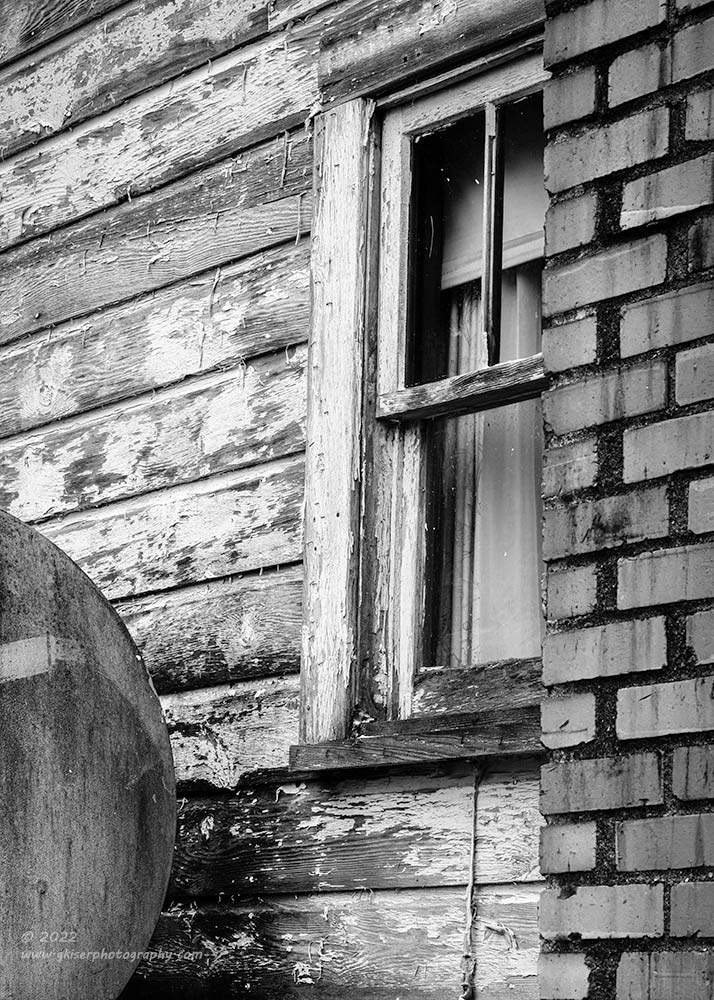
Part of what we have been working on has been subject/ground relationships and trying to get him to see shapes instead of objects in the frame. Looking at the side of the house, I was seeing all kinds of rectangles, squares, straight lines and then there was this one round object. The next composition that I worked on was purely to show how objects can be rendered as shapes in an image. I kept my long lens on for the compression that it gave me. I framed up the shot with the chimney on the right edge and a portion of the tank on the left edge. I angled the camera so that the window took up roughly as much room as the chimney widthwise. The elevation was established to get the perspective to line up as square to the house but shooting at an angle down the siding. As I looked at this, the window separated into three different rectangles, and the window treatments again formed even more. These vertical rectangles contrasted with the horizontal rectangles of the bricks, that shared an orientation with the siding boards. All of these hard lines and angles are grounded by the semicircle of the tank which was the driving force for this composition. The interesting thing was there was no single element that was shown in its entirety as even the window is partially obscured by the chimney.
I ended up with four frames of this example before I figured I had what I needed. It was the fourth frame that turned out to be the keeper. This was exactly the opposite from what I had done with the chimney cap shot. Out of the five frames I shot of that, it was the first one that was the keeper. I just never know how that is going to go, but I like to have options when I get home. That was one of the questions that came up during the morning as a matter of fact. He asked if he should bracket images with different exposures to get the right one. Since he is shooting in jpeg, that was a great idea, but even shooting in RAW, I typically capture several frames with slightly different exposure settings and tweaks to the composition. Things look different on the back of a camera than they do on the computer, so I do my best to have at least one good out of the series by shooting several variations.
Having seen this composition in practice, he decided that he wanted to give it a try. I helped him work it out and he was able to get his own version of this one. At this point, folks were starting to come into the parking lot of the church, and it looked like there was going to be a service soon. We contemplated our options and decided that we would go ahead and call it a day because he had a commitment later in the afternoon. I just confirmed that he had all that he wanted to capture, and we started to break things apart. However, before I packed it all in, I decided to shoot something on the front porch banister that we had both noted when we started. While I worked with that, he started to work on a section of the shed that he had liked.

I swapped out my lens for the 24-70mm once again and got in close to the banister looking for the most interesting area to photograph. I found the inner corner to have the most interest and I set the camera up to get the shot. It was a pretty simple composition and one that I was certain would be in black and white since there was really no color to mention through the image. I did an additional three exposures of this subject and started to break the camera apart. Once I got it all put away, I went over to John and checked on his progress. He was coming along nicely with his composition and had found the most interesting portion of the shed to work with. I helped him with a few tweaks, and he was good to go.
With those last two subjects shot, we went back to the vehicles and loaded them up. The mentorship session had come to an end. While this wasn’t as supervised as I would normally want a session to be, I thought that it was a valuable learning opportunity for him to see how I approached a new location. We went through all of the steps that I would go through in order to figure out how best to photograph it. We then split up to work on our own compositions while I was available to help out when needed. I wanted to make sure that my workflow was observed and how I worked a scene as well as evaluating how he worked a scene. I will try whatever I can to get the lessons across during these sessions. It hadn’t been the intended location, but that was also part of the lesson since the intended location might not always work out. There have been many times that I have arrived someplace only to have the weather not work for the subject, or in some cases, I haven’t been able to get access that I assumed I would have had. In any case, it is always good to have another plan in place so that you can continue on with your photography.
This was not a characteristic mentorship session because I can’t really recall a time when I have done one around an actual trek of my own where I was trying to get photographs. I’ve explained why I did it this time, but for those that might be considering doing a mentorship with me at some point, you should know that usually I don’t even bring the camera out during the time with my client. I am there for them alone, and not for my own gain. I encourage you to reach out to me should there be something in your own photography that you would like to improve on. You are also welcomed to join me on a workshop if you feel more comfortable doing that.
Even though the mentorship had ended for the day, I wasn’t quite done with being creative. When we got back out to Hwy 268, I turned left and went back to the Chapel of Rest because I still wanted to see if the ideas that I had would work there. Wouldn’t you know it that the gates were still closed shortly after 10am! I know I have an atypical though process with what is daytime, but I think that everyone can agree that daytime is 10am no matter what time of year it might be. Not wanting to waste any more time waiting on the chapel to open up, I started back towards Wilkes County to see what else I might be able to find.
On the way, I passed a cattle farm that I had seen many times over the years. Oddly enough, John and I had discussed that barn while sitting at the locked gate. He mentioned it to me as something that I might like shooting. I knew the exact barn that he was talking about because it had caught my eyes several times. As I told him, I hadn’t messed with it because there were a lot of power lines that would end up being in the shot, and the composition would be rather difficult because of the covered route between the two barns where the cattle were moved. At least that was what I was assuming it was for. I had considered it many times but had never stopped to try shooting it.
Just after passing the more interesting barn, I saw that there was a truck inside of the gate of the main barn with a couple of guys standing around. I didn’t necessarily need permission to photograph the barn since I was more than likely going to be able to get the shot that I wanted from the street, but it was nice to be able to ask. Just like that, I thought back to all of the difficulties with the composition that I had come up with and said to myself…”Challenge excepted!”

I got turned around and pulled into the parking lot for one last good look at the barn to see if it would work out like I was thinking it would. The sky was looking really good with the low clouds hanging there. I could make out just the slightest bit of detail in the clouds which I knew I would be able to really work out, especially in a black and white image. I was actually feeling pretty good about the composition I had in mind and pulled back around to go ask the guys if they minded if I shot a photo of the bar from the parking area. They didn’t have a problem with me doing that, and only offered a single warning about not touching the fence. I had been around the block enough times to know that they meant that the fence would touch me back if I did. I assured them that I wasn’t going to touch the fence and made sure that I wasn’t going to be in the way if I parked on the side of the parking lot.
I got parked and grabbed my camera. I didn’t bother with getting the whole bag since I was going to be pretty close to the truck. I just loaded up the 24-70mm lens which was going to have plenty of reach to get what I wanted in the frame. I added a polarizer, not for the sky, but for the tin roof. There was a good bit of glare on the roof that I wanted to cut through and that was going to be the filter of choice for that job. The exposure looked pretty even so I went with that. I got the shot framed up that I wanted and decided that the sky was still pretty bright. It was showing detail, and I would be able to pull the exposure down in post easy enough, but I wanted to get this closer to perfect in camera, so I ran back to the truck and grabbed a 3-stop soft ND Grad. After running back to the camera and sliding it in, I was happy to see that the exposure dropped for the sky allowing me to boost the shadows a bit, while retaining more detail in the sky. Thinking about how I would close in the image by darkening the sky a bit more at the top, I decided to run back to the truck and get a 2-stop soft ND Grad which was staggered on top of the other one. For those keeping count, I now had two different ND Grads, and a polarizer in front of the lens. You can’t do this with just any filter out there, but if you are using a top-quality filter such as Singh-Ray, you can stack them like this with no issues.
My first composition showed the barn in its entirety with the covered walkway leading into the scene. I was shooting between rungs on the gate in order to get low enough to obscure the clutter on the other side of the barn and that had an added benefit of covering a couple of the power lines as well. I liked the composition but felt that the face of the barn was too centered and static. As I was contemplating what to do to correct this, one of the guys I had talked with drove over to me and asked some details about my photography. We chatted about that and the workmanship that went into the building of the barn well over 70 years ago. I guess at this point he knew a little more about me and was comfortable enough with me to suggest that I could jump the gate and move the gate that was leaning up on the side of the barn out of my way. That was quite nice of him to offer, but I was quick to respond that I much preferred to shoot the scene as I found it. Honestly, the gate didn’t bother me at all because it didn’t create a distraction and actually added a bit of interest to that wall of the barn which I liked. After he asked me if I shot weddings, we parted ways. I’m still not comfortable shooting a wedding and doubt I ever will be.
I went back to the new composition idea that I had which was to go with a tighter crop and only shoot a portion of the barn which would move the face of the barn off of the center axis and give a bit more visual tension to the scene. The second I framed that up I knew that I had a winner. I repositioned the filters so that they addressed the sky the way that I wanted them to and shot another three frames on top of the eight that I had already done of the whole barn. The reason that I had done so many to start with was that I had found a spider web right in front of my lens that I hadn’t seen when setting the camera up. I only saw it when a small spider came into my field of view. Once it was removed, I had to reshoot what I had already done which wasn’t much. I was pretty sure that I had what I wanted, especially with the tighter crop, but I couldn’t help but think that I hadn’t even given my original composition idea from the street a try.
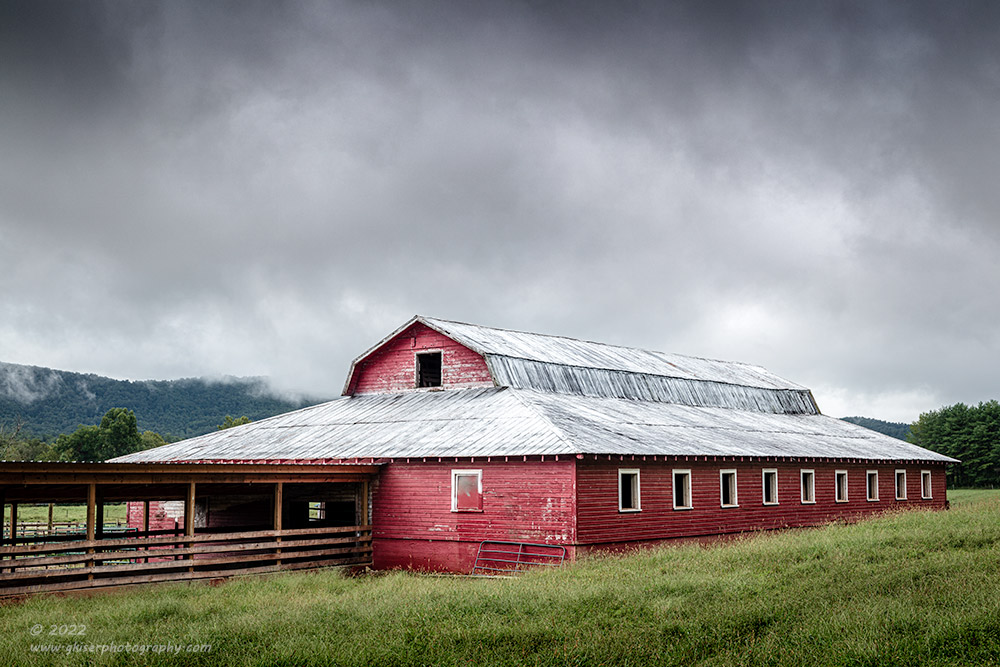
I went back to the corner of the fence and set the camera up once again. This time, I wasn’t going to be able to get down low because…well…electric fence. I did have the ability to elevate the camera over the fence though which worked just fine. I had more of the power lines in the shot from this location. There were six of the little buggers in front of and behind the barn. They weren’t something that I particularly liked, but at the same time I positioned the camera so that if I needed to keep them, they would work with the composition. Seven frames later, I had finally worked out multiple framing options for the barn as well as different cloud positions. It just so happened that it was my third exposure that got the win from this location.
As you can see here, I have included both angles of view, but have chosen to present one as black and white and one as color. I thought that both presentations were valid for this subject thanks to the color of the barn and the tone of the sky. I considered which presentation would be best for each because I wanted to do one in color and one in black and white. The final call because a matter of how the red was used within the frame more than anything else. I liked the full version of the barn in color because the red felt a little less direct and the fact that there were cooler tones in the midground mountains to balance the warmth of the red helped with the balance. I also liked that the red didn’t touch the edge of the frame which would make it a more dominant color. I did a conservative processing on the color image and then did an aggressive one for the black and white. The sky was my favorite part of the black and white version and I really wanted to make the sky very ominous to accentuate the one bright spot that it had positioned in the upper left third. In the end, I love both of these photos, and they are probably both my favorites from the day.
The irony isn’t lost on me that two very successful images came from a barn that I had not really felt inclined to shoot before today. Granted, this was the first time that I had conditions like this which I think really suit the barn well, but it was a composition issue that had prevented me from trying before. I guess since I was in teaching mode and opened up to more new ways of seeing things, I had a better chance of seeing this for the beauty that it was. It is very easy to get locked into a certain style and dismiss things that don’t quite match up to your norm. That is one of the reasons that I strive to introduce new types of photography into the mix often. By stretching my own visions, I am putting to use new skills and techniques that I can then put to use with subjects that have appeared more difficult to shoot in the past.

Feeling very accomplished at this point, I loaded up the truck and waded in a puddle of water to get the fresh grass clippings off of my shoes before hopping back in the driver’s seat. I was feeling pretty good about the day and would have been happy to call it a day after the barn. The clouds were starting to break up, but the sky was still looking awesome which kept me wanting to find more subjects to work with. I decided to go and check out the chapel one last time to see if it was opened up. At 10:45, the gate was still locked. It was official, I needed to look up the definitions of “Open Daily” and “During daylight hours.”
I was still on 268 and passed by a lone chimney that I had seen many times over the last couple of years. There had never been anything particularly interesting about it, but this time, I noticed a tone of yellow surrounding the base. This gave the scene something interesting to go with the stonework. It was that interest that prompted me to turn around and get the camera out. Of course, when I started to look at the chimney critically, I noticed a “No Trespassing” sign on it. Well, the grass was much too tall for me to both with wading onto the property for a photo. I had already loaded up the telephoto lens which gave me plenty of reach from the road. My thought was that I would just remove the sign in post even though it would be an intricate task to recreate the stonework. With that worked out, it was just a matter of finding a composition.
The most obvious one was a vertical framing since the chimney was tall. I did that first and found the composition to lack soul and interest. I flipped it horizontal to add some negative space and visual tension. This also made it possible to include the yellow flowers along the bottom edge and create a backwards “L” for a basic composition which I liked. I shot several variations of this as the sun went in and out. Before leaving the location, I shot a sign giving warning about a curve ahead since that yellow sign was surrounded by more yellow flowers. It was the color that I was after, but in the end, I didn’t like the photo because there was no story present. Maybe I should have worked with it some more, but the few frames that I had of it didn’t work so I trashed them.
Funny thing about the edit of this one. Remember I had planned on taking the sign out of the photo, but when I started to look at it for the story that was present, the sign actually played a part. I never even attempted to remove it because I think the sign added a very valuable element to the chimney as well as a little humor for the situation.
From here, it was time to head home. I kept my eyes out, but the sun was getting pretty strong and when it was out of the clouds, it was quite harsh. I was needing to get back so I could go through my images from the day and see how the barn turned out. I was also rather interested to see how my experimental images from the house ended up since I was shooting a little different than I normally would have for demonstration purposes. It wasn’t until I got to US421 that I had the urge to seek out something specific. I knew that there was a Ford truck off on the side of one of the dealerships that I had thought about photographing before. I figured that since it was Sunday, I wouldn’t be disrupting business should I decide to shoot it. It was less than a mile from the intersection, so it didn’t take but a minute to get there. When I pulled in, I went to where the truck was parked and looked at it. It was almost in too good a shape to photograph, and with another car parked in front of it, I was only going to be able to shoot isolations of it. I saw no isolations that I felt worthy for a photograph, so I abandoned that subject.
I knew of one more potential subject a short distance down the street in another business lot. I had stopped and tried to photograph it before when it was at the front of the business, but I never did like any of the compositions because there were too many distractions like advertisements for other businesses that would have been in the shot. I noticed that they had moved the car about a month ago, or maybe longer. It was now nosed in on the opposite side which would give me the ability to shoot the back end of it for a change. When I pulled into the parking lot, I noticed that a green later model mustang was parked next to it. Normally this would have been very unfortunate, but after the lessons that I learned in Boonville last month, I knew that I could use the green car as an analogous color to the bright yellow Falcon.
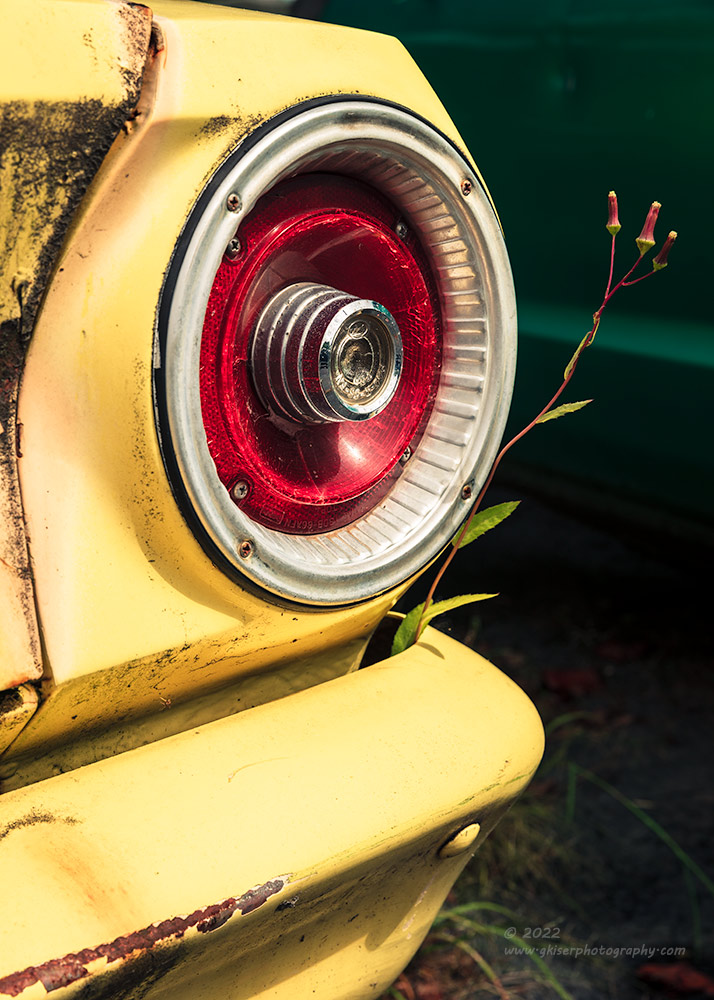
I went ahead and parked the truck and grabbed my camera without even knowing what I was going to shoot. I loaded up the 24-70mm lens which was my most flexible lens for this type of photography. There were a pair of ramps right behind the car that I had to work around because I didn’t want to disturb anything. I looked at what I had to work with, which wasn’t an awful lot. There wasn’t that much rust on the car, and the biggest points of interest were the taillights. The passenger side one was close to the green Mustang which I liked, and there was also a rather pretty weed growing up from the bumper which framed the light. The mix of colors with the bright yellow, the red, and dark green spoke to me. that was what I was going to photograph.
Looking at this like a subject/ground relationship, I started to place shapes within the frame. I used the panel line of the trunk to match up to the weed which put the light firmly in the center of the frame. I generally don’t like this type of composition, but it was what worked for the scene. I rotated the camera vertical to include the bumper for a chance of getting a little visual tension in the frame. I ended up putting to use another compositional theory that I had recently read about for this one. It is not really an exciting one, but it did provide a framework for placing an object that needed to be centered within the frame.
Once I was happy with the composition, I just waited for the sun to do its thing so that I could decide on the best lighting. I ended up liking the Falcon pretty well let by the sun because it forced the green Mustang into the shadows with just a bit of the color showing through for contrast. I also liked the shadows that developed which helped to define the shape of the car. After about 10 minutes I had what I needed and started to break the camera down again. As I was loading the last of the gear back into the 4Runner a car pulls into the lot and comes directly towards me. I’ve learned to expect this and sure enough they were representatives for the owner who was wondering what I was doing there. I explained my reasons for being there and that I was all finished before giving them my card. We had a pleasant conversation for a few minutes and when they were satisfied that I hadn’t messed with anything we were both on our way.
That was the end of my trek that had started before the sun came up. It was now right around noon, and I was pretty tired. I was about six miles from home and that didn’t take long to travel. Since getting home, I’ve been working on getting the edits done and the blog written while poor Toni was in her study room where she had been since not long after I left this morning. I’ve got to hand it to her, she is really putting in a ton of effort into this nursing degree. I couldn’t be any prouder of her and I can’t wait for her to graduate with her RN degree.
I hope that you have enjoyed the trek and the resulting photographs. As always, if one of these speaks to you and you would like a print, please let me know. There is nothing quite like delivering a physical print of one of my images to a client. No matter how good they might look on the computer, there is just no comparison to seeing them printed out, especially on my fine art Baryta Rag paper that fits my style so well.
Remember, if you would like to be a part of my mentorship program, I still have plenty of hourly sessions available. It will be after the New Year before I can take on another Advanced Mentorship, but if this is something that you are interested in, I would encourage you to start talking with me now and get on the list so that when a slot opens up you can slip right in. It is a lot of money, but I feel that you get a lot in return from these mentorships. It is the best way I’ve found to teach in a way that is as unique as the student. The goal is to improve your photography skills much faster than would otherwise be possible. If you are unsure if this is the right program for you, call me up and let’s discuss it. All consultations are free and there are no commitments. What have you got to lose…more importantly, what might you gain?
Until next time…

Remember to use the code KISER10 to get 10% off your purchase


