Tuesday, June 27, 2023
I’ll go ahead and put your minds at ease. I suffered no issues on this trek, and it was in a way quite boring after my adventures at Hawksbill a couple of weeks ago. If you happened to miss that blog entry, I’ll wait for you while you read about all the spills and thrills of that outing.
I’m sure at least somebody out there has considered that I was nursing my pride, or maybe found some damage that I had not mentioned after that last trek, since it has been so long since I’ve been here in the blog. Actually, just as I reported, everything was fine and there was no damage to any of the gear which I am very thankful for. The last two weeks haven’t been so much about my last experience as they have been about weather patterns and more house stuff. The weather has largely been a tale of two poles. Either it has been totally sunny, or a complete washout for most of that time period. Additionally, the entire last week was spent dealing with three stress cracks in the drywall of the house. These have now all been addressed, and I’ve put new paint on the walls. I think for the first time this year, there is nothing wrong with the house, and that is a relaxing thing since I’ve been chasing repairs since the beginning of the year.
During the last two weeks, I’ve been working on my next Behind the Camera which is due to be published in just a few days. It took me a little extra time to get started on it because I wasn’t exactly sure what to talk about. I have several topics in the wings waiting for the right time, but I wasn’t quite sure what I was in the mood to talk about. I guess the topic kind of played into what I ended up shooting on this trek because I forced myself to really look into my black and white photography. If you enjoy photographs without color, be sure to drop by on July 1st to check out the newest installment of that feature. Without getting into what I have discussed in that feature, I will say that this is a great preamble for it because I have gone out with the intent to create black and white photographs in one of those situations where I think that it excels…Bright light and high contrast scenes.
That was about all that I had figured out though. I knew that I was going to be looking at roughly 50% cloud coverage with the clouds mixed in the low and mid altitudes. I knew that both Linville and Laurel Springs were showing less clouds than that, with the main concentration being in the areas of Boone and Blowing Rock. That was about all that I had worked out by the end of the day on Monday. Through Tuesday, I was keeping a check on the weather and seeing that things were holding pretty steady with the clouds coming in during the afternoon and fading out before sunset. I’m still very much in my landscape mode which kept me wanting to stick with some more natural scenes. The plan was simple, Toni and I would go grab an early dinner and I would head up to the mountains around 5pm. This would give me the best mix of a lower sun in the sky while still having some good clouds. I was anticipating working with black and white captures almost exclusively after spending so much time thinking about the process. I was planning on landscapes, and I knew the general area I would be working in, but that was pretty much it. I had no compositions in mind, nor a specific destination.
When I left Purlear, the sky was pretty much devoid of clouds, and I was wearing my sunglasses which is usually a sign that it is too sunny for photography. I was itching to get some photos though, so I just crossed my fingers that the clouds were where the forecast put them. I arrived at the Parkway entrance off of US421 shortly after 5 and started to make my way South. It was a slow process as I looked for areas that caught my eye. Nothing was standing out, and the sky wasn’t quite right for me. I was looking for scenes with contrast and pronounced shapes which would work well with black and white. I just wasn’t finding anything at all.
I ended up passing by Old 421 and continuing through Aho Gap. I was about to enter into Blowing Rock and my last hope for a composition or two. I had a quick thought as I passed Aho Gap and recalled a location that I had wanted to shoot for a sunrise a while back. This attempt met total failure and resulted in a nice drive in the early morning hours with very little to show for it. In fact, there were no photos at all. The location has been on my mind for a while now though since it was the location of one of my Mom’s favorite photos from back in the day. I wasn’t liking it at sunrise, and I wasn’t thinking that it would look good at sunset, but with a sun still kind of high in the sky, I thought that it might be worth a second look this evening.
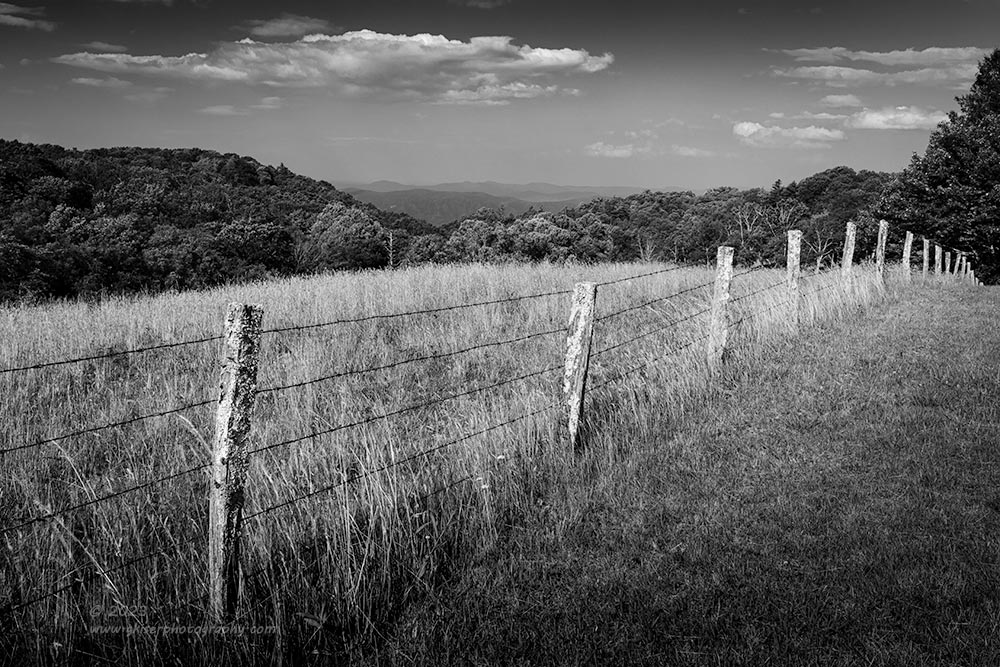
This little vista is near the Raven Rocks Overlook and it is easy to miss if you don’t know what to look for. These are my favorite kinds of spots to shoot because you just don’t see a collection of folks at these places. As I expected, there was nobody there except for me. I pulled off the road and started to look at the scene. There were some decent clouds, although not many of them in the distance. The sun was lighting up the tall grasses and the distant mountains were fading off into a haze. The scene was pretty, but there wasn’t much in the way of interesting color to the scene. That didn’t bother me at all because I wasn’t planning on shooting color during this trek anyway. I liked what I was seeing and felt that it was worth getting out to take a look through the camera.
I started to walk around to find out what angle I wanted to shoot and what lens I was going to need. I found a spot that was a little different than my last attempt here and chose my 24-70mm lens which ended up being used at 35mm. I got the camera set up with particular attention being paid to the height of the camera as to control how the fence posts broke the natural horizon of the field. I went left and right until the fence posts lined up right with the trees in the midground while the distant mountains were in a good location within the frame. Wait, you mean to tell me that you thought landscape photography was just a matter of pointing and shooting towards a pretty scene? Nope, all of the elements have to be arranged in an orderly fashion so that the photograph reads correctly and makes visual sense. Even after spending several minutes getting the right feel to the image, it still wasn’t correct. The last bit of fine tuning was going to have to be done at home because the direction of the fence made it necessary to flip the image horizontally to make it read correctly left to right.
I did shoot this scene with the black and white profile selected in the camera. This gave me the ability to see how the sunlight looked on the landscape, and I was even able to apply a red filter within that color profile. Of course, I was shooting RAW, so I was capturing a full color image, but it is handy to see how an image looks in monochrome. I added two filters to the lens to work with the contrasts and get me closer to the final image. These were a polarizer and an ND Grad filter. This allowed me to get as much contrast out of the sky as I could while making sure that I was able to take advantage of the sunlight on the field.
The rest of the time I spent here, which accounted for maybe 15 minutes total, was spent waiting for the light to change and the breeze to cooperate with me. I didn’t mind minor movement in the grass, but I didn’t want heavy blurring since I felt that the textures were very important to the final image. It really didn’t take long at all, and I ended up with several workable images from this set. As I worked on culling them, I found that there was only one that had the clouds in the right places to accentuate the distant mountains. After looking around for other compositions, I found nothing else that I wanted to work with. I did have what I felt was a solid first image in the bag though. It gave me hope that I was going to find more things to photograph a bit further down the road.
I wasn’t quite sure how much further down the road I was going to need to go in order to find my next subjects. I had some ideas, but nothing was really panning out for me. I considered the trail at Cone Manor, which I had only shot from once before. As I passed by, it looked promising with the way that the sun was providing some nice highlights on the ridges. I knew that it would only get better as the sun got lower in the sky. I had some time to kill and I wanted to take that time to see if there was anything else that I might want to photograph.
Another area that I had considered was by a red barn at the beginning of Price Park. There is a great little tree out there in the field that has been in front of my lens a few times now which I was interested to see. It wasn’t much further down the road so it would be a quick check. When I got there, there was really nothing interesting about the tree with the lighting that was on it. I also didn’t like the tree as much with full leaves on it. I decided to pass on the tree and see what Price Lake was looking like. I drove through there kind of quickly and found there to be nothing that jumped out at me. It was looking like Cone Manor was going to be the best option for the lighting that I had.
Most people know of the manor house which is also the craft’s store along the Blue Ridge Parkway. It has been lovingly restored over the years and it is a beautiful structure. I’ve photographed it a number of times, but I had no interest in that building this time. I was hunting landscape photos and I knew that there were a couple of nice locations near the house which I was hoping would work out for me. I got parked by the house and grabbed my gear to walk down to the trail by the horse barn. When I arrived there, I was reminded of how wonderful the trees were that lined the pathway. I could see off in the distance that the sunlight was giving some nice separation from the trees to the background. I might have stopped for the views across the street, but I knew better than to pass up a good opportunity that was in front of me in favor of maybe finding something better further down the trail.
I pulled off the bag and set the tripod up near one of the trees. I considered the composition for a while and even pulled out my cellphone in order to get an idea of how the composition would look. It was looking like my standard lens would be the way to go, and I adjusted the location of the tripod accordingly. After I got the camera all built up, I started to work out the composition in a more formal way. It was slow going and required me to shift positions several times before deciding that the composition just didn’t work at all. I didn’t even get to a point where I thought a test shot would be warranted. There was just too much clutter in the background for me.
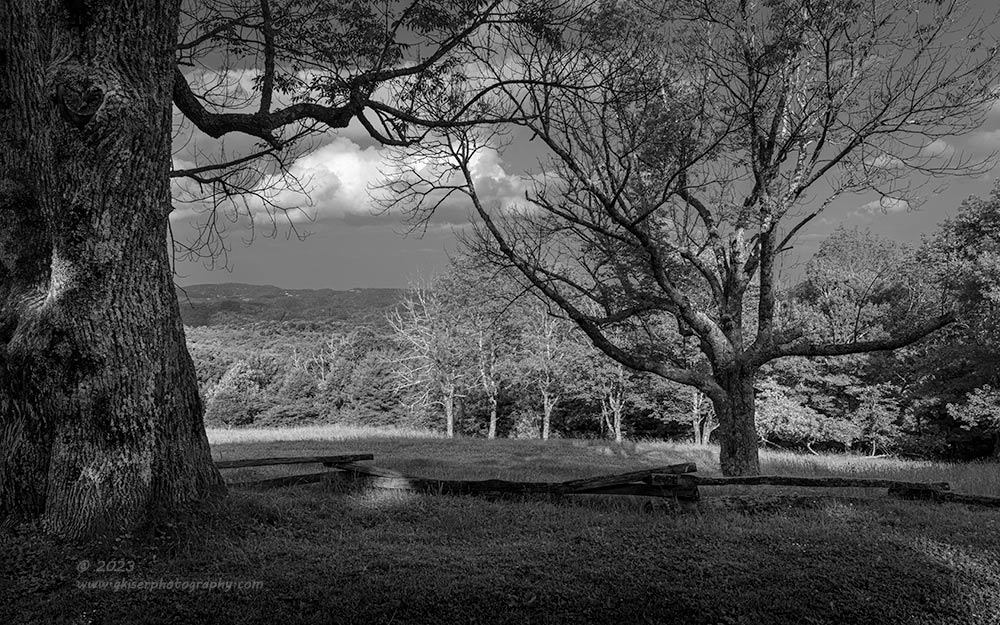
I didn’t pack the camera up though; I just moved to another tree and started the process over again. This was looking better, but there were still some major issues. I ended up doing a close crop on the larger tree which helped to give depth to the scene and context to another tree that I wanted to capture. I used them both to frame the distant mountains which was my background. This composition worked out so much better than the original concept, and I ended up committing to this location for a while.
I was still shooting with black and white in mind, and even had the camera set to show that in live view. However, the scene before me was full of major contrasts which was causing problems for the histogram. I loved the look of monochrome here, but I was losing shadow detail when viewing as a black and white image. In order to fix that, I set the profile to “Neutral” which is one that I have altered to give me a more accurate histogram for the RAW captures. This immediately removed the contrast, and I was able to add a stop of light to the exposure which lifted the shadows quite nicely. I was still planning on editing this as a black and white image, but I was having to shoot it in color in order to get the most information out of the scene.
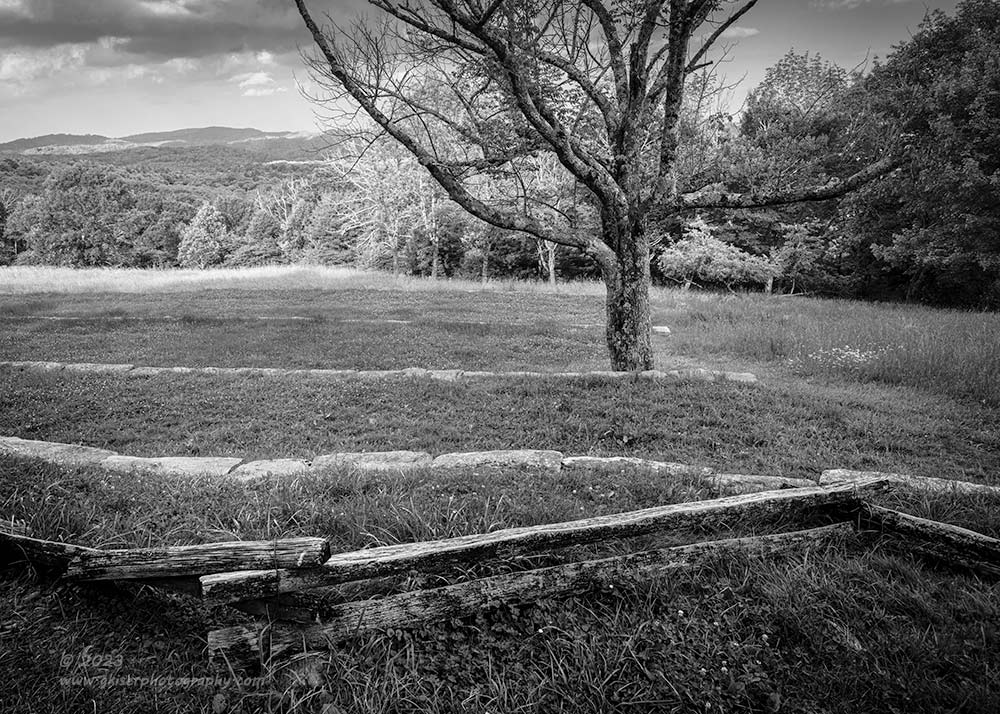
When I was happy with the composition, I decided to get in closer and remove the larger tree from the frame. It was the smaller tree in the midground which had caught my attention. I liked the way that the fence added a diagonal aspect to the scene and tried to capitalize on that fact by getting in close and shooting slightly down. The standard lens didn’t have a wide enough focal length to get the perspective that I wanted so I swapped out for my 16-35mm lens. This one did the trick allowing me to get in very close to the fence while still including a generous portion of the tree. The sunlight was still shining on the trees in the midground which gave me the separation that I needed for the main subject. Had they been in shadows, the tree would have just blended in with them. Ideally, the sun would light up the tree while a cloud forced shadows on the distant trees, but I knew that was a long shot. As long as I had visual separation between the elements, I was going to be happy.
Right about the time that I got the composition set up, I shot a quick test frame to check the exposure. I noticed that there was an additional element that I had missed getting the shot set up. There was a hiker that was standing just to the side of the tree on the level below. All I could make out were his head and shoulders. On the opposite side of the tree was his hiking pole and a bag. I quickly changed my position to mask as much as I could with the tree. When I finally got to a good point, I had to wait for the sun to come back. When it did, the hiker had come back into full view on the left side of the tree. He was now sitting though which meant that he was probably going to be still for a while. I repositioned again and used the tree to block him, but now I had his bag in full view to the right of the tree.
I continued to play this game with the hiker for much longer than I care to admit. It was a game of inches as the sunlight moved across the scene. Every once in a while I would be able to get the right light with the hiker out of the way. I had decided to deal with the bag in post as it would be the easier of the two to erase. It was just a matter of making sure that the hiker was fully behind the tree and out of sight. It took me a while to get this one worked out because of the hiker, but I finally did get a couple of workable images.
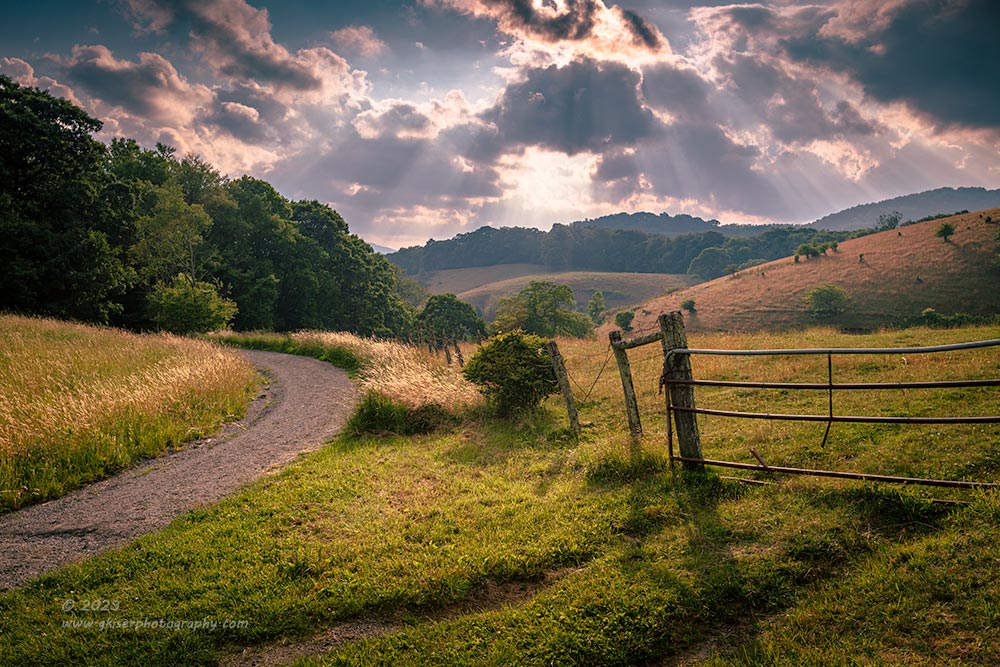
I had grown tired of working the trees because of foot traffic in the area and had decided that it was time to move on down the trail to where I had seen the sun dancing across the ridges. It was not a far hike by any stretch, and I was there in minutes. Right when I crossed through the tunnel, I was met with a beautiful scene complete with sun rays coming through the clouds. There was a gate and a gravel path which formed a nice little fork framing the distant hills and the sunlight. This was too pretty to pass up, but I knew that it was going to be a difficult capture.
What I had to take into consideration was the high contrast of the scene. It was going to be perfect for black and white but was going to introduce a lighting scenario that I don’t really like working with. I will rarely shoot in the direction of the sun when it is at this point in the sky. It is nearly impossible to prevent lens flare, and while I do like that look with portraits, I find it very distracting in landscape images. The high contrast from the back lighting was really great though and it prompted me to give it a try. I had to work out a composition first though. That was a matter of making sure that I didn’t get the trail sign which was right at the intersection of the trail. There were also two cows just beyond the gate which I didn’t want to have to deal with. In order to get the perspective that I wanted; I was going to have to go pretty wide which meant that I once again turned to my 16-35mm lens. Since I was shooting into the sun, I forwent the polarizer because it would have limited used in this direction. I was pretty sure that I was going to need some grads though, so I kept the bag open as I set the composition up.
I found the composition pretty quickly and just spent a few minutes willing the cows to continue moving to the right, out of the frame. While waiting on them to move, I was looking at the live view. I didn’t even need the histogram to see that the scene was much too high contrast for me to capture in a single frame. With the breeze, I didn’t want to try for an HDR blend and knew that filters would be my best bet. I started off with a 2-stop soft edge filter which made a good bit of difference, but the sky still lacked the body that I wanted. I slid in a 3-stop soft edge as well which seemed to do the trick. The histogram looked promising, but not ideal. I was hoping that I was going to be able to get enough of the shadow detail out of the file to make the image work. I exposed so that I was a 1/3 of a stop overexposed, clipping the brightest highlights. It was working, but barely.
In order to keep lens flare at a minimum, I used my hat and extended my arm out in front of the camera right to the edge of the frame. I had a few shots with my hat poking into the corner, but I had more where it was out of the frame as intended. There was still a bit of lens flare, but it wasn’t nearly as bad as it could have been. The end result was an image that I was rather impressed with. It was certainly not an image in the style of Greg Kiser as we have come to know it, but it carries with it a sense of who I am as a photographer. I do like the contrast of light and shadow here, as well as the rays of sunlight. There is a lot going on here, and to have found the composition so quickly while the light was changing was a stroke of luck.

Not wanting to push my luck, I decided to pack things up and go on down the trail to see if there was anything else that might make a good photograph. After loading everything back up in the bag I started on my journey. It was going to be a very long journey, uphill before I found my next spot. I’m kidding actually because I might have walked 100 feet before I found my next composition. Just as I had seen developing from the Parkway, the light was sculpting out the ridges in the field. This was what I was wanting to capture. The composition that I was needing to shoot in order to avoid including the little building in the frame, was going to pose a little bit of a problem for me. You see, I was going to need to use the 70-200mm lens. This is the second generation version of that glass which is usually a fantastic piece of kit, but it does have a well documented issue when shooting into the sunlight. The coatings on the lens don’t prevent lens flare nearly as well as they should. It wasn’t until the third generation of the lens that they fixed the issue. This is not something that has every really caused me issue because I rarely use that lens to shoot anywhere near the sun. Today was going to be an exception it was appearing.
I pulled the camera back out and loaded up the telephoto lens. I found my composition and then looked at the exposure values. I was in a similar situation as I had been with the last composition in regards to very high contrast. I started out with a 2-stop hard edge filter since the horizon was basically flat. I then added a 3-stop soft edge filter to gradually blend in the effect. The combination had the same success that I had achieved with stacking the filters in the previous composition.
I started making exposures at this point and was liking what I was seeing. As I was looking at the images, I noticed what appeared to be a very bright tree in the lower left. I zoomed in and found that it was lens flare. I didn’t have my hat far enough forward to block that light from hitting the front element. I adjusted my hat position and found that I was able to get rid of that bit of flare. I was still seeing a bright corner upon review of the newer images. Again, it was flare which I had to address. I repositioned the hat once again while using the DoF preview button to confirm that the issue was handled. I then shot a series of images as the lighting changed across the scene.
With a tired arm from holding out the hat several feet in front of the lens, I was content to call it a day for this composition. I felt pretty good that I had something workable out of the batch. I broke the camera down and continued up the trail for another 100 feet or so. After that point, I felt that there wasn’t going to be much else to photograph. I was recalling what I had seen out here before, and really thought that I had the best of the area right here at my feet. I turned around to head back to the manor to see if the trees over there were looking any different now.
Before I could get into the tunnel, I noticed that there was another photographer doing a portrait shoot in some of the tall grasses to the side of the tunnel. Not wanting to get into their shots, I decided to hang back for a bit and see if there was anything else that I might want to capture. I spent some time looking over the field that I had been working to see if there were any other compositions to be had. I didn’t see anything that would be appreciably different from what I had done already. I just looked around and enjoyed the light, but when I looked towards the tunnel and thought about what was on the other side, I decided that I actually liked the look of the tunnel. It would make for a perfect black and white image if I had ever seen one.
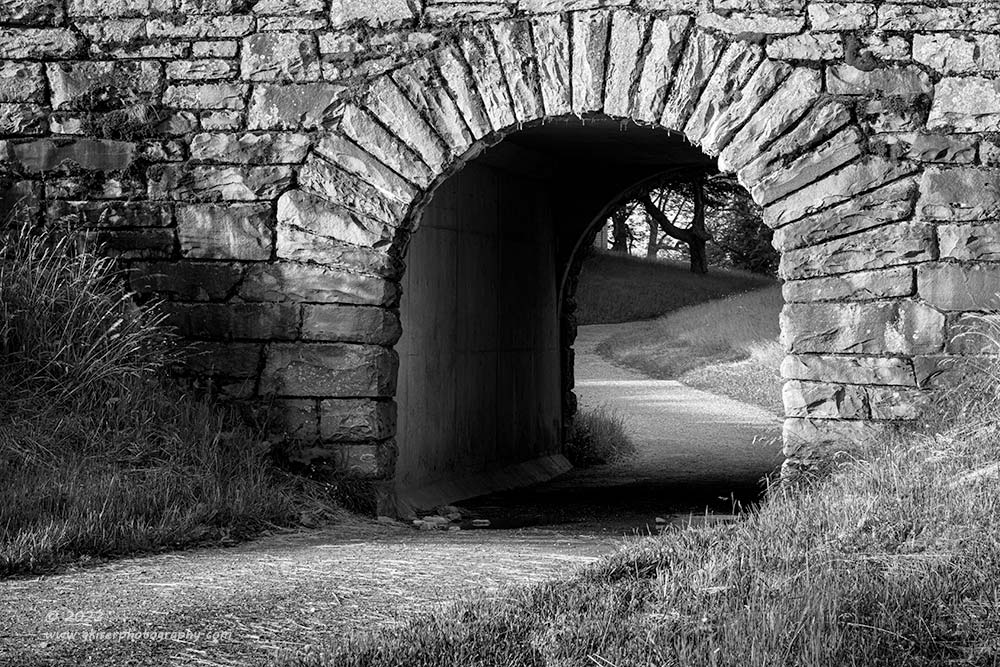
I started to explore the angles of the old tunnel in an attempt to find a composition that I liked. The trail continued through the tunnel and came out on the other side in an “S” curve that I loved. That curve led my eyes to a forked tree which I thought was reward enough for following the trail visually. In order to get this composition to work out, I was going to have to go with my long lens once again. At least this was a situation where the lens had no optical problems.
I moved around until I found a spot that I thought might work out. It was an awkward spot to be sure because the camera was going to have to be basically positioned atop a ditch. I set the tripod out with the legs splayed out to stretch to the sides of the ditch. It worked well and allowed me to position the camera right where I needed it to be. I mounted the camera with the long lens and fine-tuned the composition. Since there was water in the tunnel, I added a polarizer to darken that water to make it look more like a shadow than a puddle. I then did the all too familiar task of waiting for the light to do something interesting.
The process didn’t take all that long at all and before too long I was capturing images that I was very excited about. I did a few slight movements to the camera in order to change some of the relationships between the elements but was generally quite happy with how this one was going. Once I found the right angles and composition, I realized that there wasn’t much moving in this scene, and the light was pretty stable. With that in mind, I decided to pack it up and move on. The portrait shoot had moved to another location, and I was free to walk on through the tunnel.

After making to the other side, I remembered seeing an old house off on the side of the trail behind some trees. I decided to go and check that out since I was here. I went off the trail, down the terrace levels until I got to the field where the house was situated. It was obviously vacant and in a state of decay that I found rather beautiful. The light was good on it since it was largely in the shadows. The grasses around it were in some instances waist deep which was going to make for some interesting foreground options. I just had to work my way to a good angle on the house before pulling the camera out.
The angle that I decided on was a quarter view of the house, but I had to watch for the outbuilding which was behind the house. I positioned myself in such a way that I could frame the image with the building just out of the frame to the left. I wanted to include a tree to the right, but that was going to involve opening up the composition too much and the house would be thrown out of balance in the frame. I reduced the overall framing and found a better visual balance to the scene.
My instinct was to leave more space at the top of the house than at the bottom, but that forced me to include more trees than the grasses. It was the grasses which excited me the most, so I placed the house at the top of the frame so that I could get more of that wonderful texture to the image. I purposely tried to drag the shutter just enough to show a bit of movement in the tall grass, but not so much as to lose the textures. Since the scene was in the shade, there wasn’t any variation on lighting here, so it was really just a matter of tripping the shutter with each breeze to make sure that I had something that would work. I really didn’t stay here long at all. I wasn’t even sure that I was going to like the photo or not. It was really just a matter of shooting it since I was here, and it had been a while since I had shot an old home like this.
When I was satisfied that I had what I needed, I packed up yet again and made my way back to the truck. The clouds were starting to fade out and I was getting tired. If I were to have any chance of getting the images edited and a blog done before bed, I was going to need to get a move-on. It had been a pretty great evening with 117 frames shot. Of those, I had seven keepers which might not be my average 10% hit rate, but considering I was playing with light and breeze, it is a very respectable hit rate. I ended up with several photos that I don’t normally shoot so I had some good learning experiences with those. I managed to get quite a few black and white photos captured, and the ones that ended up in color were done that way because the colors helped to set the tone of the photo and hopefully help with an emotional reaction. The decision between color and black and white is not always a simple one, but I’ll get into that in much greater detail in a few days. Stick around for that Behind the Camera.
As always, if you like the photographs here, consider purchasing a print for your walls. There is just no better way to enjoy a photograph than to see it in the intended form. There is just no substitute for a physical print when it comes to photography. If you would like to step up your game with photography, consider joining me for a mentorship session. I offer both hourly sessions as well as advanced mentorships. Teaching photography is something that I have come to really enjoy, and pretty much, without exception, my clients have learned more than they bargained for when enlisting my services. Let me know how I can help you in your own journey.
Thank you for joining me on this trek. I hope that you enjoyed reading about it as well as seeing the photos. I hope to return here early in July with some more new photos for you. I might even try out a different format that I am playing around with after doing this last Behind the Camera which you will see published on Saturday.
Until next time….

Remember to use the code KISER10 to get 10% off your purchase