Tuesday, June 16, 2026
Welcome back! I’m going to keep this blog entry a bit more positive than the last one, but I did want to thank those of you who have reached out to check on me. It is much appreciated. All of that has just been weighing on my mind for a while and it reached a boiling point of sorts with some other things going on. It is far from resolved, but I still do have to get out there and do my photography both to keep my portfolio growing and to keep my skills current while avoiding spiritual stagnation. That is a term that was used in an email to me recently that I really liked.
At any rate, I had some time to fill and saw that there were supposed to be good clouds through most of the morning which made me start to think about doing some photography. I just didn’t really have a plan of what to do or where to go. With the clouds in the upper atmosphere, doing some landscape photos seemed to be a great option, but I really didn’t want to get up quite that early. By early, I am talking roughly 3:30 in order to get anywhere good in enough time to get in position for first light. That is just not something that I am wanting to do for something so cliche as a sunrise photo. I’ll wait until sunrise happens a little later in the morning or I have a specific want to shoot a particular location. I was just spit balling ideas at myself and that wasn’t a good enough reason to get up that early.
Some other ideas that I had was an old car that I shot back in the Winter under a dusting of snow. There had been some compositional difficulties with the bare trees, and I thought that with the trees in full Summer swing, that might not be the case. There was also a Chevy truck in McGrady that I wanted to shoot and had failed a couple of time due to the sky not cooperating when I had the time to go out there. That was two different locations that were in the same direction and could make a good start to the day. I also thought about an old Dodge flatbed truck that was close to the old car that I was wanting to photograph. This Dodge was something that I had considered many times in the past but talked myself out of it because of a combination of power lines and lack of meaningful surroundings to help compositionally. I doubted that I would stop here, but it was worth another look if the sky was looking good.
I didn’t really need to get up early, but I was awake after Toni left for work. I went ahead and got breakfast and started to look outside. There was still some residual color from the sunrise which was apparently pretty good. The texture in the clouds was good enough to prompt me to get rolling so that I was sure not to miss the potential that the sky was offering. I grabbed my shoes and the camera and I was off before 7:30am.
The sky was looking great, but the clouds were not as thick as I was expecting which meant that I was going to have to deal with the sun at times, but that just gave me some extra possibilities with the lighting during the morning. It didn’t take me long to get to the old car which was parked at the side of the road at a four-way intersection. Things had changed dramatically since I had seen it in the snow. First off, the trees that were at either end of the car were now very full and obscured both ends of the car. I could also see where the car was situated on mulch as a piece of yard art. I could have dealt with the mulch, but the trees were going to be more of a problem than they had been before. I could already see that one of the compositions that worked with the car was not going to happen and based on how I knew the angles to look, I was quite positive that the other composition wasn’t going to work either. The trees were just blocking all that was important with the car.
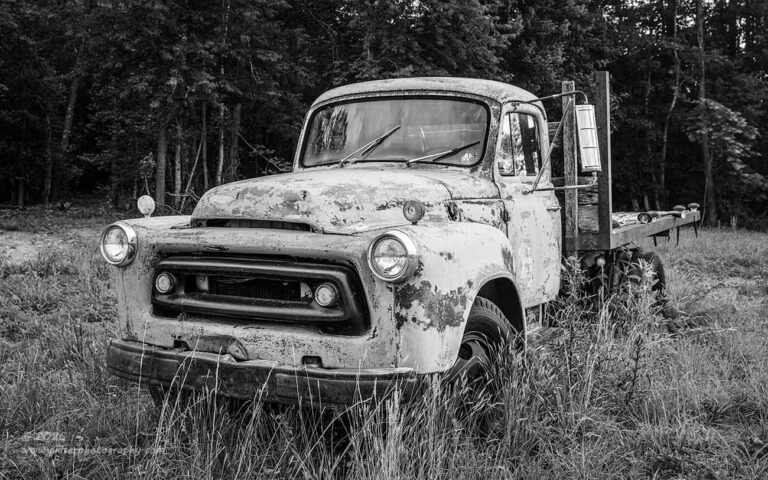
Sadly, I abandoned this spot and started to make my way to the Chevy truck which I was pretty sure would work out. Since I was going by the Dodge anyway, I pulled off to check on it real quick while on the way. It was sitting there under the power lines as it always had been. There wasn’t anything particularly special about it, but it was something that had been eating at me for well over a year now. I had looked at it every time I had driven by and had a long discussion with myself about how I would shoot it. I usually just gave up because the answer was to shoot it like a post card since there wasn’t really anything else of consequence around it to add to the composition. This time, I was feeling different about it. It might have been the fact that what I thought was going to be the first photo in the can had turned into a no-show. It might have been the fact that at some point this truck was going to be gone, or there would be some other clutter around it. It might have been the fact that I was in a mood where I just didn’t care about things all working out. I mean I had thought about this truck for a long time now and had never actually gotten out to try and photograph it. I had nothing to lose for trying, and even though I was well into the process of talking myself out of it, I decided to actually give it a try to see what would happen.
I pulled off on the side of the road opposite from the truck because the only way to get off the road was to pull into a driveway that would start to look kind of suspicious. Not wanting to draw any undue attention, I just kept the truck away so that it didn’t look like I was stealing anything from the Dodge. Looking at the scene, I figured that my best option for a lens was going to be my standard zoom because I wasn’t going to be able to avoid the power lines with the wide-angle lens, and I didn’t really have the room to use the telephoto lens without falling down the embankment.
Once I had the camera built, I walked across the street and through the field to get to the truck. I took a few minutes to walk around it and figure out the best light and background. While the sky was great, I wasn’t able to use it because of how the power lines were. The light was also better on the side that put the trees in the background which turned out to be how I shot the truck. As I had figured, the best course of action to start with was the postcard shot. This is where I just center the subject in the frame and release the shutter. Other than getting the angle on the truck right, there isn’t much to this kind of photograph which is why I don’t like to do them all that often.
Since the truck was a faded red and the surroundings were all green, I felt that black and white was going to be the best presentation for this composition. It would help to focus the attention on the shape and textures of the truck without the red overloading the senses. It would be very easy to work the tonal variations with the colors being on the opposite end of the color wheel, so that was a huge plus.
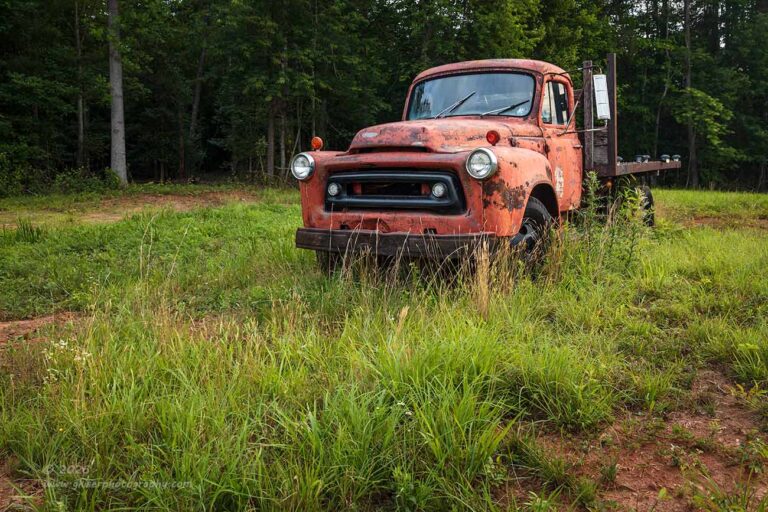
The photo felt a little static though, and I wanted to improve on the composition. There was nothing around that I could add in, but there was plenty of grass for a foreground filled with texture. There was also a tree that stood out to the left of the Dodge which I liked for a bit more depth to the scene. I backed up and went wider on the lens to capture more of the scene. It felt a little obvious to use the rule of thirds here, but that was what worked for keeping a bit of visual tension. Eventually, I did work the composition down to something closer to the golden spiral which felt better overall. It was still a very basic composition, but one that I felt was effective.
The biggest difference between this and the postcard shot was the amount of green in the frame as compared to the red. The wider-angle shot had more green which changed the color balance in the image. It worked better in color because it wasn’t nearly as in-your-face as the closer composition. After shifting the red more to the orange hue, I was able to get a very harmonious color pallet in the frame which worked very well. I now had a color and black and white photograph for this subject. That made me very happy considering that I had missed out on the first location completely.
I now had something to show for going out with the camera and was feeling better about the day. I had shot a single isolation of the truck, but it failed to really interest me because there was just nothing there as a visual anchor and no real draw to the photograph. I took my handful of images and went back to my truck to pack everything away. I was now on my way to the Chevy that was not too far from where I was now.
When I got to the Chevy, the grass and weeds were up to hood-level which really worked against the compositions that I had planned for the truck. There were other vehicles parked around it which were going to cause problems as well. The only way to really shoot this was to get in close to it, but the grass and weeds were probably too high to make that a realistic possibility. I was going to need permission to get on the property since it was all behind a fence. The shop that shared the lot was not in business and I saw nobody around to ask about the truck. With the sun kind of harsh on the scene, I decided that I would leave this until later in the Fall when the vegetation started to die back down again.
If you are keeping score, I set out with two locations in mind with a third which would probably not work out. I had now been to all three of those locations and the only one that had yielded any photos happened to be the one that I really didn’t think would work out at all. The two that I was pretty confident would make good spots turned out to be a bust. It goes like that sometimes and I just have to roll with it and go with what I find that works.
I was now looking for something else that I might want to photograph. The only thing that really came to mind was a Ford Galaxie that I had shot a while back. I had been by there recently and saw that some of the stuff that was parked around the car had been moved leaving only a single tractor trailer to the driver’s side. That opened up a lot of options about how to shoot the car that I hadn’t had before. The problem was that I didn’t want to get pulled into a very long conversation with the owner again. It wasn’t that I didn’t enjoy the conversation before, it was just that I wasn’t really in the mood to chat and the light was not going to last all that long. With how the scene was laid out, I was pretty sure that I could get the shot from the road and not have to ask permission. It was a good enough plant to head to the South where the car was.
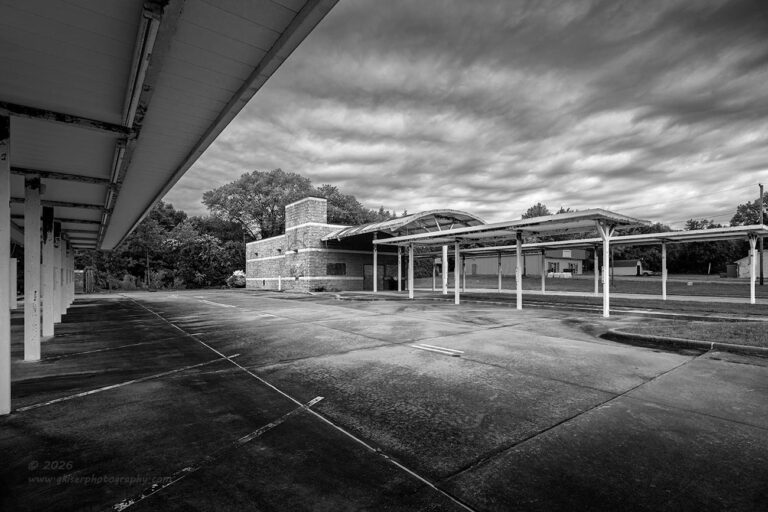
As I was going down the main road, I passed a spot that I image used to be a Sonic or something similar. I had tried to get photographs of this spot before and the best that I could muster had been an abstract of how the roof sections came together. I always look at this spot when I am driving by because the shelters for the car are actually quite interesting. The main building is boarded up and basically just a block made of bricks which makes it a little less interesting. There is just something about it that has always caught my attention. Since I was still in that mood that had prompted me to get out and photograph the Dodge truck, I decided to pull off and start working the scene to see if there was something that I might like that would fit in the camera.
I drove around the building at first to see what angles there were to work with since it had been a while since I’ve looked at it critically. As I was afraid, there was nothing there that really jumped out as a workable photo because on one side was a bank and the other was a commercial building. I really wanted to try and isolate this business to make it stand out in the frame better. It was looking like I was going to be driving on from here as well, but there was something that caused me to pull into a parking space and get out to look even closer.
I parked in a place that I figured would be out of the way and got out to look at both sides of the parking lot. I tried to use bushes to block the buildings on either side, but that wasn’t working out very well at all. I tried to get in close to see what a wide angle would do and tried to move back far away to see what a telephoto would do. Every option had extra buildings involved, but I was really kind of liking how the main building was looking in terms of the lighting and angles that I was choosing. It was worth getting the camera out and put together to see what I could come up with.
The lens that started out on the camera was the standard zoom which would give me a better understanding of where the best focal lengths might be. I used that lens and walked around zooming in and out in an attempt to find the right place to put the camera. I found a couple of spots that seemed to work and tried a few frames. They were fair but felt more like a real-estate photo than an artistic representation of the scene. It was boring from every place that I had shot it. I did find out that l preferred the left side of the parking lot because of how the roof structures looked. That was where I started to put more of my effort.
The plat was to walk around to find the best spot where I had something in the frame to help balance out the overall photo and help take the attention off of the buildings in the background. Since it was the shelters that seemed to interest me the most, I started to think about how I could include the shelter that was on the left side of the lot. I hadn’t intended on using this part of the property and had parked at the end of that shelter where I had thought I would be out of the way.
As it turned out, the more I explored the options, the closer I got to my truck until I was right at the front fender including a portion of the shelter to the left and the vast majority of the main structure. As it turned out, I didn’t have enough in the standard lens to capture the scene as I wanted it. I swapped out to the wide-angle and went back to the spot right at my truck fender. This lens was giving me a much better look of the scene and I liked the framing. The best part was how the parking lot was looking with the natural vignetting and the lines that appeared on it. Since color had very little to do with the scene, I was happy to look at this in black and white which is how it ended up being processed.
Considering how long I had known about this spot and how many times I had looked to photograph it; I was very impressed that I finally had a photo of it that I liked. Of course, I think it was the sky that really set the mood here, but the addition of the secondary shelter made the composition. It all really came together and while it is a bit busier than what I would normally want to capture, I’m quite happy with how it turned out.

As I was wrapping things up with the old restaurant, I was looking across the street and realized that there was an old house which was starting to show signs of decay. There was a sign out front indicating that the property was going to be sold for commercial property which meant that the house was going to be gone at some point very soon. There was the proverbial Dollar General right beside it, so there was a good change that they were going to buy that land and put up another one since there were only two Dollar Generals within a couple of miles on the same road. There obviously needed to be another one, and I hated to see this house go away in favor of that addition. Since it was looking a bit decayed with a sagging awning and vegetation growing all along the rear of the house, I figured it was worth taking a quick shot or two just because.
I figured that the wide-angle lens was still going to be the right choice, so I kept the camera built as it was and crossed the street. Much to my surprise, they hadn’t started building the new Dollar General in the time it took to get over there. I wanted to photograph it from the right, but there was no way to do that without including the existing Dollar General in the frame. I had to move to the left which left me with a slightly less interesting view of the house, but a much better view of the sky. It was easier to block the view of the neighboring house with the main subject while keeping the third house out of the frame to the right. The composition looked really good in the camera, and it only took a few frames to really dial in the overall look of the photo before I was happy with what I had captured.
There was no real way of knowing if the photo was going to come out the way I had envisioned it just yet. The lighting was very contrasty, so most of the house was looking like it was in shadow in the image review and the sky had very little texture to it, but nothing was clipped with was fortunate. I knew that I would have to see how the processing went before I could make a call on this photo. I felt good about it based on the histogram and when I got the images home, I found that this one checked all the boxes with great detail in the sky as well as in the house itself. For being almost an afterthought, I really do like this photo and am very happy that I chose to take a moment to get the shot.
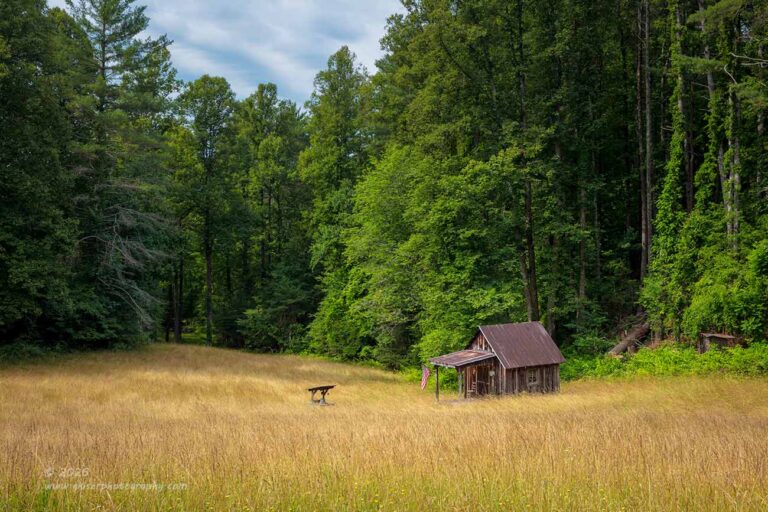
Now that I was finished with my little side quest, I decided to head back out to the Ford to see if that was something that I could work with in the light that I had. As I was driving South, I remembered passing by a little cabin that I had shot shortly after moving out to Wilkes County and thinking that it was looking really good with the tall grasses growing up around it. I could kind of remember how the photo looked that I had captured in 2020 and knew that I had shot it with a long lens. I was kind of feeling like I wanted to include more of the surroundings this time after remembering how it looked a few days ago when I had driven by it. It was certainly worth a look to see if I could improve on what I had captured before.
The location was just a few minutes out of my way so there was no problem stopping and checking on the way. The light was looking good on the little cabin when I drove by again and I was almost immediately happy that I had thought about this as a subject. Once I got turned around, I pulled off on the shoulder and started to look at the angles that I could use. There was no doubt that I wanted a broader view of the location which I really wanted to have including the clouds. The problem was that I didn’t want to shoot so wide that the cabin got lost. It was very small to begin with and at the distance that I was having to work, I knew it was going to be a tight balancing act to get the scaling right.
Once again, I pulled out the standard zoom because I knew that I wasn’t going to go very wide at the distance I was sitting. The telephoto wouldn’t include all that I wanted to bring into the scene, so I was left with this one choice. Once the camera was built, I moved as close as I could articulate without figuring out who I needed to ask for permission. I tried several different framings until I found one that I liked and that I felt offered a good overall scale to the scene. I was able to get a section of the sky which balanced out the cabin quite nicely and the grasses gave the entire frame a nice, soft look which helped the cabin stand out a bit better. I especially liked the color contrasts between the yellowing tall grasses and the trees which added just another level of contrast to the frame for more visual interest.
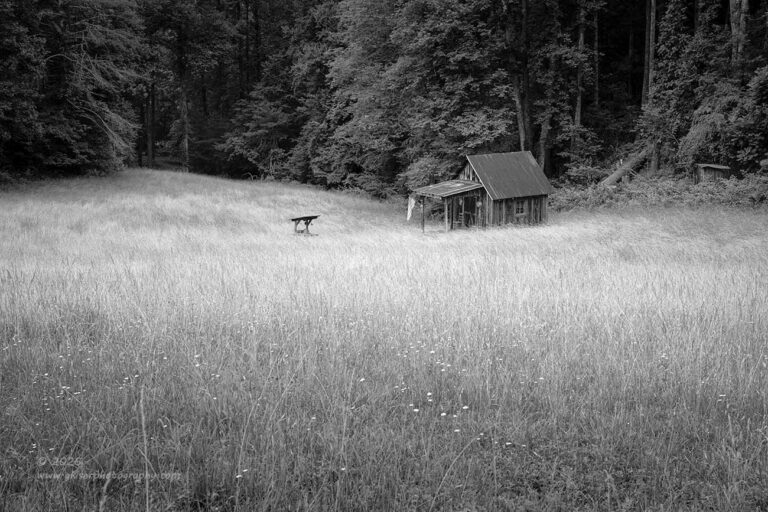
I hadn’t really wanted to do a closer-in crop as I had the last time with the long lens, but while I was here, I felt that I owed it to myself to exercise all the options that I could. I didn’t go to the extreme of using the long lens, but I did find a nice crop that had some breathing room around the cabin. This was kind of my safety image in case the contrast between the sky and the cabin was too much to pull all the detail out that I wanted. This was going to be much easier to expose, and I felt gave just about as much of a sense of isolation as the wider shot did.
It was that feeling of isolation that I wanted to capture the most. With the size of the cabin and the expanse of the field, you really get the idea that there is nothing around for a long way in any direction. Of course, that is not the case, but the photos would indicate that which does a fantastic job at setting a mood and tone for the image. Since the closer crop didn’t have that same expanse going all the way to the sky above, I chose to add to the atmosphere of the composition by removing the colors. The black and white seemed to give another type of isolation to the little cabin and made it feel just as alone as the wider, color image. The difference in tones between the grass and the trees came in very good here as well with giving contrast to the scene without needing a sky to do it.
There was no reason to hang out here any longer than this because I wasn’t able to comfortably get any closer and this was pretty much the angle that I felt was the best. The only thing that I could do was adjust the framing which I had done over the course of several different frames. There was no doubt that at least one of those frames was going to be a keeper. I was really happy to see that two of them turned out good enough to hang onto.
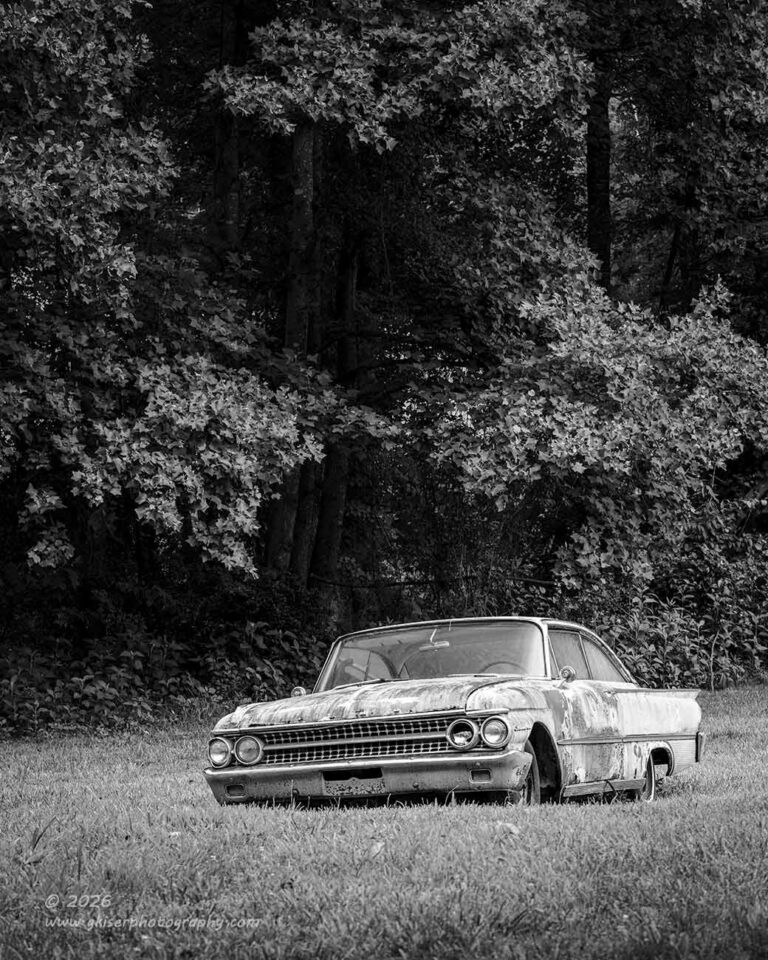
My next stop was about five more miles down the road on the other side of US 421. It was the Galaxie Starliner which I had shot a while back but had to deal with all kinds of clutter around the car which made things very difficult for me. Since most of the extra elements were now gone, I was hopeful that I could get the overall shot of the car that I had missed out on the last time. When I arrived at the spot, everything was as I had remembered it being from the last time I was out there. I had a good clear view of the car and could get angles from both sides. The best angle and the one with the best light was the driver’s side which would put me shooting right down the side of the tractor trailer that was sitting there slightly in front of the car and to the right. It was good enough that I felt it was worth stopping and giving it a try.
For the distance and for a bit of compression to the background, I wanted to use the telephoto lens which had been in the bag untouched through the entire day. It was time to show it some love, so I pulled it out and got the camera built. I got situated along the shoulder of the road and started to get the angle just right. I stayed very close to the truck to the right so that I could get the most out of the angles as I could. I didn’t want to get a straight on shot of the car; I wanted to capture the side of it since the coupe design was part of the draw to this particular car for me.
There really wasn’t much that I was able to do as far as compositions here. Fortunately, there was an area in the trees that was in the shade which provided a bit of framing for the car. The sun would come out occasionally and give the car a little glow which I liked. Essentially, I worked with the same basic postcard shot of the car since there were no other elements around it that I could add into the composition. By roughly centering the car, I was avoiding having empty space which would be a distraction. I did experiment with both horizontal and vertical orientations with the car.
The first one to work out was the vertical one which you see above. Now you may remember my argument for the black and white versus color choice with the Dodge at the beginning of this blog. If so, you are probably going to be confused as to why I chose to go with the broader photo being done in black and white since my argument was there was enough green to balance out the reddish color of the Dodge. Well, the primary color of this car was more in lines with beige and having some orange accents. These colors were more analogous to the greens in the scene and with the broader scope of the vertical photo, the car kind of got lost and the green just took over.

On the other end of the spectrum was the horizontal shot which had the car filling much more of the frame. Here, it made more sense to go with color because the balance was much better between the greens and the beige tones. The closer view of the car also brought in more of the warmer tones on the interior which helped to balance out the green even better. As you can see, when it comes to color theory, there isn’t a hard and fast rule about how to apply these things. You have to really look at the overall balance of tones and make a decision if the colors work in harmony together or of they throw the image out of balance. I’ve handled this equation completely opposite of each other between the two subjects and it comes down to the difference between reds and essentially yellow tones. Both vehicles were warm tones in terms of color, but the intensity was much different between them which caused the change in approach with the processing.
Not wanting to talk with the owner this time, I chose to call it a day at this point. I had plenty of isolations shot of this car the last time that I worked it since I wasn’t really able to get the overall photos. This time, I was able to get the view that I had really wanted that day, so between the two visits to this car I was satisfied that I had everything that I would want from it. This left me time to get the truck inspected and registered before going home to start with the processing for the day.
I had a total of 73 frames from the day and by the time I was done processing them, I had seven keepers which wasn’t too bad considering all the different frames that I had taken for light changes and trying to decide on motion in the grass with the little cabin. During writing this blog, I went back and found that I liked the more intimate view of the cabin in black and white which prompted me to finish that edit and add it to the list of keepers. That brought my total to eight for the day which was even better. About the time that I started talking about the Ford here at the end, I started thinking about the single isolation that I had shot of the Dodge at the beginning of the day. I considered why I had dismissed it and realized that the biggest reason was that there was too much red. This thought came to mind because I was thinking about the reasons I shot the Ford the way that I did and why I chose to process one in color and one in black and white.
The end result of that thought process had me going back to the isolation and giving it another look. It was pretty standard in terms of an abstract detail shot on a truck. It was framed around the area where the hood and fender come together at the door. The composition was pretty much straight on without a lot of drama to it. The overall red tone seemed to overpower it all, but black and white wasn’t going to work here because there wasn’t enough contrast built into the scene. However, I was now seeing some potential with it and possibly seeing what I had seen of it when I was actually photographing it.

I had made the focal point of the photo the hinge on the door, which was largely the same in color and texture, but it did stand out as a shape. The first thing that I did was change the aspect ratio to reduce the visual weight of the fender and bring more attention to the hinge. That seemed to work well. The next problem that I had to deal with was the color as the red was a bit too intense for me considering that it was taking up the entire frame. This was addressed through a color profile that changed the hue of the red and desaturated the image. I was able to work the saturation levels back up while bringing some visual separation between the different shades of red. After some extensive dodging and burning, I was looking at an image that had a good deal of promise. The last thing that needed to be done was to flip the image horizontally so that the eyes tracked through it as I wanted them to. Once I did that, the photograph actually worked quite well. I was a little embarrassed that I had dismissed it so quickly to begin with. At least I had gone back to give it another look before doing the final delete of the discarded images from the day.
Now my total was at nine keepers out of the 73 that I had started with. That wasn’t bad at all considering that I left with thoughts of going to two different locations which both turned into a complete bust. What I ended up working with was a truck that I had dismissed dozens of times over the last year or more, and several other places that I had photographed with only mild success in the past.
Looking back through this collection of new images, I am really quite impressed with how I saw each scene differently than I had in the past. There might be something to this learning to see differently that I am currently working on this year. Most of the photos that I came away with from today were quite a bit better than I would have expected even knowing how I would want to shoot them. The use of space was different than how I had utilized it before. The cabin got more space this time while I was afraid to give it much room the first time. I gave extra breathing room to the Dodge and the Ford that I might not have normally done for fear that it would be seen as empty space. I think that I successfully negotiated that space as negative space this time. The biggest surprise in space comes from the little restaurant that I shot early in the day. I accepted some of the background buildings so that I could get the parts of the structure that really interested me. The real reason for the success was the inclusion of the shelter to the left which I normally would have never thought about but happened to see a nice diagonal that worked with a diagonal seam in the pavement to provide a framework for the actual main subject. My use of space really changed on this trek and for that reason alone, I am very glad that I went out when I did this morning with just a small hope that I could make a couple of locations work out with the clouds.
Thank you for joining me on this trek and I do hope that you have enjoyed the story behind the photos. In the era of AI, I feel that it is more important than ever to document what I am doing with the camera and how I am getting the photos. What you see here is not a list of prompts that brings about an image of a scene that has never existed. These are real scenes in real conditions photographed in a way that carefully curates what is in the frame for the viewer to see. Everything that you are seeing in these photographs is based on a decision that I have made in the field, not at the computer. I just hope that these images connect with you as they have with me. If that is the case, please consider selecting a print to hang in your home or office. You will have a unique piece of photographic art which will be yours to enjoy in the form that it was intended to be presented in. It will make for a great conversation starter, and you will get a personalized narrative to accompany the print that tells you more detail about how it came to be. Of course, by purchasing a print, you are supporting me and my business in ways that are more important than ever. In return, you will have a piece of my heart and soul to hang on your wall.
Until we meet again…