Welcome back to another installment of Behind the Camera. Each month I come back with a different topic that I want to discuss, and this month is no different. Most of what I talk about here is directly related to the photographic process, but I wanted to break from that routine a bit this month. In the past, I’ve mentioned my views on post processing and while I’m always tweaking the boundaries that I’m willing to nudge up to, I still feel pretty much the same as I did back then. There is a new facet of editing that has been getting more and more traction out there and it has caught my attention. Now, the reason it has caught my attention is not really a positive one and it kind of has me worried for the future of photography and those that choose to honor the roots of the true photographic process. What I’m talking about is the advent of full-on automatic editing which is referred to as Artificial Intelligence Editing, or AI Editing.
I’ll go ahead and say now that I have no first-hand experience with this form of editing, but I have done a bit of research into what the capabilities are, so I feel that I have enough information to form a preliminary opinion on it. The things that I will be talking about in this entry will be total opinion and are just meant to make you think about what the next step in photography might be and what it might mean to photography in general. To throw another wrench in the works, there is also a variation of this AI Editing that actually could be a beneficial thing for a photographer, especially one that deals in volume. Let’s get to it and see how this all shakes out.
For years, post processing in general has been a topic of hot debate among photographers and those that just enjoy looking at pictures. I’m sure you have all heard the comments like “That’s obviously Photoshopped,” or “I’ll fix it in Photoshop.” The indication here is that post processing is the devil and will keep you from being able to trust a photograph, or it is a crutch for those who might not get it right with the camera. This is a mistaken assumption based on the film days when you would press the button and send off the roll of film to be developed. What we all missed out on was that the developing process was largely dependent on chemicals and paper type to determine what the final image would look like. There was also automatic color correction applied to remove any color casts that might be there due to lighting. Those 1-hour processing places had a cookie cutter approach to this while the photographer that developed their own film at home added to the process with dodging and burning using different masks during the process. Hey, wait a minute, when I process my digital images, I am using masks along with dodging and burning too. I can tell the subtleties of that statement are not lost on you and you realize that I’m saying that much of the digital editing process is very similar to the film days. There are, of course, differences when you start getting into things like cloning, or transforming elements within a photograph. The amount of tricks are endless and they do start to get into a gray area for what is photography and what is digital art. That is not the point of the discussion here though.
What I am talking about is the creative process that a photographer goes through on a regular basis. To boil it down, a photograph starts as a concept, and then the capture of that scene happens that fits the overall concept as close as possible. That digital negative is then brought into some sort of processing engine (this could be internal and automatic to the camera in jpeg workflows) like Lightroom, Capture One, or Photoshop. The photographer then makes decisions during that editing process in order to produce a final image that fits the original concept. From start to finish, the photographer is making the choices and controlling how the image looks. This is even true, to a point, when using jpeg workflows as the photographer hopefully is making the decisions on what picture style they are using and controlling things like saturation, white balance, and contrast within the image. This is a blunt tool, but it is part of the creative process which the photographer does have some control over. When importing a digital negative into software on a computer or tablet, the control is even greater and the output likely much better, but this is still based on the photographer’s choices.
Speaking personally for a moment, my photography, from start to finish, is based on my choices, and everything that I do with a photograph is with a certain end result in mind. Every photograph that you see in my galleries and here in the blog are products of me seeing a scene which excited me, and my ability to convey that excitement to you through the photograph. Each photograph is faithful to the scene and how it made me feel, and I feel confident that good or bad, I can take total credit for every photograph I’ve shot.
Let’s talk about artificial intelligence, or AI for a moment here. As we humans improve on technology, we are slowly making the computer smarter than we are. Of course, that is a debate for somebody much smarter than I am (possibly a computer), but the theory does apply to the point I’m going to make. Over the last few years, there have been different editing programs produced that use this type of technology. Essentially, the computer will evaluate the photograph (on a very much clinical level) and decide what needs to be done. I think one of the first widespread uses of this was dealing with denoise software. The computer would evaluate the image and determine the right type of noise reduction that was needed. I’m neither hot nor cold on that use, but I will say that no matter what kind of noise reduction you are using, you will see a softening of the image, so it is always better to have an image with the lowest amount of noise possible to start with.
This technology has grown over the years to include enlarging files for bigger prints, and other aspects which are not really part of the creative process behind the image. They are more finishing touches than anything. Here in the past year or so, AI has started to show up in more and more aspects of the editing process. For instance, Adobe introduced AI masks in both Camera RAW and Lightroom this past December I believe. Before that, Photoshop introduced sky replacement. The technologies used here are similar and that is probably why the releases happened so close to each other. Essentially, the software is able to evaluate an image and determine where the division line is between the sky and the ground as well as any other objects that might cross the horizon into the sky. There are also subject identifying masks which will pick out your main subject in the same way the sky can be picked out. Once the software establishes that division, changes can be made without affecting the other portions of the photo. As I mentioned, sky replacement was the first one to happen, and that allowed you to go through a catalog of skies, either on the program, or image files of your own, and replace the sky. This has resulted in some really beautiful work that I’ve seen, but more often, it results in a subject that was obviously lit by a noon sun without any diffusion from the clouds under a beautiful tropical sunset. Yeah, that is not convincing at all, and looks really odd. I’ve seen this from a number of photographers on Facebook and the results are comical, but they are thinking that the sky makes the shot perfect. That is their creative choice and I’m not here to take away from that. When it is used correctly, the results can be stunning, but the question is now posed as to whether this is photography or digital art because that scene has never existed until created with a computer.
For all the different rabbit holes that can be gone down here and all of the opinions that are likely to be created, I don’t have a problem at all with these types of AI editing tools. They are still based on the photographer’s choice and are used as a part of the editing process to get to the desired end result which was visualized at the time of the capture. In fact, I regularly use AI masks in Lightroom as a time saver. What used to take me minutes, now just takes a few seconds. For instance, I typically do dual editing on my images where I edit the sky separately from the ground and/or subject. Once upon a time, this would mean a combination of linear gradients, radial filters, and brushes to get the areas defined that I wanted to work on. These days, I can just select the subject, or select the sky and Lightroom does a pretty good job of doing just that. I might need to fine tune the selection from time to time, but even doing that I am spending a fraction of the amount of time to get the mask made. Once that mask is made, I will then make the edits and adjustments that I deem needed for my vision. The end results are very similar to what I would have created before, but they are quicker, and in some cases more polished.
On one of the last updates to Lightroom, they have blended the presets with the AI masks, and you can now go through and choose different presets for specific portions of the photo. I am not really familiar with this because I just don’t do presets in my editing. I have seen how they work, and essentially, you would pick out a preset that would accentuate a sunset sky or whatever look you are going for and apply it to your image. Lightroom would automatically select the sky, and then apply the preset which you could then tweak to your specific tastes. It is a time saver, but I think you are putting too much trust in the computer to apply sliders to your image not knowing what you saw at the time or even how you saw it. Again, this is a discussion for a different day as we are not yet into the AI discussion.
Up until now, AI has been a gradual evolution of tools and timesavers to photography. Advancement is generally a good thing even if we don’t like it at first. By the way, I do know the irony of that statement as I am about to talk about something that I don’t like, and think will really lesson the opinion of “real” photography. As with most technology though, AI is growing fast and there is a push to have it do more and more. It is kind of like a self-driving car in a way. It is great for those that are not good drivers and are likely to cause many accidents during their time driving. However, think about self-driving race cars making left turns with professional drivers behind the wheel, stick, TV, virtual interface, whatever they call it. Would the race still be interesting, would you still have a favorite driver? Would it just be a bunch of cars going around and around until the batteries wore out like your slot cars from childhood?
The newest iterations of AI software are very much akin to those self-driving cars. Essentially, the photographer goes out and captures a photograph to go home and upload it to the computer. The computer will evaluate the scene and determine the right crop for it as well as the correct editing choices. After a few seconds your snapshot will be reconfigured into a gallery worthy image with very high quality. You immediately send the file off to Bayphoto to be printed on metal and proudly display it on your wall. All of your friends come over and stare at this beautiful image on the wall talking about how impressive it is. You stand smugly back and casually throw in there that you shot that photograph with your point and shoot. Yeah, you are as good as a professional photographer and now all your fiends notice it. You are now getting asked to go and photograph Sally’s senior portraits and you go confidently into the situation knowing that the computer has your back. Only you really don’t know what you are doing, and you weren’t the creator of that picture on the wall…were you?
Think about that scenario for a moment. If you are old enough, you probably remember similar discussions when digital cameras came out in the early 2000’s. That was going to be the end of photography as we knew it because no longer did anyone have to develop film or wait for their photos to come back from the lab. Yep, digital changed the photography landscape in a lot of ways, and it opened the doors to photographers like me who couldn’t afford to always get film developed. I also could learn quicker because I could see the results of the exposure right after I shot the photo rather than waiting days or weeks to get the film back when I couldn’t make any changes. From a photography aspect though, I was still learning the process of photography just as if I was shooting with film and I strived to get it right in camera with every click. I was still a photographer who was responsible for my final images and what they looked like.
These days, with the new AI editing, the photographic process is no longer really a consideration. All you would have to do would be to find a scene that you think would make a good photograph and click the picture. The computer will then crop out the most pleasing version of the scene, and then up-res the file so that it is printable at an appropriate size. If your lighting was wrong, the computer will replace the sky with something else, and color grade the scene to match, all the while bringing out the shadow detail and recovering the highlights. The resulting noise will be removed, and whatever the computer determines is a distraction will be cloned out. Sounds like fun, doesn’t it? Except for the extreme crop and sky replacement, this process is very similar to what I might do during an edit, so why am I not on board with this program? Because, as the photographer, it is my job to make the decisions on how the image is edited because what was photographed was seen in a specific way by me and it is my job to convey that to my audience. If I leave it up to the computer, it is just not my work. In the extreme example that I mentioned here, the photographer doesn’t even have to consider composition because the computer will pull out the best composition in a wide scene, even if that just represents a fraction of the full image.

When I shoot an image, I have an end result in mind. Take for instance this shot from Price Lake I did recently. I stood in this spot for a couple of hours waiting on the different lighting conditions to happen knowing that I wanted color in the scene. I wasn’t sure if I would find that color before or after the sunrise, so I stayed for all of it. I chose the filters that I used during the different stages to capture the colors that I wanted. When I got home, I knew what colors were present even though they were faint, so I knew what colors to bring out in the post processing. I found the RAW image that had the right look of the clouds, and then started to work the colors. There was a bit of color grading used here to bring the colors close to how they appeared to me, but the color palette was shifted slightly from what I had seen in person. From concept, to capture, to execution, this image is mine and one that I am very proud of. I used AI masks to determine the sky, but what was done to the sky was totally my doing based on a series of choices with the sliders. If this were to end up on my wall and somebody complimented it, I could take that compliment to heart because I am the only one that had anything to do with its creation.
So, where is AI software going currently? Well, I have seen some information about a company that is doing AI edits based on the photographer’s editing history. This is interesting and it takes some time to build up the needed database for the edits. Essentially, the company will input thousands of your edited images to pull out what you typically do with your edits. They will then create a catalog of edits for you, so that you will only have to select a RAW image and have the software perform what it thinks you would do as an edit. Apparently, this is actually pretty accurate and results in images that are very close to what the photographer would have done had they done the edit from the start. This includes things like how the image is cropped, any transform changes for perspective, and choices between color and black and white. Of course, you can then go in and tweak the final edit that is recommended to suit the particular photograph. I’ll be honest, that this option kind of interests me for high volume portrait work because I can easily spend 12 hours working through a two-hour photo shoot. I don’t know the cost for this service, but I imagine that it isn’t cheap, and I am a long way from getting thousands of portrait photos done which would be needed for this to work.
The more I think about this program though, the more I consider some of the negatives that it offers as well, plus the potential issues down the road. As I said, you will still have to go in and tweak the image potentially after the edits have been applied. These tweaks might not take long, but since you avoided the heavy lifting, you might actually miss some interesting opportunities with the image. For instance, with a recent boudoir shoot that I did, the shot was set up to be a black and white high-key dreamy window shot with white sheers being the main prop. Using the AI software, that would be what would have come back to me, and it would have looked great. I would have made a few tweaks and sent it on to the album. In reality though, I started to make some changes, and then went through the color profiles which showed me an image where the sheers had a pink/magenta color cast to them. I loved the effect, and that changed my direction for the edit as I wanted to embrace the new color cast. The resulting image was in full color, and it had this wonderful, dreamy quality to it that the black and white would have missed. It was doing the entire creative process from start to finish that revealed that particular result. I think that this is a primary example of why AI might be a timesaver but can also snuff out the creative process.
Additionally, I foresee companies like this charging a huge premium to keep the editing profiles from ending up in other hands, or for a much more reasonable price, your editing profiles can be made available to the world. Imagine this if you would; you go out and shoot a landscape along the Blue Ridge Parkway. You have long been a fan of my style of photography from that area. Your photo doesn’t look like mine, but you subscribe to this AI editing company. For the low, low price of $XXX.00 you can get the editing profiles from Greg Kiser Photography. You apply them to your photo, and the appropriate changes are made to your file and within a few seconds, you have a photo that matches what you were wanting out of the scene. There are two things here worth talking about. First of all, did you create the photo that is now on your screen? Sure, you shot the photo, but the final presentation of it is based on thousands of my edits which were all done through my choices. I didn’t shoot the photo, but I might as well have edited it…but I didn’t. So, we are left with a photo that doesn’t really reflect the vision of anyone in particular, but it was an amalgamation that was assembled via how a computer read the input file and how somebody else would have edited it.
On the other end of the spectrum, the photographer that is looking to increase their productivity could find themselves in a situation where the “look” that is specific to them is now just a subscription away from being somebody else’s look. This is how the company could get away with charging such a huge amount of money to keep these editing profiles private. As AI gets more and more prevalent, the companies will look for ways of making more and more money with their services. Privacy for a professional photographer will be paramount because those professionals make their living not because they look like everyone else, but because their photos have a signature look, which is unique to them. This could also steal somebody’s ability to create that unique look of their own that makes them stand out in the field. AI could rob the world of the next Ansel Adams because they were never in a position to develop their own style.
When I started in photography, I was influenced by a number of photographers. Had I had the opportunity to get into this AI stuff back then, I really think that I would have done it. I remember a point in 2011, when I was really getting down because I just wasn’t able to understand editing at all, and my photos were just not looking like I wanted them to, or how I thought that they could look. To get over that last hurdle as a young photographer, I would have gladly paid for the chance to have my images edited in the styles of my favorite photographers. Had that happened, my photographs would have started to look like theirs, but yet they wouldn’t be theirs. I also wouldn’t have been pressed to force myself to learn image editing over the course of years…and still learning. It is this learning process where I take bits and pieces from others and create an editing workflow that works for me that has allowed me to create an editing style that is truly my own. More times than not, I’ve had folks tell me that they can pick my photos out of a crowd just by looking at the picture. There is no way that would have been possible had I developed a style that included using AI profiles based on another photographer’s work, which might be shared by dozens of other photographers that shoot the same thing.
Let’s go a little further into this discussion with something that I have just started seeing recently. There is a company out there called MidJourney that is beta right now which is causing a stir. Admittedly, it is very cool, but the implications to the art world are kind of scary. Essentially, this is a total AI platform where you type in keywords of what kind of art you want to create. You can pick styles like “realistic photograph” or “art painting” and then choose a subject, and what the image will be about. There are an endless number of options here and with a string of words, you will come up with four images that you can then add more detail to, or see options based on each one of the images until you get to something that you like.
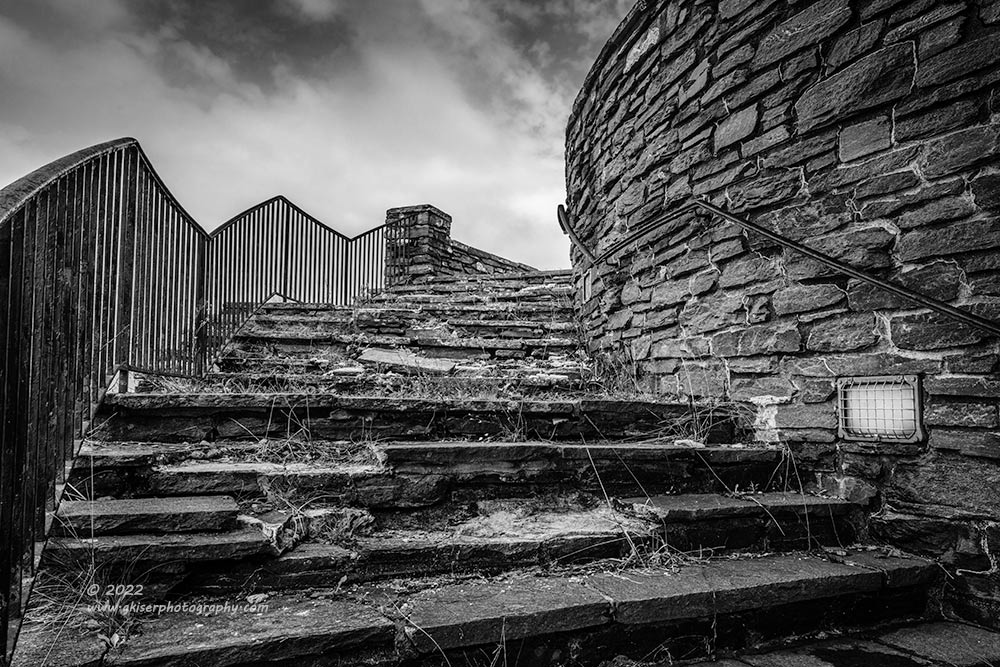
This is a photo that I have shot recently, but I could have come up with something very similar by sitting at the computer and typing in something like this.
Gothic staircase, black and white, moody, overgrown weeds, broken stonework, iron railing. Present in 3:2 format, high resolution, suitable for printing
I would have had four different versions pop up and I would have selected one to see other options. From there, I would have selected one to add details to and typed out any additional details that I wanted to have. The resulting image could then be downloaded, sent off to the print lab and mounted on the wall in a 24×36 metal print. I would have never had to leave the office. If this appeals to you, then you are going to have a great time with technology here shortly. If you would rather go out and experience the scene firsthand and be inspired by the location, then this is obviously not for you. However, theoretically, both people can come up with an image that is surprisingly similar. Which one has more merit, and which one is actually “art” as created by the person? The water is getting muddied here, isn’t it?
With this platform, unless you subscribe to a private account, your creations are available for everyone to see. The string of words used to create these images are also publicly viewable and can be copied. Somebody else can come along and take your words, and create the same thing, and by adding a word here or there, can change it to their liking. As I mentioned before, these companies will make more money through those that wish to keep their personal recipes secret. When we start letting the computers create for us, we are opening up so many wormholes that I don’t think we are prepared for.
I’ve talked a lot about what “art” is, and even gone into the realm of what makes it “fine art.” Something that I don’t think I’ve given enough credit to is the impact that the artist’s personal history and experiences has on their art. As a whole, society is getting less and less interested in experiencing different things. Yes, we travel places and see all sorts of things at a rate that has never before been done. We document every second of those experiences to put on the ‘Gram feed to impress our friends and make it look like we are doing remarkable things. I just think that the experiences are now just geared towards your social media feed, and we can’t do anything without a selfie. A huge part of my art is being in the moment with the scene in front of me. I am looking for a story that involves all of my senses that can be presented in a two-dimensional photo. I will stay at a location for hours waiting on the light to work for a photograph, all the while taking in everything that is there. Photography has become my reason for getting out there, and the photographs result because I take the time to understand what I see. It is this love for my subject that is a huge part of my art, and then it is my style that conveys that love. Those two parts get lost with AI driven art and it becomes something based on nothing human. Art is communication plain and simple, and if we are communicating something that we have nothing to say anything about, can it be art?
I’ve always said that cameras are dumb. I don’t like shooting in Auto mode, and I don’t like having the camera choose how to represent the scene for me. This is how I teach photography because I believe in the photographer making the choices. We are all unique in how we view the world, and that has so much to do with our artistic voice. The minute that we allow Artificial Intelligence to create our art is the minute that we turn our voices over to the computers and the algorithm of the day. Eventually, all art will become watered down and have the same soul as all other art. Each artist will be sitting there smugly looking at that huge print on the wall thinking they created it while there is another artist selling something with only minor detail tweaks to a commercial client for thousands of dollars. Neither of them created the images, and the ones that create the AI software will become the true artists of the future and will have all the spoils of their customers.
Keep art true to you, and your experiences. Embrace the imperfections that make us all unique. Create, create, create, and never think that a chip can do it better than you.
Thank you for joining me for this latest entry in my monthly Behind the Camera. I hope that I have prompted some interesting thoughts and maybe sparked your own creativity. No matter what you create, you keep on creating it and let it be your voice for whatever purpose you think is appropriate. Join me next month as we look at why our bad photographs are more important than our good ones. Yep, you heard me right, it isn’t those photographs that we are most proud of that are the most important after all.
Until next time….

Remember to use the code KISER10 to get 10% off your purchase