Welcome back and Happy Holidays to everyone! I hope that we are all enjoying the holiday season and looking forward to a brand-new year right around the corner. This will be the last Behind the Camera of 2024 which I guess makes this one a little special. I could have done something really impressive for this installment, but instead decided to talk about something that might be considered a little boring. Well, I hope it isn’t boring at all, but I will be talking about the benefits of photographing the mundane. You heard that right, there is a strong case to be made for making your photographic subjects less epic and more run of the mill. I’ve always been a proponent of shooting local and becoming a master at what your specific area has to offer. This still holds true, but I realize that many of you don’t live in an area that offers much in the way of photographic subject matter.
There are plenty of arguments that would change your opinion on this, and I’ve talked about them many times over the previous years. I think that there is beauty to be had no matter where you are, you might just have to adjust your own preconceived ideas about what beauty is. This month we aren’t going to be focusing on staying local though, we are going to be looking at subject matter no matter where you happen to be. I think that we can all recognize a fantastic landscape in front of us, or possibly a really pretty barn sitting in a field all by itself, maybe rust is your thing, and you have a knack for seeking out those old cars. These are more or less the low hanging fruits of photography. Things that are inherently unique or just beautiful. You know what I’m saying, those scenes that are already a photograph waiting to be shot. It is like fishing in a stocked lake. There isn’t anything wrong with doing it, and I do it plenty through the course of a year. What I am getting at is taking time to focus on the mundane subjects that you come across. Those things that you see so often that they are no longer exciting to you. This is where your abilities as a photographer really come into play, because you have to interpret the scene in a way that makes it exciting. You can no longer just point the camera and click the button, you have to really think about what is included in the frame, and how the frame is organized. For me, this is when I feel the most creative behind the camera because I am no longer photographing a subject or a concept. I am creating something interesting that most folks would walk past if in the same spot.
I already hear the grumblings out there that are saying something to the effect of “if you photograph something boring and mundane, the photo will be just as boring.” Absolutely not! This is where the creative vision comes from and where the photographer makes all the difference to the end result. Think about it, how many times over the years while reading this blog have you seen a photo that just struck you of something that you see every day. Hopefully that has happened at least once, if not many times over. I feel like I capture a lot of things that most would completely overlook, but I’m able to capture them in a way that makes you stop and take notice.
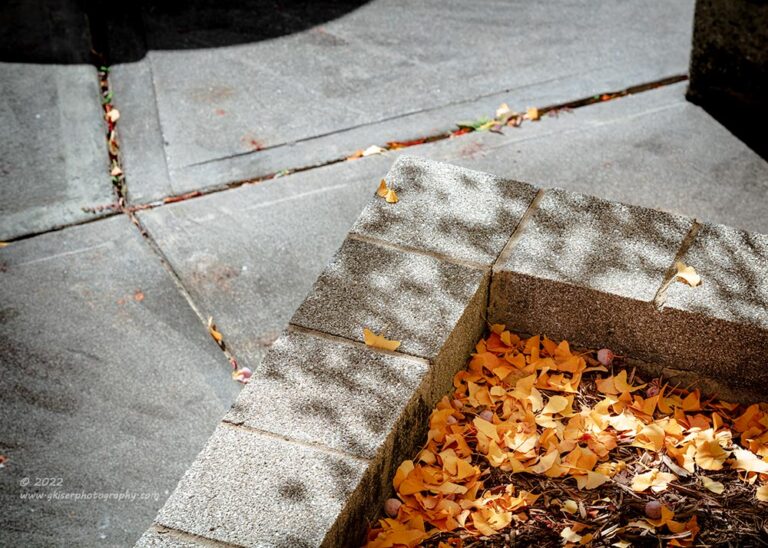
Take this one for example. It was shot on the campus of Wilkes Community College a couple of years back. I saw it as I was walking down some steps and looking over the side. This was a planter for a tree that had several of the freshly fallen leaves still inside. The colors jumped out at me because everything around it was kind of gray. The more I looked at the scene, the more I liked how the lines of the concrete added to the composition. There was nothing epic about this scene, and it wasn’t anything that was universally regarded as beautiful. However, with some careful choices behind the camera, I was able to create a composition that forced you to really look into the frame and absorb what you were seeing. I am willing to make a pretty strong bet that more time was spent looking at and enjoying the photo than if you had seen this in person on that day. It probably wouldn’t have even registered in your brain that you had seen it.
This is not your typical Fall photo, but there is no doubt about the time of year that this is. The leaves alone will give you that slight chill in the air, while the sunlight that is causing the dappled shadows gives a contrasting warmth. The different lines and angles add interest, and the lines fill the negative space to avoid that becoming just empty space within the frame. There are enough clues to get you invested in figuring out the answers to the questions that you will likely ask. Essentially, this is the type of photo that I spoke about last month when I talked about creating photos that ask questions.
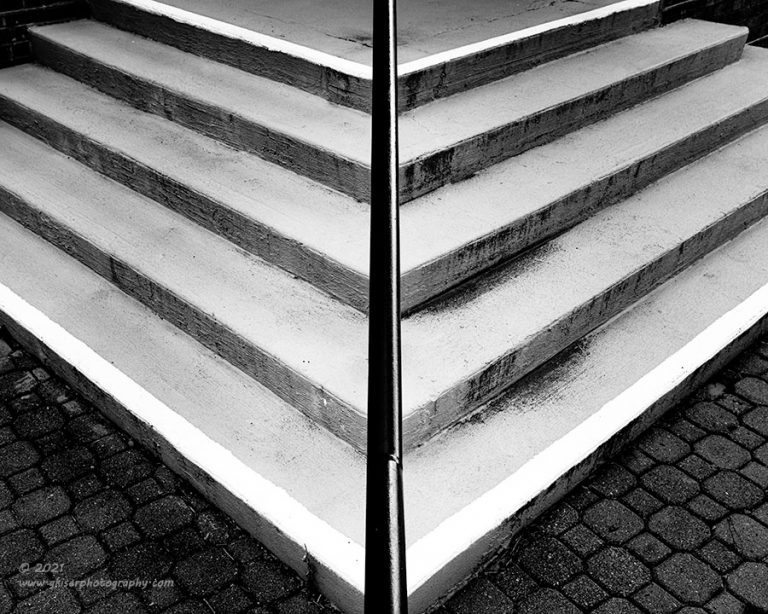
Speaking of stairs, we all are used to seeing stairs both inside and outside. Based on the number of times that I have tripped going up stairs an argument could be made that I don’t even always see them. Stairs are about as mundane as you could hope for, so why in the world would you want to take time to photograph these things? Well, for just that reason. We have gone blind to this architectural feature and really don’t take notice of them at all. By photographing them, the photographer is forcing the viewer to look at them in the same way that they did when the image was composed.
Did I change the steps and make them more interesting in the photo. No, nothing was changed with the steps, I just changed how I saw them. Careful camera elevation and placement to arrive at the symmetry makes this photo quite interesting. The railing bisects it and makes it look like an image that was duplicated and flipped to make it larger, but the staining on the concrete tells you that isn’t the case. The railing becomes a bit of negative space which defines the diagonal element. The pavers leading to the steps add texture, while the yellow paint (rendered as nearly white) frames the main structure of the composition. All of a sudden, you are spending time appreciating the steps for aesthetic reasons, not for their function.
One of the compliments that my mom gave me soon after starting photography was that I had taught her to see in a different way. She was noticing things more than she had in the past and appreciating the simple scenes that she had long taken for granted. There is even a very famous quote by Dorothea Lange that speaks to this very concept. She said, “The camera is an instrument that teaches us to see without a camera.” Apparently, the same can be said for the photographs that result and how they impact the viewer. This is why photographing the mundane really makes an impact. Everyone who rides along the Blue Ridge Parkway knows that the overlooks are beautiful and can appreciate that beauty. Most will pull out a camera or a phone and take a photo of the landscape that is unfolding in front of them. However, most would never see the little delicate scenes within the larger scene.

This was one of my favorite images from 2022 and is still right there at the top. It was shot on a morning where I was photographing the sunrise coming up over Price Lake. My attention was on the larger scene, the one that everyone would stop and appreciate. However, I was also looking for those things that would usually go unseen, like these blades of grass coming out of the water. When the light was right, I started to make some exposures of this little scene that showed the reflected sky ever so slightly. The end result is a photo of eleven blades of grass breaking the surface of the water. How often have you passed by that kind of scene and not given it a second thought?
As a photographer, my job is to show you what I see and why I think that it is interesting. In this case, I found that dainty little scene very interesting and arguably more memorable than the grand landscape that I had been shooting. That grand landscape was easy to compose and shoot, and it was something that most everyone could relate to, even if only for a passing moment. There was no challenge to it from the photographer’s standpoint. The grass in the water, however, posed a challenge because I had to explain in a fraction of a second why this scene excited me. I had to make it convincing enough to engage the audience and hopefully make them fall in love with the scene as well. Whether I did or not is up to your judgement, but I think that I captured it quite successfully. I’ve since forgotten the actual grand landscape that I shot because it blends into the other similar ones that I have done before and since. This photo still stands out years later because of all the unique qualities that it has.
Photographing the mundane is something that takes some practice, and you probably won’t be good at it to start with. However, as you start to realize just how much light and shadow plays a part to the scene, you will learn how to capture these scenes in ways that nobody would expect. There are photographers that have made a name for themselves photographing these little mundane scenes within walking distance from wherever they live. Some prefer this to the more accepted subjects because it satisfies the part of themselves which wants to be a photographer that stands out from the crowd.
I’ve spoken on that concept several times in the last few years in relation to my decay photography. I have realized that the arena of landscape photography is oversaturated and there are just too many of those images floating around for consumption. In order to make a name for myself, I pretty much have to either create photographs worlds better than what is already being created (I’m a long way from that bar), or I can photograph that which others are not. That is the easier option and the one that is much more attainable in the real world. Photographing decay subjects is part of that, but capturing mundane scenes adds another facet that I can focus on.

In this recent example, I was working with a decay subject but went for an abstract view that included an area that would likely not be subject to a long look in most cases. There are no emblems here, no chrome trim, and for the most part, this part of a vehicle is just there to collect debris. In short, there is nothing all that beautiful about it. For me, I saw a lot of lines and angles coming together with a lot of texture from the different levels of decay. It was a mundane view in the excepted sense, but I knew that there was more to this section of the car. With some careful attention to how things were framed, I was able to compose an image that really focused on those lines and the relationship of all the elements, while using the hinge as a visual anchor. The end result is a photo that forces you to look around and appreciate it for what it is and also for what it isn’t. It is a portion of the vehicle that would likely never been seen in any detail, yet that is all that I am giving you of the larger subject. Hopefully, I have made a convincing argument as to why this is worth looking at by what is included in the frame.
That is always the hurdle when photographing the mundane. As the photographer, we see what excites us about something, but it is quite another thing to create that same excitement in someone else’s mind. My argument is that because of that difficulty, the photographer is forced to create stronger images that tell more of a story. This takes a lot of practice and the ability to really dissect what it is about the scene that appeals to that photographer. The more you do it, the more efficient you will become with your visual language. Of course, this will translate into all other types of photography that you do which is a wonderful benefit. Not only will you be able to capture those images that most wouldn’t even see under normal circumstances, but you will also get better at capturing those low hanging fruit photos that everyone is shooting. By photographing the mundane, you will become a stronger photographer and will learn new ways of conveying what it is that you are seeing.
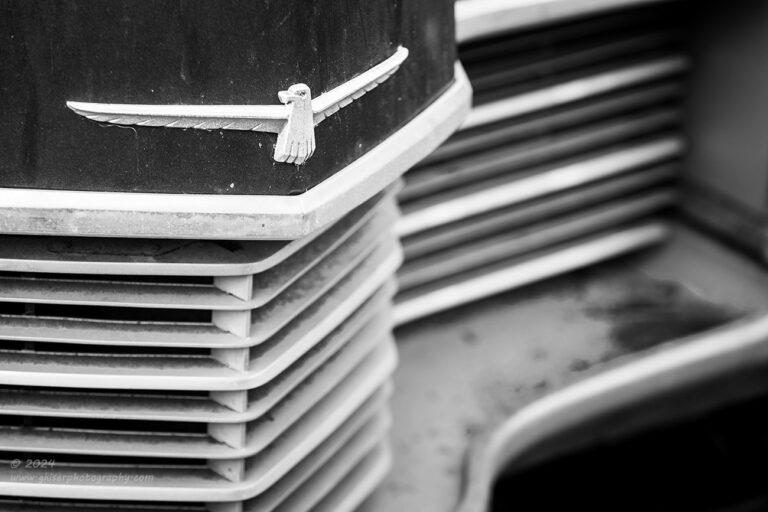
Had it not been for my experience photographing mundane subjects, I would have most certainly walked by this Thunderbird. The car was not all that interesting in design or color. However, because I had become proficient in photographing mundane subjects by using angles and lighting, I was able to figure out this composition that captured the essence of the car using the only bit of it that I liked to look at. It was the strong lines from the grill as well as the repeating shape of the bumper that framed the hood emblem so well. The shadow below the bumper complimented the paint on the hood, and the entire scene just fell in place.
Even with my enjoyment of shooting isolations on these old cars, I don’t think I would have seen this composition without having worked through boring subjects that needed a little extra composing to make them interesting. It would have been all too easy to focus just on the emblem which is how I would have normally approached this subject. However, the bird was not nearly interesting enough to pull off an entire photograph on its own. Not that long ago, I would have shot it straight on, using the horizontal grill slats to add to the composition, but that would have still been boring. It was the choice to go off to the side and add that depth through the blurred portions as well as the diagonals that made this image work so well. That is the thing with mundane scenes, you have to add things to the frame in most cases until they are interesting on a level much different than the subject would suggest.
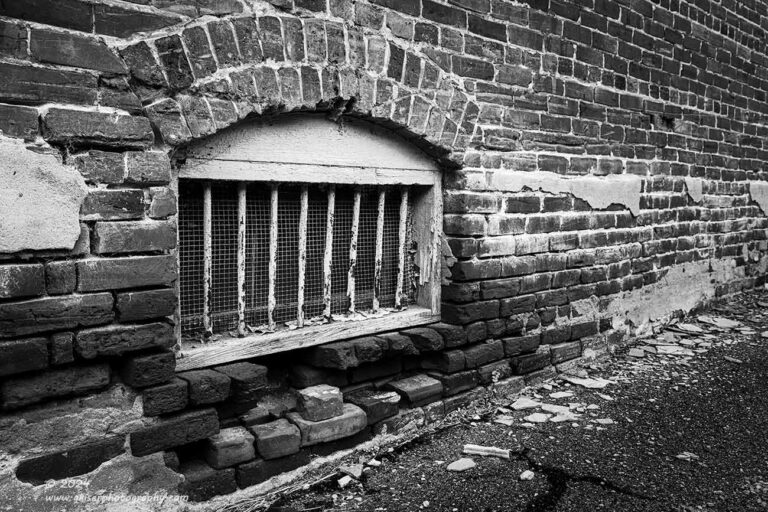
This is kind of along the same lines in that I used strong diagonals to bring the attention to the main subject. It was the grate over the window that I wanted to capture, but that would have been boring all on its own. By bringing in the bricks, I added texture, but more importantly, there were lines that brought the eyes through the scene. The added visual tension and depth brought this photo to a new level that made it much more effective than just pointing the camera and clicking.
When you spend the time photographing the mundane, such as a hood emblem, or a small window, you learn what else can be added to the frame to make it work. This goes against the popular thoughts behind photographic compositions being a subtractive art where you remove the elements that don’t add to the scene until you have a stronger composition. When you work with mundane subjects though, if you remove too much from the scene, you are left with a boring photo of a mundane subject. In the last two examples, I have worked backwards to achieve the photos. I started with a single subject but then added elements around those subjects that complimented them and completed the story. Those extra elements also provided a lot more visual interest with the intent of engaging the viewer for much longer. In the case of mundane photography, oftentimes, photography becomes an additive art just like painting. It is important to understand when this is applicable and when it is better to reduce the scope of the composition.
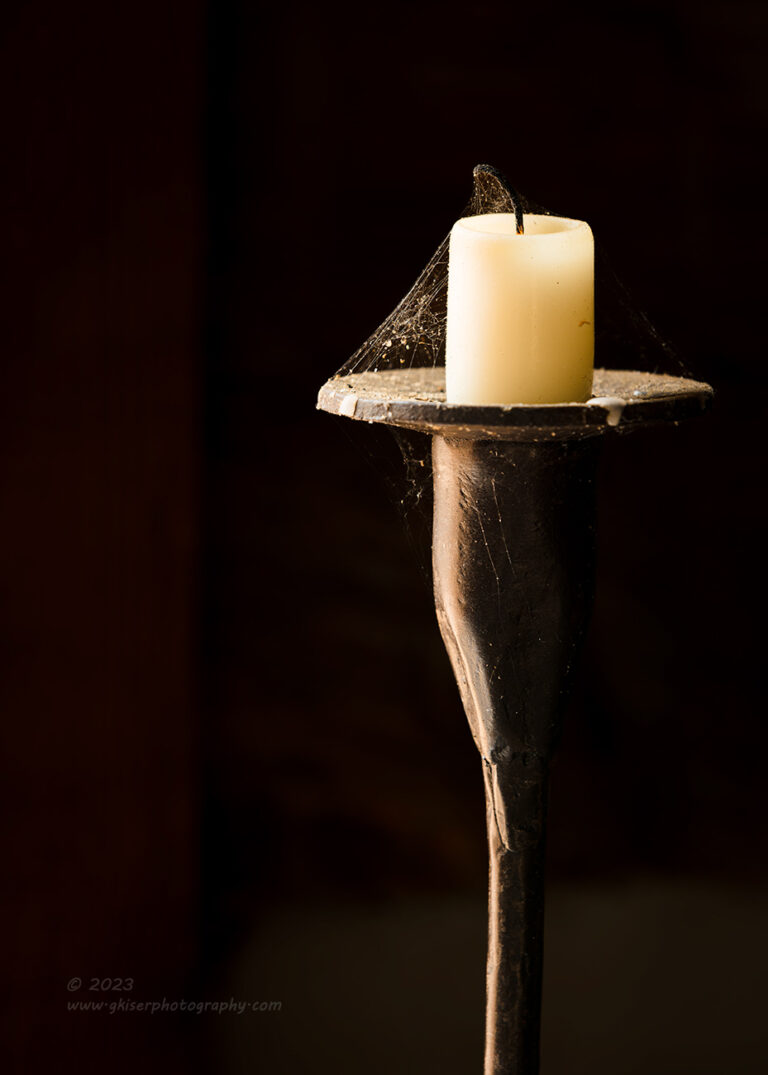
I have mentioned the use of light and shadow to make mundane subjects pop which can be seen in this example. This is a candle stick that has just the added interest of some cobwebs. Arguably this is a very run of the mill subject, however, the way that the light is hitting it from the extreme side, makes things more interesting. The shape is defined in a different way which changes how it is received by the viewer. That is not the only trick at play here to add to the interest though.
In regard to adding elements to these mundane objects, you might say that I have added nothing at all. That would not be entirely accurate though. You see, I have chosen to add a good bit of negative space to the frame with all the deep shadows. This has allowed me to add visual tension by shifting the candle over to the side, but more importantly, it adds mystery about the location. I purposely gave the background just enough exposure to make out some shapes. Part of that was to frame the candle, but I wanted there to be just enough clues to make you really wander about the background. In truth, it was a wooden wall similar to a log cabin. The dark shadows made that much more interesting than seeing the wood framings in full light.
All of these lighting tricks worked very well to draw the attention to the rather mundane candle and with the last trick of using a narrow depth of field, brought the attention to the web which was the story behind this object. That web would have been totally unseen had the background not been in shadow and the web been in the light. When I talk about the creativity needed to recognize and photograph the mundane, this is what I am talking about. We need to pay attention to these mundane subjects and understand the conditions that they are in to be able to seize an opportunity such as this when presented.
As we look through these photos, you might be starting to sense a theme of sorts. They are all photos of small details. This might be giving you the idea that photographing the mundane will include only small views within a larger landscape. Yeah, to a point that can be true, but there are plenty of times that the mundane can exist on a broader scope, even a grand view. Think about your typical landscape photograph. It will typically include a foreground, midground, and background with a defined subject or anchor. You will know what drew the photographer to the scene almost without thinking. This thought process behind landscape photographs tends to set some high expectations for what works in a landscape photograph. I’m here to tell you that landscapes can also be mundane, and still successful as a photograph at the same time.
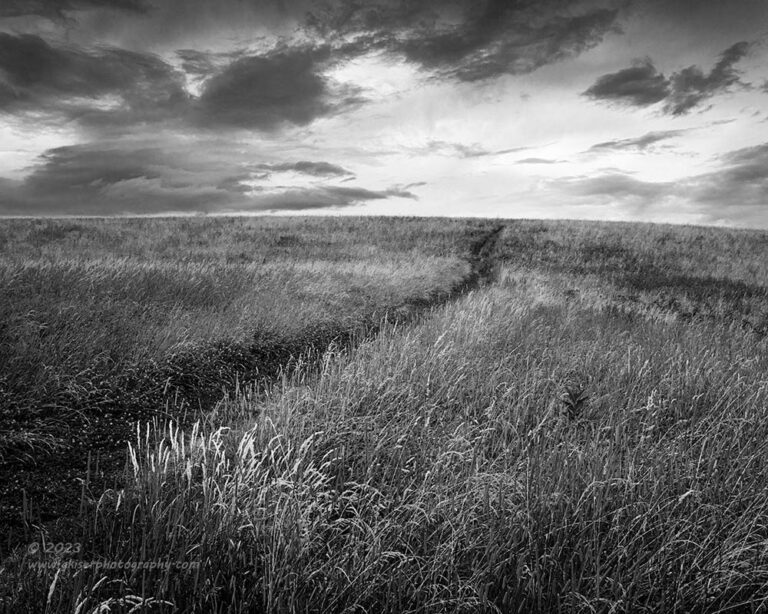
Here we have a very minimalistic landscape. There are no mountains in the background, no bodies of water, and no real visual anchor. This is a scene that most would see, and the only response would be to walk down the path. From a photographer’s standpoint, that simple path leads your eyes through the scene and the reward is an interesting sky above. There is nothing particularly beautiful in the accepted sense about this scene, but putting all the parts together makes something greater than the whole. In essence this is the magic of knowing how to photograph the mundane. When you pay attention to the lighting and conditions, and add elements carefully, you can make a nothing scene just as impactful as one of those grand landscapes from Iceland, or some other exotic place. This is a powerful realization for a photographer, especially one that isn’t near those epic locations.
Photographing these types of scenes will help train our eyes to see things as a photographer and not just a spectator. A spectator will come to a scene and realize that it is beautiful. A spectator that knows a bit about photography will find the right time to come back and photograph that scene. A photographer who is versed in capturing the mundane will be able to see scenes that a spectator would never even notice and make images that are as impactful, if not more so based on how they are “seeing” that scene.
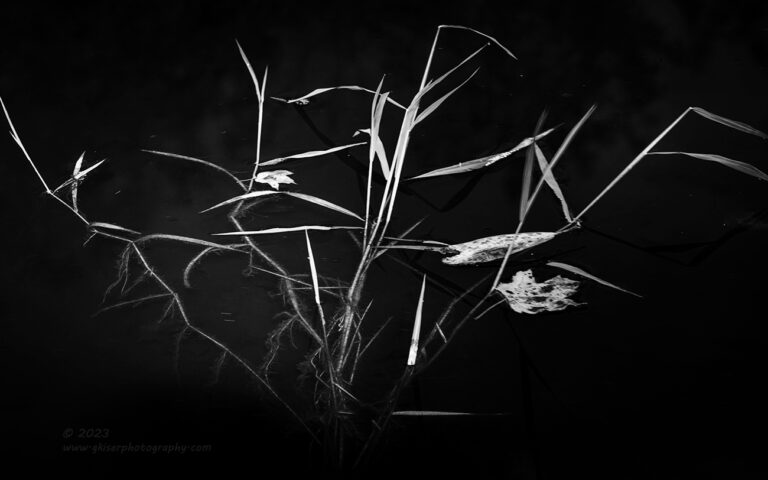
How about this small landscape scene. It is similar to the one that I shared earlier with the grass poking out of the water, but this one has a much different feel to it. Instead of feeling light and airy thanks to a high key approach and simple lines, this one feels much heavier and more macabre. With the various angles of the grasses and the black background, it feels otherworldly and somehow more serious. So much can be done with these mundane subjects which offers a lot of incentive to photograph them.
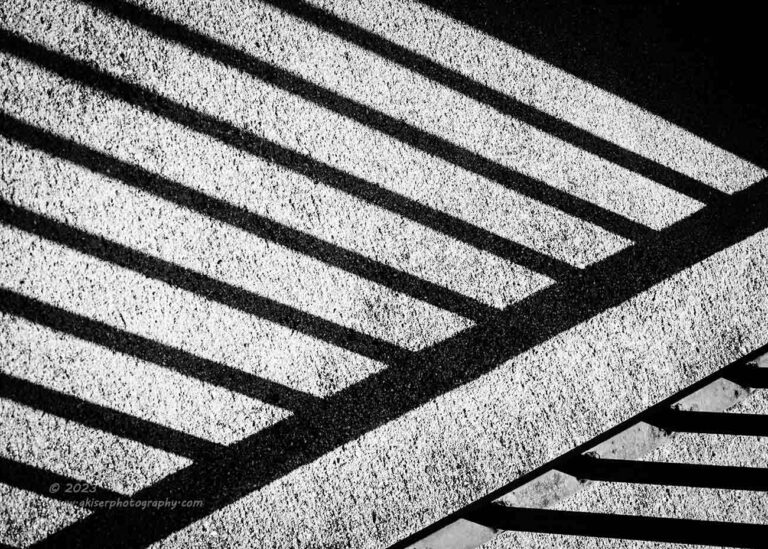
There are also times when the mundane subject is only visible under certain conditions. What I mean is that in this photo, there really isn’t a subject at all, it is just a photo of a sidewalk with a small section of railing in the lower right. The shadow from the railing makes this abstract an interesting photo because of the composition. Think about all those times you have walked past shadows and just saw them as shadows from regular objects. When you really think about it, those shadows can become their own subjects and create shapes that will change throughout the day or even disappear altogether if a cloud comes by.
When it comes to photographing the mundane, shadows are a whole different level to play on. I’ll be honest in that it has taken me quite some time to really learn to appreciate the shadows in this context. I owe it to a client of mine during a workshop who mainly worked with shadows. His work on that workshop as well as since has inspired me to pay more attention to the shadows that I come across. It really has opened up a whole new level to my photography, especially in the scope of photographing the mundane. Shadows can turn literally nothing into something, and something that is quite unique based on the sun’s position at the time relative to different objects. With the sun shifting North and South in the sky during the course of the different seasons, you can expect to find these exact compositions once, maybe twice in a year.
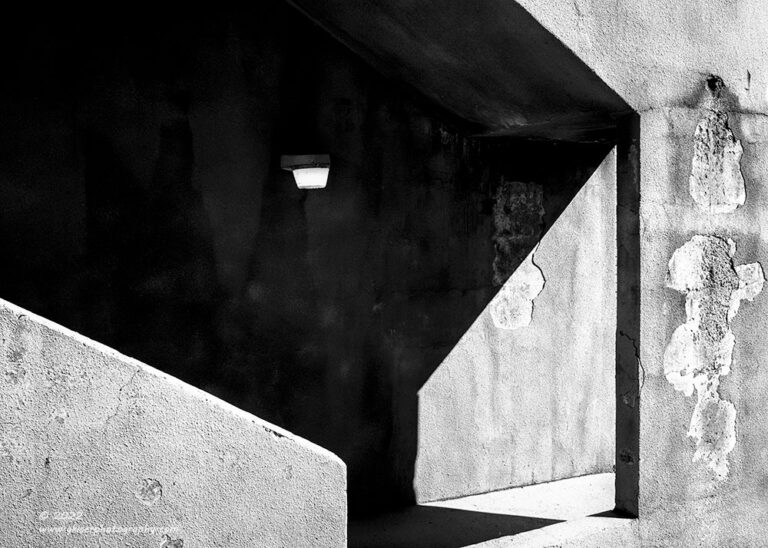
Along those same lines, shadows can add separation to shapes that are already there while adding additional shapes. Take this composition for example. There are only two primary shapes in the foreground of this walkway. The trapezoid on the bottom left and the upright with the two diagonal extensions on the right. However, thanks to the shadows, you can see those shapes better, and there is another pentagon that has been added to a blank wall just inside of the right-side wall. Thanks to the shadow on that wall, there is a clear separation that defines the two shapes as different entities. The darkest area that takes up most of the photo is completely made of shadow and frames the light that is mounted to the wall. Imagine what this photo would have looked like without the shadows included. It would have been very boring with no depth or shape. Light and shadow really make such a huge difference when photographing the mundane.
I’ve found the best way to go out and find these mundane subjects is to go on a photo walk. Just grab your camera and a couple of lenses and go for a walk in a place that you have driven through many times or even walked through. Change your mindset though and stop looking at the big picture. Don’t worry about where you are in relation to that one store, or building. Just walk and look at the details. Find things that interest you and then build a composition by adding to that single element. It can be anything from shapes, to shadows, to a collection of particular colors. Find ways of conveying why these scenes attracted you in the first place and make a photo out of them.
It will be a slow learning process more than likely, but one that will be very rewarding in the end. You will be teaching yourself to see in a different way and you will learn to respond to what most people will ignore. This will open up tons of opportunities photographically and you will be better able to find subjects that most would not give a second thought to. Harness that power to open the eyes of your viewers to the things that they have been missing.

Think about this. We have become so used to seeing corporate signs along the road that this Exxon sign would have gone unnoticed unless you were running on fumes. In that case, you would see the sign and then be furious that there was no gas station below it and hadn’t been for many years. Unless you are drawn to decay, this sign wouldn’t hold any particular interest to most folks, but it was something that I had seen several times during my travels. There was nothing really to go with it to make for an interesting composition though which was why I never shot it before. It just happened to be the right time of the year when I passed the sign and saw the greenery growing up around it which made me see a photo there. Again, with photographing the mundane, it is often what elements can be added to the subject to make it work. From there, I waited until the sky was something that would benefit the mood of the image I had in mind.
The end result is a photo of a basic Exxon sign that has been weathered. It is a rather mundane sign, but with a little care, the resulting photograph is one that hopefully draws the attention to it in a way that it typically wouldn’t have if you were just driving by. Now that I have your attention on this sign, the hope is that you are now looking at the faded and weathered state of it. This speaks to my love for decay and the greenery that has grown up around it shows the neglect and time that has passed. There is now a story to be told here which is evident from the photograph. The sign by itself is really nothing all that special though.
Understanding how to photograph the mundane is so important to other forms of photography and will open up so many more areas to explore. The beauty of it is that you can find subject matter just about anywhere which saves you a lot of headaches that would be had with traveling all over to these epic locations. You also won’t need to stand in line behind 50 other photographers who saw the latest post on Instagram about this magnificent mountain range. Something that I strive for in my photographic experiences is to find no other photographers around when I am working. When those times happen, I know that I am creating something unique no matter if it is of a mundane subject, or something a bit more impressive. I like having my photography stand out from the crowd, and if that means that I have learn how to photograph things that most folks don’t pay attention to, then so be it. I accept the challenge and hope to create images that beg to be looked into rather than looked at.
Thank you for joining me for this last Behind the Camera of 2024. Keep your eyes out for my 12 most significant images of 2024 which will be coming up later this month. We will also be back here on January 1st with a yearly wrap-up of events which have defined me as a photographer for the year. I hope to see you back for both of those. In the meantime, enjoy your holiday season!
Until next time…