Sunday, August 7, 2022
It would be so nice if the scenes that I pass by and want to photograph were laid out in a way that were easy to photograph. What I mean is this…There are so many great subjects out there that deserve to be photographed, but they are usually situated in locations that have too many confusing elements or just plain old distracting elements. That is one of the hardest parts of doing my decay photography, right after finding the subjects in the first place. All too often I will pass by something that I think would make a great photograph only to see that the background has some neon painted treehouse with balloon animals tied to the roof. OK, that might be a little bit of an embellishment, but it isn’t too far off from the truth. The reality is, I will find a perfect little rusty truck sitting in the back yard, but there will be years of discarded home items stacked up on the hood, and the bed will be filled with what looks to be a decade old Goodwill load. It is all familiar for me to find a beautifully rusted old car parked next to a brand-new Lexus with a basketball goal post touching the opposite door. None of these things makes it impossible to photograph the subject, but it sure makes it more difficult.
Remember my favorite rule in photography…Ask yourself what you like about the scene, and then ask yourself what you don’t like about the scene. The goal here is to create a composition that showcases what you like while omitting what you don’t like. In essence, you are striving to create a story with the elements and all of the elements should support that story and keep it all very simple. This thought process comes into play more often when photographing old vehicles than anything else. Landscapes and barn photography is pretty simple in comparison for the most part because it is easier to isolate those subjects due to their size. Cars and trucks and things that go (my favorite book as a kid by the way), tend to be more difficult because they are usually stored next to something, or in the middle of a lot of things. They are effectively magnets for clutter which continues to grow with the years. When I’m looking for something rusty and decayed, I’m usually staring at a subject that has been drawing clutter for 10-30 years.
This brings me to my second rule when it comes to photography. I like to shoot it as I find it. What that means is I look for scenes that capture my eye as they sit. I’m not looking for a scene that needs to be changed to work. I am looking for something that I can fall in love with just as it looks. Once it captures my attention, I will look to see if I can make a photo of it. This is the process of looking critically at the scene to see what distractions are present. More times than I care to admit, I will abandon a subject because there is just too much clutter in the way. Other times, I will find ways to work around the clutter, but never will I alter a scene to make a photograph. That is a very slippery slope to start on. As you start to move things out of the way, you will leave evidence behind of whatever had been sitting there which will be a distraction in its own right. The more and more that gets moved, the more the scene changes and the initial reaction is no longer present. Once you move something, you can never get it back just the same way it was because you will overthink it. The best thing to do is to embrace the scene for what it is and work with what you have. The resulting photographs and stories will be much more accurate to the subject in my opinion.
I know that this sounds like the beginning of a Behind the Camera installment, but I swear that it is not. I only mention this part of my process because it has a lot to do with this trek. You see, for a couple of years now, I have been going back and forth to Winston in the Miata by way of back roads like 268 and 67. Along that route, I have found a lot of really interesting scenes that I have photographed occasionally through the years. On my last trip out that way, I passed by a little restoration shop I had noticed many times before. There were several really nice examples of older cars in various states of decay out front. The two main cars that caught my attention where next to an old gas pump island where there were still pumps installed. These cars were all blocked in by other cars for obvious reasons. There was always a lot going on out there during the days and I just didn’t see much way of getting any photographs made.
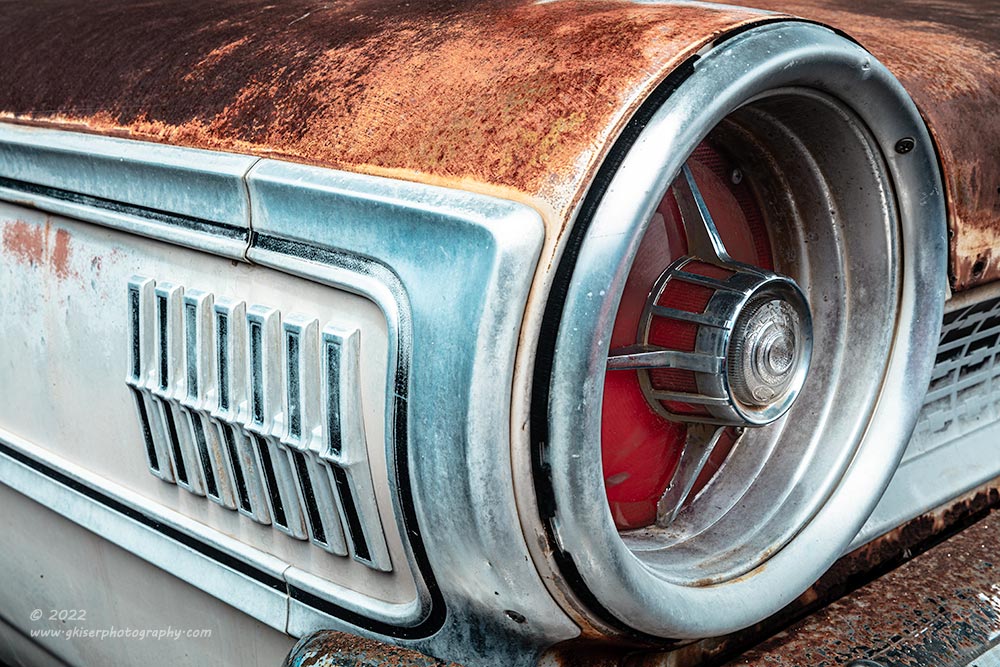
It was on this last trip that I started to think less about getting overall captures and started to focus on the possibilities of getting some nice isolations of the cars. I felt that was probably doable, but with everything so packed in around the cars, I wasn’t sure about my ability to move around. There was also the problem of the parking lot which was usually pretty busy with customers. The last thing that I would want to do would be to get in the way of business. I had considered going out here during the weekend before with the hopes of avoiding the crowds of customers, but I was pretty sure that I was going to need to have cloudy conditions to make the light much softer from the sun. That meant that I was going to need to have very specific weather on a weekend, preferably a Sunday as I was pretty sure that they were opened on Saturdays from previous trips through the area. I had seen no signs indicating that they intended to keep people off of the property, so I was reasonably comfortable with going out there to grab a few photographs when they were closed.
Looking at the weather for Sunday, it was looking like clear skies early with increasing clouds in the afternoon with chances of storms. That has been pretty much the same forecast that we have seen for the past month around here. It meant that I could sleep in late and head out in the early afternoon to the shop that was about an hour away from home. When I woke up, I looked at the weather and saw that the clouds were actually looking really good right then. It was around 8:30 and the clouds were looking to fade out by 10. That meant that I didn’t have time to get to the location before the clouds faded. The afternoon clouds were looking less intense as well and the chance of storms had faded to nothing. It was looking like I wasn’t going to be able to get out there this weekend which was a bit disappointing because I had been looking forward to giving this location a try for a while now.
I got started with my morning and kept a loose look at the weather as the time ticked by. The forecast was ever changing, but it was looking like there was going to be about two hours of high-level clouds which might work starting around 1pm. If I left the house at noon, I would hopefully have a couple of hours of work before the sun came back full force after 3pm. I honestly wasn’t feeling too confident about this plan, but I had set my mind to go out and do some photography and I was feeling rather creative. Not wanting to waste that creativity, I decided to head out shortly before noon. I grabbed my gear and off I went looking at a mostly clear sky overhead.

By the time I got into Elkin, the weather was starting to change a bit. The clouds were bright, but they were coming into the area, and I could see that the shadows were much less pronounced now. This was all that I was after when I was looking for clouds. I wasn’t needing a dramatic sky because I really didn’t think that I was going to be doing any compositions that included the sky. I was really figuring that I was going to be working isolations on a few of the cars and if I was lucky, I might get a half dozen images out of the day. It wasn’t a big deal trek by any stretch, just something that I wanted to check off the list more than anything. I had been telling myself that I wasn’t going to get anything good from here for so long, it felt like this was more an opportunity to prove that to myself than anything else. I was minutes away from seeing if my assessment was accurate or if I was going to be able to pull a rabbit out of my hat.
When I arrived, I was happy to see that the clouds were still overhead, and they were doing just what I needed them to do. There were four cars by the pumps that I was interested in, as well as a yellow pickup by the front door. I looked around the parking lot and confirmed that it looked to be closed. There was a pickup truck parked by the garage doors that somehow seemed to be out of place. From my experience, I figured that this was probably an employee, or possibly the owner who had come in to get some work done. I went over to that side of the building and peeked inside. Sure enough, there was a man rolling up a hose inside, so I knocked on the door and noted that there was a dog laying at the door. I slowly opened the unlocked door and introduced myself. After a brief conversation, I had permission to photograph any of the cars outside that I wanted to. In fact, he brought be a business card to exchange for the one that I had left him, with a request to email him the photos that I shot. I had already detailed my standard offer of a free small print if any of the photos turned out good, so this was a quick way of showing him the photos from the day.
With his blessing, I went back to the truck and grabbed my camera. Since I wasn’t going to be moving around much, I decided to leave the bag in the truck. From experience, I knew that I was only going to be using my standard 24-70mm lens and a polarizer anyway. That was how I built the camera and mounted it to the tripod. I decided to start out the day with the obvious shot of the Galaxie taillight which I’m always happy to photograph. That didn’t take long, and I was well on my way having the first image in the bag. It seems that it is always that first image that is the hardest to create so I’ve learned that if there is an easy shot to be had, I will start off with that one just to get things moving along.
With the taillight captured, I started to look at the other side in case the colorations were better. What I found was that the lens of the passenger side light was dislodged and was aimed down. This added a bit of interest to the image, and I started to look at framing up that light in a similar composition. There was a big dent on that quarter panel that made the composition look odd though. I tried it from the opposite side and found that I was having a hard time working out a frame for the image. The tight isolation wasn’t working at all here, and the scene only made sense when I started to widen the angle of view.
It wasn’t long before I was starting to include the black car on the other side of the pumps which made the image way more complex than I had imagined. It also taxed my standard lens too much and I decided to go back to the truck and swap out for my 16-35mm while keeping the polarizer attached. I went back and resumed my attempts at finding a good framing for the image that was developing. I finally found a workable focal length of 20mm that successfully captured the taillight of the Galaxie while getting the front end of the black car as well as the pump. Of course, at this point, I had a portion of the building in the frame as well, so I had to make sure that the signage that was present made sense and nothing was cut off. This all goes into my often talked about “edge patrol” as I check for separation of important elements in the frame.
There were some clear bags that were bundled up on the island that I didn’t like at first, but the more I looked at the scene, the more they kind of made sense. Regardless, had I attempted to move them, they would have left wet spots on the concrete that would have been a distraction as well. With the old tires in front of the black car, the bags kind of completed that story so I had no reservations about including them in this photograph. For me, this is the beauty of shooting a scene as I find it. Since I give up all control of the elements, I am left with only being able to work around what is there and that really does make things simpler for me. I know it seems like it would be easier to just move things around as needed, but I see it as cheating and potentially being quite rude to the property owner by manipulating things on their property. Plus, once I start moving things around, where do I stop? If I moved the bags, I would then move the tires. Then I would have debris stacked up where the removed items had been, so I would need to sweep. There would still be dirt and moisture left behind, so I might as well pressure wash the pavvement at this point. You see where this is going don’t you? By the time I get it all suitable for a photograph, the moment is gone, and the story is different.
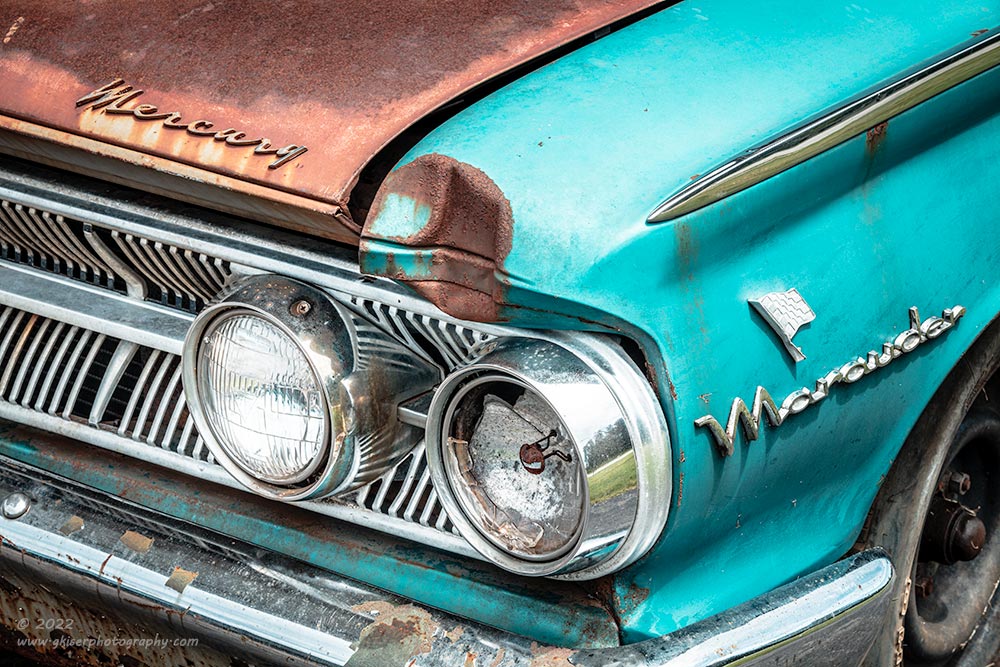
I was feeling pretty good about my Galaxie taillights at this point and wanted to move onto different subjects. The Mercury which was parked next to the Galaxie was also interesting because of the colors that it had. The grille and headlights were the first things to draw my attention so that was where I started. I pretty quickly noticed a problem here that I have from time to time. The chrome was actually in pretty good shape which meant that I was going to become a cameo in any photos that I shot of the front of this car. I looked for alternatives and with the angle that I was wanting to shoot, I found that if I put some distance between me and the car, I would be able to avoid showing up in the reflections. Once again, I went back to the truck and swapped lenses. This time, I went with the telephoto 70-200mm which would give me the distance I needed from the chrome. It would also hopefully give me a better chance of isolating the elements that I was trying to get on the cars.
I returned to the corner of the Mercury and started to frame up a composition that included the passenger side front corner. When I couldn’t get a composition that I liked, I moved to the other side and tried again. This time, there were more emblems available to tell the story and I had a great color contrast between the hood and the fender. I got the shot framed up the way I wanted and fired off a few exposures as traffic went past behind me. With the chrome I was dealing with, not only was I having to be careful not to appear in the photo, I also had to pay attention the cars passing behind me as they would change the reflections ever so slightly. Nothing like having a bright colored car reflecting in the headlight bezel that you miss until you get home and see it on the screen. My goal was to make sure I didn’t have any surprises like that when I got home.
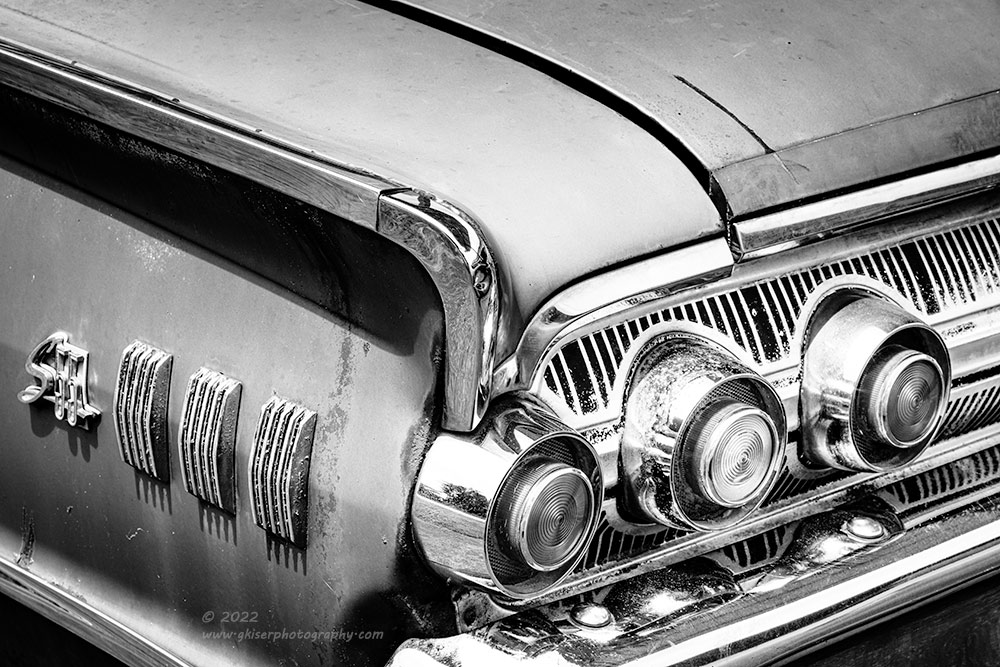
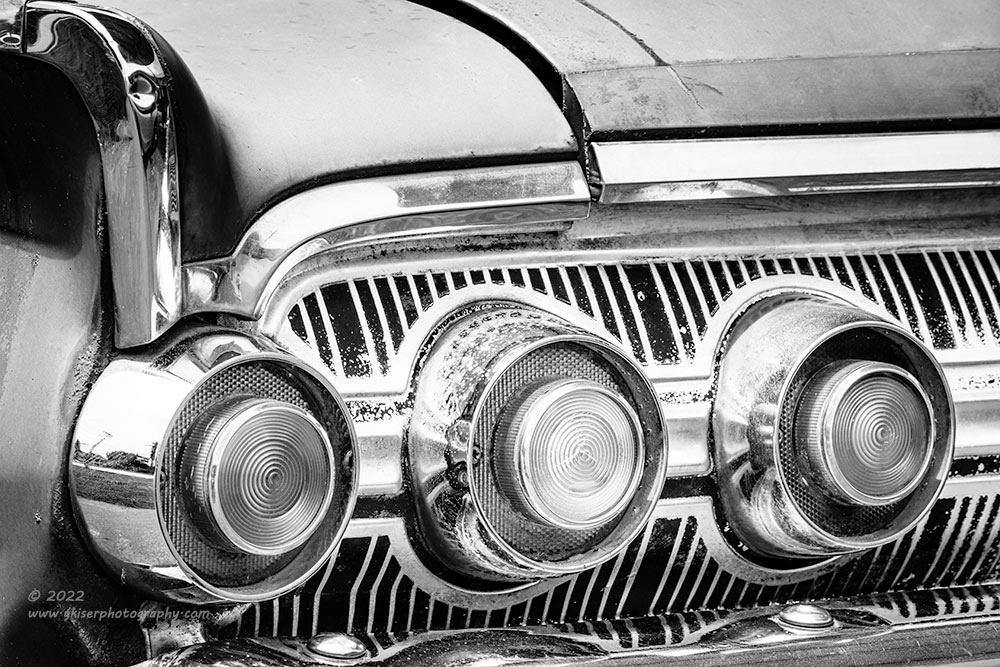
I was reasonably happy with the front of the car at this point and decided to go to the back. I wanted to pay attention to the taillights on this car because they reminded me of the Impala’s lights from the same era. I knew that these lights would make for good images because of the sucess that I’ve had with the Impala lights previously. I kept the long lens attached because there was even more chrome back here and I was finding it all too easy to be included in the photo. In addition to myself being included in a reflection, I had another problem which started off to be a big issue. this was a bright Orange Honda Civic parked right behind the Mercury. I wanted nothing to do with the Civic but found that no matter where I placed the camera, I was getting a bright orange reflection in the bumper and other chrome. I thought about this for a minute and decided that maybe I shouldn’t be fighting against the Civic. The Mercury was teal and the Civic was Orange which made for a perfect color pairing.
I decided to embrace the reflection and started to form up compositions that included the bright orange in the chrome. As I was making exposures, one of the other employees at the shop came out and got into the Civic. He said that he was going to move it out of my way. How thoughtful of him to offer that, and I did consider it for a brief second. Then I realized that if I were to let him move it, I would violate one of my favorite rules I have for myself, plus I would be putting them out to have them alter what the lot looked like just for me. I assured him that I was making use of the color, which I was, and didn’t need him to move it. He assured me that he was happy to move it, and I was equally as happy to have him leave it right there, which is what happened.
Ironically, when I got these images home, I started the editing process and found that the reflected orange wasn’t quite as nice as I had hoped. It would have worked had I gone forward with it, but the color balance was off looking at all of the images on the computer. I opted to go with black and white for both images and couldn’t be happier with them. By taking the color out, I removed all of the considerations made for the orance reflections. It just simplified the images completely which I felt was a better way of addressing the concern in the long run.
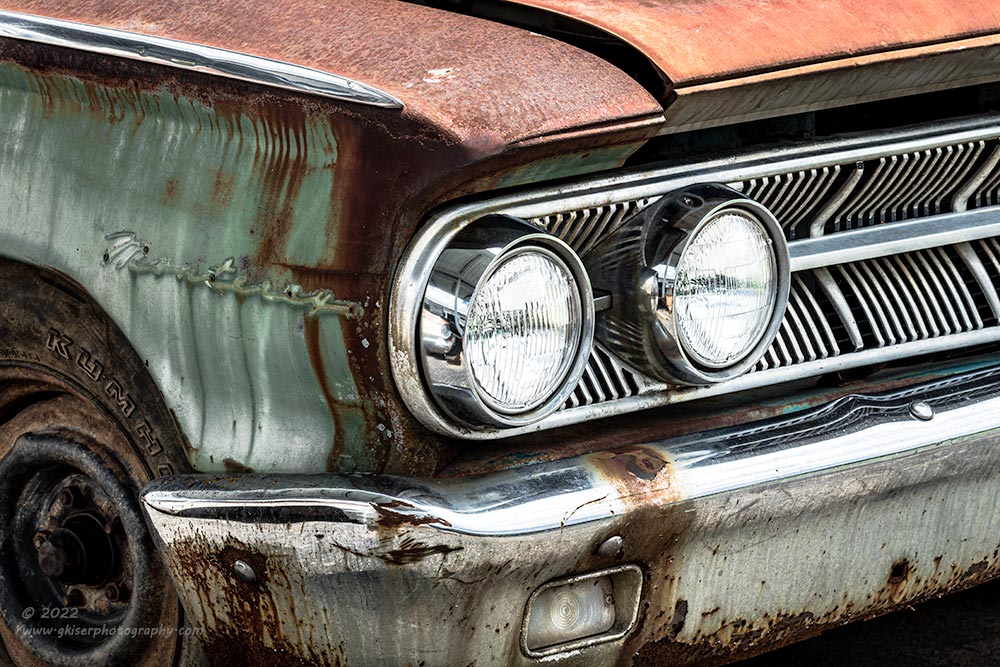
Feeling a bit better about my ability to compose images on this car, I went back to the front and started to work images of the grill and front emblem. these were fairly typical compositions, and I did a lot with reflections around the headlights because I really liked how the grill was working with the headlight housings. The more I played with the grill, the more I started to become interested in that passenger front corner again. I had worked out a similar composition on the opposite side that had included two different emblems which I really liked. On this side, the hood had no emblem, and the fender emblem had been removed. Interestingly enough, the remains of the emblem were not that of the Marauder which was present on the opposite fender and the trunk, but that of a Monterey which I found to be a bonus as it almost looks like I shot a different car. The composition worked out very well on this side with the faded emblem location and the headlights being the focal points of the composition. The patina of the fender was nearly perfect with the streaks of rust and other deposits.
I was finding that this car was turning into my favorite subject at this location. I had easily spent the most time with it thus far. I had shot the back and the front and was feeling pretty good about what I had done with it. However, there was still the matter of the orange Civic behind it. I felt that I had only tapped the surface of the color when I was shooting the taillight, so I went back to look at other alternatives. by this point, I had been out here for a while and the sun was getting rather hot. I had sweat dripping off of me continuously and I was starting to feel tired from being in the heat. I really wanted to get back in the shade, but the shot that I was after was out here in the open sun.
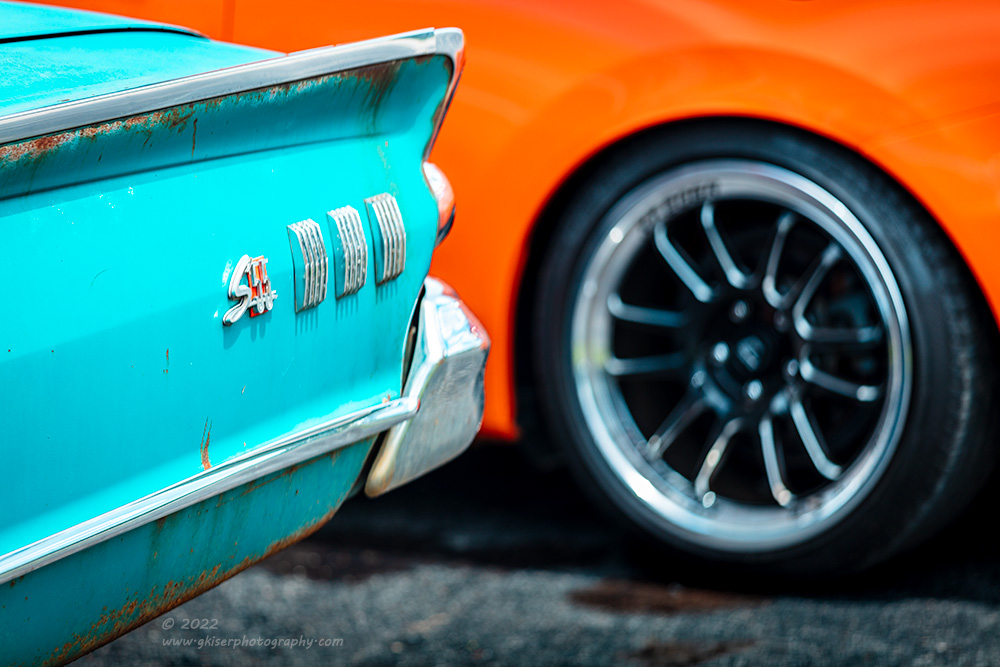
It was that open sun which was giving me the colors that I was looking for. The highly saturated tones of the teal and the orange were just what I needed. I wasn’t looking for reflections here, I was looking for the full-on colors in my composition. I looked at what I had to work with. I didn’t really want to get the Civic in the shot, but I wanted the color. In order to get the color, I was going to need to include parts of the car. I tried several different approaches to this all with the long lens. In order to keep the amount of orange to a minimum to maintain the focus on the teal, I chose to include the wheel and tire as kind of a framing element for the Mercury. To keep the Civic from being too much of a focal point, I used a very shallow depth of field to blur it out while locking the focus on the S55 emblems which happened to have a similar colored background to the Civic. I thought that the colors all worked together quite well here.
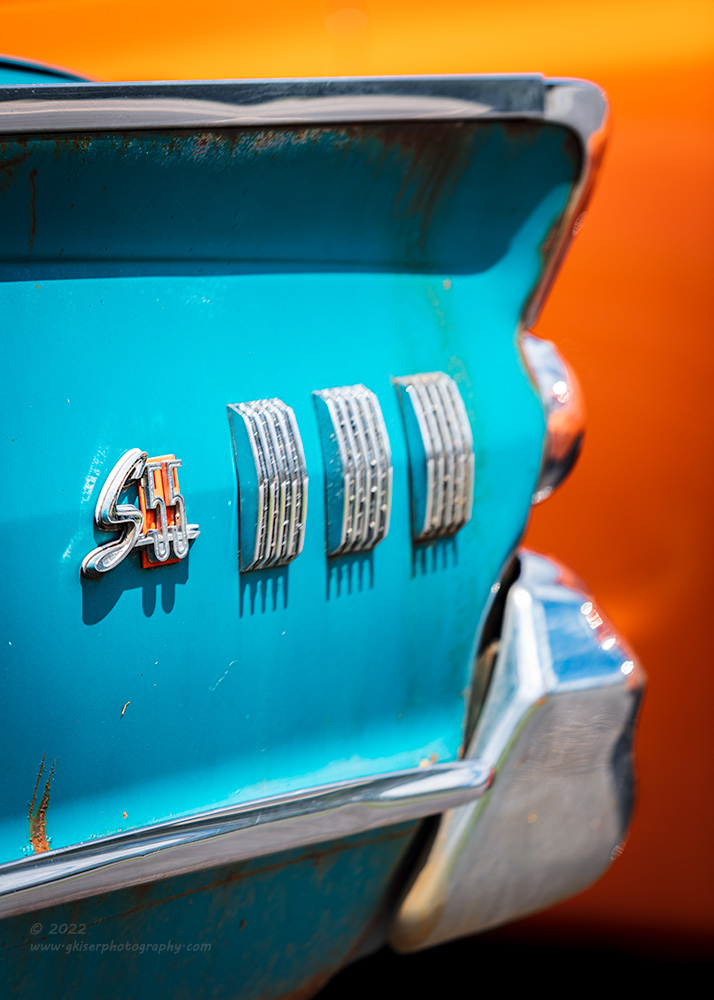
Feeling that I was onto something, I flipped the camera to the portrait orientation and took the wheel out of the frame entirely. I left just enough of the orange to frame the quarter panel of the Mercury. It was a completely different balance between the colors, but one that seemed to work pretty well. I again used a very shallow depth of field for this shot focusing the attention on the S55 emblem and letting the rest of the scene go soft pretty quickly. I don’t usually go for this type of limited depth of field, but I’m finding more and more opportunities to use it these days and I’m thankful that I do have the fast glass that I have even though it is not needed for landscape work.
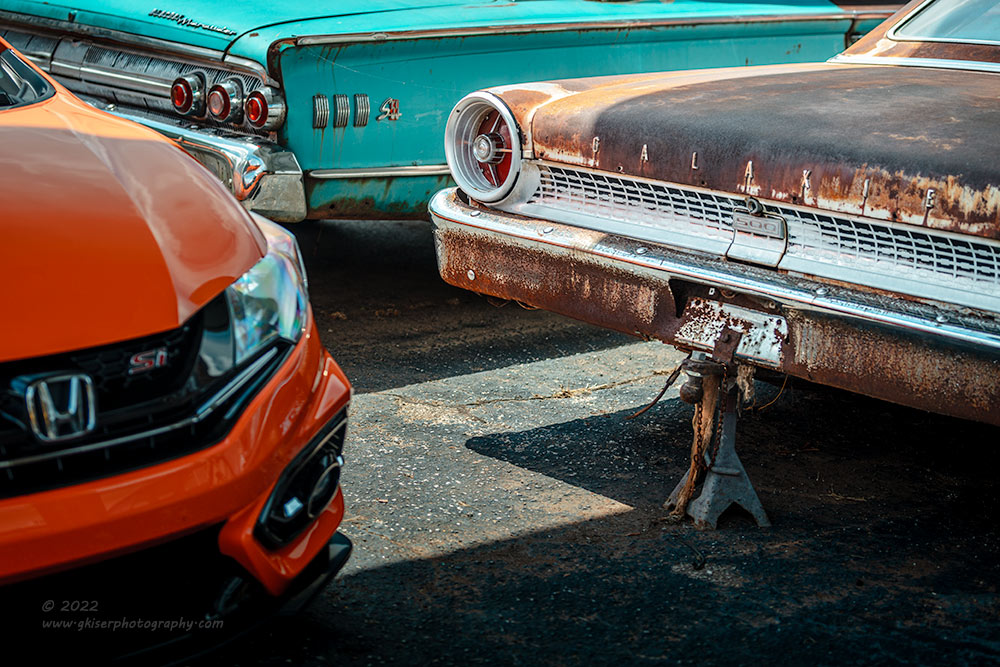
I was actually feeling pretty proud of myself for working that Civic into my photographs. I usually try everything that I can to avoid including late model cars in my compositions, but this was just working. I figured that since I was having so much success including this brightly colored import, I would go all in and make it recognizable. I moved around to the front of the car and looked at the scene before me. I had the orange Civic, and the teal Mercury that still worked well together, and they were framing the Galaxie. Now there was no way to include any of these cars in their entirety with the exception of the Civic. I made the decision to just include portions of each of them with emphasis on including emblems for identification. If you look at the photo above, you will see the “H” emblem as well as the “Si” badge on the front of the Civic. You will also see the full “Galaxie” lettering on the back of the Ford, as well as the full “Mercury Marauder, S55” badging on the Mercury. These items tell the story, but I wanted the focus on be on the older cars so once again, I used a limited depth of field and purposely blurred the Civic in the foreground to push the eyes past it despite the color dictating full attention. By focusing on the taillight of the Ford, I was able to get that car and the Mercury in the field of focus rather easily at f/3.2 while the Civic with soft and remained mostly in the shadows.
As you see, a photo like this requires a lot of planning to make work. Even then, it might not work at all. I’m still undecided on it, and I asked Toni her opinion as kind of a tie breaker. She didn’t like the Honda in it which was kind of my thought. However, the Honda serves a valuable purpose here I think so it is worth including it. I don’t know if this will ever be a portfolio image or not, but I like the concept of it, and I like the execution of that concept. I just don’t know if the concept is a successful one to begin with. Time will tell on this one I guess.
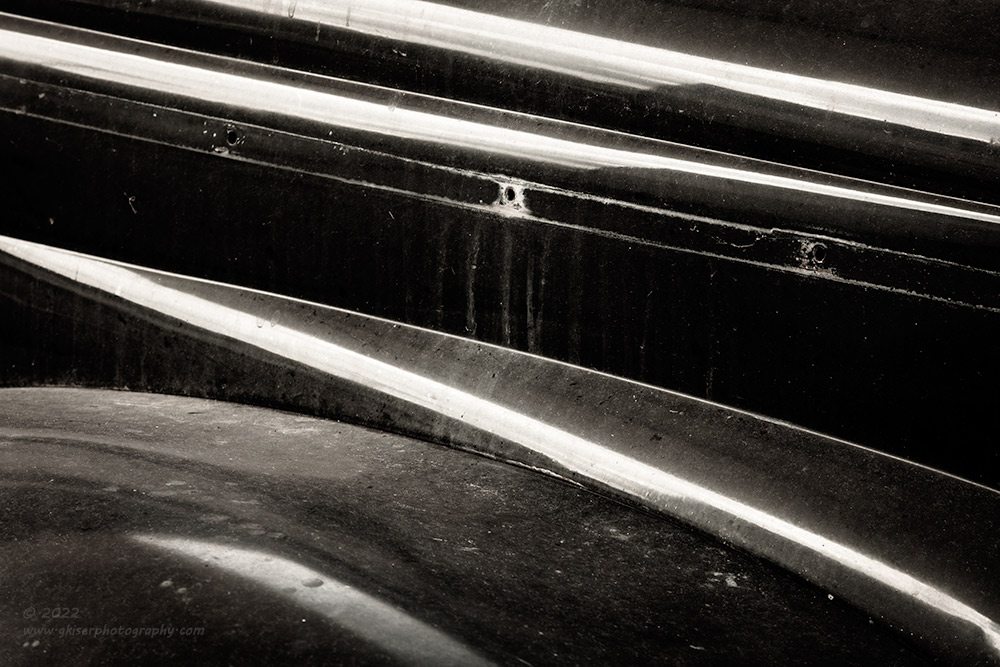
As I was working on the previous composition, I found myself looking at the black 40’s coupe parked to the right. I had already spent some time looking at this car and determining that it was just too shiny and didn’t have enough rust to really be of interest to me as a primary subject. However, the more I looked at this car in the ever-increasing sunlight, the more interesting the lines were becoming. There was an area around the hood and fender that particularly interested me, and I thought that there was a good chance for an abstract composition here. When I got finished with me concept for the trio of cars, I moved my attention to the coupe. I still had my long lens attached which was proving to be very flexible in this location. I was enjoying the ability to isolate different areas with relative ease while still being able to capture three different cars at the same time. I knew that this was the perfect lens for capturing abstract details on a car though, and I was really interested to see if I could make that happen with this black car.
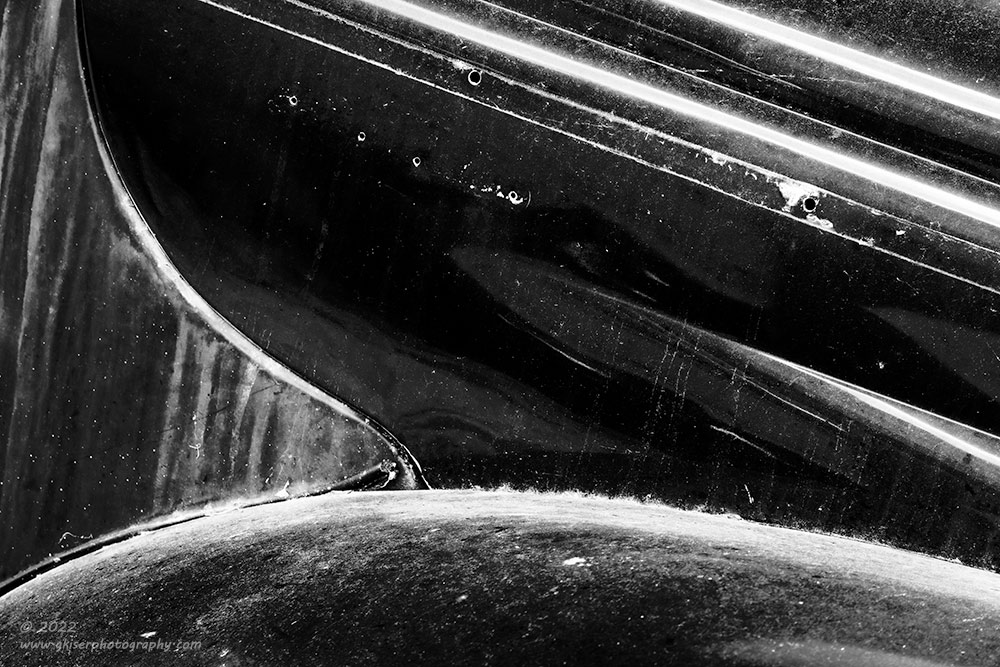
Black paint is a great color for showing off good body work. It is a fun color for that “murdered out” look on cars and has a certain gangster vibe to it. However, when it comes to photographing a black car, the color sucks the available light and returns copious reflections at the same time. When you photograph a black car, you are usually photographing everything around the black car unless the paint is faded and dull, and then you are just photographing the lack of light. In this case, the paint was actually in decent shape and was very reflective. The polarizer helped but could only do so much. For the concept of the abstract compositions, I was going to embrace the glare of the body lines, while using the polarizer to darken the reflections down. This seemed to work, and I was able to see the shapes that had drawn my attention to the car while working the previous composition.
I tried about a half dozen or so compositions on the side of the car with slight variations between them. I was looking for body lines, character lines, and seams all working together to create a visually interesting image. Since color wasn’t important, I was shooting this with the intention of having them all black and white. However, when I started to process them, I found that Automotive Lines was a great candidate for a subtle color tone across the image. This is actually a full color image, but the white balance has been tweaked and the overall saturation has been dropped significantly to give you the image that you see above. I chose to do it that way for just a subtle difference and something to give it a bit of mood to help the overall impact.

By this point in the day, I was getting very much overheated and was wishing that I had brought some water with me. It was over 90 degrees at this point and the humidity was atrocious based on how much sweat I was making. After working with the isolations on the coupe, I started to see some interest in this old black car. I felt compelled to try for an overall photograph of this one in a similar fashion to one of the earlier images with the shop in the background. Obviously, to do this, I was going to need to swap lenses, so I went back to the truck. This time, I went with my usual first-string lens for this type of photography, the 24-70mm. I left the polarizer attached and went back to frame up the composition that I had in mind. This was where things got a little interesting. I was again dealing with the old take-off wheels and tires that were right at the front of the car. I wasn’t worried about the bags because I didn’t plan on having them in the composition. There was an old square body Chevy truck and forklift behind the car, and piles of old parts beside the building. I was going to have to make sense of this whole scene in order to make a compelling photograph of the car.
As I was getting things set up for this, the same employee came back out and offered to move the tires for me. I again recognized how nice of an offer that was but was feeling more and more strongly that each of these items had a part to play in the story of this car and location. I was happy to have them stay right where they were even though it did mean that I was having to put forth a good deal of effort to compose an image that made sense. I thanked him again and assured him that I was enjoying the challenge, which I actually was. This is one of the big things that I talk about during my Decay workshops, and any chance I get to practice working with less-than-optimal settings the better. I would also feel like a total hypocrite if I moved these distractions out of the way while teaching others to work around those same distractions. This was how I was comfortable working, and I saw no reason to change it up.
I could tell that I was getting tired and hot at this point because I was starting to carry on conversations with the three dogs that were floating around the lot at this point. I was describing what I was doing to them, and I really think that the Doberman was following along quite well with my logic. This was confirmed when I finally got a composition that I liked and started to look at the exposure readings. The Doberman agreed with me that the sky was just too bright to work since I was dealing with light sucking black car…in the shade. We discussed options and the Doberman suggested that I use a 3-stop ND Grad to control the sky. I thought that was a little overboard, but I didn’t want to get bit, so I went to the truck and grabbed the filter to slide it in. I hate to admit it, but the filter did the trick and evened the exposure out quite well across the board. I now had a decent exposure in the shadows while keeping the sky full of detail. The only thing that was left was making small adjustments to the composition in order to make sure that none of the signage was blocked and that I had reasonable separation between everything while the distractions were minimized or covered up. This one turned into probably my favorite image of the day, and it was a personal accomplishment as well because I had taken a very cluttered scene and organized it in a way that made total sense…even the Doberman liked it. I know this because between every shot, she kept moving into the frame waiting for me to call her over to me for another head scratch while I made an exposure.
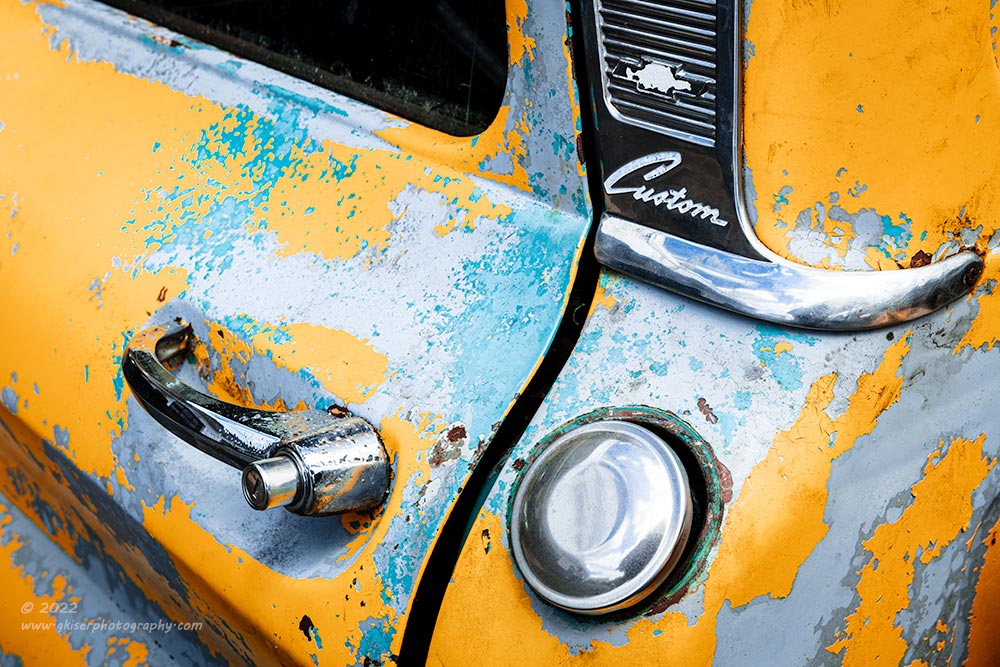
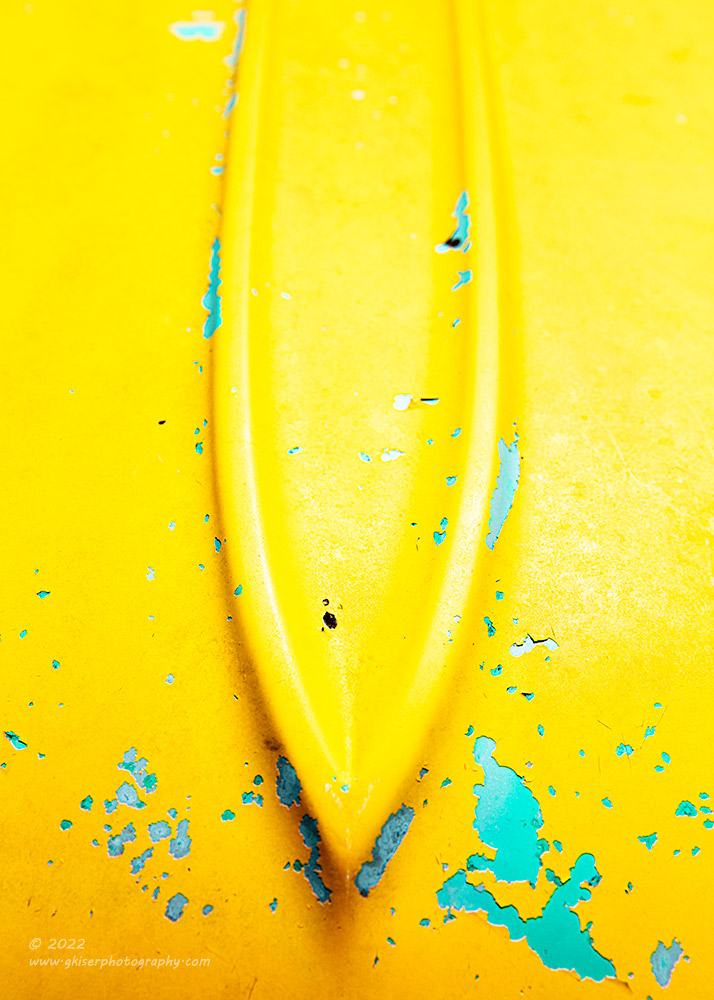
At this point, I was feeling that I had shot everything that I wanted to with the exception of the old Chevy truck which was parked right next to me. The truck was yellow, and the paint was chipping off pretty heavily on most of the surfaces. The underlaying color was a blue and a gray which I thought went very well with the yellow. Before leaving, I went over to this truck and started to figure out where the points of interest were. I was actually having a problem with this one finding that compelling composition. I finally landed on the hood, not literally, but I saw something interesting there to work with. It was not my normal emblem or hood ornament that caught my attention, but the stamped body line right down the middle. There was just enough shadow on the lines to make it stand out and the bits of bluish paint beneath the yellow made for a great color contrast to work with the contrast for the body lines.
I worked out a composition that was really quite simple that just had a symmetrical look with the main feature right down the middle. There wasn’t much to this shot and I only made two exposures of it with slightly different exposure settings before moving on to something different. I wasn’t sure if this would work or not but felt like there wasn’t much else that I could do to improve on the shot. I knew that there had to be something else to capture on this truck because it was just too cool to have only this one composition to offer. As I worked around the truck, I found that the driver’s side cab corner had a lot of interest going on with the chrome handle, gas cap, and “Custom” trim. The patina of the paint was particularly interesting here as well which prompted me to start looking through the camera to find the composition. It took a little while to arrive at the right angle and position relative to the cab to get this composition worked out. Once I had it locked in, I knew I had a winner and I shot three different variations before deciding that I had all that I needed of this truck.
That little switch flipped in my head, and I knew I was done. The heat had been getting to me far too long at this point. As I’ve mentioned before, there comes a time in most of my shoots when I just don’t even want to look for new compositions anymore because I’m creatively spent. That was how I was feeling, but I had a feeling it was more heat related than creativity related because I had been on such a roll here. I was pretty sure that I had that half dozen images that I thought I would get. Actually, I had 78 frames shot for the day and if my normal 10% hit rate applied, I was looking at 7-8 new images that would be processed. That would be a very good day and I was hoping that I could pull off that number. Of course, if you have been keeping track, you will know that I’m well above that 7-8 image mark. Looking back over what I’ve posted, I have….carry the one…..14 keepers from this single location which is a nearly 20% hit rate. I just can’t complain about that at all!
When I got in the truck, the first thing that I did was crank up the A/C and try to cool down. As much as I hated being this kind of hot, I can still remember very well being so cold that my fingers didn’t work well enough to collapse the tripod or to break the camera apart when I was done. I’ve been in the truck holding my hands in front of the heater vents causing them to throb in agony while I was sitting on seat heaters at full blast just trying to get the feeling back in my extremities. Which one is better? I don’t really know because both of them suck pretty bad, but at least I can still function when I’m hot. It also takes less time to cool off than it does to thaw out.
I was headed home which was an hour away and around the 3/4 mark, I was actually feeling a little bit of creativity returning. The clouds were looking decent in Wilkes County so I decided I would look for another potential target of opportunity. I didn’t have anything in mind at this point, but I knew the area that I wanted to drive through. It was just a bit up Hwy 18, and kind of on my way home. I exited on a road that I’ve used several times to get home, but instead of making my normal turn, I just stayed straight remembering that there were some decent subjects out that way. If I was lucky, I would find one that was in good light, and I could get a few more photos.
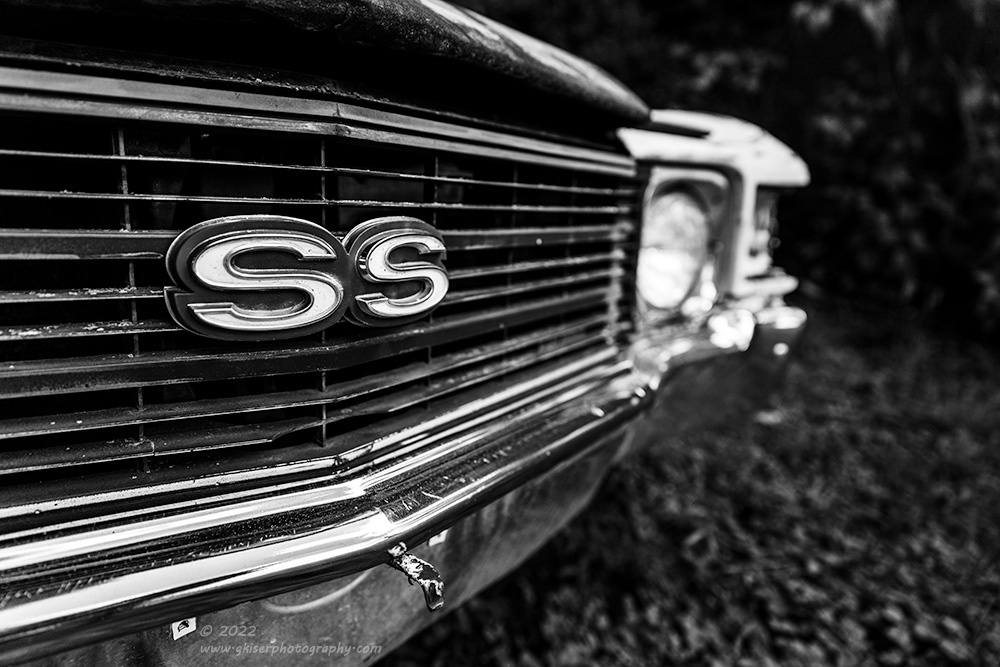
Within a block of passing that normal turn, I was driving slowly and looking. As I passed one house, I saw the unmistakable front end of an early 70’s Chevy with an “SS” badge on the front. It was in the shade which made for great lighting on it, and even though it was parked next to the house, there were large bushes between the two elements that would make for a better backdrop. I got turned around and looked from the other angle. There was a garage behind the car, which was not ideal, but I could see some potential isolations on this car that would be worth trying. Without much extra thought, I pulled into the driveway and went up to the front door to ring the bell.
The door was opened much quicker than I expected, and I went through my quick introductory speech and asked permission to photograph the car. They were happy to let me get some photos but were concerned about what I saw in the car. I believe that the actual response was “you are welcome to photograph what’s left of the car.” I’m quite used to this kind of reaction and assured them that there was plenty of car left for photos, and the parts that were left were some of my favorite kinds. I grabbed my camera and went over to start working the compositions. I started with the overall shot which I wasn’t all that happy with. After getting that first shot out of the way, I heard the door open and the owner came out to chat with me, and most certainly check up on me to see what I was doing. I would expect no less, as I would certainly do the same thing if I found myself in their shoes.

I ended up having a great conversation with the owner who told me that he was the original owner of this 1971 Chevelle SS and it had been on the road as recent as 10 years ago. I did see from the tag and inspection that it was actually more like 20 years, but time does fly. He had fallen ill over the past 10 years and hadn’t been able to do much with the car. His son was supposed to come and get it to restore it, but that is not seeming like a priority for him. We talked about several other things, and it was a very nice conversation. After 10 minutes or so, he was needing to get back inside and out of the heat, so I was left to my own devices and went back to the task of capturing some photographs.
Since I wasn’t happy with the overall shot, I moved in for some of those isolations that I had seen from the street. Funny thing was, the actual compositions that I was coming up with were not as good as I was thinking they should be. Was my creativity actually finished for the day after all? I think it was just a lack of visual interest in the normal areas that I would like to photograph. There was just not the right kind of aging in the right places on this car and it made finding good compositions difficult at best.
I started to concentrate on the front of the car around the SS emblem which has been a good subject in the past. As I tweaked the compositions, I found that ones that I had shot previously on other cars were more successful than these were. I’ve learned over the years that unless I can improve on a composition, there is really no reason to keep reshooting the same one over and over. I tried some different variations that I thought might suit this car better and found one that used the emblem as a visual anchor and foreground while the headlight was the background. In atypical fashion for me, I let the headlight blur out and I focused on the emblem only. This actually seemed to work out quite well and turned into a pretty good black and white image since color really didn’t factor into the frame.
Feeling a bit better about the isolations, I went around the car in search of other intimate captures. I found something that I felt was workable on the back right corner, but when it was all said and done, there wasn’t enough shape to the composition, and the colors were lacking which made it an overall bland photograph. I tried finding other emblems or focus points to work with, but nothing was sticking out at me. Most of the trim was missing which is my normal point of contrast for a rusty car. The hood had been caved in from a tree that fell on it recently, so I didn’t have that part for body lines. It was seeming that all I was going to get was a shot of the SS badge on the front. I couldn’t accept that with a car this cool though.
I went back over to the front corner and started to look at the compositions from there once again. I realized that I had been shooting too wide to start with, so I backed the camera up and zoomed the 24-70mm to roughly 65mm and recomposed. This was looking better, but the relationship between the car and the garage in the back wasn’t looking good to me. It got worse the higher the camera went, so I went the other direction and dropped the camera to the ground. I was on a slight hill, so I ended up putting the camera about six inches above the grass which put it on roughly the same plane as the Chevelle. This slimmed the car down and made the garage door an important element to help separate the car from the greenery where the light was getting dimmer. This worked out much better, but there was still something wrong with the shot. There was too much negative space above the car for my tastes and it made the car look awkward in the frame. I was able to fix that with a quick switch to a 16:9 aspect ratio that put the background in a proper relationship to the car. This ended up working perfectly, and by the time I was finished here, I had an even 100 frames captured for the day with an additional two keepers from this last location.
What started out as an experimental trek where I didn’t have much hope for anything developing has turned into one of my most successful treks in a while. It just doesn’t happen all that often that I get 16 keepers from a few hours’ worth of work. It is especially unheard of when the sun was as bright as it happened to be for most of the day. I am really quite proud of the job that I did, especially knowing that I stayed true to my shoot it as a find it mantra. Both locations had elements that I usually wouldn’t care for which ended up in my photos and yet still had a purpose and a part of the story to tell. It is just quite satisfying to work through these concerns in the field and come up with strong images despite the difficulties you come across. I think that it is this concept more than anything that I try to teach in my workshops, especially dealing with the decay subjects because that is where you find the difficulties more than anywhere else.
Thank you so much for joining me on this trek and I really hope that you have enjoyed the photographs. Remember, if there are any photographs here that you would like prints of, I do sell prints of all of my images. If you don’t see the size or media that you are wanting, just contact me and we can discuss a custom order for you. Don’t forget that I have my highly popular decay workshop coming up in November in East Bend, NC, where we will spend a full day getting hands-on experience dealing with issues like I’ve been talking about during this trek. It is probably my most popular workshop and it is a unique one in that it deals with shooting decay subjects rather than landscapes. There are still slots available, but you need to get signed up soon to ensure your spot.
Also look for some changes to this website coming soon. I am getting ready to ramp up my portrait and boudoir work and there will be a corner of this website designated for those endeavors. I’ve already started a new Facebook page for that work so that I don’t confuse my main page. I invite you to drop by and check it out and give it a like and follow to see what kind of work I’m doing with people photography. As I say, you don’t have to be rusting or falling apart to appear in front of my lens. If you are looking for some type of portrait service, and you are reasonably close to Wilkes County, give me yell. I would love to work with you and capture your own unique qualities here in the studio or on location. I’m not a high-volume photographer by any stretch, so you can rest assured that I will give your shoot all the attention that it deserves and we will create art together.
Until next time…

Remember to use the code KISER10 to get 10% off your purchase