Thursday, August 4, 2022
I tend to go through stages with my landscape photography. There are times that I just want good daytime light with an interesting sky to tell the story, and then there are times that I try to get more dramatic colors in the sky around sunrise and less often at sunset. I really try to get those times coordinated with the shorter days of winter so I can take advantage of the late sunrise and early sunsets. The problem there is, I get cold waiting on the sun to do what it is going to do, and the color on the landscape is generally rather blah during those times. Occasionally, I get the bug to go out and hunt the colorful skies in the Summer and I just have to suck it up that I’ll be out either really early or really late.
I’ve recently had the want to get out and do some sunrise/sunset landscape photography, and that might be due to the Behind the Camera that I have been working on for the previous month. One of the mistakes that I talked about was getting to a location too late or leaving too early and that was directed mostly for this type of landscape photography. It isn’t my favorite style as it is often the most captured time of the day in landscape photography, which makes this just too saturated a market to really have anything that stands out. However, I tend to enjoy more subtle hues than most do for this type, and I do enjoy playing around with the colors in the sky from time to time.
You might remember my trek from last weekend to Price Lake for sunrise. I had been waffling between going to Price Lake and Doughton Park. I had reasons for going to each of them, and the lake won out. That didn’t mean that I was forgetting about Doughton though, I was just looking for slightly different conditions. I love Doughton with a stormy sky, and I have recently fallen in love with an area that I haven’t really spent that much time in over the years. Ironically, it is within sight of my most often photographed location within the park where my favorite tree resides. It was last year that I decided to stop at this location, and I found so much to like about it that I just had to keep coming back. The more I looked at the location, the more compositions that I found. The best part was that I was seeing compositions that could be done with a variety of my lenses, including my 14mm that I love working with when I get the chance.
Since this was normally a morning location for me, I have been wanting to try it in the evening for a sunset, and since I was looking for dramatic and stormy skies, this was probably going to be the best time to make that happen. The weather has been very unsettled here of late with just about every afternoon and evening seeing storms rolling through the area. I had a couple of appointments in Winston Salem Thursday morning when the weather was supposed to pretty nice with partly cloudy skies and no chance of rain. Because of that, I took the Miata which was a mistake. It was a great ride out there in the morning, but on the way back the clouds built up and it really started to look like rain. In fact, it did rain, three different times and one of those times forced me to close the top which I rarely do. Fortunately, the road never did get wet, so there was no spray kicked up on the car, just beads of water blowing over the surfaces of the car. It did make me regret not taking the truck and packing the camera as I had originally planned when the forecast was calling for this very same set of conditions. I was looking at some great clouds and really good lighting which got my mind focused on photography through most of the ride back.
When I arrived home, I was thankful that the car was not even dirty except for the extra bugs that I was already expecting. The clouds were not as pronounced, and the midday light was a little too harsh for the time being. It did get me thinking about going out for an evening shoot to take advantage of the storm cells that were supposed to be rolling through the area. I checked the weather and saw that the clouds were supposed to fade away until about 5pm when the high-level clouds would start to roll back in. These are the clouds that lead to good color as long as the sun has a hole to peek through at the horizon. It was worth a shot to go to Doughton and see what I could come up with since it wasn’t but a 40-minute drive from home.

By the time 5pm rolled around, the sky was still brilliantly clear with no clouds able to be seen. Looking at the cloud radar, we were in a trough between the clouds that had passed by earlier and more that were coming up from Asheville. It didn’t look like the clouds were going to actually make it to Allegheny County in time to get out there. Without a fair chance of color, I was content to stay at home. I had been out all day and I hate going out in the evening for photography because my creativity is usually fading away later in the day unless I’ve been gearing up for something specific since waking up. I had all but decided to skip it and go in the morning when there were more high-altitude clouds expected. Just when I was settling back down, I noticed that the light dropped outside. I got up and looked and saw that there were some clouds finally arriving overhead which were bound for Doughton Park. I had already decided that I was going to need to leave by 6:30 in order to get up there in time to get compositions staked out and get things in order for the exposures to start. It was just before 6 at this point. I considered it briefly and asked Toni what she thought I should do. The end result was I was getting socks on and grabbing my keys to go downstairs to get my shoes on and to load the camera in the truck.
When I got into open country and could see more of the sky, the clouds that were passing overhead at home were most definitely headed where I needed them to be. They were looking really good but looked lower than I had expected which might impact the color possibilities. It didn’t take long at all before I was pulling into Doughton and driving by the wildflowers that everyone goes nuts over each year. They are colorful, but flowers just don’t grab my attention like they do for most people. I was looking for a dramatic sky, and I knew where I wanted to be located. I drove the length of the driveway until I got to the lower teardrop parking area. There were only two other vehicles there and one of them belonged to a group at some picnic tables. This was really good because Doughton in the evening is usually kind of busy from my experience.
I got parked and grabbed my camera. I started the quick hike up the trail through the meadow that is so familiar to me. When I got to my favorite tree, I saw all of the compositions that I had shots before, and also saw a man leaning up against the tree. I guess it was a very good thing that I wasn’t planning on shooting here this time because that tree is a key component in the majority of my favorite compositions. I just bid him a hello and continued on my way to the next stop which was where I planned on working from. The total hike was just at 10 minutes, and I was there. The sky was looking really good, but I was less happy with the compositions than I had expected. The clouds made the light very flat which I knew ahead of time, but it was hard to really get a feel for what I wanted to shoot just yet. I walked around and looked at the angles until I had a better understanding of where the interest in the sky was, and how to best place it with the elements that I had available to me.
The best sky was looking due West which was not what I was hoping for since that was going to give me a very high contrast scene if I was going to get the sky exposed as I needed it to be. The fact of the matter was that was my shot no matter what I was concerned about. If luck worked out, I would be able to shoot from either the North or the South to get some nice side light, but for now, the clouds dictated this position. I got the tripod set up in roughly the area that I wanted to shoot from and thought about the elements available to me. I wanted to have the tree in a power position within the frame and also wanted the fragmented rocks in the foreground. I knew that I could shoot this with my standard lens but wanted to add a little more drama to the view in hopes that the lighting would support it. I decided on my 16-35mm which is a great lens for this type of scene.
With the camera built, I started to work the different variations on the composition that I had seen until I landed on the right balance of elements. Once I was happy with the composition, I started to look at the exposure. I could tell that the sky was bright, but it wasn’t the main portion of the sky that bothered me. It was the open portion right at the horizon which was the brightest and causing the most difficulties. I tried an ND Grad first off and selected a 2-stop hard edge Galen Rowell with the intention being to get the density added in quickly to the sky right at the horizon. I quickly saw that this filter was darkening the top portion of the sky way too much as well as the tree which went into the sky rather boldly. This wasn’t going to work at all. I took the filter off and thought about doing an HDR blend of images, but with the tree forming a main component, the wind that was moving around would make getting the blend very difficult without some heavy-duty anomalies. I knew that there was a workable way to capture this scene, I just had to slow down and think about it. I could do a long exposure with a 15-stop ND filter, that would do the trick (see mistakes #7 and #6)! Nope, a long exposure wouldn’t do a thing here, but a reverse grad would work. The Singh-Ray Daryl Benson Reverse Grad is one of those filters that I carry, but rarely use. It is designed for sunrise and sunset photography when the horizon is the brightest part while allowing the top of the frame to go back to a normal exposure while leaving the ground unaffected. This was the job that the filter was designed for, but the tree was going to cause some issues that would have to be worked out in post which I knew about going into the shot.
I slid in the 2-stop Daryl Benson Grad and brought it right to the horizon which was largely straight. The exposure of the sky came down very nicely in relation to the ground. I took a quick test shot to see where the exposure landed and saw that the brightest part of the sky was still blowing out slightly, so I dropped the exposure a little bit more. When I got rid of the blown-out portions, the darks were getting too blocked up which was going to be a problem when recovering the detail of the tree. I added a bit of exposure back in until there was just 2/3 of a stop worth of clipping going on at the brightest portion of the sky. I knew from experience that I could recover that in Lightroom, and it would allow more detail in the shadows. The image looked really ugly in the LCD upon review, and it didn’t help that I had a visitor that was making a cameo appearance after landing on the filter. With the lens wide open, I didn’t see this in the live view, but when the image review popped in at f/13, there he was. At Toni’s request, I’ve added this “capture” to the blog and will probably use it as a teaching point later on.
I also thought that you might like to see a RAW image straight out of the camera without any editing save a resizing. This is the type of image that I see in my LCD on playback because I use a Neutral picture style with the contrast and saturation dropped to the lowest point. This gives me the most accurate histogram for the information that has been captured and allows me to really fine tune my exposure to get the right image. I will then take this RAW image and bring back the colors and contrast that I removed, but in a very controlled way. It also allows me the opportunity to have a ton of detail in the dark as well as the bright areas.

The image that I actually selected as the keeper from this series wasn’t the one with the bug on the filter but was shot some time later when the sky changed up to give a better balance to the composition. However, the overall exposure is similar between the images so you can see the difference that a fully processed RAW image has over its digital negative. There is another benefit here that I will probably point out more in my next Behind the Camera when I talk about AI editing of images. This is the sky that I was presented with at the location and is not a sky replacement. The scene was processed to capture the emotions that I felt when I was looking at the scene.
My goal for this composition was to capture the tree with a brightly colored sky behind it as the sun dropped. However, as the sun dipped beneath the clouds, the contrast became way too much to deal with. I knew that I had about 15 minutes before the clouds would light up with color. I knew the location for the composition, and it was not a difficult one to arrive at with the exception of having the camera extended well above eye level to capture the right perspective (see tips #4 and #3). With that in mind, I figured that since the sun was popping out, I would go to my originally intended composition to see if I could get the light to play nicely. As I was walking around to that angle, I remembered the gentleman that was sitting at the base of the tree at the top of the meadow. I was hoping that he wouldn’t get in the shot as that tree is included in this composition.
As luck would have it, he was gone at this point, and I saw a nice clear view of the landscape. I still had the reverse grad filter attached and felt that it was warranted here as well because the horizon had the brightest section of sky to it from this angle as well. As I set the composition up, I wanted to bring a bit more contrast into the sky and since this was at pretty much 90 degrees to the sun, I was able to use a polarizer which I snapped onto the front of the filter holder. I dialed in the correct amount of polarization and started firing off exposures. The sun wasn’t hitting the ground or the tree like I wanted so I was basically just capturing the sky once again which wasn’t all that fantastic, but it was giving me some options when it came time to go through the images.

Just as I was getting into the rhythm from this angle, I noticed a family of three at the tree in the distance. They were all running around at the top of the meadow, and I could see that causing problems from this angle. I also happened to notice that there were about 30 head of cattle slowly eating their way towards me…and my composition. There was every chance in the world that I was about to be done with this location, but I wasn’t quite ready to give up on it just yet. I walked over to the nearest cow which took the hint and turned to eat in the other direction. I returned to the camera and looked at the scale of the people on the hill and determined that as long as I could get them in more open areas at the ridge, I would be able to remove them in Photoshop. As I had come to these conclusions, something magical happened to the scene. The sun broke free of the last bit of clouds and started to bathe the landscape in this awesome warm light. It was what I had been waiting on and had hoped for. The sky wasn’t picking up the color that I was hoping for, but the sunlight on the land was too good to pass up.
I started making exposures and found that the warm glow was looking great, but it was too muted on the tree because of the reverse grad that I still had attached. Looking at the scene, there wasn’t anything in deep shadow, so the exposure was more even through the scene which allowed me to remove the filter leaving just the polarizer attached. This made all the difference in the world and allowed me to speed up the shutter slightly and get a very balanced exposure through the scene. The tree was well lit in the sunlight which was very important for the scene. I was watching the family of three on the hill and trying to time my exposures for when they were in locations that were easy to clone out. I also realized at this point that one of the cows had walked into the scene just beyond the main tree beneath the ridge. I had to work around the swinging of the tail to make sure that it wasn’t included in the frame. I somehow managed to get everything to line up for this particular shot with the sun at its brightest and the family of three huddled together right on the ridgeline.
The sky wasn’t quite what I was hoping for, but the image as a whole is a total win in my book. I’m very happy with it, and that strong side light that sculpted everything just worked so well for this scene. Since the sun was already poking out from beneath the clouds, I was expecting the clouds to light up any moment. I decided to keep with this composition rather than move back to the original one. Moving and getting set back up might only take me three minutes, but that might be the entire length of the time the clouds would be lit up. With the family now gone, and the cow moving out of the frame to the left, I was content waiting here. The sunlight had faded on the landscape which forced me to add the reverse grad one more time as I waited.
I’m not quite sure why the sky didn’t light up with glorious colors because the sun had a clear hole through the clouds almost all the way to the horizon. However, the color never did come, and the best of the color was right at the horizon. I moved back to my original spot to get that composition dialed in once again, but quickly saw that there was no use in doing that at all. The color in the sky was so small that it got lost in the original composition. That wasn’t a problem though, and I had something in my bag of tricks to take care of that issue. I just swapped lenses to my 70-200mm telephoto which would isolate that portion of the sky quite well.

I went ahead and left the filters off and started to frame up a composition that worked. I had already scoped out the base of the tree that I thought was really nice and I found an angle that showcased that as well as the distant blue ridge mountains under that glowing orange sky. I fired off one exposure and found that it was too hot, so I backed it off by a 1/3 of a stop and tried again. That worked like a charm, and I saw no reason to repeat this composition so I picked it all up and moved around looking for something else that would work. The sky was fading fast, and I wasn’t finding anything else that I wanted to shoot. Well, that might not quite be true, there was a great cloud formation just South of where the sun had set that was still picking up some color. The problem was there was nothing I could put below that would make a good composition. I had to just enjoy it and let the photography go for a while. Sometimes it is like that as not everything is a photograph. That doesn’t mean that I can’t still look and enjoy what I am seeing though.
As the light faded, I started to think about calling it a day and packing up my gear. The cows were getting closer still and were in the way of most of the shots that I was wanting to take. In fact, you can see three of them in the previous image if you look closely. The clouds were building and there wasn’t much chance of a second blush at this point, but I had to remember my own advice and wait until I was sure that the light was done before packing up. I would hate for somebody to call me out and say that I had committed mistake #10 just a few days after publishing the list.
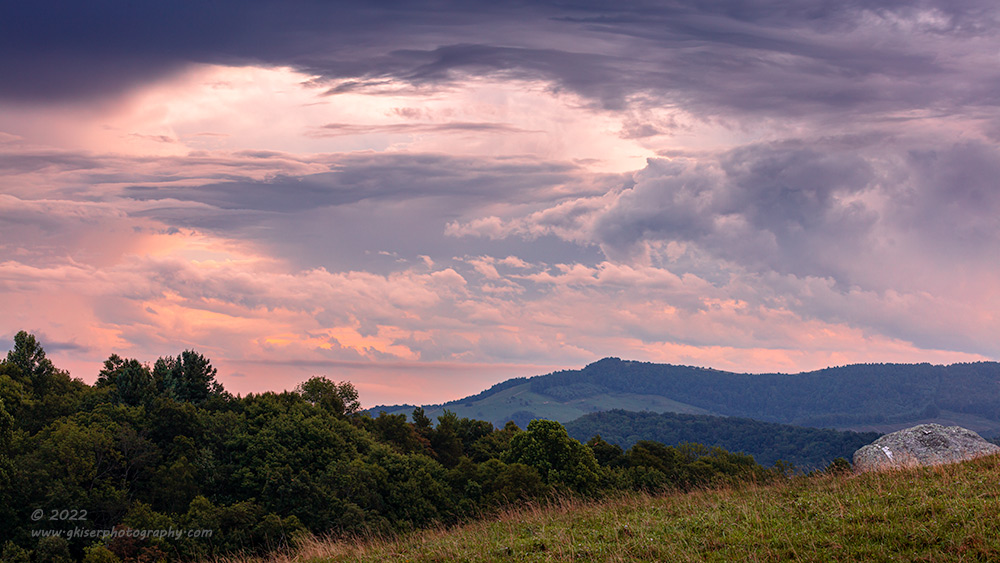
As I waited to see what was going to happen, I started to see some interesting patterns and textures developing to the North. There wasn’t much of interest to put beneath of it, but there was also nothing blocking the view to the sky either. I went ahead and got as much altitude as I could by finding a little ridge in the meadow. I still had the long lens attached which was the best option for capturing the sky like this. In order to get a little more contrast since it was still lit by the sun at a very hard 90-degree angle, I added the polarizer back in front of the lens and framed up the shot. The light was really fading fast at this point, so I had to work quickly to find the composition. I centered the image on an area of the sky that had the most interest and decided to have an exposed rock frame the image opposite of the band of trees in the midground which were in the shadows. I included just enough of the grass to give a foreground, and a place for the rock to sit on, but the main area of concentration was the distant mountains in the background that transitioned up to the sky.
When I got this one into Lightroom to edit it, I found that the composition didn’t read all that well, so I flipped it left to right. This gave a more pleasing flow to the scene with the eyes entering at the lower left and bouncing off of the rock to follow the background mountains before entering the sky and pursuing through the brighter areas until meeting the dark clouds at the upper right corner which drive the eyes back into the scene to the rock once again. Flipping this image made me consider doing it with the previous one as well since a tree on the left side of the frame will either introduce a scene or block the eyes from moving through it. I wanted to see which case was present with that image. Sure enough, flipping it, opened up the entire composition for my eyes and made it read much more correctly.
With the light completely done at Doughton, I packed up my gear and started the walk back to the truck. I could see lightning in the distance in that really cool cloud formation I had seen earlier. With it getting darker, this was going to be a good time to get some lightning photography done which is something that I haven’t done in years. The problem was I wasn’t able to find a composition that I liked for the cloud no matter where I was looking. When I got to the parking lot, I went over to the side where that cloud was and tried to pick out something that would work. There was nothing there either. It was the direction that I would be traveling going home, so I figured that I would keep my eyes out for something that would work on the way.
During my trip, the lighting got more and more pronounced, the closer I got. It was now dark which was perfect for lighting photography as it is just a matter of doing a bulb exposure until the lighting hits. I just couldn’t find anything to put under the lighting that would make sense. It does give me the idea for doing lighting photography in the future so I can start thinking about where best to capture it from. Once again, I just decided to enjoy the show and forget about the photography for a bit. It was an exciting ride home watching the lighting, and it was a nice conclusion to a very impromptu trek that resulted in 77 frames captured and four keepers added to my collection.
I hope that you have enjoyed this trek as much as I did. I was very surprised to see so few people out at Doughton and that really made the experience even better because I love the peace and quiet that I usually get in the mornings, but rarely get in the evenings. Remember, if there are any of these photographs that you might like prints of, please let me know, or you can order prints directly from this website. Keep in mind that I can do pretty much any size you would want, and I can have them done on many different types of media like metal or canvas, in addition to fine art papers. I capture these images with the intent on having them printed to be enjoyed hanging on the walls. Seeing them online is great, but there is just nothing that can compare to seeing them in that tangible form.
As we get closer to the Fall season, consider looking into my workshops which are scheduled for October, November, and December. You will see that everything from landscapes to decay is represented in those workshops. If you would rather learn on a more individual basis, consider taking part in my mentorship programs which can all be customized to your needs. I’m about to have a vacancy for my Advanced Mentorship program here in the next month or so if that is what you are wanting to take part in. I can only take a small number of these mentorships on because of the time needed for the clients, so get your name in the box for when I have a spot to open up.
If you aren’t a photographer, but want to have your photo taken, then I can help you out with that as well. My test shoot calendar is just about full, but I might be able to fit you in for a free, or deeply discounted session if you get signed up soon. Otherwise, it will be full price which will grow as my experience grows. Let me know what you have in mind, and I’ll be happy to work with you in order to get those perfect photos. You will start to see more about my people photography as I publish a few more web pages hopefully very soon. I will still refrain from doing blogs about most of the shoots though because I want to keep this section of the website purely about my landscape and decay photography. I’ll talk about it from time to time when there is some educational purpose to what I’ve done, and only if I have the needed releases from my subjects.
Until next time….

Remember to use the code KISER10 to get 10% off your purchase