Saturday, November 11, 2023
This was one of those treks that just never really made sense to me, but when I look back on the photos from the day, I’m astounded at what I came up with. I could go into detail with each photo that I shot and talk about gear, but that really won’t tell the story from the day. I’m actually trying to get away from talking gear as much because it plays such a small role in the final image that it really is a waste of time to write the “Red L Paragraph” that Toni so lovingly calls it. If you are interested in the gear that I have used, you will find links under the photo for the major players. If you are interested in how specifically I use the gear that I have, I invite you to join me for a workshop or a mentorship session where I have no secrets as to my process. If you are just interested in the creative process, just keep on reading and I’ll bring you right along with me for this wild ride.
The last time I was out, was two days ago when I did a mentorship session with a client at Mabry Mill. We covered a lot of different aspects around photography during the day, and then yesterday, I sent out an email with some thoughts from the day. I like to do that when I have some constructive pointers that might help the learning process. One of the main themes that I brought up was the benefits of working fast in the field. I don’t mean rushing through things, but rather not taking so long to get ready for the photo that you miss the conditions. This is a bit of an opposite concept from what I normally would teach where I suggest that you spend time working the scene.
So, do I recommend that you go fast, or go slow? Yes….both. The trick is to be able to set up quickly so that you can capture the scene that prompted you to bring the camera out in the first place. Once you get to that point, you can slow down as much as you need to in order to work the scene. The reason that I bring this up is because these points had a lot of bearing on my trek today, and I felt like it would be a great reinforcer to what I was just talking about. The things that I teach are not just fuzzy concepts that sound good. They are the skills and techniques that I have been using and perfecting over the years. Nothing I do is a secret, so I have no problem putting it out there for those that want to learn.
Let’s get back into the story of the day before I get myself sidetracked and end up writing the next Behind the Camera. I was wanting to get out, and actually needing to get out with the camera for a little bit of stress relief. I’ve been patiently waiting for a nice cloudy day to go out and work. You might recall that I was wanting to go out on Friday, but the location prompted a change that turned into Mabry Mill on Thursday. It was all for the best because Friday was a little bit rainy, and I didn’t feel like going out in the wet. The forecast for Saturday was looking really good though with pretty much total cloud cover with mid and upper level clouds which usually means some good texture. I just needed to figure out where to go as I didn’t have any particular subject in mind.
As I thought about my options, I began to think about a road near the house where I had been told about a truck close to the road that might be of interest as well as some old buildings well off the road. It was a quick drive to get into the area and I thought that I could start off there. When I got done in that area, I wanted to get back out to Traphill again since I tend to have really good luck in that area about every time I visit. The weather seemed to support my idea, and I saw no reason to get too early of a start since the clouds would be around all day long.
I spent the morning down in the studio getting my daily work taken care of and plotting what I might be shooting. When the late afternoon came rolling around, I went upstairs and looked outside. The light was beautiful with some directional light coming through the clouds. Off to the West, I could see that the clouds were starting to break up which was not part of the forecast. I was hoping that this was going to be short lived, but I wanted to get out there soon so that I could take advantage of the light that I was seeing currently. Light is fleeting, and it rarely stays the same long.
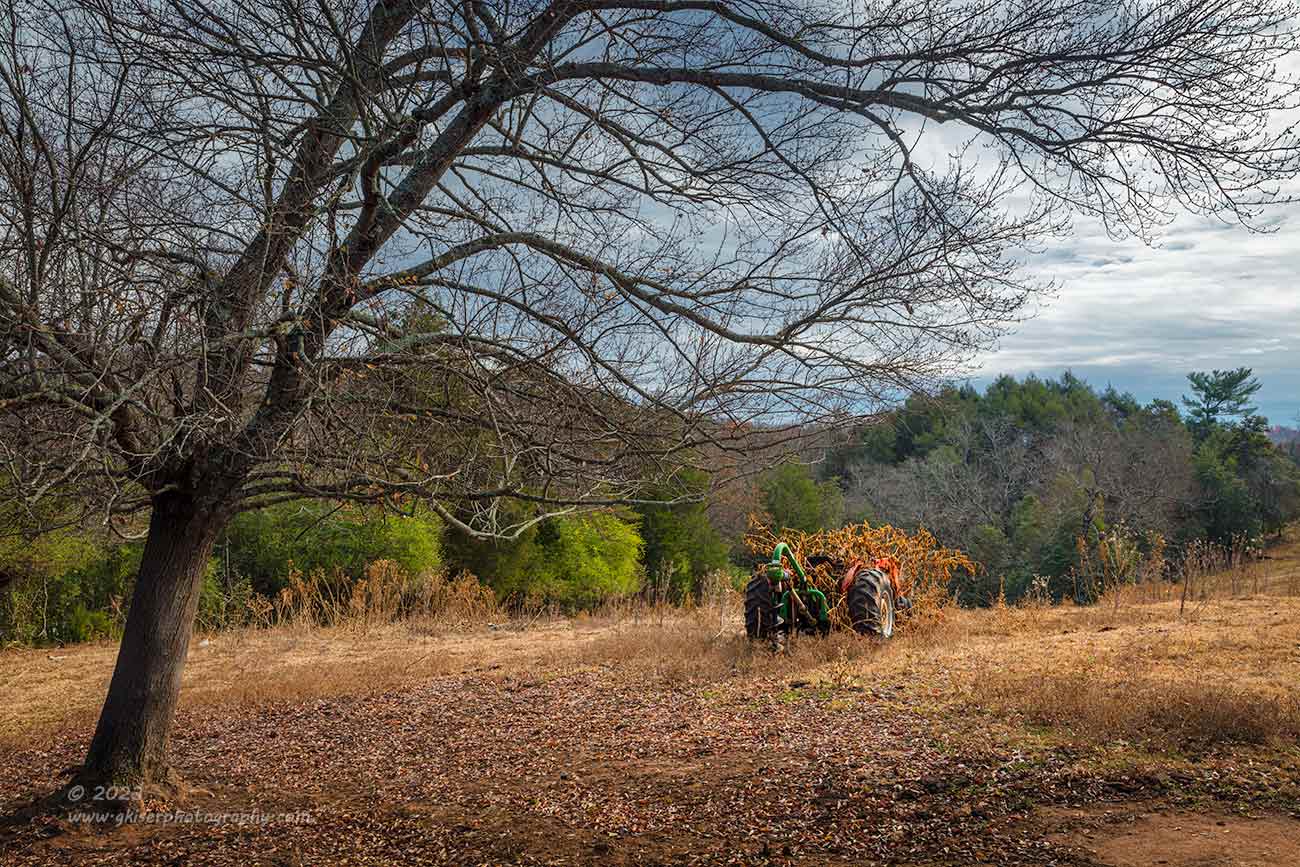
I hopped in the 4Runner and set out on my way to the first destination. The route to get there was just up the road that I live on and have been on many more times than I can count. My plan was to go and look for the truck on the side of the road and the old buildings. I wasn’t really thinking I would see anything else since I was relatively familiar with the location. This brings me to tip number one for the day. Just because you are familiar with an area, don’t think that you won’t find something worthwhile to shoot that might never have struck you before. Not even two miles up the road I passed a field next to an intersection that I was quite familiar with. I had seen a tractor in the field before, but it never really caught my attention. Today, something clicked with the light that was available. I just saw it out of the corner of my eye and could see the vines in their brown colors growing up all along the front of the tractor. I had to turn around to get a better look because this looked like my first image of the day.
Once I pulled off on the shoulder, partially in the road with the flashers on, I got out to take a better look. There was a fence that limited my ability to get in close, and there was a tree whose limbs were stretching out over the tractor. I could get a simple shot of the side of the tractor easy enough, but it seemed too much like a postcard, and there was no story to the scene. It quite literally would have been a snapshot of a tractor with weeds growing through it. There had to be a better option. I walked back towards the truck and started to pay attention to the large tree that was behind the tractor. It was a beautiful tree, and it established the setting perfectly and allowed me to introduce the sky into the frame which was looking really good in this direction. That process took about a minute to go through.
Thinking about the actual times that I was suggesting to be able to start shooting, I noted the time on my watch as I was opening the hatch of the truck. I pulled out the tripod and extended the legs to approximately where I needed it to be for the composition that I had spotted. I opened up the bag and pulled out the camera and a lens which were stored separately. I mounted one to another and then affixed the camera to the ballhead. Then I mounted the polarizer to the filter holder and popped it on the lens. I checked my watch when I had the tripod placed by the fence. Right at two minutes had lapsed and I was ready to compose the shot.
When I got the shot composed, I realized that the sky was going to be a problem in terms of exposure, so I went back to the truck and grabbed a 2-stop grad filter and confirmed that the histogram looked right. Another two minutes had lapsed, but I was starting to make exposures at this point. I moved around to the left and right as well as backed away from the fence to allow myself to get a little compression to the scene so that the tractor didn’t get lost. I shot a total of 12 frames in just six minutes with each one having a slightly different composition. It was the second to last that turned into the keeper shot from this location. When I turned the camera off and started to break it down, I had spent 10 minutes from opening the hatch of the truck to getting my last image. Putting the camera away took only a minute and I was back in the truck well under 15 minutes from pulling off the road.
Was I racing to prove a point? nope, I was hustling for two very different reasons. First and foremost, I was partially in the road and didn’t like being an obstruction. Fortunately, I think only a single vehicle passed by while I was parked there. Secondly, it was the light that had prompted me to stop and get the photo after dozens of times driving past this scene with a camera. If I had taken too long, the clear sky that was approaching would have dominated the scene and changed things dramatically. I would have loved to have worked the scene longer, but with the fence and a background that had some distractions from certain angles, there weren’t really a lot of options available to me. This had to be quick and dirty, and it worked well for me with the first image in the bag for the day.
I continued down the road to the area where I was going to be hunting that truck and the buildings. It was now a race against the sun as the sky was turning clear blue to the North and West. That blue was approaching quickly and that was going to be a killer for the day’s plans for sure. If nothing else, I could scout the location, but I was hoping that I would have the time to get a few shots if I found something.
Well, I found the truck, and remembered seeing it several times before. I didn’t remember it because I had dismissed it due to the fact that it was parked surrounded by a fence which refused to allow a clear view of the vehicle. I found plenty of old barns and some houses, but nothing that particularly interested me as a photograph. This is not to say that there wasn’t a photograph there, because light plays a huge part in whether a photo works or not. Just look at the tractor I had just finished shooting. After years, I was finally moved to stop and get a photo of it.
The sun was starting to get bright, so I got redirected and started to make my way to Traphill. When I got to Hwy 18, I looked at the sky which was clear to the North and cloudy to the South. I had planned on going North and picking up Longbottom Rd, but the sky forced a change of plans, and I turned South. Everything from my position North was looking too clear which made me reconsider my next destination. On the fly, I chose to go back down to Taylorsville where I have had some tremendous luck over the past couple of years.
The drive wasn’t too far, but it was nice to get away from the blue sky. I’ve joked about chasing the clouds many times here in the blog, but that was just what I was doing here. I was going where the conditions were right for what I wanted to shoot. I had no subject in mind, only an idea of the light that I wanted to work with. The further South I went, the better the light was looking, and I started to pay attention to different things.
I passed a house with several restored Studebakers in the driveway and an old one in a barn. The front of the Commander was just poking out of the red barn, and it looked wonderful to me. I was going to need to get permission to get on the property though, so I got turned around for a second look. On the second pass, I could see that stored right above the car was a white pickup bed topper. There was no way to get the image that I was wanting with that element so close to the car. It was really a shame because the car looked great in the barn, not to mention that the light was absolutely perfect for the scene. I took a pass on it, but remembered the location in case the owner ever moved the camper shell.
I continued down the road and went off on a side street where I knew of an International pickup parked on the side of the road. I’ve photographed the truck before and really enjoyed the experience. I’ve stopped by a few times to see if the owner would be willing to sell it cheap so that I could turn it into yard art, but he no longer has the shop opened for business. This time, I was wanting to see if there were any other photos to be had of the old truck.
When I arrived, I found the truck just as I had seen it last with a tarp draped over the front end held in place by some bricks. There wasn’t enough of it visible to photograph unfortunately, so I had to take a pass on this subject as well. This is the way that it goes sometimes. I find lots of almosts, but they just aren’t ready to be photos quite yet. I wasn’t worried at all because it was still rather early and even if I didn’t find anything else, I had a great photo already in the bag which would keep me busy when I got home.
I decided to go back down my favorite street which I can’t share the name of out of respect to the property owners that have allowed me to photograph on their properties. As I made my way down the road, I kept chanting to myself “shot it, shot it, shot it, shot, etc.” I have put in quite a few hours on this stretch of road, and I was looking for that next thing to pop out at me. It wasn’t happening as quick as it normally does, but that is to be expected after years of working an area. The chance of finding new subject matter gets greatly reduced when you have shot everything that is visible and tons of things that aren’t visible.
I ended up taking some roads that sounded familiar but that I hadn’t been on in a while. I was thinking that I was on track to get to the old Esso station that I had photographed several years ago during a wonderfully foggy morning. Sure enough, I came out on the road that I knew the station was on. It was about a block away and I headed out to check it out. Not much had changed with it, but there was nothing special about the light that was currently falling on it. I guess I just really loved the early morning in the fog there because I just can’t see it any other way since that point.
I was starting to think that this was going to be a bust of an afternoon. Nothing that I was seeing was stimulating my creativity and it was starting to look like just a day of driving around which I wasn’t too keen on since I had a photograph to edit. I got turned around and went in the direction that I remember finding an old Chrysler sitting in a parking lot a while back. I wasn’t positive where it was but remembered that it was possibly close by where I was at. It was a long shot, but I was hoping that I might get lucky there again with another car because there was no way that this Chrysler was still parked there.
My memory was better than I thought, and I was just a turn away from where the car had been. As I was coming down the road, I saw the back end of that sickly yellow car. It was the same blasted Chrysler from nearly three years ago. The parking lot was just the same, and the VW Bug was even still there behind the fence. I pulled into marvel at the fact that the car was still there. In fact, it looked to be in exactly the same condition as I had left it last time. I wondered if anyone used this building for anything, and I wondered if anyone else had just driven by like I had since this was a dead-end road. Questions aside, I had a potential subject in a commercial parking lot which I view as fair game as long as there are no signs up indicating otherwise.
I remembered not being overly impressed with the car, but it was an easy shoot so I worked it as best I could. After editing the photos, I liked the car a bit better and appreciated the warm hues of the ugly paint job against the cooler sky. I had never really considered trying to shoot the car again because it just wasn’t that great a subject. However, it was here, and so was I. The weather was very good, and actually reminded me of the last time that I shot the car. There was no reason that I couldn’t get out and try to get a photo or two of this car.
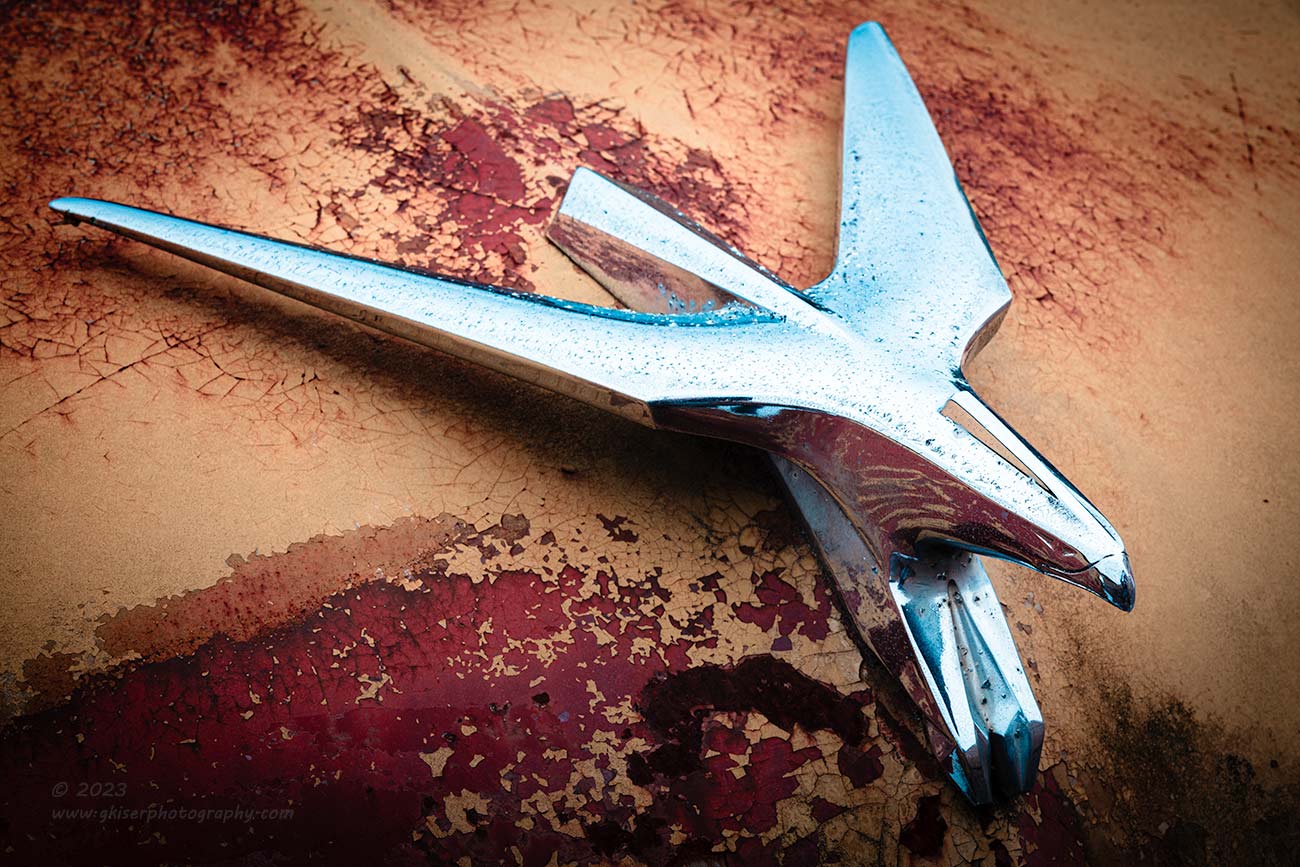
I got out of the truck and started to walk around the car to see if there was something that struck me as a photograph. There was really nothing that I could do differently as an overall photo, and the paint made me not want to do much in the way of isolations either. The car just didn’t really inspire me, and I didn’t see much area to improve on from the last time. Of course, I was recalling the photos from memory and wasn’t quite sure how good the edits were. As I mentioned during the last trek to Mabry Mill, I will often reshoot subjects just to try a different editing approach to the photos. The logic is simple, my editing skills are always improving as are my compositional skills. If I just revisit the edits, I am likely leaving a lot of improvements to be made on the table. Might as well get a fresh shot with a new composition to go along with the new edit.
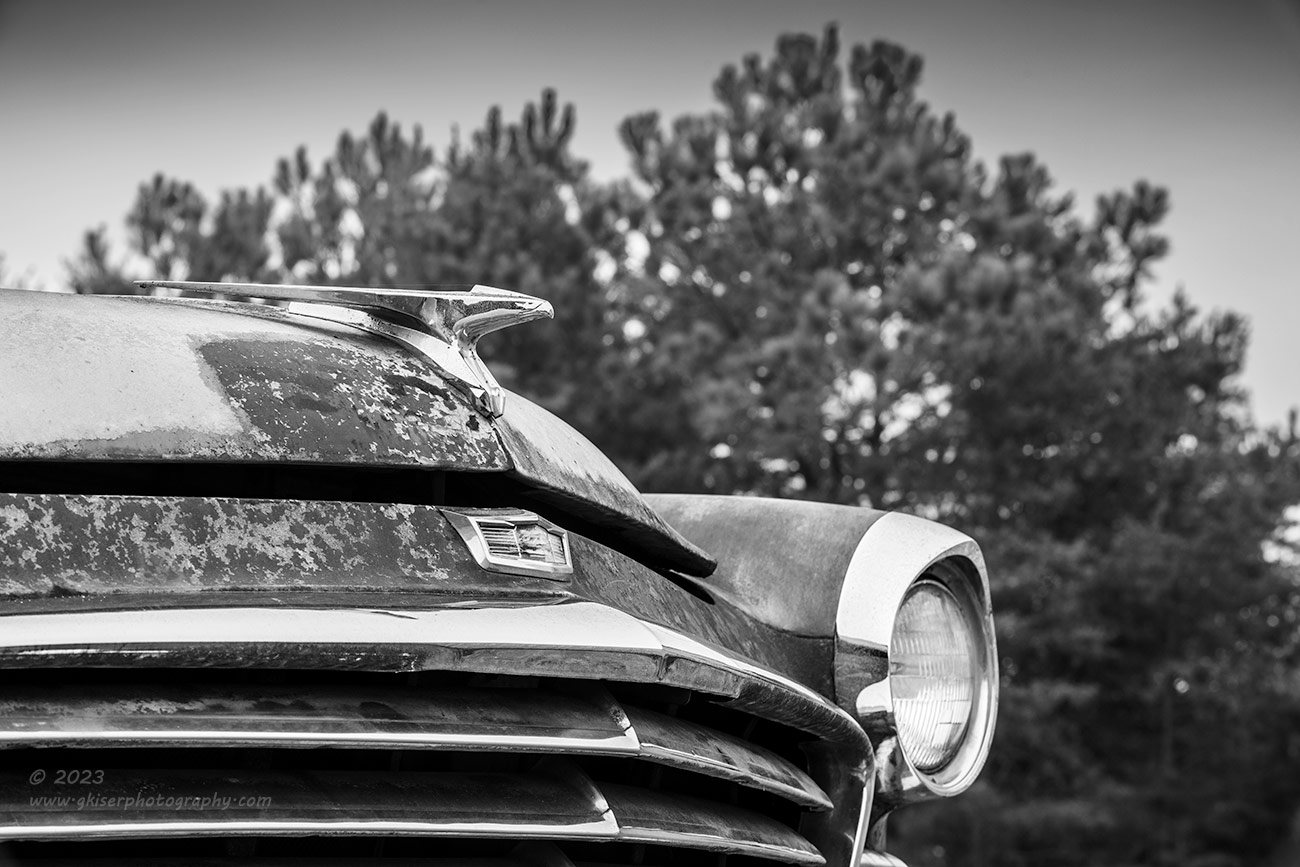
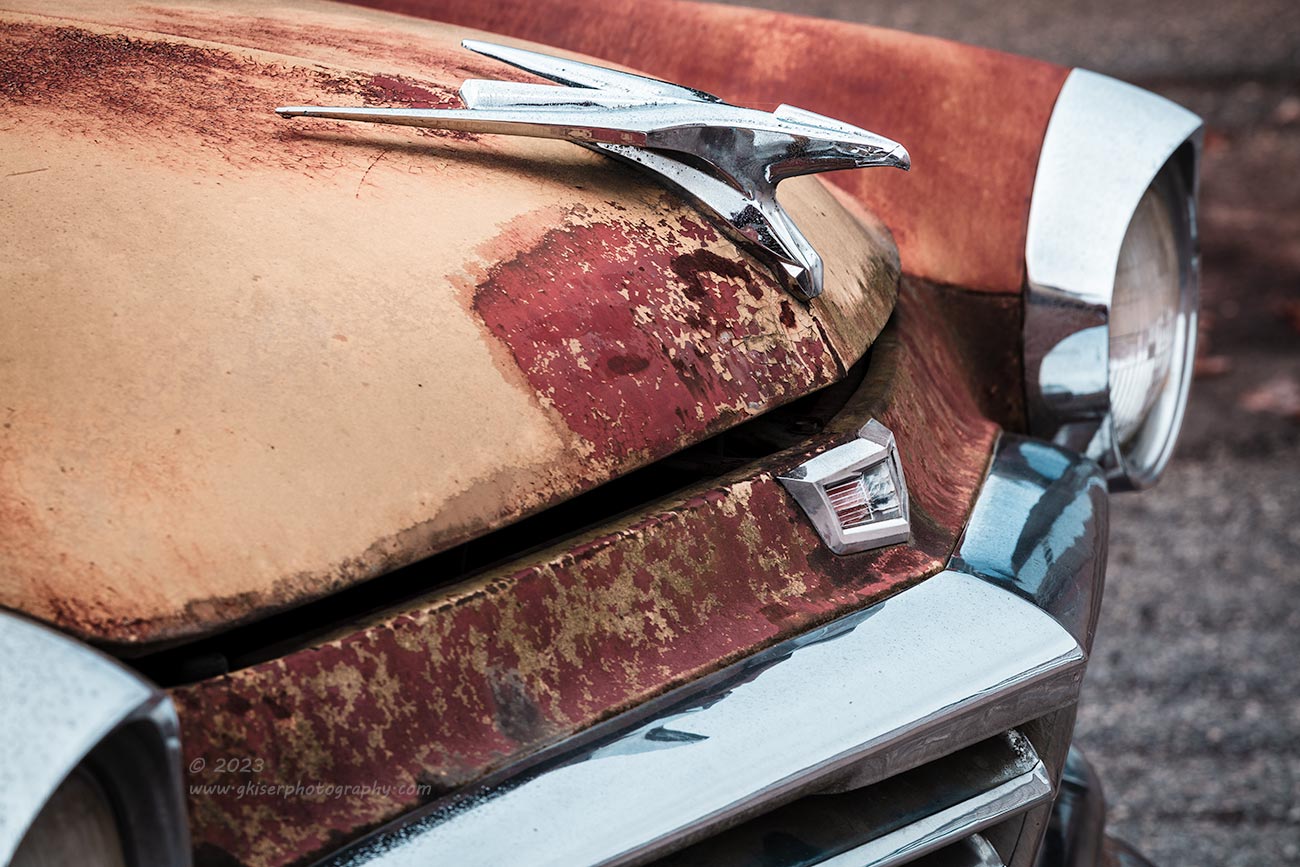
I went ahead and grabbed the camera out of the truck and went to the front of the car where I had seen a potential shot from the side, down low of the hood ornament backed by the trees. It wasn’t an earth-shattering composition by any stretch, but it was a different take on what I had done previously. I changed up my normal approach by omitting the nearest headlight and using the other one as a supporting element for the hood ornament. I used the lessons that I learned from the last time to make sure that I kept the hood ornament surrounded by the trees so that it would pop out of the photo better. I started making these photos at 1:56 and felt no sense of urgency at all. I still had the camera built and ready in a couple of minutes, but that is just muscle memory at this point.

I worked my way around the front of the car and concentrated on the different shapes that were incorporated in the styling as well as the hood ornament. I was still really surprised that this car had not changed at all over the years and could remember that Spring day quite well when I was working my way around the car for the first time. There was no getting past the comparisons that I was going to be making with the previous set of photos, but that comparison wasn’t going to be happening right now. I remembered well enough what I had done before, and kind of remembered how the photos had looked, but if I had looked at them again on the phone, I would have gravitated to those very compositions once again and I wanted to look at this with fresh eyes. The idea was to use all the tricks that I had in my bag which would work on this subject in order to give me some new photos.
It was nice to have some more compositional recipes available this time because I found myself starting to use those, and then grow into other compositions that worked well for this particular vehicle. Not that I was in a hurry for the tractor, but the process here was much slower. There was no need to hurry, and while I had the camera set up and ready very quickly, I was now using my available time to explore compositions. There would be just a handful of captures from each composition to ensure that I had a safety image for each one that I thought was really good, and I would have several different variations on each composition to make sure that I had the best one to work with when I got home. The process was methodical, but I was getting a lot of different frames this way.
A lot of the time that I spent on this car wasn’t with the camera engaged directly. I would walk around the car and look at all the angles. Backgrounds were considered as well as what I wanted to say about the car. Of course, I shot the standard images like the hood ornament which turned out to be a very similar composition to my last attempt. I treated it differently from the depth of field to the edit and when I finally let myself compare images, there was absolutely no comparison between the two in terms of impact. For those photographers out there, you really should take the time to compare your own images over the years. Even photos that you look at as being standard fare in your collection should be improving each time you shoot the same subjects. The difference here was not even subtle, and I’m proud of myself seeing how far I’ve come in both capture and edit with the same composition being compared. Of course, the fact that the composition was the same was a total accident, I just liked how the composition looked both times, I guess.
Of course, I didn’t spend the time here duplicating the same compositions. No, that would have shown very little personal growth. Over the years, I have found many new ways to photograph these old cars and I was determined to put all those tricks to good use this time. One of the new compositional techniques that I utilized here was to shoot a composition around the A pillar that uses the panels lines of the door and hood to define shapes while the patina fills the negative space. For this one, I paid particular attention to the glass because I knew that the green tint would offer a beautiful complimenting color for the paint and patina of the car. The trick was to find out the best way to balance the elements and give a pleasing flow to the composition.
What I landed on was to use the rust in a diagonal form along the bottom with the green glass and chrome filling up the upper left while the less interesting unrusted panels gave a bit of negative space in the upper right. It looked ok in the camera, but I wasn’t sure how it would really look when I got it home on the large monitor. As it turned out, I really loved how it looked when I could see all the details. All of the elements that I had intended to include were there and I found a good amount of visual interest throughout the composition. Once I got in and tweaked the colors to fit the color wheel a little better, it all just came together. This was something that I would have never considered the first time that I shot this car. Again, personal growth is fun to witness!
I kept trying to come up with something for the rear of the car, but nothing really fell into place. There was very little around the rear of the car that I found visually interesting and that had a lot to do with my not being able to find a workable composition. I really do need to be excited about something to really make a good photograph of it. While the rear of the car was a dud, I kept coming back to the front of it around the grill and hood ornament. The next composition that I wanted to try was a variation on the one that I had done from earlier where I used the far headlight to balance out the hood ornament and crest with the grill as a lower framing element.
This time, I chose to focus on the apex of the grill which looked like a beak to me, which worked out fantastically since that feature was directly under the Eagle. I wanted to keep the hood ornament well within the fender so that the chrome showed up nicely while the car filled up the frame. I had a very hard time doing that and being able to omit the closer headlight. After a minute or so trying to get the camera in a position where the light was not seen, I realized that it wasn’t going to work that way. I backed up and tried to include the light, but that ruined the composition and changed the entire focus of the shot. My last option was to include only a little of the light and have it go slightly blurred to push the eyes further into the scene.
There was a little bit of time involved in figuring this out because it was not a composition that I had done before, and I had to feel it out to find the right balance for that element where it would do the job to introduce the composition while not being a strong foreground or a visual anchor. The main characters for this one were much deeper in the frame. Those needed to be in focus and dominant to the eyes. When I was relatively happy that I had the right balance, I made a couple of exposures fully expecting to toss them when I got home. To my surprise, the photo worked very well and it turned into one of my favorites from the front of this Chrysler up to this point. It was just different enough to stand out and be different from the other photos I’ve shot of the fronts of cars in the past.
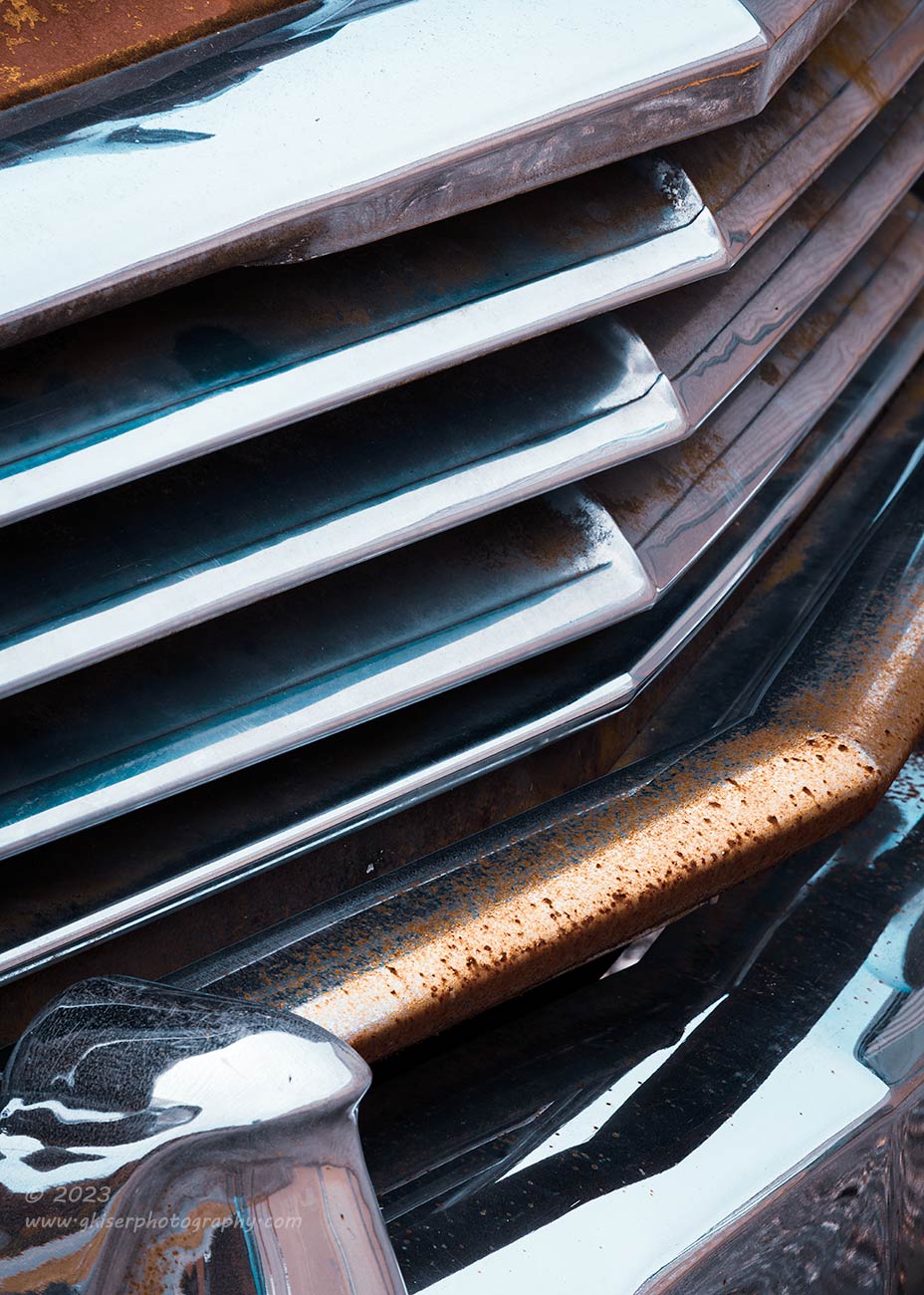
It was that grill that was starting to really interest me though. With the shiny characteristics of it, I couldn’t help but remember a certain Buick that I had shot a while back here in Wilkesboro. I ended up doing a shot of the grille that had a certain abstract quality to it with the reflections and the high contrast black and white presentation. This turned into one of those rare old iron photos that Toni actually liked. She liked it so much; I ended up doing a print of it and having it framed for our walls. It is still one of my favorites. I saw a similar opportunity here for another abstract in chrome. The bits and pieces on this grill were much more intricate and that resulted in a good bit of time spent trying to figure out the right approach to it.
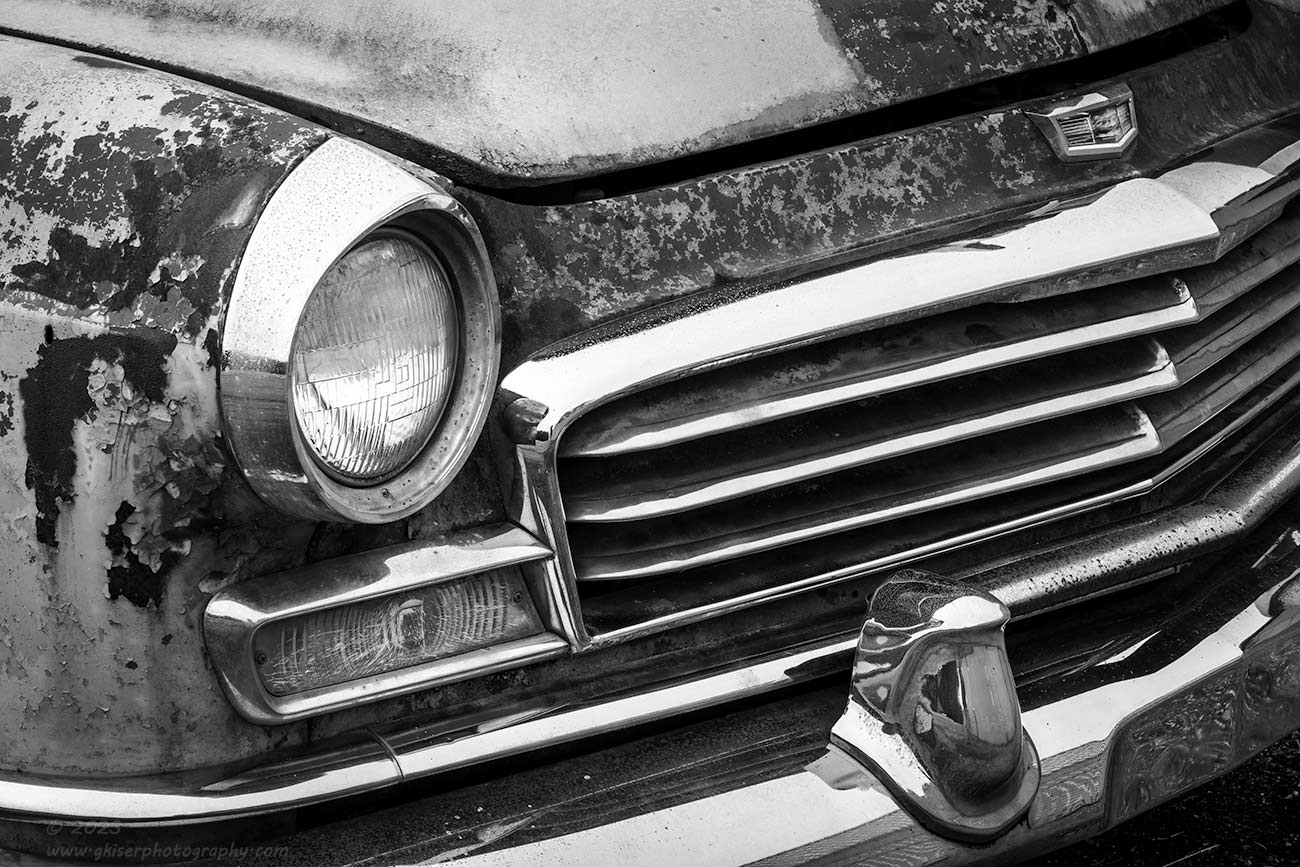
I checked out all the angles from high to low, left, right, and center. The best angle that I could find happened to be one from an elevated position and slightly off to the left side. This allowed me to see the apex of the grill and be able to put the slats in a repeating pattern. My first inclination was to focus on the points more than anything else and shoot a vertical composition. I used the bumperette as a visual anchor to the photo while the facia of the bumper framed the bottom right and matched up to the patina above the grill to the upper left. That gave the image a pleasing diagonal component and I thought that it would work quite well as a black and white similar to the Buick I had shot before.
Well, when I got this one home, the black and white didn’t work. Well, it isn’t that it didn’t work, it is more that the color helped to tell the story better. Since I had the patina in the photo, there was a texture that was added to the top left that really wasn’t answered anywhere else in the photo. That put the entire frame off balance in my opinion, but when I looked at it in color, the warm tones matched up to the decorative bumper bar which had a little surface rust showing through. Seeing that correlation, I started working my color theory magic on the photo by bringing out a bit of teal in the chrome reflections while enhancing the rusty tones. The end result turned into a very well-balanced color image that I think works great.
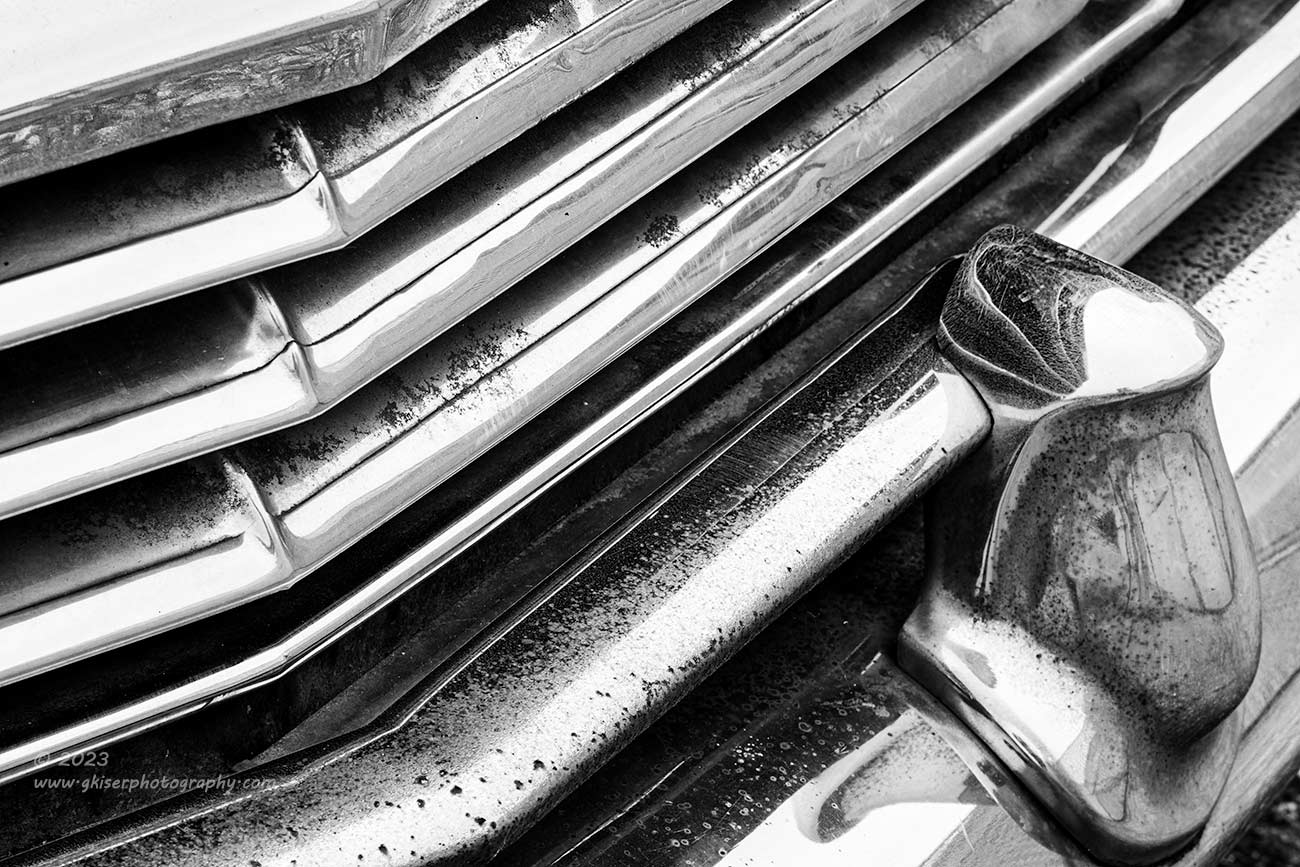
Since that first composition turned out to be a color image, I am glad that I stuck with the front of the car for a bit longer because that extra time resulted in what I think is one of the stronger photos from the day. As more or less an experiment, I flipped the camera back horizontally and worked on another composition. The basic theory was the same because I focused my attention on the points of the grill slats while using the bumperette as a framing element. I went with the other side of the grill this time though because I felt that the optical flow was better and allowed a better use of a strong diagonal element.
The more I tweaked the composition, the more I liked the photo. While I only shot three of the vertical composition, I doubled that and shot six of the horizontal. I believed in it that much. I wanted to make sure that the exposure was right on, and I wanted to be sure that I had the composition right. This one was shot with black and white in mind, although I was looking at the live view in color for a better histogram. There wasn’t much color here anyway, so nothing was going to confuse me. I didn’t like the color image all that much because that rusty bar on the bumperette was off balance without the patina above the grill. There was no issue without the color though, or at least that was what I was counting on.
It is images like this why I will always say take your time and work a subject. When I was doing my initial walk around of the car, most of these compositions weren’t presenting themselves. Only well into my time here did I finally start to zero in on the grill as a subject. I ended up with two different compositions of this grill with one of them being a really cool photograph that I suspect will continue to grow on me as the months tick by. Had I spent all my time on a single composition, or just rushed the experience, I would have missed this one and a few others. Only by slowing down and working the scene was I able to find these compositions. Just remember, spend your time making photographs, not fumbling with equipment.
If you have really been paying attention to how this location was progressing, you are probably wondering why I don’t have an overall shot of the car. You saw one in the previous blog entry where I first found this car. Why had I not shot another one? Well, to put it bluntly, I saw no reason because I remembered really liking how that one turned out and didn’t really see any reason to reshoot it. Well, that was my initial reaction when I did my first walk around. As the hour progressed, I was paying attention to how things were looking all around the car and started to see some interesting patterns developing in clouds overhead. The first time I shot this car, I remembered that there were some interesting contrasts going on that helped to bring a lot of attention to the sky. I was seeing a similar type of occurrence this time, but with a pattern that looked like ray radiating from the top of the car. When the sky gives you leading lines, you kind of have to go with it.
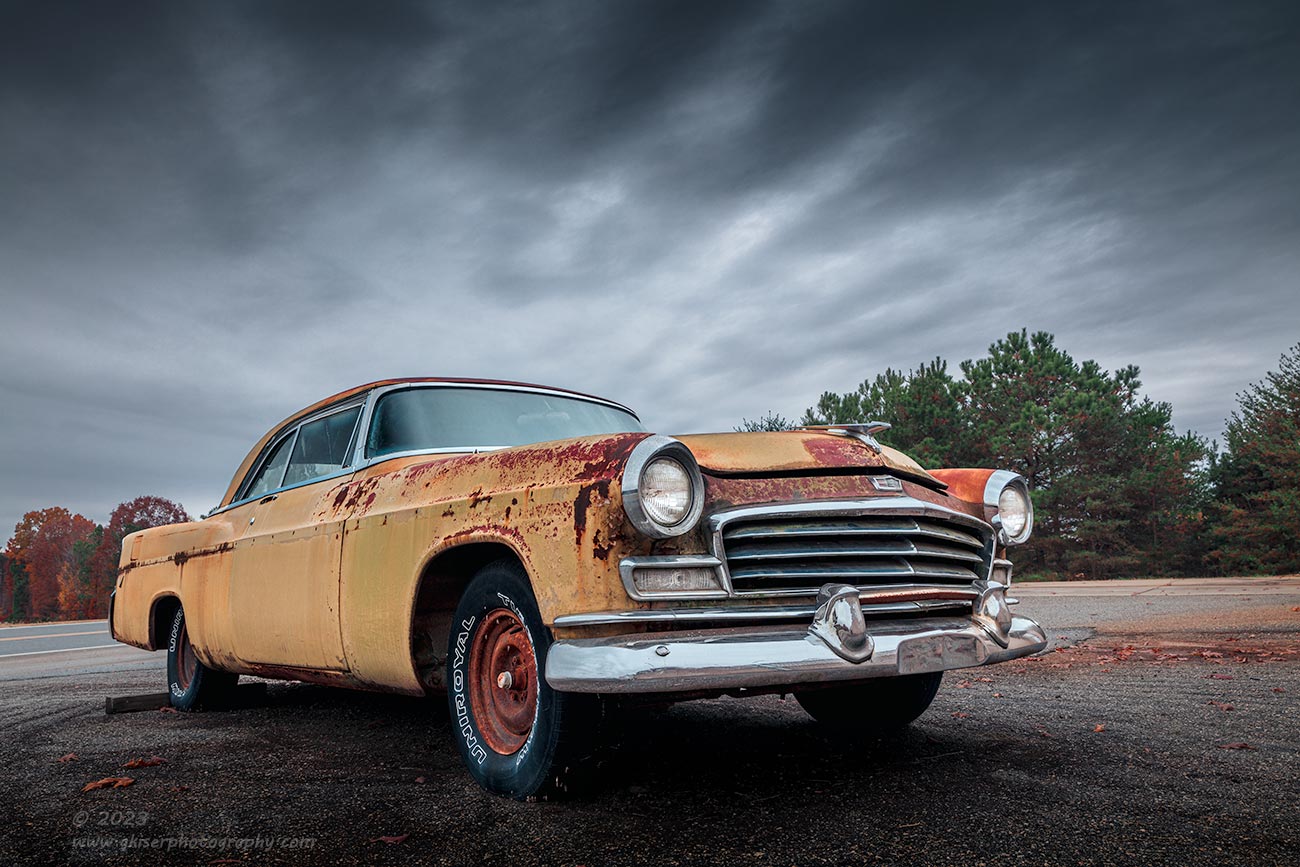
I went back to the truck which was parked on the other side of the car and swapped out lenses for a bit wider view and was back in action maybe a minute later. It was time to get the shot composed which I kind of remembered how I had done it before. I knew that one of the most important parts was to keep the hood ornament within the trees so that it showed up easier. Then I remembered the second issue that I had to pay attention to. There was a power pole within view of the rear of the car across the street. There were also four lines going to that pole which I didn’t really like. The lines would be easy enough to clone out, and for all intents and purposes, the pole would be as well. However, I didn’t want to do that much work in post, so I chose to compose the shot in a way where the car blocked the view of the pole. By getting down low, I was able to achieve both of my goals with the hood ornament and the power pole.
The sky was very bright, and I was having a hard time with the exposure, so I went to grab a 3-stop grad to pull back some of the exposure in the sky. That worked and allowed me to get the car exposed correctly. By protecting the highlights, I made sure that I had plenty of information in the highlights to bring out the texture in post. The RAW image showed a featureless white sky that made the image look very dull, but with a few local adjustments, I had a sky that set a wonderful tone for the entire image. The fall colors filled in the left side of the photo and balanced nicely with the rusty wheel and the rust on the front of the car. The evergreens provided just enough color contrast to keep the photo from appearing too warm.
That last series of photos finished me up for the day. I had shot 63 frames and was expecting around six or seven keepers. Much to my surprise, I had a total of nine that really worked out well in my opinion. Eight of these photos were from the same car that I had only been able to shoot three compositions with the last time. I ended up duplicating two of them and in both cases did it so much better than the first time from capture to edit. I really love seeing growth like this, and it is those times that keep me motivated as a photographer.
I spent just over an hour working the Chrysler, which was more than double the time I spent with the tractor. When you think about it though, I was actually working faster with the car since I came away with many more compositions. Variety is the key, and you can only achieve that when you can work through the process quickly. Don’t confuse this with rushing because at no point during the day did I rush anything. I spent minimal time with my gear and the vast majority of it, working the scenes as best I could. Of course, it is much easier to work a scene when you can get in close to it like the car. When you are limited by a fence or distance, the time is spent making the best out of the situation rather than shooting a variety of compositions. The takeaway here is to allocate the time where it is best spent, and you will usually find that you can work a scene with relative efficiency. Build your muscle memory for the things that don’t really matter like mounting lenses and filters. Get to where you can set a tripod up with your eyes closed having all the controls in familiar locations. Practice, practice, practice.
I hope you have found this trek enjoyable and like the photos that I captured. If any of them speak out to you, consider purchasing a print as those sales go a long way to funding treks just like this one. Not only that, but you will also have an original piece of art to hang on your wall at home or at the office. There really is no better way to enjoy photography than to be able to hold a print in your hands. Don’t forget that with Christmas right around the corner, art makes a wonderful and timeless gift. No matter what media you want your print on, there is still plenty of time to get those into production and delivered. Contact me today and let’s get this order started.
Until next time….

Remember to use the code KISER10 to get 10% off your purchase