Sunday, July 30, 2023
It might sound like the lead-in line for a joke, but this trek turned into anything but a joke. There are some funny parts though, like how I ended up finding this jewel of a location, and the connection that I already had with the owner. The first part of this story began a couple of weeks ago during a mentorship session with a friend in East Bend. While Bob and I were talking with Dean who owns the shop that we were at, he mentioned a couple of locations that he knew I would like to shoot. Now, Dean has known me and my photography for many years at this point, and he does have a really good idea of what I like to photograph, so when he offers up a location, I am usually pretty attentive to it. The first location was not too far from his shop and sounded promising with an old truck at the end of a long driveway by a church. He didn’t know the owner, but it looked like the house was occupied so I could find somebody to ask permission to access the property for the shot. I took some notes on the location, and he then added another spot where he knew the owner. This was in Booneville, and there were several old cars parked on the property that might appeal to me. He gave me a good idea of where this was at, and later on in the day even provided me a phone number for Kenny and said that he had already spoken with him about me possibly coming out there. The funny thing about all of this, was Bob had asked how I found all the locations that I shoot. Part of the trick here is to let locations lead to other locations. It seems far-fetched, but here we were in a situation where we were shooting one location, and two more were placed right in my lap.
Of course, there was not time to do anything with the information on the day of the mentorship since I wanted to cover as much as I could with Bob during the time there. When we were finished, I had to get home to get ready for what became a pretty awesome photographic experience on the Georgia coast at Jekyll Island. When we got back home, I spent the following four days editing the images, writing blogs, washing cars, mowing the yard, and generally getting caught back up around the house. I also had some work to do for an upcoming project in Asheville in mid-August, as well as a workshop at the end of this week. There wasn’t really any time to put together a plan for a trek even though I had two different locations in mind.
The weather patterns were not all that favorable either with the forecasts showing sunny skies for the entire week until Sunday when there was a chance of storms in the afternoon. Well, as the week moved on, the forecasts didn’t change, but the actual weather certainly did. I was out mowing the yard on Friday under what was supposed to be clear skies, and I just barely got finished before a strong storm came through with lots of wind and some rain. Saturday was about the same and Toni and I got caught in a rain shower on the way back home from dinner. The skies during both of these events were pretty great, but there had been no warning at all of the possibilities of this kind of weather. Coming into Sunday, there was finally a chance for storms in the afternoon with mostly clear skies during the morning. I was going to use that time to get some final things done around the house so that I was completely caught up with things.
Much to my surprise, when Toni and I woke up, it was very cloudy outside, and shortly after we got up and moving, the rain started. Well, this was different than expected. It felt like a scene out of Forrest Gump where he was talking about the rain falling in many different ways and directions. It did this throughout the day, but I was able to get done what I was needing to handle shortly after lunch. Now that I was pretty much caught up, I started looking at the weather. Originally, I had the passing thought that I might try the Booneville location during the afternoon when the clouds were supposed to be coming in, but looking at the weather, the clouds were going to be overhead just as long as the rain was going to last. Between all of the weather apps, it was looking like I might have a break in the rain between 4-5pm which would be shouldered with rain on once side, and clear skies on the other. That didn’t leave me much time to work, but the next favorable day would have been Wednesday. Since Dean had gone through the trouble of talking to Kenny, I didn’t want to drag out the follow-up call out of respect. An hour would give me time to check the property out and to hopefully get a few good photos captured before the sun came out and ruined things. Not really knowing what the property was like, there was a chance that I could make use of the sun as well.
I went back and forth with whether or not to give Kenny a call, and I kept looking at the weather. Around 3pm, I gave in and gave him a call. He was home and had no problems with me coming out to photograph his vehicles. He told me that he had some that were in really good shape in the garage, and there were some that weren’t in good condition outside. I think it surprised him when I said that I was going to be more interested in what was outside than what was inside, but as you know, decay is my thing.
Once I had the go-ahead from Kenny, I grabbed my stuff and put on some shoes before heading down to the truck. It was going to be about an hour drive to get out there. When I left, the rain had just stopped in Wilkes County, but that line was heading East, so I expected that it was still raining in Booneville. If I was lucky, the rain would be all finished by the time I got there. If I was really lucky, the clouds would stick around for long enough that I could create some images.
When I got there, I called Kenny again per request and he said that he would meet me over at the garage next door to his house. I pulled down the long driveway not seeing anything at first, but as I got closer to the garage, I could make out a black Studebaker and what looked like two Ford trucks sitting off to the side. This was certainly one of those locations I would have missed driving by, and my first impressions were quite positive. The rain had stopped, and the clouds were providing good light over the area. This was going to work out quite well I thought.
Kenny pulled in right after me and we chatted for a few minutes. I found out from talking to him that there was already a connection shared between us. Like I said, one location will usually end up with another one being shared with me. Kenny started talking about his brother who had some old cars. As he mentioned the name and then the road where he lived, I immediately recognized who he was talking about. I had been out there some time ago, again after a tip from Dean. It had been years since I had returned out to the area and Kenny told me that there were now a couple of new cars added to the collection which I might be interested in. OK, I’ve now got a new location to check out. If you are keeping count, what started as a return trip to a very familiar location had started off with two new leads, which had resulted yet another lead. This is how to do decay photography, and it requires very little scouting. Once you start pulling at the threads, you can easily end up with more than you can shoot. I was starting to get that feeling, but I was perfectly OK with it.
Summer is one of those odd times for me photographically. The landscape starts to lose some of the appeal because everything turns green. It is also usually very hot, and the skies are mostly clear during the best parts of the day. The overgrown vegetation can quickly cover a vehicle, and even something as large as a barn which makes them difficult to locate and to photograph. The Summer months are some of the hardest times for me to do photography, but you certainly wouldn’t know it to look at the plethora of new images that I have created since the beginning of Summer. I’m not sure, but I think that I have been busier creating images this Summer than I ever have been before. The oddest part is that those images are everything from landscapes, to decay, to coastal, and rural. I know that the fortune will run out eventually, but I’m really enjoying it while it lasts.
While Kenny and I were talking, he showed me around the property starting with the garage. He did have some very nice specimens in there, but they were all a bit nicer than what I would really want to photograph, and I wasn’t sure if I could get meaningful compositions in the space. I did take some mental notes about what was there since he said that I could return any time I wanted to. Maybe an idea would pop into my head about how to deal with some of these shiny cars in the garage setting. It was what was outside that I was most interested in for this session.

We went out to the cluster that I had seen when I came into the driveway. There was a black Studebaker Silver Hawk parked in front of a pair of rusty Ford pickups. There were some compositional issues that I was going to have to work through with a very bright background, but there was a lot of potential here. Kenny then said that there were more cars on the other side of the garage. I hadn’t seen those yet and we went over to check them out. As we rounded the corner, I saw a yellow car that I immediately recognized as a Studebaker Commander. It was sitting off by itself surrounded by the trees. The colors were perfect, and the setting just screamed a good composition. Right in front of this one was a 2-door Hudson that was pretty well uniformly rusted. It didn’t have the same draw as the Studebaker, but like the Studebaker, I don’t get a lot of chances to photograph Hudsons which meant that I was going to have to try something with it. The last car on this side was a black Mercury Montego which was parked right beside the garage wall and in front of a trailer. I was thinking that this car was going to be the hardest to capture because of the location it was in. There were some interesting details on it which I would try to work more than the overall view.
Now that I had the lay of the land, Kenny again offered to have me come out any time to photograph the cars which I really appreciated. He bid me good day and headed back to the house so that I could get to work. I looked up at the sky and saw that the clouds were already starting to thin, but I was still going to have some time to get some photos made if I worked fast. I figured that I would do the smartest thing and get the easiest compositions done first. If I had started with the harder ones, by the time I had them figured out, I would have lost the light for the composition that was jumping out at me in the first place. That gimme composition was the yellow Studebaker situated off on its own in the woods. It was simple, well lit, and the colors were effective.
I went to the truck and grabbed my camera with the 24-70mm lens attached. I added the polarizer, but that was all I took with me. I didn’t see any need to carry the bag because everything that I was planning on shooting could be done with this lens, and only this filter. The bag would just get in my way and it was close enough that if I decided that I needed a different lens, or even a different filter, I could get it without any real hassle.
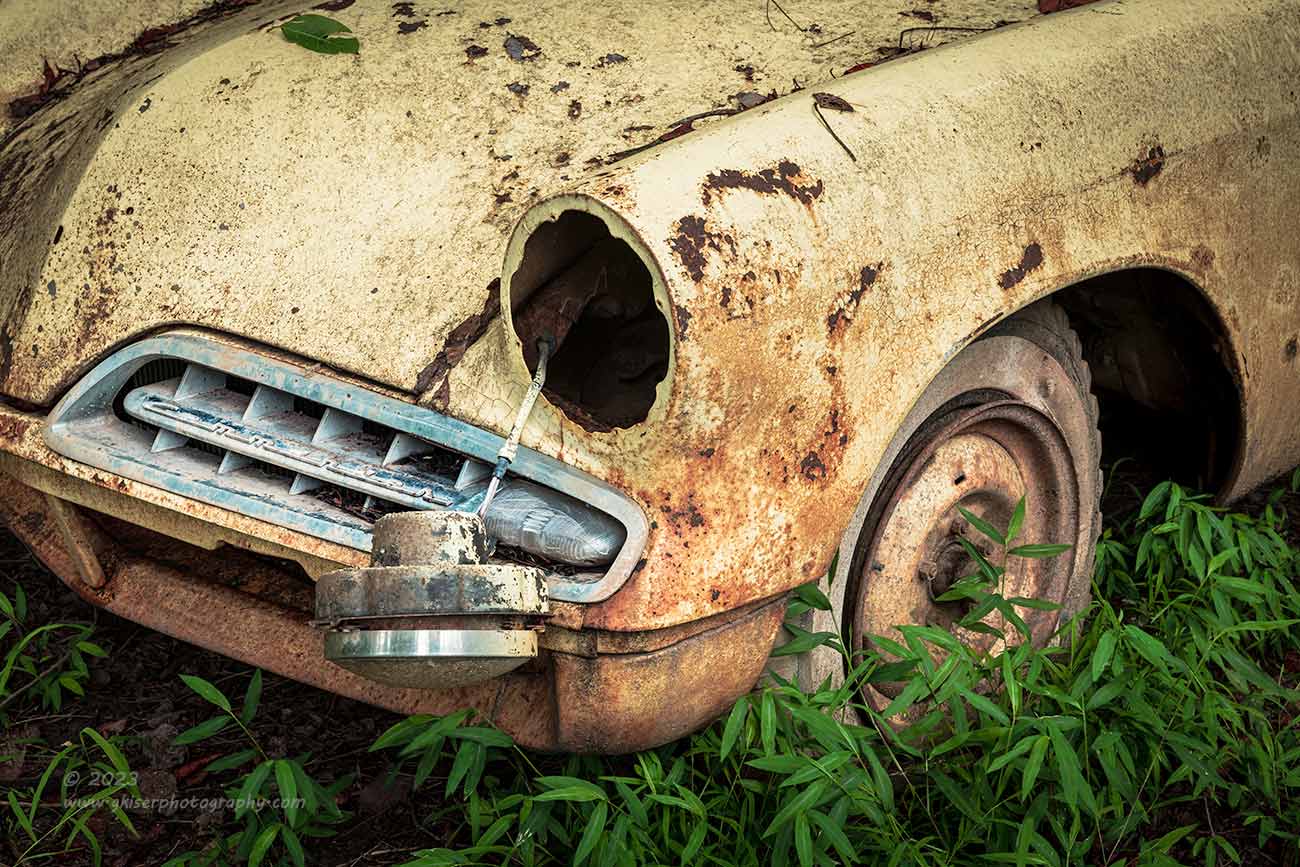
I went around to the far side of the garage and up on the slight hill to get a closer look at the Studebaker. I loved how the driver’s side headlight was pulled out, and the passenger side grill was laying on the ground in front of the car. The balance introduced by this was perfect and couldn’t have been planned any better. I went with the easiest composition to start with which was from the driver’s side front quarter view. I tried several different focal lengths until I had something that I thought looked good with the car. I shot several variations on that theme before moving in on a tighter view of the front of the car. This view seemed to be a little more effective and I worked out the right framing to highlight the wheel, headlight bucket and the grill that had the model name stamped in.
This composition seemed to flow better and gave more of the personality of the car. The lighting was great with nice diffused, and moderately directional light hitting the front of the car sculpting the curves and lines. It was the eighth image of the day that turned into my first keeper which you can see at the top of this blog. Things were finally starting to come together as I got back into the mindset of decay photography after working coastal images so intently the week prior. I can tell what I am most comfortable shooting at times like this. What took me only eight frames to get in the right frame of mind, took two different sessions at the coast before I was in the groove. As artists we learn to see things differently, and with practice that gets to be second nature. There is no doubt where I’ve had the most practice here lately.
As I was starting to get back into the groove of rusty images, I moved to the opposite side of the car which was the side in the shade. There was a bit better directional light on the car from this side and yet the shadows were faint enough that I was going to be able to capture plenty of detail there as well. This is why I love shooting on an overcast day. There is usually not a bad direction to shoot in. I liked the passenger side quarter view and started to work out a composition. I really liked how the trees were back lit to the right causing them to go into shadow except for a section that was getting some of the sunlight. It created a “V” that pointed to the car, and I really liked that emphasis from the surroundings. The 17th frame turned into my second keeper of the day which wasn’t too bad at all.
I spent some time looking at the Hudson and the Mercury but didn’t see anything in the way of a composition that jumped out at me just yet. Knowing that my time with the clouds was going to be limited, I decided to go to the other side where I knew a rough version of a composition that I wanted. There was something there with the trio of cars situated in the trees, and I knew that there was more interest here than with the other two cars on the side that I had started.

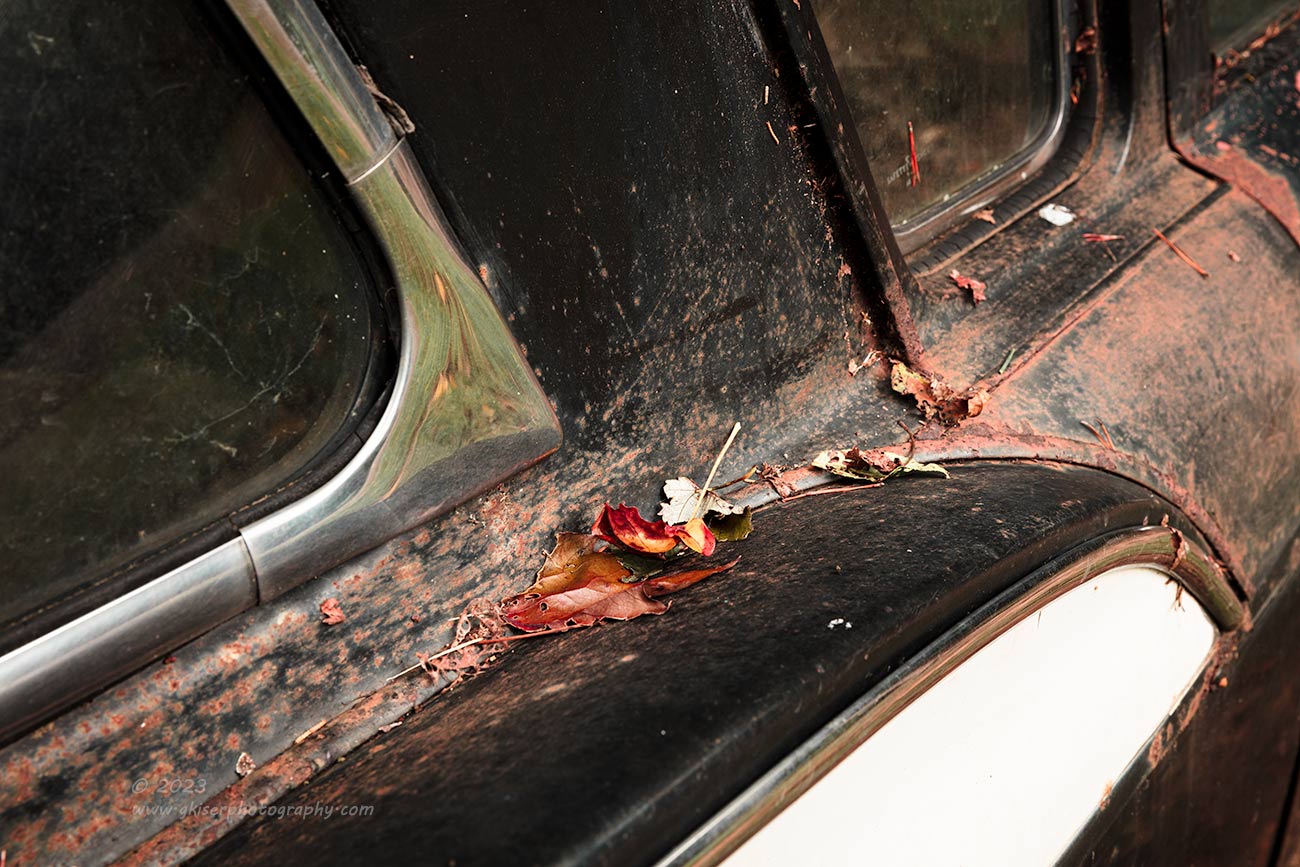
Oddly enough, it was the Studebaker that grabbed my attention first. I had wanted to get some overall shots of the scene while the light was even, but it was the isolations that spoke to me first. I liked how the white panel on the quarter came into the body lines below the side windows. I worked out two different compositions of this section that anchored on some fallen leaves. It was the second of the variations that landed me my third keeper of the day, and it was only frame number 19. I wasn’t sure how it would turn out while I was shooting it, but liked the abstract quality and the way that the lines all came together.
Originally, I had figured that this was going to be a black and white shot which is a pretty standard thought when I am photographing black cars with bright details. The color rarely plays into the look of the photograph. In this case, it was the warm tones of the fallen leaves that kind of forced my hand to leave it in color. The leaves just went so well with the rusty hues coming through the paint. In the end, I really can’t see this as a black and white image because of the statement that the leaves and the rust made in the frame.
Things were starting to move quickly now, and I moved to the front of the car. I kept looking at the center grill and couldn’t really get behind the styling of that front end. However, it was an iconic look to the marque and I wanted to capture that aspect of it. It was the gaping intakes below the headlights that caught my attention with the front end of this car. That is how I wanted to portray the front of the car, and since the crest of Studebaker was off to the driver’s side of that large grill, I had my rough idea for the composition.
The way that this front end was all organized, I had to really work the angles to have it all make sense. When I finally landed on the right camera position, things all came together for me and I was able to crank off another couple of frames to make sure that I had a safety photo in case one of the many flies happened to make a cameo. The 21 image that I shot for the day turned into the fourth keeper from the day which I was very happy about.
I was interested in the Ford trucks, but I also knew that I had photographed so many of those trucks over the years that anything that I shot now would just fade into the crowd. It was these Studebakers that really jumped out at me since I just don’t get the opportunity to capture them on the same level as a Ford or Chevy. I guess you can say that these cars are a bit exotic for me and offer up some different looks from my usual decay photos.

Not wanting to give up on the Studebaker just yet, I started to look for an overall shot of the car. This was going to be very difficult without including the Fords, which brought with them some other compositional difficulties. I looked at all the angles and just couldn’t really land on anything that excited me. However, I did start to pay attention to the fender emblem which indicated the motor size and the Studebaker script that looked quite elegant in the aged state. With that point of interest in mind, I moved in closer and started to figure out just how I wanted to capture this part of the car. Since the paint was still roughly intact, and the rust was minimal surface rust, I didn’t see any point in doing a straight on capture of the emblem because it would look too boring captured in that way. I started to play with angles and other elements to see if I could make the photo a little more dynamic. The more I added, the better I liked the photo, and eventually ended up with a frame that had the emblem, wheel, mirror, and turn signal all surrounded by the dirt that had become the car’s home.
I was including a lot to tell the story of an emblem, but the story somehow seemed complete with all of the surroundings included. I really liked how the image appeared on the LCD in the image review and ended up shooting three variations on the concept with the last frame becoming the keeper. In a surprising turn of events, when I was editing this image, I didn’t like it nearly as much as I had when I was seeing it on the back of the camera. The rust and the dirt were the same hue, and that brought in only black to round out the color palette. The image just felt too sedentary, and it lacked the visual tension that I had worked so hard to create through the composition. I decided to see what it would look like in black and white since the color seemed to be getting in the way. The image almost immediately improved, and I could see that this was the direction that I needed to be going in at this point.
I played with the various black and white profiles until I found one that had the right contrasts to start with. I then started to fine tune it to what I wanted and did a little local dodging and burning before I came up with this image. I loved how it looked and felt that it successfully captured the feeling that I wanted. When I was showing it to Toni, she said that it actually felt alive, and it appeared as though the car was trying to move forward. That was it, there was life with the image in black and white while the color version just sat there. There was an implied struggle with this version, and that was what I was after when I created the photo in the first place.

Not wanting to get overly bogged down in photographing the Studebaker, which according to that last image was pretty bogged down itself, I moved my attention over to the two Ford trucks just on the other side of the Studebaker. I spent some time framing up a shot that included both of the trucks and shot three frames with slightly different lighting. At this point, the sun was starting to come out and it was showing some highlights on the scene. This was not idea because not only was it causing some bright dappled light across the scene which made an already complex scene more so, the background was bathed in sunlight while everything that I was focusing on was mostly in the shadows. This caused a very bright spot to shine through in the background which I didn’t like at all. After those three frames, I got tired of fighting the light and decided to make use of it. I had noticed that the sunlight was shining on the front of the nearest truck which was visually the most interesting of the two. The sun was hitting right at the passenger side headlight bucket which happened to be the side where the tire had just rolled off the wheel adding another point of interest to the front of the truck.
I moved the camera into position quickly and started to frame up a shot that captured these elements as well as the great patina on the truck. it was not an easy composition to come up with and I ended up shooting a total of ten frames with variations on the angles that I shot as well as the depth of field. The light kept changing as well, which forced some duplicate attempts over those ten frames. I liked the concept behind the composition, but I wasn’t sure if any of these were going to pan out when it came time to cull through the images.
When I was going through the series of frames from the trucks, the first three were all tossed aside which were the only ones that included both trucks. The light was just not right for these, and I didn’t like how the images flowed. The next 10 were hit and miss with angles and the light, but the seventh one of the intimate compositions on the front of the truck seemed to work well. That was the one that I edited, and in very short order, I found that I really loved how it turned out. The tire that just looked exhausted made for a great leading line into the image and offered an unexpected shape to the composition that added to the effect of the truck being on the ground. The depth of field simplified the composition and kept the eyes where I wanted them to be. The bit of sunlight added the right amount of interest to the scene as well. The headlight bucket and the hubcap were placed in the right locations within the frame to complement each other. Everything in this photo worked well, and I was glad that I had stayed with it as long as I had.
Let me know if you found this video helpful. I like to share how I work and some of the things that I think about behind my images. If this is beneficial, I will try to make more videos to include in my blogs.
Once I was pretty sure that I had what I wanted with the front of the one Ford, I went back to the overall scene of the two trucks and considered if the light was right for me to work that scene once more. It wasn’t appearing any better and the sun was starting to get a good bit stronger at this point. I shifted my attention back to the Studebaker once more and tried to figure out a composition that could take advantage of the light that was on the side of it. The dappled light in the woods was also adding some interest in the background which appealed to me. My first idea was a deep crop into the car to avoid the nearest Ford truck, while the one in the background would drop behind the car and stay out of sight.
This concept worked, but the visual weight didn’t quite work with the car getting lost in the frame. I had to step back and consider what I was shooting again. I had good light, and an interesting scene, but the composition was failing because of how I was cropping the car. I realized that the main points of interest on the car from this angle was the large white fin, the taillights, and ultimately the Silver Hawk emblem on the trunk. These were the defining attributes to the car and I was doing it a disservice to crop all of those elements out. That was what was wrong with the composition as I was shooting it.
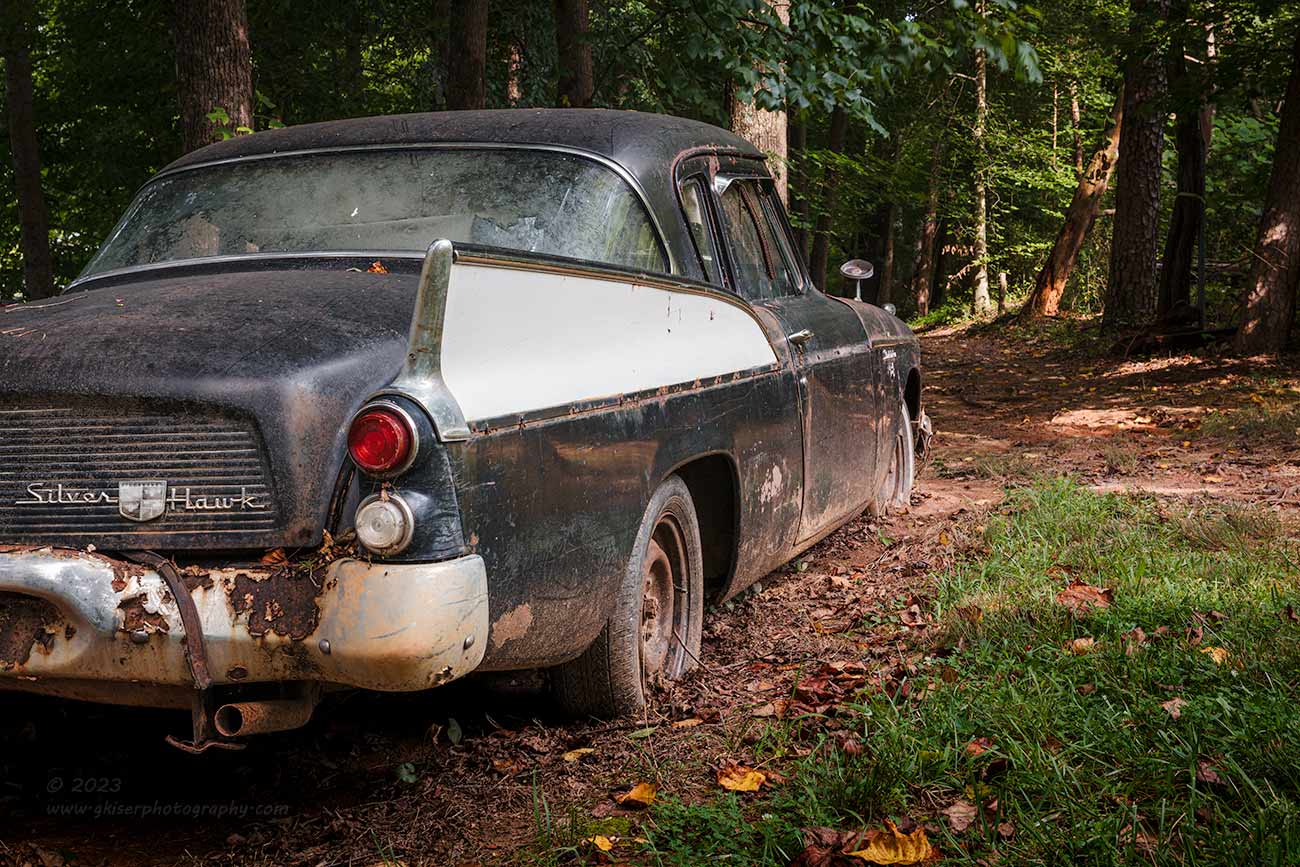
I pulled the camera back and a bit further to the left. I was now able to capture the rear of the car, but now I could see the Ford truck to the left which I thought was a big distraction. It created too much imbalance to the scene, and I wanted to see more of the truck which wasn’t possible unless I raised the camera which would then show a portion of the other truck. As a last resort, I went with a crop that took out half of the trunk but left the shape of the rear window and the emblem on the trunk. This seemed to work out pretty well, and the white panel on the side of the car pointed into the woods down the trail. The dappled light completed the visual path into the image and the visual balance finally seemed to work out perfectly. It was the third of four images that turned into the keeper because of the angles and how the sun fell in the background.
At this point, I had shot 41 frames and if you are keeping count, I have seven keepers which is pretty awesome. I am far from done at this point though which is equally as amazing. I had been planning on staying just while the clouds were out, but as you have seen, the sun has become an element in the last few scenes, and it was doing interesting things with the compositions in many cases. I decided to stick it out a little bit longer to see what I could manage with the sunlight added into the mix.
I’ll be back here with the conclusion to this blog soon enough. In the meantime, if any of the photos speak to you and you feel that they would look good on your walls, do consider purchasing a print. There is no better way to enjoy a photograph than in a physical form which is the ultimate vision of this photographer. I don’t create these images in the hopes that they will only be seen on a computer monitor or phone screen. Every image that I shoot is done with the hopes and intention that they will turn into prints and displayed on a wall in either a home or an office. By selecting a print for your space, you are not only bringing a one-of-a-kind piece of art into your home or office, but you are also supporting my artistic endeavors. You are showing me that my work is worthwhile, and you are helping to fund the treks that produce the works all at the same time. It is a win-win situation in every respect.
I do hope that you are enjoying this trek, and I look forward to finishing things up shortly.
I’ll see you back here in a bit…

Remember to use the code KISER10 to get 10% off your purchase