Monday, January 5, 2026
Welcome back! By my calculations you are probably reading this on Friday which is essentially a week after this trek took place. I know I have been doing a lot of the multi-part blogs over the last year or so. It is not intentional, but just a product of finding myself in situations where I can get a ton of photos. I know you don’t want to sit here and read through a post that has dozens of photos and the narrative to go along with them. Quite frankly, I don’t want to commit to writing that much in one sitting. By breaking things up, I’m making it easier on myself and my fingers while making the pieces more digestible for you. With that being said, here I am starting that last piece of the puzzle on Wednesday morning.
When we last spoke, I was working with an old Chevy truck that was parked beside of a barn on the property. It wasn’t quite a whole truck, but the cab was mostly there. I had photographed it before when it was under a tarp which made for a rather interesting photo with the missing parts kind of obscured. That was the best way to capture the entire truck, so what I was concentrating on with this trek was finding isolations that I liked. Most of those you have already seen, but there was one more that was kind of a late addition to the collection of keepers from the day. In fact, it didn’t make the cut during the entire first day of processing. It wasn’t until I came back downstairs the next day that I went back through the discarded photos to look once more. I had 23 keepers from the day at this point, but in the first few minutes of the second day, I had added another two to the mix. This was one of them.
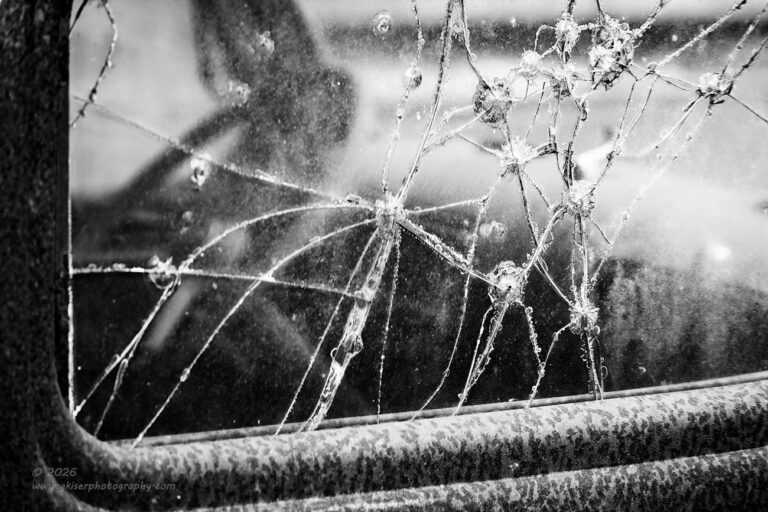
I had seen some interesting patterns in the broken glass on the passenger side of this truck that I wanted to photograph. It was just a matter of finding the right composition for the image. When photographing glass, I have to keep in mind what is on the other side of that glass because it will factor into the overall composition and balance of the image. The glass was a bit clearer on this side which allowed more of the details to be seen within the truck. I played around with the framing for a bit and finally decided that I wanted the rusty door to frame the glass on the left side and lower edge. This formed a shape that effectively introduced the contents of the photo and gave a nice reference point for the focus plane of the image. Of course, the broken glass filled most of the frame, but the key was finding out the best way to structure the background. I played with the angles until I found something that had a sense of balance within the framework of the scene. The steering wheel gave a valuable bit of context to the setting and allowed us to make out the shape of the dash and the pillar. Knowing what all of those shapes were because of the steering wheel, I no longer needed to render them in focus. By reducing the depth of field, I kept the attention on the on the broken glass which was the reason behind the photo.
The unintended benefit to the composition that I had chosen was that the luminance values progressed from dark to light which helped your eyes travel through the frame. It was an effective composition, and I had liked it a good bit in the field. When I saw it on the big screen in color, I was less than impressed by it, however. After processing 23 other images, I just didn’t have it in me to work through this one as well and chose to commit to the window shot with the repeating patterns that we saw in the last entry. It was arguably a much stronger composition than this, but when I looked back at it with fresh eyes the next day, I saw the same potential that I had seen during the actual photography. The color really got in the way because there wasn’t really much there and it forced the eyes to focus more on the metal door rather than the glass. By converting it to black and white, things changed and became more what I intended. With some careful selections in the profile that I used and work on the contrasts within the scene, I came away with the image that I had envisioned when I shot it. It still isn’t as strong as the other photo, but it is one that is worth keeping in the collection.
By this point, I had pretty much worked everything that I wanted to with the exception of the big white firetruck. I still wasn’t quite sure what I wanted to do with that since I had photographed it so many times before. I just knew that anything that I did with it would be very similar to another photo that I had shot of it. I didn’t want to do the same old thing, so I chose to look for some off the wall compositions instead. I’ve talked a lot about all of the old cars that Dean has on the property, but something that I don’t give enough credit to is the fact that he has a lot of spare parts and random things that he stores in case he might need them in the future. I’ve found some great success with photos of his spare parts laying around from fenders to fire hoses. Since I was looking to do more abstract work, I figured that this would be a good time to go around and look to see what I could photograph that maybe I had never given a second thought to.

One of the first things to catch my eye as I was walking around one of the barns was a stack of wheels. I hadn’t seen these before and the blue color on the wheels was bright enough that I should have seen them at some point. That deep blue really got the creative juices flowing and I really liked the contrast with the hubcaps that were still mounted. Maybe it was because I had just shot an isolation on the blue fendered Chevy truck’s wheel, but I wanted to photograph this wheel atop the stack sitting in the barn. Much like that other wheel, I didn’t want to just fill the frame with the wheel and take the shot because…boring. I needed some visual tension to the frame, and something to direct the eyes. Fortunately, there was a valve stem in a decent position close to me that I wanted to use. This was not the valve stem that we are used to seeing that is just black and blends in with everything. This one was a light colored stem that really stuck out against the blue. I just had to figure out how to incorporate it in the composition.
Looking at the wheel and tire, there was a drastic contrast between light and dark tones. The blue wheel and the tire were very dark, while the hubcap and the valve stem were much brighter. I needed a diagonal relationship between the two light colored objects for a bit of visual interest. That was the basis for the composition that I ended up with. By moving the hubcap into a corner, opposite of the valve stem, I had to decide where to crop into the wheel and tire making the focus the brighter aspects of the shot. I played with this for a while and tried some different placements and crops until I landed on this composition. Now, to be fair, it started out as a horizontal shot because that was just how things worked out from where I had to stand in order to get the stem in the right place relative to the hubcap. In post, I found that it felt better to be a vertical composition with a slightly shorter aspect ratio. This pretty much made the tire a natural vignette with the blue wheel being a series of repeating patterns that framed the valve stem.
Oddly enough, this composition breaks the rule of having the heavier weighted elements lower in the frame for visual stability. I did try it like that, but it just felt wrong, even though visually it was better. Having the larger hubcap at the top of the image added to the visual tension within the frame and somehow put more importance on the valve stem. Seeing it this way just felt right and that was what I went with. It is always good to know the rules, or suggestions in composition, but it is much better to know when it is time to break them and trust your gut.
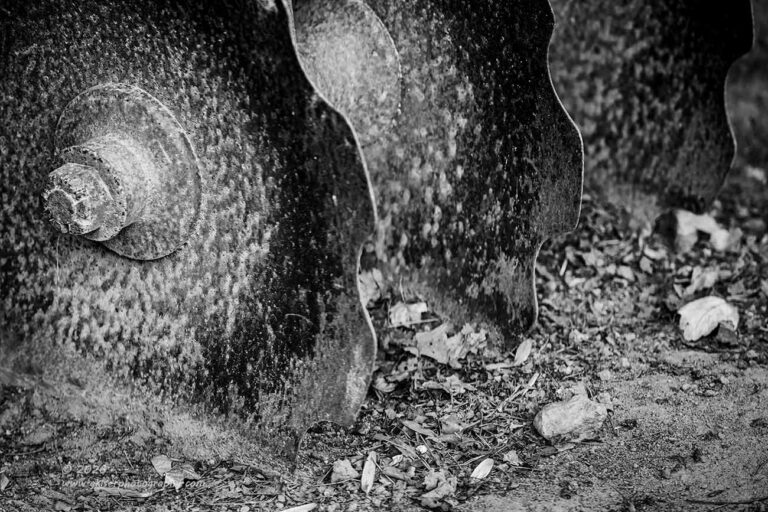
If there was ever a situation where I trusted my gut and not my good sense, it was when I saw this disk plow in another section of the barn. It isn’t the first time I’ve seen it, but somehow with my mind on abstracts, I kind of wanted to try a composition with it. What I liked about it was the repeating patterns with the axle bolt as the visual anchor. There was tons of texture to work with, but not much in color contrast. The metal was dirty and rusted which just blended in with the dirt around it. I knew that if anything was going to work it was going to have to be done in black and white. I flipped the camera over to black and white so I could more accurately see how the contrasts were going to look. I saw potential in the live view with the lack of color, so I decided to go forward with finding a composition that was going to work.
I knew that I wanted to concentrate on the patterns, and I wanted to keep the number of disks to a very simple trio. That axle bolt needed to be fairly prominent in the frame, and I wanted to show some depth to the scene. That didn’t seem like too much to ask, but to find a well-balanced composition with those requirements took a few minutes and several different variations before I landed on something that I felt would work well enough. This was never going to be a stellar photo, and I really didn’t have high hopes for it when I was shooting it, but I seemed to be on a roll finding new ways of looking at things so I pressed on. It wasn’t until I got the image into Lightroom that I started to really see the potential of what I had captured. By selecting a profile that gave a little extra contrast within the orange, yellow, and red tones, I had a good starting point to work with. From there it was all about bringing out the textures of the scene and making sure that there was separation between the disks and the ground. I had also limited the depth of field a fair amount to really push the focus on the nearest disk while the shapes were most evident in the further ones. This helped to simplify the scene by reducing the impact of the textures.
I kept looking at all of the other various objects within the barns to see if there was anything else that caught my eye. Nothing was sticking out, but I was starting to feel like I was ready for the firetruck. You remember the firetruck, don’t you? That was the thing that I saw the previous week that got me thinking about coming back out here. I had now been out and shooting for a couple of hours and had yet to point the camera at the truck. I was ready now, and I went over to it and started to look around to see what I could work with that would be different from previous times.
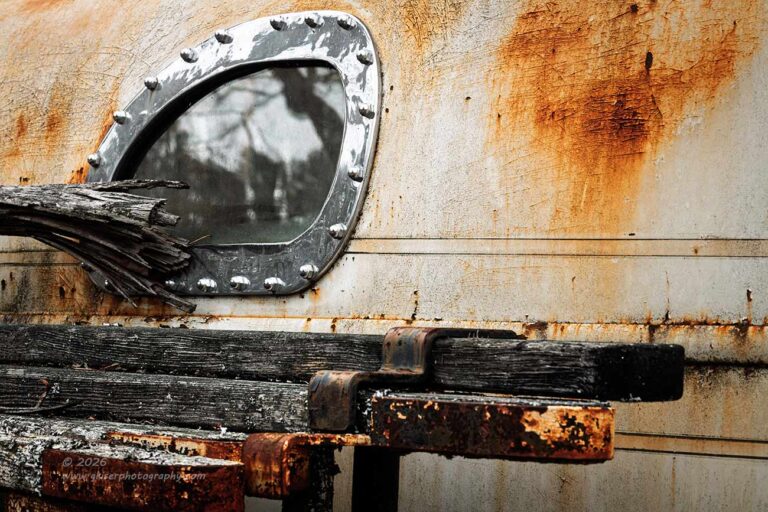
I knew that there was the pump gear on the driver’s side which made a nice composition, but I knew it did because of all the times I’ve shot it, or seen it shot during a workshop. There was really no reason to go back to it again and do the same thing. Most of the points of interest I had shot before, but there was one that I haven’t been able to work out for myself. Now, to be fair, I have successfully worked out a composition during a workshop based on the client’s interest in the truck, but I didn’t share that same background, so it wasn’t something that I necessarily wanted to photograph for me. Oddly enough the particular element on the truck was an old wooden ladder with the steel hooks on the ends. This meant very little to me, but as a former squirt (fire fighter), he had a deeper understanding of the significance of the ladder. For me, the interest was in the aging wood and rusted metal on the ends. I also liked the way that the different sections were stair-stepped in the collapsed position. That was what I had tried to figure out for my own compositions over the years, but hadn’t been able to get anything that I felt was remotely interesting to look at.
That was my starting point for my first composition with this firetruck. I just really concentrated on what I wanted to showcase and then thought about the power of “And.” I had the ladder segments stepped as I liked seeing them, but I needed something beyond that to balance out the composition and give it a touch of interest. The most logical thing to add was the observation window at the top of the truck. There was an old pole that was pretty well rotted away that was blocking part of the window that kind of bothered me at first, but I did like the window. To really show off the stepping nature of the ladder, I wanted to get the terminal end of it which introduced a nice diagonal, but I also needed something more at the top right of the frame. That was where a rusty patch came to the rescue. I had the three main elements that I needed to make a composition.
Now that I was looking at those three elements, I started to figure out the exact framing which wasn’t all that bad to work through. By this time, the rotten pole was starting to make more sense. It introduced the wooden textures and colors into the upper portion of the frame so that actually helped to unite the window with the ladders and kept those elements cohesive. The rust in the upper right was just that splash of color that went with the patina behind the window to link that part of the photo as well. It all just came together, and I felt like I had a winner on my hands by the time I pressed the shutter button. That thought was confirmed when I got the images home and started to process them. This one actually turned out to be much better than I had originally thought that it would. It was a new way of seeing this truck and the details on it. It was also the first time that I had figured out a composition that was true to what interested me about this section. I think that previously, I had just asked the wrong questions of myself and that was why I hadn’t been able to land on anything that I liked. With the right questions, I found the answer that I had been looking for.
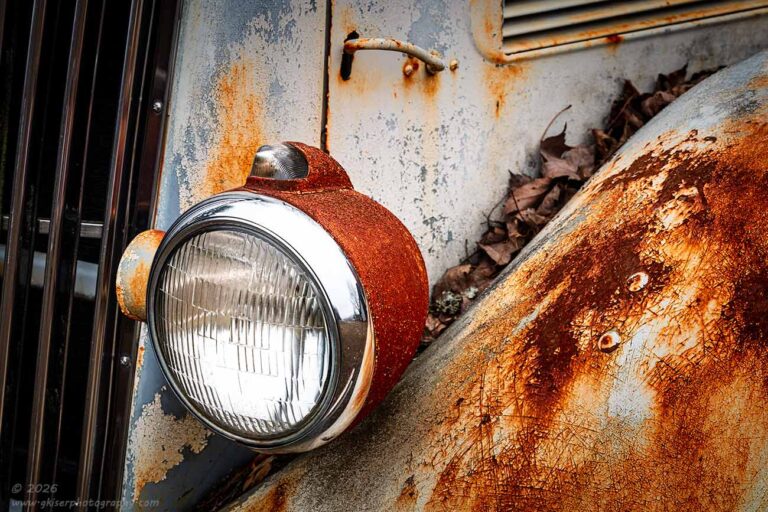
Feeling even more confident about the potential with this truck, I continued to look around, and I was specifically looking for the more advanced decay which I knew was something new and had been what drew me back to this truck in the first place. The part that I kept coming back to happened to be that front fender and light on the driver’s side. I used to use this fender as a teaching tool for setting manual exposures based on a nearly white surface. Yeah, I remember when this fender was solid white, but now it was getting a pretty nice coating of rust and flaking paint. The headlight bucket was also solid rust at this point with the grill surround showing the gray primer. The leaves that were laying in the crevice happened to be the icing on the cake for me.
This was the area that had really caught my interest, and it was an area that I have photographed before and am usually drawn to which made this a natural composition. I’m thinking that the first time I photographed this part of the truck I had a hard time working around the grill because it contrasted so wildly with the white paint. Now that the rust had toned that down, and there was texture, the darker grill wasn’t a distraction any longer. In fact, it helped to frame the light as it created a convergence of lines to where the light was located. Using the rule of odds, I chose to include just three slats of the grill. Oddly enough, this is one of the only rules that I choose to really give a lot of attention to these days, but I’ve found that it is a powerful tool to use for composition. It is a great fallback when you are wondering how many elements, or how many sections of an element to include. More often than not, the odd numbers will win.
Now that I had the composition figured out, I dialed in the exposure which was miles away easier than the last time I shot this. Now that what was left of the white was rather dull, and the clouds were covering the sun, there was nothing there really to overexpose except for the chrome which I didn’t mind clipping at all. The biggest thing that I had to deal with was the depth of field. I wanted to have a pretty deep depth of field to show off the texture, but I also wanted the image to go soft to the right which would keep the eyes from leaving the scene. It was a subtle trick, but one that I felt was important to this composition.
All the thinking here paid off in the long run. I liked the image during each of the culling stages and liked it even more when I started to do the processing on it. It just felt right and didn’t look like a picture of a headlight which is what it had been in the past. There was a deeper story now, and the light was actually just a visual anchor at this point and not the focal point. It was that texture and the age that drew my eye now. That is what I liked about this truck, and about this portion f the truck specifically. My eye still goes to that aspect automatically and that is what I spend the time exploring in the image which makes this a success in my opinion.

I felt odd just concentrating on the details with this truck though. I mean, you just don’t get to see a firetruck that looks like this all that often anymore. From the styling to the color, it is unique already. The aging has brought it to a whole new level at this point. I owed it to my old friend to capture it once again knowing that at any time the funding could be there for the build to take place. Every time I see this truck, it is a gift, and something that really makes me understand how long I have been coming out to this property since it looked nearly new the first time I saw it.
I usually shoot this truck from the driver’s side because that is where the sun is usually looking the best on it. The background also has the chance of looking cleaner with fewer extraneous elements lurking behind it. The thing is; the lighting was much more forgiving this time, and I had the chance to shoot it from the passenger side which also included that ladder I had worked through previously. I’ve shot this side of it a few times, but somehow it seemed better this time. The level of decay was all quite uniform from the truck to the barn, and ultimately the bare trees in the background. Everything just fit together and set a very cohesive mood that I don’t think that I have achieved with this truck before. Yeah, the background was a bit more cluttered than I would have liked, but because the truck was still mostly white, it was the brightest thing in the scene. That overpowered the background sufficiently for the image to work with the focus remaining on the truck and everything else making this an honest scene that told a story. I say this every time, but I think that this might actually be one of my favorite photos of this truck with the exception of one that I did at 11pm using a flashlight for lighting.
Something quite interesting to take note of here is the lens choice. I’ve mentioned that I am really wanting to get better with the wide-angle lens this year and it would seem that that lens would have been the most logical choice here. I mean, I am including a bunch of the scene here between the truck, trees, and a couple of barns. I could have used the wider lens, but that would have included more background while making the truck larger in the frame. By using the telephoto lens, I was able to keep the scaling much more in line and give the photo a more relaxing look. The wider lens would have introduced more drama and would have overly complicated the scene as well as more than likely including a good portion of the sky above the trees. I would much rather just have the trees in the background to block out the basically white sky above.
Looking through the photos in this blog series, you have seen me use this telephoto lens on both detail shots as well as overall and establishing shots like this one. You have also seen me use a wide-angle lens for overall and establishing shots as well as close in isolations. This is the benefit of using these lenses in different situations as there is no “right lens” for the job. It is all a creative choice, and you can use any lens in any situation as long as you understand how to use it. Once upon a time, I would just use the telephoto lens when I wasn’t able to get close enough to the subject without it. In fact, there was a couple of weeks that my telephoto was in the shop to remove a bit of debris from inside of the barrel and I hardly noticed that it was gone. Two years ago, I was seriously thinking about reorganizing my bag in order to fit the camera with the 70-200mm already mounted because that was my go-to lens for nearly everything. I used it for distant work as well as close in work. I am now much more proficient with how that lens works and how it interprets the world which allows me to get a range of compositions with it. I’m hoping that by the end of this year, I am just as proficient with the wide-angle, though I know that will never be a primary lens for me to go with because of how much background is shown in the frame.
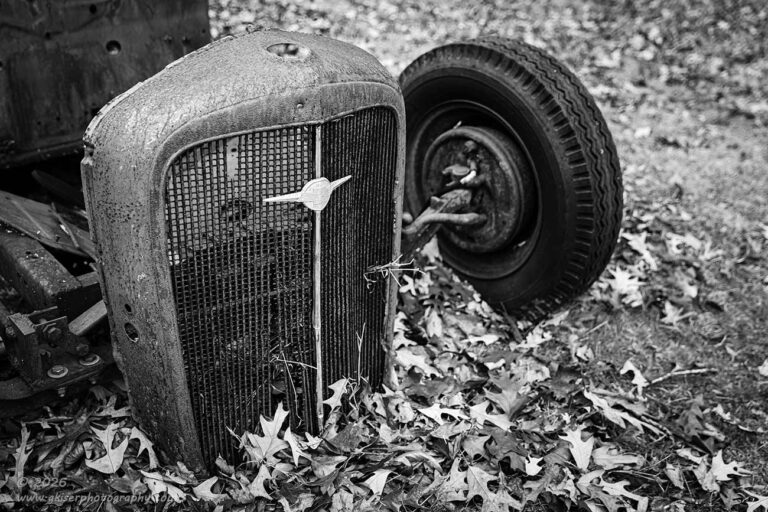
Speaking of lenses, and no, I’m not going to make this a gear blog, but it seems worth mentioning that when I was finished with the firetruck, I went over to the shell of the hotrod that has been in several places on the property over the years. I’ve gotten plenty of really great photos of this car but hadn’t really looked at it on any serious level today. As I was looking at it, I started to see a variation on a concept that I had shot a while back dealing with the grill. The car hadn’t moved and there was still a lot in the background that didn’t make me happy, but the grill still looked like a tombstone the way it was sitting right on the ground. I really liked what I had shot during the Fall but recalled them all being in color. The overall brown of the season was telling me that black and white would be a better option this time and I wanted to try a variation on one of the compositions that I had shot before.
This is where the lens choice comes in. For the vast majority of my time as a photographer, the 24-70mm lens was really the only lens that I used. It is the standard zoom, and it was my workhorse by a wide margin. Only occasionally would I switch out to my other lenses. As you look at the descriptions of the photos in the blog from this location, you will see that I have only used two lenses, the telephoto and the wide-angle. This subject matter used to be the domain of that standard zoom, but I just wasn’t using it at all during the trek. Now the Studebaker that started the day out was an exception and I used that standard zoom exclusively for that subject because it was just the right choice for the job. Maybe if I had some more time with it and some more time to think through things, I would have pulled out the other lenses because they are designed to see differently than our own eyes and require a bit of translation to see compositions.
The last time I had shot the shell of this old car, I had done the translations and had used the telephoto for the shot that I was wanting to fine tune on this visit. Now that I was looking at the grill and working through the composition as I wanted to display it, the telephoto was just not the right choice even though it was already mounted to the camera. There was no way to get the camera high enough to make it work, and I didn’t want the compression either. I was actually liking how the perspective was appearing while looking with my own eyes.
This is why the 35mm, 50mm, and standard zooms like the 24-70mm are so popular. They recreate a field of view much like what the human eye sees. In short, this is what is comfortable for us. In order to make a scene more interesting, a change in focal length might be all it takes. There are other times when a scene just works the way you are looking at it which means that the composition will be close to 50mm. After swapping out the lens for my standard zoom for the first time since early in the morning, I found the composition just as I had seen it and it looked great in the viewfinder.
The problem that I had with the previous shot from this angle was that the grill kind of got lost between the two wheels thanks to the compression from the long lens. I wanted the grill to be more predominant in the frame which meant going with a wider focal length and putting the grill closest to the camera. The best way to do this was to crop out the nearest wheel and let the grill be the foreground while the other wheel was there for visual balance and to complete the diagonal line through the frame. This is how I set the composition up and found a framing that really looked good in the camera. This was what I shot, and I only made one from which I felt was just what I had envisioned.
Interestingly enough, during my culling stage, this one only passed through the first round of culling before it was discarded. It wasn’t until I was starting the second verse of this series that I wanted to go back and look at this one. When I did, I could see why I didn’t like it as the RAW image had been assigned a color profile that was really quite flat and kind of made me forget how good it had looked in the camera in black and white. I made the conversion and started the processing from that point to see if I could remember what I liked about the photo. The more I worked it, the more I started to see the qualities that had drawn me to this one in the first place. Well into the blog series, I was now adding keeper number 26 to the collection from the day.
When I had gone through the first round of edits on the first night, I had a total of 23 images out of 89 frames for the day. That was far and away more keepers than I thought that I would get. By the next morning, I had added two more to that count, and by the end of that second day, I had another one added. This trek might have been a little later in the year than what I try to do, but there is no denying that the results are really quite strong. It was a much more meaningful trek than just going out on the first, selecting a location arbitrarily. This trek was all about considered subjects with reasons behind the photos that were shot.
Once again, Outlawed Restorations came through with what I’m starting to think is an endless number of photographic options. I can’t visit here without coming away with a basketful of photos to work through. It was just what I needed to start working through some of my goals for 2026. I think that I’ve started out with a bang and have already found new ways of seeing both with my own eyes and with a lens that I usually use for just landscapes. I’m looking forward to seeing what will be coming in the future.
If you would like to broaden your photographic horizons, consider discussing a mentorship with me. I have lots of options and am happy to put together something personalized for your needs. These have replaced my workshops so that I can more efficiently cater to the needs of the client rather than trying to put together something where one size fits most. I’m all about helping you create the photos that you want to create, not just tell you how I would do it. Let’s start up a conversation about what would be a good fit for you.
Thank you all so much for joining me for this trek. I really hope that you have enjoyed the photos, the story, and the tips along the way. These blogs are basically my notes from how the trek went, but I also know that they can be entertaining for you as well as giving you the backstory behind the photos that you see. Unlike the AI slop that we all see day in and day out, these photos actually have a story behind them and were created around something that actually existed in that split section of history. There is a real experience behind the photos as well as an emotional reaction that the photographer tries to convey through the final photo. That human quality can never quite be recreated in a microprocessor. From one human to another, thank you for being here.
Until next time….