Monday, January 5, 2026
If you have randomly clicked on this blog entry, you might be a little confused at the title and how I’m going to start this one off. Those of you who subscribe to the blog will know exactly what is going on and have been looking forward to this post. This all started on the morning of the 5th as I began the first trek of the year. I started off slow with a single car which you can read about here. There were two other places that I attempted without success and finally ended up going to a location that I knew would provide lots of opportunities for photos. That was the second chapter of the day, or at least the start of it. That brings us to the next part of the adventure. Up to this point, I have gotten the first images of the year in the bag and have started to really explore some of the creative goals that I set for myself for 2026. As silly as it sounds, it was like I had opened up a new door into photography putting several different techniques and thought processes together. I was starting to feel pretty confident, and I wanted to see where that confidence was going to lead.
I was still walking around and looking for something that would entice me to point the camera at it, but I was trying to be selective with the subjects this time around. I really didn’t want to get home and have to sort through hundreds of RAW images and then end up processing thirty or more photos. As you will come to find out, I kind of missed the intent behind that thought with this trek. In my defense, I did keep the frame count below 90, but I’m kind of getting ahead of myself at this point. I was still looking for things that I could potentially see in different ways. I still had the wide-angle lens on the camera and was enjoying learning to use it in a different way. I was looking for subjects where I could use this lens some more, but where I was walking it was rather difficult to see in terms of a wide-angle lens. The trucks back behind the barn were rather close to together and most had been stripped of many key parts. There were some highlights among them like door art with one, another had a face that was always a teaching point in my workshops there, and there was another that always made for a good composition under a curved branch.
It was that truck at the end that always looked good under the branch that I went to next. I knew that I could work the wide-angle there, but when I started to look, I decided not to even bother. I had shot that many times over and had demonstrated it during workshops. There was also more clutter in the rear of it than there had been which was going to create distractions in the photo. It would also mean that I was falling back into the routine of shooting the same things in the same ways as before. That was what I was trying to get away from. I decided instead to look around the truck to see if there was anything that I hadn’t really paid attention to yet. There was only the cab of the truck left and most everything was covered in moss or a uniform rust. It worked well for an overall but failed in terms of isolations in many regards.
No matter what I tried to come up with, nothing was grabbing my interest with this truck. I had to move on from it and see what else I could come up with. There was another truck that I had photographed many times with the barn wall in the background. This truck was also a cab only with the frame cut off at the back edge of the cab. It was sitting on two stumps. The hood was off, and the glass was broken. I hadn’t been able to get much in the way of isolations on this truck before so I thought that I might be able to come up with something. There were more details present here than on the other truck and that would give me options.
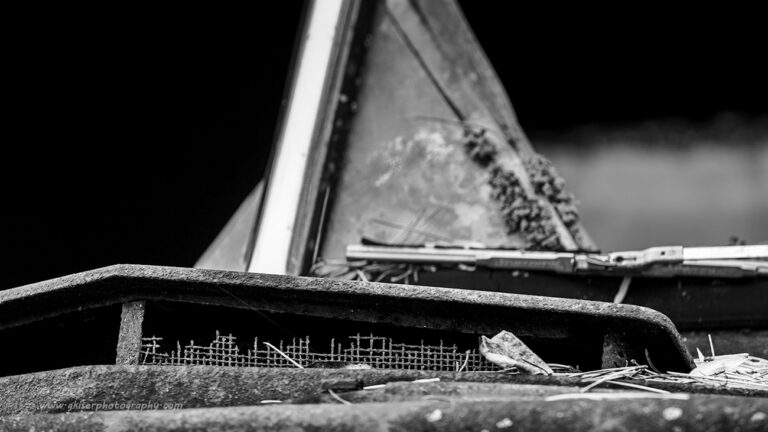
As I was walking around trying not to fall into the same traps that I had before with this truck, I couldn’t help but remember two different occasions where I struggled with compositions. The first was during a trek of mine years ago when I was really trying to get creative with the artistic isolations. I had concentrated on the open vent behind the missing hood and tried to get an abstract of that to show off the textures. It had looked good in the camera, but the depth of field was too narrow when I looked at on the computer. I didn’t really remember how I had composed the shot, just that it didn’t work out and the image was tossed after processing. There was nothing saying that I couldn’t give it another try during this trek, so I started to look at the open vent to see what aspects I liked about it.
There wasn’t much left of the vent with the screen missing from more than half of it. There was no hood leading up to it, and really no color contrasts because all of the rust around it was the same color. Directly behind it there was what was left of the windshield and the center windshield post. One of the wipers was still there, laying on part of the remaining windshield. There was moss on the glass where it was broken, but what did that have to do with the vent below?
That got me thinking about another time that I struggle with this truck during a workshop when I helped a client work through a composition that they had in mind to photograph the remains of the windshield. I didn’t recall exactly how the conversation went, but I did remember looking at the glass from both the inside and the outside. That center section was an interesting part with the triangles of glass remaining. The moss also gave me some added texture that complimented the smooth glass. That could be very interesting in a photo, but not as the only element.
I was now starting to think about combining these two elements to form a single photograph, but how was I going to do it? I started to move the camera around with the telephoto lens now attached. I wanted to see how things lined up and looked. There was a point where the vent became a strong foreground and visual anchor while the broken glass resided in the midground. The dark cab provided a low key approach to the whole thing. It was kind of funky looking and certainly abstract. I started to look at how I wanted to crop and frame the image and eventually planted the tripod when I got it close to what I thought would work.
There was going to be a lot of negative space provided by the interior of the cab which rendered as black in the photo. That simplified the image, but I needed to make sure that the space was seen as negative space and not empty space. That meant that I had to really work the scaling of the other elements in the frame. Something that I had to figure out how to include was the rear window of the cab. That let light in and changed up the negative space balance. If I went low enough to get that out of the frame, I lost the vent which was one of the main reasons behind this photo. As I was jockeying the camera up and down, I realized that I could line it up with the shard of glass on the left of the post. It almost looked as though that was part of the opening in the back, especially with the glass slightly blurred through the viewfinder (looking at things with the lens wide open and focused on the vent). It was a visual trick that simplified the image and brought that shape into the left side which gave more balance to the whole image. It also allowed me to have separation between the vent and the wiper which was important so as not to have the wiper arm be a distraction.
Once I got all of that figured out, I dialed in the appropriate depth of field to make sure that the vent was in focus, and the glass was just going soft. The rear of the cab was pretty much obliterated in bokeh which was fine by me. The image reminded me of a sailboat and I liked the different angles that were visible throughout the photo. It was quirky, but there was no denying that it was more effective than what I had tried before. I wasn’t sure how much I would like it, but I was pretty sure that this was going to be a keeper from the day. The added touch of black and white added to the abstract nature of it and made it that much more interesting when I was done with it.
Now that I am finished with the processing and have seen it on the big screen, I can say without hesitation that I love the image and expect that it will have a pretty long shelf life in my collection. It is certainly evidence that I have started to see things differently when it comes to compositions. I really can’t wait to see how this develops going forward through the year.

I was giving myself several pats on the back for figuring out that composition, but I knew that there was another part of this truck that had baffled me for a long time. I can’t even remember when I first tried to shoot a composition around the double horns on the firewall, but I know that the truck that I did it on has since been moved to the tree line and has mostly been engulfed by the trees. They have always interested me with their shape and how they are positioned, but I have never been able to figure out a composition that supports that love. Even after years of trying, I have mentioned during a couple of my last workshops here that if anyone can come up with a composition that would work for these I would be impressed. Sadly, nobody has ever cracked the code to make it work out.
Here I was feeling pretty good about myself and my ability to see things differently than I had before, so I thought that I would give it another try. I usually had tried something pretty straight on to the horns, or directly from the side. There was one time that I tried from the outer corner of the truck, but in every situation, there were just too many extra elements introduced on the firewall. This time, I shot from across the open engine bay and had the ground and trees behind the truck included in the composition. I found that from this angle, I could eliminate the clutter on the firewall, and I was able to introduce a leading line of sorts with the inner fender bulge and the top of the fender. I just didn’t like how the vegetation looked in the frame.
Well, one of the powers of a telephoto lens is the ability to really have a narrow depth of field, so I started to open up the aperture, something that I had never done for this subject before. By focusing on the horns, I could see that the background was pretty much a blurred mess with the lens wide open. I just needed to stop it down enough to get the horns fully in focus which was a f/4. Checking the depth of field preview button, the background was still pretty much obliterated, but the colors were a distraction. I changed the camera over to black and white to see what the composition looked like without color.
It was one of those moments when I amazed myself. After all these years of trying to figure out this composition, I had landed on it. It wasn’t the first truck that I had tried it on, but this one had the fender structure that the other one didn’t which made this angle work. The black and white kept the attention right where it needed to be, and everything worked out so well. Even the pine needle that was resting on the inner fender helped to frame the composition while giving just that bit of interest to the negative space to the left side. I finally had a composition that worked for these horns and it just got better when I started to process it in Lightroom later in the day.
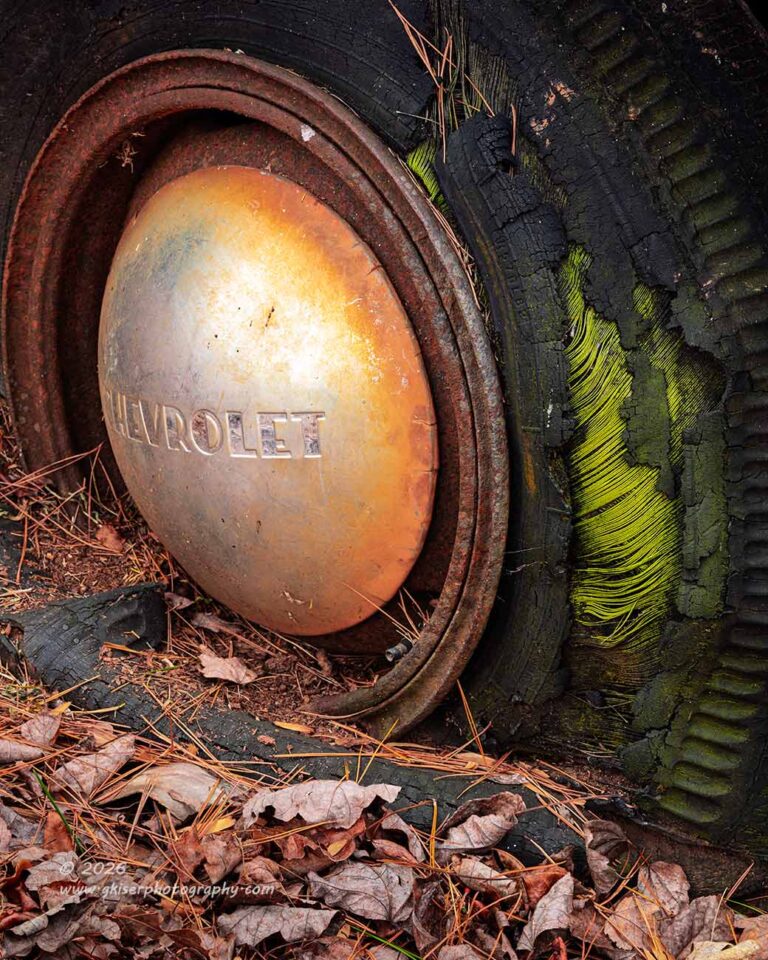
Things were going very well for me now and I was feeling even more confident than I had to begin with. I decided it was time to visit one of my favorite trucks back here and that was the one with the blue fender and the dent that looked like a punch was laded under the right eye. I use this truck to talk about “stories” and “personalities” with these vehicles because it is one of the more expressive subjects that I have photographed.
One of the aspects of it that I have recently discovered is the fact that the steel belt is now showing through the split rubber of the tire. Of course, this is on a wheel where the hubcap is properly indexed to show the “Chevrolet” stamping correctly. The flat portion of the tire is now collecting leaves and pine needles that really shows how long this truck has been sitting here. I’ve done several isolations of this wheel and tire including the fender and cropping in closer to the tire. I wanted to see what I could do with it this time and see if there were any changes to the appearance compared to previous times.
I started to look at the tire and wheel to see how I wanted to compose it. I wasn’t exactly sure how I had done it in the past and made it a point not to look back through my website to find it because I wanted fresh eyes. It is far too easy to let previous compositions influence current decisions which is why I don’t spend a lot of time looking at other’s photographs. I really just wanted the current vibe to direct how this photograph was going to look.
I knew that composing a photo of the entire wheel and tire was going to be too symmetrical and therefore boring, so I needed to find a way to push the attention to the right side where the green belts were. As I played with the framing, I found that I liked a vertical composition with the moon hubcap pushed over to the left seemed to work the best. I got an interesting perspective by moving to the right of the wheel. It was just a matter of where to crop the image in camera to make it all come together and not look accidental.
What I ended up with was a composition that I really liked, but I wasn’t sure if it was any better than what I had done before or not. It wasn’t until I was typing out this blog that I went to find it to see what the differences were. Considering that the subject and scope of the photo were pretty much the same, there was nothing at all similar about the photo. This latest one is just miles away better than the first example that I had shot. The edges are more considered, and the vertical orientation works better than the horizontal one that I had done previously. Even the color treatment seems better this time with the green having more punch and there being a generally warmer tone overall thanks to the season. While this was an attempt at a photo that I had already done, it was well worth shooting again because I improved on the photo quite a bit and gave it a much more open feeling which I really liked.
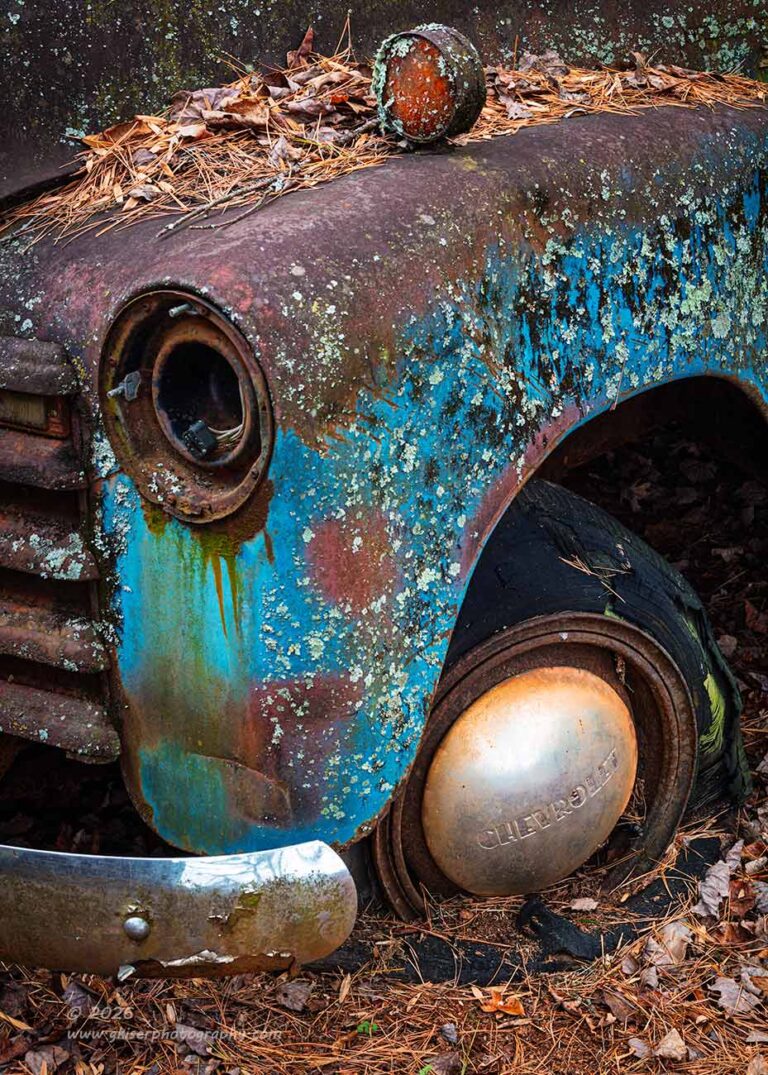
Of course, since I was focusing on the front corner of this Chevy once again, I started to widen my approach to include the blue fender. This blue fender has captured my imagination since the first time I saw this truck in 2018. Back then, it was nearly enveloped in trees which had some great blossoms in the Spring. The truck is much easier to access now and that fender still sings to me with the contrast between blue and rust. This is the fender that I will always say looks like the truck is crying with the streaks below the headlight. Of course, we can’t see the punched in fender on the other side which is the reason for the crying. That is my take on this truck, and I talk about it during pretty much all of my workshops here because it really does help show how to tell a visual story.
I didn’t want to get an overall shot of the front of the truck this time and really just wanted to concentrate on the corner. I had done this composition before but always felt like I was crowding the elements too much. As I was building out the composition, I knew that I wanted to have three visual contact points which would mean including the wheel, the headlight bucket, and the turn signal on the fender. It was up to me to choose the angle where these elements would form some sort of triangle for some added visual interest.
Something that I did differently here was to not overthink things too much. In the past, I would end up creating problems for myself by looking at the marker light in the grill and trying to either include it or avoid it. That created other compositional problems that were much worse than the light. There was also the matter of how much of the hood to include since I was using the turn signal as a framing element. This time, that signal was part of the core composition and that meant that it needed more room to breathe. I kind of let instinct guide me as to what the scope of the frame would include and I must say, I think that it turned out pretty good. The added texture of time really helped the look of this old truck and that green bit in the tire also adds just that bit of interest that is needed down in the lower right corner. Oh, that light in the grill…it is now dark enough due to age that you really don’t even see it anymore. The collection of pine needles on the top of the fender are much more visually important to the image.
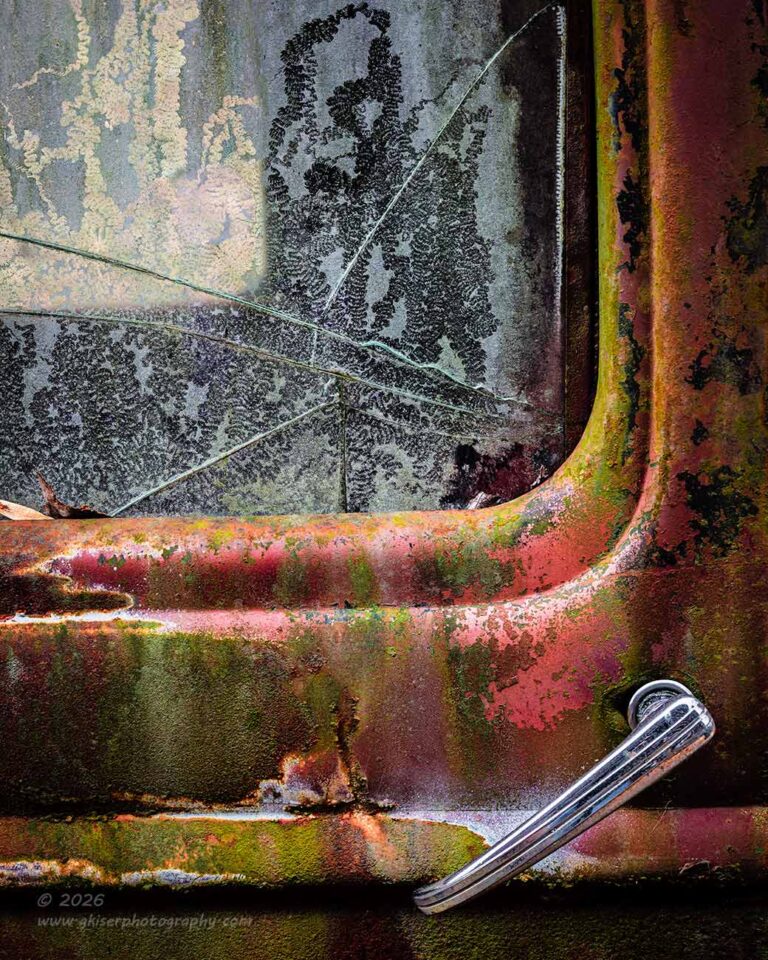
Once again, I was really feeling good about how things were going. I realized that this was an exercise in experimentation, but it really seemed that everything was working out well. I wouldn’t know for sure until I got home and started to go through the images, but I was feeling pretty good that I was going to be seeing a bunch of keepers. Not wanting to linger too much on a truck that I had shot many times now; I moved over to an old ’30-something Chevy truck that I had only really worked two other times. Each time I spend time with it, I find more to love about it. The odd thing is much of the truck is missing which normally would make this a less than interesting subject. It was one that I spent a lot of time with during the Art of Decay Workshop as it offered lots of opportunities to look beyond the entirety and focus more on the details. That was what I was going to do with the truck this time.
I walked around and tried to find something that interested me. It was kind of a slow process, and the answer didn’t really present itself quickly, and when it did, the actual photograph took a bit longer to come together. What I found that I liked was the cracking on the driver’s window and I liked the dropping handle. I saw this as a black and white opportunity and started to frame up a shot that would work. The more I worked with the composition the more I realized that the crack in the glass didn’t really lend itself to a photo as much as I had thought. I still liked the handle and how it drooped, so my attention turned to that aspect. I tried to work out a composition around that, but it was all seeming rather dull. Even when I thought about doing the photo in color, it just lacked something. As I moved around to try and get the cracked glass over the dark portion of the other side of the cab, I hit a spot where the shapes of the two door windows mimicked each other, and I saw a repeating pattern. The more I looked at it, the more of those right angles I saw on different planes of the photo. Even the stamping of the door had the same shape, and the character line below the handle completed the horizontal line to go along with it. The handle broke that pattern and became even more visually important.
This was the composition that I started to really spend time with and got the camera positioned just right to keep that pattern looking right throughout the frame. When it came time to process the image, I went with full color as opposed to the black and white. I even went slightly overboard with the color treatment to add some excitement, but as much as I added to the colors, I also pulled exposure out to darken it. The result was a moody and very colorful frame leading into the repeating shapes within the cab. The handle still held a large portion of the visual weight and cracked glass gave just enough interest there to really complete the photo.
When I shot this one, I really thought that it was a throwaway shot and something that wasn’t going to work as well as I wanted it to. Looking back on it now, it is one of my favorite images from this trek if for no other reason than I surprised myself with the composition trying to work something not nearly as interesting to begin with. There is nothing wrong with having happy accidents while working out compositions and that is part of the joy of looking through the camera as you are moving around. You will see things that would go unnoticed without the camera. That was exactly what happened here and I’m glad that I was around when the opportunity presented itself.

I knew that the hood of the truck held some interest and had shot it before. There was no denying that how I had done this the last time had been very effective with using a window in the barn to frame the hood ornament. In fact, I had taught this very composition during one of my workshops where I tried to show how to include environmental elements to further the subject that you are actually photographing. One thing that I had noticed in the photo that I shot was that I had used too narrow of an aperture and felt that the barn needed to be blurred out a bit more. This is one of those things that I have become more and more aware of after spending time doing portraiture where you really want to separate the subject from the background. I’ve learned more about how to utilize this technique since early 2024 when I first did the composition. Now that I was in a very creative space, I felt that I could improve on what I had shot before with the simple solution being using a narrower depth of field.
As it turned out, I also ended up using a longer lens, but I think that the actual focal length was pretty close between the two attempts. I know that this time, I included more of the hood which gives the photo a bit more room to breathe which I really like. The window is still framing the hoor ornament and there is a similarity between the window and the area where the grill is missing. The extra blur of the barn really worked out nicely for this shot allowing more of the attention to fall on the textures of the truck and focusing on the warm rusty tones which contrast nicely to the cool gray of the barn. There is no doubt in my mind that I have improved on this shot, if only by a little bit. Any improvement is an improvement though and that was just the kind of day I was having.

While I was here, I wanted to get a vertical shot of the hood because I had recalled doing that before but ended up tossing the photo because it just didn’t work. I wanted to give it another try and not recalling exactly how I had done it before allowed me to look at things with a fresh set of eyes. To make this a little bit different than the horizontal shot, I decided to include the far fender for a bit of added shape to help give the main subject some structure. What that simple addition provided was an element that introduced some much needed visual tension between the different sides of the composition. The far fender was significantly lower than the panel in the foreground next to the grill opening. The different levels, but similar colors created an asymmetry that really worked for this composition. Of course, the window was still framing the hood ornament while providing a link between the subject and the background with the block of darkness.
I’m almost thinking that the vertical composition is stronger than the horizontal one and that makes me really wonder why I discarded the vertical one before. Whatever the case, I was very satisfied with the two compositions that I had shot with this Chevy. The question was, had I reached the end of the road for the creativity for the day? I still hadn’t done anything with the firetruck which was the main reason for coming back out here. I guess that is a clue that there will be another part to this adventure. Stick around, and I’ll be back tomorrow with the conclusion of the day.
See ya soon….