Saturday, February 26, 2022
***Notice, there has been a cancellation in my bookings for the Spring Workshop at this location. There is an open slot available currently if you would like to sign up****
It would seem as though I am steadily getting ready for my Spring workshops at this point in the Winter. Last weekend, I went out and scouted downtown North Wilkesboro to see if that was a viable option for a Spring workshop through the Wilkes Art Gallery. I’m still not sure as to whether or not that will work as I would want it to, but it gives me a starting point for figuring out what to do for them. Time is also getting close for the Spring Landscape Workshop which is scheduled for April at Stone Mountain State Park. While I am very familiar with the park and what it offers, it has been quite some time since I’ve been there. In fact, one of the last times was at the end of 2020 when I did a day-long One-on-One session. If I’m not mistaken, I’ve only been back out there one additional time at the beginning of last year. Since I’ve already scheduled the workshop for this year and have seen it sold out, I figured that it would probably be in my best interests to get out there again to make sure that nothing has changed. I also needed to figure out a rough plan for the day with several different options based on the weather. That was kind of the point of going out there today more than anything else.
The thing that I like most about Stone Mountain is that it has a little bit of everything within a short hike. There are mountain streams, waterfalls, woodland scenes, historic and rustic locations, and, of course, lots of landscapes. It is those landscapes that are so unique here in NC with the various balds that you can hike across as well as see from different locations. Regardless of the weather, there is always something that can be photographed within the park, and I needed to refresh my memory about what was there.
I had planned on going out there on Friday since the weather was looking promising with fog in the morning, decent clouds through the morning and then clearing off in the afternoon. Well, when I woke up that morning and checked the weather, there was fog as expected, but there was also rain forecasted through most of the morning. The skies were going to clear off right about the time that the rain stopped which was not a good thing at all. I considered going on and getting some spots picked out, but the bed was just too comfortable to give up for an opportunity to go out and stand in the rain. Yeah, I whimped out and stayed home. Looking at the weather for Saturday, the rain was not present, and the clouds were going to last for most of the day. I wasn’t going to have fog, but that was fine by me. I mainly wanted some clouds to play with and there were some mid-level clouds forecasted which would give me some depth to the sky.
I woke up while Toni was getting ready to go to work and checked the weather. The clouds were actually thicker than anticipated according to the forecast, but currently the skies were reported to be clear. It wasn’t ideal, but Sunday was looking like a rain event and nothing but clear skies were in the forecast for the following days. The general consensus was if I was going to get pictures, I was going to need to go today or wait for what could be another week. With that, I rolled out of bed and got ready to hit the road. As I was pulling out of the garage, I noticed that there were clouds in the sky which gave me hope for the day. I was just hoping that there would be some texture to them so I could work compositions with the sky included.
As I got to the park, the sun was already at the horizon. That is the nature of the beast when the park opens at 7am, right when the sun was waking up. I knew that the Hutchinson Homestead was a good location to catch some morning color, and it was about the only place that I could get to quickly. However, looking at the sky, I could tell that there wasn’t going to be any color this morning, so I thought about my options. With the lighting pretty flat I was inclined to work the water features of the park which included several waterfalls and a lot of different mountain stream locations. I figured that I would hit Widow’s Creek Falls first, and then work the various streams that went alongside the road. I debated on how best to park and decided to just park at the lower trail head and walk the mile to the falls and back so I could pay attention to the areas that I might want to include in the workshop.
Widow’s Creek Falls
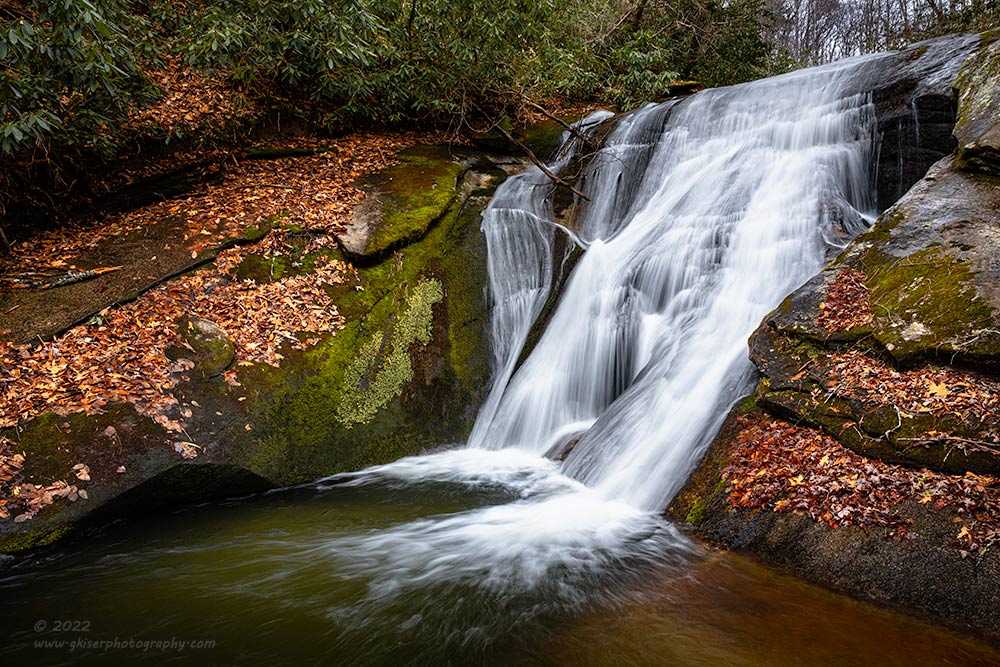
You might have noticed that I have titled the chapter here which is not something that typically do with my treks. The reason I’m doing it now is since I’m scouting for the workshop, I wanted the locations of the photographs to be included so that the participants might get a better idea of where we are going to be spending time. As I mentioned, my first stop was going to be Widow’s Creek Falls which has its own parking area, but I usually like to walk the route so that I am free to stop and photograph the streams as I go by. I at least wanted to be able to check them out to see if there was enough room for six of us to be standing around with cameras in hand.
The walk was pretty quick since it was only a mile away. It took me about 20 minutes to walk down to the falls and then the quick 30 second hike to get to them. I’ve photographed this particular waterfall more times than I care to count, so I know the areas where I am going to get good compositions before I even get there. The only wildcard with this waterfall is the flow of water which can really alter the available compositions. The flow was looking fantastic this time and might have been the best that I have seen here. I went ahead and tucked my pant legs into my socks and did the short wade across the water to get to the opposite side of the falls for a bit better flow to the composition. I started to look at the locations where I knew there to be compositions and immediately recognized that there was a branch caught in the tree to the right which was going to cause some distractions to the photographs. Since the branch wasn’t really attached, I had no problems pulling it down and getting it out of the way, but in order to do that I was going to have to get in really close to the falls.
I kept my feet nice and submerged as I skirted around the pool to get to the fallen limb. Once I got it down, I figured that I might as well start making photographs from this location since I was here. I usually don’t get in this close, but since I was here…I went ahead and grounded the camera bag and pulled off the tripod which was mounted to the side for ease of carrying. Since I was in close, I didn’t need anything special when it came to my lens choice, so I just pulled out my standard 24-70mm lens which is my favorite walk-around lens. I then added the polarizer since I was working with water and put the whole rig on the Acratech head. It was then just a matter of finding the exact placement that I wanted for the camera, so I moved it around while looking through the viewfinder until I found the right area to set up in.
I started to make some test exposures to see how the water flow was looking with the different shutter speeds and I quickly realized that the conditions were still quite dark thanks to the clouds. My shutter speeds were hovering around three or so seconds which was way too long for the speed of the water. I knew I was going to need to get down to 1/5 of a second or so for this one. I opened up the lens as much as I dared before I was sure to lose depth of field. That still didn’t get me anywhere near where I needed to be, so I ended up boosting the ISO to 400 which I don’t like doing, but it was the only way I was going to get the right shutter speed for this one.
With the camera in the right ballpark, I was able to move between f/7.1 and f/11 to get the shutter speeds that I was after for this waterfall. I was confident that unless I messed up the exposure badly, I wouldn’t have any issues with ISO400, but that was going to be the limit of where I felt comfortable shooting without having to worry too much about noise. As I worked through the different shutter speeds, I moved the composition slightly in the different directions until I was relatively confident that I had the right composition for what I was after.
Normally, with this waterfall, I like to include one of the secondary drops as a foreground to add depth to the image. This time, with the water flowing as it was, I didn’t feel like I needed that extra element nearly as bad. I did move back away from the waterfall to try some foreground elements. I even swapped out to my 16-35mm lens in order to get a pair of rocks in the foreground. I was pretty happy with those on the back of the camera, but they ended up lacking when I looked at them on the computer screen at home. Before I left, I decided to swap in my 70-200mm lens to go for one of my favorite isolations of this waterfall. I was already in the perfect position for it, so it was a pretty easy change from shooting at 16mm to something around 100-135mm.

What I really enjoy shooting with this waterfall is the section near the bottom. There are two different details that always catch my attention regardless of the flow. The first is the area where the face of the wall has been eroded away by the water. There is a goldish colored rock at the bottom of that divot and the water always flows so interestingly around all the surfaces. The other aspect is just to the left and it is a slightly elevated portion of the wall that resembles an angel or a dove depending on the flow of water around it. This time, it was very much looking like an angel, and there was a distinct separation of the sides of this form. It was almost as if this was half dark angel and half angel of light. It was that duality that prompted me to really commit to this composition. I worked this for a while with different shutter speeds and slightly different framing to try and really isolate the shapes that I was interested in.
I remember thinking to myself that this was going to be my favorite image of this composition because the water flow was just perfect, and I was having so much fun making the image. Even after I got it home, I still loved how this one looked and still think it is my best attempt at this one thus far. Strangely enough, the first series of photos yielded another image that I think rivals my previous best attempt at this waterfall. What makes that so impressive is that I usually don’t get in that close because I’ve often thought that by doing that, I was making an overly simple postcard shot of the waterfall. When I looked at the image on the computer screen, it was not a postcard that came to mind, but a very involving photograph of a fantastic waterfall. I was definitely happy that I had decided to come here first, but I was really wishing that there was a bit more light to work with. Fortunately though, I didn’t have any issues with noise due to the higher ISO setting. In fact, the only noise reduction that had to be done was up in the trees in the first shot because I pulled them out of the shadows quite a lot. I was actually impressed with the performance of the camera since this is a known weakness of the megapixel monster 5DS R.
After an hour and a half working this waterfall, I packed up the bag and started my way back to the trail head. I took some time to consider the different stream options, but didn’t see anything really outstanding to shoot. Looking at the sky, I was about to have some texture develop and I wanted to be able to take advantage of that up at the higher altitudes of the park. Even with the stopping, I was back to the trailhead in about 30 minutes and started off on that hike that I knew would be mostly uphill.
Wolf Rock
The hike up the mountain took some time as the trail is a series of switchbacks that take you to the top of the mountain. It was the first time that I have been out here since the controlled burn last year. Hey, I had forgotten all about that trek! So, I guess it has been just under a year since I’ve been to Stone Mountain. The trail seemed to be different and there was a lot more visibility than I was used to. I actually thought I had gotten lost a couple of times, but I think it was just where they had cut in new trails. I was very familiar with the huffing and puffing though which assured me I was on the right path for the most part.
Eventually, I got to the top of the mountain and things leveled out. I knew to look for the turn to get to Wolf Rock which has always been one of my favorite locations to shoot. When I arrived and came out from the woods it was like an old friend waiting to see me. The sky wasn’t all that great yet, but I had time to look around to see if there were compositions to be had. I remembered that my favorite tree had fallen down sometime last year, and I confirmed that it was gone soon after stepping foot on the bald. That was a real shame because I always found great compositions with that tree since it was set in the middle of a split rock. Oh well, nothing that can be done about that, it was gone, and I needed to find other compositions that might keep my workshop busy.
It is the landscape that interests me the most about Wolf Rock. The rocky surface is quite unique and special. It makes for a fantastic subject under an interesting sky which is when I enjoy photographing it the most. I didn’t have that sky this time, and the distant mountains were still in their dormant state which didn’t really help matters any. I pondered some different views and then ultimately settled in on photographing a composition where the water runoff was making some very interesting patterns on the bald. I stuck with that composition for a while and felt pretty good about it. It was dramatic and took advantage of the best part of the sky. Sadly, when I got the image home, I realized that I had a great leading line theme going on with the image, but those lines weren’t leading me to anything interesting at all. There was just no prize for the eyes, so I had had to trash the whole series of images. It happens from time to time and that is what happens when you become your own critic. You have to make the hard decisions about images that you might be very happy about capturing but end up realizing that they just don’t work.
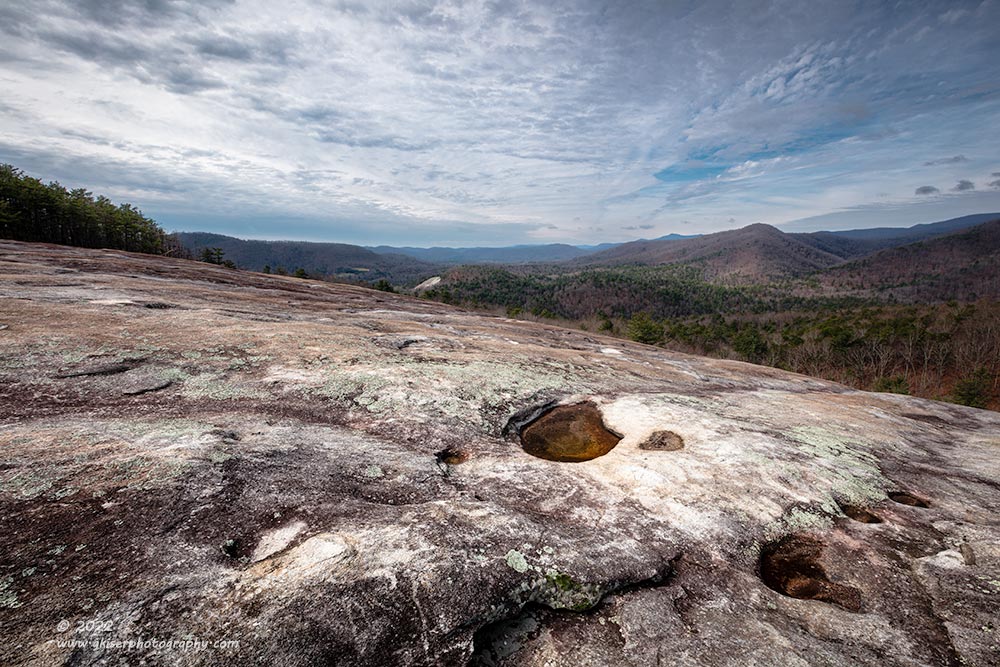
Fortunately, I wanted to make use of the wide-angle lens that I had fitted on the camera for the previous shot. I moved around to find another scene that had some interesting foreground elements in the form of potholes. I worked on that scene for a while and tried several different compositions before settling on the one that you see above. This time, the viewer had some elements in the background that balanced out with the foreground and the whole scene made more sense because of it. This was a very simple scene, but one that worked in a relaxing sort of way. I didn’t spend that long with this composition, but I did at least get one image that I liked from this rugged landscape.

I actually found myself feeling kind of bad about Wolf Rock without the tree that I loved to photograph. I just wasn’t really finding a lot of inspiration for photographs like I normally would. Heck, there have been many times I’ve spent hours up at this location and didn’t have time to go to anything else. This wasn’t going to be one of those times unfortunately. I think I spent about an hour here mostly walking around looking at things. I was actually considering the possibility that I would do better on the other side of the park for the workshop. Of course, it was things like that which was the reason why I wanted to come out here and scout the location before the big day.
As I was getting ready to pack it up and move on to the next spot, I decided to check out a tree that I had photographed so many years ago that it turned into a gift for Sierra’s 1st grade teacher. You might remember that she is now a senior in high school. I hadn’t done anything else with that tree since that time because the brush around the tree has grown up so much that I just couldn’t get the composition that I wanted. Nothing had changed since that discovery and if anything, the surrounding brush was even worse now. The tree itself was still really interesting though and since I hadn’t been able to get my tree picture from this location I decided to see if I could make something work out with this tree.
I still had the wide-angle lens attached and since I really didn’t know the composition I would be trying, I just left it on. The overall picture of the tree was definitely out of the question because there would be no way to determine where that tree stopped, and the others started. That had been my go-to for this tree the times that I had shot it, but when I was out here with Jon for the One-on-One session, he had opened my eyes to another possibility. His vision for the tree was a more intimate capture focusing on the trunk with the Fall colors in the background. The idea had stuck with me, but I didn’t want to steal his composition and idea, so I just kind of sat on the concept.
As I was looking at this tree, that concept came back to me, and I decided that I would build on his idea. I didn’t remember the image that he shot in detail, but I remember that it was a limited depth of field shot and that the background was the Fall color. I was pretty sure that he had shot this with a telephoto focal length which added to the limited depth of field. I considered doing that, but as I was looking, I noticed a small grove of trees in the distance which interested me. I had shot these before as their own main subject, but they weren’t quite organized enough to make for a compelling subject like that. Looking at them in relation to this gnarled tree was something else entirely. I had the idea to compose the shot using the tree as a frame for the distant trees which would allow me to isolate the shape of the tree that I liked and give me a reason for putting it off center to minimize the surrounding brush. In order to do that, I was thinking that using a wider focal length would be the trick. Sure enough, the 16-35mm lens was the right choice and it allowed me to get about a foot away from the stump of the tree and frame up an image with a lot of breathing room for the trees in the distance.
Since I was so close to the tree, I had to worry a lot about depth of field. Fortunately, when shooting with a wide-angle lens, the depth of field is much deeper than a telephoto range. I worked out they hyperfocal distance at f/16 and f/18 in hopes of getting it all in focus. I wasn’t sure if that had worked, so I did a couple of different focus stacks where I focused on four different points with the intention of blending them in post when I got home. I did this more as a failsafe than a primary plan. I will always prefer to get the image right with a single capture if at all possible. Any time multiple images are blended together, there is a chance that something is going to end up out of place which will require more work at the computer. In light of that, I was thrilled that my f/16 shot worked out very well with everything in focus that I wanted to be. I was actually fine if the background went soft, but I didn’t want it blurred out since the grove of trees was an important part of the composition.
I have to thank Jon for this one since he came up with the composition. It is now my favorite photo of this tree, and it gives me another location on Wolf Rock that I can work with in the future. I’ve said it many times before…I learn as much when I’m teaching as the students in most cases. This time, I learned a fresh way of seeing an old friend and over a year later I’m putting that knowledge to work.
Cedar Rock
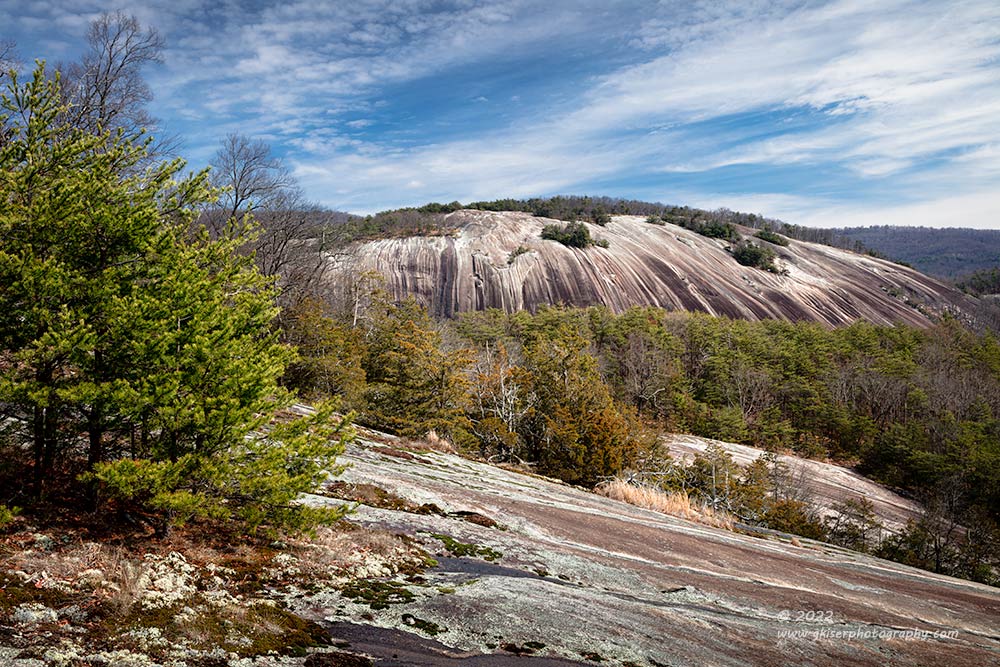
When I finally left Wolf Rock, my next stop was Cedar Rock. It had been some time since I’ve been down to that point, but I wanted to check out the view of Stone Mountain as this will be an important part of the workshop should we make it up on this side of the park. It really isn’t too far down the trail from Wolf Rock, and it is mostly level, or even slightly downhill to get to it which was a welcomed quality after the slog up the mountain. When I got there, I entered at the first point as I tend to do. This allows me to really check out the landscape because this location is very similar to where I had just been. It is all about texture on this bald as well.
Sadly though, I wasn’t finding anything that jumped out at me at this location. For some reason, I just wasn’t feeling this landscape today. The sky wasn’t helping either because while there was some clearing in the sky, the light wasn’t all that engaging, and the clouds lacked personality. I was here and I still had scouting to do which kept me going. I just stayed on the bald and crossed the trail a short distance from where I had entered the bald. I kept going knowing that a view of Stone Mountain was just around the corner. That was the main point of me coming up this way so I was hoping that the view would be worth it.
When I got to the other side of the trees, I could see the summit and the sky was actually looking rather interesting over it. I found a bit of foreground interest in the form of a grove of trees. I remembered this little patch of vegetation quite well because it formed a foreground for one of my first photographs of this view back in 2007ish. Back then, the trees were little saplings which I had to use a wide-angle lens to make prominent enough to make sense in the image. These days, the saplings are well developed trees which can still be used as a foreground, but they now have to be placed over to the side because they are taller than the summit.
I spent some time working out this composition with my standard lens because I needed to make sure that the mountain retained a good bit of its scale in relation to the trees. In addition, I had to elevate the camera well above my head in order to keep the trees from dwarfing the distant summit. It all worked out quite well and I was able to get off a series of frames before the sun was covered up by thicker clouds killing the light. I spent some time after that working different compositions as I moved closer to the summit. I eventually removed all foreground elements and just had the trees at the base. This was obviously the simplest composition, but the sky never really came back as good as the original composition. Without the sky, the latter images didn’t have a chance of matching up against the one that ultimately ended up being my keeper for the day.
This view of Stone Mountain happened to be my only image from Cedar Rock. There was just nothing else that really interested me up here. I had a working idea of how I would need to proceed with the workshop at least and was thinking that the next time I came out here I would be trying the summit hike because there are a bit more options for compositions on that side. Regardless, I was happy that I had come out to this side today since it had been so long since I had visited. It was time to head back down the mountain and consider hiking up the other half of the park before I got done for the day. I considered that option all the while I happily walked downhill.
The Hutchinson Homestead
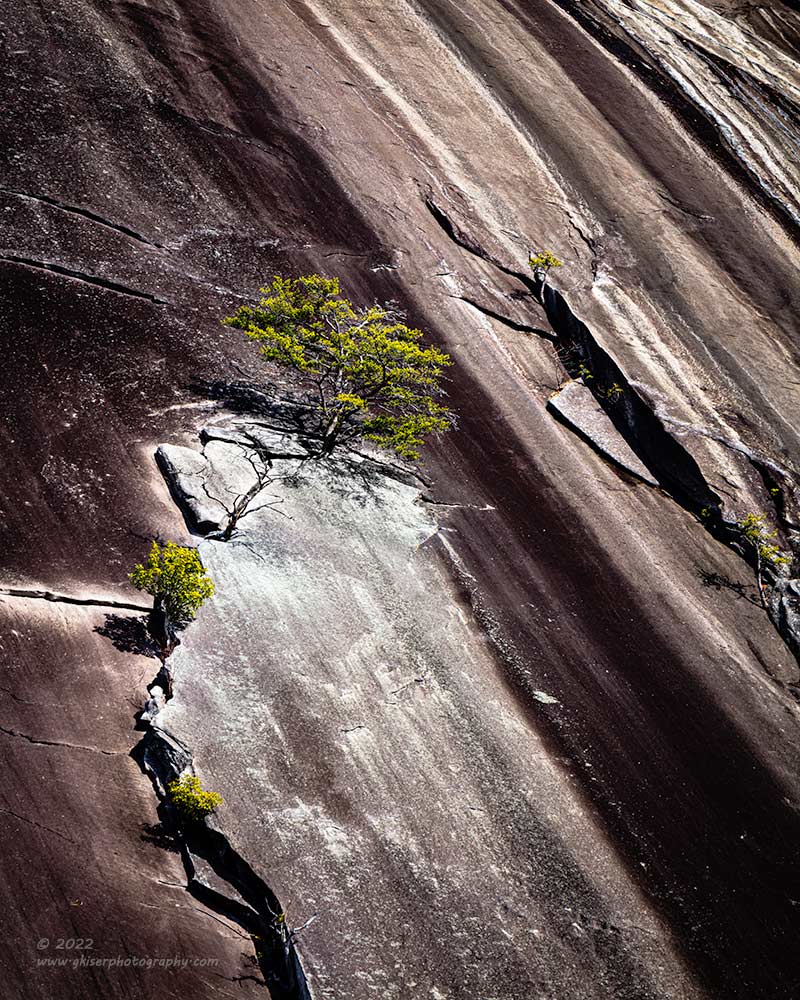
As I got closer to the parking lot, I realized that the lighting wasn’t all that great anymore and I would do better to wait for another time to scope out the other side. With the time that I had left, I wanted to check out the homestead and the view of Stone Mountain from the meadow. This was an easy detour from the trail back to the parking area and I just made that turn and worked my way to that part of the park. When I arrived, there were a lot of folks sitting on the benches watching the mountain climbers on the summit as well as the folks running some sort of event through the park. Some were running the trails, some were walking the trails, but they all had bib numbers which indicated that it was an organized event. Leave it to me to come to the park on a day when there is a major event going on. Anyway, I took some time to look at the meadow and see what I would have to work with. Not much had changed which was good.
I considered doing my standard composition of Stone Mountain, but the conditions were not nearly as good as the last time I had shot it in black and white with a long exposure. Any attempt at that composition would be wasted because there was no chance of getting something better. As I was looking at the mountain, I started to notice some details that I thought would make for some good compositions. There was a grove of trees at the top of the bald just above a very interesting break of the granite and there was another tree close by that was growing out of the side of the bald. Both of these views captured my attention and I decided that I might as well give them a try.
I tried the trees at the top of the mountain first. This was such a small portion of the mountain that my 70-200mm lens didn’t have the reach to be able to isolate that section. My only option was to add the teleconverter which would give me up to 400mm reach. While I was mounting that converter, I realized that I had used all but one of my lenses today and had shot just about everything from 16-400mm. The only glass left in my arsenal was a 14mm prime which I love, but is a very specific tool that needs a particular environment to function in. It just so happens that today didn’t have those ingredients. The teleconverter is kind of the same type of tool and I don’t get to use it often, but it is invaluable for those times when I do get to use it like today. With that extra reach I was able to frame up some compositions on the trees at the top of the mountain, and then I moved to the one tree that was growing out of the side of the mountain that I thought was quite special.
Trying to frame up a photograph of a nearly vertical surface while capturing a tree was not as easy as it appears. There is absolutely no visual anchor for this image and the pure nature of it is almost abstract because we are just not used to trees growing this way. I decided to incorporate the diagonal elements of the rock face since I was shooting from an angle. This added a bit of depth and visual tension to the scene. It also allowed me to balance out the tree with the surrounding rock surface. It was an experiment for sure since I had never attempted a composition like this before. I’m not entirely sure I like it, but the concept is just too cool to pass up on.
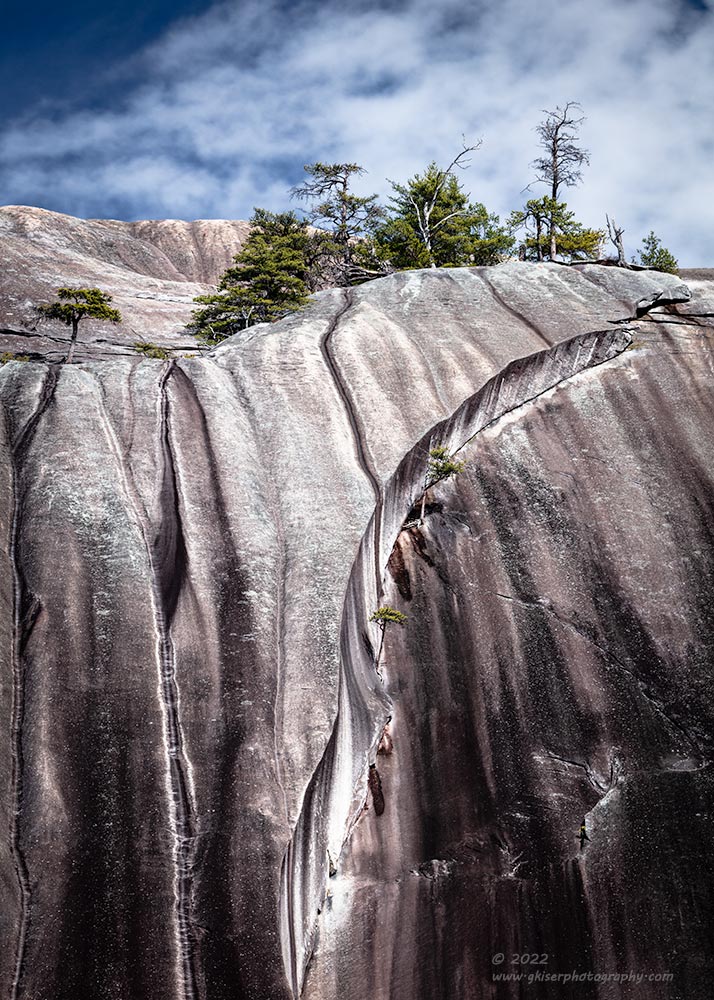
As I was getting a little more comfortable with the focal length that I was shooting at, I decided to go back to the composition that I had been working on to start with. I had been working this as a horizontal as well as a vertical orientation and continued with that for this second attempt. The clouds were coming in a little better and I was able to get a bit more visual interest in the sky this time. I ended up liking the vertical orientation better than the horizontal because it really highlighted the surface where the rock had broken off at some point and left the remaining sliver of granite behind. Something that I did different this time, was I included the one lone tree off to the left which allowed me to give a bit more breathing room to the rock formation and add a little dimension to the scene. I think that it worked out quite well in this presentation and this became my keeper.
Something that I learned from this experience was that when shooting in excess of 200mm with the tripod extended up to the maximum height, you absolutely have to use a remote shutter release to keep camera shake from softening the image. Looking at my spirit level, I could tell that it took about 15 seconds to calm down after I made an adjustment. I would always wait to fire off the shot until both bubbles ceased any movement. That was how I knew that the rig was stable. Normally I wouldn’t extend the tripod like this with the teleconverter mounted, but I actually needed that extra height to make the compositions.
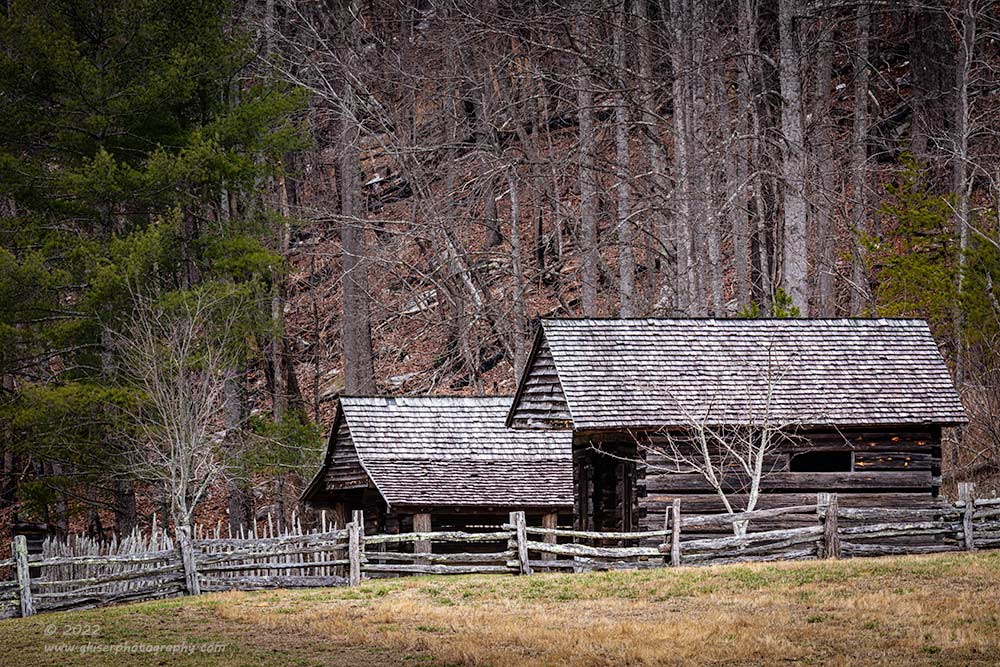
Before I called it quits here, I turned my attention to the homestead which I have photographed many times before. I was looking at the two buildings off to the corner at the base of the mountain this time. These are not all that easy to photograph because of the information kiosks that are in front of them. I couldn’t help but notice that from this distance and angle that the kiosks were successfully hidden behind the fence. I looked through the camera to confirm that and with a focal length of just over 200mm, I was able to see a clean photograph developing. The overall compression made the trees stand out nicely and the buildings looked very nice at this focal length which kept the relative size similar between the two. I just went ahead and set up the shot and fired off a few frames of the buildings before breaking the camera down.
When I was done with the last shots of the day, I pulled the camera apart which took a very long time with that extender screwed in-between the lens and the body. I got it all torn down and packed away neatly in my camera bag. I mounted the tripod back on the side and started the hike back to the truck. I had a brief notion of going up to the summit since I was passing by that trail but opted against it. I was tired and figured that the light wasn’t all that great at this point. I would come back another day and scout that part of the park to see if it would be better than Wolf Rock and Cedar Rock. For now, I just wanted to get back to the truck and get a snack and some water.
The last bit of the hike wasn’t bad at all since it was pretty much on a road. When I got to the truck, I threw everything in the back and grabbed a snack. It was time to head home because I was actually quite tired at this point. On the way out of the park, I took a few detours in an attempt to find a location that I had shot a couple of years ago for a client of mine but couldn’t find it. I ultimately got back on Traphill Rd and started to make my way home. I remembered a scene that I had noticed coming into the park this morning which I had wanted to stop and photograph several times before but had never worked out a composition in my head. The idea that I had this morning was a simple one, and I thought that I could give it a try since I was going to be driving right past it anyway.
Bonus Location

When I got there, I pulled off the road and looked at the scene as I had done many times before. Nothing had changed and the composition still wasn’t one that I really loved. However, the light was looking good on the scene and the sky was looking right for the mood that I wanted to convey. I went ahead and parked the truck and got out to look at the scene from several different angles. What I learned quickly was that the best angle that showed the front of the truck came with a bright yellow box truck which was parked beside the building. It was the most colorful object in the scene and if I had included it, that would have become the main feature of the image. I wanted the truck and the building to be the primary focus, and both of them were rather drab which meant that I couldn’t have any bright colors in the scene. The only way to make it work was to shoot from behind the truck which would give me a good view of the building, but also the trash pile in front of it. The rear quarter view of the truck wasn’t all that interesting since it was a flat dump bed with a scoop strapped to the bed. It might not be perfect, but it was a workable solution.
I went back to the truck and got my camera out once again with the 24-70mm lens mounted as well as the polarizer. I went back to the place that I had figured out would work the best and set the rig up. I started to make exposures but wasn’t happy with the perspective of the shot. The truck was too big in relation to the scene, and it was pulling too much attention from the building. It was an easy solution fortunately. I just walked across the road and framed the image up again, but with a much tighter focal length. That did the trick, and the compression changed the scale of everything in the scene to much closer to how I had seen it.
I didn’t take too long to get this image done. Most of the time had been spent figuring out the composition. The sky wasn’t changing much so I didn’t have a reason to wait for that to change. I just got the shot and put the camera back in the bag for the last time. I was done, it was time to go home. I had shot 204 frames since 7am. I had hiked around seven miles and according to my watch climbed 75 floors. It would have been nice to come home and stretch out on the couch, but I had to go downstairs to the office and charge my two batteries and start editing images. Here I am at 1am still typing after uploading the nine new images that have been added to my catalog. Such is the life of a full-time photographer. I’ve worked more hours on a Saturday than I used to work during a weekday. I’ve also unpacked the subjects of my upcoming product shoot with includes 15 pieces. I’ll have to get that done and edited here in the next few days and sent back to Florida. I am looking forward to playing with the studio flashes once again though. There is just something about controlling the light that really appeals to me since I’ve been at the mercy of natural light for so many years.
I hope that you enjoyed this trek, and if you are signed up for my Spring Landscape Workshop, I hope you got a good idea of what we might be in for during the day. I’ll get back out there and work the other half of the park to see where our best bang for the buck will be come April. For those that are signed up for my composition workshop the following month, you will get the inside information on how I form my compositions and will get the opportunity to put some of those tricks to use in your own photography. I’m really looking forward to getting out in the field and teaching photography once again. It is just so much fun for me, and from what I’ve been able to gather, it is just as much fun for the participants. For those of you who don’t care to learn photography, that is perfectly fine as well. I’m glad to have you here enjoying my photographs. I would like to remind you that the best way to enjoy a photograph is in the printed form. I would love to match you up with a print of your very own of that special photograph that speaks to you. Maybe that special photograph would be a photograph of you or a loved one. I can help you out with that as well. I’ve come a long way since I started portraiture and I’m ready to book your session now. It doesn’t even have to be a portrait. It can be a theme inspired shoot that we work together on. whatever you need, I will do everything that I can to make it happen.
Until next time….

Remember to use the code KISER10 to get 10% off your purchase