Sunday, June 5, 2022
There are those that think that landscape photography can just be done at the beginning and end of the day during golden hour. There are plenty that think that midday sun is not favorable for landscape photography. While I like golden hour, it is not my favorite time to capture images. The light is so fleeting that you end up spending a lot of time for just a single photograph most of the time. If there is something specific that I want, then this is fine with me, and I’ve done that many times before. However, if I am just wanting to get out and do some photography, the thought of being limited to 30 minutes or less is not appealing to me at all. I would much rather spend more time working different subjects and trying different things out. That would mean that no matter when I started, I would end up going beyond golden hour very quickly and running out of the “good light.” Well, I learned many years ago that all light can be good, it is just how you choose to use it.
For me, I’ve found that clouds are the great equalizer when it comes to light. They might not give that warm glow of the low sun, but they can create shadows on the landscape, diffuse the direct sunlight, and give great personality to the sky. In short, I have found that I prefer good clouds to that magic hour light. Don’t get me wrong, I still enjoy a photograph made with that quality of light and I do search it out at times, but it is just so fleeting that I’m forced to put all my eggs in a single basket when it comes to subjects and compositions.
Since I was feeling particularly creative on Saturday evening, I looked at the weather for Sunday and saw that the day was going to start with clear skies and end that way as well. It was the time in the middle of the day starting just after noon, and going until about 4pm that the clouds would be rolling in. For this time of year, everything that I have read would suggest that I would do better getting up early and getting the low sun and then coming home and napping during the cloudy phase around midday, only to come out again in the evening for the low sun once again. Sure, I could have done that, but my skies would have been boring, and the need for finding a specific scene would have been paramount. My own experience has taught me that this is not the way that works best for me. When I saw a mix of high and mid-level clouds in the early afternoon, I felt that was the right time to get out and see what I could find.
When Sunday rolled around, the cloud forecast had dwindled a bit and the window had gotten a bit smaller. I spent the morning down in the studio getting a few things ordered for some particular set ideas that I have been working on. It was around noon when I got all of that finished up and I came upstairs to see what the weather was doing. The sun was still very bright, but the forecast was telling me that the clouds were still going to come in around 2-3pm. I grabbed a quick snack and pondered my options. The high sun would not be all that great for barns, or other decay photography because it would cause shadows where I would want to see details. Landscapes, however, do work well in these lighting situations. I just had to decide where I wanted to go.
Looking back on what was motivating me to go out, I was able to dial in a concept for this trek pretty easily. Here recently, I have been very detail-oriented with my thoughts on photography. I have been working out portrait sets in my mind down to minute details. I’ve been studying details in different photographs to figure out how certain aspects were created, and just generally caught up in the details of the photographic process. This meant that for the most part, I had lost sight of the big picture and really felt that it was necessary for me to regain that mental balance. I needed to concentrate on larger scenes, and I needed to simplify them. With that thought, I knew just the place I wanted to go.
I’ve been to the Lump Overlook on the Blue Ridge Parkway quite a number of times over the last five years or so. It is one of those overlooks that took me a while to appreciate. I mean it is quite literally a lump on the side of the parking lot that has little to nothing present at all. On the side of the overlook is a grand vista that looks over Wilkes County if I’m not mistaken. There is a fence between the parking lot and the lump, but that is pretty much it. As a young photographer I dismissed this as a boring location with no photographic potential. Then I started to try my hand at minimalist landscape photography which suited this location almost perfectly. The one element on the lump was a trail. This trail became the visual tension in many of my minimalist attempts. As many times as I’ve tried, I haven’t gotten it right yet. I’ve gotten close, but I have just not landed on the right focal length, camera location, and sky to really make this compositional idea work. Since I was feeling creative and wanted to try some things, I figured this was the place to go.
I set out around 1pm so that I could get a good head start on the clouds which were starting to come into the area. I wasn’t exactly sure what kind of clouds I was going to get, but I felt pretty good that there would be some sort of visual interest in the sky that I could work with. If I was lucky, the high clouds would also provide a nice softbox quality to the light that fell on the landscape. The really nice thing about the Lump Overlook is that it is just 17 miles from the house, so it takes me no time at all to get up there. When I arrived, the clouds were actually already looking gorgeous over the lump. Going on previous attempts here, I remembered that my long lens tended to produce better results with the compression. That is what I started out with.
I worked the trail for about 10 minutes trying different locations to set the tripod and varying the focal length that was used. It was getting a little frustrating though because nothing that I was shooting was getting that minimalist approach that I was after. The balance was all wrong, and the scale was off for some reason. For those that think that creating a landscape based in minimalism is easy, you really need to think again. When you are balancing multiple elements, it is much easier to come about a pleasing composition. When you are dealing with a single element, or even no elements that visual balance becomes so much more difficult to achieve. Negative space becomes a fine line that you have to control, and you have to maintain the focus of the composition to keep the eyes occupied with very little visual information. I was running into failure after failure. Well, that might be a little harsh. I just wasn’t happy with anything that I was shooting and couldn’t get the right perspective figured out.
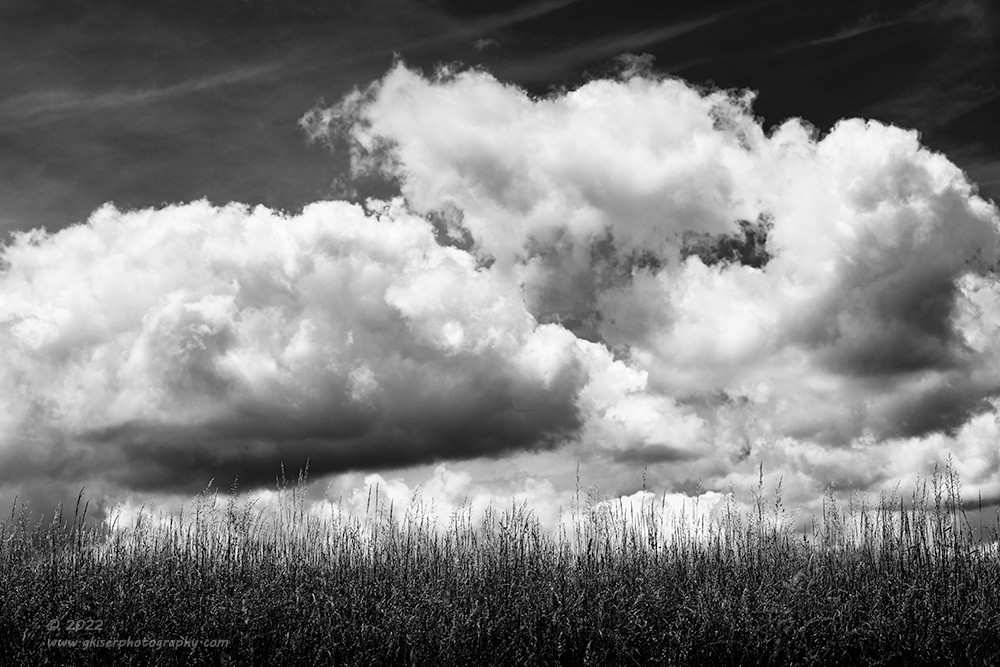
Recognizing that I was getting frustrated, I moved my attention to the tall grass that I had been walking through in order to get in the right place for the photo. The grass provided a nice texture to compliment the clouds and I could see a composition forming that I had not considered before. I got the camera down very low to the ground for a different point of view and chose to include just a small sliver of the grassy foreground while concentrating on the clouds that were forming in the sky. The photo was more or less a cloudscape with the grass just forming a bit of foreground interest and a texture contrast. The image was framed so that the amount of blue sky above the clouds was about equal to the amount of grass at the bottom. Knowing that I was going to do this as a black and white image, I expected the blue sky to go nearly black which would match up to the grass and create a beautiful framing element for the clouds.
Depth of field wasn’t all that imperative here because I really didn’t care if the clouds went soft because they are soft in reality. I just wanted to make sure that the blades of grass were tack sharp and well defined. An aperture of f/8 assured that all of those criteria would be met, and I focused right on the ridge. I only needed two captures here before I was happy with what I had shot. I felt like this was the first image that was in the bag, and you know how important that first image can be for me. From there, I decided to redirect my attention on the original composition that I had been after for so long.
Before starting to make exposures again, I decided to switch my lens for the 24-70mm. I wanted a bit more of an open feeling than I had been getting, and I figured that this was the best way. When I had tried to open things up with a wide-angle lens in the past, I had gotten too much negative space, and worse, I started to get the trees that were situated to the left of the field. There were effective compositions to be had that way, but they were not the minimalist images that I had in mind for today.
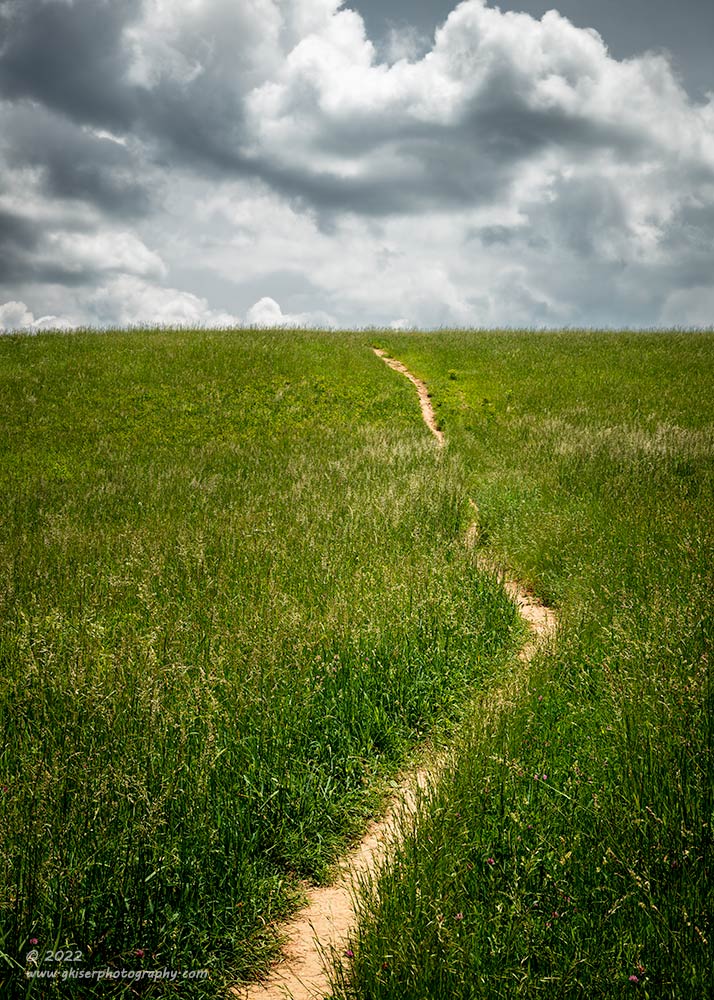
I worked myself around the area and finally found the right spot to stand. As I looked at the scene, I realized that the perspective and point of view of the scene looked just about right from eyes at eye level. I planted the tripod and zoomed the lens to 50mm which would be about what my eyes were seeing. I flipped the camera on its side to accentuate the trail before I figured out where to put the trail. I started as I had done in the past with the trail entering from the left side and snaking through the frame. This still didn’t feel right, so I moved to the left and ended up with the trail coming in just offset to the left on the bottom edge. It took a subtle diagonal line to the right and then curved back to the left, but not so much as to terminate at the same point to match below. I kept a slight diagonal appearance to the two terminal ends of the trail for that bit of tension. This was what I had in mind for this scene, and it was finally coming together. The last part of the puzzle was the clouds above which were starting to get very defined. I framed the top of the image near the tops of the clouds and set the sides where there was enough negative space around the trail. The bottom fell where it would because I knew I would be cropping the vertical image to probably a 5:7 ratio in post.
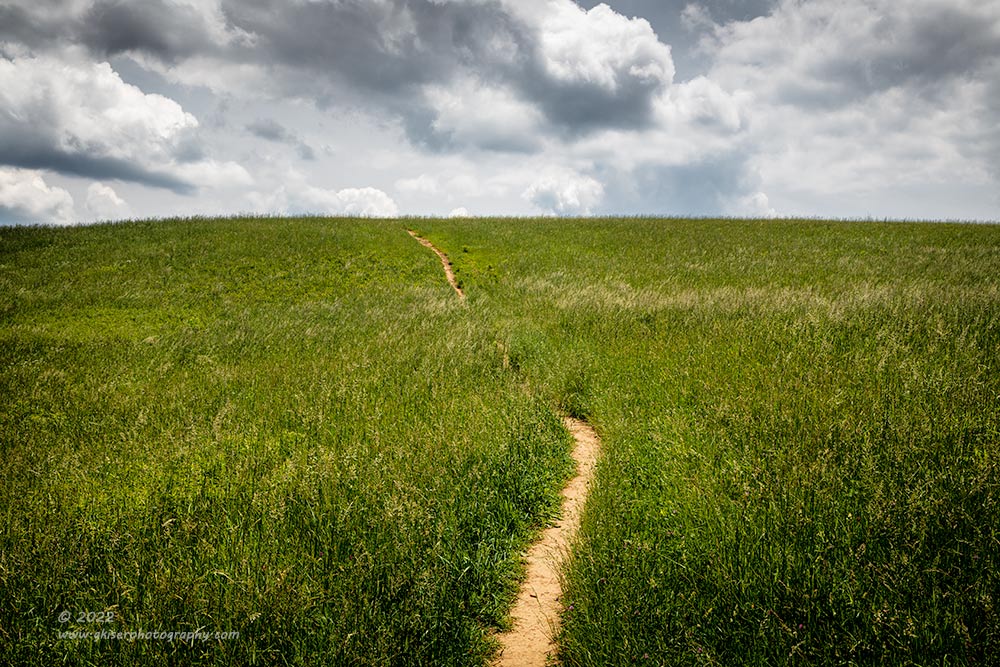
As I was contemplating the framing of the image that I was working on, I started to see another opportunity with the trail. I was liking the roughly centered aspect of it within the frame and decided to include a lor more negative space to set it off. I flipped the camera to a horizontal orientation and moved slightly to the left which pushed the end of the trail further to the left when compared to the lower portion. This created an implied link in the two parts of the trail that was covered by the tall grass. The way that the clouds were formed, there was more visual interest to the right, so I wanted the trail to end up more to the left ultimately forming a visual “S” curve through the scene. I placed the horizon line right at the top third line in my live view and opened the frame up until I had the right amount of clouds and negative space around the trail. I ended up at 35mm for this one.
I had finally gotten a composition that I really liked here, but the sun was now behind the clouds and the landscape was much too dark in the scene compared to the sky. I thought about adding an ND Grad filter but decided that I wanted the sunlight on the landscape instead. Looking up at the cloud that was blocking the sun, it was only going to be a few minutes to wait. As I waited, a couple came along the trail from the parking area with picnic supplies. I was hoping against hope that they were not going to stop along the trail and set up before the light hit. They made it to the last third of the trail and stopped. I was afraid that this was where they were going to remain which would have completely ruined the composition. As it turned out, he had just set things down to wait on her. When she rejoined, he picked up everything and they continued on with their walk until they cleared the ridge and went out of my view. I was very lucky with that because right about when they were no longer in sight, the sun popped out and lit the field up once again. It was brief before another cloud covered the sun, but it was all that I needed to make a couple of quick images.
I’m not sure which is my favorite of the two compositions that I have here, but I am currently leaning towards the vertical one. I feel that the negative space in that one suits the scene more and pushes the focus to the trail which carries its own visual tension. The clouds really make the scene pop and set a mood even though they take up much less of the scene. I do like the expanse of the horizontal image better though. It looks like a case of two different images that are designed the same way, but have two different feelings associated with them which is why I have chosen to include them both here.
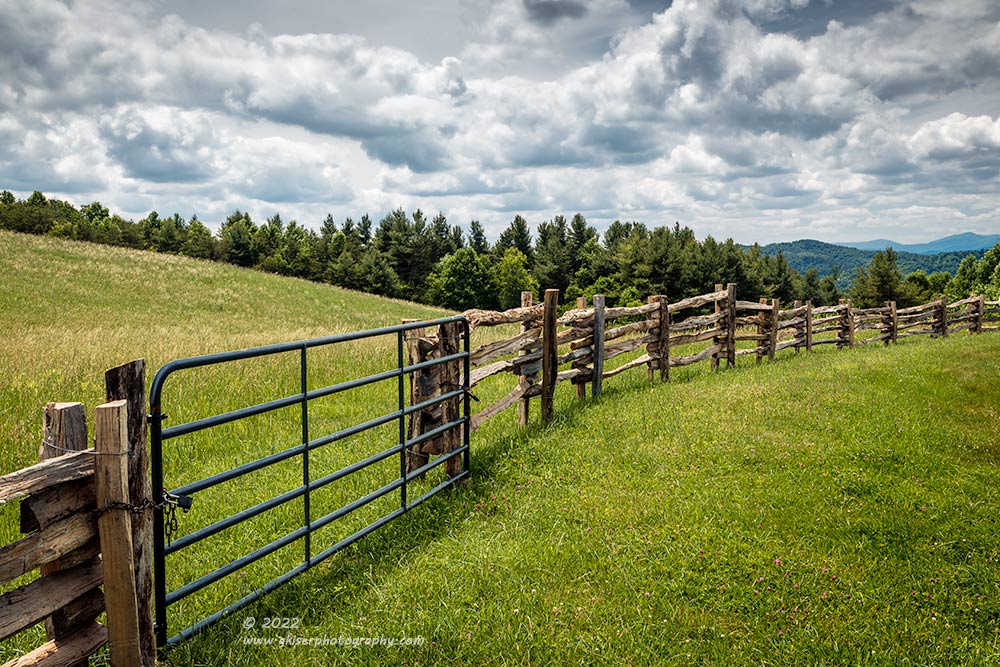
Having finally achieved the minimalist images that I have been after for so long, I moved my attention to other areas of the overlook. In the past, I have had a lot of fun photographing the fence between the parking lot and the field. In the past, there had been a walkthrough and the rest was just fence. I noticed that with the new fencing that had been put in recently, they had put a gate in which I’m always happy to photograph a nice gate with a texture rich wooden fence. The gate was roughly in the same position as the broken fence section that I had used as a foreground for a sunset here years ago. The concept would work with a gate as well, so I got into position to work out the composition. I opted to leave the same lens on even though I had shot this previously with my wide-angle lens. I wanted to keep the background a bit larger in relation to the foreground, and I didn’t want to chance getting any of the vehicles that were parked on the side of the parking lot. Once again, 35mm was the magic focal length and it seemed to make a pleasing composition. The lighting was much easier to work with this time than when I had shot the sunset. That time, I had used two different grad filters to control the sky. This time, the exposure was relatively even throughout the scene, so I was content with just the polarizer.
I spent quite a while here adjusting the height of the camera determining how I wanted the fence to fall within the scene. I liked getting down low so I could include more of the sky, but that pushed the fence and gate into the distant trees and made it cover up the background mountains. That added a lot of complexity to the center of the image and crowded my main points of interest. I found that the better compositions were with the camera elevated which provided separation between the fence and the midground trees which I thought was very important. I just tried not to elevate so much that I lost the sky. I kept just a little better than a third of sky in the frame and paid very close attention to where I cropped the fence at the gate. There was no reason to include the base of the fence here, but I did want to complete the thought of the gate because that structure was included as a whole element. The fence was already being cropped on the left, so I kept things even by cropping in on the bottom as well.
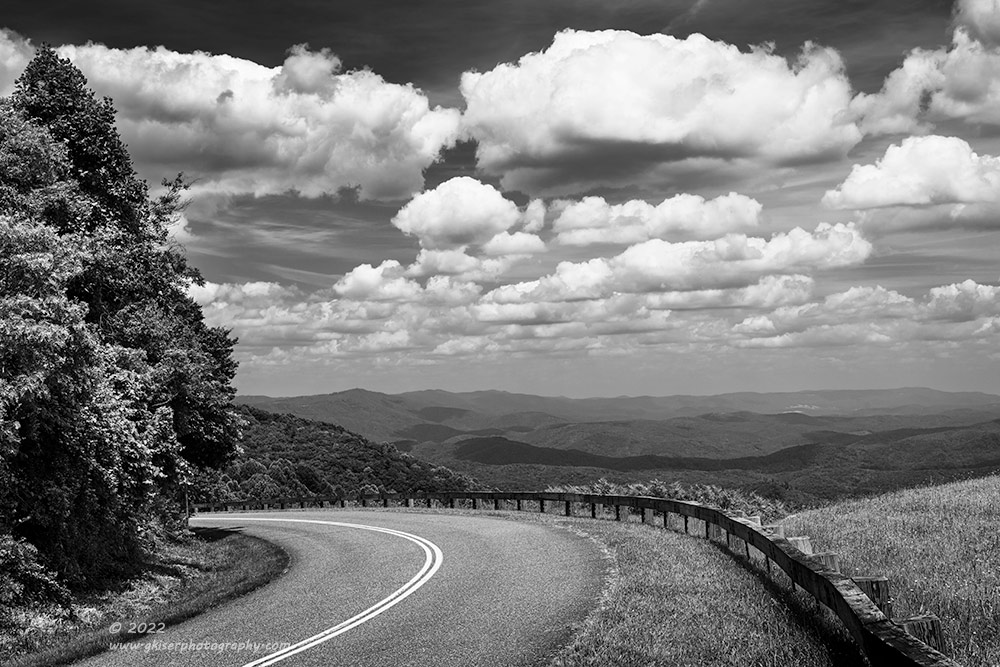
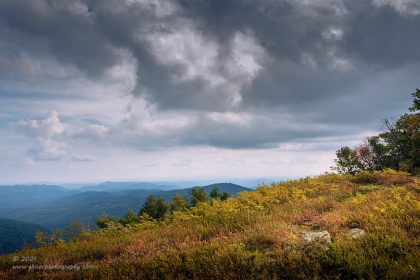
I was starting to feel like I was hitting my stride here, so I went out to the road where I knew there was another composition or two to work with. In the past, I had worked this view with the long lens, but I was feeling a bit more normal today, so I kept the standard lens attached. I tried a couple of different compositions to see what I liked and found that I liked one that included the railing off to the right of the frame and the steep slope of the mountain with the trees to the left as a framing element. The photo was all about the clouds this time as opposed to the distant views which just lacked being impressive with the current lighting. This scene looked nice in color as I was shooting it, but when I got it home, I decided that there was just too much green in the scene, and the colors distracted from the clouds. I made a quick switch to black and white and started the processing from that point. The removal of color helped the scene tremendously and allowed the attention to fall on the clouds as well as the composition which was my intention from the beginning.
Something that I have been learning about myself here lately is that I don’t particularly care for Spring as a photographic season. I know that this goes against everything that a landscape photographer should think, but I just don’t like the vibrant greens as much as I once did. When I started out as a landscape photographer, it was those lush greens that got me motivated to take photos. These days, the new greens of Spring just go against my wabi sabi nature. Fall and Winter are just my favorite times of year to do photography it seems. I’ve really come to a head with that this year because I just haven’t been motivated to get out despite the fact that there have been some brilliant Spring colors to be had. I just don’t appreciate those colors as I once did, and the scene above supports that newfound realization. It is odd for a landscape photographer to want to do a black and white capture when the colors are so lush and fresh, but this scene was not about the colors and they distracted from what I wanted the viewer to focus on.
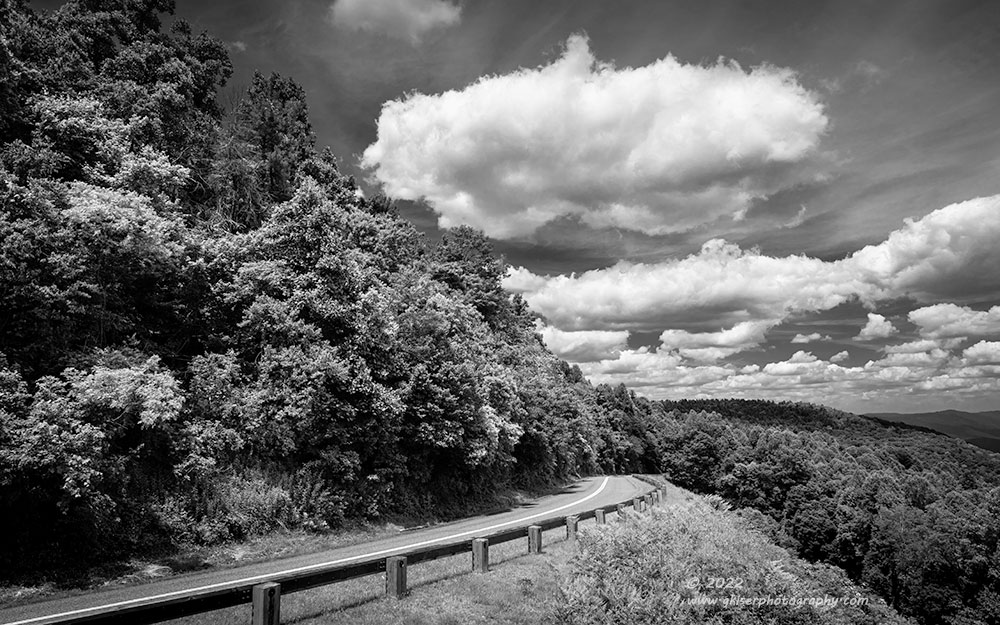
The same can be said about this view from a bit further down the road. I had no intention of shooting this as a black and white shot, but when I started to edit it, the colors took over and there was just too much green to be had. By pulling all of the color out of the scene, I was left with an image that again focused on the composition and the clouds. The greens all became interesting textures to be enjoyed rather than so much green that pulled the attention away from the smaller in scale blue sky. Black and white photography is a powerful tool to be used in many different situations. In my case, it was the perfect option to keep the focus of the image true to why I shot it. This made for three images that were presented as black and white for the visual simplicity of the scene. In all cases, the focus was the clouds which were the brightest parts of the scene, but had been unable to compete with the colors for the attention.
At this point, I had been at the Lump for probably over an hour and the crowds were starting to settle in. When the crowds arrive, that means it is time for me to pack up and move on. I decided to go North and see what I could find along the Parkway in that direction. That seemed to be where the clouds were at anyway, and I knew that the Parkway was closed at US421 which wasn’t too far to the South from where I was at. I was actually feeling pretty good about the time I had spent at this simple overlook that I had taken for granted for so many years. I felt confident that I had my minimal images and if I was lucky, I was going to have a few other grand landscapes. Whatever was to come from the stop would be worth the time spent there because I was exercising my creativity once again in just a few days which hasn’t really happened in several months
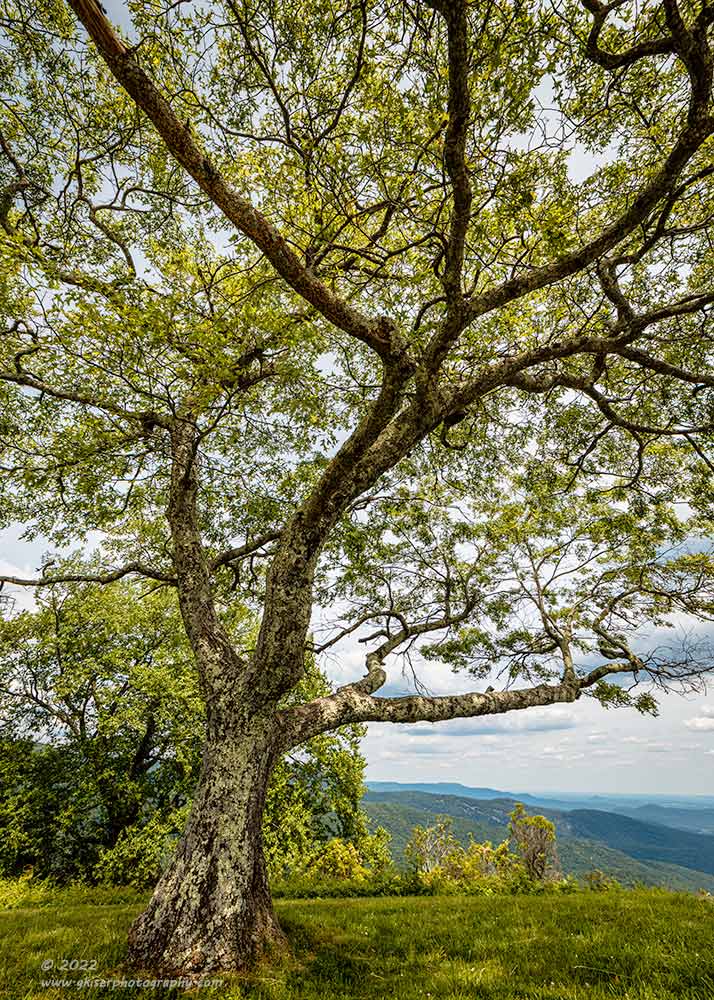
I wasn’t having the best luck finding my next subject as I was driving North. I knew that I was getting closer and closer to Doughton Park once again which is where I’ve seemed to end up repeatedly here of late. I wasn’t opposed to visiting Doughton again, but I wanted to try some different things even more. As I passed by the Bluffs Overlook, I happened to see a tree just to the side of the parking area. Of course, I’ve seen this tree countless times, but it had never hit me quite like it was this time. I saw this amazing structure to the tree and the new leaves were just adding color without taking away from the structure. I could see a wide angle shot already and I got excited about trying it. I pulled off on the side of the road and grabbed my camera with the 16-35mm lens attached. I started from the opposite side of the road and moved in gradually closer to see what perspective I wanted with this tree. I liked it up close much better and saw that the structure took on a very dramatic look at 16mm right at the edge of the road. Hmmm, if it looked this good at 16mm, what would 14mm do for it?
I went back to the truck and swapped lenses to the Rokinon and went back to roughly where I had been standing. This lens made the tree look outstanding to say the least. I just had to juggle where I was going to place the camera knowing that I had an edge of the parking lot to avoid to the right, and I wanted to give as much separation to the tree as I could while still keeping a partial view of the distant mountains in the background. There was a lot to keep in mind as I composed this shot. I found that the best location for the camera was very close to the ground with the camera looking up at almost a 45 degree angle. I knew that the exposure was going to be difficult because the sky was bright and by the nature of the composition, I was shooting the shaded side of the tree looking up. I pushed the exposure all the way to the right until I started to clip the sky. That gave me enough information in the shadows that I knew I could get plenty of detail out of the wood and leaves in Lightroom.
The wind was a problem here because the limbs and leaves were such an instrumental part of the scene. I ended up having to boost the ISO to 400 in order to get the shutter speed reasonable for the motion in the scene. All of this moving around with the exposure was not all that simple because I had no live view or histogram to work with. Because this lens doesn’t have the AE chip in it, I am not able to pull up an exposure simulation like I can with other lenses. I can just set the aperture and use the light meter in the viewfinder for an accurate reading. I figured out what the correct exposure was from a creative standpoint and then I just shuffled the values between shutter and ISO until I had that same exposure with a fast enough shutter speed to freeze the limbs.
Every time I shoot with this lens, I remember how much I love working with it. It might be a bit cumbersome since it is a fully manual lens, but the results are usually quite stunning. It is an incredibly sharp lens with beautiful contrast. The colors are not always spot on, but I’ve learned how to deal with that issue in post easy enough. The distortion is minimal thanks to it being a prime and overall, I get better results with this lens than I do at 16mm on the Canon glass. I’m sure that is because one is a zoom and one is a prime, but to have a lens that cost me less than $300 compare favorably, and even better than a lens costing almost six times that amount is amazing to me. I really can’t recommend this lens enough. But I digress.
Once I had the shot of the tree here, I was done at this overlook. There were other points of interest here, but the lighting was just not right for any of the other scenes to be had. I just packed up my gear and got back on the road once again. By this point, I was in Doughton Park and was considering what to shoot. When I got to the picnic area, I went in to see how everything was looking. As I got to the teardrop parking, I saw that there were people all over the place. Even if I had seen something that I wanted to shoot, chances are I wouldn’t have been able to do so. I cut my losses and exited the picnic area destined for a place that wasn’t quite so….peopley.
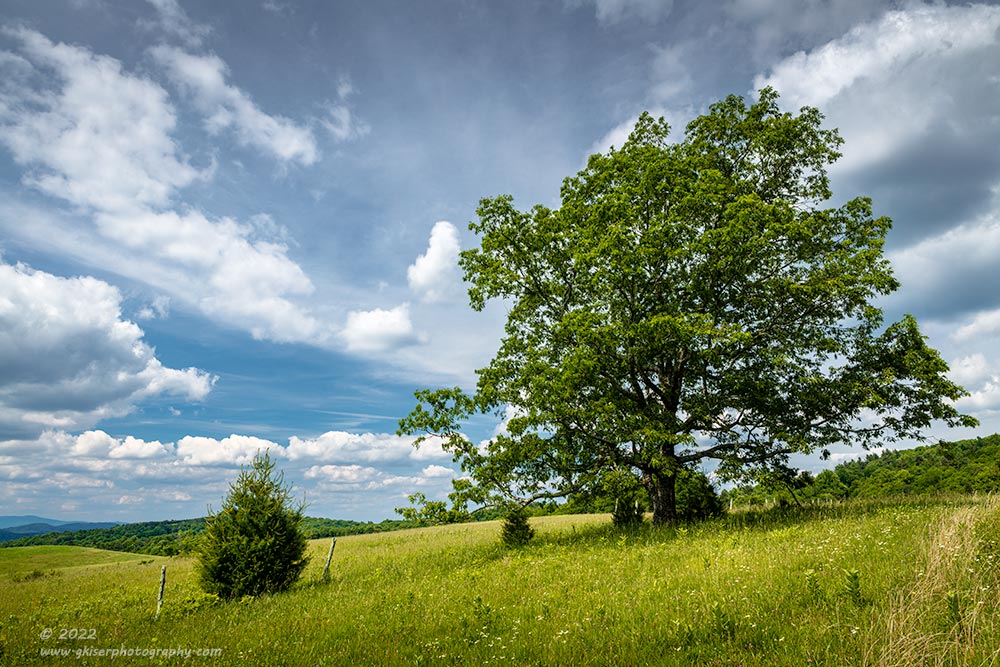
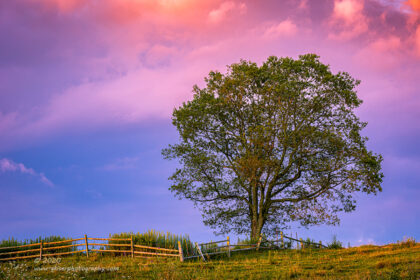
I knew of a location just outside of Doughton Park that I had photographed maybe 10 years ago. There was a lone tree in a field right next to the road. With the sky looking really good, I decided to give that location another try. It wasn’t a standout place by any stretch, but I had made good photos there before and hoped to do the same this time as well. I remember that the last time I had gone here, Toni had joined me and had gotten very bored waiting for me to get the composition that I wanted and the light to go along with it. I think it was the last time that she joined me on a trek to the Parkway with the exception of anniversary trips to the mountains.
I was able to take my time getting things set up for this shot and I played around with all the angles and tried to get the right focal length to get the scale right throughout the image. I had a piece of farm equipment that I had to keep in mind that was in the background. It was easy enough to hide behind the smaller pine tree to the left of the big tree, but the minute I forgot that it was there and I moved to an angle that allowed it to be seen. Because of that, I had to keep constant focus on the fact that it was there.
As I was experimenting with the various positions of the camera, I decided to put the camera down low in the weeds. There was a section of Buttercups that I liked as a foreground which I was able to utilize. There was a lot that I liked about that composition, and it was done with a 16-35mm lens to really emphasize the flowers. I really thought that was going to be the winner from this location, but just in case I went with a different composition using my 24-70mm lens keeping the focal length more reserved and the camera elevated above the weeds. It was a simpler image and one that I didn’t love at the scene.
When I got the images home and started to look at them on the computer monitor, the one that I thought I was going to love turned out to be too complex with all of the weeds. There was a weed blocking the view to every one of the main elements in the background and they ended up fighting for visual importance. My goal had been to create an image that have a more fluid flow to the scene, and the one with all of the weeds just missed that mark. It was the simpler of the two images that worked better in this regard as it kept a clear focal point for the eyes to land on. This was the one that I ultimately went with during the final edit. I’m much happier with this one overall, even though I liked the concept of the other better.
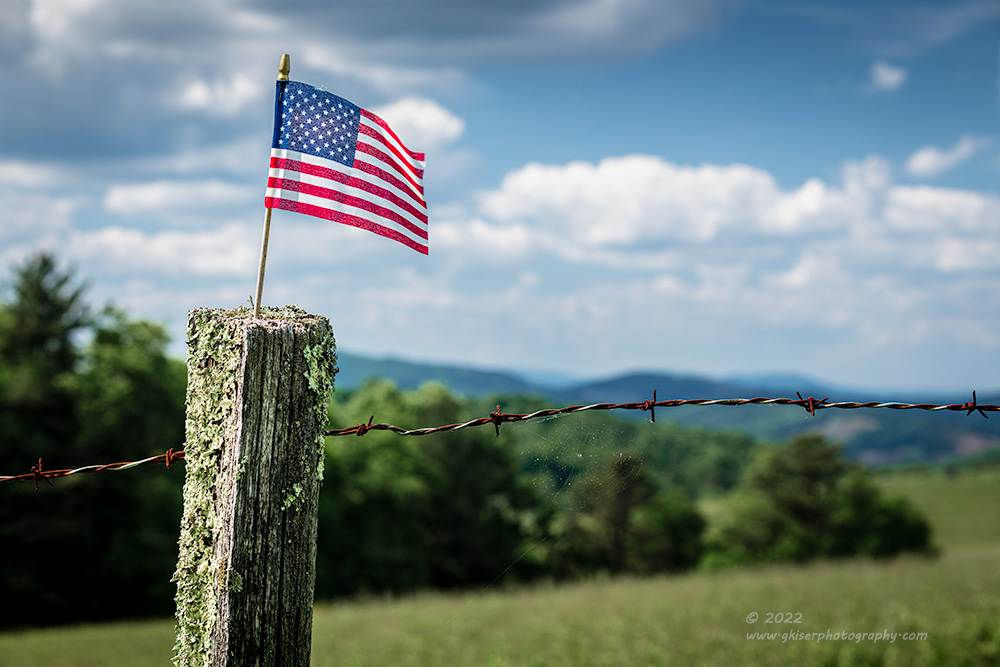
As I was getting the last of the exposures made as the sun was changing across the scene, I noticed that somebody had placed an American flag on one of the fence posts. It was just a simple flag, but it caught my eye. Maybe because we are getting close to July 4th, or maybe I’m just missing the patriotism that the country once had. Either way, I felt compelled to photograph this little flag. I went on the other side of the fence and fit my long lens to the camera along with the polarizer I had been using. I went with a very simple composition dictated by the fact that the flag should be on the right, with the stars on the right (from the flag’s point of view, not the viewer’s). I moved around until the landscape lined up in a pleasing fashion with the flag above it all. The bit of barbed wire was not the easiest to deal with because it tried to complicate the scene, so I just chose to place it roughly at the horizon line to simplify the composition. I had a grove of trees that formed a nice long triangle that led the eyes to the mountains in the distance. Once I had the composition figured out, I played with the depth of field until I had the background in just the right amount of blur to reduce the visual weight of the background while keeping it recognizable. A side benefit that I didn’t know about until I got home was that there was a spider web under the barbed wire that added to the storyline here by giving a bit of in focus balance on that side of the frame.
Once I got everything lined up and the exposure dialed in, I just waited for the breeze to blow the flag mostly straight. That didn’t take long, but in that time the clouds were starting to clear off. I remembered that the forecast said that they would do that. The lack of clouds, and the bright sun were going to make it very difficult to continue with photography. Even though the sun was getting lower in the sky, the lack of clouds was allowing the sun to remain too harsh for me. It was time to head home and call it a day. I had just under 120 frames captured which wasn’t too bad at all for a short trek like this. I was going to have to wait for the following day to see what I had captured though because I was tired and didn’t want to start what was likely going to be a 5-7 hour ordeal to get the photos edited and then the blog written. In hindsight, I’m very glad I didn’t start this last night as I am currently eight hours into the process and getting close to the end. It would 2am by this point had I uploaded the RAW files last night.
I do hope that you enjoyed this trek, even if it is a day late. If any of these photographs speak to you, I would love the opportunity to match you up with a print of any of them. You can order standard stocked sizes here on the website, or you can contact me directly to talk about larger sizes or specialty media like canvas and metal prints. There really is no better way of viewing photography than in the intended form. A print will always be better than viewing on a computer monitor.
Until next time….

Remember to use the code KISER10 to get 10% off your purchase