Wednesday, May 7, 2025
If you have been following me this year, you will know that I’ve been very busy behind the camera. In fact, it all started around September last year and I’ve just been rolling ever since. The vast majority of what I have been shooting has been decay subjects which is where I normally spend most of my time these days. I’ve sprinkled in a few landscapes from time to time with the from the coast as well as the mountains. I even managed to get out to a waterfall recently which was a nice change of pace for me. The recent landscape treks have shown me that I am a little rusty when it comes to shooting this kind of photography. I’m not saying that I have forgotten how to capture the scenes, it is just the whole process is a little foreign to me at this point. I’ve gotten spoiled shooting rural decay which is best done on cloudy days where the light is good all day long. I don’t have to wake up at any particular hour, and I can kind of be lazy about the whole thing. I can head out around lunchtime, spend a couple of hours out and come home with a half dozen images without breaking a sweat. There is more to it than that, but essentially, I can shoot decay with one eye tied behind my back.
Landscape photography is a bit different because it is much more dependent on motivated light meaning golden hour, or more interesting light. It is the light and the shadows that sculpts the landscape and adds depth and dimension to the scene. This is best found at the beginning or the end of the day. I’m old now, so the end of the day for me means stretching out in the recliner or at least being at home. The thought of heading out after 5pm is not really something that I enjoy doing but will do it occasionally for the right reason. For the most part though, once I eat dinner, I’m in for the evening and don’t want to drive out to a landscape scene to wait for the sun to go down knowing that is just the start of the process of editing the images and writing a blog which will normally take place the following day. I’m much happier getting an early start to the day and being able to get all the way through with the trek by the end of that same day. It keeps me from starting the next day behind.
Now, early for a landscape photo is a completely different thing than early for a decay photo. There is usually more travel involved for a good landscape scene, and this time of year sunrise is around 6:30 in the morning. Let’s take a look at how this pans out. I’ve been wanting to get out for a sunrise for a little while now and have been going through the locations that I could visit which is a little limited with the Blue Ridge Parkway still being largely shut down from Helene last Fall. I had two locations in mind with Beacon Heights being one, and Rough Ridge being the other. I think that I can get to Rough Ridge, but I knew I could make it to Beacon Heights. Travel time to either is a bit over an hour and a quarter for me. Since I was really interested in shooting a panorama, having only done one other one this year, I decided on Beacon Heights which has one of my favorite panoramic views. That was showing to be right at 1:15 travel time from home. The hike to the viewpoint would take me about 15 minutes, so make travel time 1:30. I needed to be in position about 30 minutes before sunrise which meant by 6am. After some careful subtraction, I was needing to leave the house no later than 4:30am. Because I like to prepare for the unknown, I added 15 more minutes to that, which meant that I was going to be on the road around 4:15. Giving me time to wake up and get some breakfast before getting dressed and loaded up, I was going to need to wake up at 3:45am which is 15 minutes earlier than Toni wakes up on a work day.
As it turns out, we both had very busy days yesterday and when she got home a little before 8pm, we caught up and then pretty much fell asleep in our chairs until I woke us up at 9:30 to go to bed. Yep, we are old, so going to sleep that early is expected. It did make it easier to get up early in the morning though. The first thing that I did was to check the weather which had been very promising the night before with high clouds with approximately 75% coverage in the area of Beacon Heights. Those percentages had dropped a little bit and were now looking at between 40-60% which was still pretty good for the sunrise potential. Without much else planned for the day, I got up and made a bowl of Cream of Wheat for breakfast. I said I’m old….let it go. Once I got dressed I was headed out the door with my camera ready to visit Beacon Heights for the first time since two years ago. That actually surprised me because I could have sworn that I was out there last year. At any rate, it had been quite some time.
It was a little chilly, but I still opened the sunroof in the truck because the pollen is beginning to calm down and I liked the fresh air. It allowed me to see the stars in the sky that would indicate that the sky was clear. This wasn’t a great thing as I needed clouds to reflect the color of the sunrise. I made my peace with the fact that this might not turn out like I hoped, and I decided to just enjoy the ride and the chance to be in the mountains with the camera. I was sure that whatever happened, I would be able to bring at least a single photo home that would be worthwhile. I was looking forward to shooting a pano though, and that was what I was really interested in.
Why was I so caught in wanting to get a panorama of Beacon Heights. I’ve done probably a half dozen panos here over the years and most of them are pretty similar in composition. It is the light that changes each time to provide a different story. While I was expecting different light this time as well, that wasn’t the main thing that drew me to wanting to shoot it. I had a different idea for a composition that I had not done before…well at least not as a panoramic image. I wanted to include the rocky surface that I would be standing on for a bit of foreground to give a different feeling for the area. I think that every time I have shot a panorama here before, I have used my telephoto lens. This is the lens of choice for a pano because the collar is set to the perfect location on the lens to control parallax distortion and it has the least amount of issues when it comes to stitching the images together. However, at the widest focal length of 70mm, that doesn’t allow more much foreground interest. I knew that I could use the standard zoom for a pano to introduce a nice foreground because I have done it once before with a great deal of success, but it was a tool that introduced some potential problems when joining the individual images. I did want to give it a try here for something a little different. I knew that there was a chance that I would get the images home, and they wouldn’t stitch together or would look awkward once they joined up. It was an experiment of sorts that kind of relied on a good sky to make the attempt worthwhile.
I arrived at Beacon Heights right at 6am and I set out on the hike that turned out to be quicker than I remembered it being. I was in position at around 6:15 with the light already happening to the East. I was looking North, so it was still rather dark in that direction as well as where I was standing. I had to use a flashlight to get the tripod leveled out so that I could get a sold run from one side to the other without introducing an odd tilt to the image. Once I had the tripod set up, I placed the vertically oriented camera on it. This is one of the best uses of an L bracket because it allows the camera to rotate on its nodal point while flipped vertical without the need for a lens collar like my telephoto lens has. This was the first time I had mounted the camera so low to the ground at this spot, especially for a panorama. I checked with the hotshoe spirit level on the camera to make sure that the sweep was perfectly level as I was going to be covering about 120 degrees from left to right. It all checked out and I was ready to get focused and start working the exposure.
I wanted to have everything in focus which was a pretty big ask for my camera considering the foreground was just feet in front of me and the main subject of the photo was a mile or more away. I could have done like all the YouTube photographers and said that I was going to do a focus stacked panoramic image so that everything would be in focus near to far. Yeah, I could have done that, but I would have shot three different frames for focus for each of the eight frames that I shot for the actual panoramic image. Doing a little math, that meant that I would be shooting 24 frames during changing light, that would then have to be merged together in post as three different panoramas, and then as the focus stacked image. Honestly, that seemed to be a bit much for my tastes in photography. I decided that I could get everything that I needed in terms of focusing by using the hyperfocal distance and a narrow aperture. I picked a point in the series that had all the different layers to check focus with. I stopped down the lens to f/16 and saw that I was around 44mm in focal length. I knew that with the wide-ish focal length, I had a bit more depth of field to work with, and by keeping the lens stopped down to f/16 I had a lot of added depth of field without introducing diffraction. Using the depth of field preview button, I found the point where the nearest edge of the foreground started to go soft and backed it up a bit. I then looked at the midground and background to see if the focus was still sharp. It was, and I was satisfied that I had the right depth of field for the scene.
It was still well before the color would hit if there was to be any, but I did a practice run through the series of images to see how the series would photograph. Even at ISO 200, I was shooting each frame at 30 seconds, so I realized really quick that what started out as the right exposure was very overexposed by the end of the series. It did let me know that it would take eight frames to capture the scene from left to right. I was hoping that the light would get up bright enough to allow for a much quicker exposure so I could move through the scene in less time for a more even exposure.
The biggest problem I was facing at this point was the lack of clouds. There were some very thin strands of clouds over the scene, but I wasn’t sure if they were substantial enough to pick up the color like I was wanting. I could just barely see them in the sky. There were more clouds to the left where the sun was rising, but they were above the horizon based on the color that I was already seeing with them. I had every possibility for color if the clouds above my scene were thick enough to catch the color. I knew that the sun would make an appearance and do its part at least.
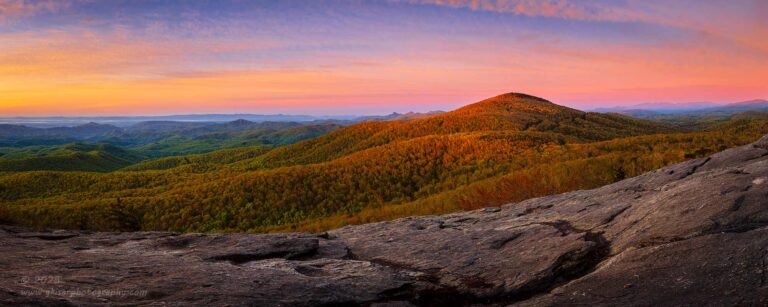
Over the next 27 minutes I would do a repeat series every few minutes as the light changed just in case that was the best it would get. On the thirteenth run, my shutter speed was down to 0.4 seconds at ISO 100. The clouds had picked up a pink hue while the thicker clouds to the left were a more pronounced yellow. The sun was above the horizon and lighting up the mountain which really showcased the fact that the leaves were just changing at that elevation. The difference between the greens in the lower altitudes and the reds at the top really brought a lot of interest to this scene with the warm light hitting the red trees. It was looking like my best opportunity for drama and color for the morning. Once I finished the series, I flipped the camera to horizontal and added a polarizer to start getting some single frame captures in case the panorama didn’t work because of the proximity of the foreground.
Ten minutes after sunrise, I could tell that the light was done. The clouds were turning white, and the blue sky was starting to look really pale. Even the light on the landscape appeared to be without shadows which just make things look flat. I had another nine frames that were done as single frame captures, but I really wasn’t convinced that they were going to work out. They were there just in case the pano failed. I had what I came to get, and now it was time to go back to the truck.
All that time and effort to get up here by 6am and I had only been up on the mountain for 45 minutes before calling it a day. This is a great example of the frustration of a landscape photographer. The light only lasted a few minutes and was gone. That was my day…done. With a good cloudy sky and lots of decay subjects, I could shoot for hours upon hours collecting a whole slew of images. The landscape isn’t quite that giving. I just hoped that it gave enough to result in a single photo.
When I got home, I imported the 113 frames into the computer. I picked two of the single frames as my standbys and then looked at the different groups of pano photos. There was really no way to tell what they were going to look like, but I could see color in the last few series that I had shot. I went ahead and selected the last run and had Lightroom stitch it together. It took only a few seconds which surprised me, but it came up with a fully stitched image from the eight frames. It looked really good too. I played with the rendering options and found that only two of the three would work for this scene which was a shame. I really wanted to see what the “perspective” option would have shown because of the pronounced foreground. That one wasn’t able to stitch together because of how close it was. I did get to choose between the other two variations for the best option. Once that was finally stitched together, I did three others for comparison to see what would work best for an edit.
It turned out to be the final pano that was shot. The composition looked good, but I wasn’t sold on the overall look of the image. I started doing a bit of processing on it and started to see some potential. I slowly worked through the edit until I was sold that this was going to be a really good photo. I committed to this one and spent about an hour and a half processing it between all the little tweaks that I kept going back and forth on. I also did a quick look at two of the single frame captures to see if there was any potential there. They weren’t terrible, but the compositions were weaker than what I had with the pano which made me decide to go all in on the pano. It would be the only photo from this trek to survive the culling stage. That wasn’t a bad thing because I went out here knowing that I only wanted a single photo, and I wanted that photo to be a panorama. I count this as a success.
I do hope that you have enjoyed this trek and the resulting photograph. A lot went into capturing this one, and it does count for eight frames exposed, so there is that. I’m glad that I woke up as early as I did and managed to get out here for a pretty decent sunrise. It was nice to do a little landscape photography once again, and this is the time of year when I really do enjoy doing it. I just wish that more of the Parkway was open.
Until next time….