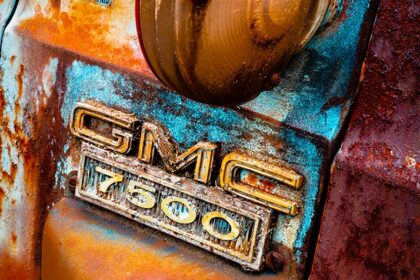
Welcome back! We are quickly moving in on the end of 2021. I hope that everyone had a wonderful Christmas and are getting ready for a fantastic new year. Since we are in that awkward week between holidays I figured that it is time to start looking back over the images of 2021 to see how things have gone for the year. I started doing these entries many years ago and they started out like so many other photographer’s list of top images which included “the best” or “my favorite” images of the year. All of that is so subjective though because best and favorite might change according to my mood. It was a few years ago that I decided to go with my 12 most “significant” images of the year, which I tend to like better. I have to tip my hat to Ansel Adams for the concept of this though because it was he that said, “12 significant images in a year is a good crop.”
Even though I like doing the significant list better than trying to pick my favorites, or even going on the feedback with likes and comments from social media, I still have a great deal of difficulty deciding what images fit that criteria. This year I decided to do things a little differently in that instead of starting to go through my images in November, I just went ahead and made a folder on my computer where I dumped my favorite images as I was uploading them to the gallery. I figured that I could visit that folder from time to time and see how the images were holding up during the year. By the end of the year, I had it whittled down to 24 images that I liked from the beginning and still thought were significant accomplishments after they had time to breathe and exist.
At the end of this list, what I found out was my significant images were kind of all over the place. I know that other photographers tend to lean toward certain formats, or presentations with their photographs. When I had the list compiled, I noticed that there were no clear similarities between the images. Here is the breakdown of the list just for ease of looking:
5 Vertical compositions
5 Horizontal compositions
2 Panoramic compositions
3 Black and white
8 Color
3 Landscape
3 Decay
1 Studio
1 Rural
3 Long exposure
1 I really don’t know…historical maybe??
3 are from Doughton Park on the Blue Ridge Parkway (interesting tidbit there)
9 shot with a 24-70mm lens (obviously a favorite piece of glass)
1 shot with a 70-200mm lens
2 shot with a 16-35mm lens
I’ve found that over the years, my photographs are usually broken up this way quite often. Last year I was a bit more centered on color landscapes though. It is interesting to go back through the years to see what I have been creating and what I felt were the most significant images of those years. As you go through the old entries, you will find links early on to the previous years like 2019 and 2018. When I look back through them, many of the images are still favorites of mine, but the more common reaction is that I’ve done so much better than those since that time. That is the real reason that I do these lists each year so that I can go back and really look at my growth as a photographer. It is so easy to just start picking random images and realizing that you have improved, but when you look at what you feel were among the strongest examples of your work for the year, it is often harder to see a difference. As long as I am seeing a difference, I am thrilled and know that I still haven’t gotten to the pinnacle of my abilities. For you, it is a chance to see my journey and to see what I consider to be significant in my own work. I hope that some of your favorite images are in this list. If you don’t, it is just because the image doesn’t represent something significant in my journey. I have lots of photographs that I actually like better than the ones on this list, but I like them for different reasons. This list is all about my own journey as a photographer.
I don’t want to hold us up any longer and want to get right to it. I’ll start a countdown for the top image, and I’ll just have to trust that you aren’t going to scroll to the end to see what that photograph is.
Open curtain and play the orchestral music to get this started….
Number 12

You probably forgot all about this image, didn’t you? Well, it was shot a while back on February 28th, so I will forgive you. Just to look at this, I am betting you are wondering why this is a significant photograph. It is after all, just a photograph of some gas pumps in front of a service station. Yes, and no. What makes this photograph so significant is that it is one of those times when I was sent out by a client to photograph a certain location that I hadn’t really felt the draw to capture before. She had wanted me to photograph this old gas station which was now used as a battery business in Wilkesboro. It was the old design for the station and there were still two Esso pumps out front which were no longer operable but did light up at night. I had seen this many times driving through the area and had written it off because of the current signage in the windows as well as the business sign out front. Those were not nearly as hard to get over as the area of town that it was in which had grown up all around it leaving very few options for compositions with an open feeling. In short, the good qualities that this location had didn’t outweigh the hurdles that I would need to overcome in order to photograph it to my satisfaction.
Now that I had a request for photographs from this location, I really no longer had any excuses as to why I couldn’t get images from there. I had to at least try and figure something out. Toni and I had been out, and I had the camera with me on the way back home. Wanting to see how this location was looking and possibly to try some test shots before nightfall, we drove by, and I started to work the location. You can read about it in the blog entry that I mentioned above, but this was one of the “test” shots that I set up during the daylight. The idea didn’t work for the nighttime concept, but when I got the image files home and started to go through them, I really loved how this one turned out. It was something a bit different from my norm as I was trying to really focus on the pumps themselves and not the entire station. Finding a way to compose the scene was very daunting because no matter where I was aimed, there was clutter in the background. I could have gone for a limited depth of field and blurred out the background, but I felt that I would be missing the story had I done that.
I had to figure out a way to tell the story of these two pumps and that was done through this photograph. I worked quite a while thinking about where to place the camera so that all of the elements fell into a logical place and the entire photograph worked together to tell a story. I was even able to make use of the large brick building next door as a source of texture to balance out the other side of the composition. I used every compositional trick I could think of to get this one to work and it came together beautifully. By choosing the black and white presentation I was able to give it a timeless quality that the color wouldn’t be able to bring. I managed to cover part of the business sign that would have indicated that this was a battery business rather than a gas station. I used lines and angles to bring in drama and visual tension which made this a more exciting image than it could have been.
Is the fact that I used all of the tricks in the book to compose this image what makes it a significant image? That is part of it, but the most important part was that I was able to rise to the occasion for a client. It is one thing to drive around and find a scene that I love and want to photograph based on that first impression. Even if I have to work for the composition, there is no comparison to working out a composition when I don’t really have that drive to photograph it. What makes this so significant is that I was able to be very creative in a situation where it would have been too easy to just get the basic image that was requested of me. It would have been even easier to respond with “I’ve looked at that before and didn’t see a good composition.” Nope, that’s not my style and I wanted to give it a try. What I came away with was better than I could have imagined which in itself makes this a significant photograph. I’ve talked about the differences between expectation and reality before, and this was one of those times when the reality of the image was much better than the expectation.
Number 11

Here is an interesting photograph that you might also wonder why I’ve added it here. It is just an old house that is falling apart. I have photographs of houses in worse shape than this, so how did this photo from the middle of April end up here? Well, it is a constant reminder to me that I have to photograph scenes when I find them or risk them being gone forever. The significance of this image is I only photographed this house once and I’ll never be able to do it again. In fact, I don’t remember seeing this house but one other time a few weeks before I shot this image. It was located just outside of Taylorsville, and it had been concealed from the road by vegetation I think, because it took me a very long time to actually see it, even though I had been this way many times. After this quick session in a light rain, I never saw the house again.
This is one of those things that I tend to run into with my decay photography, and it is the nature of the beast. Whether it is an old truck, house, or barn, eventually, these subjects are no longer there. I’ve told myself so many times over the years that I need to just stop and get the photo instead of waiting for that perfect moment and this is exactly the reason why. On the day that I shot this image, I had already passed by the house once because it was raining and just thought that I would get it another day. Fortunately, I had gone futher into Taylorsville to look for some less rainy conditions which I didn’t find. On the way back home, the rain had slacked off just enough that I could get the photo of the old house, so I stopped. I think I was there for 20 minutes or less and managed to come up with this one composition that used the house to conceal the newer house that was behind it. It would be the last time I ever saw this subject.
As it turned out, the cloudy skies made for the perfect mood for the image which is why I initially liked it so much. Over the following months, it was that mood that just really elevated the image for me. The lighting and subject all just worked together to give the image an emotional feel that I am always after. The fact that I nailed that emotion on the one attempt that I will ever have here makes this a truly significant image for the year.
Number 10

Coming in at the #10 spot is an image that might look familiar to you from last year’s list. In fact, this was the composition that turned into my most significant image of that year. So, what makes this similar composition worth being included on this list? Well, for one, I think that this image is better than the first attempt, so I believe that it has already elevated beyond all of the images from 2020. If the composition was good enough to garner the top spot last year, it should also be worthy of at least a mention in this current list as well. I did struggle with this one, as far as adding it here because it really felt like it was a lazy thing to do, but the more I thought about it, the more I really thought that it represented something special…yet again.
I had shot this image at Doughton Park at the end of August while I was out there trying to make use of the clear skies that we had been having. My whole purpose for going out here was to capture the Milky Way for the first time in a couple of years. I had no intention of doing regular landscapes because the sky just had nothing at all to offer me. However, while I was there and getting things set up for the evening of astrophotography, I was paying attention to the surroundings. This favorite bank of trees right at the entrance had lost a majority of the leaves near the bottoms of the trees which gave a very similar look to the image that I had shot there the year before. I remembered that previous photograph had also started out as an afterthought as I was putting my gear away. Here I was about to start shooting a night sky, and I was looking at the same scene with a clear sky behind it as opposed to a flat and cloudy sky from the previous occasion. Since I had the time, I figured I would just set the shot up to see if the light would do anything behind the tree as the sun set in the other direction.
As it turned out, the twilight wedge (Earth’s shadow) gave some really interesting colors behind the tree, and I started to get really excited about the possibilities of this image. It did turn into a nice capture, and I loved the composition once again. What gave this image a place on this list was an aspect that is rooted in research that I was doing for portrait photography at the time. I had been familiar with color theory and the use of complimenting and contrasting colors, but I had not really gone fully in depth to that topic. With portraiture, there is a lot more opportunity to put specific colors together and I had started to use a color wheel in planning out those images. With that knowledge, I started to edit this image and realized that I could finesse the colors into the proper relationships for analogous colors with a contrasting pop of green. There was a little creative license used here with some of the tones, but the end result just fit together so well. Since that time, I have always looked at this image and smiled, much like that one that made it to the top spot in last year’s list.
Number 9

Coming in at the ninth spot is a recent one from the end of Summer here in Western NC. With a quick look at this image, you might be wondering exactly how it made it into this list of significant images. Sure, it is a really nice picture of a barn, but that isn’t something new here. The sky is dramatic, but again that is nothing really new with my photographs. What makes this one so significant was that I wasn’t even thinking about this composition when I shot the scene. In fact, I had been going nuts trying to form compositions from much further to the left as well as much further to the right. I’m sure I looked quite funny walking briskly up and down the road and taking a few shots here and a few shots there. Nothing that I was getting was really capturing the feeling that I had when I looked at this barn though, so I was getting frustrated. The harder I worked at the compositions, the worse they started to look. As I was about to hang it up and hope that I had something that was going to work, something happened to the scene.
Most of the time when I am out photographing the different compositions, you will hear how I am just sitting there for significant amounts of time waiting for the light to change on the composition that I had selected. That is why Toni doesn’t go out with me much anymore. I get it, it is rather boring to watch me wait for the light to change. This is kind of like that routine, but in one very different way. As I was trying to settle on a composition to commit to as the light changed, I saw an opportunity develop which I had not anticipated. The sun broke loose of the clouds and lit the barn up with amazing light which also provided some great shadow details on the yard in front of the barn. In a split second I saw a composition that had not existed before due to being overly flat. With the now existing light, I was able to get a full face shot of the barn under the sky.
I got the camera set up really quickly putting a bunch of moving parts of the puzzle together simultaneously like establishing the proper depth of field from the foreground tree through the entire image. I had to look to see how the shadows were falling on the ground to get a pleasing frame established. All the while racing to get the right intensity of the sun before it went back into the clouds again. While all of this was going on, I realized that there was a large area of the clouds that seemed to sit right on top of the barn which were still rather dark. With the sun on the barn, and the dark clouds, I had the depth that I needed to really make this one sing. It was all over in a matter of minutes, but I had seen and recognized the opportunity to get a very special image.
During the editing stage, I once again realized that the colors were all working together very harmoniously when matched up against color theory models. That gave me the ability to tweak the colors in such a way to bring it into a new level. I was rewarded with this effort in the form of a print sale not long after I shot it. Almost as a celebration for the image, it was the first one that I ever printed on my new fine art Baryta paper, and the resulting image was stunning. It is probably one of my absolute favorite printed images that I have ever done.
It was the way in which this photograph was created, followed by the techniques used in editing, and the ultimate print that was achieved which ensured this one a spot on the list this year. It might just be a photograph of a barn, but it is one that was captured at a level of photography which I hope to duplicate in the future much more often. As with the number 11 image this year, it is also a reminder to let the light dictate the composition rather than the composition needing to wait on the light.
Number 8

Coming in at the number 8 spot for the year, we have our first panoramic image which was shot on the outskirts of Forsyth County back in July. This rather large image made the list for much of the same reason as many of the images did last year. It was the realization of an image after a very long time of trying to figure out the composition. The story of this photograph dates back at least four years ago when I first paid attention to the unique pine woodland off of the road. The uniform trees always captured my attention as a very strong repeating pattern. The floor of the woodland was pretty bare which is not a normal thing here in NC which added to that photographic quality that I look for in a woodland scene. Clutter along the floor tends to overcomplicate a composition so having a floor with no distractions made the trunks of the trees that much more interesting in the composition. The problem that I ran into was there was just no visual anchor at all to the scene and it would produce a fairly boring photograph.
I actually shelved the idea of capturing a composition of the pines and just hoped that I could find something similar somewhere else with a strong visual anchor, or at least a color palette that added interest. I put this location out of my mind because it was just too frustrating to figure out. A few years later I was driving by and saw an old logging truck had been parked on the edge of that property. It was interesting and there was a bit of rust on the boom which I liked. However, with the brush around it, I wasn’t seeing a very successful composition because all that was really visible was the cab, and the controller unit at the end of the truck. There was just no context to it and no story. I pondered that truck off and on for about a year and just never found a way that I wanted to capture it. It was parked very close to the road and next to a roadway sign that added more difficulties as far as compositions that were available. Again, I pretty much shelved the idea.
During the earlier Summer months, I had been doing several panoramic images of landscapes and finding that with my 5DS R camera, the 50mp images merged together were really slowing the computer down when it came to processing the images. It got to the point where it was taking well over an hour’s worth of time to merge the files, and then save the finished image. The editing process was also slowed quite a bit as well which forced me to consider a new computer. Before I went that route, I decided to add more RAM to the existing computer. To test this Band-Aid fix, I needed to find a good scene for a pano to capture. I had recently gone by this scene with the old logging truck, and it was in my mind. I had a crazy idea to blend my two ideas for a photograph here as a pano that included the truck and the strong vertical trees which the truck was situated right next to. I had no idea how this would work but it was something and I needed to see how the computer would stand up to the work.
I ended up doing a couple of things differently with this panorama. First of all, I shot it with the camera horizontal which was because I wanted less frames to blend together because of the closeness I was to the scene. The second difference was with my filter choices. I rarely use filters on panos because they are hard to position across a large scene, especially a grad filter. I had to do something with the bit of sky right above the truck, and that was going to mandate the use of a grad. However, I didn’t want that filter darkening the other portions of the trees, so I just used the filter on one frame. It was removed after that first frame, and the other two were shot just with a polarizer. I felt safe using that polarizer because it was mainly affecting the truck and would have limited effect on the trees. With no blue sky visible I didn’t have to worry about polarization banding through the image. It all worked out fine, and the merger in Lightroom went lighting fast due to the new memory. That was a massive relief and I was happy that my workflow on panos was going to be much faster in the future.
It is the merger of two different concepts for this one image that lands it on this year’s list of significant images. I had the two ideas and knew that they were not going to be successful images on their own, but because I was prompted to consider doing a pano, those two ideas came together to make an image that is decay as well as landscape. I had the visual anchor for the pine trees, and the truck now had context and a story. This would not have worked had I not really forced a pano out of the scene because both elements needed to occupy a lot of space in the scene for it to really make sense as a whole.
Number 7

The number 7 image is also the second black and white image included in this list. It was created at the end of the first month of the year and has remained a favorite of mine since. It just so happens that this was the second time that I had photographed this old house on the Southern edge of Wilkes County. The first time I had been out I had really enjoyed working with the cabin with the extreme state of decay that was seen. The bare trees had really added to the scene as well. The problem that I had was the lighting which was a little harsh for what I wanted. On the day of this image, there was a good deal of fog in the area, and I had already spent the first part of the morning photographing an old general store at the North end of the county. This was my second stop, and I found the fog just as wonderful, even though it was about half an hour later in the day. One of the biggest differences between this scene and what I had photographed a couple of months before was that you could no longer see the Brushy Mountains in the background. That was fine with me because I wanted more emphasis to be placed on the trees that provided the framework for the old cabin.
So, why did this photograph end up on the list of most significant images of the year? Well, it is rather simple when you think about it. I am always striving to establish an emotional connection and to have the entire photograph designed and constructed to support that particular emotion. This is one of those images where I think that everything came together just perfectly to achieve that. The fog gave the much-needed atmosphere to the image to get it off the ground. The elimination of the mountains in the background due to that fog forced the focus onto the trees which represented starkness, and the bare branches matched up with the bare roof and siding of the cabin. The choice for removing the color here further added to the mood and emotion as well creating a very lonely and still image. There is very little hope in this photograph, and it is much more about despair, which I think is a relatable emotion to so many out there. As you look deeper at what you are seeing, you will start to imagine what was once there. You start to add the color, then add leaves to the trees, and ultimately the pieces start coming back together on the cabin until you start hearing a family enjoying a warm summer’s day in the yard of their home. Yes, it might be a stretch, but when I see this photograph, I see two completely different settings and I compare them. It is a very engaging photograph for me, and one that I firmly think deserves its place on this list.
Number 6

Bringing up the bottom half of the most significant images of the year is this one from Doughton Park which was shot in March. For those of you who have followed me for any length of time, you will most likely recognize this tree. I’ve shot it more times than I can count, and I’ve formed workshops around this tree. This tree is old hat for my camera, so why is this photograph living on this list of most significant images of the year? There are actually two reasons for that. First of all, this represents a completely different way of seeing this tree with a composition I had never thought of before. The second was dealing with the post processing of the photograph which was a huge first for me.
As I mentioned, I’ve shot this tree way more times than I can count. I’ve been out here during sunrise, sunset, clear days, cloudy days, and in the fog. I have literally shot it from every angle, including this angle. The difference is that this time I have included the rocky section of the meadow as a foreground and a framing element for the tree. It is not an obvious composition by any stretch, and I found it as I was going back and forth looking for leading lines to bring my eyes up to the tree. I had started on the left side of these rocks and shot some from there, and then moved to the right side and tried that. Neither concept was working for me as the sun was rising in the sky. I hadn’t been all that happy with the color in the sky, so my morning became about trying new things which is what I ended up doing.
As I was going back and forth between the two sides, I caught a glimpse of a view where the rocks split up and framed the tree. I stopped and pondered the scene briefly and decided that it could work. I got everything wedged into position where I could get the best relationship of elements in the scene with the best separation that I could manage. What I ended up with was a perfect natural frame to the tree that happened to include a leading line taking your eyes right to the tree. All of this was done with the use of several triangles in the composition. It was probably my most successful composition of this tree that I’ve ever shot. It was intimate yet included a lot of depth which is not the easiest thing to do.
It was that depth that leads us to the second reason that I wanted to include this image in this list. Because of where I was physically limited in placing the camera, I was very close to the foreground and a good distance from the tree. Even at f/22 I wasn’t going to be able to get the entire scene in focus which would negate the composition. It had to have that sharp foreground to introduce the textures, and if the tree wasn’t sharp then the whole point of the image was lost. Fortunately, I had been watching several YouTube videos on focus stacking and I understood the basic concepts behind it. Having never done it before, I decided to wing it and did a series of images here with different focus points to make sure that I had it all in focus. I believe that I did three total images here at a very sharp aperture. When I got home, I spent a lot of time editing the image which included bringing out colors in the sky which were barely visible to my eyes. Once I had the overall image edited to my liking, I brought the series of images into Photoshop and did the focus stacking on them. The resulting image really came to life and was more than what I was expecting when I saw the composition.
I do remember thinking that this will be one of my favorites from the year, and here we are nine months later, and it is still just that. For me, it represents stretching my own creativity in the field with the composition as well as stretching my creativity with what I can be capable of with post processing. Both of those aspects are independent of each other, but when combined will always make for a powerful image. Another important significance for this image is that I’ve been able to do focus stacking on other scenes now that I know how it works and how I can create expansive depth of field in my images when needed. It is another tool in my toolbox and that is always a good thing to have.
Number 5

We are now into the top half of the list at number 5. We are going to be looking at our third image from Doughton Park which was shot in early July which also happens to be the second panorama that has been included in this list. What you are seeing here is the result of a couple of months worth of planning after having stumbled on the composition while teaching a workshop. It all started simple enough, I was working with a client who wanted to photograph the rocks here in the meadow at Doughton Park. Coincidentally, these are the same rocks that were included in the previous image as a foreground. As I was walking her through the compositional possibilities, I started to see a panorama developing where the rocks were used a foreground to the distant mountains. I used that time to demonstrate how to set up and execute a panorama and used her camera since it was already built and on the tripod. I wasn’t sure how it would turn out, but it sufficed for the instruction part of what I was hoping to demonstrate. As a follow-up for that workshop, we did a Lightroom session a few days later and I asked for the RAW images from the pano so I could show her how to stitch them together and ultimately edit them. When I started to put them together, I saw a scene that was better than I had hoped for, and as I edited it, became increasingly happy with how it was all coming together. I could have played the card that I set the shot up, and actually executed the panorama, as well as edited it so it was my image. The only claim that my client actually had to this image was that it was shot on her camera. That is just not my style at all though. This was her workshop, and I was instructing her, so the image was hers to do with as she wanted. I still liked the concept and worked through some different lighting options which might make it better so I could go and try it out for myself.
I came about a formula that I was hoping would work for this scene and decided to head out to give it a try early in July. It was the first time I had gone out where shooting a panorama had been the main goal for the day. It was the only image that I cared about getting and I had previsualized it for about two months. When I arrived, there was another aspect of this photograph that makes it a significant image for the year because it was the first time I had to beg the cows to get out of the way so I could make the photograph. I knew that they used this field for the cows but had never actually shared it with them before. They were nice enough to mooooooove out of the way for me so that I could get this panorama shot. The conditions couldn’t have been any better, and it just came together beautifully. In fact, I would say that this is my personal favorite image of the year. If this list was just about my favorites, I think this would be at the top spot. However, looking at it in terms of significance, it just barely cracks the top five which is still not bad at all.
In addition to the first time I really put a lot of planning into a panorama, this is the first time I used such a dominant foreground element which also presents some challenges when it comes to shooting panoramas. The perspective changes as the camera pans from one side to the other and it is too easy to get weird perspective ghosting, especially when using the 24-70mm lens which was mandated by the position I had to have the camera in for the relationship between the foreground and the background. With that lens, I am not rotating on the nodal point as I am with the 70-200mm, so I had to be very careful to just gradually transition between frames introducing just a minor shift with each one. I just can’t describe how happy I am with this image on all points whether technical, artistic, or emotional. It deserves a place on any list of honor that I could come up with for the year.
Number 4

What do we have here??? This most certainly can’t be a Greg Kiser image, and if it is, what is it doing here on a list of the most significant images of the year? Well, it is one of mine, and I do believe that it is a very significant image which deserves to be placed on this list. It was shot in my studio back in June and it was the first time in a number of years that I had done smoke photography. As I was getting a little tired of working in the Summer conditions, I decided to work on my editing skills and chose to go back to some smoke images that I had shot years ago to do some fresh edits on them. The first time that I had gone through these images I was only using Photoshop and I wasn’t good at that platform at all. Now that I was using Lightroom, I felt that I had a much better chance to get some really interesting images out of the original RAW files. I taught myself some new tricks on how to work these images and then decided to try them again with the higher resolution 5DSR.
The whole nature of smoke photography is the element of chance. You will capture a lot of frames before you get a shape that means anything or is particularly interesting. That is the hardest part of the process, and what helps make this a significant image for the year. There is a definite shape to this smoke and from what I’ve gathered from many people that have seen this, it is universally recognized as the shape of a female. There is a little question to the top part of the frame as to whether it is a scarf or a horse. I’m onboard with either reaction because I can now clearly the form as being both. To get something that this defined and recognizable by chance by blowing a little smoke is amazing to me. That alone would make this a significant image in my eyes.
What raises it to the top half of this list is that I used a new editing technique on this series of images which I think adds a whole new dimension to the images, and this one in particular. Using a dual color approach to the scenes allows me to introduce a bit of color theory into the images for another avenue of balance. Of course, the smoke is colorless as it wafts through the air, so it is up to the photographer to add color either through color temperature or adjusting the hues in the image. That was all that I did here, and it was the first time that I really did local adjustments to a smoke image.
It was the combination of luck in timing as well as how I edited this image which brings it into this list of significant images. The beauty of this type of photography is that it can be at any time and in any conditions since you are doing them inside. It is a fun little diversion from your typical subject matter and allows you to photograph a fantasy world at your leisure. If you get the timing right, you can really get some amazing images, and this is an example of just that.
Number 3
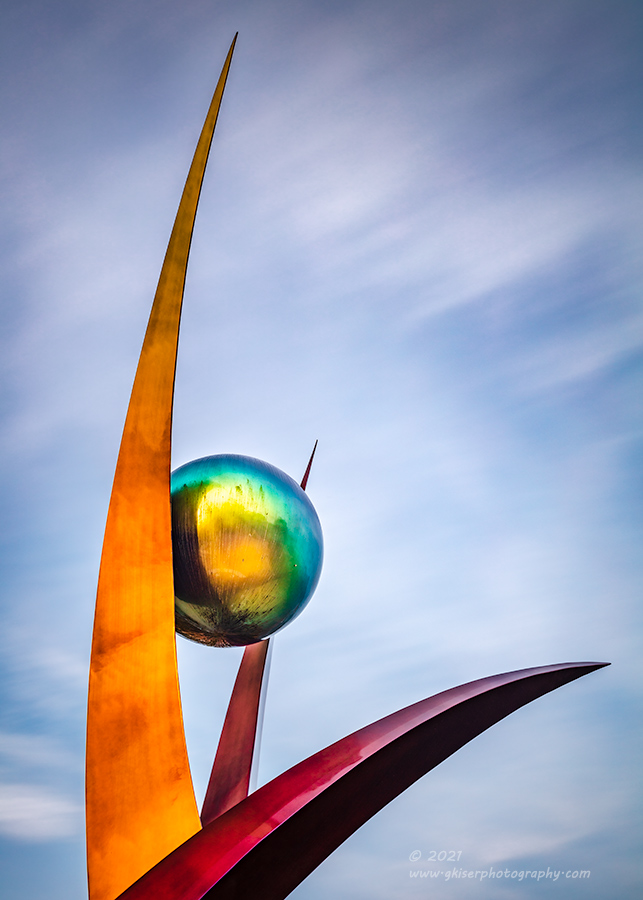
Finding its way into the number 3 slot in this list of most significant images of 2021 is another photograph that you might not immediately recognize as one of mine. It was shot at Appalachian State University just before the Fall semester got started. It is not a landscape image, nor is it decay. That begs the question as to why this image is a significant one for the year if it doesn’t even fit my normal genres. As you will see the top of the list here has kind of a theme to it. I’ve had some creative struggles this year when it comes to my photography. I’ve alluded to it off and on, and skirted the issue at times, but when it all comes down to it, I am wanting to elevate my art. I don’t want to create photographs that look like other photographs out there. I want to do something different, and I want to create images that have a certain impact. I’ve been striving for a fine art appearance in my images more than ever before. What is fine art as compared to…well, art? When I figure it out, I will let you know. That has produced a problem for me, especially this year because I have a goal that I don’t really know how to define.
That is where this photograph comes into play and why it appears on this list. I have been searching out subjects that I think would fit with a fine art vibe and what better subject matter to consider than art itself. I found myself looking for something with a strong graphical appearance and while doing some really odd searches on the internet I stumbled upon this sculpture which is located in the central part of the campus of ASU. The pictures that I saw of it showed me a lot of potential and I got excited about the possibilities. Knowing that I wanted to go out there before the campus got busy, I chose to go out one morning before the students returned for the Fall semester and try my luck with this sculpture. I got there before first light so I could see how the light worked with it through the morning hours. There were some clouds which I wanted, as they tend to add a little texture to the sky.
I ended up shooting three different compositions of this sculpture which you can see here. I’ll be honest here and say that I had a terrible time selecting just one of these images for the list. Each of the three have a specific mood to them, and a whole different presentation when it comes to colors. It is really a three-way tie here, but I have chosen this one to represent them all. I feel that it has the most impact with the contrasting colors (again with the color theory), the strongest composition, and the most separation of the elements. When it comes to the fine art feel, I think that this one might just barely edge out the other two, although I love them all in their own rights. This was the last image of the morning I shot of the sculpture, so the sun was finally shining on it which caused the unique colors of the paint to show. That really helped with the colors involved, and the softening of the sky with the long exposure really made the sharp lines pop in the frame which was what I was after the entire time.
I don’t know if this counts as fine art or not, but it is getting closer to what I want to create when I’m after that aesthetic. This image, and the entire series from this location have stuck with me since the Summer and I’ve been amazed that I’ve captured these images. That is a very good indication that a photograph is significant in your own collection. If you can look at an image six months after the fact and still say “Whoa, I did that?” then you are probably onto something good. I just wish that I could highlight each of the photographs from this sculpture because they all deserve to be here on this list.
Number 2
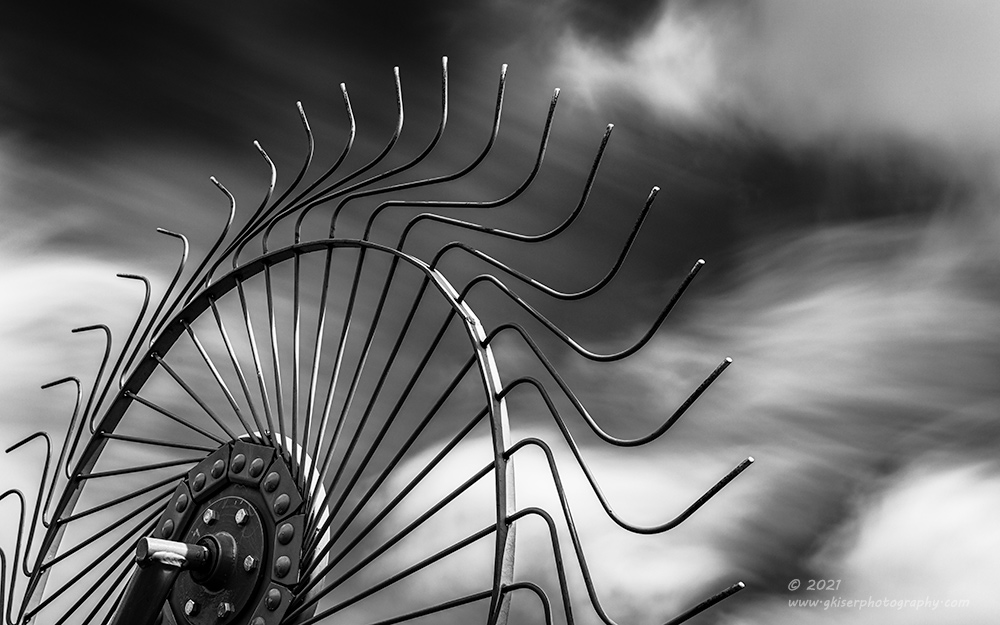
I warned you that the top of the list was going to be a bit of a shock to you and not look like my regular images. This is one from an early Fall trek on the Blue Ridge Parkway to capture some Fall Foliage. But wait a minute, there is no foliage in the image, and no color, and no indication of the season. You are correct. This photograph has nothing at all to do with why I was out with the camera that day. This is an example of seizing an opportunity when it presented itself. That concept has already been discussed with the Number 9 image on this list and is something that always excites me when I can take advantage of a fleeting scene.
So, what happened is this. While driving on the Parkway, I saw this old tractor on the side of the road, and it had a hay rake attached to the back of it. Since there was no Fall color in the scene, I drove on past it. When I came back through a while later, I had realized that there wasn’t much Fall color to be had just yet in this area and I was willing to try photographing the tractor for a bit since it was kind of interesting and the sky was looking good above it. I spent some time with the tractor and actually got a pretty good photograph of it. There was just something pulling at me and telling me that I wasn’t finished with this scene just yet. I recognized that the clouds were moving in the sky from left to right at a decent pace which would make for a great long exposure. The problem was the scene that I was photographing really wouldn’t benefit from a long exposure in any way. As I was pondering, I looked at the hay rake that was sticking into the sky. It hit me like a brick. No, not the hay rake. I didn’t get impaled on the side of the Parkway thank goodness. No, it was the concept for a long exposure that hit me. I could use the hay rake as a solid visual anchor and have the clouds moving past it. I loved the idea and it fed into that want to create fine art dealing with strong graphical elements.
I got things set up and shot a great many frames as the clouds moved through the scene. I had thought that these images would work as either color or black and white, but I was leaning towards the color end more and more. I had a lot of different examples to choose from when I got home, but when I started to cull the images there were two that really stuck out by the end of the day. I ended up editing them both but did one as color and the other as black and white. It was the latter that I thought was the most successful and the most significant. There was just this beautiful, implied motion from the orientation of the hay rake and the way that the clouds were moving through the scene. It provided an element to a still photograph that just couldn’t be faked. The black and white presentation gave it a certain elegance and simplicity that I think goes well with the fine art vibe that I have been looking for.
What really makes this significant is that this image taught me that I can find graphical images in some very unlikely places. Normally, I would be looking for them in the cities, or where there is modern architecture. That is where I’ve found that hard lines and angles show up the most often. This image proved to me that on the side of the Blue Ridge Parkway in the community of Laurel Springs I could find those very elements and photograph them. By using something as basic as a hay rake, I can create fine art images with subject matter that most in this field will never even see, much less consider photographing. It is something that might take my photography to a higher point than I ever thought possible. Time will tell on that, but I am now on the hunt for similar opportunities when I am on my rural road trips looking for old barns and cars. I have yet another tool in my bag that will allow me to see different things, and things differently.
We have gone through eleven of the most significant images from the year. You have seen a number of different genres of photography represented here. We have looked at images that are pretty much my bread and butter captures like the old wooden structure images and the landscapes. We have looked at some of my work in the studio as well as some attempts at the fine art end of the spectrum of photography in an attempt to define that category a little better. We have seen some growth in my own views of photography as well as post production. In short, this list has been all over the place, but that kind of represents the year that I have had with photography. I’ve been trying a lot of new things to keep it fresh for not only me, but for you as well. So, what in world am I looking at for the top spot for the year in terms of significant images? I am a landscape and decay photographer, so it would stand to reason that the image would fall into one of those two categories.
Nope….
I’ll give you a hint on this one. It is the only image that I have shot essentially straight up into the sky this entire year. I think my spine is still slightly out of alignment from trying to frame this image up. It represents my want to achieve fine art through strong graphical elements, as well as my appreciation for unique architecture. It is an image that came from one of my most successful and unique treks of the year which you have already seen referenced in this list once before.
This is one of those images that most of you will look at and not even see as one of my pieces. I would also venture a guess that the majority of you probably won’t see the significance of it at all in relation to my other photographs in this list, or even across my whole body of work. However, this is my list, and this image represents the single most significant combination of elements for the entire year.
I am proud to introduce the most significant image of 2021, and it is one that I absolutely love for what it represents to my own art.
Number 1
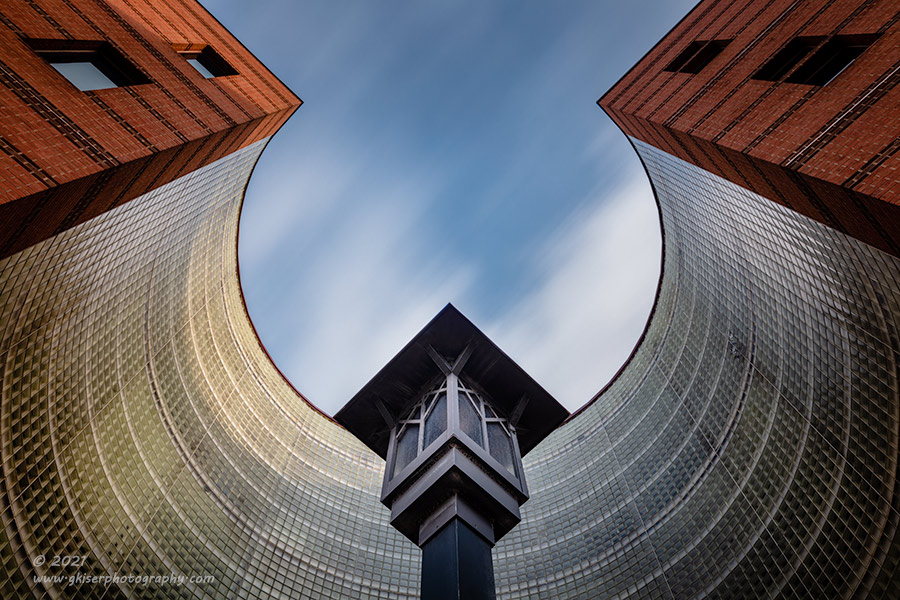
This photograph was created after working the sculpture at Appalachian State University at the end of Summer. I was firmly into the mindset of graphical images with strong colors and shapes. I was thinking outside of my normal box which primed me to be able to see this composition in the first place. I was walking around the campus remembering my years there, but also looking for other compositions that I might be interested in shooting. I came upon this one building which I had seen coming in that had caught my eye because of a sculpture by the front door. I went over and started to frame up a composition with the sculpture that used the block glass as a background. The more I tried, the less I liked what I saw. I was about to give up on the location but decided that I liked the style of the light post that was near the sculpture and had also provided some visual hurdles for compositions of that sculpture. As I looked at the light post I had a crazy idea to shoot it from the bottom looking up and to use the unique curve of the building to frame it.
It took some work to get the camera in position to shoot essentially straight up and then I had to finesse the composition so that the lines all intersected exactly where I needed them to. I had to make sure that this scene was symmetrical in every way except for the lighting which was where the visual tension was going to come from. It took me about 10 minutes to get the shot set up if memory serves and I really thought that I was going to need a backboard when it was all done. When I finally got the composition set, I had to figure out the exposure because the clouds were still moving overhead at enough of a pace to where I could get a long exposure to show motion. The angle of the clouds was going to point towards the warm section of light on the glass blocks which would help to support that element. I experimented with several different shutter speeds to determine what matched up with the speed of the clouds best. I ended up deciding that between 8 and 10 seconds would work the best. I just shot frame after frame as the sky changed until I was sure that I had at least one frame that would be significantly better than the rest.
The resulting image nailed every aspect that I was after. I had symmetry, interesting light, great contrast between the light and the wall, movement from the sky, and a graphical impact that took this photograph to another level. I had seen something that my eyes usually don’t see, put the elements together and produced an image that was exactly what I had envisioned. I feel that this is firmly into the realm of fine art and helps me to define that concept in my own photography. It is not a photograph of any particular element as much as it is a symbiotic relationship between unrelated images that forms a cohesive photograph. When you see this, you see shapes and light above all else. It is interesting and captivating as you try to understand it. That surely falls into the realm of fine art as art itself is meant to create a reaction over all else.
So, there you have it. My 12 most significant images of 2021. It was a hard list to really put together and decide on. I do feel confident in my choices here but would love to hear your thoughts on the subject. Are any of your favorites included in this list? Did I include photographs that maybe you had forgotten about and never realized how they fit into my collection? Let me know. There are a lot of images that are my favorites that didn’t make the cut because there was really no significance to them other than I liked them. I’ve done those lists before, but I’ve found that over the years my tastes change, and I much more quickly change my mind about what has been included on that kind of list. When I look at significant images it is much harder to second guess myself after the fact because significance is not nearly as fleeting as whether or not you like an image over another one.
Thanks for taking a look back on this year through its images with me. In just a few more days we will be looking at the entire year and what all has happened in my first installment of Behind the Camera in 2022. With that entry, we will bid farewell to 2021 and step into the new year where hopefully I will grow on the experiences that I’ve had throughout this year.

Remember to use the code KISER10 to get 10% off your purchase