Saturday, December 16, 2023
Something that I have said for many years has been you don’t need to travel to far off and exotic places in order to find photographs. There is so much around us all that is interesting and exciting to photograph, we just have to look for it. That is the key, and a part that should never be overlooked. The trek that I am talking about today is a prime example of why you should never stop looking. It kind of all started a few weeks ago when I went to the bank to make a deposit. I’ve been to this bank several times a year since moving out to Wilkes County in 2020, and it is in North Wilkesboro where I have spent a lot of time with a camera just walking around. In all that time, I have not seen this particular scene, but feel pretty confident that it has been there for at least as long as I have been in town. I just happened to spot the tail end of a 50’s model car sticking out from behind a wall as I was driving up the road. As I continued driving, I was thinking back in my memories trying to recall what I had just seen. Nothing…There was nothing in my memory about this location. The more I thought about it, the more I was convinced that I had never checked it out before, and that started to build up some excitement. I love finding new places locally because at this point, what I am finding is generally well hidden from the average person.
It was a couple of days later that I was out and about again and decided to do a little scouting at the location I had seen to see just what was there. When I arrived, I found my way in closer to the area I had seen which turned out to be the rear of a commercial building. There were several vehicles in a state of disrepair clustered together. There was a Ford Expedition, Ford Mustang, a stripped Nissan 300ZX, a mid ’90’s Caprice, and a few ’60’s model pickups which didn’t really grab my attention. What I had seen was the tail end of one of two ’50’s DeSotos which were parked facing each other in a recessed area below the parking lot. There was also a ’30’s model Chevrolet tucked in nearby. At first glance, I loved the three cars, but knew that there was going to be a lot of difficulties photographing them because of the locations they were in and the surrounding distractions. On the positive side, there didn’t appear to be any signs indicating that I couldn’t be there, and there were no fences, or other barriers. From everything I could see, this looked like a commercial lot where customers could be.
The day that I was out there was a sunny day, and the light was just no good for anything that I might want to photograph. I was going to need a light diffusion layer of clouds overhead to make this work. Looking ahead in the forecast, there were no good days ahead except for days that rain was also forecasted. Sure enough, when those days rolled around, The sunlight changed to rain almost immediately which was not going to work for what I was needing to do with the cars. Days turned into weeks and there was just not a good day at all to go out and try to photograph these cars. I was also really hoping for a weekend so that I wouldn’t be in anyone’s way while I was out there.
I kept mulling around how I wanted to shoot the cars while I was waiting for a good day. Having been away from this type of photography for a while now, I was starting to have a bit of creative block which is just part of life as an artist. I realized that I was long overdue for a creative break and needed to have a little down time, even if I did try out a different technique in the studio. That exercise was a vacation from how I normally see photographs, as well as how I usually edit them. It was a great vacation while keeping that creative part of my world engaged. However, after doing that, I effectively moved away from living and breathing landscape and decay photography. Think of it kind of like a palette cleanser between courses. I was on vacation mentally at this point and that was well deserved. I let things brew in the back of my head as I embraced the ebb of my creativity for a bit.
I knew that eventually I would want to get back to work as a photographer, so I kept pushing myself to think about how I would photograph these cars behind the business if the chance presented itself. I knew that overall compositions weren’t going to be workable because of all the distractions around the cars that did nothing to support the stories that I was wanting to tell. The answer was going to have to come in the form of isolations and a bit more of an artistic take on the subjects. I reveled in that concept because I had just recently released a workshop based on just that concept. It was an area that I have been experiencing a lot of personal growth in recently and was looking forward to going out with that being the intention for the day.
The hardest part of thinking about a scene in terms of isolations is that it is really hard to determine what aspects of the car will really jump out at you when the photography starts. Isolations come down to lighting more than about anything else. This is why I was looking for an overcast day, but having some directional light was still not a problem. I just needed shadows to be a little more subdued so that I could add the contrast where I wanted it to be. There were two different generations of cars that I would be shooting with the two ’50’s body styles and the one ’30’s body. They each had different shapes and defining characteristics which I was going to have to be in the right mindset to capture. The one with the best curves was also the one that was black which doesn’t photograph all that well most of the time. The later model cars had better colors, and in one case more rust, but the shapes were not as dominant. In order to get the best possible photos, I was going to have to look for the most interesting parts of the black car that also fell in areas where there were interesting shapes. On the two DeSotos, I was looking for shapes more than anything else, and hoping that the colors of the patina worked in those areas.
There was a day about a week ago where there was going to be clouds through the morning with rain coming in just before lunch. I had planned on going out and trying to photograph the cars on that day, but when I woke up, it was already raining. Knowing that I was going to be shooting isolations, I knew that water, and the drops of rain on the surfaces would more than likely be a distraction. Looking at the hourly forecast, there was only going to be a couple of hours when the rain might stop, but I doubted that the cars would dry up in that time. The idea to go out was shelved in favor of staying at home and remaining warm.
By this point, the holidays were starting to get in full swing and there was traveling to be done as well as a Granddaughter who would be with us for the remainder of the year. The travel started with going down to South Carolina to meet with her dad and do the “custody exchange.” Since neither Toni nor I wanted to deal with Charlotte traffic at rush hour on a Friday, we just stayed the night in Columbia, SC. On a related note, one star, not recommended. We were back on the road after the free continental breakfast which was pretty good. I had remembered that the forecast was calling for cloudy conditions through most of the day with rain coming in during the mid to late afternoon. I was watching this because I was hoping to miss the rain and a reason to have to wash the car which was still clean from the last time I washed it.
As we were driving, I noticed that the clouds were really thin, and the sky was mostly clear. The further North we got, not much changed. It was looking like we were going to miss the rain which was my main goal. By the time we got to US 421 and headed West, I could see that the clouds were building up a little bit. They weren’t dense at all and there was no texture to be seen in them, but they were diffusing the sun very nicely. I could see a nice quality of light on the landscape with a touch of directionality. It wasn’t what I was counting on, but I could see the possibility of being able to go and shoot the cars in North Wilkesboro with this light. It also seemed as though the rain was going to hold off for a while more too which would give me plenty of time to go out and work the scene.
When we got home and got everyone situated, I started to consider going out for a bit to get the photos. I knew that Sunday was going to be a rainy day and we would all be inside which would make for a good editing day. I had good conditions to shoot in, and a great day for the processing and blogging, but I still didn’t really feel like going out. It really is like Newton’s First Law of Motion. An object in motion will stay in motion, and an object at rest will stay at rest. My creativity had been at rest for so long that it was happier staying at rest. I recognized this and decided that I really needed to get out there and shoot something to get things flowing again. In order to keep from getting overwhelmed with the concept, I tried to keep things as simple as possible. I already had a single location picked out, and that location was forcing a specific kind of photography (isolations). I decided that I would stick with my telephoto lens because that would more than likely be the best option for the environment, but I have also recently realized that the 70-200mm has become one of my favorite lenses over this past year. By using that lens, the only filter that I would need would be the polarizer. All of these decisions were made before even committing to the shoot, but they served to keep my options limited so that I could focus on the creative aspects of the day.
Feeling like I could deal with this kind of low key trek, I put my shoes on and loaded the truck. The drive took about 15 minutes which is one of the best parts about shooting locally. When I left, I knew what the lighting conditions looked like, and I wasn’t investing a full day in getting to the location. It really was a spur of the moment thing where I was able to react to the weather to fit a concept that I had for some photos.
When I arrived, I went around to the front of the building where I could see that the space wasn’t currently in use. There was a sign in the door that said for the customers of the hot rod shop to come around to the rear of the building. This was great news because it put the area where I was wanting to shoot firmly in the public setting. I went around back and found the main entrance. I checked to see if anyone was there but found all the lights off and no signs of anyone working. I made one more check to see if there were any signs or other indicators that I wouldn’t be welcomed but found nothing at all along those lines. I went back to the truck and got the tripod and camera with the telephoto lens and polarizer attached. I left the rest of the gear back in the truck.
I started to walk around and look at the different cars to try and determine what I wanted to shoot. It was a very slow process as I worked through the different angles to try and find something that excited me. It was a little discouraging for me at first because I just wasn’t seeing anything at all. The cars were great, and I was really excited to have found them, but finding a photograph isn’t always that easy to do. I could feel the creativity within myself coughing and sputtering as it attempted to come back to life. After maybe ten minutes, I decided to go for the low hanging fruit and get a shot in the bag. That always helps when I am having a hard time getting started.
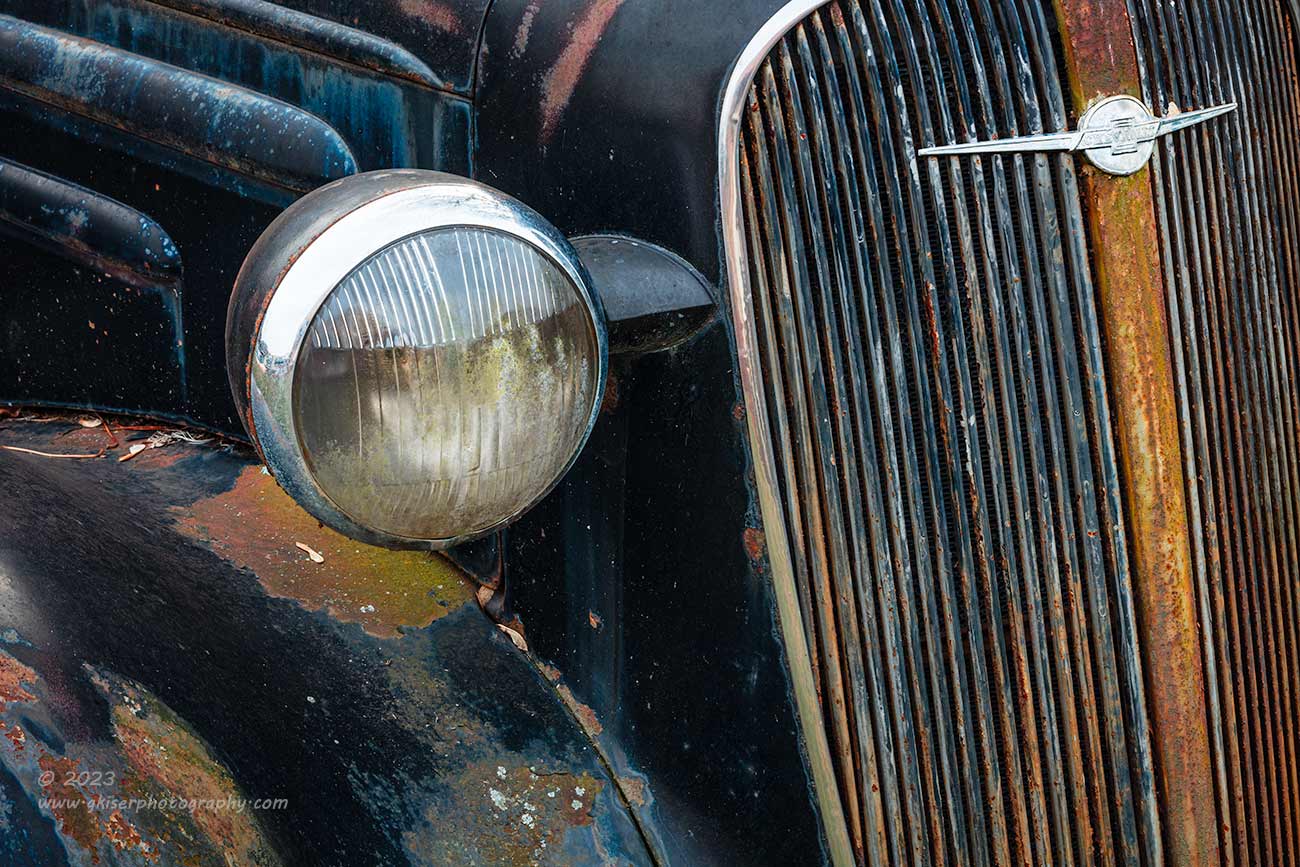
For me, the low hanging fruit in automotive photography has always been something around the headlights. The Chevrolet was the only one where I could get a clear working area around the headlights, so that was the car I started with. As I looked at the light, I decided that I liked the vertical grill with the Chevrolet emblem on it. That contrasted nicely with the horizontal ventilation slats on the side of the hood which became leading lines to the headlight bucket. The curve of the fender was another nice element to the scene as well. It was a simple composition, but I felt an effective one. I framed it up and shot two slight variations on the idea before considering the first one in the bag. That did the trick, and I could feel a weight lifted off of me. I might not like any of the photos when I got home, but I was feeling like creating photos for the first time in a while.
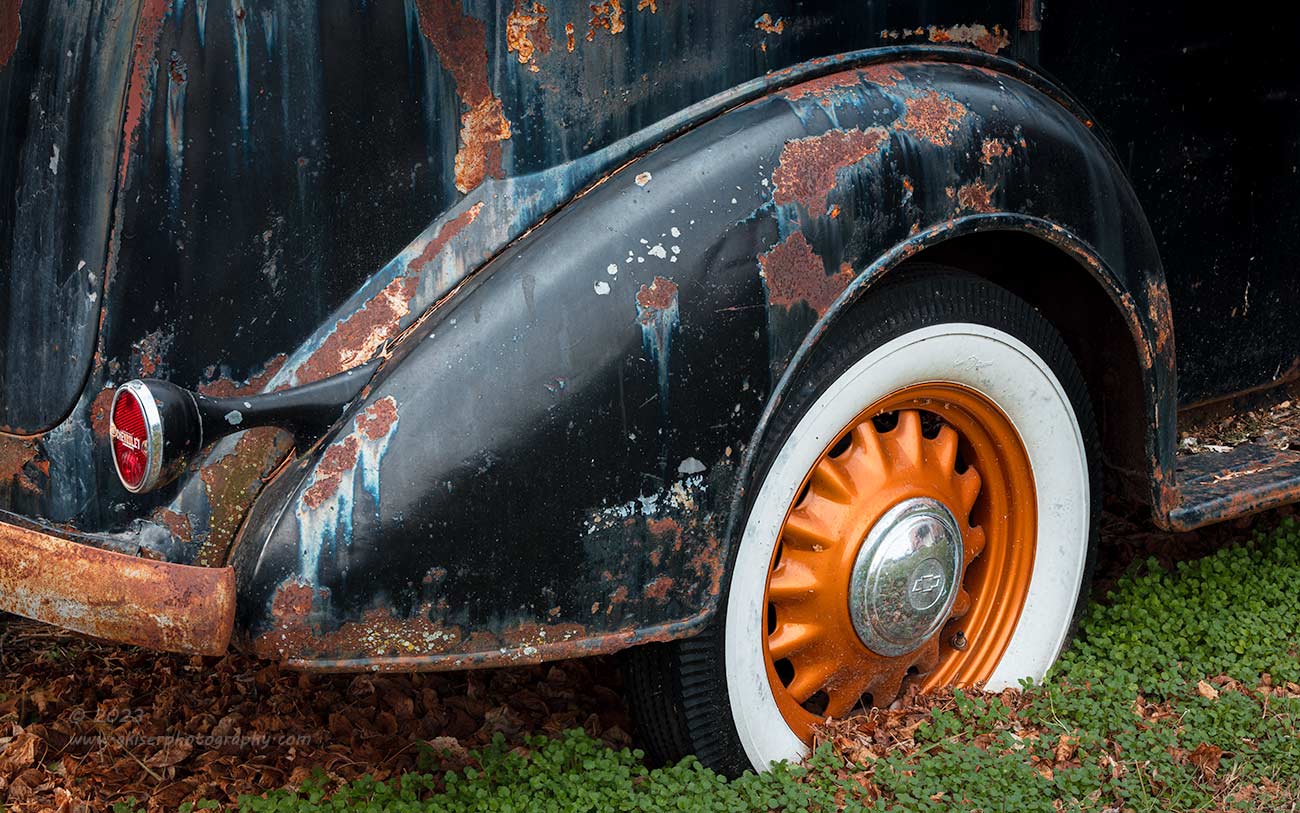
As I was starting to feel more like myself, I started walking around the car to see what else drew my attention. I liked the way that the patina was working through the black paint giving it an oily look. I also liked the copper wheels which were in much better shape that the rest of the car. They were wrapped with whitewall tires that were in equally as a good shape but covered at the bottom with yard debris that showed how long this car had been sitting there. I liked that dichotomy and started to really focus my attention on the wheels. While looking at the wheels, I noticed the detail on the taillight which had a stylized “Chevrolet” stamped across the lens.
This was the area that I concentrated on for the next photo. I was able to incorporate the patina of the paint and the shape of the rear fender while focusing the attention on the wheel and taillight. This was another one that I kind of liked because of how the copper wheel jumped out of the frame surrounded by the thick whitewall tire. I didn’t know if I would like it when I got home, but it captured the elements that I liked about this area of the car. The composition seemed to flow nicely as well which made me happy about it. I was now five frames in with two compositions shot. The confidence was building and I felt that it was time to move over to the two DeSotos at this point.
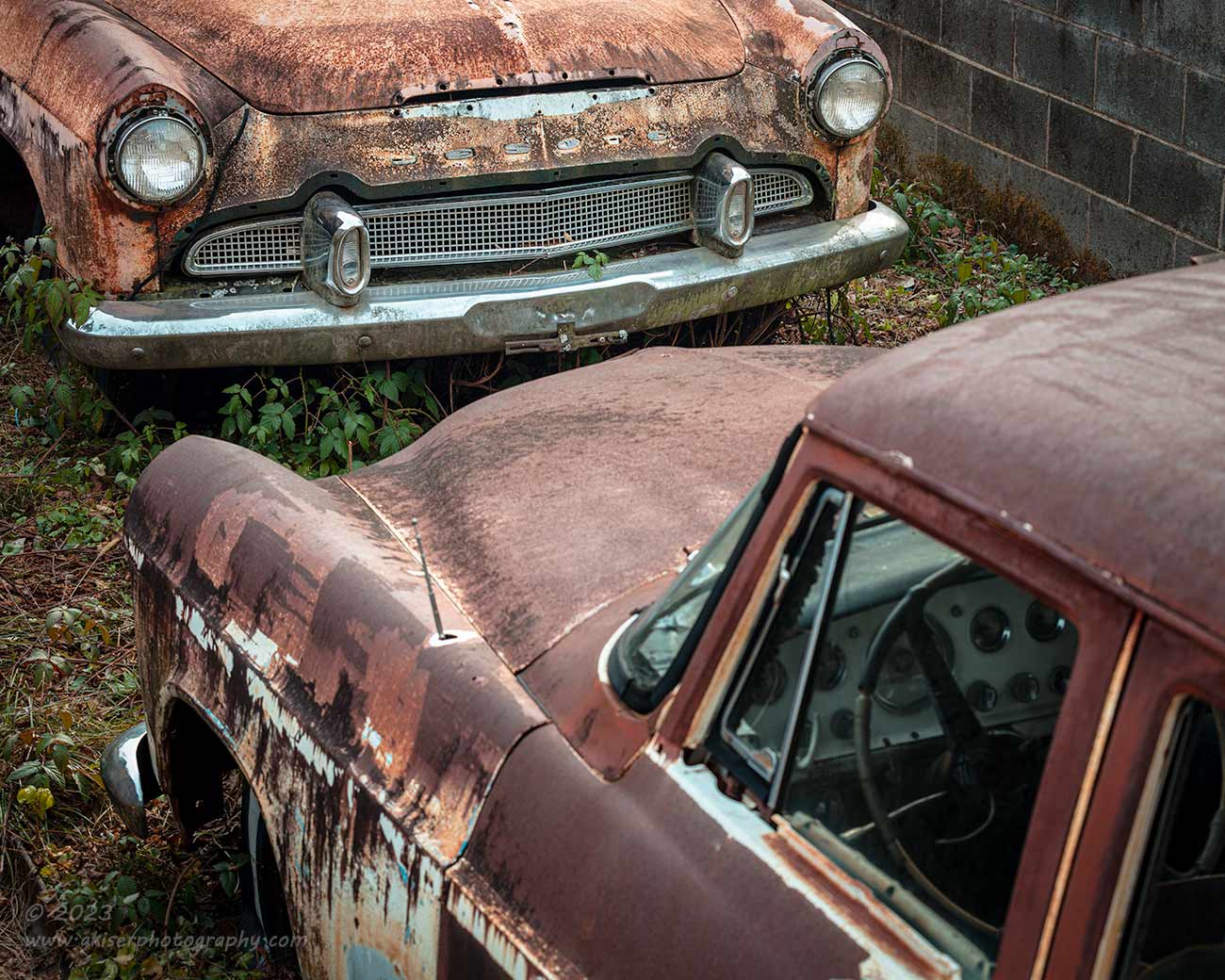
Since they were both recessed well below ground level, I wanted to take advantage of that perspective and stay up high above them. The first composition that I tried was on the driver’s side at the windshield post on the more colorful of the two cars. I didn’t like how this turned out and abandoned the composition after a single frame. I then moved my attention to the front clips of both cars which were interesting to me because of the shapes of the grills. I shot another six frames between the two cars from both sides in an attempt to get something that I liked. The composition was working, and I liked the fact that the rustier of the two cars had a front bumper sitting right on the ground. I was really thinking that one or two of these would work out well as a photograph.
When I got the images home and started to cull through them, two of the photos made it through to the editing cut, but I never started to work an edit on them at all. The more I looked at them, the more the photos looked like snapshots and just felt uninspired. Nothing about them was really memorable to me, so I ended up trashing them in favor of a composition that I shot a few minutes late. Things were slowing down for me at this point because I was having a very hard time working a composition from the elevated position that I was at while taking into account the confines of the wall on either side of the cars.
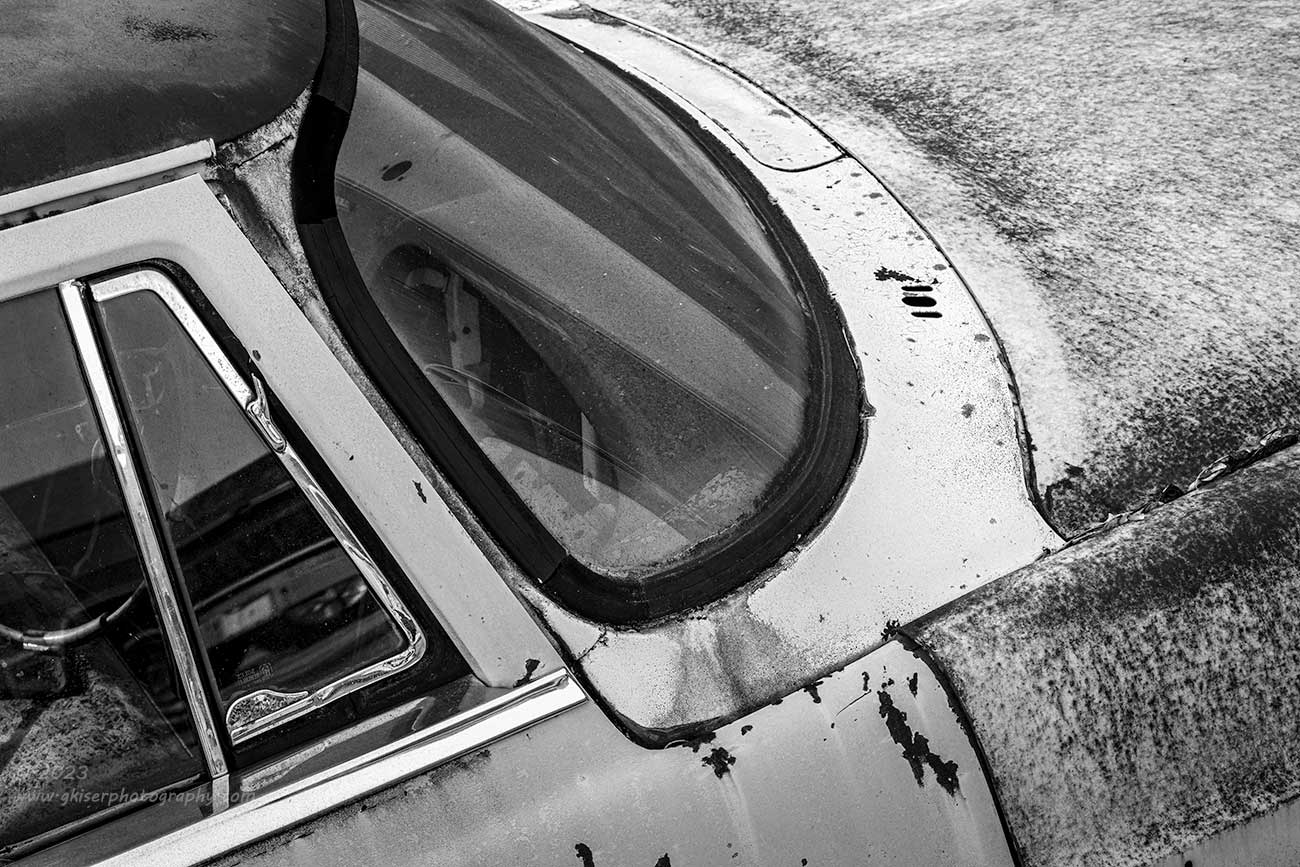
Since I had been going back and forth between the sides as I was working the compositions on the front clips, I had started to revisit the windshield post composition that I had only shot a single frame of on the driver’s side. The passenger side had a much better flow to it and I framed up a composition that worked there. I ended up shooting three variations on that one, of which, the first one was a keeper. In all fairness though, this one almost didn’t get edited because it was not as visually striking as others that I have shot from this same angle. It was a successful composition, but just fell short of the others due to the colors that were present. Just because I did like the composition a lot, I went with a black and white conversion which I thought would show off the more interesting lines a bit better than the color version. This worked well and allowed me to focus on how the body parts fit together along with the textures of the rust rather than the different colors that were present. I found this edited photo to be quite interesting to look at for different reasons compared to the similar compositions that I’ve shot of this area of cars in the past.

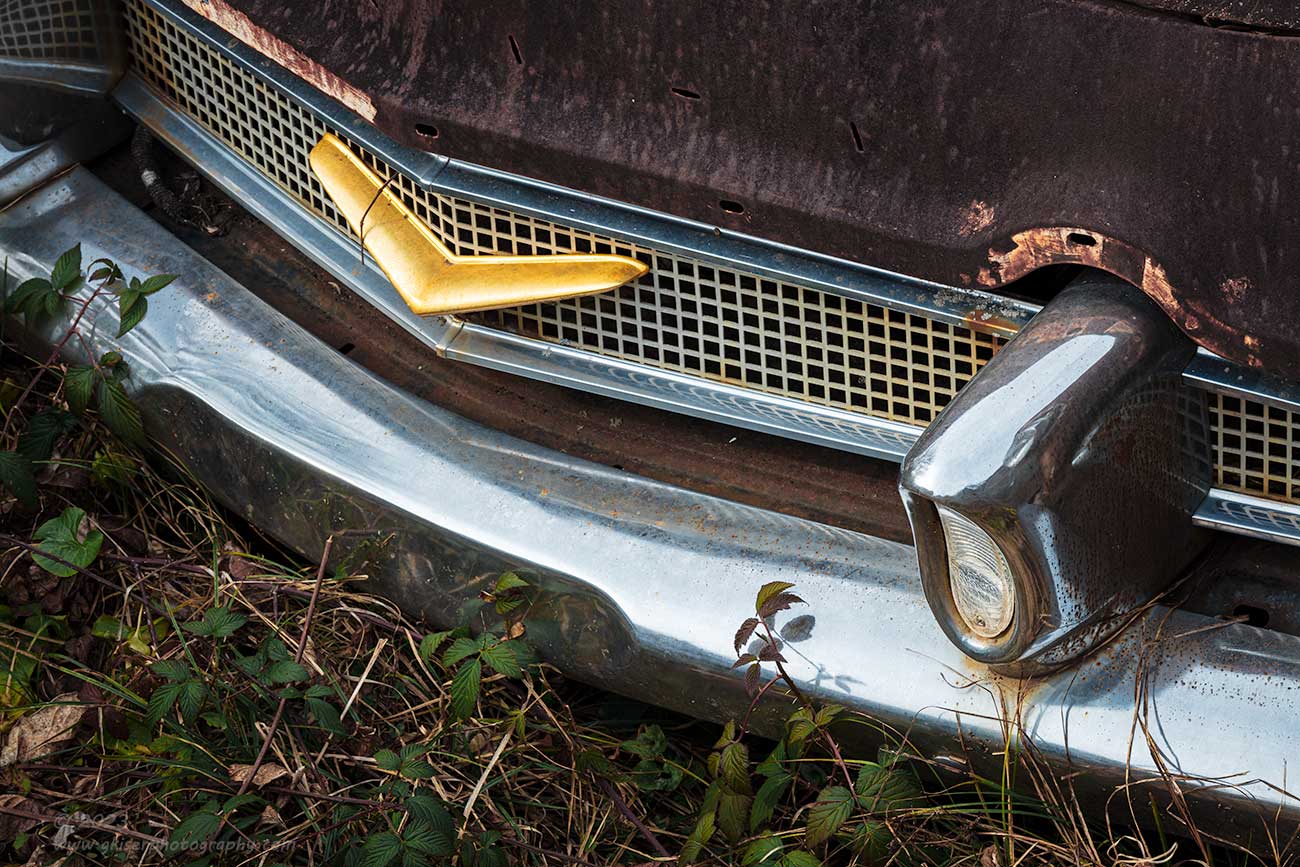
Even though I was feeling pretty good about the front clip compositions that I had shot of both cars, I wanted to revisit that concept once again, but on a smaller scale. I don’t think that I was consciously thinking about this fact, but I really believe that I was having an issue with compositions while I was shooting them but couldn’t articulate why. As I tried this once again, I decided to really focus on specific elements rather than the entire front of the car. Oddly enough, I even decided to avoid the headlights because they weren’t all that interesting to me in the grand scheme of things. What I really liked was the DeSoto “V” emblem and the way that the light was recessed into the bumperette. The grill pattern was also a nice texture. You will also remember that I liked the way the one car had its bumper sitting on the ground which was not something you usually see with cars. This is what I focused on and looked at it from both sides. It was the way that the weeds were growing which dictated the direction that I was going to shoot in more than anything else.
This composition seemed to work better, but I wasn’t sure if I would like it on the big screen when I got home. I shot two frames to make sure that I was able to freeze any motion and felt that was probably good enough. It was a longshot chance at a good composition, but I felt that it might work out. I had already planned on doing an edit with most of the image desaturated while the “V” was almost glowing in that golden finish. When I got to the edit, I did it just like I had planned and found that the image worked very well. In fact, it worked much better than the broader composition that I had started with and spent more time with. This is a lesson that I have to relearn over and over again, but it is a good lesson. There are times when less is more, and if there is a small detail that really appeals to you, don’t clutter the image up because you feel that it needs a sense of space. Just jump in and pull out that small detail, which is what I ended up doing with this composition.
I still did want to get a more inclusive shot of the front of the car, but the more that I thought about it, the less I was liking the individual front clip compositions. After spending some time back and forth between the two cars and working the angles, I started to appreciate how the cars were reacting to each other. They were parked facing each other and there was a decent chance for a composition that showcased two similar cars, in opposite directions for a bit of visual tension. I looked at the scene closely and found that I liked the front of the more colorful DeSoto better because it had the lettering present to identify it. The rustier of the cars had a less cluttered interior and didn’t have a tarp over the roof which made it better for use as the foreground in my composition.
I worked out a framing that I liked and then started to work through the depth of field that I wanted. There was no need to have it all in focus as I wanted the attention to go to the emblem on the front of the one car. I just needed to define the shapes of the car in the foreground and have it sharp enough to carry a little attention, while forcing the eyes foreword. I tried several exposure variations with this so that I would have the right one to choose from when I got home. It was the middle of the three variations which turned into the keeper.
Feeling like I had shot all that I could with the pair of DeSotos, I moved my attention back to the Chevrolet. There was an area behind the passenger door which showed that oily looking patina on the black paint. I worked for a while to figure out a composition that would showcase this patina and still make sense. It was a complicated photo, but one that I thought worked very well. In fact, it was the first photo of the day that I was really excited about. You are probably looking for it in this blog but can’t find it. Well, my excitement was not warranted at all. When I saw it on the computer, it looked haphazard at best and only made it through the first round of culling before getting trashed. It just didn’t work as a photograph, not at all. I had shot four frames of that composition thinking I had something special.
The next four frames were shot of the front right wheel which I felt was just a cya move in case the rear wheel didn’t turn out as good as I had hoped. I loved the copper wheels, and these were the only two that were present on the car. I had a lot of the same elements at play with the front wheel that I had with the rear one, so it was going to be a nice safety image in case I messed something up with the rear wheel. I still had the wonderful shape of the fender, the blue hues around the rust looking like oil, the bright whitewall tire, copper wheel, and the dichotomy of the wheel condition while being overgrown by the yard debris.
I shot the next four frames of this view to make sure that I had the grass tack sharp. I didn’t really plan on going far with this photo, but after the editing was finished, it was one of my favorites. I liked both of the wheel photos which you have seen in this blog, but the front one just seems to be a bit stronger overall. It was that taillight that really pulled the other one together for me and created a separate narrative from the front wheel.
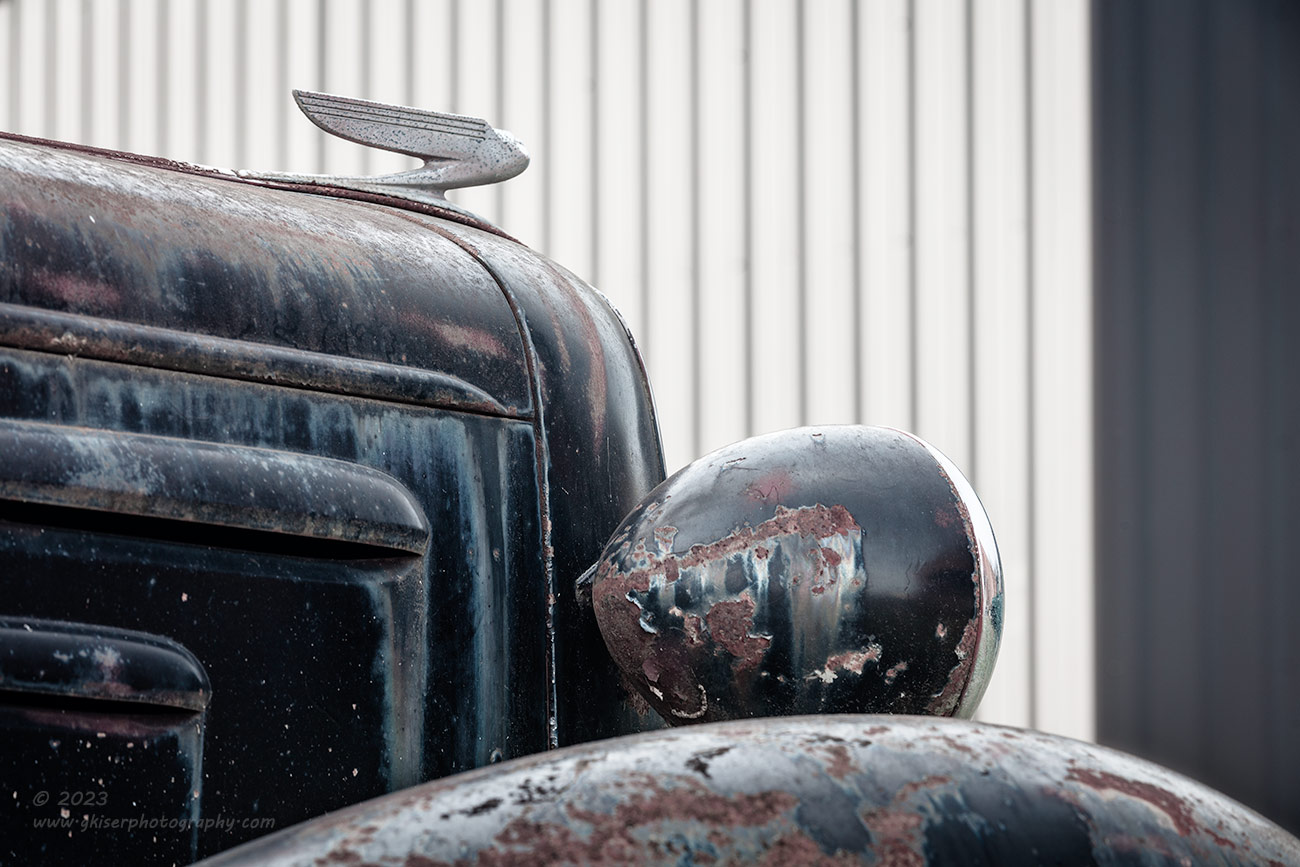
I had now shot 28 frames between the three cars and was feeling like I had everything that I wanted to get. I made another walk around the area to make sure that I didn’t see anything else that I wanted to photograph. The only other thing that stuck out was the hood ornament on the Chevy. I hadn’t shot it yet, and this is something that I would normally spend a few frames on. This one wasn’t all that interesting to me though, and my gut said to skip it. However, as I was looking around, I happened to see the back side of the neighboring building which was done metal. The vertical slats gave an interesting pattern, and I considered using that as a background for the front of the car.
I kneeled down and started to look and see how things were lining up behind the car. There was potential here, so I splayed the tripod out to lower the shooting position a good bit. I then created a composition that pulled in all the aspects of the front of the car that I liked while using the building as a clean backdrop. Before shooting, I reduced the depth of field and tried to work out exactly where to focus to keep the foreground and background soft while keeping the hood ornament, hood, and headlight sharp. This took a bit of doing, and I shot several variations to make sure that I had it right since it can be hard to see that kind of fine detail on the LCD.
Just before I called it a day, I happened to realize that there was a side wall which was in the shade that I had not been including. My only issue with the composition had been that the eyes tended to trail off to the right, but if I were to use this shaded portion of the building, I could create a natural vignette within the frame to keep the eyes focused on the car. After three very considered attempts at getting the depth of field exactly right, I changed up the composition by moving the camera to the left a few inches. This brought the shaded section into the frame, and I was able to recompose for what was looking like a stronger composition.
I felt much better about this variation and shot another five frames with slightly different apertures and focus points. I wanted to keep the background soft, but with enough density to the vertical slats that the texture added to the image. Those vertical lines helped to draw the attention to the way that the patina appeared to drip from the horizontal vents on the hood which formed an “L” shape. It was the combination of shapes and lines in this composition that really stood out to me. Because of that, I almost did this as a black and white composition, but I wanted to keep that oiled look to the black paint which I thought helped to draw the attention as well. I also knew that color was not really the most important aspect of this one, so I chose to go with a desaturated color profile which I love using in situations like this. The end result is a very subdued photograph with just enough color to tell the story, while the focus is on the shapes and contrasts within the scene.
It was this last composition of the day which turned out to be my favorite. At the time, I was just thinking that it was a shot in the dark at making something that would stand out. I had shot only 36 frames in about 45 minutes. I was glad that I had come here and done the shoot, but I really wasn’t holding out much hope for great photos. I was still feeling a little less than when it came to my levels of creativity, and when I’ve gone this long without making photographs the imposter syndrome starts really sneaking into my thoughts. This hadn’t been a grand location, and the subjects weren’t all that fantastic either. What would make me think that the photos would be all that great?
Well, when I am feeling that way, I have found that the best thing to do is to hold off on the edits until the next day. This gives me time to flush the preconceived ideas from my head and give me the opportunity to see the photos in a fresh light. That is what I did and didn’t even upload the photos into Lightroom until Sunday morning. When I looked through them for the first time just to recall what I had shot, I wasn’t all that impressed with them. However, when I started to look frame by frame, my opinions changed pretty quickly. I was actually liking what I was seeing and saw several that I really thought turned out well. By the time the editing was over, I was very happy with the photos and felt that the reality had exceeded the expectation for once. These are very happy occasions when they happen and do a lot for my level of creativity. I feel like I could go out and shoot most anything successfully again which is a good feeling to have.
If you would like to jumpstart your photography in 2024, I’ve got some workshops scheduled that you might like. There is a photo walk through downtown North Wilkesboro which is where this session took place, and I have a dedicated workshop dealing with the art of decay where we talk about how to see images like these specifically. If you have more specific needs or questions, consider joining me for a mentorship session where I will custom build an experience for you to help you progress with your photography. If you would like to gift this experience to a photographer, we can arrange that as well. Just contact me and we will work out the details in time for Christmas.
Thanks for joining me for this quick and impromptu trek. I hope you enjoyed it even more than I did at the time since I didn’t fully understand how well it went until the next day. I do like sharing the fact that photography is not really as easy as it appears. There is so much more to it than clicking the button. By seeing some of my personal struggles behind the camera, I hope you have a better understanding of what goes into creating photographs. This hopefully appeals to those of you who enjoy looking at the photos as well as those of you who want to create your own photos.
I hope that everyone will have a Merry Christmas. Be sure to look for my upcoming Top 12 Significant Images of 2023 coming up by the end of the year. I’ll also see you back here on January 1st as we take a look back at 2023 and how the year has gone.
Until then….