Sunday, January 2, 2022
So, there I was at the base of Midnight Hole working on a few different compositions as I tried my best to make use of the rushing water that was much higher than I was used to. I kept hearing yelling upstream, and I wondered just what was going on. It wasn’t the type of yelling that said that something was wrong, so much as communicating over a distance. The longer I worked, the closer it got and eventually I saw a kayak come to rest at the top of the waterfall. Then another, and then another. I shifted my attention to some isolations and eventually there were about eight kayaks perched on top of the waterfall and two of them had slid through and were beaching about 8 feet from me. I had been worried about this coming out here on a weekend, but I had no idea that I was going to be caught up in a kayak shuttle from one end of Big Creek to the other.
Let me start from the beginning so this all makes sense. You might remember that I went out on New Year’s Day and ended up photographing a Dodge Coronet. I had wanted to head out to Big Creek to take advantage of the clouds, but it looked like I would have better luck on Sunday with thicker clouds and having the benefit of some heavy rains overnight to get the water active again after a long, dry Fall. As I got things wrapped up from the Dodge shoot, I was looking at the weather and it was really looking promising for getting some good images at Big Creek. I tend to only go out there when the weather is looking really good because it is a commitment with time since I’m still three hours away, even though we moved closer to the mountains last Summer. The three hours is better than four, but it still represents a lot of driving which I want to be worthwhile. The weather was looking good, but I was worried about the crowds on a holiday weekend. Nothing will ruin a trip like this quicker than a bunch of folks sneaking into every frame that is shot.
In addition to the concerns for the weekend crowds, I saw that there was now a winter weather advisory for the area, and they were expecting a lot of snow on Sunday night. This meant that they were probably going to be treating the roads with the salt solution which I hate to drive through since it mandates a wash to get the corrosive salt out from under the truck. I kept thinking about things and decided that I would probably be better off going another time. But then it hit me, I was trying to talk myself out of going at all. It wasn’t that I wasn’t wanting to go, I was just worried that I would get there, and the pictures wouldn’t be any good and I would have wasted the effort to get there. It is a form of self-sabotage that I tend to do to myself which cheats me out of a lot of chances for good photos. With that knowledge in mind, I decided to put my Gortex boots to use and go out there.
As I was pulling up the GPS directions to get the quickest way to get down to I-40 in that direction (through Lenoir) I saw that the reviews of Big Creek were really low. Out of curiosity I clicked on the link and there were single star reviews one after another. Since I love this park, I wanted to see why that was. As I was reading, they were all saying the same thing. There has apparently been a rash of catalytic converters stolen from the parking area since the Fall. I remember dealing with that crime a lot when I was a police officer, and I knew that there was very little that could be done to prevent it from happening. Maybe I should not go because I didn’t want to be a victim and have to be towed out of there.
Dang! My self-sabotaging was really in top form at this point. I knew better than that. These thefts happen at night 95% of the time, and there would be regular traffic through the parking area during the day which would prevent this from happening. I just needed to get on with it and go. I went to sleep planning on leaving at 6, which would get me there around 9 when the morning rain would have ended. I got up around 5 as Toni was getting ready to go work. I looked at the weather and it was looking even better than it had when I went to bed. I had no more excuses. The rain was going to help the water flow and I had great clouds, not to mention the time to actually go. I was awake and realized that I had no reason not to go.
It didn’t take me long to get ready and I was on the road by 5:45. It was still raining pretty good as I was making my way down to I-40 but that was to be expected based on the radar images I had been seeing. The rain should be done by the time I got into Haywood County. The trip was actually quite boring with very little traffic. It gave me hopes for just a few visitors at the park…you know, just enough to keep the criminals at bay. I spent the ride out there thinking about some of the different compositions that could shoot. It had been well over a year since I had last been to Big Creek, but I knew it pretty well. There were a couple of compositions that I wanted to try again which I had done during that trip, and I also wanted to spend some time doing some isolations and water abstracts. It really helps to have a plan when you are going to be spending a lot of time at an area.
The rain finally stopped as I got to the Harmon Den exit, which I found out is now the highway as they are repairing the flood damage from the Summer. It was a very simple detour since I was the only vehicle on the road. On the return trip, that wasn’t the case and the travel time increased by nearly a half hour because of the detour. Anyway, I was happy that the rain had stopped because it is kind of difficult photographing waterfalls in the rain. The rocks are just too slippery, and it is nearly impossible to keep the lens dry between the rain and the spray from the waterfalls. When I pulled into the parking area, I was met by four other vehicles which were already there. I wasn’t the early bird that I expected to be for a Sunday morning. Oh well, I was hoping for just enough folks here to ward off those looking for auto parts, and I had that. I just wondered if they had been there overnight and whether or not they had their full exhausts in place.
I went around to the back of the truck and mounted my tripod on the side of the Lowepro bag to make for much easier hiking. It seems like forever that I have done this since most of my hikes for photos have been really short in length and I didn’t mind carrying the tripod. This time, I knew it would be about a mile before I would get to anything good, and I just wanted my hands to be free. I started off towards the trail and met up with a guy that had been fishing on the other side of the parking lot. He was a little frustrated with the amount of rain that had fallen because it was really messing up the fishing. I shared that I was in the other school of thought and that for my purposes the rainfall really helped the look of the area. He said that he was going to try and go to Midnight Hole to see if that was any better. I assured him that in all the times I had been here, that has always been the calmest spot and is just about tranquil. He was happy to hear that, and we parted ways since I was walking a bit faster than he was.
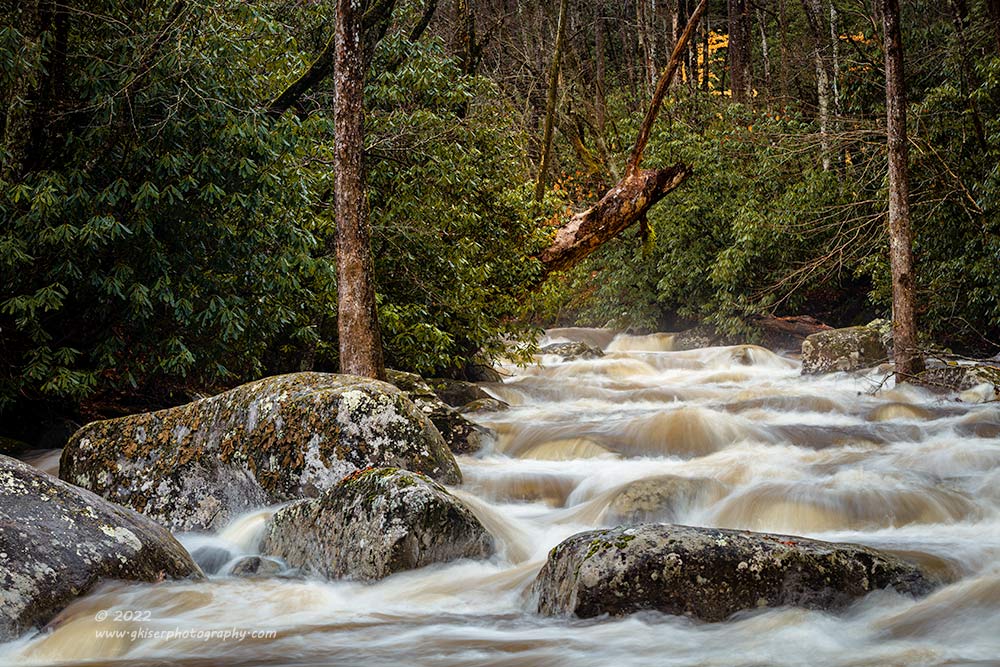
Like I said, it was about a mile before the trail met back with the water and I was able to get down to the creek itself. When that happened, the first spot I came to was one that I had remembered stopping at when I was teaching Sierra about photographing moving water. There were a couple of decent compositions there from what I remembered, but that time the light was just not good at all. I was hoping that this time would be different since the light was spectacular thanks to the clouds. A big change that I was noticing here this time was there was a lot more water than I was used to seeing. I thought I had seen everything from drought conditions to fairly full conditions. If you check out those two blog entries, pay attention to Mouse Creek Falls and compare those images with what I captured today to really show you how the water levels changed. I have to say that this visit showed what could only be described as nearly flood conditions for the creek which was making some of my compositions rather difficult. I found that out at this first stop as I wasn’t able to get out into the creek as I had been able to do before. The compositions that I had seen before were just non-existent now since the rocks were completely covered up by the water. Since the last time I was here there were also a number of trees that had fallen and were stacked up along the sides of the creek.
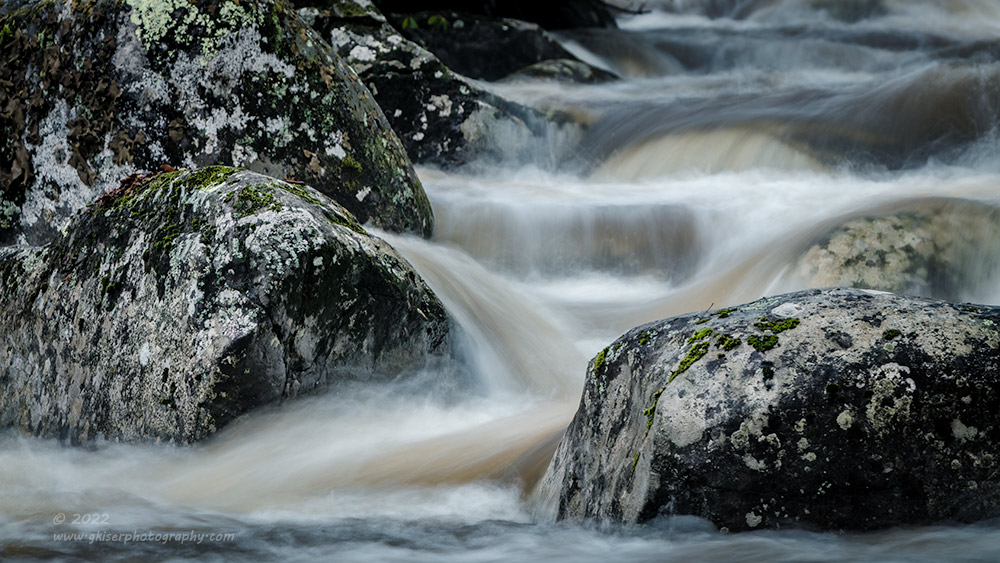
Not wanting to give up, I started to play around at this location with some different compositions. Because of all of the water, I decided to use my long lens and try to get some more intimate captures and find some abstracts in the water. I used this opportunity to dial in a shutter speed range that I liked. Since I wasn’t used to photographing this creek in a torrent of water, my typical 2.5-3.2 second shutter speed just wouldn’t work out. I was going to need something quicker than that to show any textures.
On the subject of shutter speed, I have been having a bit of change of heart when it comes to showing the motion in the water since I did a Behind the Camera installment on shooting waterfalls. I still want to show motion, but my thoughts on the correct shutter speeds have changed a little bit since I did that piece. I’m starting to enjoy quicker shutter speeds around a single second or so when it comes to photographing moving water. There isn’t really a right or a wrong here, it is just a matter of season to taste. I’ll probably do another entry on photographing moving water later this year with some of my current views which are different now. At any rate, I was using the LCD image review to look at the results of the different shutter speed settings to see what I was going to like the best. What I ended up with was a range between 1 second and 1/8 of a second depending on focal length and direction. This was much quicker than I was used to, but it was what was needed to show the movement of the water and not just create a whitewash over the rocks. It was just another way to bring texture into the image and that was what I was after.

I stayed at this location probably longer than I should have because I was doing so much experimentation with things. I ended up getting a couple of keeper images from this spot, which was a nice surprise; but with about 30 frames shot I was due something, if only for the law of averages. I still wasn’t feeling Big Creek like I was hoping I would. Part of what I love about this location is the aqua hue to the water. Of course, with all of the water turning frothy there was no chance to see that hue that I loved so. I was also a bit overstimulated by the white water that I was seeing which was making compositions rather difficult to come up with. It was just going against my previsualizations, and it was going to take a while to recalibrate my mind to work with the conditions that I had.
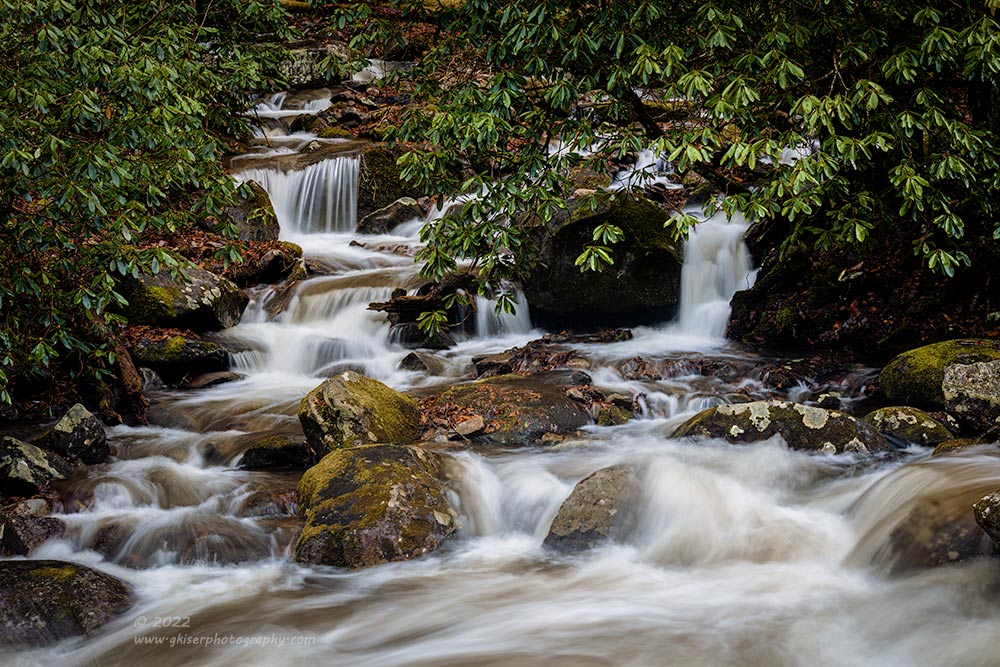
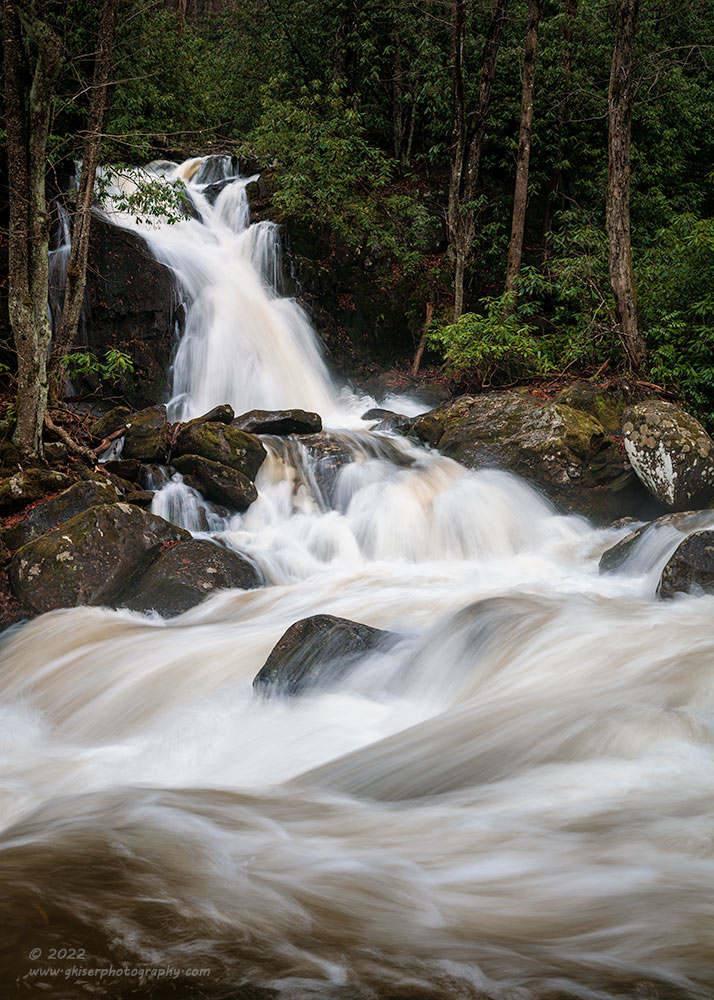
My next stop on the trail was a location that I had never stopped at before because… well… the subject had not existed until now. There was a nice little waterfall that was flowing down the opposite bank from the flood waters above. This was something completely new for me and I wanted to capture an image of it. The formation of the waterfall was nearly perfect the way that it flowed between the trees. The hardest part I was going to face was going to be getting down to it. Since this was not a normal feature of the Creek, there was just no established scramble path available to walk down. I had to create my own by carefully selecting where my feet went. As I got closer to the water, I started rock hopping to get into position. I got as close the edge as I could which happened to be perched between two boulders. Yeah, your visual is probably right. I was straddling an opening while I had the tripod set up with two legs on the right boulder and the remaining one stretched out to make contact with the left one in a way that wedged the tripod into position for security. I worked several different compositions from this location and shot both vertical and horizontal versions because I couldn’t tell which I would like better when I got home.
As I was shooting, I kept looking at the trees and found myself wishing that I could get lower and be able to shoot from beneath them. I looked around and saw that there was a bit of embankment below where I was straddling the rocks that might be a good vantage point. The question was how to get there. I could have just jumped between the rocks, but there was a good chance that I would destroy the camera going between the rocks. I looked around the boulders and found a small path that I could possibly be able to shimmy around to get to the base. I left the camera bag where it was and just carried the camera and tripod down the side of the boulders until I reached a portion that was too unsteady to walk on. I looked at the waterfall and realized that the angle was not going to work out as well as I had thought and figured that trying to go any further was not warranted with the risk of damage, or injury. Since I was here, I looked around for some isolations to shoot and found a couple that I wanted to try like the one that I’ve added above.
I was starting to get my groove going with moving water again. I kept telling myself that it had been a while since I’ve photographed any moving water, so it was going to take some time to get my head in the game. With each press of the shutter button, I could feel it coming back to me. I wasn’t getting the easy images like I had at Roaring Fork Falls back in the Summer which meant that I was having to really think about this. It is different photographing a mountain stream when the whole thing is frothy since each shot is an isolation where you have to visualize the effects of the slower shutter speed which make it appear much different than your eyes will see. I just kept looking for prominent structures within the water that I could anchor a composition with and then worked on how the water needed to look around those static elements. It was quite a bit of fun and I was really glad that I convinced myself to come out here again.
With my confidence improving I set back out for the next spot which was going to be rather close to Midnight Hole. When I got there, I worked my way down to the side of the creek and found that I had told a huge whopper of a lie to that fisherman. What was normally tranquil, and calm was anything but. I could actually see Midnight Hole in the distance from where I was standing and there was nothing but white water and rapids all the way up to the falls. I had never seen it like this before and it was amazing.
I pulled out the camera and attempted to get a composition from here as this was one of the ones that I had wanted to do again. The water was just too choppy, and the waterfall didn’t stick out enough to pull off the composition. No matter what I did, I wasn’t able to get a composition that I was really happy with. There was one that came close, but when I started to look at it on the monitor at home, I quickly dismissed it. There was just no flow to it, and I wasn’t able to see the “why” of the photograph which meant that the viewer would be lost as to why I shot the photo as well. It wasn’t the end of the world because I wasn’t here to shoot the actual waterfalls as a primary objective anyway. I wanted to get the creek itself and I was doing just that.
Figuring that I might have better luck at Midnight Hole, I packed up the camera and went on down the trail to that specific location. I didn’t see the fisherman, so either he had finished up, or had decided that the water was just too lively for him. I’m betting that the latter was the reason that he wasn’t there. I doubted that there were any fish in that water which were interested in taking any bait or could see it for that matter.
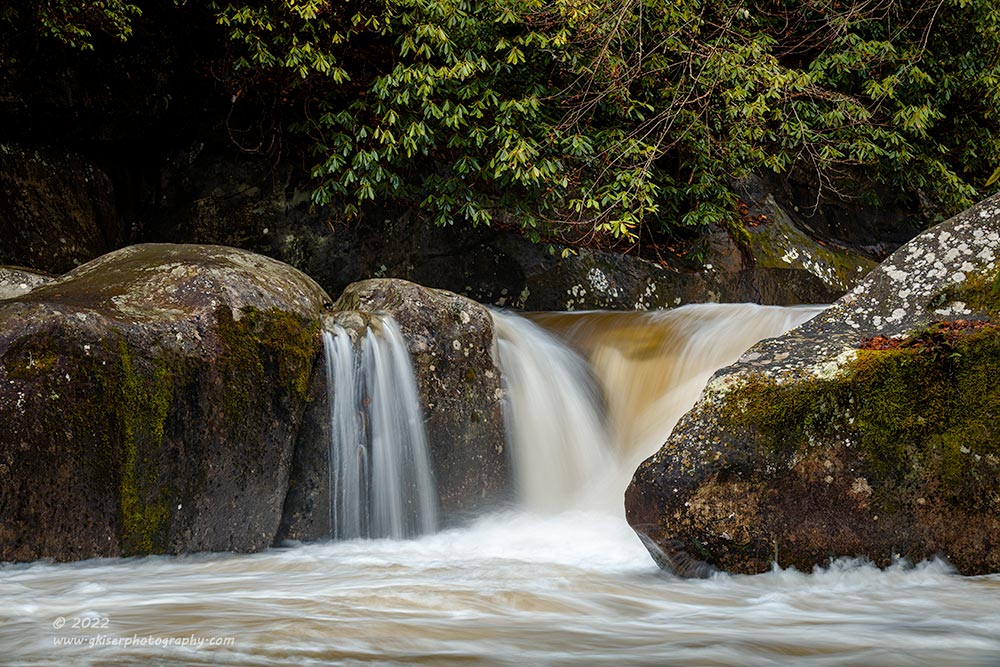
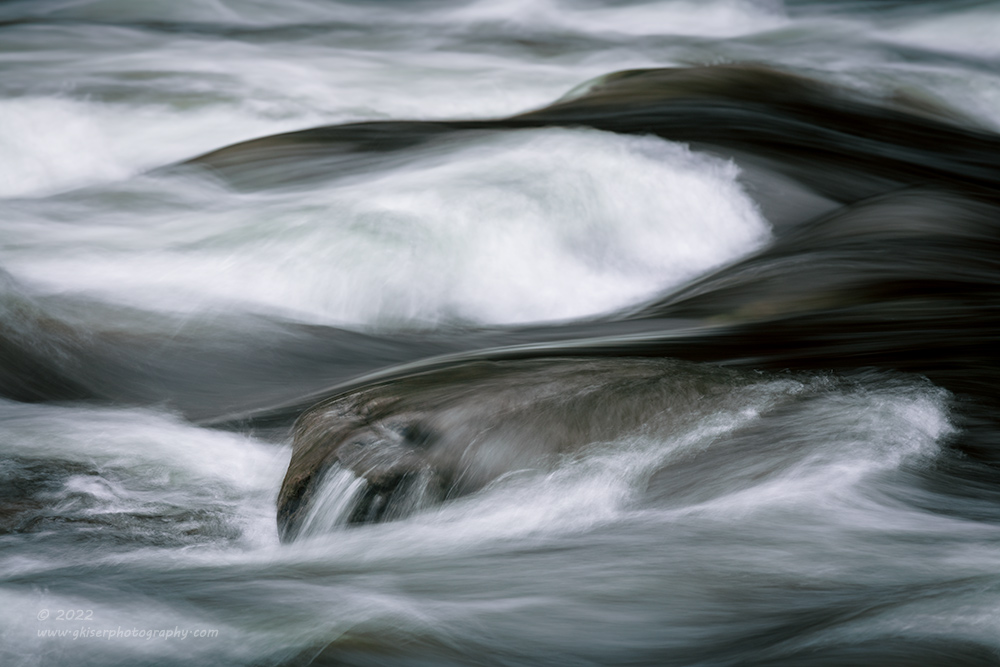
My first reaction when I saw Midnight Hole up close was that there was just too much water pouring through the split in the rocks. There was no definition there, and the pool that was typically calm and aqua colored was a raging torrent of frothy water. I had plenty of photographs of this waterfall, so I really didn’t need another one which prompted me to look around to see what else I could work with. I knew that there were lots of isolation possibilities here which was what I started to work on. Surprisingly, the water level wasn’t so high here that the rocks got covered as I was expecting. In fact, the water level looked almost average, but the movement was quite a bit faster here.
I pulled out the camera with the long lens and started to work on different isolations where I concentrated on the shapes of the water more than anything else. To add a little bit of interest to the dark parts of the frame, I reduced the amount of polarization which left streaks of glare on the surface of the water that I just loved for these shots. Again, it was a matter of finding that perfect shutter speed for the conditions which was getting rather difficult. I was needing a relatively fast shutter speed, with a wide depth of field (for a telephoto shot) and the light was actually getting dimmer. I found myself boosting the ISO to as high as 400 which I have never done when photographing moving water during the day. In fact, once upon a time, I would have reveled in keeping it at ISO100 and shooting the scene at 20 seconds. I just wasn’t feeling that at all today and wanted more texture in the froth.

I do remember thinking to myself how easy it was for photographers to fall into marketing gimmicks when it comes to their gear. In all of my workshops that I have taught over the years, every participant has had an ND filter. At least half (optimistic assumption) have not really known what they are used for as they will ask me why they don’t see a difference when they use an ND filter. This is one of those filters that has always been marketed for use with waterfalls and that is how most photographers end up buying them. With only a couple of exceptions, I have not used an ND filter with moving water in the last 12 years or so. Here I was listening to all that marketing hype that you can’t photograph waterfalls without an ND filter and struggling with getting enough light into the camera through a single polarizer. Not only was I not wanting an ND filter, but I was also having to boost my ISO up to 400 in some cases so that I could get the right shutter speed for the water while keeping my depth of field within reason. When I was a newb photographer, I would have added that ND filter, and been shooting at 30 seconds all day long thinking that I was doing something fantastic. How times have changed.
Before I packed up my gear, I started to look at Midnight Hole once again. Yes, I had photographed this waterfall many times over the years, but I had never seen it like this before. Maybe I would get a quick shot on the off chance that I liked how it turned out. Yeah, it was the expected composition, but there is a reason that you see this composition so much. It just works. I even shot a panorama of it years ago, and by the time I cropped it down to a good composition, I had basically the single frame composition, so I knew better than to try that again. There I was standing in the water, up to my ankles with the tripod nearly a foot into the water framing up the composition.
I was starting to hear some yelling in the woods in front of me, but I wasn’t able to make out what they were saying. I just knew that it didn’t sound like an emergency situation. I just kept on framing up the waterfall and figuring out how I wanted to shoot this image. I finally figured out my composition and did a test frame to check the shutter speed. That showed it to be a little too slow and I was losing the definition in the waterfall which I wanted to keep. I dialed in a 2/3 stop change to the shutter speed and fired off another shot. This one looked much better, and I was happy with it. Now that I had the shutter speed dialed in, I went to work on tweaking the composition. As I was doing that, I saw a single person walking out on the rock to the right. They were dressed in a wetsuit of sorts and had a helmet on. Shouldn’t they have a boat or something? Well, about that time I saw a kayak come to rest at the top of the waterfall. This was what all of the yelling had been about. Another one joined, and another one. They were content to stay at the top of the waterfall so that meant that I was done photographing the waterfall.

I wasn’t all that concerned because I had shot this waterfall many times and the composition that I was shooting was really no different than anything I had done before. I had captured the water and that was enough for me. I went back to working on my isolations and gave up on the waterfall. A few more minutes passed, and I had gotten some better isolations thanks to my new position further to the right of where I had been originally. I had a few that I really liked, and it was just going to be a matter of what looked good on the computer later on. I was half paying attention to the commotion that the kayakers were creating behind me and really hadn’t realized what they were doing. I turned back to see if they had cleared out yet and was surprised to see two kayaks just about eight feet or so from me with another one perched atop the waterfall getting ready to go over. That was my cue to leave. I could just see my tripod getting taken out by a kayak that went out of control going over a waterfall. Plus, the noise was getting to me since I liked to do this alone with my thoughts.
A little further up the trail I came to another section that I have photographed before, but this one wasn’t normally as obvious as the other locations. On a typical day, it looks like just a regular mountain stream which isn’t all that special with the exception of a particular detail. The trees seem to bend over the water creating a tunnel element to the scene. When the water is down low, this doesn’t really make sense to the overall composition, so it doesn’t really stand out. In fact, I had only shot this maybe twice before when the water levels were good. It is a great scene during these times, and I actually have that very image as a start-up picture on the 4Runner’s infotainment system. This was one of the scenes that I wanted to photograph, and it grabbed my attention quickly as I approached.
I exited the trail and went down to the area where I would normally set up but found that I wasn’t able to get to the rock that I normally place the camera because of the rapids. I ended up working from the shore which was a little difficult since I was having to shoot over the rocks that I would have normally stood on. I thought about using them as a foreground element but that would introduce just too much of the white water into the scene and that would throw off the balance of the photograph. I’m a little embarrassed to say that I worked for a very long time to get a composition put together here considering that I see the composition every time I start up the truck. It just wasn’t coming together for me. Of course, the additional water changed a lot about the composition and how everything worked together.

After what seemed like an eternity, I finally landed on the right angle to get the landscape image captured. There was a nice curve to the scene that pulled your eyes through really efficiently. The arched trees gave your eyes a reward for following the stream because they were framing the warm glow from the bare trees in the background. This was the first time that I had strayed from my long lens all day and I was finally using what I would normally say was my workhorse lens for this location, the 24-70mm. Up until now, the water had just been too much of a feature to include that much of it. This time, I needed to include some foreground rocks to help frame the scene and give some added balance. I tried this composition as both a vertical and a horizontal composition and found that the vertical one didn’t feel right at all. I wasn’t able to get the camera high enough to give the right perspective to the stream to pull off the tall framing. I liked the horizontal composition quite well, but even that seemed a bit on the wide side.
Just to see how it would look, I selected the 1:1 crop on the camera and framed up a square image. Hmmmm, that worked very nicely. It had the feel of the vertical composition without the odd perspective that I was facing. It had all of the good qualities from the horizontal orientation without including too much on either side. It was a simple execution and directed the eyes perfectly into the woodland frame. It was the first image of the day that I was really excited about and could already see how I wanted to edit it. It wasn’t until I got home that I found that the horizontal image worked just as well and had a bit more of a sweeping feel to the scene. I wasn’t able to decide on one over the other and decided to process both of them with similar treatments. The vertical compositions from here were all trashed because they just didn’t look right at all.
I kept looking for more kayakers because I really didn’t want to get home and find that I had a bright red cameo in the background that I had missed during the shooting. Fortunately, I didn’t see any more of them and had stopped being able to hear them talking amongst themselves a while back. It was just me and my thoughts once again. The fact that I was here getting the scene captured that I had really wanted to shoot was icing on the cake. I think I had been here for roughly three hours thus far and had shot well over 100 frames. Thinking back on what all I had shot I couldn’t see that many presses of the shutter button, but I guess as I was getting the shutter speed dialed in, I was getting a lot of throwaway images that just didn’t register in my mind. I still had more to do, and I was looking forward to seeing what Mouse Creek Falls was looking like.
I got the camera packed back up and was back out on the trail. There was about a quarter of a mile or so left before I got to Mouse Creek Falls, and there was one other area that I wanted to stop at first. When I got there, I found the large clearing that I was expecting. There was a lot of space to shoot in, but sadly, there was nothing that I could figure out to capture. There were trees growing right out of the water, which was very cool, but the only compositions that I could find with them were overly complicated thanks to the large boulders in the water. I looked at several different angles but wasn’t able to figure out anything at all. I never even pulled the camera out here before going back to the trail. I finished out the hike to Mouse Creek Falls and saw a couple of hikers standing there at the top of the ridge by the trail leading down the bottom. They were enjoying the view, so I just stayed out of their way as I contemplated what I was seeing.
Mouse Creek was raging, and the water was moving very fast indeed. From the vantage point I was at I was actually doubting that I was going to be able to get into my normal position by the edge of the water to photograph this waterfall. I wasn’t all that concerned because it was lacking a lot of the character that I normally like about this waterfall. If you will recall the links that I shared earlier and suggested that you check out the photos of Mouse Creek, you will see two different conditions of this waterfall. In one of them, there had been drought conditions and barely a trickle of water. I said in that blog entry that I liked it better that way as compared to how I had first photographed it many years before (lost blog entry). I still wasn’t completely sold on the waterfall as I just didn’t think it was that photogenic. The other linked entry was a bit more recent, and I found the waterfall to have a good bit more flow than when I first saw it which changed my mind about how photogenic this waterfall actually was. In fact, I have a framed 13×19″ print of one of those shots on display in the living room because I liked it so much after that trek. The current flow of the water was many times what was there at that point, and it was looking like a dump rather than a waterfall. I didn’t leave just yet though as I wanted to get a better look once the other couple had moved on.
When they left, I moved in closer to the edge and saw that the waterfall itself wasn’t all that great, but the flowing water below it was amazing. That was what I wanted to photograph more than the waterfall. Looking down the embankment, I could see that there was a very little bit of land that I could stand on for a photo or two. I went ahead and started my decent with hopes that I could make something good out of this scene. What I had liked so much about the pervious winter’s image was that the creek was just full enough to give a little bit of interest in the lower section of the image while still working with the overall direction of the framing. With slightly more flow, the creek and the waterfall start to conflict with each other and draw the attention away from the other. That leaves you with an image that actually has two directions of viewing which really confuses the scene.
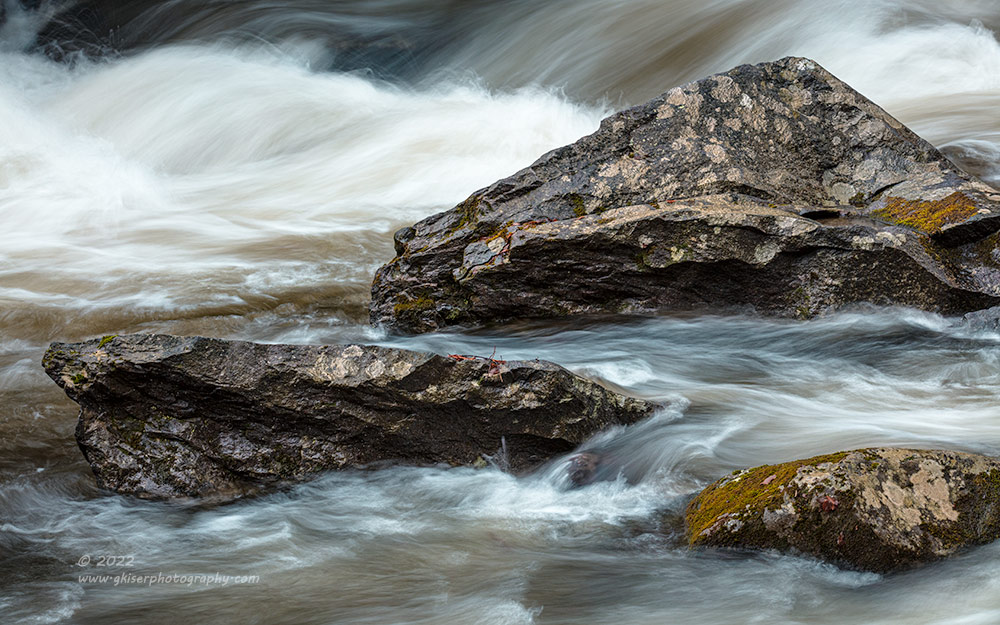
When I got down to the bottom, I was almost amazed that the water wasn’t pushing me downstream. I had never seen it this forceful before. I took some time to really look at things and take it all in. What I found was that the main creek was the part that interested me the most. It was dominant in the scene and that meant that the waterfall wasn’t all that important, but that I could use it as a secondary element to support the composition. I picked out some interesting portions of the scene and started to build a composition from that. I pulled out my 24-70mm lens once again because I knew that I was going to need to go moderately wide for what I had in mind. It was just a matter of how I was going to frame the scene up. I tried both horizontal and vertical images with the waterfall to the left and to the right. What I was looking at was just so complex and visually stimulating that I really didn’t know how any of them would turn out. It was going to come down to what kind of detail I could pull out of the water. Again, shutter speed was paramount for this scene in order to capture that detail.
What I decided worked the best was 1/5 of a second which is getting close to motion stopping speed, but with the speed of the water flowing here I didn’t have to worry about that at all. In fact, any more motion blur than that would have ruined the scene. I was a little worried here because for some of the shots I was having to boost the ISO to 320, while in others, to keep the ISO lower, I was using an aperture of f/7.1. Ideally, I would have been shooting at f/11 and ISO100, but that would have forced the shutter speed that would have completely eradicated the detail in the water. Years ago, I might have gone for that and then decided that I didn’t like the scene because there was not enough contrast in the water. I was more experienced now and knew what I needed to do as a photographer to address that concern. It just came with the cost of limiting my depth of field and/or adding noise and grain to the image. I just had to be careful with those so that I didn’t end up with an unusable image when I got home.
I tried a lot of different ways of capturing this scene because I really didn’t know how I was going to like any of them when I got home. I knew that there was a possibility that I was going to want to trash all of them because it was an overly complex scene with a lot of movement in different directions. My hope was that I was going to create images that had a uniform flow to the different directions of movement. All I could do was shoot a lot of variations and keep my fingers crossed.
When I figured that I was done, I pulled the camera apart and put it back in my bag. before I made the climb back out of the area, I looked one last time because I hadn’t considered doing a panorama of this one yet. I looked at the long flowing creek with the ample waterfall above it but didn’t see a good composition that would make sense. I guess I really was done, so I put the bag on my back and started to climb out of the hole I was in. When I got back up to the top, I continued on with my hike a bit further up until I got to the bridge. I have made great compositions here in the past and hoped that the increased water flow would benefit those compositions. When I got there, I could see that there was just too much water and there was no need in trying anything there.
I reversed my course and started back down the trail towards the truck. My thought was that if I could get back to the truck by 1:30 or so, I would have time to hunt targets of opportunity on the way home before dark. I was getting tired, and I had nearly 200 frames at this point. I passed by Mouse Creek Falls again and found that one opening that I had given up on earlier. I wanted to try one more time to come up with a composition but was unable to do so after another 15 minutes or so moving around the trees in the water to get different angles on them. I never brought out the camera but used my cell phone to look at the different compositions. It was all for nothing though because I just ended up back on the trail moving down the way
I met another couple hiking up the trail at this point and they asked if they had passed Midnight Hole yet. I had to think on that because I really couldn’t remember where on the trail that I was at this point. We figured out that they had passed it and had actually sat at it for a while. They asked about Mouse Creek Falls which I let them know was about a quarter of a mile further up the trail. we parted ways and I continued down the way. Sure enough, I passed Midnight Hole because I was still a little confused about where I was in relation to it. A bit further down I saw another clearing that had some interesting views. When I stopped and began looking at the scene, I realized that this was the same spot that I had stopped at on the way up to get that one scene that I was after. Funny how things always look different on the way back down the trail.
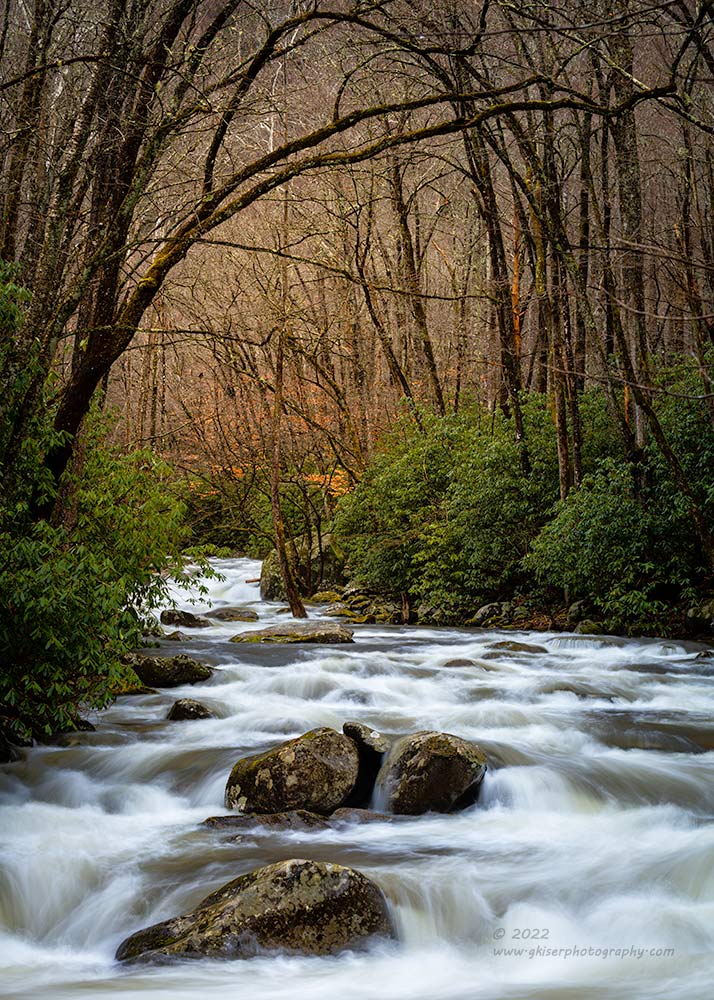
I almost kept on walking but could see a view through the trees that I hadn’t ever considered before. It was a similar composition to what I had shot from beside the creek, but I had that extra altitude that I needed for the vertical composition that I had failed at before. I loved the scene so much that I felt that it was a good idea to pull the camera out and try it again. This time, I went with the long lens since I was a bit further back and didn’t need to emphasize the foreground as much from this angle and distance. The problem that I was running into was the trees that I was shooting between. They kept wanting to creep into the image, so I had to pay particular attention to the placement of the camera and how high it was. I kept having to close focus to see the limbs in order to keep them out of the composition, but I finally landed on the right placement of the camera so that I just had the creek and those wonderful arched trees in the frame.
As I finished getting the composition fine-tuned, I adjusted the polarizer and started doing the shutter speed game to find what worked best here. I couldn’t just rely on what had worked before since I was using a different focal length, and the distance was further. As I was getting that figured out, the couple that I had seen about 15 minutes ago was coming back down the trail. I asked if they made it to Mouse Creek Falls which they had. They were also impressed by the flow there. She looked at my camera and deduced the composition that I was working on and said that she had gotten the same picture. I told her how much I enjoyed this scene and really loved the arching trees. She had a kind of confused look when I mentioned the arching trees but kept on going with the conversation. After a minute or two, they continued down the trail as I continued to work the scene.
When I was finally happy with the images that I had captured from this location, I packed things up and continued on down the trail. I kept running into folks with kayaks as they were walking up the trail. I lost count at 20 of them. Did I miss a memo? There had been about eight of them when I was at Midnight Hole, and I had been seeing a few occasionally on the trails, but it was like a full-on tour group at this point. There were times when I had to wait for them to get passed because there was not room on the trails for two rows of traffic and a boat. I took this as my cue to get out of the area because I hate crowds.
When I got back to the parking lot, there were no spaces left to park in and there were more kayaks being unloaded. I passed by one group that was heading to the trail and said that they had missed out on being the first here. I was corrected as they said that this was their second time going back up. Ok, so apparently, there was a conveyor belt of kayakers going down Big Creek which meant that this was definitely the right time to leave the area. I got the truck loaded up and started out of the parking lot. The road in and out was a rather narrow dirt road and I kept having to move over to let a vehicle carrying a kayak in. I really missed a memo on this, but I guess it is a weekend kind of thing which is why I much prefer going on the weekdays.
When I got out to the paved road and got down by the power plant, I saw what was going on. The kayaks were being recovered at this point and then shuttled back to the trailhead. There were tons more at this end and it was a constant flow of hiking and kayaking. Yeah, it was time for me to get gone. It was now 2:30 which meant that I was going to get home around 5:30 which was just in time to make something for dinner. Well, that didn’t work out well because of that detour at Harmon Den. that added nearly a half hour to the return trip, and it was a matter of creeping down the highway. I was getting hungry and the last thing I wanted to do was be stuck in traffic. At least I had an epic sky to look at. It was a total shame that my creative energy was gone as I would have liked to have detoured to find a place to get some good sky images. I was hungry and needed food first and foremost, so I just continued on at 10mph.
The sunset looked to be epic in my rearview mirror, but again I wasn’t in the right place to be able to take advantage of it. I was satisfied with my day’s work and content to just enjoy the colors in my mirror. I had shot a total of 208 frames through the day and those resulted in 12 keepers which was roughly twice what I had expected. It continues my string of luck at Big Creek because I always come back from here with a good number of images no matter the conditions. I can really tell the differences in my editing style after this trek though. Looking back at some of the older images I am kind of cringing at a lot of them because of how I used colors and saturation in them. These have a much more mature feel to them and that is what I am striving for these days. Personal growth is always a good thing, and it is even better when you can recognize it in yourself.
Thank you for joining me on this first hike of the year. I do hope that you enjoyed it and enjoyed the photographs that resulted. As you know, should you see any of the photographs that you would like to look at on a daily basis hanging on your wall, I would love to match you up with a print. You can order directly from this website, or you can contact me for other options as far as sizes and media. Either way, I want to make sure that you get exactly what you want and are expecting. If you are a photographer and you are interested in learning how to create these types of images, consider my mentorship program that is new this year. This is a holistic approach to teaching and learning photography because it is designed to take you into consideration and what you are wanting to focus on. I am also working on putting together a waterfall workshop for either the Spring or late Fall, so keep your eyes out for that.
Until next time….

Remember to use the code KISER10 to get 10% off your purchase