Monday, January 1, 2024 (continued)
Welcome back to my quick little trek to start off 2024. I’m not going to tell you how many photos I ended up with at the end of the four hours I was at the location, but I will tell you that this is not the end of the blogs from the day. If you missed the first installment, feel free to check it out now before we get back into it. Don’t worry, I’ll wait for you.
OK, now that you are up to speed, when we last spoke, I was a half dozen photos into the day and had just started to hit my stride. I have worked a total of two subjects so far and had done quite a bit of them in black and white which is something that I am wanting to work more with this year. I was starting to use the shadows from the bright sun to my advantage which is also something that I am wanting to get better at for the year. I was even interpreting the subjects differently than I have in the past, which was a lot of fun for me.
It is both difficult and easy to revisit a location time and time again, and Outlawed Restorations is one of those places where I’ve been way more times than I can count. I’ve even lost count of the number of workshops that I’ve done there over the years. This makes me very familiar with the location, but that puts a lot of pressure on me to photograph the same subjects differently each time so that I’m not just rehashing previous creative moments. It is all too easy to fall into that rut of put the camera here and shoot in that direction, so to combat that, I spend a lot of time looking for new angles and new ways of photographing the various subjects out there.
The Chevy truck that I had just finished up shooting was a prime example of what I am talking about. I have shot it before and thought that I had done all that I could at the time since there wasn’t a lot of detailed bits left to the truck. Here I was, having just shot four very different photos of the truck, three of which were of the hood ornament alone. I was seeing possibilities that I hadn’t seen before which is always exciting for a photographer.
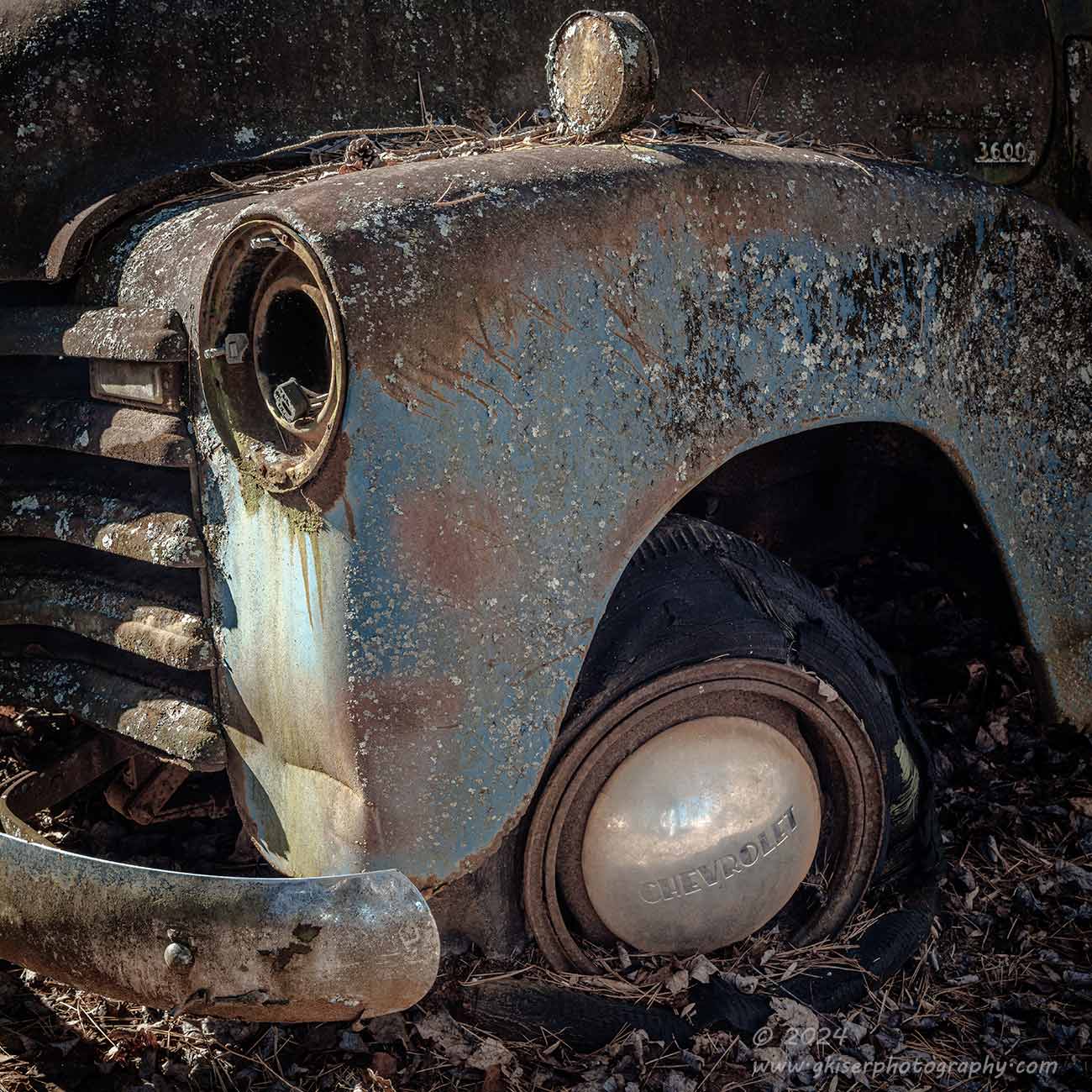
Since I was on the back side of the property, I decided that I was going to check out my favorite truck which has been there since my first visit all those years ago. It is always a feature in my workshops because of the story that it tells. I’ve shot the composition that tells that story many times, and in many seasons. I was looking for something a bit different this time. You see, one of the aspects that I really like about the truck is the fact that it still has the moon hubcaps on the front wheels. The one on the driver’s side is in pretty good shape too. While this usually gets featured in the overall photos that I have shot, I wanted to really focus on that aspect for a photo this time around.
Looking at the driver’s side, it was in the shadows with the bright sun shining on the front face of the fender. The “better” light was on the passenger side, but the hubcap was bent, and not in the same orientation relative to the truck. The light, while better, was flatter, and with the wheel pointed the wrong direction, the composition wasn’t going to work out nearly as well. I was faced with a decision to make, and it all comes back to something that I have started teaching in my workshops.
A good photo needs at least two of three qualities to work. The three qualities in a photo are subject, composition, and light. If you can get two of those qualities, you will have a pretty good photo. If you can nail all three, you will have a great photo. If I went with the best light, the composition was weak, and the subject was a little on the ambiguous side. Shooting from the driver’s side left me with a stronger composition, and a more interesting subject, but at the expense of the light. I opted for the better overall shot from the driver’s side, while keeping the lighting in mind.
I composed the shot from an angle that allowed the light to illuminate the front face of the fender and show off the headlight bucket and the bit beneath it that looks like tears to me. The majority of the photo was in the shadow which I knew would affect color and saturation. The smart thing to do here would be to shoot this as a black and white image which would have worked fine, but I wanted to keep that blue hues because I thought that helped to set the mood quite well. I just wasn’t going to be able to make the colors pop like I would usually like doing.
The edit that I had in mind for this one was the exact one that I ended up doing. I wanted to use my favorite desaturated color profile and then work the hues specifically from there. This left me with a lower contrast scene with cooler tones throughout. It fits the shadowed look of the photo, while keeping the sunlit parts within reason in the overall exposure. The photo that I was left with focused on the Chevrolet hubcap which was placed perfectly in the square frame with the headlight bucket, and the turn signal. The shape of the fender gave the entire composition structure as well.
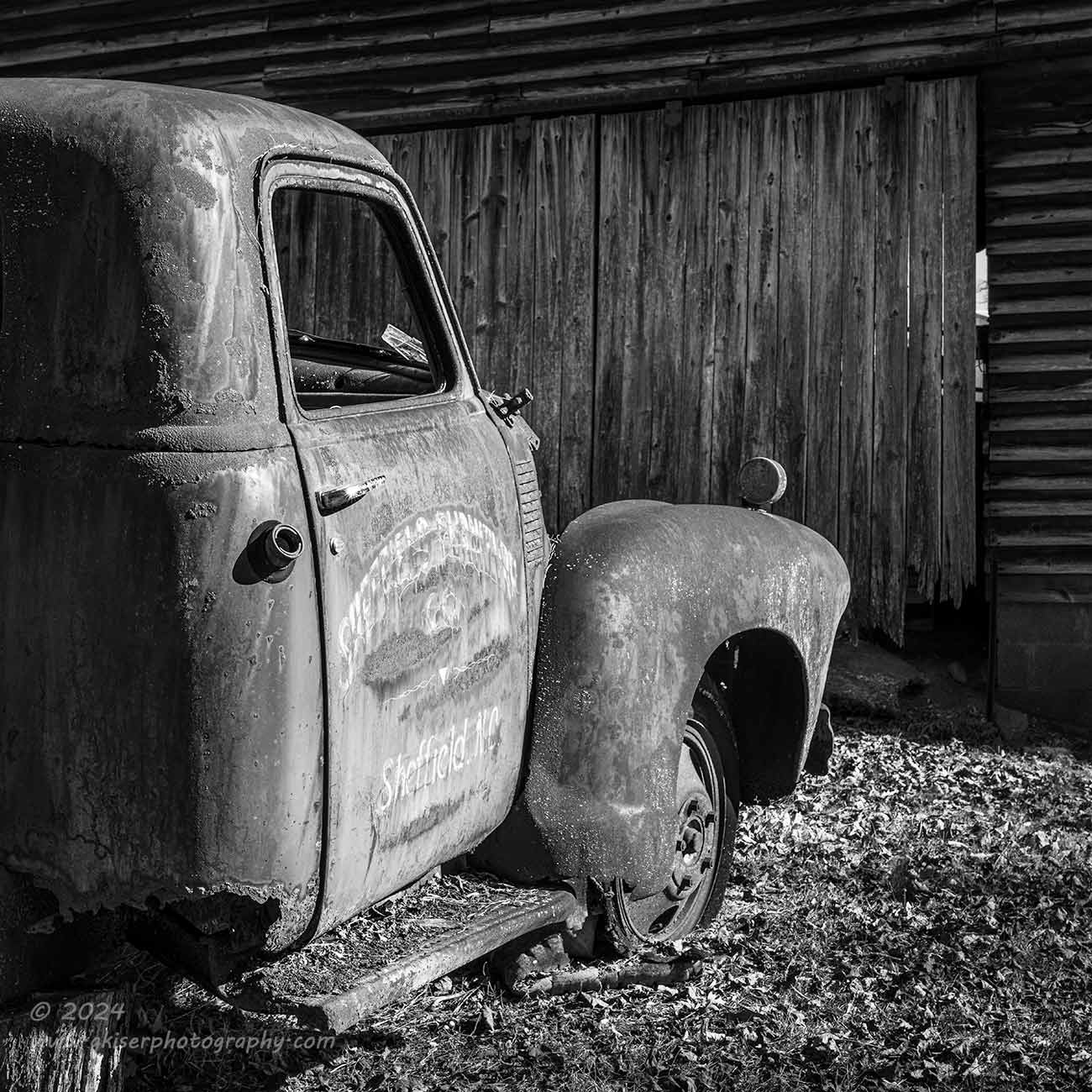
Right beside the truck that I had just shot was another partial truck that I have photographed a few times over the years. For some reason, I am really drawn to how it looks against the barn door when shot from the back right corner. I guess it is because the barn door makes for a great little frame within a frame. Of course, it is not the truck that I am looking to photograph though. Most of the front of the truck is missing, and the frame has been chopped behind the cab leaving the cab propped up on logs. What I love about the truck is the door art and how it looks on the patina.
That door art is still fairly readable, but it is faded and some of the previous designs are showing through which make it a little more difficult to see. It would work as a straight on composition, but that feels somehow very uninspired to me. I do gravitate to this one basic composition with this truck and have shot it this way a few times now, with one of them being at night. The difference that I was playing on here was the sunlight that was hitting the truck.
Normally when I photograph this subject, the clouds are out and there isn’t much direct light. This gives me a very flat light across the scene that I do enjoy, but I saw the opportunity to use the sunlight to really draw the eyes to the main subject being the truck. The barn was left in the shadows which darkened the wood in comparison to the truck, which I really liked.
I got the composition set up and started to have a problem with the top of the barn on the left side of the frame. I also was not liking so much of the truck in the frame with the lighting the way that it was. The more I fiddled with the composition, the more I realized that the fix for both problems was adjusting the aspect ratio of the frame from 3:2 to a square crop. When I did that, things immediately came together, and the composition flowed perfectly. The main interest wasn’t on the truck in its entirety as what happens most of the time; nope, this time the focus was on the door art with the truck and the barn just giving an environment.
When I got the image home and started to edit it, I found that the color version was looking too editorial which was certainly not what I was after. Since I had gone into this trek looking for more artistic photos, I decided to look at this one in black and white. That changed the feeling of the photo quickly, and I saw some opportunities to really direct the eyes. The way that the sun was hitting the scene, I was able to emphasize the fact that the door was really the biggest part that was in the light while the back of the truck and the barn was in shadow. This natural vignette showed up so much better without the color getting in the way. The lighter colors on the door art paired with the sunlight made the door the brightest part of the image and where the eyes gravitated to. It all just worked so well, and I saw no reason to change anything around once I committed to the black and white version.
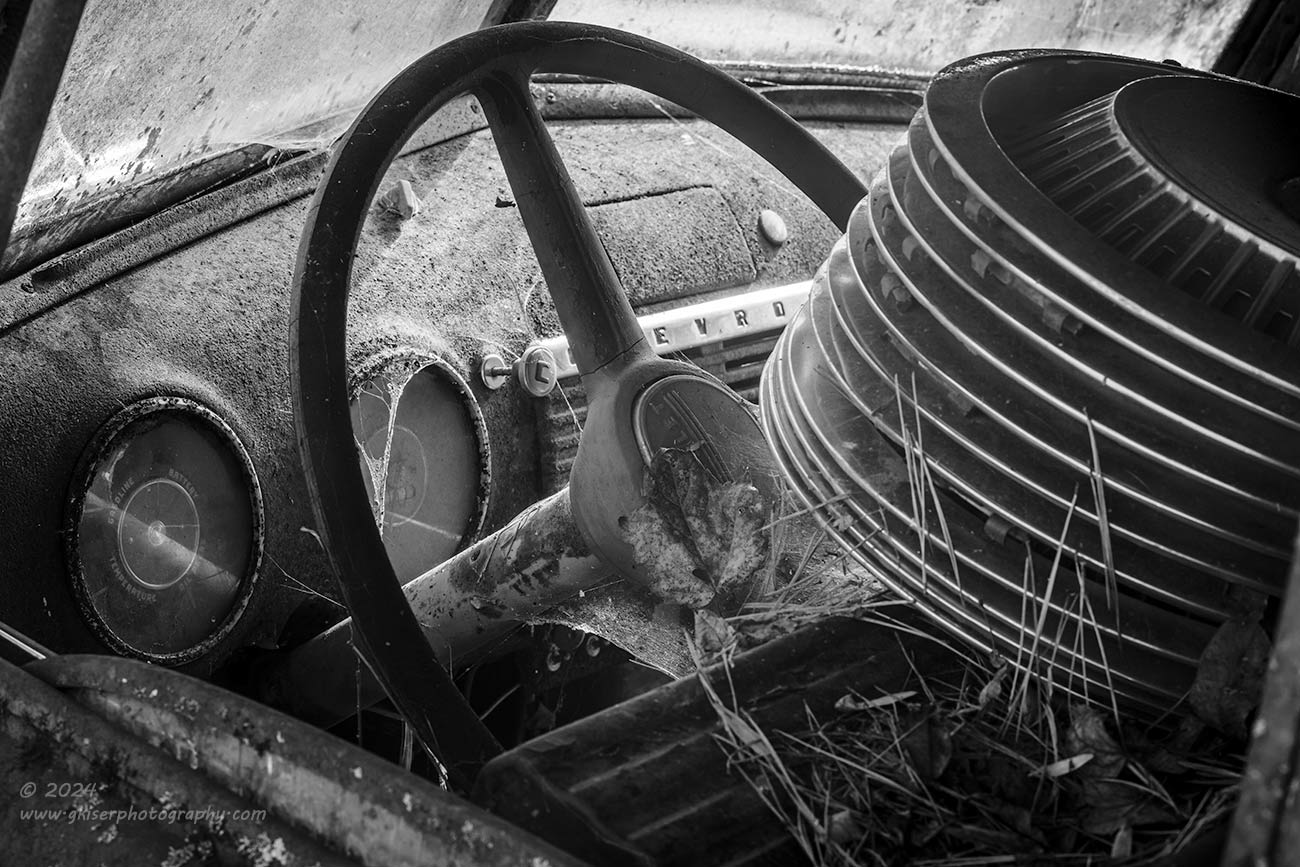
Happy that I had what I wanted from the door art, I moved back to the truck that I had previously shot which was parked right next to the current subject. I felt that there was still more to photograph with that subject, so I did the slow walk around to see what might catch my eye. Pretty quickly, the interior caught my attention, but not in the way that interiors usually do. This one was filled with parts and cobwebs. In a way, that became the story that I wanted to focus on. There was so much going on in this interior that you usually don’t associate with the cab of a truck, yet there were elements that told you exactly what you were looking at.
I swapped out my lens for the telephoto zoom and started to frame up a composition that showcased the elements that I felt were important to the shot. I needed to get the steering wheel and a portion of the windshield along with the dash to establish what was being seen. I kept the frame just below the sun visors so that I omitted some contrast in the upper parts of the frame which would pull the eyes away more than the clouded windshield. I then started to figure out how much of the stack of hubcaps I wanted to include on the right side of the frame. This was a balancing act for sure because if I included too much of them, they would overpower the entire frame. Too little, and they wouldn’t give enough context to be worth including in the first place.
As I tweaked the composition, I found that all I needed to include at the top of the frame was the top of the steering wheel which limited the vast white of the windshield. The steering wheel also created a frame of sorts to establish the top of the composition. To include some diagonals, I used a portion of the windshield post to establish a boundary in the upper left of the frame while the door itself cut through the lower left of the frame. The stack of hubcaps formed the right side of the frame and introduced a repeating pattern of diagonal lines pointing to the front of the truck. The composition made a lot of sense to me, and my eyes seemed to go right where I wanted them to.
As I was shooting some variations on the framing and with different points of focus, I was considering the final photo. While I was shooting this with a color profile on the camera to make sure that I had the highest dynamic range possible (due to my custom picture style for RAW capture), I was pretty sure that this was going to be a black and white image in the end. There just wasn’t that much color available in the scene, and what color was there really made no difference at all. What I was after was the shapes and textures that I saw, and that always makes for a great black and white image.
With the interior shot completed, I felt like I had all that I wanted from my two favorite trucks behind the barn. There were still a lot of other vehicles on this side of the property which I wanted to work with. There was one on the other side of the truck that I had just shot which I walked around and looked at. The only thing on that truck that caught my eye was the vent under the windshield. I tried a few shots of that, but really didn’t think that they were going to turn out all that great. Because of that, I didn’t spend much time on that composition. When I got those images home, I actually kind of liked one of them, but wasn’t convinced. I started to edit it and found that I had made an error on the focus and part of the main subject was too soft for me to continue. The composition on the other version wasn’t good at all, so I had to trash that concept. I now know that there is a valid opportunity there to capture a photo, so I will try it again next time I am out there.
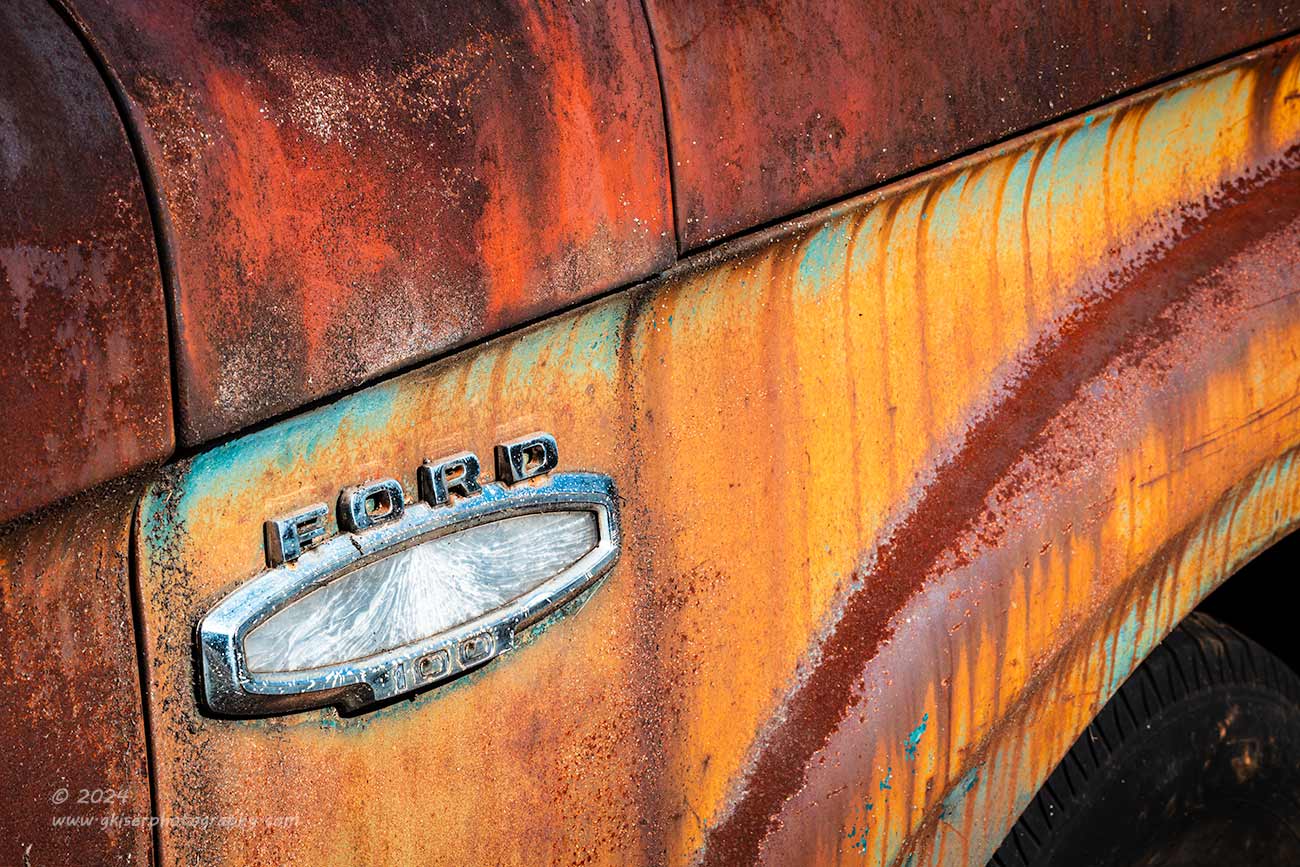
I moved over to the other side and started to look at the vehicles in that section. One of them was a ‘60’s model Ford truck which I have shot the hood emblem on before, but not much else. It would make for a great overall composition, but there is too much clutter around it to be able to isolate it the way that I would want to have it done. However, the patina on the truck is great, so I wanted to find a way to capture that while I was here and thinking about doing isolations more than anything else.
When trying to capture patina, the best way to go about it is to look for something that stands out from the patina so that you have a visual anchor. Since I had already worked the hood emblem, I moved my attention to the fender emblem which was very bright in comparison to the surrounding surfaces. Not wanting to make this a basic emblem shot, I looked around to see what I could include with it so that it was just a part of the story.
This is where my current mindset is vastly different from where it used to be. I used to like shooting emblems perfectly square in the frame which showed no depth of dimension. These days, I am all about shooting angles and getting other elements in the scene to add to the interest. In this case, I liked the body lines which would make for some interesting diagonals, and if I brought the wheel arch into the frame, I would have a curve to balance out all the straight lines.
I played around with the composition for a while until I had something that I felt was a very strong culmination of elements. The wheel arch was there to balance out the emblem, while the body lines framed the emblem quite well.
It was the edit that I did on this one that really brought it home. Instead of doing this one in black and white which had been a goal of mine when I started the trek, I decided to go with a full color presentation where I really tweaked the local contrasts and saturation levels to get the patina to really pop. The more I worked the photo, the more I liked it, and much of what I liked about it was thanks to the sun that was hitting the fender. That sunlight really does a lot to saturate the colors, and this is something that I don’t get to benefit from on those cloudy days that I am usually photographing on.

When I was finished with the fender on the Ford truck, I really felt that there wasn’t anything left to capture on this particular truck. Well, I could have done more photos with the same concept using different focal points, but I knew that this one was going to be the strongest option without a question. There was another truck that I was interested in working with before the day got away from me. This was an old Chevy that used to be parked under the pine trees in the center of the property where I had photographed it many times over. Since moving over to the side of the property and partially in the tree line, it has served as a supporting character for other compositions, but rarely has it made an appearance as the star.
I had an idea that I wanted to try since the hood was off and the engine removed. There were some details on the firewall that I wanted to capture but hadn’t been able to figure out how thus far. I started working on the compositions that I had in mind and while I shot a few test frames, nothing was really coming together the way that I wanted it to. Surprisingly, though, one of the test shots made it pretty high into the culling stage and I started to edit it.
I had known that I wanted this to be in black and white since it was a complex scene to begin with, so that is where I started. I worked through the beginning parts of an edit and decided that nothing that I was doing was helping to simplify the scene and provide a visual pathway to the main subject. After about 10 minutes of fiddling with it, I abandoned the edit and moved on to the next one that I had shot.
That next one happened to be of the same truck, but of a different section. The nose of the old truck has always interested me because of the grille that was still present, but mainly because of the frame for the hood at the top of the grill. I’ve usually shot this from straight on because it looks like a helmet of sorts, but this time, I wanted to try something completely different.
There were leaves behind it still attached to a tree that added some different textures to the scene and if I shot the photo from the side, I could really take advantage of the different lines and shapes that made this look even more like a helmet. I played with several variations on the composition, but still felt that I was missing something. The photo just didn’t have the balance that I wanted it to have. I needed something on the right beneath the leaves so that it all made sense. By stretching the composition out, and including some of the vertical bits of the grill as well as the headlight bucket in the background, it all came together.
I was thinking that this was going to be the workable composition from this truck and honestly didn’t know if I was going to like it better in color or in black and white. When I got it home, I tried it in both presentations and ultimately chose the black and white version. The structure seemed to be more visible with the lack of color and I stopped looking at this like a rusty vehicle. Instead, I was left trying to figure out what it was I was looking at with the biggest clue being the headlight bucket as I imagine not too many people will be able to recognize the grill framework of a nearly 100 year old truck.
This was the surprise of the day because it came out so well after I had basically just come up with the composition on the fly as something to try based on the location the truck was parked in. This photo checked off more of the boxes than I expected and left me feeling quite satisfied with the attempt. I can’t wait to live with this one for a while longer to see if my opinion changes any with it over the months. It might actually become one of the significant images of the year, but it is way too early to guess at that outcome.
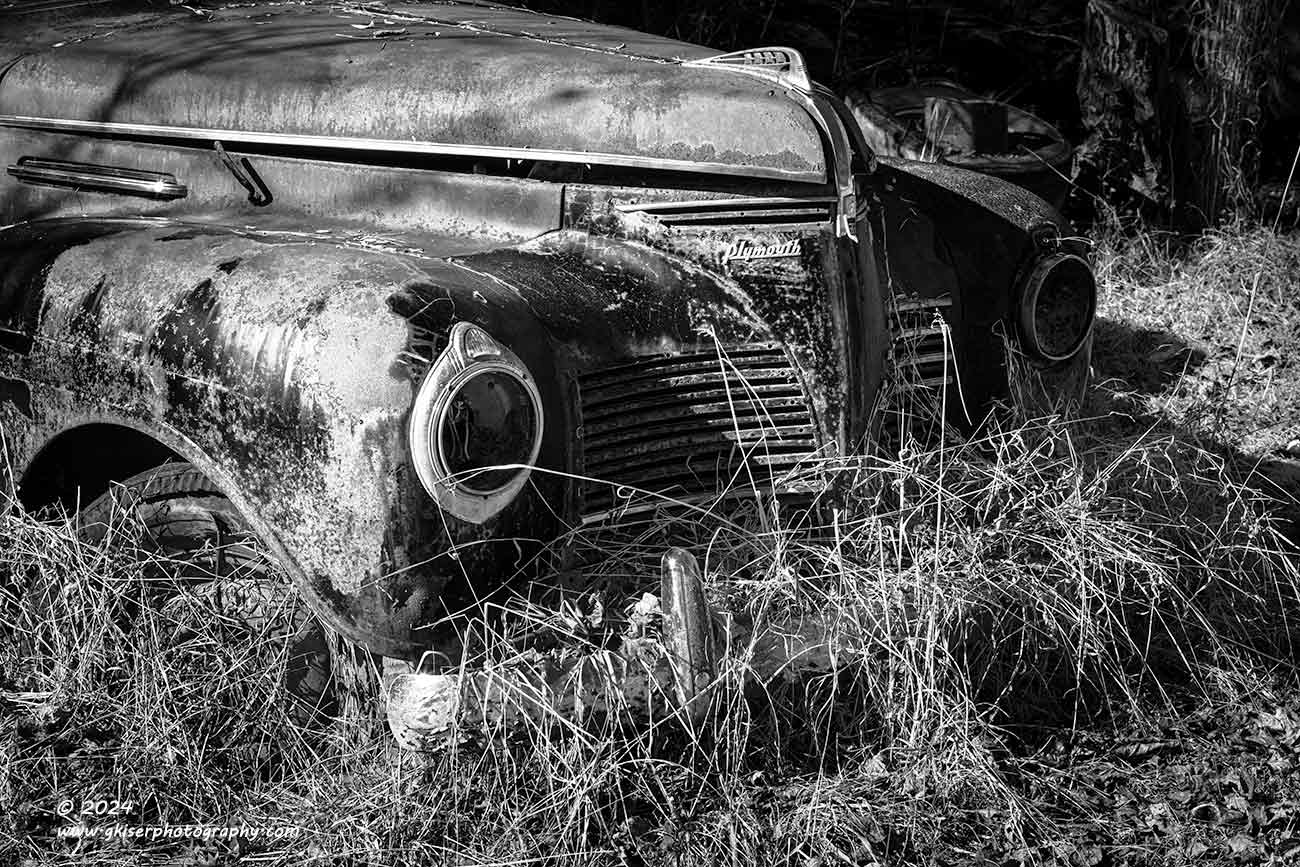
Just a few feet away from the old Chevy truck was a new addition to the property which I had shot recently. This Plymouth was quite interesting to me because of the bodystyle. I don’t get a lot of opportunities to photograph this particular body and to have the chance was really exciting for me. I’ve done quite a bit of work with the car since its addition to the collection, but I wanted to try some different things with it today.
I hunted for some isolations that I could shoot of the old car, but nothing was really that interesting with it. The only thing that I kept coming back to was the fact that the grass had grown up and around the front bumper. This was different from the last times that I had shot the car and I quite liked it. The more I looked at the front bumper, the more I wanted to capture a photo of that aspect. I looked around at the angles, but the bumper kept getting lost, which meant that I needed to include more clues as to what the viewer was looking at. By the time I finished adding the necessary clues, I had the entire front clip of the car in the frame. This was not really a bad thing, because it was a different composition to what I had shot before, and I did like the design of the car.
What I liked the best about this composition was the fact that you could really see how the grass had overgrown the car and it finally looked like it had been there for a long time which helped the story that I was trying to share. I wasn’t convinced as to whether or not this was going to be in color or black and white, but I was shooting it with the color profile attached to the file for review. I shot several of this composition mainly due to the breeze and the few sprigs of tall grass that seemed to move just enough to blur. After getting a couple of images where everything looked sharp, I started to consider my next option for a composition.
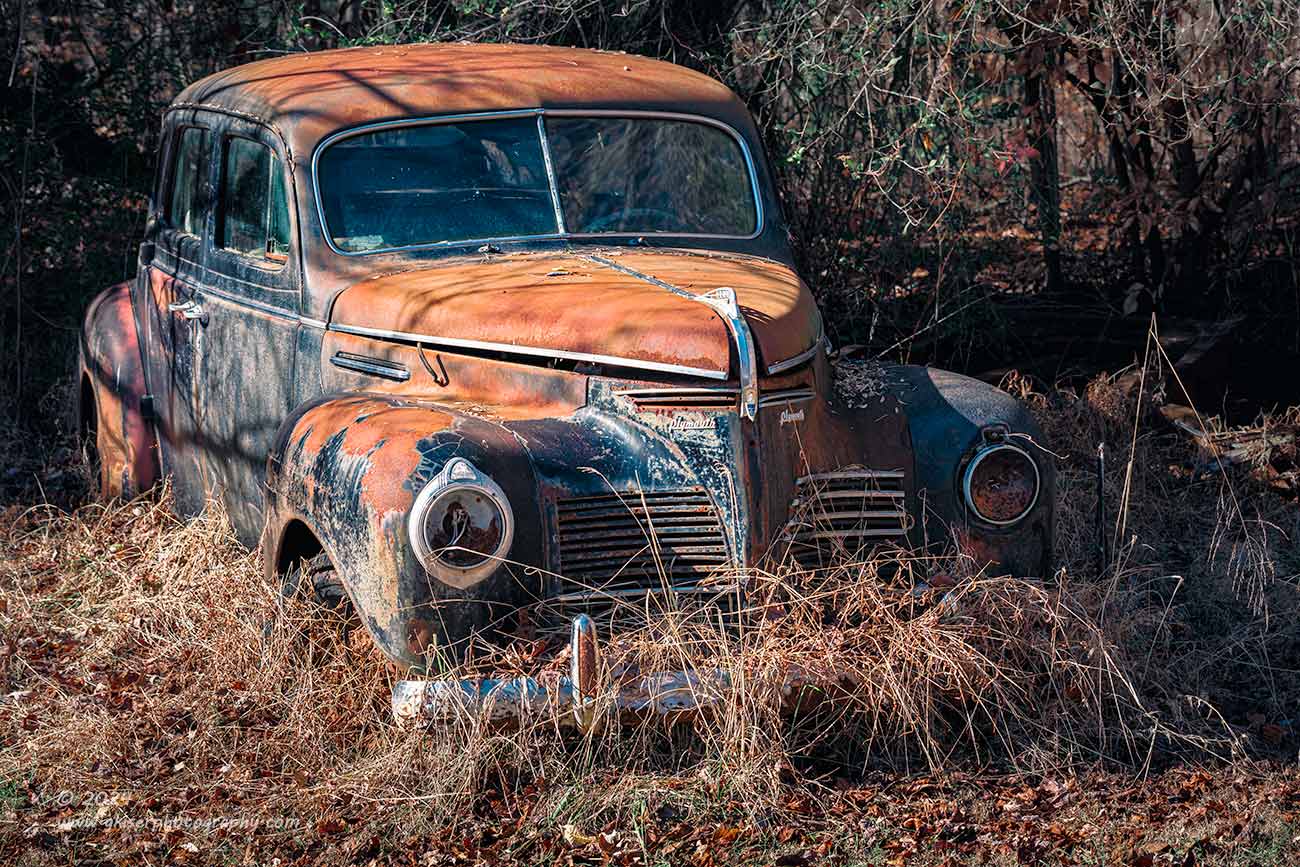
After spending so much time on the front clip of the car, I kind of wanted to capture the entire car for the next composition. I’ve done this a couple of times, but in different ways. I’ve shot it from the driver’s side which is the easiest direction to shoot it from normally. Today, that was the side in full shade, so there was no way of getting that composition shot. The only thing that I had done from the passenger side also included the trucks that were parked beyond it which I had no interest in doing this time.
With the lighting that was present, I felt that I had a good chance to get a shot that featured the front a bit more strongly but angled to the passenger side enough to show the entire car. By elevating the camera, I was able to see more of the patina and make it look much lower than it actually was. I liked how this composition was looking in the image review as well as in the viewfinder. It was one of those images that I was immediately happy with and felt that it was going to be one of the stronger images.
It wasn’t until I got home and started to edit it that I saw some difficulties popping up. The light was just not working with me for this composition. Nothing was blown out, and it looked fine in the camera, but the harsh light from the sun just wasn’t all that flattering for the subject. I tried this photo as a black and white as well as a color version to see what the possibilities were with it. The black and white versions fell flat, even when processed the same way that I had done the previous image. The balance was just off without the color.
Leaving the color in presented a different set of issues because the saturation levels were off across the scene leaving me wanting more color, but when I brought more color in, things didn’t look right there either. I fought with this one for a while, and probably worked with a half dozen color profiles before landing on one of the vintage ones that Lightroom offers. This helped to reduce the contrast in the scene, and it washed out all the colors to a point. This was as good a starting point as I had seen and decided to ride that profile to the end of the edit.
There was a lot that went into this edit, and more than once I wanted to just trash the photo and forget it. I had a great subject, a strong composition, but the light was not on my side. I had two of the three ingredients and felt that was enough to keep the photo. The edit I used did fit the lighting and the mood that I wanted to include with this photo, so in the end I’m happy with the photo, but it isn’t what I had in mind at the time of capture. It is a good reminder that we can never fully imagine a photo in the field. There are always nuances that will affect how we respond to it when we have left the moment. This is not always a bad thing as we saw with the grill of the old Chevy I had just recently shot. That one turned out much better than I had thought it would, so it is only fair that this one didn’t turn out quite as good.
At the end of the day, the important thing to remember is that I went out to get a photo or two to start the year off. At this point, I had shot 83 frames, and we are looking at 13 keepers from the day. We are still counting too, but you will have to wait to see how many more photos will be added for another day. I was still going strong at this point though and I wasn’t ready to stop.
At the time I am writing this, I am not able to access the editing modules of my website due to an error, so I am doing this in Word. I hope that I’ll have things back in order tonight, and I can say to join me again tomorrow, especially if you enjoy fire trucks. Unless I change things around, tomorrow’s entry will be all about two different fire trucks that I shot while on this trek. I’m actually kind of excited to share those photos with you because they are much different than what I have shot before of these two subjects.
Remember, if you are wanting to learn how to spot these types of compositions and how to capture them, I am doing a workshop at this very location in April. It will be a two-day workshop, with only one of the days in the field capturing images. The second day will be all about image review and discussion so that we can learn from each other. Even though this is the same place where I have done decay workshops in the past, there will be a completely different take on it this time around. We are going to be focusing on finding those isolations and photographing them successfully. If this is something that might interest you, click the link and get signed up soon. There are already three spots spoken for, so I expect that this one might just sell out by April.
Thank you for joining me on this quick trek to start the year off. I hope that you are enjoying it so far, and I really hope that you are reading this at some point today with the website fixed. Look for me to return soon with another entry to this series. If the weather cooperates with me, I am also planning on going back out to East Bend this afternoon to photograph the old Dodge truck that I now have contact information on thanks to Dean. If not today, Friday is also looking promising for a return to the area.
Well, good news, I was able to get the website issue fixed which means that it wasn’t a major problem to begin with. A quick copy and paste over here and the addition of some photos and we are all set and good to go. I’m glad that some things can be simple in life, if only more of the issue could be solved as easily.
See you soon!