Monday, April 3, 2023
That is probably what you have been thinking since probably the middle of last year when I pretty much transitioned over to rural and decay photography. I am sorry for the clickbait title, but I thought I would try it out since all the cool kids are doing it these days. I wanted to catch you off guard for this entry because it is a little different from what you have seen from me for quite a while now. Not to worry, I am still doing landscape photography, and am actually expecting to do more of it this year than I have recently. I think I had gotten a little burned out with this genre of photography which made for a great opportunity to work with my decay subjects. That has been going quite well here lately, but I’ve been getting that itch to go out and work some landscapes again. The only hangup with doing that is I find the best time to go out for a landscape photo is during the early morning hours…which has become absurdly early for me.
I’ve gotten spoiled working with cloudy days and needing good light for my decay work. I can easily wake up around 8am and mess around in the studio doing some work on the computer before heading out for photos. It is a relaxed schedule that I maintain for that type of photography in most cases. If I do the same thing with landscape subjects, I am usually seeing boring light, and flat conditions. While this is good for some subjects, and moods, it doesn’t really fit the Spring vibe that is starting to awaken around these parts. To really capture this time of year, I wanted to get some dramatic light mixed in with the landscape.
For about a week now, I have had the intention of going to Price Lake on a foggy morning because there is a scene there that I want to capture. The hope was that the clouds would be thin and clearing, allowing for some sunlight to hit the area that I was wanting to emphasize. That type of morning is just not easy to get, so I kept putting it off. Last night when I was winding down from the day, I looked at the weather and saw that there were high clouds expected during the morning. What made this even better was that they were coming in heavy right at sunrise. There was no mention of fog in the forecast, but it was looking like the chances for some brilliant colors was pretty high. Again, I shelved Price Lake and started to consider other options. I stacked my three favorite areas for sunrise and considered each of them. My first thought was Rough Ridge near Grandfather Mountain. It has been longer than I can remember since I’ve been there for a sunrise, and it always delivers some great photographs. The problem I had with that location was that I was sure that most of the trees were still empty and part of the draw to this location is the foliage that the trees possess. I might get a great sky, but the core of the photo would likely be less than ideal.
My second thought was to head just a little further down the road to Beacon Heights which has become a favorite of mine within the last couple of years. I have still yet to figure out a great composition from the right side of the fork in the trail which keeps me wanting to go back and work that out. The easy composition was on the right side of the fork and I’ve shot that scene as a panorama several times. I think that it is beautiful, but I don’t want to go out and shoot the same thing that I’ve done before. Without an idea of how I want to approach the location, I would rather wait on going back there till more of the trees have filled in.
That left me with my third choice which was Doughton Park. This has long been a favorite location of mine and I’m sure it shows since I visit there very often and have conducted many workshops there over the years. The frequency of my visits there was kind of a turn-off for me, but I quickly got over it since I haven’t done many landscapes at all lately. I figured that returning to this location would be excused as long as I managed to get some decent photos. It was also a safe choice for me considering just how long it had been since I went out on a dedicated landscape trek. Yeah, I wanted a place that I knew well, where I could adapt quickly to the changing light. I didn’t want to be stuck looking for compositions while I missed the light which was a strong possibility since I was pretty sure I was going to be a bit rusty in this workflow.
I started to do the math about how the time was going to need to work out with sunrise at 7:08am. I was probably going to need to stop for gas on the way, and the trip there was right at 40 minutes. I knew that the gate would be locked forcing me to hike in from the lodge which was no problem. I was going to need about 15 minutes to do that, and then I was going to have to find a composition and set the camera up. I wanted to be in place around 6:30 to make sure that I caught first light. That meant that I was going to need to get up at 4:30, and be on the road by 5:15.
Wait a minute….you mean I have to get up nearly four hours earlier than I am used to? Maybe I’ll take the overcast day and go find some decay subjects and sleep in a bit. Yeah, I don’t want to shoot landscapes any more. Getting up early is for the birds.
But hang on…I really did want to get out and have a quiet morning in nature watching the sun come up. Maybe I’ll go ahead and go to see if I still have it in me to shoot landscapes. I set my clock and turned in a bit early just to make sure that I was able to get up and go. When the alarm rang, I was already partially awake so it wasn’t a surprise to me, but I still didn’t like the idea of getting out of bed just yet. I checked the weather hoping that things had changed for the worse, so I could roll back over and go to bed. Sadly, it was better than before. The sky was clear currently, but the clouds were going to be coming in right at sunrise which was perfect. Shortly after sunrise, it was looking like overcast conditions were going to be the flavor of the day.
It was time to suck it up and put my hiking pants on. I was going to do this, and I was kind of excited about the conditions. I got dressed and grabbed a quick breakfast before heading downstairs to handle my morning posting on social media. I can’t live without those likes and comments! Once that was done, I was on my way down the driveway in the pitch black of night. I’ve forgotten how to drive with my headlights on. The temperature was reading at 37 degrees which concerned me a bit. I was expecting mid 40’s when I got to Doughton and I was dressed for that with a t-shirt and light jacket. I should be fine with what I had.

As I figured, I was down to about a quarter of a tank and needed to get gas. There was a station that I have used before at this absurd hour which was on the way. I had plenty of time to get gas because I had planned this out in advance ’cause I’m detailed like that. I hadn’t considered that the hours had changed for the station, which was unfortunate. It was closed, and the two other stations nearby were also closed. I had enough gas to get to Doughton and back into North Wilkesboro, but not much of a reserve. I didn’t have time to go down to the other station that I figured was open, so I just kept on rolling North to the Parkway.
I was making good time and noticed that the temperature actually went up as I was climbing the mountain. When I arrived at Doughton, I was showing 43 degrees which was about what I was figuring on. I got parked and hopped out of the truck. The second the ambient air hit me, I wanted to get back in the truck and go home to the bed. It was cold…like very cold, even with my jacket on. I guess I never really developed my winter skin this past season since it was so mild. I knew that I would warm up as I was making the quick hike to the top of the meadow, so I just grabbed the bag and tripod and got started. The chill in the air forced a faster pace than I would normally have done which worked out well. It was fun hiking with a flashlight once again.
There really is something serene about being in nature in the dark with not a single sound to disturb you. It had been entirely too long since I’ve been ready to shoot some photos and hadn’t had to think about asking permission, or where I could safely park. This was too easy in comparison. I just walked until I found something and would start to work the scene. I knew that there were two areas that I was likely going to end up at which took the last remaining anxiety away. I was very happy that I had decided on this location for that very reason. It was also looking like I had picked the perfect morning for a sunrise shoot as the sky was already starting to kick off. It was still much too dark to do anything with it yet, but I was feeling the excitement building up. Maybe it was the excitement, or maybe it was the fast hike, but the cold wasn’t bothering me anymore which was very welcome.
As I got to the first location that I had considered, I was pretty sure that I was going to have to work this one because the sky was starting to really come to life. The tree that I usually use here as a visual anchor had broken from the high winds that we have had recently which kind of disappointed me. It was the second tree that I had seen thus far which had fallen victim to the winds. The other being one of the trees at the entrance that I’ve shot many times over the years. I guess this is a concept that I am very familiar with thanks to my time doing decay photography. Nothing is forever, and even nature will change dramatically and quickly at times.
I started to figure out how I was going to work with the broken tree by walking all around it and seeing what angles worked for it. The limb that was broken was still attached and had just fallen to the ground. Looking at the sky, I was going to have to include that branch in some way or fashion, so I looked for a way that it could tell a story. Beyond this tree was another one which I had photographed several times that was much smaller in comparison thanks to the perspective. I started to walk backwards to see if I could make the far tree bigger and find a way to place it near the fallen branch as if one tree was reaching out to the other to hold hands.
I was able to get the relationship between the trees that I wanted and knew that I was going to need my telephoto lens to make the image. Using the flashlight, I pulled out the camera and fitted the long lens on it. There was no need for any filters here, so the setup didn’t take but a second. As I was looking at the scene through the viewfinder to get the composition, I tried both horizontal and vertical orientations. I liked the horizontal one, but it felt a bit too plain. The vertical one allowed me to have a longer focal length which helped the scene a bit. It was that realization that prompted me to consider a panorama which would add drama to the horizontal composition while allowing a tighter focal length.
The flashlight was pulled back out to assist in getting the tripod leveled and the camera leveled for a smooth series of frames to form the panorama. I did the dry run and found my composition, exposure, and focus before shooting a series of seven frames. These were done at 20 seconds a piece so the whole series took longer than I would have liked with the light changing as fast as it was. They appeared to come out nicely though, but I wasn’t sure I had the right composition. From here, I went with some single photo shots of the trees as I had envisioned just so I had something with the sky looking as it did.
This was something completely different for me with a sunrise. Usually, I will commit to a composition and stick to that during the entire sunrise. I just wasn’t convinced that I had the right framing so I kept moving around. After two other compositions, I fond a different angle that had the starburst of the sunrise off to the side of the pair of trees. I liked this much better, but the trees were on the left side of the frame now which was going to cause a visual block for the viewer. As I was going back through the motions of setting up the panorama, I considered that I was more than likely going to flip the fame horizontally so that the trees were on the right side framing the clouds.
Sticking with the motto of the morning, I fired off the eight frames that this composition took and double checked the exposure before moving to another location. I had shot two different panoramas with just a single take each. Normally, I will do at least one safety series just in case there was a problem with the first one. I didn’t have time for that this time and knew that there was a better composition to be had. To be honest though, I was feeling pretty good about the panorama, and when I finally saw it all stitched together, I was very happy with the outcome of it.

I was glad that I had chosen to take advantage of the broken limb for several shots. There was a time when I would have written this tree off for such an important role for a photograph. It was my decay photography that gave me the insight to see that there was still beauty in the broken tree. While I only included one of the photos from that tree, I felt that the story was the same with each composition, but the second panorama told it best of all. For me, there was no way of escaping the appearance of a parent and child watching the sunrise together. This went into the title of the piece with the trees representing the old and the young. There is also a correlation between the start of a new day and a significant loss to our sturdy tree there. It just seemed to all come together, and it was because of that broken branch that the photo works like it does.
Since I was moving quickly, there was still plenty of color in the sky to work with. Just in case the broken tree didn’t maintain my interest when I got the photos home, I decided to move up closer to the smaller tree. This is one that I have tried to photograph before but have been unable to do so from this side. The only time I’ve really liked a photo of this tree was when I shot it from the trail below. That photo went on to become my sixth most significant image of 2022. All of my other attempts at this tree have been failures. This time, with the landscape below the tree largely in shadow and silhouetted, I saw an opportunity to make this work. The fact that the branches were still bare really helped the visual structure of the scene.
I had a feeling that the best way to capture this tree was to fill the frame in stark contrast to what I did with the pair of trees in the previous panorama. I still had the long lens attached which I wanted to use again in order to keep the mountains in the background full of texture. I played with the distances that I could shoot the scene from and finally landed on a distance that kept distractions from coming in at the sides while lowering the camera nearly to the ground to give the branches as much separation as possible from the horizon. There was nothing that I could do with the right-hand side, so I let one of the branches ride on top of a large rock which helped to simplify the scene a bit to my eyes. The rest of the composition just kind of fell into place.
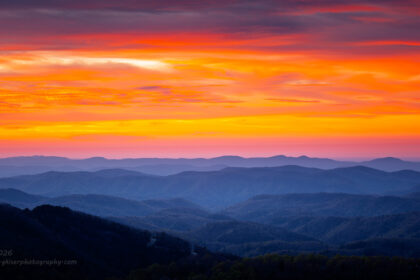
This was the composition that I committed to after the first couple of shots. I really loved how it was all coming together and decided to see what the sky was going to do over the next 10 minutes or so. I saw deep reds to start with and those transitioned to oranges and yellows with hints of the blue sky behind the color. The one that I decided worked the best had a good deal of yellow and pink which matched up very nicely with the purple mountains in the background. The colors were so good here that I didn’t have to do anything with the colors in post, and actually desaturated them a bit to keep it from looking over the top. The final piece of the puzzle came in at this stage which was a bit of rim light on the ground in front of the tree. The little strip of warm light really helped to give a bit of depth to the foreground.
I’m not the biggest fan of sunrise and sunset shots because they can seem a bit cliche, but I have to admit that I really like how this one turned out. The colors and the shapes that are present are quite interesting and they work well together. The best part is I finally have a photo I like of this tree from a different angle than I had shot previously. This photo is a bit unique in my collection I think because of the vivid colors that are present and I’m going to be happy to show it off in my the gallery.
Since I had committed to this tree for so long, I stopped making exposures when the colors started to fade in the sky. When I saw that the sun was over the horizon, I knew that the colors were done in this direction which prompted me to start looking in the other directions to see where the color was now. The nice thing about the thin high clouds that were overhead was that the color was all around me and I could make images in just about any direction I wanted to. I noticed that on the top of the hill where my other favorite tree was sitting the sky was a beautiful pink color. There were just enough clouds to give it a bit of texture too. I didn’t have long to get the color, so I went over to the base of the hill with my long lens still attached to frame up a shot.
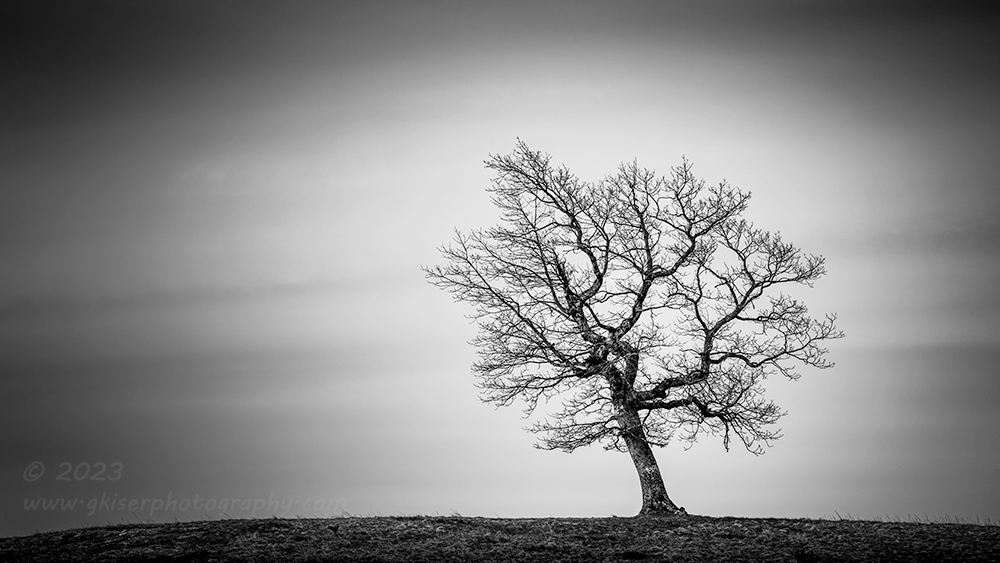
I was very familiar with this tree from this angle and knew that I wanted to make a minimalist composition of it. I allowed just a sliver of the ground to enter into the frame and positioned the tree on the right side. Those that have attended my composition workshop here, know about the direction of implied motion and why I chose to place the tree where I did. Things were looking really good in the frame and I was sure that this was going to be another winner for the day. I only shot a few of this one to make sure that the increasing breeze didn’t bother any of the branches. Once I was satisfied, I moved on up the hill to see what else I could get from there. I was hoping that the sun was going to illuminate the jagged rocks at the top and I wanted to be there to capture that.
As a side note, while I’m walking up the hill, I’m sure you have noticed that the last photograph is not in color, and certainly not filled with a pink sky. Don’t adjust your monitors or phone, this was intentional. While I had every intention of representing this one in full color to go along with the theme of the day, it just didn’t quite work out when viewed on the computer. There was just too much pink and nothing really to balance it. The ground and the tree were almost devoid of color thanks to the shadows they were in which amplified the problem. I tried two different edits to make the pink sky work out and ultimately I awarded the photo a four-star rating and decided to go no further with the edit at this time. It wasn’t until I had finished editing all of the other photos that I came back to this one and looked at it again. The problem wasn’t the edit, it was the overuse of a single color that was meant to bring about excitement. That was not the reaction that I was going for with this photo as the minimal composition brought about a calm feeling to it. I decided to convert the image to black and white which took the color issue away entirely. The mood of the photo immediately changed with the emphasis coming back to the tree and the space around it as opposed to the sky. This was what I had been hoping for, but the color took away from what my goal was. I’m glad that I revisited this one as it is a much needed update to a similar composition I shot of this tree many years ago. I’m a fan of the smoother transitions with this one as well as the better shadow detail. There are a lot of similarities between the two, but this one feels more honest which is what I really wanted out of the scene.

After a few minutes of walking, I was up at the tree that I had just shot from a distance. The sun was well up at this point and was shining on the tree, but not on the rocks that I was hoping to capture. Since I had a minute, I decided to make a quick photograph of the light hitting the tree while framing the tree I had just spent the morning photographing. I still had the long lens attached and didn’t want to swap it out for a wider one since I was going to use it for the rocks. Instead, I used the focal length to my advantage for making the distant tree larger in relation to the foreground tree. I then cropped heavily on the foreground tree to concentrate on the framing aspect of the limbs. The sky still had a little bit of color in this direction, but it was fading as the sun got further into the sky. The clouds were also coming in as expected making for a largely overcast sky in the background.
Thanks to the magic of nature, the sky developed a color gradient in the clouds from an amber blush to a magenta tinted blue at the top. I liked both of those colors to go with the warm tones that the sun was depositing on the tree itself. The color palette that was showing up before me was perfect. I had to work quick to get this one dialed in before the sun changed. Once I had the position right for the camera, I locked focus on the near tree and set a very narrow aperture so that the background would just go a little soft, but not too much. At the last minute, I decided to add my polarizer since the sun was off to the side in a perfect position. I snapped the shot and went to confirm that the final result was right. By the time I had checked the image review, the light had changed and the quality that I had seen was gone. I had just the one shot which you see here. It was a very hurried attempt to capture the light and I have to admit that it turned out better than expected.

As it turned out, the change in light on the tree was just what I was needing for the rocks that were behind me. I grabbed the camera and went to the approximate position that I was expecting to shoot from. I set things up with the polarizer still attached to my telephoto lens. Normally, I shoot this with my 24-70mm lens, but I wanted to minimize the sky since it wasn’t doing anything particularly interesting. I framed up the shot and started to make exposures. It wasn’t looking as good as I thought it could so while the sunlight was still bathing the rocks and starting to kiss the ridges in the distance, I moved my position a bit closer. I filled more of the frame up with the rocks but included only a small section of them. This element dominated the foreground and the diagonal created by the rocks, worked amazingly well with the diagonal from the ridge to the left. The light was perfect here with a nice warm yellow/orange hue on the rocks while the sky and distant mountains were a rich shade of blue. The spring reds in the trees were amplified by the sunlight as well to complete the color palette.
I spent more time here than I had anticipated as I was waiting for the sun to hit the right intensity. I also kept having to change the tilt of the camera because going by the hotshoe spirit level, the horizon actually canted off to one side and wasn’t level. This was actually how the scene was, but the slight angle to the horizon was a distraction. Overruling the level is not easy for me since I have a pretty bad astigmatism which makes finding level difficult on my own. I had to use the top of the LCD live view to make a parallel line to the horizon which worked pretty well but caused some delays in getting photos made as I was fiddling with a false level. I think that the end result worked out very nicely though and I managed to get this one photo where the sun was the perfect intensity with the horizon level, and the framing as near to perfect as I could imagine.
I’ve lost count at how many times I’ve shot these rocks over the years. Looking back, they have always been roughly the same with trying to include the entire length of them leading to the mountains in the distance. I’ve really liked several of these attempts, but they all lacked the punch that I was seeing from this composition. I think I have a new favorite way of shooting this feature which is pretty amazing since I’ve worked this area probably more times than any other location I’ve shot. It is nice that after all these years I’m still able to find new ways of seeing familiar things. Looking back over the photographs that I’ve captured through the day, All but one of them has been captured in a different way than I have ever done them before. If that is not the mark of a successful trek, I just don’t know what is.
I stopped making exposures when the sun dipped behind the clouds finally. The cloud was very far reaching and I knew that the sun was gone at this point along with my light. What had been dramatic and full of life was flat and dull now. I took a long look around the area to see if there was anything else that I wanted to try and capture, but there was nothing left. I packed up the camera and started my hike back to the truck. In all the excitement, I had forgotten that it was cold. Now that I wasn’t thinking about the next composition, my mind had time to dwell on the fact that I was still quite cold considering it was now in the upper 40’s. Oh well, I would be back at the truck before long and could get warm.
Well, I got to the truck and continued past it. The hike had warmed me up once again and I felt like doing more walking. I went around the area scouting more than anything. The light wasn’t good for landscapes at this point, so I just tried to find different subjects that I could work with in the future. I didn’t really find anything, but I did spend some daylight time with the trees at the entrance. The section of the first tree that had broken was the tallest tree, and the one that really dictated much of the compositions here. There were still trees in place in both sections of the rock which meant that I could still use this as a composition in the future. In fact, the simplification of the first bunch of trees might actually be a good thing once the dead tree is removed. I’ll be interested to try some new images here in the future to see if it is better or worse with the missing tree.
Once again, when I got back to the truck, I decided that I just wasn’t ready to call it a day just yet. Since I was parked at the Bluff’s Lodge, I decided to give it a once over. This is not the easiest of places to photograph, but it is interesting and worth the time to try and figure out photographs. I had always paid attention to the repeating patterns of the doors and windows thinking that they would make some sort of interesting composition. Everything that I looked at was less than interesting and not worth putting the camera on. However, as I was walking to the second building, the corner caught my eye. I had never really paid any attention to the corner of the building even though I had spent quite a bit of time working out compositions of the rafters in the ceiling last year. Our minds must be in a place to receive inspiration I guess, because I was now determined to photograph the corner of the building with the windows and door. The ceiling was of no interest to me this time.
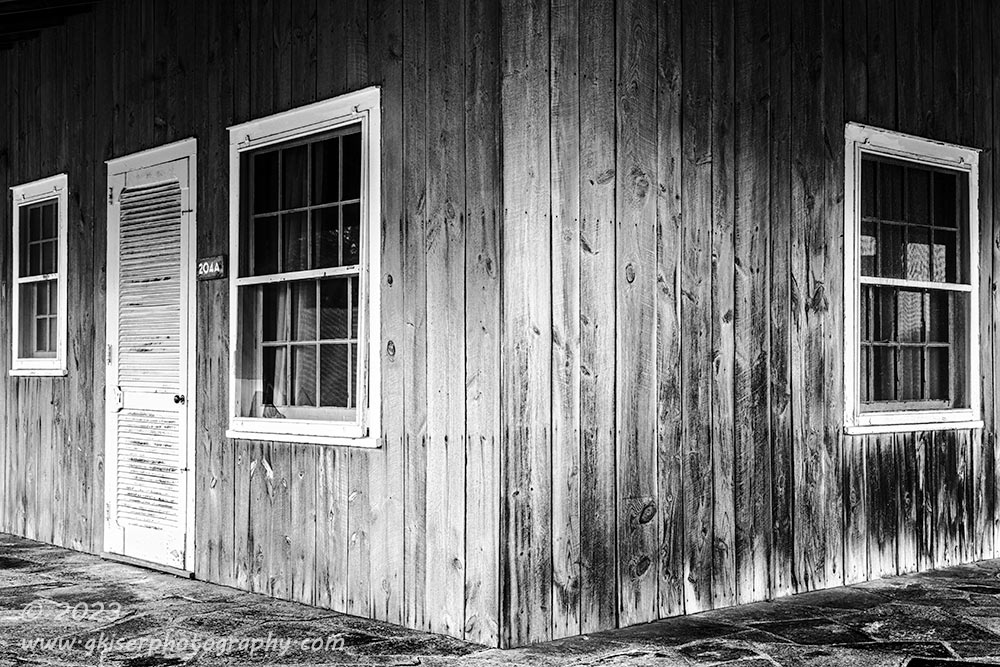
Even though I was caught in a very cold breeze (I guess that was because I was in the breezeway), I decided to pull the camera out once again and frame up a shot. I used the 24-70mm lens this time because as I was testing with the cell phone for composition, I realized that I was liking the compositions around 50mm or so (as an estimate). I considered using a polarizer, but the only benefit that I would get from that would be some darkening on the windows, but since they were on two different planes, it would not be uniform and therefore more of a distraction. The scene was largely monotone which made me think that this was going to be black and white, but I shot it with color in mind because I did like the warm tones in the wood.
Getting the camera positioned right was the most difficult part of this photo, and quite frankly was more difficult than any of the other shots that I had done earlier in the day. I had to figure out the right focal length to use that would give me the right perspective, and then I had to get the camera at the perfect height to that the lens was perpendicular to the vertical of the wall. This would prevent converging or separating verticals. My dual axis spirit level does a great job of getting me to this point and I was very happy that I have it in my toolbox. It worked so well, that I tried to do a transform action in Lightroom to adjust for any angularities, but it made no changes at all to what I had shot.
I hadn’t been totally convinced of whether this was going to be color or black and white when I shot it, but when I got it into post, I went through all the profiles and found that black and white was the most effective way of doing it. It allowed me to really highlight the textures on the right wall that helped to give some very needed visual interest to balance out the lack of physical elements on the right. I’ll be the first to admit that this is a strange composition and one that you normally don’t see from me. I do like it and am interested to see how it ages this year to see if I still feel the same way in six months that I do now about it. I hope that I do, or I hope that I like it even more. It was just an experiment, much like many of the other photos that I shot during the day. It was also my only decay image that I captured which makes this a very unique trek for recent times.
So, what do you think about the landscape trek? Do you want to see more of these in the future, or are you happy to see me continue with the decay photography almost exclusively? Like I said, I’ve been itching to get out and do some landscape photography for a while now, and now that I’ve gone out and done it, the itch is still there. There are a lot of wonderful things about photographing landscapes, and while my arguments for shooting decay are still in place, I can’t just dismiss my photographic roots. For nearly the first decade of being a photographer, I was a primarily landscape photographer. In fact, I went the extreme route of avoiding man-made objects in the landscape for fear that they would dilute the natural story behind the images. It is too early to tell, but I am thinking that during the spring and into the summer I’ll be focusing more on landscape photography than the decay work. I’ll still take all the opportunities that I can in terms of decay as they come along, but I’m kind of needing some time to reconnect with nature these days which makes landscape photography a great alternative.
No matter if I’m shooting landscape or decay, or anything in between, the best way to enjoy any of my photographs is in print form. Each time I press the shutter, I am picturing a large print hanging on the wall. If the photo fails to rise to that bar, I get rid of it. My hope is that my visions and the resulting photographs will end up on many walls all over the US. These prints are all unique because I am not a volume seller. Those that purchase my prints are among a select few and do have a collectable piece of art. You can tell by my pricing that I want to give my clients a bit of exclusivity with their purchases. This is by design and the hope is that there is value added to the piece just for that reason. I could work myself to death and make large prints for $35 and sell tons of them every week, but then the value goes down and I will just turn into an image mill which has never been my goal. When you buy one of my photographs, you really are buying a part of me, and there is every chance you will be getting a one of a kind piece, but definitely a print in limited production as I don’t think I’ve made five prints of a single image yet. With that in mind, let’s start talking about how I can help you fill your wall space.
Thank you for joining me on this long overdue landscape trek. I do hope that you have enjoyed the day as well as the photos that resulted. Now that I’m looking back on it, getting up at stupid o’clock wasn’t too terrible. Of course, that might be because the photographs overshadow the lack of sleep required to get out there for the images. It was a lot of fun, and I did truly enjoy the solitude of being the only one in the park until I left when I saw one other person walking a dog. I can see the draw of the landscape and remember vividly why I loved it so starting out as a photographer.
Until next time….

Remember to use the code KISER10 to get 10% off your purchase