Friday, June 3, 2022
Hey, remember me? Yeah, that landscape and decay photographer that hasn’t been out doing much here lately, or at least that is what it seems like. I was actually kind of surprised to find out that I had been out three times during the month of May because it certainly seemed like less to me. The last time I went out with the camera, I solved the Energy Crisis with my new take on green energy. The time before that was kind of a cheat day as I spent some time before a workshop getting some new landscape photos on the way to Doughton Park. This was all after trying to determine just what kind of photographer I was with all of the different genres of photography I had been working in lately. During those treks, I spent time capturing both landscape and decay images which is what I am most known for. Doing that was a nice mental break from learning new types of photography and the new skills that come along with it. Mixed in during the month, I did a lot of mentoring which kept me focused on other people’s photography rather than my own. I started to see some problems with that as I started to see myself focusing too much on other photographer’s voices, and not enough on my own. To kind of punctuate that issue, I also spent the entirety of the Memorial Day Weekend judging 58 entries in a Decay and Abandoned photo contest held by the Sandhills Photography Club. By the end of that, it was fair to say that I had spent much more time on other photographer’s photography than developing my own.
I decided that I had to do something about that, and it needed to happen pretty fast, or I would not have anything constructive to offer those who were actually getting out with their camera. I would just be an armchair shooter which is just not my style. Looking at the weather, it was going to be pretty much sunny for the coming days with the exception of Thursday which was supposed to have some storms rolling through during the afternoon but was mostly sunny in the morning. As Thursday got here, I was too tired to think about going out after spending roughly 9 hours on getting the Miata officially ready for convertible season with a full detail, and then spending most of the following day working in the yard. Toni did mention that the forecast for Friday was looking more like a continuation from Thursday’s forecasted storms with clouds through the day and rain in the afternoon. This was new and it caused me to take a closer look at the forecast with hopes of maybe getting out on Friday for a bit.
The storms rolled through Thursday evening with torrential downpours and heavy winds. We lost cable and internet for a while during the storm, and the power blinked off for a brief second. However, after about an hour and a half, it was all over. The weather was still looking good for a trek on Friday, so we turned in early and I had my clock set for 6am to get an early start on a foggy morning. Well, wouldn’t you know it, the power went off around 1am for no good reason. That started a chain reaction of things that I had to do and check on so that by the time I finally settled back to sleep, I had lost a couple of hours of sleep. When the clock went off at 6am, I was in no condition to get up to do anything, so I killed the noise and rolled back over to doze some more as I considered my options.
I did look at the weather before I rolled over and saw that it was partly cloudy at the moment and there was apparently no fog in the area. The clouds were still looking to come in around 8 or so, and the rain was going to hit at noon. I had at least another hour of sleeping before I really needed to get up, so that was what I decided to do. An hour later I woke up again and reluctantly looked at the weather. The clouds were looking good, and I still had a good window before the rain set in. I guilted myself to get up and go because if I was going to be qualified to teach photographers, I needed to actually be one. I got up and got ready to go. Since the computer was completely shut down, I didn’t worry with my normal morning stuff as it would have taken too long to get it cranked up. I just grabbed the camera and tossed it in the truck.
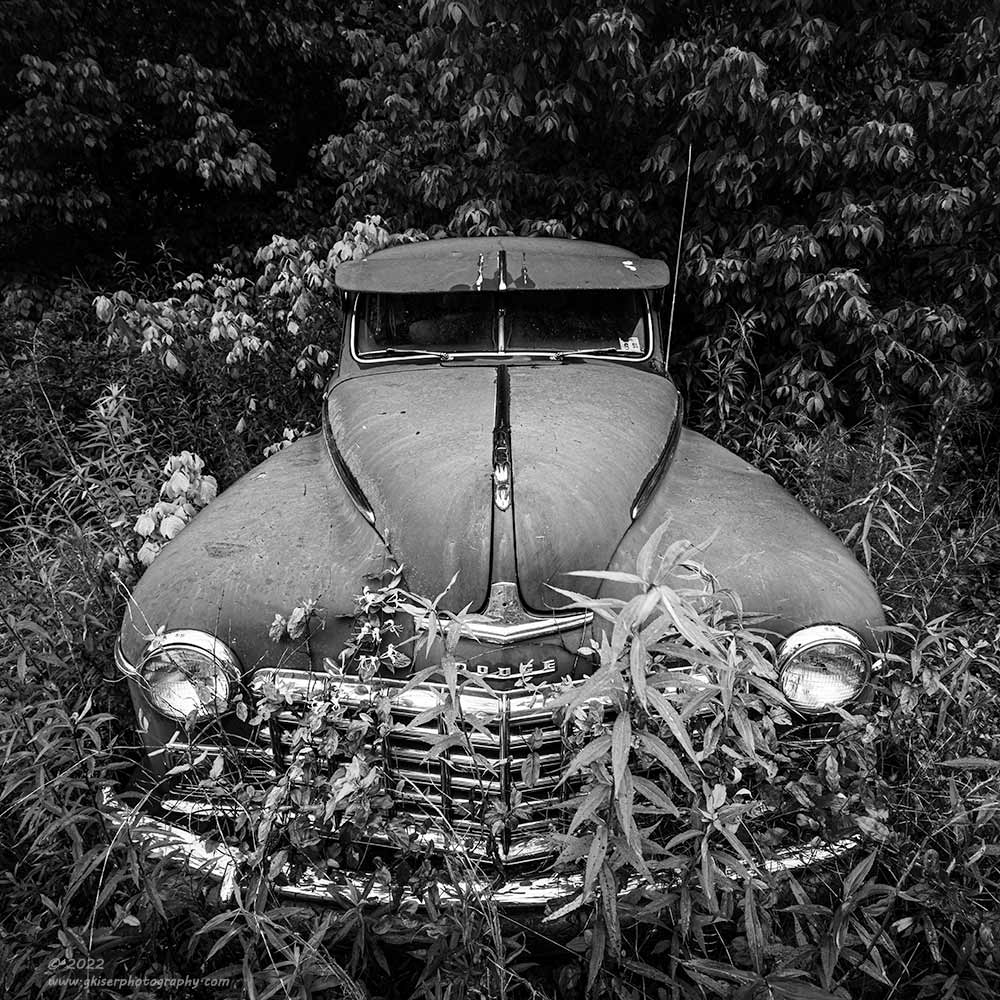
I wasn’t really sure what I wanted to photograph just yet, but when I got outside and saw the sky, I got excited. The clouds had a lot of mood and drama which I could make use of very nicely. I considered doing some landscapes, but I recalled John telling me recently that the Dodge that I had photographed about a year ago was back in the same position it was in back then. I had gone back through that blog entry after seeing the images and I remembered just how lousy the light had been during that shoot. In fact, the sun was so strong and harsh, I ended up doing Infrared captures of the car which turned out pretty good, but they weren’t what I was really after. I had the right lighting now, and the mood was right for that car. The pictures that John had sent me also showed that the grass had grown up around the car making it look even more the part. That was where I needed to start my day.
The location that the car was parked wasn’t but about eight miles from home, so it didn’t take long at all to get there. When I arrived, I found the car in the exact position it had been in last time, but there was a fence that was propped up against the trailer which was off to the side of the car. I loved the idea of the fence as a leading line, and it also provided some nice color contrasts to the scene that was largely green. I remembered having a rough time with the color of the car when compared to the surrounding landscape. It wasn’t going to be any easier this time, but I had a much better understanding of how to manipulate colors this time around.
I started off with a composition that included the fence, but I just wasn’t able to find an angle that I liked which included the fence. The more I moved around with the 24-70mm, the more I started to think that this was a lost cause. I eventually gave up on the normal lens and decided to go all out with the wide-angle lens that would allow me to get much closer to the car and overshoot the fence. The perspective distortion would also give the car a bit more presence to counteract the similar color tones to the surrounding landscape. I kept the polarizer mounted as I swapped the lenses and got back into position.
The extra width of the new lens allowed me to avoid the clutter and focus on the car, but I still couldn’t get the angle right for some reason. I decided to go for the easy shot to get things started and went to the very front of the car. I looked at how things were falling in the scene and determined that a square crop would be the way to go here. I did that in camera while the lens was set to 16mm and moved in as close as I could to get the right perspective of the shot. This was going to work out quite well, so I spent the extra time to make sure that the car appeared level in the frame even though it was at a slight slope. With no strong verticals in the background to confuse the issue, the only level that mattered was that of the car. When I got it all centered up and the frame composed the way I wanted it, I shot the photo. The exposure looked good, and I could certainly see this as a monochrome image. I saw no reason to trip the shutter again, so I put all my hopes into that first real exposure and then used that success to fuel my next composition.

Feeling pretty good about this wide-angle lens for this particular subject, I decided to keep with the theme and try the quarter view again. This time, I opted for a vertical orientation since the sky was looking absolutely terrific. I framed the composition knowing that I was going to be cropping it to either a 5:7 or 4:5 ratio. I just wanted to get enough of the sky in to have it add to the drama of the scene and to set the mood. Things were coming much quicker now that I had that all important first shot in the bag. The wide-angle perspective was working for this bulbous nosed Dodge. A few frames into this composition and I started to see that the exposure wasn’t the best. There was a very high dynamic range to the scene which I didn’t really care for and I wanted to be able to control it a little bit better at this stage to keep me from having to fight it in post later on. I went to the truck to grab a 3-stop ND Grad which I slid into the holder behind the polarizer and got it lined up with the diagonal horizon line. The filter easily reduced the intensity of the sky and brought the exposure together with a higher degree of balance.
I waited on the clouds to get in the right positions until I would trip the shutter. I ended up snapping a frame about every minute as I waited on things to change in the sky to complete the composition. It was time well spent I think because the resulting image turned out really good and better than I had hoped. I had a trick in mind for this composition, as well as ones that followed which included the sky. I was going to give the sky a bit more of a cyan look than the blue/gray that I would normally go for. The idea was I wanted the sky to compliment the color of the car which I was going to add a bit of cyan to in order to separate it from the vegetation which I was going to push more to the yellow end of green. Like I said, I had a better grasp on how to shift the colors of a scene to make them work for me. I just had to keep everything analogous when it came to the colors because there wasn’t going to be much opportunity for contrasting colors here.

Feeling pretty good about the vertical composition, I decided that while I was here, I might as well shoot a horizontal one as well. It would have a slightly different feel as the visual weight would shift from the dramatic sky to the car. I wasn’t sure which I would like better, but they both seemed to work well. The horizontal composition added some unique difficulties though. In order to keep as much of the sky in the frame that I needed for proper balance to the car, I had to include a good bit of real estate to the left of the frame. I had no problem with the negative space in this situation, but there was a dirt pile, and some concrete blocks that appeared within the frame when working with this composition. If I composed with them out of the frame, the visual balance was off, and the sky looked accidental. To get enough sky in the frame meant including the extraneous clutter to the left. I made the decision to clone the dirt and concrete out in Photoshop when I got the image home. The areas that I was having to deal with were insignificant to the scene and their absence goes completely unnoticed which is my litmus test for cloning out elements within a frame.
As I had done with the vertical, I waited patiently for the clouds to move around to a good position for the composition. It slowed things down, but I had nothing but time and the camera was on a tripod which made it easy to wait for things to happen. As I was waiting for those moments, I was looking at the car for the details that appealed to me. I was pretty sure that I had the overall shots that I wanted to get already, and I remembered that I had not tried any detail shots of the car a year ago. When I was finally confident that I had the right clouds in the shot, I brought the camera back to the truck and swapped out the highly useful 16-35mm lens for an equally specialized lens…the 70-200mm. This is a great portrait lens, and a great tool for getting isolations and distant subjects, but it is also very handy in photographing parts of cars when you need to stand back because of the chrome that will force you to be a cameo in your own photo. I left the polarizer attached, but I stored the grad filter since I knew I wasn’t going to be needing that any more.
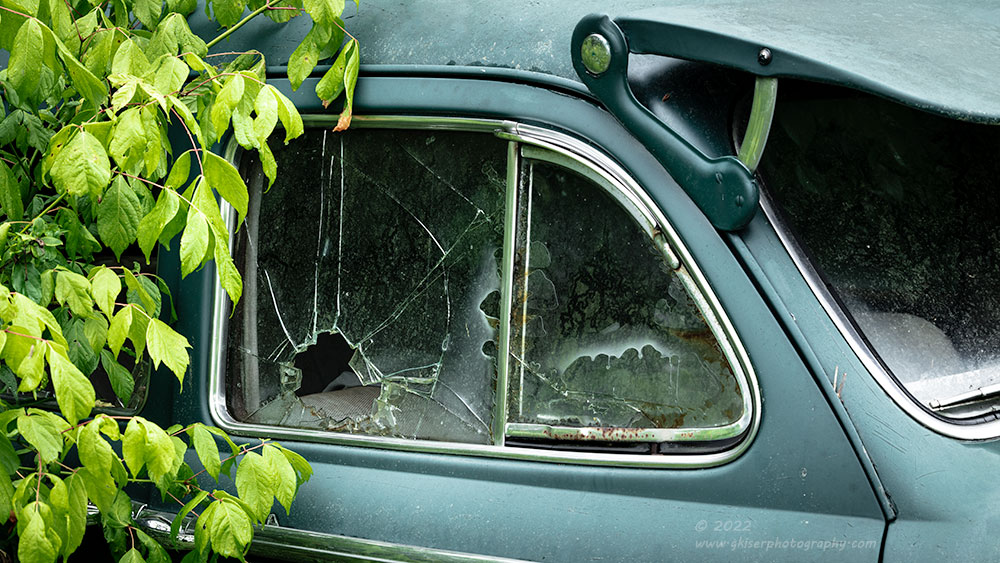
I went over to the side that I had not yet photographed because there was a beautiful broken window on the passenger door. I had noticed that and found it interesting when paired with the visor over the windshield. I worked on a pleasing composition that gave some context to the broken window. I included enough of the car to show the uniqueness of it, and then chose to include the leaves around the window for a bit of color and a change in textures. The light green framed the scene nicely, and I used the chrome trim to mimic the slight angle of the visor at the opposite corner. I made sure that the broken window was the visual anchor of the entire scene as that was what drew my attention here in the first place. I just wanted enough of the other elements to provide a bit of a storyline to the glass.
I did a few different variations here with different crops and even shot it as a vertical for a few frames. In the camera, I liked the vertical one better, but when I got it home to the computer it was the horizontal that won my heart. It just fit better and had more of the elements that I thought told the story in it. It was the colors that were difficult to work with as I wanted separation between the leaves and the paint even though they were very closely related in color tone. I worked with the calibration and saturation levels to arrive at this presentation that I think fits the scene quite nicely.

Feeling pretty happy with the outcome of the broken window, I turned my attention on the front of the car next. I have always enjoyed photographing hood ornaments on cars of this era. The ornaments are always so interesting and full of character. I had regretted not trying to capture it the last time I had worked this car and was determined not to let it escape me this time. With the long lens still attached, I started to figure out how I wanted to fill the frame with this bit of chrome. As I was working with it, I realized that I had vegetation to work with, or around for this shot. Typically, when I am doing hood ornaments, the weeds and grass are much lower and are never a consideration for the photo. This time was different though. I saw an opportunity to use a portrait technique to show depth to the scene and blur out the foreground. This is just not really my style and I usually find this kind of blurred element in the foreground to be a bit distracting. In this case, since the hood was pretty bland with uniform paint on it, I liked the idea of having a different texture in the foreground, and the fact that it would match up with the green in the background was even better. I got into position and using my DoF preview button, figured out the right aperture to use to give me the depth of field that I wanted. As I was getting that figured out, I noticed that the green in the background was broken up into a dark green and lighter green. The lighter green had a shape to it that seemed to go along with the shape of the hood ornament which I decided to use to frame the horns and really draw the attention to the chrome bits.
When it was all said and done, I really liked how this one turned out if for no other reason than it was done in a completely different way from how I would normally photograph it. I really liked how the vegetation went so soft while the hood was reasonably sharp. It was just a slight effect that really went a long way for this composition. As I tried slightly different angles on this ornament, I ended up on the other side of the hood and saw another opportunity.
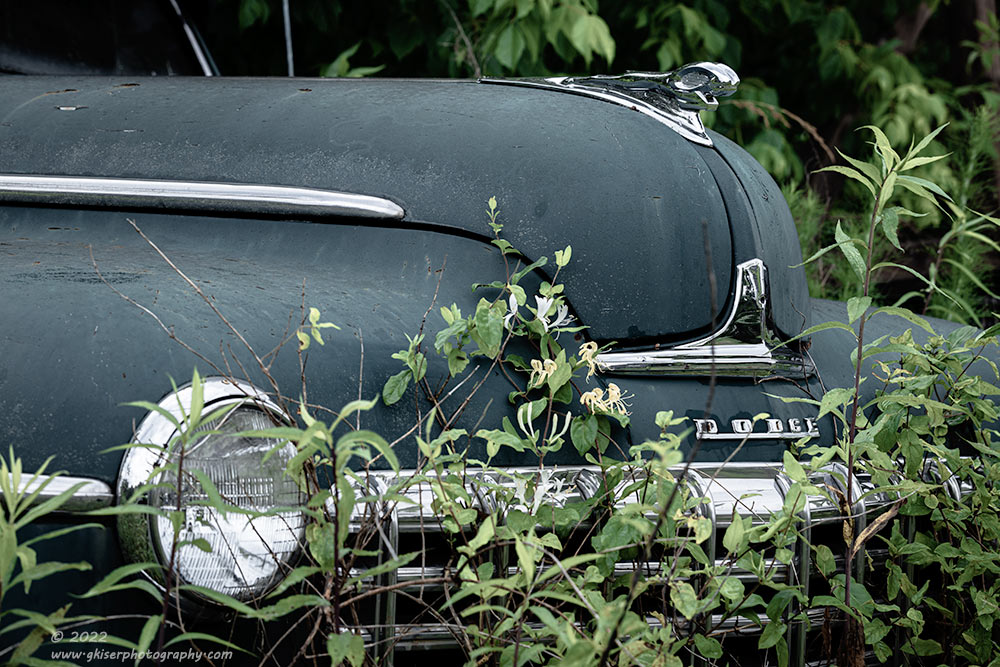
While it had been the hood ornament that had caught my eye, the light from this side of the car prompted me to think about capturing more than just the ornament. From this angle, I could get a headlight and the grill in addition to the other emblems and trim up front. I started to work on a composition here. I started with my favorite top down composition that turned out pretty good. The issue that I had with it was the fender was just too large in the frame. I adjusted my position and got a little lower. That changed the scale of the fender to a much more favorable relationship to the other elements. I wasn’t sure if I was going to like the horizontal lines of this composition as the diagonal lines of the former composition were more preferred.
As it turns out, the lower position with the stronger horizontal lines gave a more relaxed composition and focused the attention more on the chrome and less on the fender which was a very good thing. Once again, I set out on my post processing journey to figure to how best to separate the colors when there wasn’t much difference between them. This time, I chose to start with a very desaturated color profile and the slowly build up the colors as needed while changing the calibration to add to the separation. The colors may not be completely accurate here, but the presentation captures the mood that I was after which took precedence over color accuracy. I really like the muted tones of this one, and they suit the relaxed composition I think.
It was after I shot this view that I had that mental nudge that said I was done here. For years, I have had that little inner voice that will tell me when I’ve hit the proverbial wall. Usually, this is at the end of my creative energy, and I just don’t have any more in me. This time it was a bit different though. My creative energy was actually coming online with a vengeance at this point. The prodding to stop was just for this location. I had milked this car for all that I cared to at this time. What I was needing to do was to pack up and move to another location to see what I could do next.
As I started driving, I looked up at the sky and saw that the clouds were still looking really good to the North. As I have done several times upon leaving North Wilkesboro and going up Hwy 18, I thought about a barn that is up that road a few miles. I had photographed it before, shortly after Toni and I moved to Purlear, but I wasn’t completely happy with the outcome. To make matters worse, every time that I had gone back to give it another try, I had abandoned it because of a new Dollar General that was built right in the background. As I was considering my options here, I realized that the other times that I had attempted to photograph this barn, the trees had been bare. There was every possibility that the trees would now block the visibility to the Dollar General now that they had leaves.

It didn’t take but a few minutes to drive up the road and find the barn. As I passed it by, I could see that the Dollar Genera was completely covered by the trees now. I was very excited and got turned around to pull off on the side of the road. I considered my options for a composition here as I have done many times before. I am limited in what I can do because I had to shoot from the side of the road and over a fence. I was thinking that the last time I had shot the scene I had used my 24-70mm lens which I mounted to the camera to start with. As I tried to frame up some compositions I didn’t like what the focal length was doing for me. I went back to the truck and swapped out with my long lens once again. This time though, I wasn’t looking to shoot isolations, I was needing to reach out and touch the barn from teh shoulder of the road. I had the polarizer fit as I knew I was going to want to reduce the glare on the tin roof. As I started to find compositions, I saw that the exposure latitude was a little wider than I wanted. To combat that, I went back to the truck and grabbed a 2-stop soft ND Grad which would take a little bit of the bite out of the sky.
I had the right exposure now, and it was a matter of trying different compositions in hopes that one of them would work out. I found myself repeating what I had already done which didn’t really suit the scene this time. The more I looked at things, the more I wanted to go a lot wider with the framing, but that put me into the realm of the 24-70mm lens which I didn’t like the perspective of, or the framing. Just like that, I had a crazy idea to shoot a vertical series to be joined in a panorama. It would give me the right framing top to bottom as well as left to right without having to do a deep crop into the frame. I had found the right spot to shoot from for a single image where everything lined up right, so I just stayed where I was. I leveled the tripod as that is the most important step of the whole process. I then extended the neck of the tripod to give me maximum elevation over the fence and checked to make sure that the camera was plum on the Acratech head. Once I had that confirmed, I flipped the camera vertical using the spirit level to confirm that I was exactly 90 degrees from where I had started. I then did a dry run through the scene to check my margins top and bottom and to establish a base exposure. I locked the focus on the barn and set the grad filter so that it would follow the horizon pretty closely. I then did a series of five exposures right to left overlapping about a third into the frames.
Seeing that I misjudged the exposure by a third of a stop, I dropped the shutter speed and did a second series repeating the process from the first one. That series was the one that I ended up stitching together and processing. I had also shot another one further up the hill that was very similar, but the sky wasn’t quite as good from that angle. There were also several other single shot attempts at this barn just to make sure that I had plenty to work with. I was hoping for two separate images from this barn, but in the end, all of the compositions were roughly the same. It was panorama that did the best job at providing a good visual balance and the best fit into the golden spiral.
Things were going very well at this point, and I could have easily called it day and gone home. I had roughly 100 frames captured already and knew that I had a half dozen or so keepers out of all of these. I just felt that there was still more creating to be done and the sky was still looking very good. I was on 18, so I just kept on going North. I had considered going up to Doughton Park earlier in the day for some landscapes. I know that going there seems a bit redundant since I’ve spent a lot of time there over the years and the last time I went out was to go there. You are right, and normally I would agree with you, but as normally happens during a workshop when I am not actively engaged in shooting images, I started to see things that had escaped me previously. This is partly due to looking at the different participant’s compositions and seeing things through different eyes, and then it is partly because I am able to become one with the landscape without any anticipation of capturing any images. The result was that I had several compositions that I wanted to try at a location that I had only recently began to enjoy shooting.
I made the drive out to Doughton which wasn’t far at all. I parked by the lodge because where I was planning on ending up was pretty much the halfway mark on the trail between here and the other side of the meadow. In the interest of seeing things new, I went the route that I rarely take. The hike was quick, and only took 10 minutes before I arrived at the little grove of trees just before the top of the meadow. I started to look around to try and find the compositions that I had seen when I was out there a couple of weeks ago. The first one that I landed on somehow didn’t have the same visual impact this time that it did last time. I spent a good deal of time looking at the angles on the tree to try and figure out what I was missing. No matter what I did, I couldn’t get a good composition worked out. Had I misread my creative energy? Was I spent? Surely there was something here that I could shoot. The sky was still awesome and full of details, so I wasn’t quite ready to give in.
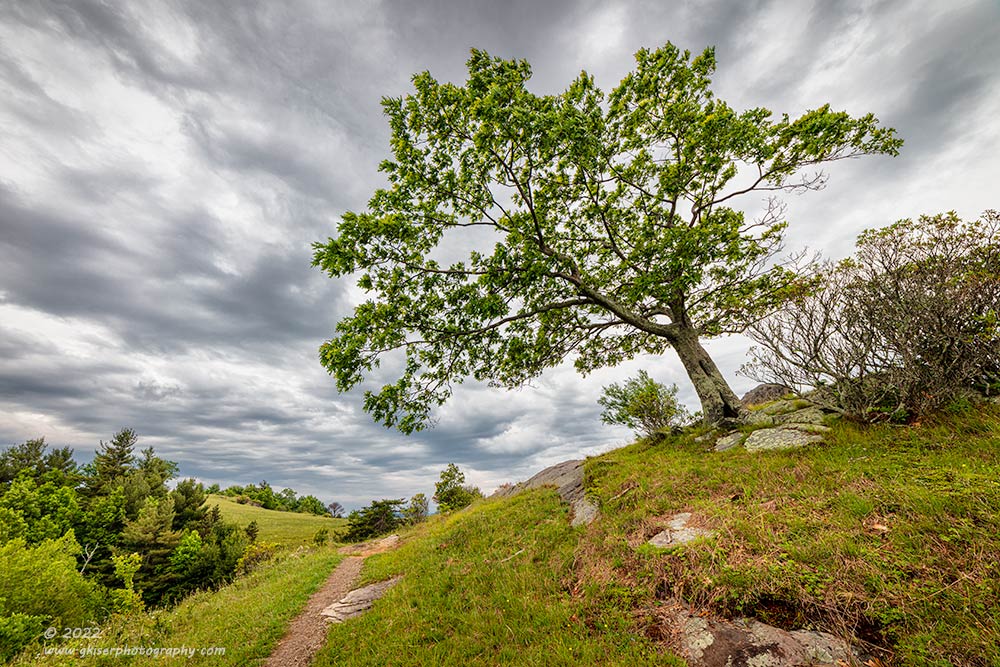
I started to walk around the tree that I had been working with to see if there was a completely different angle that spoke to me. As I got down lower and back on the trail, I saw a composition that I remembered seeing a couple of weeks before but had forgotten about. This composition struck me as interesting because the tree was growing at a strong diagonal in the frame, squared up to the slope of the hill. This interested me, and the sky was gorgeous behind the tree. I pulled the camera out and fitted the 16-35mm once again because I knew that I was going to want to go wide for this one. Since the sun was all behind the clouds and I didn’t see a whole lot of need for a polarizer, I just left that off. With the wind that was whipping around, I felt that my energy was better spent ensuring a fast shutter speed instead of reducing just a small amount of glare from the grass. As I got the composition dialed in, I ended up with an exposure of 1/160 of a second, f/11, at ISO 200. That was enough to freeze the branches and leaves and I started to make exposures as the sky changed.
As I was constantly reevaluating the composition, I started to question how things were lining up in the scene. I decided to that I wanted to have the tree trunk fall between a small bush and a rock instead of going through the small bush. This gave the tree more shape and structure. I moved the camera slightly to accommodate that decision, but things still didn’t feel right. Even at 16mm this scene looked crowded. I backed up and that helped a little bit, but the scale was off at that point. I thought for a moment and since I wasn’t using any filters for this shot, it was completely logical to pull out my favorite cheap lens, the Rokinon 14mm.
This lens is fully manual and doesn’t completely communicate with my 5DS R for exposure information. I have to manually set the aperture and the focus which makes this a fun lens to use. I can’t use live view with it because of the lack of an exposure chip in the lens so I have to rely on the light meter through the viewfinder. Fortunately, I had already worked out the exposure with the 16-35mm lens and just swapped the lenses out. I dialed in the same aperture of f/11 and fired off a test shot to see where I was at. The image was overexposed slightly so I had to back the shutter speed down a little bit and ended up with 1/200 of a second which was even better than what I had been shooting with the Canon lens.
I double checked the framing which was pretty much right on the money since I had left the tripod in place while I swapped out the lenses. You see why I like tripods so much? I just tweaked the edges a little bit to make sure that I didn’t have anything distracting coming into, or going out of the frame. Once I was satisfied, I started to make exposures ever so often as the clouds moved around in the sky. It was still too early to know for sure, but I was thinking that this was going to be my favorite image of the day so I made sure and devoted a lot of time to it. Usually when I break out the 14mm lens I end up with a composition that I love. That lens is just so awesome for being such a simple and cheap piece of kit. It also goes to show that because of how I “see the scene“, even when I am shooting an ultra-wide angle lens, I am still concentrating on a single element within the frame. This image is very true to who I am, and how I see the world.
When I was pretty sure that I had all that the sky was going to give me, I packed up the camera and started back to the truck. Something didn’t sit right with me though. I felt that there was something else that I was missing. I walked back up the slight hill to the area that I had started from. I found the other tree that I normally would photograph here and started to walk around it. As I moved around, I wasn’t seeing any personality in the tree and nothing was sticking out for me to want to photograph it. As I Was about to give up on this one, I hit that perfect angle where my other favorite tree at the top of the meadow found itself sheltered under the branches of the tree that I was currently working. It was a composition that I had never seen before, but it was perfect, even at my visual 50mm eyes.
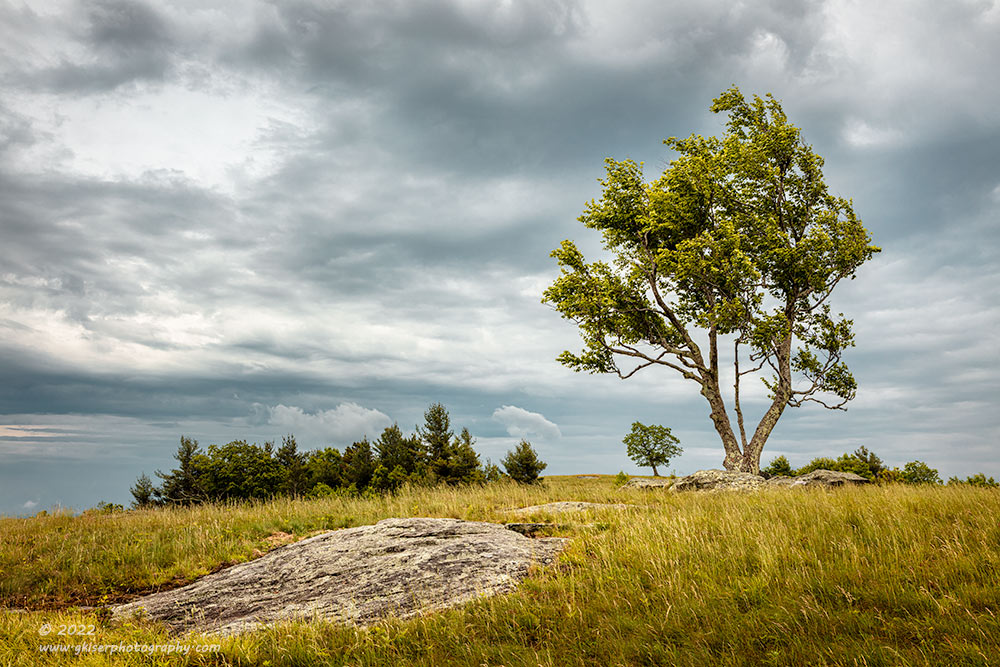
I set the tripod up and pulled the camera out. This time, I knew that I was going to be using the 24-70mm lens because I loved the perspective that my eyes were showing me. I still had the wind to deal with, so I left the polarizer off this time as well. I kept my settings pretty much the same as I had done from the other image but had to speed up the shutter to 1/250 because there was more light on this side. I wasn’t upset at all about gaining a third of a stop of shutter speed with the wind doing what it was. I got the image framed up as I had previsualized it, using the bald rock as a foreground element leading to the tree in the midground that was framing the tree in the background. I ended up shooting it at exactly 35mm which is what the human eyes see when you take into account the peripheral vision. It was true to how I had seen it, and I committed to the composition waiting on the sky to do things that might add interest to the scene. I ended up choosing this image because the sky partially opened up to the left which gave a nice pleasing visual balance to the image, and the hole in the sky mirrored the bald rock. Both pointed towards the tree that was the focal point of this shot.
It was a composition that I had never considered before, but it really worked so well, and the fact that it incorporated two of my favorite trees at the park in a single shot was awesome. With that composition finished up, I was pretty sure that I was done. I was creatively exhausted and since it was slightly after noon, I knew that the rain would be coming in soon enough. I had 145 images on the memory cards and that was plenty to work with for the rest of the day. It had been a great day and I was so glad that I got up and went out despite having had a very rough night with the loss of power. I realized that everything that I had shot I had attempted before, but I got images that were far and away better than the previous attempts. I chalked that up to understanding color theory much better this time around and after teaching a composition workshop, I was more in tune to the basics once again. The same can be said about my mentorships that I have been doing lately. In fact, I am working with two Advanced Mentorships currently which keeps me on my toes with how to read a scene. It isn’t that I forget, but I can get lazy in my own photography from time to time so it is good to push myself to take that extra step and evaluate the scene a number of ways before calling it a day.
If you are interested in learning more about how I capture my images and want to incorporate some of my techniques in your own photography, consider joining me on one of my upcoming workshops. I have three more scheduled before the end of the year. Whether you like landscapes or decay, I have a workshop for you. If you would rather learn on an individual basis, I offer very flexible mentorship programs where we can do anything from image critiques to hourly instruction sessions, to a full-on Advanced Mentorship which will include 15-25 hours of structured instruction time, plus ongoing support and plenty of informal time as needed. As I mentioned, I currently am running two of these programs right now which is my current limit. I suspect that I will have an opening sometime in the month of August for another client, so get your name in the hat soon to ensure your slot for this great learning experience.
If you don’t want to learn photography, but appreciate what you see here, I’ve got you covered on that end as well. As with all of my treks, I would love to help match you up with that print that speaks to you. You can order basic prints right off of the website here, or you can talk to me directly about larger sizes, or specialty media like metal prints. My photographs are shot with the intention of being printed, not just to be looked at on the computer. There are a growing number of clients who have my work on their walls. What is keeping you from joining them?
I would also like to mention again that I am looking for test shoots for creative portrait ideas. Depending on what you are looking for, I might be able to do your session for free but can certainly offer a really good discount. No is the time to get your shoot set up to ensure that you get this kind of pricing. I’m looking for anything creative like for example, I have two upcoming equestrian themed portrait sessions, a large family shoot that I think will be themed, and a couple of shoots that still in the planning stages. These include things like a trass the dress shoot at a waterfall, and a few boudoir shoots, along with potentially a figure study session. Most of these will not end up in the blog here for obvious reasons, and I will try to keep the people photography to a minimum here. Once I get established as a people photographer, I will have an offshoot website of some sort to keep this one just landscape and decay. I’m still working on that part of the equation, but the main thing right now is that I am getting the experience needed to take this portrait show completely on the road.
I do hope that you have enjoyed this trek as well as the resulting photographs. It was as lot of fun to get back out there once again to capture the images that excite me. Remember, if you shop at Amazon, or B&H, I would greatly appreciate you using the links that are found throughout this website to access your favorite retailers. As long as you enter the sites using one of my links, no matter what you buy I’ll get a few pennies from the sale without it costing you anything extra. These affiliate links help fund things like this trek, and they keep me going with the landscape and decay photography when the print sales fall off. It is just a simple way that you can show your support of what I am doing without it actually costing you anything.
I’m looking forward to the next trek already, but the next several days are going to be sunny so I don’t expect to get out much during those days. Hopefully I’ll get back out soon though.
Until that next time….

Remember to use the code KISER10 to get 10% off your purchase