Thursday, August 13, 2026
Welcome back! I’m glad to have you here. If you missed the first chapter of this series, I would be happy to give you some time to catch up and see how this all got started. Just click this link and when you are done, I’ll be right here waiting on you for the conclusion of this story. For those who have read the first part, you will know that it was a series of events that brought me to this location at this time after about a year of contemplating it with just one car that I was interested in photographing. Sometimes it just works like that, I can be watching a spot for what seems like an eternity and one thing will change which will have me deciding to finally work the location. It was the addition of the Chevy coupe that finally lured me in.
When it comes to deciding on whether or not to stop for photos, I am usually looking for at least one composition that I know I can get, or at the very least, I am looking for something very interesting that I can kind of cheat on the compositions a bit with because it is so interesting. The old Ford was just about that interesting to me, but it was the location that was really throwing me off. I saw too many issues to really know if I could make photos work with it. Thanks to a string of eye issues and an appointment of my own, I had that chance to see the Chevy that had been added to the side of the road which had some good compositions available. That was all it took to get me to really want to seek out the property owner which I had never seen walking on the property. That changed on the very day that I was planning on shooting this scene and it was just a stroke of luck. The guy I found wasn’t the property owner, but after a brief conversation, I had the permission that I needed.
Ironically, after I had been working out there for about 30 minutes, the guy I talked with left. It really was a situation of fortunate timing because if I had arrived just a half hour later, I would have missed him. While I was prepared to get the photos that I could from the side of the road (public easement), I really wanted to be able to get in closer to the cars which would require permission to access the property. Having that permission really paid off, and you will see the results of that permission in this blog entry.
Now that we are all caught up and back in the frame of mind as to what was going on, I was last working with the front corner of the Chevy and had gotten a really interesting photo of the textures on the fender. You have also seen a slightly abstract capture of a small plant or weed growing up from the debris on the bumper of that car. As you can tell, I was really enjoying working the details on this car. I was far from done though and wanted to work with some more intimate views before I was all done. I was still very interested in that little plant because it just didn’t belong on a car which created a visual juxtaposition. These are always very interesting to work with in photography.
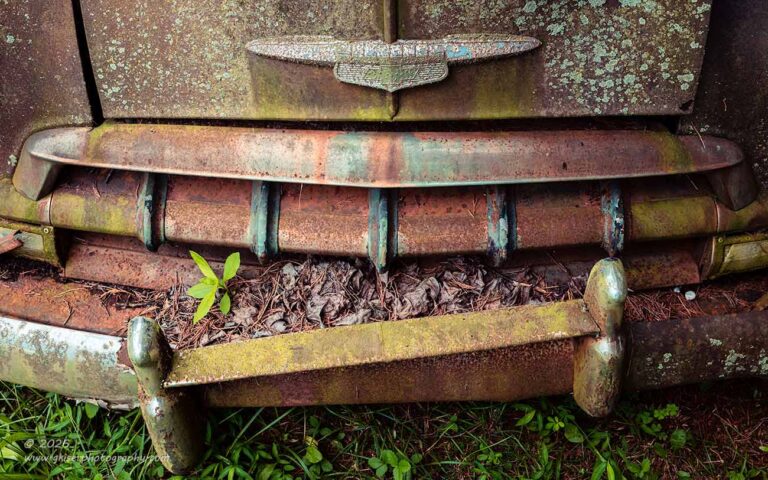
Going back to that concept of synecdoche from Haiku poetry, something else that I learned about writing Haiku is the concept of the shock within the poem. This is a contrast built into the short verse that grabs the attention of the reader. The same thing happens in photography and I was looking at it right here at the front of the car. The photo that I had already captured that really focused on the plant was a photograph about the plant with the framework of the car around it acting as the contrasting detail. This time, I was wanting to establish the car as the main subject and what the photograph was all about. The little bit of juxtaposing contrast was in the shape of the little plant growing from the bumper. In many ways both photos had the same story, but it was told from different points of view.
Consider this, in the original photo, everything was centralized on the little plant, and the metal bits just framed that piece of nature growing in an odd spot. It was all framed in a way that the car was just a background that provided some shape and structure to the frame. Now, I was looking at things completely differently with the car being the main consideration in the composition. I had to figure out what aspects of the car I really liked so that I could get the composition worked out. I knew that if I included too much of the car, the little detail that I needed to be seen and appreciated would be lost. If I got in too close, it would be another story of the plant as I had done before. I needed a meaningful structure here and I looked at areas around the plant which would fill that structure in the best.
Going with the rule of odds, I looked for things in odd numbers. The first thing that I noticed was the hood ornament matched up with the dual bumperettes below. These elements formed a triangle, and in the case of this car the overrider between the bumperettes was all bent and created another diagonal between the two uprights. As it turned out, the portion that was pulled away from the car was there at the plant which added another framing element to that important detail. That was the basis of the composition. I started to look around for more details and found that the grill formed three horizontal lines when combined with the bumper below as well as three horizontal voids of shadow. The center section of the grill had five bits of trim over the slat which happened to be an odd number. As a framework for the image, I chose to include the edges of the grill which created a bit of symmetry to the scene that also pointed the attention to the bent bumper. All of this was used to frame the little plant which ended up in a most perfect spot within the frame, especially after I changed the aspect ratio to 16:10 which I felt fit the scene much better than the 3:2 aspect ratio.
I bet you had no idea that there was that much planning involved in putting a photo together. Sometimes it is much quicker and more organic, but there are times when I really have to think through the details in order to get the shot that I am seeing in my head. I just had a rough concept of what I wanted to do with this one, but thanks to understanding how the elements all come together in a composition, I was able to get this worked out in a matter of just a few minutes.
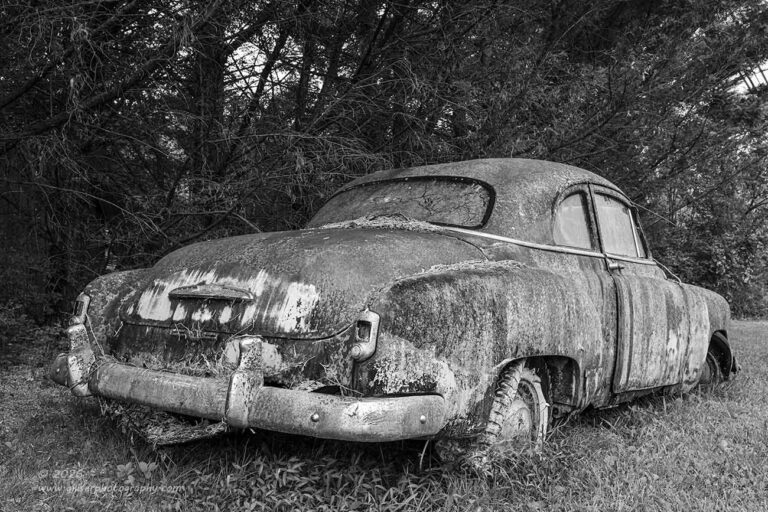
After I was done, I started to think that I had spent too much time with the front of this car and remembered that it also had a very interesting view from the rear. I moved around to that back corner and started to look at things. Once again, I really liked the shape of the car and from this angle, the large trunk was very prominent. The tires were also in odd positions because it had recently been moved from whatever patch of ground it had been stuck to for years. After studying the scene, I found that I really liked the shape of the car, especially when viewed from a bit closer than would normally be comfortable. What I didn’t like as much was the fact that the car was largely green and matched the colors around it. This was going to cause some problems in a color image which I had already dealt with in the view from the front. The problems seemed more impactful from the rear though which meant that I was probably going to move this to black and white so that I could introduce some different contrasts into the frame to make the subject pop out.
That was just what I did because anything that I did with the colors either looked unnatural or became overly complex in trying to draw more attention to the car. Since it was already largely monochromatic, I had no problem shifting this one to black and white. From here, I was able to adjust the tones to bring the car out while working the subtle contrasts of the scene to let the textures of the rust identify the car with the softer textures of the vegetation around it for the background. It actually worked out quite well and ended up with a photo that basically explained what I saw in this scene.
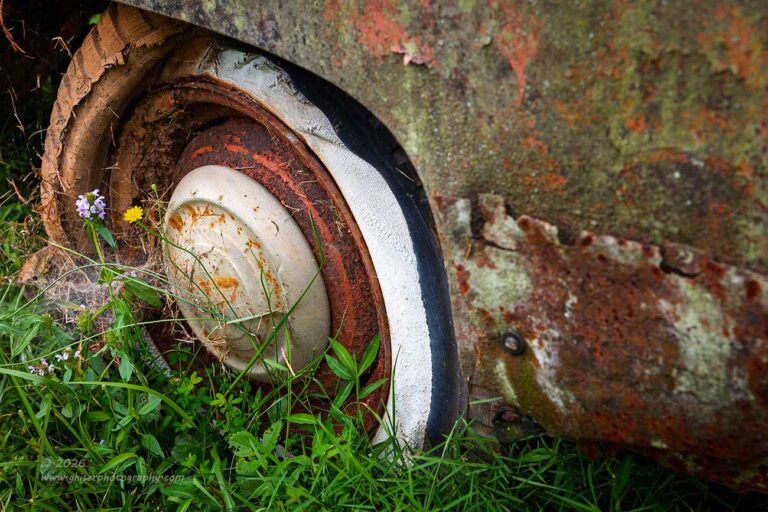
Working this scene also allowed me to start to recognize some of the other little details that were around the car on this end. The first thing that I noticed was a pair of flowers that were growing up beside the rear wheel. The purple and yellow really worked together and added a bit of vibrancy to this rusting car. The bright white wall and lighter colored hubcap added to the visual contrasts and would help to bring the eyes into the area of the scene where the flowers were. That was the concept for this next composition and that was where I started to set up next.
As with the composition on the front of the car, I had to spend a bit of time to work out the exact placement of things with this composition. That took a while because I needed to make sure that the overall scaling didn’t leave the flowers lost in a sea of other details. I also wanted to make sure that the car was still the primary focus of the photo. The flowers were just there for a splash of color, and I didn’t want them to steal all the attention. Then there was the issue of the breeze. I couldn’t afford to have the flowers blurred as I wanted to keep them sharp enough to draw attention in the scene. This meant really speeding up the shutter while waiting for the breeze to slow as I also had to wait for traffic to stop driving by which was adding to the disruption in the air. Between that and just trying different versions of framing, I spent a long time with this composition, but in the end, it was exactly what I had in mind.
Of course, working with the rear wheel got me interested in seeing what I could do with the front wheel. There were no blooms for color by that wheel, but there was something else that spoke to me about that front wheel. It was turned hard to the right and the bowtie emblem was in a pretty good position relative to the ground. There was a bit of yard debris hanging from the top of the fender arch and bright green grass growing from the ground below. The colors looked good, but I wasn’t really seeing a solid composition, or at least a reason to be taking the photo.
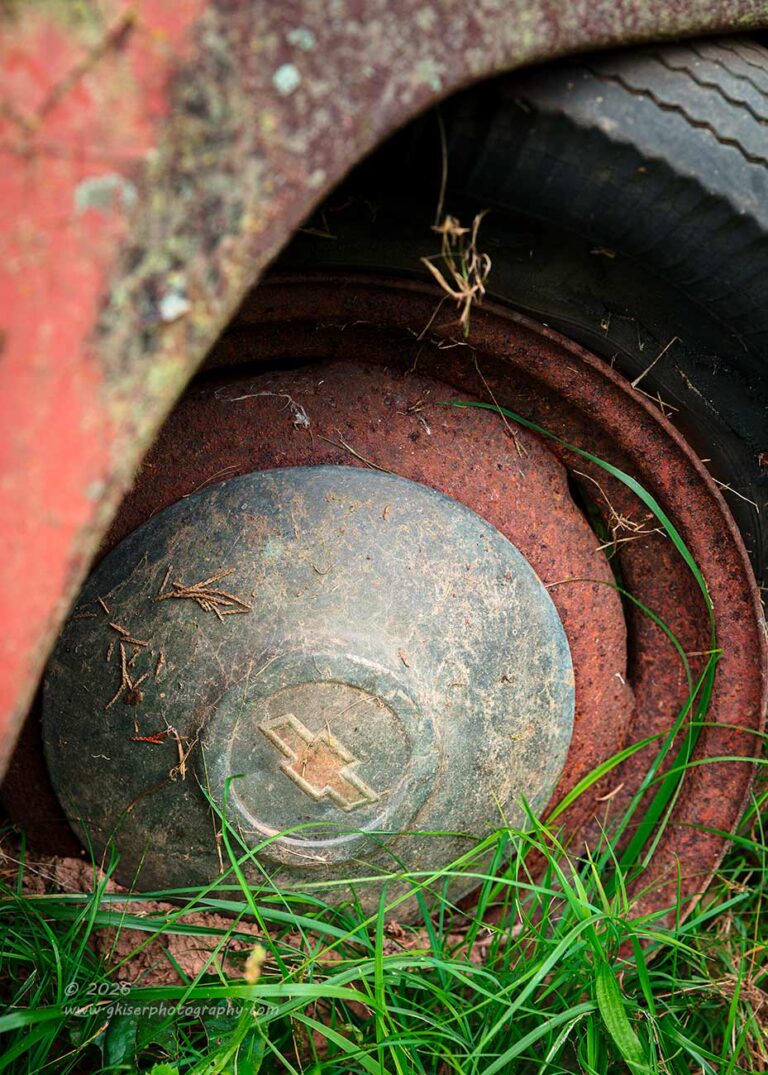
In photography, one of the most important questions you can ask is “why are you taking this photo?” I was asking myself that question and I wasn’t able to answer it. The obvious answer would have been that center cap, but that was not a reason to take the photo. Well, it could be, but this hubcap was nothing special and would not make for a very memorable photo. I just wasn’t able to get past the fact that I was being drawn to this wheel by something. I still needed to answer that burning question of why I wanted to photograph this wheel before I was able to make a successful image though. In an attempt to figure out the why, I thought I would start off by trying some compositions that might reveal what I liked about the wheel.
I got down low and close to the wheel to start moving the camera around to explore the frame. This is very helpful as it lets you see the scene through the limitations of the camera. These limitations can work against you at times, but they can also be quite helpful in defining a scene through a framework that our own eyes can’t really establish. I started out with the camera horizontal since that was how I had been looking at the scene. I tried something similar to what I have done in the past with the fender providing some negative space and a shape to frame the wheel. This worked but wasn’t inspired. It was missing something, so I cropped in closer to see how that worked. That lost the context and the shapes that I was seeing and became boring. It was at this point that I rotated the camera vertically which essentially cropped out much of the fender. It was this orientation that revealed what it was that was drawing me into this scene.
It was the way that the wheel arch met with the oddly shaped flat tire at the top. It formed almost an apex and created a loose triangle form around the scene when matched up with the grass at the bottom. This triangle framed the hubcap which framed the Chevy Bowtie that happened to be oriented at a diagonal as well. It was the connection of all of these lines within a frame of circles that had excited me and I would have never known that without having explored it through the camera.
In addition to the different shapes that I was able to capture here, there were lots of different textures included as well between the rust, the smoother hubcap, and the blades of grass that you could just about imagine feeling between your fingers. Even the tire offered a rubbery texture that is familiar to most folks and adds just one more layer of textures to this scene. What started out as a boring photo of a hubcap turned into an experience in textures and shapes that became a tactile experience for those looking into the photo. It became a thought-provoking piece, or at least that is my reaction to it and that is the kind of image that I really enjoy creating. It is photographs like this which I find most interesting as wall art. They give you a chance to think about touching things and how they feel as you are walking down a hallway or sitting on a couch. A simple photo becomes a gateway to another time and another place which is all in your mind. If this sounds like something that you need on your walls, keep in mind that I do offer prints of all my work and you can start the ordering process by visiting the gallery store.
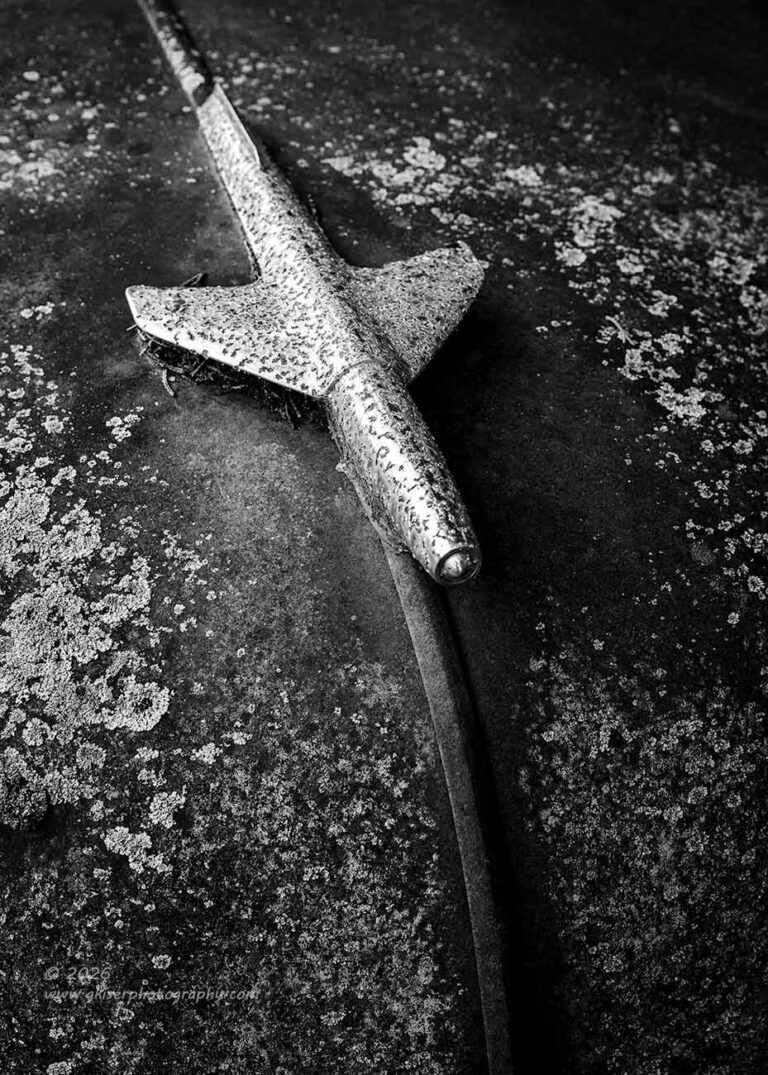
Speaking of textures, I’ve already talked about how much I really love the textures on this Chevy between the lichen and the moss that is growing on the surface. I’ve found that one of the easiest ways to capture textures like this is a shot of a hood ornament which for those cars that still have them will make for a great visual anchor and in many cases they make for fantastic main subjects as well. For this Chevy, the hood ornament was fine but nothing exceptional in terms of photography. However, the surface around it was looking really good and I needed a focal point to be able to photograph that surface texture.
I had already used the curve of the front fender against a slightly blurred hood and windshield as a focal point for the texture, but I felt that this would be a different way of showcasing the same thing. I started to work out a composition that made sense and read visually well that utilized the chrome hood ornament as the all-important visual anchor. I realized quickly that anything horizontal was going to force the frame to be filled with the ornament and making it the main subject. By going with a vertical orientation, I was able to change that visual weight and dedicate more of the frame to the textures that I was after. I would say that I had roughly 75% of the frame dedicated to the textures on the hood which because of those textures kept that from being negative space.
The final bit of the puzzle was to make this a black and white image so that I could really bring out the contrasts in the scene to keep the attention on the textures. The body line that ran under the hood ornament provided the visual pathway to keep the eyes from staying locked on the ornament. In fact, that hood ornament went from just being a visual anchor to directing the eyes to the line that would pull them through the scene. The darkness at the bottom right kept the eyes from leaving the scene as there was some strong contrasts just to the left which brought the eyes back into the frame and then back up to that anchor. I felt that this composition worked very well indeed and the final execution of it satisfied all those ideas that I had for it.
The issue that I had been having with the hoor ornament was the fact that I was pretty well locked at 70mm to get the framing that I wanted. This made me think that it might be time to get the long lens out and start finding some more detail shots with that one. This is a lens that I have had great success with over the past few years and knew that it would unlock some other compositions that I had not considered before. Once I had that lens mounted, I started walking around the Chevrolet to see if anything would work out better with that lens. I was kind of surprised that I saw nothing that really interested me through that lens. This is normally one of those lenses that really opens up a whole new world for me, and I can find composition after composition. That wasn’t the case this time. Everything that I was finding I felt I had done better with the standard zoom earlier. There was really no real need in reshooting the same compositions with pretty much the same framing as I was still hovering around that 70mm mark which was where I was with the other lens.
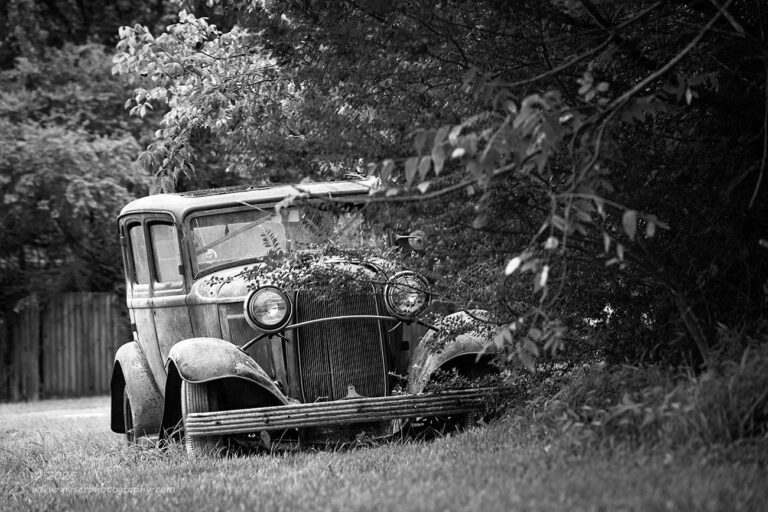
In a strange turn of events, I started to walk back to the Ford to see if there was anything that I might have missed earlier with the wider lens. It was at this point that I saw a composition that I had not even considered with the car. I was a good distance away from it and the tree was partially hiding the car, but more importantly, it was hiding the house and the cars in the front yard from view. There was still a portion of a fence visible behind the car for a bit of depth to the scene. I really liked how this was looking to stand and see it. I knew right away that the long lens was going to be the right choice for this composition due to the compression of the scene. It just felt really special to see it from the distance that I was standing.
I pretty much stopped right where I was and got the camera positioned very low to the ground in order to shoot under the tree branch as much as possible. There were a few places through the trees that I saw some bright blue objects which I felt would be a distraction, but to eliminate those from view, I would be including a portion of a red structure beside the Ford which I felt was worse. No matter what I did, there was some kind of colorful distraction in the background. By choosing the blue object through the trees, I felt that I could easily do some cloning within the tree to cover it with leaves. This would be preferable over removing the object that was touching the side of the car. This would have been a messy alteration to the photo and one that I wanted to avoid.
It really wasn’t until I got the images back home that I decided that the better option was to do the photo in black and white. This took care of the blue that was visible through the trees and allowed me to get a bit more brightness on the car which made it stand out much better than the muted rust tones that were contrasting with the greens. The black and white also made the fence in the background more visible which aided in the depth of the scene. Once I was done with the processing, I could not see it as a successful color image as the black and white just looked like the perfect choice for this scene.
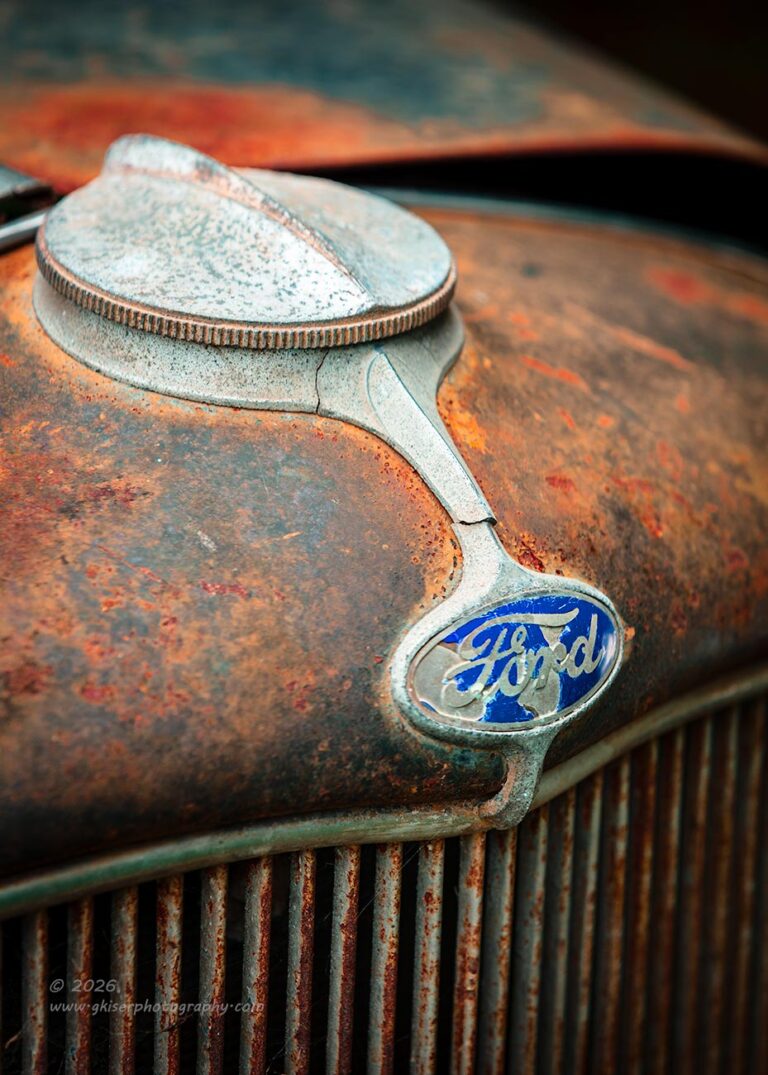
It had been the lens which had unlocked the composition and that was how I had come to look at this long lens. It saw things in a way that our eyes usually don’t. After years of practice with that lens, I have learned to view a scene through that range of focal lengths and have found it quite natural to do. When I saw the car from a distance, it all just fell together. With that success under my belt, I had a new drive to find another composition that I hadn’t worked with before. After looking around the car, I realized that I hadn’t really done anything at all with the iconic grill. This became the next area that I wanted to focus on. The grill was pretty much just a series of vertical lines which had nothing at all to break them up like the Chevy grill that I had photographed recently. If I brought in the grill shell, there was really nothing that I could use to direct the eyes through the scene and it became very boring without a visual anchor. The only points of interest that I could find were the Ford emblem on the top of the shell and the radiator cap which was linked to that emblem by a bit of trim.
As I started to look at that area, I realized that the shape of the grill had a bit of a character line which brought your eyes to the trim right below the emblem. This character line and emblem started to form the basis of this next composition. I tried it first with a horizonal frame and decided that I needed more in the frame to make the image work. The parts that I could add to bring more to the story were above and below the character line which forced the camera to go vertical. Now I was able to add more of the grill, but I was also having to bring the radiator cap into the frame as well which was going to be the brightest element in the scene. I wanted to minimize that, so I started to crop through it and minimize the impact, but that felt too cramped for the emblem.
I’m a little embarrassed to say how difficult it was for me to put this composition together. Most everything that I came up with felt flat and boring. Of course, that was because most of what I was framing up had an element of symmetry to it which I realized had to go. I shifted over to the side and started to look at things from a completely different angle. This was getting better, but I still wasn’t there yet. There were some adjustments to the height of the camera as well as some more movement from side to side. As I was starting to get the composition dialed in, I was really liking it and finally settled on a working composition. It was now time to get the focus set on the emblem, but that was where I started to have problems. I had great framing at 85mm, but I was too close to get the focus where I wanted it. I had to create more distance from the scene.
When I backed everything up, I had to zoom in further which again changed that minimum focusing distance and I was still running into the same issue. By the third time I backed up and raised the camera to keep the right composition, I finally had a good distance for focus at 145mm which changed the relationship between the elements slightly making that radiator cap larger than I would have wanted in comparison. However, this was overall a better look for the composition as a whole because the character line was more recognizable at the tighter focal length.
I played with the depth of field for a while to try and get the eyes to go where I wanted them to and not linger on the large, bright radiator cap. I tried everything from f/2.8 to f/11 to get just the right look. It was f/5.6 that won the day for me and happened to be the last frame that I shot for my time at this location. It is also one of my favorite photos from the day because of how the colors, shapes, and textures all work together. It reminds me in many ways of the compositions that I have started shooting with the Ford tractors where I get the very top of the grill in a similar fashion. There was no doubt that this worked well on the old car and I think that it will be in my portfolio for quite some time to come.
After right at an hour of working these two cars, I was pretty well satisfied. I had shot a total of 59 frames and knew that most of those were repeats for controlling the wind and figuring out depth of field. I felt really confident thinking back over the compositions that I had five or six keepers out of this which I was going to be very happy with. When I did get home and Toni asked me how it went, that was what I told her when normally I would have said that I might have a few that work out. For some reason I really did feel confident about this trek and the photos.
That confidence skyrocketed during the culling phase when I ended up with 15 frames that I wanted to look at for processing. That was a ton of photos and right up there with new 33%(ish) hit rate these days. One of those images didn’t quite make the cut though which left me with a total of 14 keepers from the day. I certainly can’t complain since this trek was figured out because of convenience rather than any sort of major planning. I just happened to be in the right area at the right time because of helping my dad out after going to an appointment that I almost didn’t go to. Because Toni has been having some issues with her eyes, I decided to go just to make sure that my eyes were still in good shape, so at the end of the day, it was three sets of eyes that brought me to this spot and have now resulted in you reading through a two-part blog. Looks like the eyes have it, and it all worked out very well in the end.
Thank you for joining me for this trek, and I do hope that you have enjoyed it as much as I have. There is still another scene out that way that I am interested in photographing and might be able to do it soon enough if I can get a gameplan of how I would like to approach the different subjects. There is also that Dodge close to home that I am considering working with but need to have a gameplan there before approaching the owners to unlock the gate to the property. That is definitely an ask that I don’t want to waste without really knowing that I can do something with the truck while I am there.
There are things in the future, but I’m not sure when they will happen. I know that the weather is kind of unsettled right now which means that I might have good conditions on any day, or it might not look good for several weeks from now. I’ll keep an eye out and hopefully I’ll be back here before too much longer with more new photos.
Until then…


Remember to use the code KISER10 to get 10% off your purchase