Wednesday, April 24, 2024
With Spring finally hitting in full force, or at least that is what the pollen and the weekly mowing are telling me, I have started to get back into some landscape photography once again. I’m not saying that there are no landscape scenes to be had during the Winter, but it is during that time that I much prefer to work on my decay photography. It just works out that way because those subjects are much easier to find when the vegetation is dormant, and that makes it much easier to create simple compositions. As things start to liven back up, I start to feel that spring fever just like most everyone else and get ready to hike again and become one with nature. I got a head start with that at the beginning of last month when I went to the Outer Banks for some coastal landscapes but have started with the mountain landscapes only recently. It might be a tad early to really get that springtime feeling in the mountains, but I was willing to make that compromise in order to get out and enjoy Doughton Park once again.
You see, since last Fall, Doughton Park has pretty much been closed off due to the ongoing construction projects along the Blue Ridge Parkway. Toni and I had made a jaunt out there about a month ago to see if access had been opened back up again since I was needing to get out there for a mentorship session. It was closed up to the Bluffs Overlook which was not nearly close enough to work out. A couple of days ago, I went out in the Miata to enjoy the warm sunshine and found myself back up on the Parkway headed out to Doughton. This time, the way was open, and I could get access to the park, but not the parking areas near the picnic area. It was a start and I had hope that I could do the mentorship session as intended in early May.
I really wanted to get back out to the park for some photography again because I always have great success there. Part of the reason is that from the top of the meadow, there are 360-degree views and I can make use of just about any lighting condition possible. This is why I love working this area for compositional instruction. All that was needed was a basic concept for a trek out that way. Sunrises are always a lot of fun and probably my favorite time to go to Doughton. That means I have a lot of photographs depicting that time of day in my collection. I don’t have nearly as many evening photographs with sunset represented which gave me the concept that I was after.
It was now up to the forecast for when I would be going out to Doughton. As it turned out, Wednesday was looking to be a partly cloudy day with what I would usually consider beautiful low clouds in the morning. Those clouds would thin through the day until right at sunset when a 50% high cloud layer would come back into the sky. Ideally, I would go out in the morning and photograph several different areas taking advantage of a great sky. If I did that, I knew that I would be tired by sunset and would likely talk myself out of going out again, or just staying out. I could tell from the forecast that there was going to be very little chance for color in the morning which was going to make for a much harder morning of landscape photography. I knew that I would end up looking for decay subjects which would then shift my mindset away from the landscape. With all that in mind, I chose to make a compromise to ensure that I had the best chance of getting some new landscape photos in the bag. I would forego the ideal clouds during the morning in order to focus on the potential for a sunset that evening over Doughton Park.
Honestly, I was fine with that compromise because I have added an incredible number of photos to my decay collections over the past six months or so. I could do with chilling out on the rust for a while and focusing my attention on an area that I have been neglecting for some time now. Since I owe my success in decay to learning landscape photography first, I didn’t want to lose that edge by letting the landscape skills fall by the wayside.
The day was pretty relaxing which is always quite nice. There was an early dinner so that I could be on the road shortly after 6pm which would get me to Doughton Park around a quarter till 7pm. This would give me plenty of time to hike to any number of locations and have the time to listen to the landscape in order to find the best possible photos. I’ll get into that concept of listening to the landscape in a bit more detail in my next Behind the Camera, so watch for that on May 1st. Just know that in order for me to really understand how to capture a scene, I have to spend some time with it first.
All the way up the mountain, I was looking at the puffy clouds that I like to call “Simpson’s Couds” because they remind me of the opening of that iconic show. I wasn’t sure if the sun was going to paint them with colors, but I was very hopeful at the possibility. When I arrived at the picnic area, I pulled to the main gate which was still closed. The parking area by the old lodge was also blocked off by barricades still. The restaurant across the Parkway was also closed with construction equipment blocking the entrance. If I was going to shoot here, I was going to need to park on the side of the driveway by the main gate. I made sure that there were no signs indicating that wasn’t allowed and found a spot as much out of the way as possible before getting my gear.
There was about an hour and 20 minutes before sunset which gave me plenty of time to walk the half mile or so through the meadow to get to the best spots to work. It was an oddly quiet walk as there were no cows to be seen, and no other hikers. There were always other hikers out here when I come in the evenings which is partly why I love working this park in the mornings. I didn’t question it, I just enjoyed the time all by myself in nature. It was quite rejuvenating to be sure.
The hike only lasted about 10 minutes before I got the first area that I wanted to check out. I knew that this section was great for a sunset photo or three, but there was something about it that I didn’t care for today. There was a branch that had broken off of the tree about a year ago which was still leaning to the ground while being connected to the trunk. That ruined a lot of the lines for me, and I recall making the compromise during a sunrise to include the fallen branch in the compositions. I didn’t want to do that on this attempt. There was much better foreground to be had here, but the fallen branch was too much of a compromise for me to make this time out. My alternate location was just up the hill anyway, so there was nothing keeping me from checking that spot out to see if it was any better.
The two locations are within sight of each other, and the one further up the hill was one of the first spots I fell in love with at this park. There is one of the most expressive trees situated all alone on the top of the hill. Even before I knew the power of the lone tree, I was drawn to this as a subject. There was a period of a year or two when there was a kite caught in the branches which made this a difficult tree to photograph, but I could see that the kite was finally gone. The tree was still in great shape and all of the branches which created the form I loved were still attached. I’m a little surprised at that because there is no cover from the elements for this tree and I know that this hill gets a lot of wind at times. There will come a time when this tree falls, but for now it is still standing proudly atop that hill.

I didn’t see any reason to continue looking for a subject or location because the sunlight was raking across the tree beautifully and it was full of blooms adding to the color while not covering the structure as the leaves would have done. I started to walk around the tree in order to get to know it a little better. I found that for the light to look the best on the tree, I had a more complicated background to work with, but to make for a more pleasing background, I would lose a lot of the sculpting through the shadows. There was a great minimalist angle where I could eliminate the background, but that would remove all the light from the tree leaving only the shaded side in the photo.
Now that I understood the light, I could start working out the compositions. This was where the compromises started. I found the best composition and could see that the light was going to work with me well enough here. The camera was set up with the standard zoom to give me a bit depth to the scene and I added a polarizer since I was going to be shooting at roughly 90-degrees from the sun. I liked what I saw in the viewfinder, but the sky was really boring in this direction. I had the light, I had the background, and I had the composition, but the whole point of coming out here was to get some interest in the sky. I didn’t like this composition because the photo was going to look really boring and there wasn’t enough balance to the scene to keep the attention. Looking at the sky, I could tell that the clouds were tracking in a way that would not fill the sky any time soon.
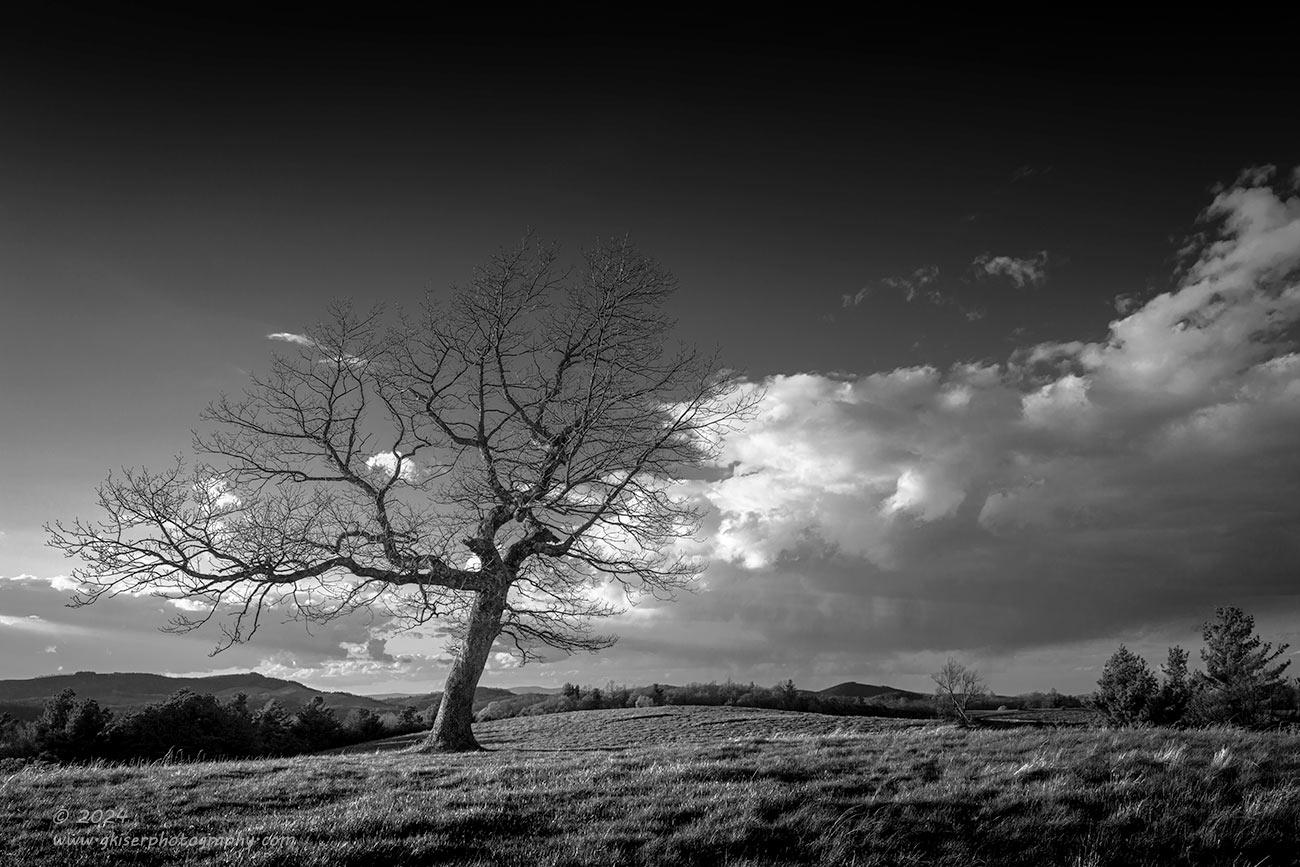
I could have stayed committed to the composition and remained here until the sky started to cooperate, but that felt like a waste of time seeing how the clouds were progressing in the sky. The decision was made to abandon the composition that I had spent so much time on to go with a compromised composition to get more interest in the sky and hopefully workable light on the tree. I found that composition a bit further to the left which brought the clouds back into the scene behind the tree. By positioning the tree on the left, it allowed the clouds to build up to the right as a mountain would. There was just a hint of the sunlight on the trunk to give some depth. The compromise really came into play with the other trees in the midground to the right. I had eliminated those in the original composition, but now was forced to include them in the shot. I played with the camera position a bit more and found the right scale between all the elements. I didn’t really like the blue sky in the frame because I felt it overpowered the other elements. This caused me to consider this as a black and white image. There was no color in the clouds just yet, and by removing the color and giving it a red filter effect, I could add contrast to the sky while darkening it to match the tonality of the ground. By switching the picture style in the camera, I was able to see just that effect and the photo immediately worked much better.
I shot a series of frames as the cloud moved across the sky. Eventually, it separated from the tree, and I was left with the same problem that I had before where the sky was too boring behind the tree and the frame was off balance. The sun was getting lower, and while it wasn’t really putting any light on the clouds just yet, there was a warmth to the light which was showing on the tree. I felt that the right compromise was to go to the fuller view of the lighting on the tree to capture that warmth while it didn’t do much for establishing depth on the tree being mostly front light at this point.
I started to play with the angles and found one where I got a little bit of shadow on the tree and some decent cloud formations behind the tree. This was where I spent some time as the sun dropped in the sky. The light on the tree got better and better, but the clouds only started to pick up the color right at the very end of the light show. By that point, the tree was in the shade and the impact of the composition was over. The compromise that I had to make was to sacrifice the color in the clouds to have more light on the tree which made it more dominant in the scene. The clouds, while not colorful at this point did repeat the shape of the tree with a long outstretch to the right and a bit of crown right above. All in all, I liked the compromise here much better than when the clouds started to get more colorful.
It was at that transition when I saw the only other people that I ran into while at Doughton. It was a group of hikers walking along the trail. They stopped to talk with me about photography for a bit which was fun. By the time they were back on their way, the light was totally gone from the tree, and I didn’t see any reason to remain at this spot any longer. I left the camera where it was and moved around to see where I could best get the clouds in the shot. I didn’t like the broad bank of clouds that I had been photographing, so I looked for something where the clouds were a bit more broken up.
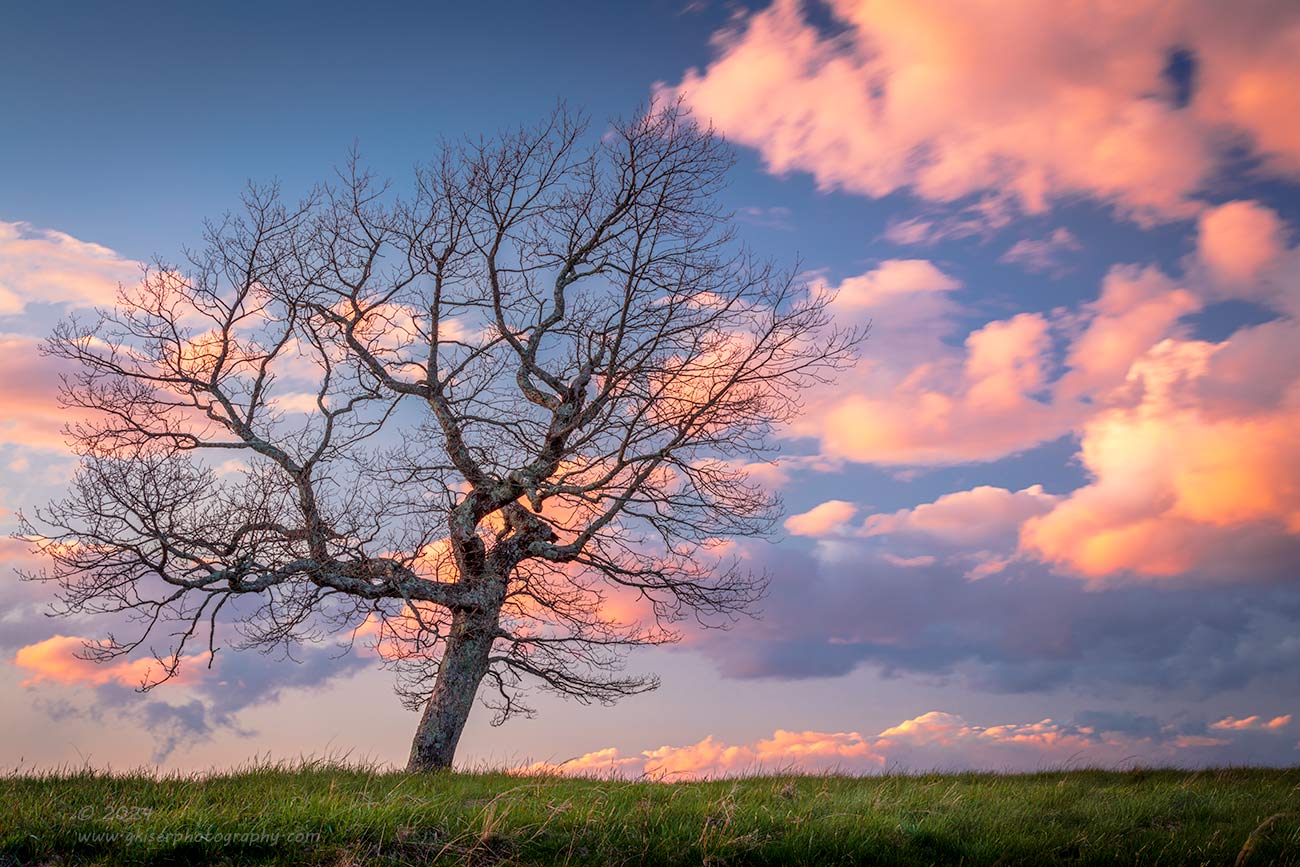
I found that vantage point over to the right, close to where I had shot the black and white frame earlier. The clouds were too close to the ground leaving too much empty space above them which meant that I needed to change to a longer lens. This was also a good time to walk away from the tree and go down the hill slightly. This was that minimalist image that I had scoped out earlier where there was no background. It was now going to work quite well as the clouds were going to be the background that I was most interested in.
After getting the lens switched over, I started to play with the position to get everything just so. I found an angle where the clouds once again went with the shape of the tree by getting taller as the eyes moved to the right. I knew that I wanted to bring out more of the oranges in the clouds, so I switched the white balance over to shade to protect the warmer tones in the highlights from blowing out based on my exposure. There were several shots done here without regard for the light on the tree because with the bright clouds in the background, I needed the tree to be dark in order to show off the structure.
It was the lack of light on the tree that made this one of the last photos to be edited, but in the end, I think that the overall impact of the scene was just what I was after. The tree structure was simplified because of the shadowed light on it and that gave more visual importance to the clouds which told the story that I wanted here. The tree serves as a strong visual anchor, and it gives an impactful point of interest that gives context to the clouds behind it. With a bit of tweaking in Lightroom, the final photograph turned out to be a very strong image and shows probably the least amount of compromises as any of the photos here.
By this time, I had been working the single tree for nearly an hour. While I love the tree, I did want to get some more variety in the photos, so I started to look for other areas that interested me. One view that has captivated me for quite some time now is the view off to the Southwest using a rocky outcropping as a strong foreground leading out to the mountains in the distance. The low sun was starting to cause a shift to pink in the sky beneath the low cloud bank. My hopes were that the sun would drop below that cloud and light it up as well. Knowing how this composition was going to look, I knew that I had the right lens on the camera. All I had to do was move into position and frame up the scene.

Everything fell into place as I suspected that it would, but the deep cloud above was causing me some issues. There were some rain squalls in the distance, so I wanted to have the cloud in the frame, and the hopes were still that it was going to light up with the sun reaching the horizon. I had more of the cloud in the frame than I really wanted, but if it did take on color, it was going to look great. As the light changed, I fired off exposures hoping to capture the best light. The rain squalls were getting more and more pronounced with the strong side light which I loved. This was an aspect that I really thought brought a lot of visual interest to the already colorful sky.
The exposures got longer and longer as the sun got softer and softer. Fortunately, there wasn’t much of a breeze and the six second exposures that I was shooting didn’t seem to be causing any issues. Just in case, I did raise the ISO and dropped the shutter speed back to 3.2 seconds just to control the gusts. In a short amount of time though, the light faded to where the color was no longer that intense, and the deep cloud was still pretty much blue. That was all that I had for this composition, and I wasn’t sure that it was going to work out at all.
The biggest compromises that I ran into with this photo was in the post processing phase. I liked the photo for what it was, but at the full 3:2 ratio, The cloud at the top of the frame was too overbearing for the image and made it feel very claustrophobic which I thought didn’t fit the mood I wanted for the photo. I went with a 16:10 aspect ratio which cut a lot of the cloud out leaving what I felt was a natural closing in of the scene. This was how I edited the photo, but it still felt odd to me by the time I was done. After playing with a few more crops and aspect ratio changes, I left it alone to look at again in the morning.
When I came back to it the following morning, I had that same claustrophobic feeling at 16:10 that I did with the 3:2. I dropped that down to a 16:9 ratio which allowed me to eliminate the cloud altogether which I liked. However, removing the cloud from the composition left the rain squall just hanging there without a reason. That forced the rain, which I had loved in the composition, to become a distraction to the scene. That was not a compromise that I was willing to make. By shifting the framing up a little bit, I was able to get a sliver of the cloud in the frame, but if I allowed it to go from left to right, I was back to that claustrophobic feeling that I didn’t like. My only alternative was to have a bit of the cloud on the right side of the frame allowing it to move out of frame quickly just after the rain. This opened up the sky and gave the photo the feeling of openness that I wanted, while still having enough cloud to give context to the rain squall. It was not ideal, and I would have loved a sky with more texture, but this was the situation that I had and what I had to deal with. The final photo is one that I do like and does work well for this composition thanks to the rain. There are also some different colors here than in previous attempts which will give my print clients another option if they like this basic composition.

While I was noticing that the sky was losing the color in the last composition, I could see a glow on the horizon to the right, through the trees where the sun had dipped behind the mountains. Remembering a photo that Toni had shot when we were enjoying a sunset together a while back, I went to find a clear view of the horizon so that I could try something similar. I walked about 150 feet to the edge of the ridge I had been working on. This gave me a clear view of the distant horizon. Immediately, I could see that the layers of hills were looking great in the haze of the sun. The clouds right above the horizon were picking up the reds from the sun, and there were some faint oranges above the clouds that went into a radiating section of clouds that had some deeper tones to it.
I was going to have to work fast to get this light, and I had no idea the composition that I was going to use. I knew that I had the right lens attached because there was no need for any foreground as I just wanted the receding mountains to lead the eyes into the photo. This was going to be a cloudscape more than anything else since that was where the interest really was at. The first composition that I framed up was a horizontal one that encompassed the entire sky with the radiating clouds to the left and the glow from the sun to the right. The upper right was largely negative space, but there was a cloud that encroached into that portion of the frame to keep it from being empty space. I didn’t really like the composition though, so I started to play around with other options.
As the sun was pretty much gone after that first shot, I moved to a vertical orientation to get the dramatic cloud above the long cloud. This felt really good in the camera, and I tried a few different framings in quick succession thinking that I had nailed it. As the light was changing, I went back to a horizontal orientation once again, but one that was much tighter on the fading color. This felt better to me than the first attempt, but not as strong as the vertical one. There were about eight frames shot as the final bits of the sunlight faded behind the hills, and that brought me to the end of the trek.
There were 44 frames shot for the evening which kind of surprised me. I felt that I had been working much slower than that with a lot fewer exposures being made. It was a good number of shots though, and I figured that I was going to be able to get four photos out of that bunch without too much problem. No matter how many I managed to keep from this trek, it was great to get back out to one of my favorite locations again after both conditions and construction had kept me away for so long.
It was that last series of photos which were the last to get looked at for edits before I went to sleep on Wednesday night. I had three of them picked out to edit on. There were one each from each basic composition that I had shot. I had included the first composition that I had felt was the weakest because it was the only one with the glowing red sun that reminded me of Toni’s photo from before. Again, I thought that the vertical one was the strongest composition out of the bunch, but for some reason that was not the one that I chose to edit. I went with that first composition that I thought was the weakest.
The edit was quick and as I went through the steps, the photo just came to life right before my eyes. By the time I was done with the global edits, the photo surpassed anything that I could have done with the other two options. In fact, this one shot became my favorite from the evening. The dramatic colors, the glow on the horizon, the mountains in the haze, even the secondary colors above the clouds all worked together for an incredible photograph. The glow of the sun was instrumental in providing the balance that this composition needed with the negative space on the right side. This was something that the other horizontal image failed to deliver on. The vertical composition didn’t showcase the mountains enough to give them sufficient weight to establish the frame. This early failed composition checked all the boxes for me and quickly became a success after seeing it on the larger screen.
The evening had been all about compromises to work within that triad of qualities that I look for in a photograph. I try to have at least two elements present out of these three attributes: Subject, Composition, and Light. There were countless compromises made in each of these keepers to get the strongest of all aspects of that triad in each photograph. I’m happy with all five of these for how well I managed the compromises both at the time of capture and during the edits. However, looking back over these photos reminds me why I much prefer shooting sunrises rather than sunsets. It all comes back to listening to the landscape. After being out here for about an hour and fifteen minutes, I was finally able to hear clearly how the landscape wanted to be photographed. Unfortunately though, the light was now gone. Had this been a sunrise, I would have been in the zone and fully connected to the landscape. I would be able to work many more compositions from this point forward as the light continued on. I can say that I am happy with the fact that I was in tune with the landscape when it came time to act fast to capture that sun behind the horizon. That was an easy one to miss for sure.
I hope that you have enjoyed this trek and the photos that resulted. It is nice to get back out into the landscape again and Doughton rarely disappoints. Should any of these photos speak to you, don’t forget that I do offer prints of my photos. You can select from stock sizes through the gallery store, or you can contact me directly for larger sizes and specialty media such as canvas and metal. There is just no better way to enjoy a photograph than in its intended form. The digital images you see here are very low resolution and saved at a fraction of the quality from what the print file would have. No matter what size or form you want your print in, the quality of the photograph is leaps and bounds beyond what you will ever see here.
I had fully intended to have a workshop here at Doughton this spring, but with the construction concerns I wasn’t sure if that would be possible. Even calling the Parkway offices didn’t yield a solid enough answer to make it a possibility. However, after I see how things go for the next little bit, I might try putting together a small workshop here in the Fall. Keep your eyes out for that in the near future. In the meantime, should you want to work on your photography skills with me in a one-on-one setting, I do offer mentorships and have some open slots available. Just give me a call for a free, no obligation consultation to see if I’m a good match for you. The nice thing about mentorships is that we can go to the locations specific for what you are wanting to learn and cover exactly what you want to. Let’s get your mentorship underway!
It will probably be a while before I’m back here with another trek. I’ve got a presentation in Chapel Hill this Saturday, and my Photographing the Mundane Workshop on Sunday. There are a few obligations going on the following week, and then I will be gearing up for a corporate headshot session in Charlotte. It will be hard for me to concentrate on my own photos, which makes me very happy that I have been able to get out for two different landscape shoots this early in the season.
Until next time….