Monday, September 20, 2021
If you remember from over the weekend, I mentioned that any time I start having dealings in Traphill I tend to get busy with new locations to shoot? That comment is really starting to sound a bit foreshadowing now because you see, I was out delivering a print Monday afternoon to a client of mine that lives in Traphill. The scene in the print was of a barn in Ashe County, but the connection was certainly there. While scheduling the delivery, my client happened to mention that there was an old house located in Traphill at her Grandmother’s place that I might want to photograph. Old house….Traphill…that sounds like a winning combination for my photography. When I dropped by to deliver the print, I got some more information about it and found out that the house was built in the late 1800’s. It was a two level house that housed quite a number of branches of the family tree over the years. Of course, it had fallen into disrepair, but that was just when they started getting interesting for me. With the location confirmed and the blessing from her Stepfather who owned the property, I was on my way out to Traphill once again.
You think I’m kidding about Traphill, but it really is the truth. As you go back through my rural blog entries, you will see a trend that I keep getting tips out in this area and every time I shoot something, it will lead to something else. For my decay photography, I would say that this corner of Wilkes County has been the most fruitful for me over the last year or so. The odd thing is, to just drive through and look, it doesn’t really look like it would have this many subjects. I really believe that it is the way that I approach my location scouting that has yielded such a positive outcome. As you well know, I am very respectful of property and with very few exceptions nobody would ever know that I was there. My care with the properties as well as my drive to capture these memories with respect for the past has opened many a door for me. It is something that I hold near and dear and consider it a trait that all photographers should have.
I might have digressed a bit there, so lets get back on track. I was headed back out to Traphill to a road that I had been on many times over the last year. When the GPS pinged that I had arrived, I could just see a driveway from the road. As I turned in, I saw the house well back on the property. It was magnificent and even better than I had been lead to believe. It had more mood and atmosphere to it than any amount image editing could add and I just got chills running through my skin at the thought of being able to photograph this treasure. I got parked in the driveway by the occupied house and spoke with the property owner. He confirmed that he had no problems with me getting some photographs of the property. He also brought out a framed painting that an artist had done back in ’93. It was 4/4 and showed the creek running through the property with water in it, and a small cascade leading to the house. Of course, the house was in better condition 20 years ago for the painting, but there was still a nice decay vibe to the painting that I loved.
I hopped over the fence and worked my way down through the field noticing the cow patties in the yard. I could tell that this was now the cow pasture and I was going to have to be careful about where I set my bag when I started to set up. I surveyed the scene to see where the best angles were going to be. The stream was non-existent at this point so that wasn’t going to be a possibility for a composition which was well enough. You see, there were a cluster of buildings and barns over to the right of the house which either weren’t there in the ’90’s or the painter decided (correctly) to omit them in his composition. That is the really nice thing about being a painter, you just include what you want in the scene and you can alter scale as needed. Photography is a bit different because you only have the scene in front of you to work with, and you have to compose a scene that omits or minimizes things that you don’t want in the frame. In short, painting is an inclusive artform and photography is an exclusive one. I was going to have my hands full with working around the extra buildings to the side. I was also noticing that there wasn’t much in the way of foreground interest to work with either. Now, I don’t always have to have a foreground, but it does help by keeping the photograph from looking like a postcard.
I finally found the first angle that I was going to capture which was off to the left of the house looking at the quarter view. The oldest chimney was forefront in the composition and I wanted to enhance the size of the house so I opted for my 16-35mm lens to start with. I got that fitted on the camera and then mounted it all to the tripod. I added a polarizer because of the tin roof and to try and get as much contrast in the sky as possible. As I was getting my position set up, I noticed that two cows were coming towards me from behind the house. This has happened to me before so I just started to talk to them and let them know I was just there to photograph the house and I would leave them alone. They didn’t seem to buy it, because one of them let out a long Mooooooooo which apparently translated into “Hey ya’ll, come here and check out this guy with funny walking stick.” Within a matter 30 seconds or so, I found myself surrounded by about 20 cows. A quick survey of them showed no horns, so I wasn’t too concerned. I just continued to talk to them as they gathered around me like I was going to tell them a story. The thought crossed my mind, but my main goal was to convince them that I was boring and that they didn’t need to monitor my existence.
Well, as the minutes ticked away, I could see that things weren’t going to go well from this angle. I had already put the bag on my back, so I just picked up the tripod and started walking to the other side. As I was hoping would happen, the cows parted and allowed me to pass through them. This was going to work. I just walked across the field and didn’t give them any mind. Well, that is, until I heard some shuffling behind me. I turned around to see a rather comical sight of all 20 head following me in a “V” formation about three feet behind me. I got to the area that I was wanting to photograph and set the tripod down. The cows immediately continued past me and started to form a circle again. Hmmmm, this wasn’t going to work. At this point, they were becoming comfortable with me and two of them were sniffing the tripod legs. That bothered me because if they were getting that close, there was a good chance that the camera might get knocked over and trampled. Notice I wasn’t worried about me, just the camera here. I went ahead and picked up the camera and moved towards the fence that I hopped back over. I thought that I might be able to get a similar composition from on top of the hill from behind the fence. I was also hoping that once I was out of their pasture that they might just leave me alone and let me work.
So far, I had worked compositions out on two different sides of the house, and had captured not a single photograph. I had been the star of a one man show that was keeping the attention of the cows much longer than I was hoping for. As I was seriously pondering whether or not I was going to be able to get any images of this amazing house, a few of the cows broke off from the herd and started back around the house from the area where they had come from. I just sat an waited for the rest of them. Most did leave with the exception of a Mom and her baby who stopped midway in their retreat to have a little milk break. There were still two young cows which I recognized from the sniffing of the tripod that stayed with me and watched as I started to compose the shot that I wanted. I was finally staring to make images thanks to being able to shoot over the cows right at the fence. As I got into my groove, the remaining four cows decided that I was no longer of interest and they turned and left the area.

Not wanting to give them a reason to return, I wanted to wait a bit before going back into the pasture. I was not liking the angle that I was getting on the house from behind the fence, so I was prepared to abandon that and move onto something else. I had noticed an old heavy duty Chevy truck sitting in the field back down the driveway. It was covered in weeds, but I kind of liked the look of the scene. As deep as the weeds were I was pretty sure that wasn’t part of the cow’s normal area to be in so I felt that I might be able to work that truck really quick without them returning. I went over towards it and jumped the fence once again. I had swapped out my wide angle lens for my 24-70mm from when I was shooting from behind the fence and that was the perfect lens choice for this old truck. I framed up a nice tight shot of it that provided just enough detail to the cab in comparison to the textures that surrounded it. I only did a couple of exposures here, both with a polarizer attached to help with the contrast and glare of the scene.
Once I was happy that I had finally gotten something in the bag, I moved further into the pasture fully expecting to see the cows returning once again. For the time, I was alone and thankful. I could see the little stream that showed up in the painting, but there was really no water in it to speak of. This angle also lacked dimension to the house as well as would have forced me to include the other structures to the side. There was nothing here that I cared to compose around even though it looked great in the painting. The scene had changed, and the compositions that would work had changed as well. Not wanting to draw attention to myself by going back to the same side that I had started at before, I decided to go back to the left side of the house first. I had spotted a patch of weeds that happened to be just big enough to be used as a foreground element.
I considered switching back to my wide angle lens, but as I was playing with the proportions, I found that the standard lens was just perfect and it didn’t introduce any odd perspective distortion. The sweet spot for the composition was right at 35mm which would have worked with either lens, but I knew that it would be sharper with this particular lens since it wasn’t at the extreme of the zoom range. I played with the altitude of the camera and then decided that the sky was going to be a little too bright in the composition as well as the new tin room. To combat that, I changed up my filter selection by adding an ND Grad behind the polarizer. By choosing a soft edge filter and only 2-stop, I was able to add a little density to the sky as well as take out some of the highlights from the roof. The exposure quickly improved on my histogram and I was ready to start making exposures.
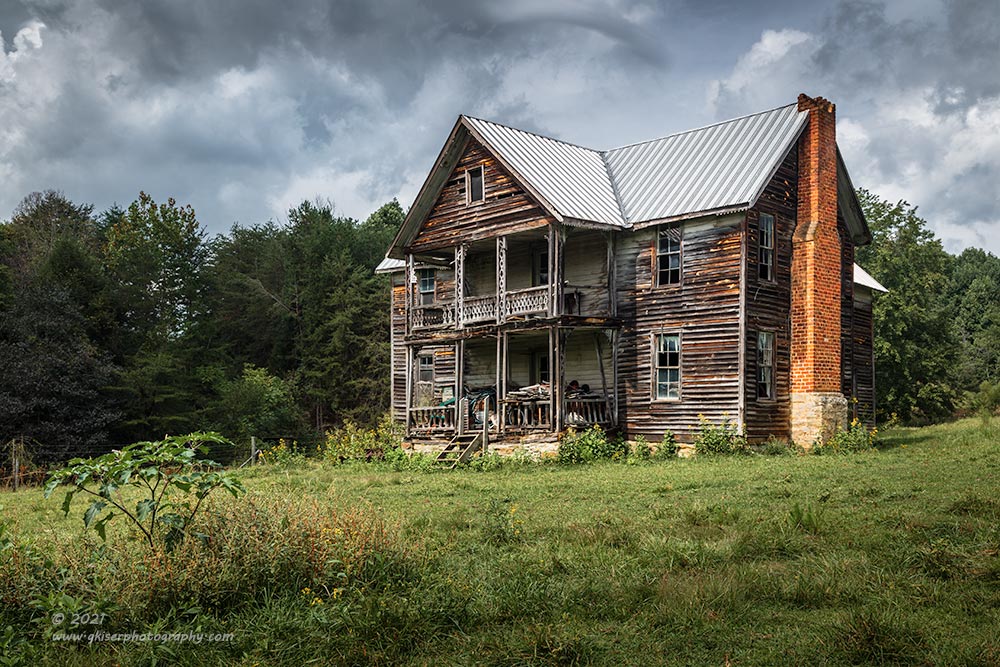
The clouds were moving quickly across the sky and from one frame to the next the formations of the clouds would change. That gave me plenty of reason to just stay there for a bit and see what happened. Another benefit to having the clouds moving around was that the levels of sunlight on the house continued to change. I decided that I didn’t want the house to be in full shadow because there was just too much great detail to be had in the siding. I also didn’t want it to be in full sun because that would make it look too cheery and that would negatively impact the mood of the shot that I was going for. It was those in-between times when the light was building or fading on the house that I loved the most. Those were the times that I tried to capture more than any other. I was hoping to have several images to choose from when I got home so that I could pick out the best sky for the scene.
While I was watching the sky move, I was noticing that the cows had not returned and I didn’t hear cow noises in the distance either. I guess they finally got bored with me which was great by me. I was feeling a little bit better about moving around freely in the pasture at this point. When I was reasonably happy that I had several images to choose from, I picked up the camera and went back over to my first location on the other side of the house. I started to line up the different elements from this side and realized that the angle that I had started with was a little too tight on the side. I had chosen that in order to block the view of the structures on the other side of the house, but it caused me to lose depth to the house. I moved back to the right a little bit and found that the house looked much better, but I was getting the shed off to the side which had a skidsteer parked in it. I didn’t like that aspect, but I could live with the building poking out a little bit on the side for balance. It also gave a much more flattering angle on the house which was the most important aspect.

I left the lens and filters on the camera that I had started with and fine tuned the composition. I chose to give the house a bit of breathing room off to the right which would keep me from centering the house. I chose a tree in the right side of the frame to be a framing element. Because I was shooting in close at 30mm, I could tell that there was a bit more perspective distortion on this side than the other so I over shot the scene at 35mm to include a bit more on the sides so that I could correct the converging verticals in post. It was a small price to pay for the scope of the composition I thought.
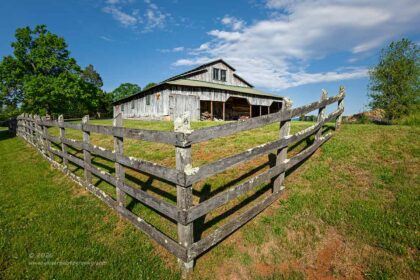
As I had done with the other side, I sat there and waited for the clouds to move across the sky so that I could get the most balance to the tones. I also found that the light that fell between sunlight and shadow was the best light for this side as well so I shot specifically at those times when they happened. I wasn’t quite sure which view I liked better, but I was thinking that black and white would probably be a great option for at least one of them to really add to that mood. In the end, I made the decision to leave the one with the weeds in the foreground in color because that foreground interest just got lost in monochrome. The little splash of yellows in the weeds helped to add that visual interest that was so needed for it to be a successful element in the image. The view from the left side was more about the wooden siding and the textures there so that kind of forced my hand on the presentation of that piece. It also helped to have that smaller building to the side blend into the scene better by getting rid of the color. The Bobcat that was parked in there wasn’t nearly as problematic as I thought it might have been.
I had now been able to shoot the two compositions that I had located while entertaining the cows. I was pretty happy with them at this point, but knew that there was more to this pasture than what I had shot up to this point. I wanted to check out the cluster of barns and sheds over to the right of the house which I hadn’t really paid any attention to as of yet. I walked out that way and started to see what the buildings were and whether or not they would be able to make for good compositions. Most of the structures were sheds and not really what I was looking for, but there was a very interesting barn which was behind the other buildings which I liked. It had a slight slope to it that was visually interesting and would give me a diagonal to work with in a composition.
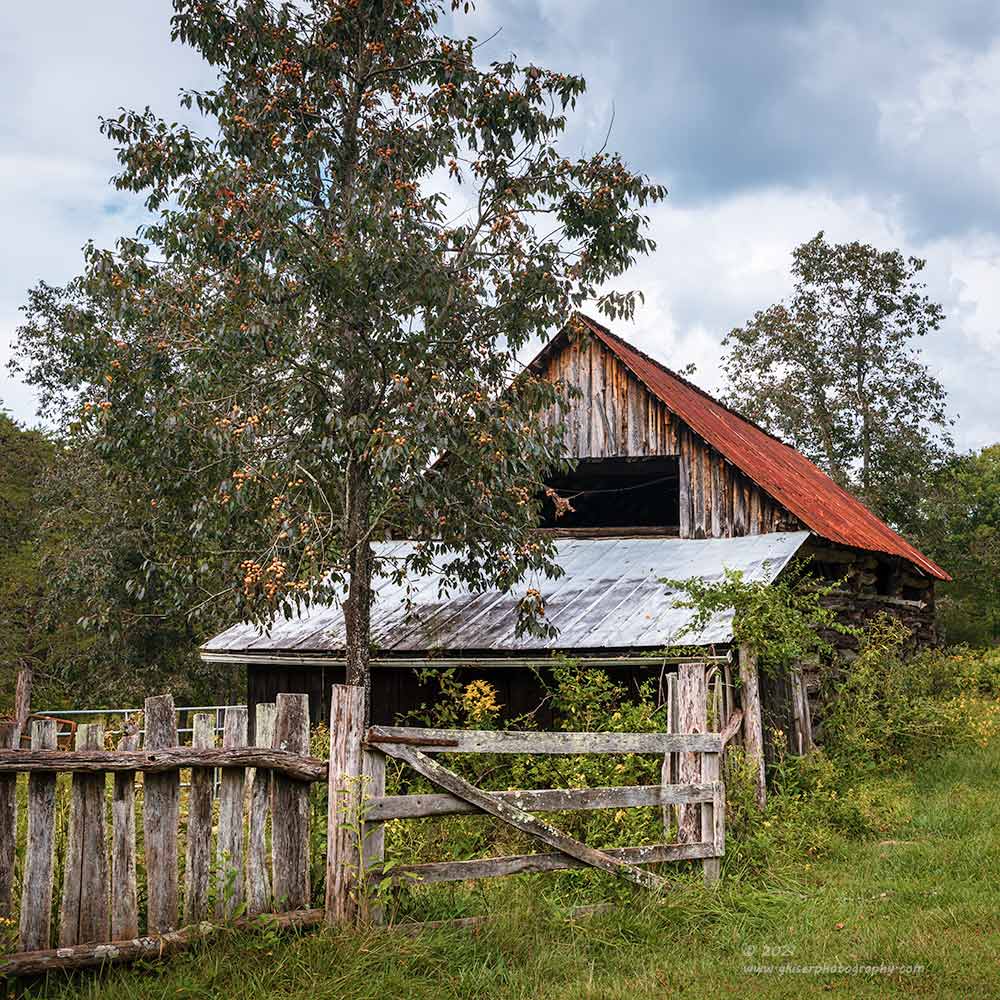
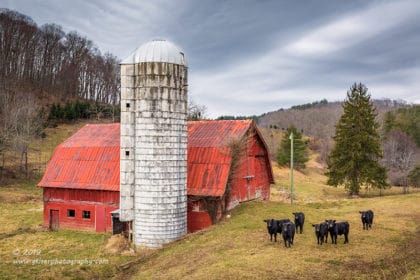
I started to really study this barn and try to figure out what angles I could get on it. There was a tree that was right at the corner of the overhang that was obscuring part of the barn, and there was a shed to the left that was encroaching very close to the barn. I tried a lot of different angles here from horizontal to vertical but nothing really worked for the scene. As I will often do in those situations, I selected a 1:1 square crop in camera to see how that would look. Without even trying to fit the elements in place, the tree lined up perfectly on the left third line, and the other elements fell right into place as well. This was going to be the best way to capture this side of the barn. I still had the polarizer and the grad filter on and saw no reason to change anything because they were working just as well here as they had for the house.
With the sky not being a huge part, I didn’t have to wait for the clouds to move around like I had before. I was just waiting for the lighting to be right. That didn’t take long because I knew what light I wanted here. I just loved that moment between full sun and shade that would fall over the scene every few minutes. That light just seemed to work so well for everything out here. The hardest part was getting the breeze to die down long enough to get a still image, but even that didn’t take too long. I was satisfied with this barn, but there was a part of me that said that I needed to look at another angle a little more from the side to see if that would work.
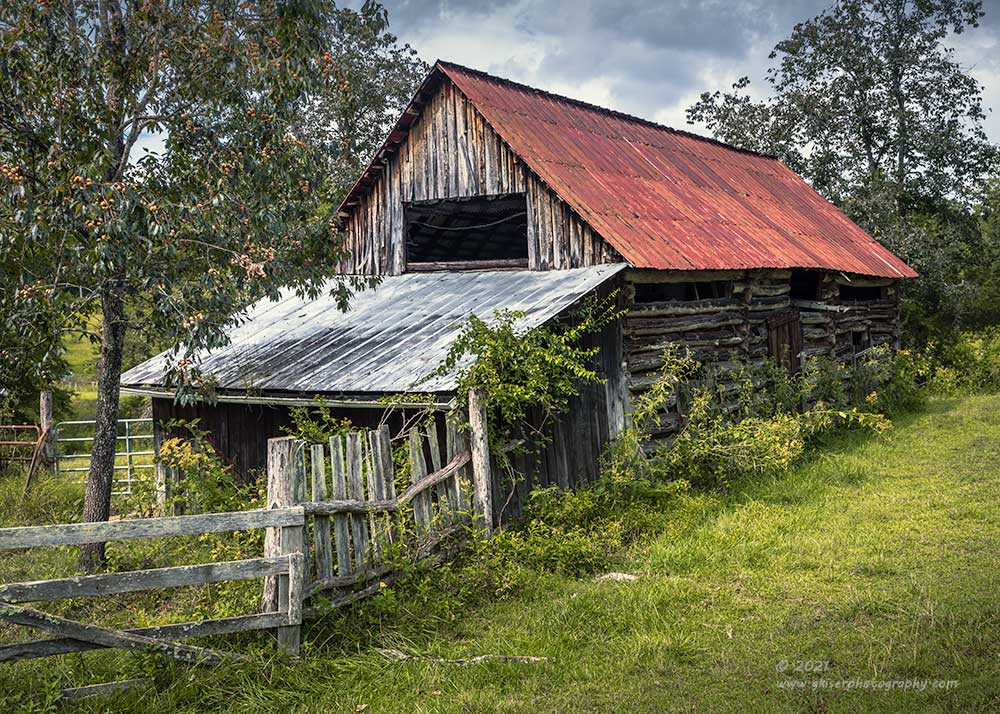
I moved over to the right and stopped with the roofs lined up on two of the buildings in the background so that I could put the left side of the frame just inbound from those roof corners. That angle gave me the diagonal of the fence that I had liked so much when I first started to look at this barn. With the left side frame of the scene right at the two roofs, I had the tree in a good location and it wasn’t really obstructing the view of the overhang which I liked as well. I also got more of the rusty color of the roof which I thought added a nice pop of color to the scene. It was a largely different composition from what I had shot before and it showed a whole different character of this barn.
It was a quick capture because I knew how to time the light perfectly at this point and the sky wasn’t quite as important as some of the other ones so as long as I had texture above the barn I was happy with it. The grad filter remained on and provided just the right amount of density for the sky and the polarizer removed the glare from the metal surfaces as well as saturating the greens a little bit. It was just a nice and simple rural scene which I love being able to capture when I can.
From here, I walked around a bit more and almost had another great composition of a small boat sitting beside a small pond. It was one of those scenes that I had been wanting to find for some time, but this wasn’t quite going to work. There was a tree which had a branch that dropped well into the composition and interrupted the flow of the water behind the boat. There was a tree in the background that I wanted to place as a complementing element which forced me to include the drooping branch in a place that just killed the composition. The more I tried to work around the branch, the more haphazard the composition became. I finally threw up my arms and gave that idea up because I just wasn’t getting anywhere at all with the idea.
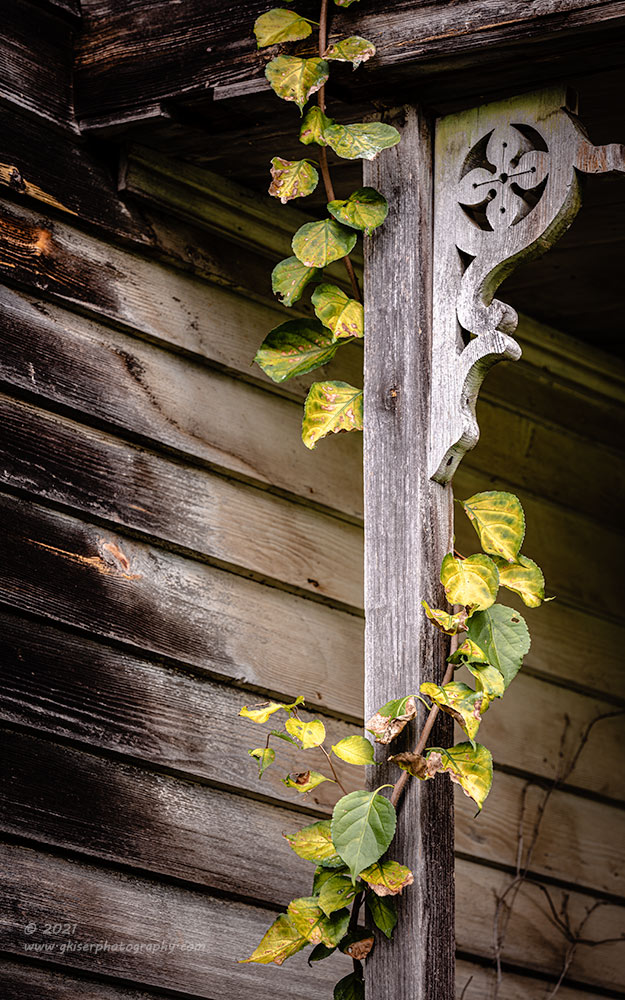
As I came back around to the house and the barns, I started to look for one last composition to shoot before I loaded my gear back up in to the truck and set my course to home. I wasn’t really seeing anything that captured my attention at this point. I did, however, remember that there was a vine growing up on one side of the front porch. I had spotted it when I was working the overall image of the house from the left side. I walked around to check it out a bit closer. The vine was in the soft light of the sun which worked great. It was wrapped around a decorative bit of wood that I thought was just beautiful. The weathered siding of the house provided a nice balance to the composition that I had in mind. I really felt that a vertical shot of this was going to be the way to go, and I was going to crop it narrow to really accentuate the length of the vine. I typically don’t crop verticals in this fashion because they tend to look better at a 4:5 or 5:7 ratio, but this was a great exception to the rules.
I swapped out my lens for my long 70-200mm telephoto which would allow me to reach out and get a tight shot of this vine. I stripped off all the filters for this shot because I kind of liked the highlights on the leaves and thought that they added to the composition. I only shot a couple of exposures here because it was really that kind of simple. The wind was my only concern so I wanted to make sure that captured it in a proper lull which was the reason for the multiple shots. I did manage to freeze the motion in all of them, so I just had to choose which one had the leaves placed in the best location as there were a few that I could tell had been blown around between frames.
With this shot in the bag, I looked to see how many frames I had captured for the day. I had shot 67 frames at a location that I never knew about, and had only started to consider it a few hours before. Looking through the compositions on the image review, I was thinking that I had five images that would work, and possibly six. When I left the house, I knew there was a possibility that I would be getting some images of an old house, but I never would have imagined that it would have turned out quite like this. Like I keep saying, Traphill is a magical for me, and every time I go out there I end up coming away with something fantastic. The only question is where will this trek lead me to next? Looking back at history, I’m probably good for another three adventures into Traphill before things calm down again for a while. I’m looking forward to it, and I just can’t wait to see where it all leads me.
I hope that you have enjoyed this trek and the photographs that resulted from it. I had a great time, especially talking with the cows. Had they listened to me a little better, I might have gotten a few of them to pose for me, but they didn’t understand depth of field and the need to have them in certain locations within the frame. At least they did eventually allow me to work once they got bored of my presence there. If you see any of these photographs that speak to you, I would love to talk with you about your very own print. There is just no substitute for holding a print on fine art paper and being able to enjoy it in the manner in which the photographer intended.
Until next time (probably in Traphill)…..

Remember to use the code KISER10 to get 10% off your purchase