Saturday, October 1, 2022
Since we are still experiencing some issues with the email notifications, if you missed the first part of this adventure, you can find it here. I’ll wait while you catch up.
It is a short one, so there is a good chance you are done reading it by now. This is going to be the second installment to the series and will included the images that were captured up by the house. In order to keep from dumping 24 images into a single blog entry, I’ve decided to break them up into location where they were shot. After working on the area by the side of the road for quite some time, I decided to explore up by the house for a bit. I walked up the driveway where I was parked and found a Mach 1 Mustang sitting at the top of the driveway. It was a white car with very little patina to the paint, but there were plenty of signs of age on this car. I liked the contrast of how it stood out from the trees, but that was really about all that drew me into the frame. It was interesting enough to try a few shots of though.
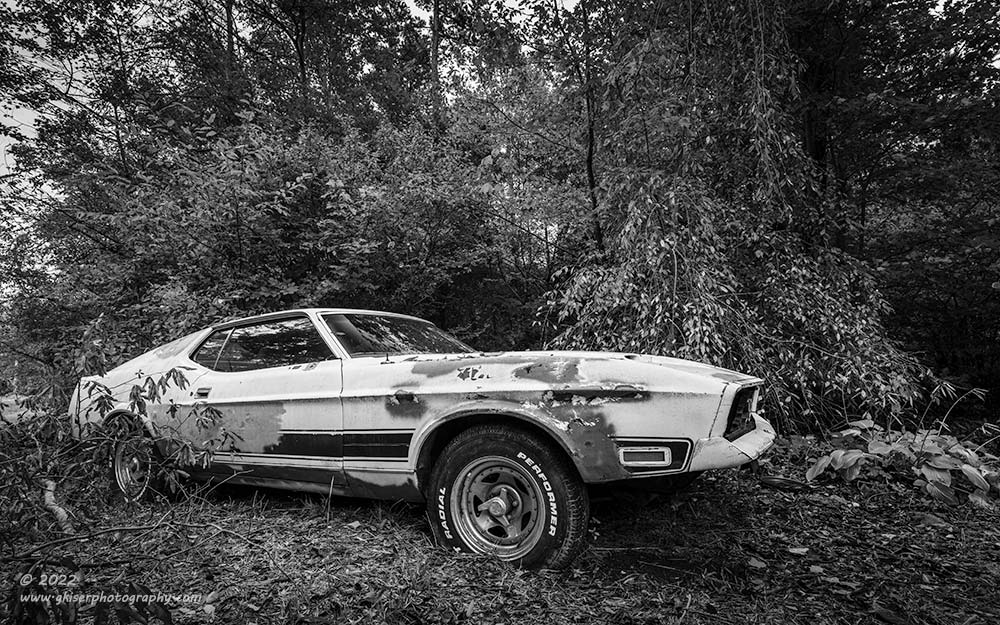
What I quickly realized was that I had painted myself into a corner here in a way. I was able to see my white 4Runner in the distance through the trees, and I was also able to see a green Geo Metro just inside of the trees. There was just no angle that I could see working with this Mustang. I wasn’t prepared to give up quite so quickly though. I looked at all the elements that I needed to control, and then started to ask the owner’s dog which had taken an interest in photography all of a sudden. We talked about the different problems that I was running into with the removing elements that I didn’t want in the frame. For a new study on photography, the dog suggested a great idea. I decided to switch out to my 16-35mm lens which would allow me to make the Mustang much bigger than the Metro and I might be able to hide it behind the Mustang while keeping the 4Runner hidden behind the trunk.
The suggestion worked, and I was able to get a composition that showed off the lines of this muscle car. I had gotten the camera down very low to the ground in order to completely hide the Geo, but that added to the dramatic look of this composition. It still wasn’t as visually interesting as I had hoped for it to be. The white car didn’t really stand out in the way that I wanted it to. The lack of rust didn’t let the character shine through, and the overall scene was just too green. While I was pondering all of this, I decided that color played absolutely no part in this image, and I was more interested in the shape of the car which was amplified by the contrast between the white paint and the darker green of the trees. I’m not sure why the dog didn’t suggest this in the first place, but this was a perfect candidate for a black and white image. I even set the camera to show me a monochrome scene in the live view to confirm the thought. It worked beautifully without color, and I was convinced that this was going to be a great image compared to my initial assessment.
Shortly after getting this image captured, the owner came over and talked with me a bit. He told me some of his history as well as the history of the property. I learned about a lot of hardships in his life, but also about the amazing fact that he is still around to talk with me. He took the time to let me know that he was wanting to sell most of the cars that were on his property and asked if I could help him with that since I said that I had an online presence for my photos. I was happy to help, and I have his contact information in case anyone would like to call him and do some wheeling and dealing. The vehicles that I have captured here are but a small fraction of what he has on the property, they are just the ones that appealed to me for photographs. I’m happy to help fill in the blanks with what I know for those interested.
Anyway, I was happy with the photo of the Mustang, and the owner had gone back to doing some work on the property leaving me once again with my new canine student to find compositions. The next scene that I went to was a late ’70’s Camaro that turned out to not be all that photogenic. There was also a VW Bug parked near that Camaro which did catch my eye. The Bug was red and really stood out in the greenery. I was just having a very hard time figuring out a composition with it though. Even the dog was having a hard time making suggestions. No matter the angle, I was running into other cars, or even the house getting in the way. I just kept on walking through the property to get an idea of what else was to be found to photograph.
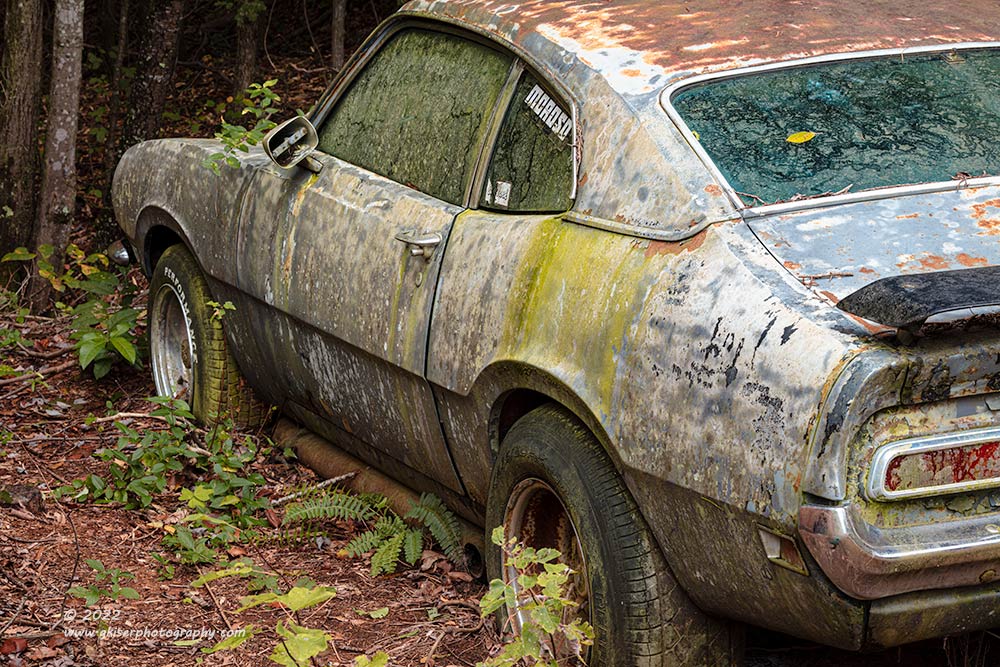
As I got to the back area, I saw another Bel Air similar to the one that I had shot next door, but this one was buried in the brush with only the fin poking out. I looked at this scene for a while and couldn’t figure out how to capture it. A short distance beyond the Chevy was a Ford Maverick. This thing was just too cool! It had the cowl induction hood, side pipes, big meaty tires on the back, and a spoiler on the front. The patina of the car was pretty awesome as well. I felt that I had to photograph this one, if for no other reason that when I was in high school, I helped a friend with a similar generation Mercury Comet, although his had two extra doors. This Ford was parked between two trucks that were pretty close to it. The front was right up to the trees, and the only open area to work with was the rear of the car. I spent time trying to identify isolations but couldn’t manage anything that I liked. What I was most interested in was the shape of the car, in specific the profile shape which I thought was a beautiful design (again, not with two extra doors though). I tried a composition from the passenger side where I could get the angle, but I had to include the red truck parked opposite which had just too much visual weight due to the color. I was still using my wide-angle lens and started to see that was not the right tool for this job.
I remembered some of the difficulties that I had in similar circumstances when using my 24-70mm lens and just how liberating it was to use the 70-200mm lens last week when I was shooting next door. That was the lens that I mounted on the camera at this point. Once I did that, the heavens opened up and I started to get inspired for compositions. Much like what happened last week, I was able to look at close crops on two and three sides to make the images work. I started off on the driver’s side of the Ford and found a wonderful composition that cropped through the rea and along the roof which blocked the view of the truck on that side. To make the crop look right, I cropped through the big tire as well, but left enough of it to show that this was a power maker back in the day. I left the breathing room in the direction of implied movement which gave the shape of the body room to be enjoyed.
I was feeling pretty good about this composition and was feeling like I had the key to getting the compositions that I was after in close quarters once again. I moved over to the Bel Air that was pushed into the brush and looked at it once again. There was another car parked behind it which kept me from getting the entirety of the back, which was a shame, but it was the fin that I was after most of all. I looked at my options and decided that I could do something similar as I had done with the Ford right before.
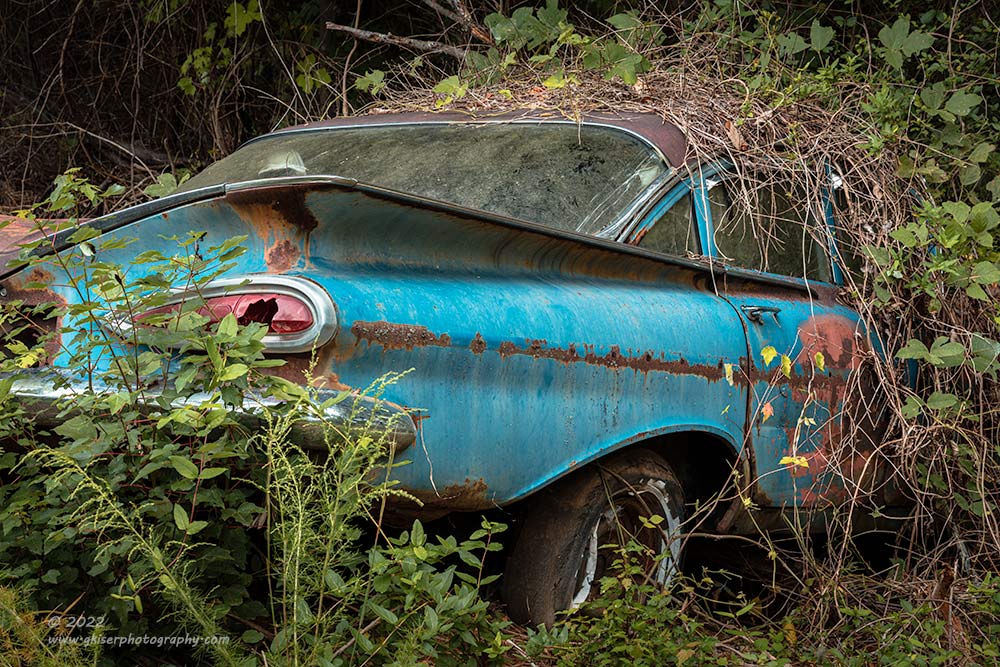
I decided to concentrate on the exposed fin by cropping the frame right at the apex of the two fins coming together at the rear. I would let the side of the car go until it was obscured by the vines and leave just enough breathing room at the top and bottom to make sense. This was a two-side crop composition which usually isn’t all that easy to pull off, but with how things were positioned and the actual shape of the car, it actually looked quite natural. The blue paint really stood out from the green, and the bit of rust, along with the taillight offered that balancing warm tone that really made the image work well.
Things were going pretty good now, and after being here for an hour or so, I was starting to really get into the zone with how I was needing to capture these vehicles. The long lens was opening up a lot of possibilities for me with the way that it minimized the background, and it also allowed me to work around highly reflective chrome surfaces much easier. The 70-200mm still isn’t as flexible of a lens as the 24-70mm, but there are times when it is absolutely the right choice, and this was one of those times.
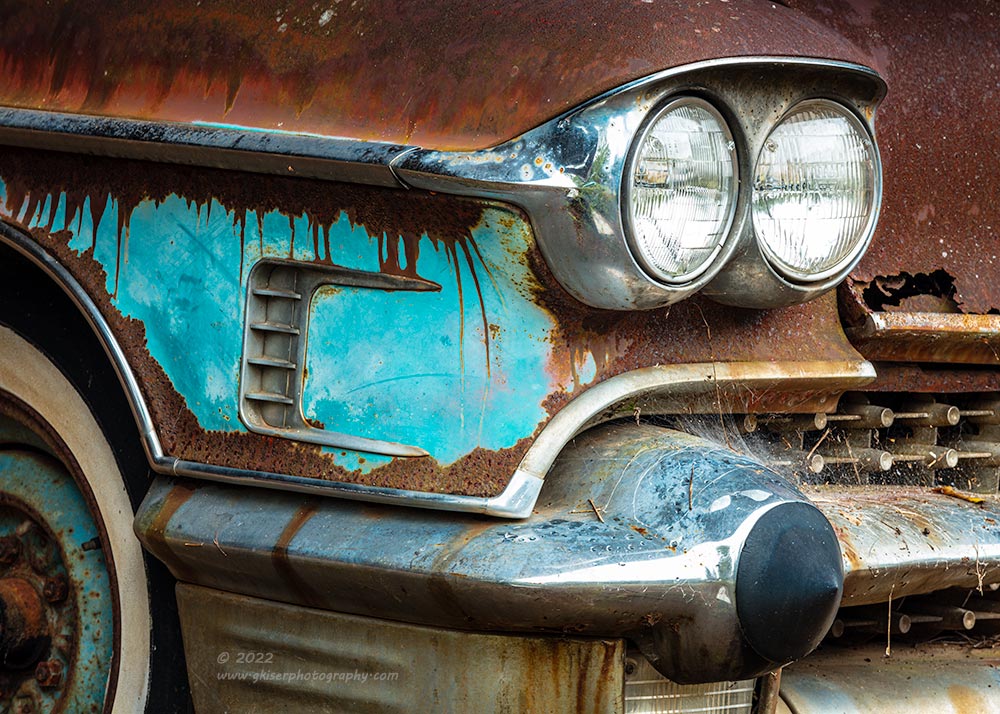
I spent some time looking around for other compositions and played around with a few ideas that didn’t really work. I was starting to look at the shelter in the middle of that part of the yard which had some very interesting subjects parked inside. I could see fins that had to be from a Cadillac on the other side, so I walked around to check it out. When I got around to the front of the car, I saw the beautiful blue paint mixed in with the warm rusty tones that I knew would make some great photographs. I was excited and started to examine the angles to see what I had to work with.
Once again, I found myself in a situation where there were lots of things around the car that I didn’t want in the photograph which made it very important what I did choose to include. I loved the twin headlights, the scallop trim at the front of the fender, and the way the fender cleared the bullet on the bumper. There was also the color matched wheel that I liked as another element which might be able to be used. With the chrome trim, I was going to have to be careful about being a cameo in my own photos, so I paid particular attention to the possibility of my reflection.
The first composition that I framed up included all the elements that I liked, even the wheel. I wanted to include the wheel because it helped to bring more attention to the curves around the bumper and the headlight housings. With that wheel in place, I was able to frame the harder edges of the scallop which brought more attention to it as well. The few remaining rain drops on the chrome added to the visual interest in areas that would normally just disappear which I was very happy about.

Because the front of this car was so cool, and I loved the color palette, I had to spend time working on several different compositions to make sure that I had something wonderful when I got them home. I probably spent the most time shooting this one car out of everything on the property, but that was all because of that all-important color contrast between the paint and the rust. This is such a perfect combination I didn’t want to leave it too early.
The next composition that I shot was one that I’ve done many times before, so I knew it would work. I framed up a vertical composition that used the scallop as a framing element and focused the attention on the headlights and the bullet part of the bumper. That blue still came through and made the image pop which was what I was after. I had to be a little more careful at this angle because I was much closer to the car than I had been, and I was starting to show up in the Dagmar. A slight change of angle took me out of the view and left a relatively clean bit of chrome to work with. I liked this angle because I was able to get one last bit of trim at the top of the fender to be included in the composition for a bit more visual interest and a bit of contrast to the rust.
I moved to the other side of the car and started to look for different compositions. That side of the car didn’t have quite as much of the blue paint still in place and failed to excite me visually. I looked for ways of capturing the fins on the rear, but quarters were much too tight back there and the light was too flat for me to really get excited about. In the end, I did come up with a composition that Iiked on the front left corner that was slightly different from what I had been shooting on the other side. The only problem that I had with it was the fact that the blue was just not a dominant on this side.

Taking the same concept for the composition back over to the other side, I framed it up again, but with the blue taking up more space. It worked much better over here, and I liked the dominance of the headlights when paired with the slight hump of the bumper which was all framed by the scallop and blue paint. I realized that I had shot a total of eleven frames of this one corner and had actually shot nothing else on the car. I felt bad about neglecting so much of what is arguably one of the larger cars of the era, but when it really came down to it, this was the only interesting corner between the light and the colors available. This was the corner that was going to capture the essence of the entire car for me, and I was satisfied that I had all that I needed for that.
I was sure that I had at least one image that I was going to like from this car. I can’t say that I was shocked when I ended up editing three different frames, but I wasn’t really wanting that many of the same part of the car. Had it not been for that perfect pairing of colors, and such beautiful elements coming together, I would have culled these down to just one image, but I couldn’t bring myself to delete two of these having grown to love them each for different reasons. That is why you are seeing three similar photographs here, when normally you wouldn’t. The color combination was just that powerful for me, and I continued with that same matchup a few minutes later.

By this point, I was feeling pretty sure that I had everything that I wanted from this part of the property. My canine companion was starting to whine a bit which made me think he was getting bored with the same few subjects that I kept going back to. Not wanting to upset the dog, I agreed to go back to the main part of the yar to see what I could find there. he seemed all too happy to follow me up to that part. Once we got there, I started to look at the Bug again and even asked for ideas from the dog. Neither of us could come up with a compelling composition for the car. I kept looking at the other cars that were scattered around the property. Most were not of interest to me, like the Volvo wagon. However, there was a boat of a Ford that caught my eye. It was an ugly big car, but it was blue and there was lots of rust on it. Having just come from the Cadillac with that same pairing of colors, I decided that I needed to try something on this car.
I looked around it for a point of interest that I could use. There was nothing up front that I liked, and the side panels were the size of billboards so there wasn’t much interest there either. The only part that caught my eye was the slope of the rear window which was almost like a fastback design. The top had been covered in vinyl which was long gone revealing the typical surface rust. At the base of that pillar was an emblem that simply stated “XL” which was appropriate for the car. I do like working with emblems and this one did have some visual interest. It was in a rusty part of the car, and in close proximity to the blue paint. I just needed to get a composition that worked around that emblem to include the colors that I needed.
I decided that this was going to be a great opportunity to use lines to create a geometrical composition that supported the colors that I was using. I started to look for the all-important diagonal lines and then started to look for ways to balance the image. To look at the final framing that I chose, you might start to wonder why the main point of interest is so small in the frame while I used so much area for basic panels. My theory was pretty simple though, the emblem was my visual anchor, but I wanted to establish a composition that allowed the eyes to travel. I had a sweeping line dividing the rust from the blue that brought your eyes right into the composition. There was a subtle ledge at the top of the blue that was showing signs of rust which linked the two sections, and then I also included a larger rust patch at the bottom right to balance the colors out even more. I used the back window and the quarter glass to give the pillar shape and context through the use of triangles. While the image started out as photographing a simple emblem, the final composition was about so much more than just that.
I was actually quite happy with how this one turned out. For an ugly car, this made a very dramatic photo that gives a sense of sportiness that the car never had. The colors worked very well as they had with the Cadillac, and it again shows how powerful that combination can be. This was actually a very fun experience in making a composition as I learned a lot through this one as to how to make an isolation with an area that doesn’t really have much going on.
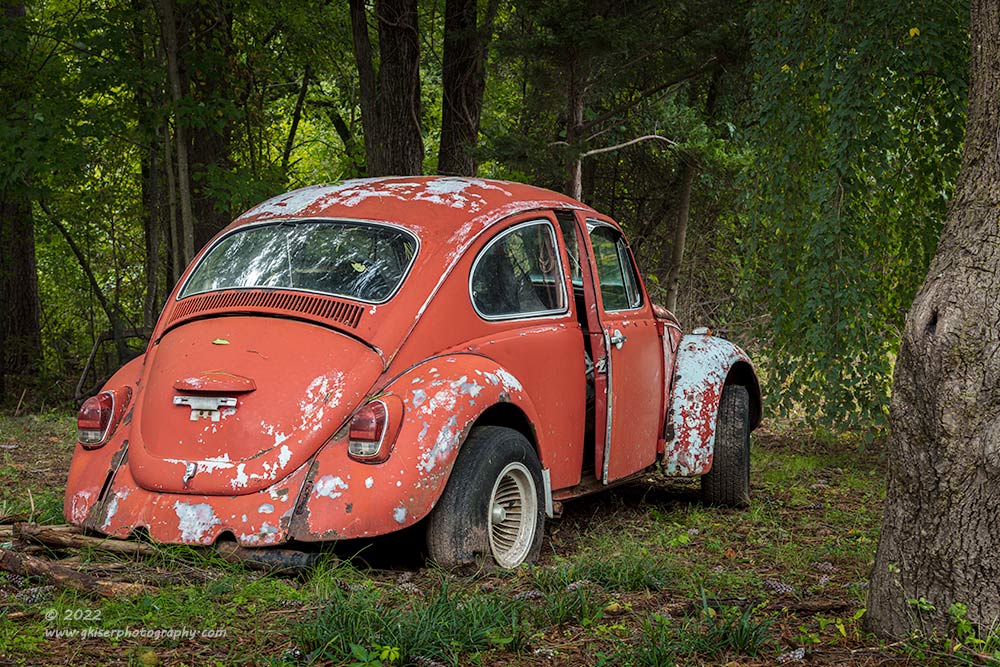
Feeling pretty accomplished at this point, I once again turned my attention to the Bug sitting there by itself. I looked for isolations since I had been having such good luck with them recently. The problem was that the car was actually in too good a shape to get a good isolation. The paint was smooth which eliminated the textures that I normally look for. There wasn’t that much rust, and at every turn, I could think of better compositions that I had shot with isolations of a Bug. The story here was the overall look of the car within the wooded setting. The smooth texture of the paint contrasted with the textures of the greenery around it which made for an interesting paring in addition to the colors.
Knowing that I was wanting to do a full shot of the car, I really started to consider my options. I wasn’t able to shoot it from the front left because I would get the house in the frame. I couldn’t go from the front right because that would show the Camaro in the background. From the back left, you could see the sea of cars where I had been earlier as well as the large shelter. From the back left, I had to shoot between two trees while trying to avoid photographing a large white door that was propped up against the trees. It was the only workable corner for me, so I got far enough away where I could shoot through the trees, and low enough that the car blocked the door.
The composition worked, but it was too static of a composition with the car centered in the frame. I tried opening up the lens a bit to include both trees, but that felt even more static having such a blatant framing element in place. I decided that the tree on the left had to go which would give the car nose room in the direction of the front, but the tree on that side blocked the visual progress of the car. In a last attempt, I decided to crop in through the tree making it a framing element. That allowed me to push the car over to the left in the frame while filling the right side of the composition with a tree that was of un uncertain size. The balance of elements worked here by doing the close crop of the tree, and I finally had the image that I had been after for this car.
I remember looking at the dog and saying that I knew I could do it, and that he was wrong for not having faith in me. Yes, I know I was having some really in-depth conversations with this dog, but it is what I do when I have a dog following me around while taking photos. Just look back on this trek to Jonesville not that long ago. I did the same thing there and it worked quite nicely for the photos. It really does help to talk things out when you are having a hard time with compositions. At least when I am talking to a dog, nobody realized that I’m talking to myself out loud.
Feeling that I had gotten everything I wanted from the main portion of the property, I was ready to call it a day. I had shot 70 images so far in about two and a quarter hours. The clouds were starting to get interesting, and it was time to look for some barns to photograph. I kept my camera out in case anything else popped up on the way back to the truck. I bid farewell to my canine companion as I walked past the Mach 1 Mustang and down the driveway. When I got to the truck, I decided that since I had the camera out and was using the telephoto lens that I might want to revisit some of the earlier subjects once again.
That is where part three will pick up. I hope that I’ll see you back there when I get down writing it. I still have eleven more photographs to go through from the day, so we are just a bit over the halfway mark at this point. I’m not sure if part three will be finished today or not. I’m getting a little tired of sitting in front of the computer and it is time to get something to eat. While you are waiting for the next phase of my adventure, consider joining me for my Fall Decay Workshop in East Bend, NC, in November. I’ll be sharing many of my techniques and tricks for this type of photography. We will have access to an entire property with tons of great potential ready to be photographed. Get signed up soon to ensure that you get a spot reserved before they all sell out. I’ll be back here in a little while with some more photos from this trek, so hang tight.
Part 2 … You are here

Remember to use the code KISER10 to get 10% off your purchase