Saturday, October 12, 2024
Calm down, calm down. I don’t mean with a gun. I’m actually in a pretty good headspace right now. Things are finally back to normal for the most part and my mind is a bit freer to explore creative things. The problem that I am facing is the weather. With the exception of a major hurricane that came through the NC Mountains and destroyed most of what was in its path, the weather has been largely bright and sunny which I don’t care for when it comes to photography. Normally at this point, I would be looking towards the mountains for some Fall color to capture, but this year, the colors are less than inviting due to the extreme drought that was with us through much of the Summer. The temperatures haven’t been dipping low enough to get the colors to really change either. For the most part, the leaves are just dropping off of the trees without really showing much color. With the majority of the Blue Ridge Parkway closed, I have become less and less interested in hunting leaves this year. If I have the opportunity, I will take it, but I’m not going to go too far out of my way to find them.
The last couple of weeks, I have been feeling rather creative and have been wanting to get out again with the camera. I mean it has been since the middle of September that I was out in the field. Wait, I’m just a few days shy of a month of inactivity? Wow, I didn’t quite realize that. It hasn’t been for lack of want though. Just having a good weather day on a day that I could break free to do some photography was not an easy prospect during the last month. A couple of weeks ago I did manage a portrait shoot here in the studio which helped to ease the withdrawal symptoms allowing me to be creative in a slightly different way. It was good that I needed that because for pretty much the entire Summer, I have not had much of an urge to do any photography. It has started to come back slowly over the last couple of months, but there still wasn’t the all-consuming urge to go out that is usually there.
The fact that I was now at a spot where I was looking at the weather on a daily basis to try and figure out a way to get out with the camera was very welcome. There just weren’t any good days in the foreseeable future which looked like days I would want to go out. Yesterday, I started really looking at things that I could do in the bright sunshine but decided to go play tennis with Toni instead. That turned out to be a lot of fun and got me out of the house for a little while. I wasn’t inspired by the light but knew that I was going to have to do something soon, or I was going to set things up in the studio and do something in there.

By the end of the evening, I had decided that I was going to try a photo walk which is usually best done on a very sunny day. I didn’t really want to go back to North Wilkesboro again even though that is probably my favorite place for a photo walk. I’ve just done it too much, and I was already thinking about the same subjects that I had photographed before. I could go into Wilkesboro, but I’ve never really had much luck there looking for subjects. There isn’t as much character there. There was always Elkin, but there are usually a lot more people there on a Saturday and that is not a great thing for me. I had a thought late in the evening that I could go over to the college and photograph some of the buildings in black and white which I haven’t done in some time now.
When I lay my head down to go to sleep, I had plenty of options and none of them required me getting up too early in the day. In fact, midday sun was going to be my best bet for pretty much everything that I was thinking about photographing. I just hoped that the creative energy was going to stick around until the following day so that I could get out and do something with the camera once again.
When morning came, I got up and didn’t feel overly pressed to leave the house. The lighting was bright outside and that just doesn’t inspire those photographic urges within me. However, as I was thinking about the light, I started to really not care what the light was doing. I just wanted to get the camera out and get some photos. This is an all too familiar feeling, but it has been probably a year since I have felt it. This is when the little voices in my head start to control what I am doing and I become a passenger to the adventure. I don’t even have to think about the photography when this happens as everything just comes to me and it becomes second nature. You might recall during some of my more recent treks that I was having to think too much through the process. That is what I’m talking about here. The way that I was just wanting to go and shoot something meant that more than likely it was going to be instinct that was driving me through the day. I would be lying if I said I wasn’t looking forward to that possibility.
When I got things done downstairs, I was ready to head out. Essentially, I just grabbed the camera and drove out to North Wilkesboro to see what the light was looking like on the buildings. I had thought about starting off at the depot, but when I got there, there was an RV parked to the side of it and I figured this would not be the best time to spend a few hours walking around the building. I continued on to the other ‘boro to see what it was looking like. There were no surprises there and I was underwhelmed at what I was seeing on all of the little roads snaking through town. I imagined that I would have the same reaction to the school, so I started to think about other possibilities.
I knew that one of the local salvage yards had gotten a new Malibu in which I had been thinking about photographing. It was a four door car and was parked right next to the road and beside another truck which was going to make photos difficult. I was imagining only a composition or two working out there, but it was something. While thinking about shooting that car, I realized that I was really wanting to shoot some old iron rather than the urban subjects that I had set out to shoot. This was where the voices in my head started to get louder. They were overruling what I had decided to shoot, and the lighting wasn’t really going to be great for working with old cars. However, I wasn’t able to ignore those voices as they got louder and louder.
The next phase of the voices is usually a destination that is totally different from anything that I have thought about. That was what happened. The idea of a little restoration shop came to mind that was located in North Wilkesboro. There are always a few interesting cars parked out back which I had shot a couple of years ago during the winter. It wasn’t but a couple of miles up the road, so that is where I went.
When I got there, I saw the harsh sunlight on the cars, and they were all in some form of shade which meant dappled lighting on them. I would normally have turned away and kept going, but those voices were getting more insistent that I stick around and get the camera out. I didn’t even get out of the truck to do a closer inspection. I just turned it off and put the long lens on the camera before mounting it to the tripod. I then walked over and started to look at the cars to see what I wanted to shoot. As with the last time, the most interesting subject was the 30-something Chevrolet which was still sitting right where I had found it two years ago. This time, it was splattered by sunlight through the tree that was on top of it. It was not ideal, but there was something to be said for the light adding to the saturation of the rust while adding some visual interest to the black paint.
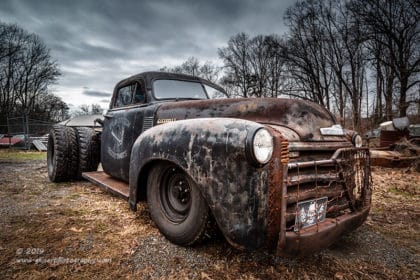
I started to figure out what angles would work and what shapes I could start to build compositions around. As with the last time, it was the copper painted wheels and the curves of the fenders that really excited me and that was where I started. Not remembering the exact compositions that I had shot before, I made an effort to try things that I might not have thought to do before. The first composition that I opened this entry with was a similar one that I had actually shot before but was opened up quite a bit to show more of the fender. I think that I had cropped in tighter last time to avoid the headlight bucket. This time, I didn’t really have a problem with it, so I was able to get the entire fender which I think makes for a stronger composition. The main difference is that the wheel is minimized in the new composition because of the elevated perspective. It’s a good thing that I have both versions because the main focus is different on each one.
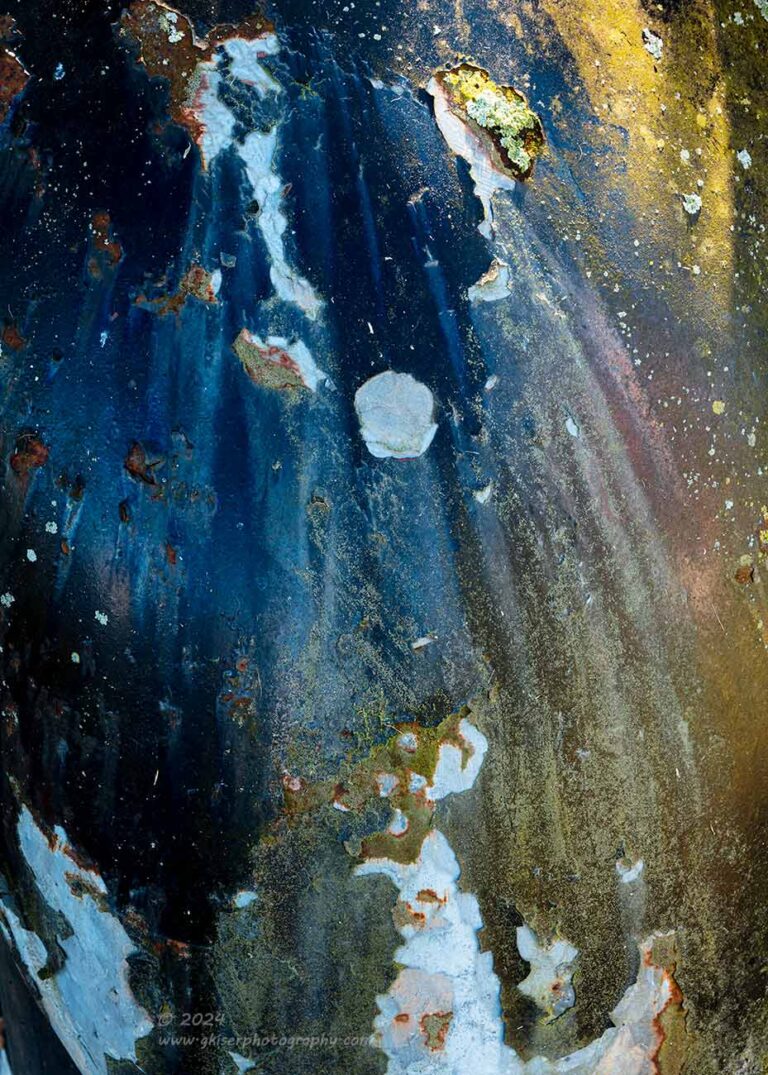
With the sunlight very bright, I knew that I was going to have to focus on smaller areas of the car to avoid complicated compositions with the dappled light. I began to look for areas of rust that I found interesting which might make a good photo. One of the areas that I found was on the rear quarter of the car and it showed off some moss growing in addition to the textures of patina and rust. The sunlight was also hitting a portion of it to create a shape for the eyes to explore. It only took a minute or two to find the composition within a frame and fire off the shot. I made one small adjustment to the framing and released the shutter once again which is what you are seeing further up in the entry.
Things were going well despite the fact that the sun was intruding too much into my compositions, or at least that is what I was thinking at the time. My reluctance to work in these conditions didn’t seem to matter to any part of me as I just kept moving the camera around and finding new compositions to shoot. By the time I started to focus on the front of the Chevy around the hood ornament, I wasn’t even hearing my objections to the lighting. I was on full auto-pilot at this point and ceased to think on a conscious level.
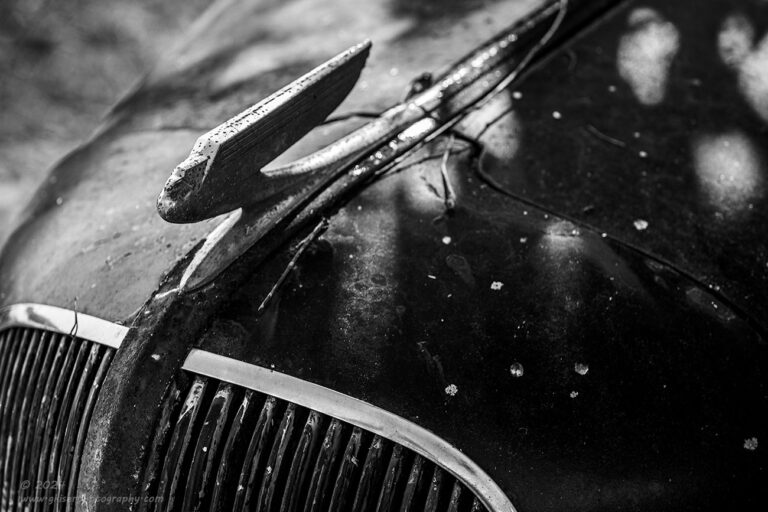
had I thought about the composition with the hood ornament, I would have undoubtedly shot it from the other side so that the ornament would have been in the sunlight. That is obviously not what I did here, and now that I am back home, I can see why shooting from the shaded side worked so well. The darker ornament contrasts nicely to the brighter area in the background while the ornament itself matches the tones of the black paint. It is not something that I would have seen normally, but that was how I ended up shooting it and didn’t question it at all while doing so. The checkerboard lighting really made this more interesting and the shadows in the foreground helped to get depth to the entire frame. Guess I’m glad I didn’t allow myself to overthink this one. Of course, had I been thinking, I probably would have passed this by in favor of coming back at another time under some clouds.

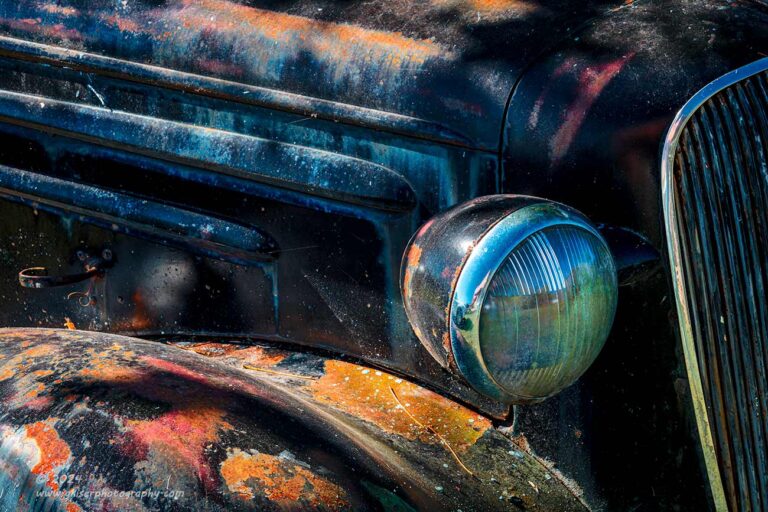
I did remember from the last time that I shot this car that the sides of the hood made for some interesting lines and shapes when matched up with the headlights. I didn’t recall exactly how I shot that view but knew that it turned out pretty solid. I framed up another composition here and focused on the side of the hood along with the colors of the rust on the fender and on top of the hood. The headlight was a secondary concern as was the grill. They were both there just to establish the frame within a frame as well as give visual direction back into the photo. I felt that was a different way than I had shot it before as I felt that the headlights would have been the primary focus at that time.
It wasn’t until I got home, processed the image, and then looked at the first attempt at the similar composition that I realized just how different the new photo was. The first attempt felt stubby and definitely focused more on the headlight and the grill emblem. The side of the hood wasn’t a dominant feature at all, but still added to it. In the new composition, it is the hood that pulls the weight of the image while the headlight and grill just establish the scene. This makes the two images fundamentally different and once again, I am glad that I just let myself shoot what came into my head rather than really thinking about it

A couple of years ago when I was here, I split my time between the Chevy and the two DeSotos that were parked in a recessed area. Those cars were still here, but they were largely buried by tall grass. There was a Ford pickup which I had seen before, but didn’t really take the time to shoot it. I remember thinking that it wasn’t all that different from any other ’60’s model Ford truck that I had shot, and I didn’t want to waste time on it. This time, with the DeSotos buried, I decided to take some time to get to know the old truck. It didn’t take long to realize that the hood ornament was being illuminated by the sun shining through the trees which made it rather interesting visually. I moved into position and set up a shot on the emblem which was like many other photos that I have done. It was the lighting that interested me with this one as well as the rust patterns on the hood.
I didn’t spend long with this because I knew how the composition needed to go and setting the camera up for the shot was very simple. From there, I started to pay attention to the fact that the window was missing from the driver’s door. This allowed for a view inside of the cab as well as a view of spider webs which were holding the fallen leaves. Hey, this could be a Fall photo with the orange and browning leaves resting in the web. I started to think about the scene and with the light teal colors inside of the cab on the dash and steering column, I had a great color combination going on. It was enough to convince me to try some frames to see what I could do.

I ended up doing horizontal and vertical compositions of the open window. In the end, it was the horizontal one that won out. It just felt more direct and had a more effective composition. The vertical one included the door handle which added to the visual interest but pulled the attention from the interior which was where I wanted it to be. The colors worked out just like I intended, and I felt that it was very much a Fall photograph which made me happy considering the time of year that it was.
After the two compositions on the truck, I felt like that was all the truck had to offer me. With that in mind, I stepped away from it to an old shell of a truck cab a bit closer to the building. I walked around it but found nothing of interest which prompted me to walk back to the other Ford truck and the Chevy I had started to work with. When I turned, I looked at the Ford and realized that the car that was parked on the other side of it was completely hidden from view by the truck. The building on the other side of the street was largely hidden by the tree as well. Oh yeah, and that tree was forming a fantastic framework around the truck. The lighting wasn’t ideal with the truck in the shadows and the background in the sun, but there was a lighting contrast which worked to separate the foreground from the background.
I collapsed the tripod to get the camera down low so that I could explore this composition with the truck blocking more of the building and allowing more of the tree to come into the frame. It was a very simple composition, but I liked how it was looking. Of course, in the camera, the truck was way too dark as I was having to protect the highlights of the sky by underexposing. I didn’t really give much thought to it through and just went with my gut. I cranked off about five frames with slightly different compositions and exposures to make sure that I had everything that I was going to want, and decided that was going to be a good photo if the shadows came out ok.
It was this photo of the truck that I pulled into Lightroom first for an edit. I felt really good about it when I was culling the images and wanted to see if I could make it look like I had envisioned. Even with the global only edit, it was looking very strong and awful close to what I had envisioned. By the time I had the majority of the local edits done, I was sold that this was going to be a favorite image of the day. It took a few more visits as I tweaked the edits, and added more local adjustments, but by the end of it, I was immensely happy with the outcome. It just radiates the mood that I was after and wasn’t quite sure if I was going to be able to capture.
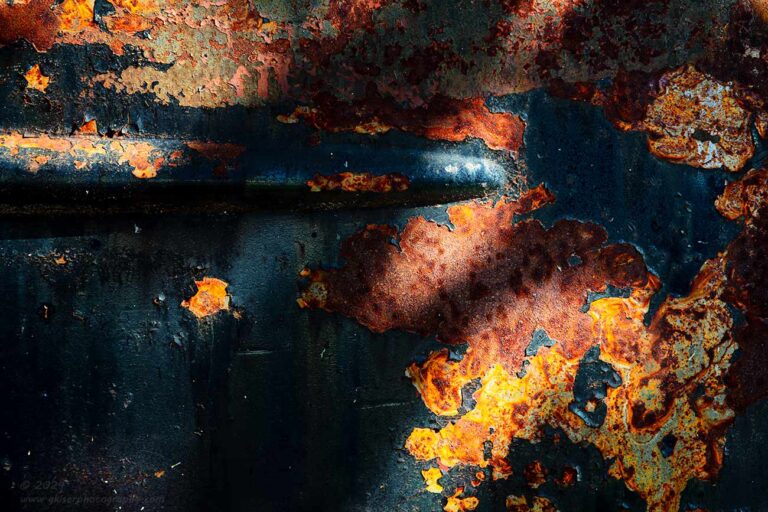
With that one all finished, I decided to turn my attention one more time to the old Chevy. There were compositions that I wanted to try a couple of years ago, and a few that didn’t turn out the way I had expected. I wanted to try some of those odd compositions since I was having so much luck with the location. One of those compositions was around a rear window. That was where I started to look, but as I was looking, I found a body line that interested me as it was partially surrounded by rust. The way that the patterns looked, really pulled me in and that was where I focused my attention over the next few minutes.
I think that the dappled light on the surface made this image work better than if the light had been diffused. The black paint started to have some visual interest to it with the shadows and turned the empty space into negative space which I was very happy to see. The textures of the rust gave tons of interest to the brighter areas while the body line gave context to the patterns. It was a simple image, but one that I think is effective as an abstract rendering of rust.
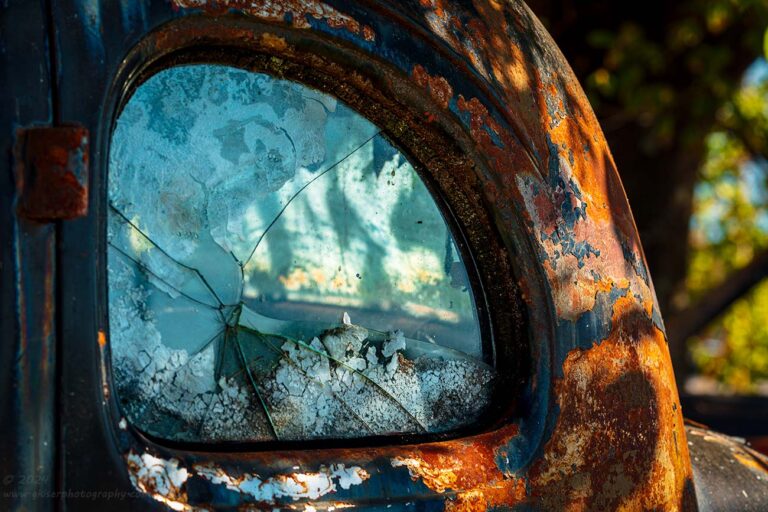
When I was satisfied with that composition, I moved back to the window that I had come to check out initially. I loved the cracked glass and how the one unbroken portion seemed to frame the shadows on the rear window. The entire thing was surrounded by a wonderfully rusted section of the car making the frame visually interesting. The tree behind the car showed the depth in the frame. I didn’t give this a whole lot of thought because I think that is what killed my attempt last time. I overthought it and the composition wasn’t effective at all. This time, I just let instinct form a composition which was basically a frame within a frame while the limited depth of field blurred the background establishing the depth that I wanted to see. The hinge gave a bit more of a frame to the broken window as well.
The last bit of the puzzle came in the post processing end of things where I flipped the frame horizontally. Knowing that the eyes would seek the brighter portions of the frame, I didn’t want the introduction to the image on the left being the brightest portion because I knew that the eyes would not want to go further to the right. However, if I put the brightest parts to the right side, the eyes would enter from the left and be pulled through the image taking it all in. The contrast on the broken window would pull the eyes back into the frame before they left. It was that one little detail that made this photograph work because as it was shot, the eyes would have had a hard time moving through the frame and the best parts would have been missed.
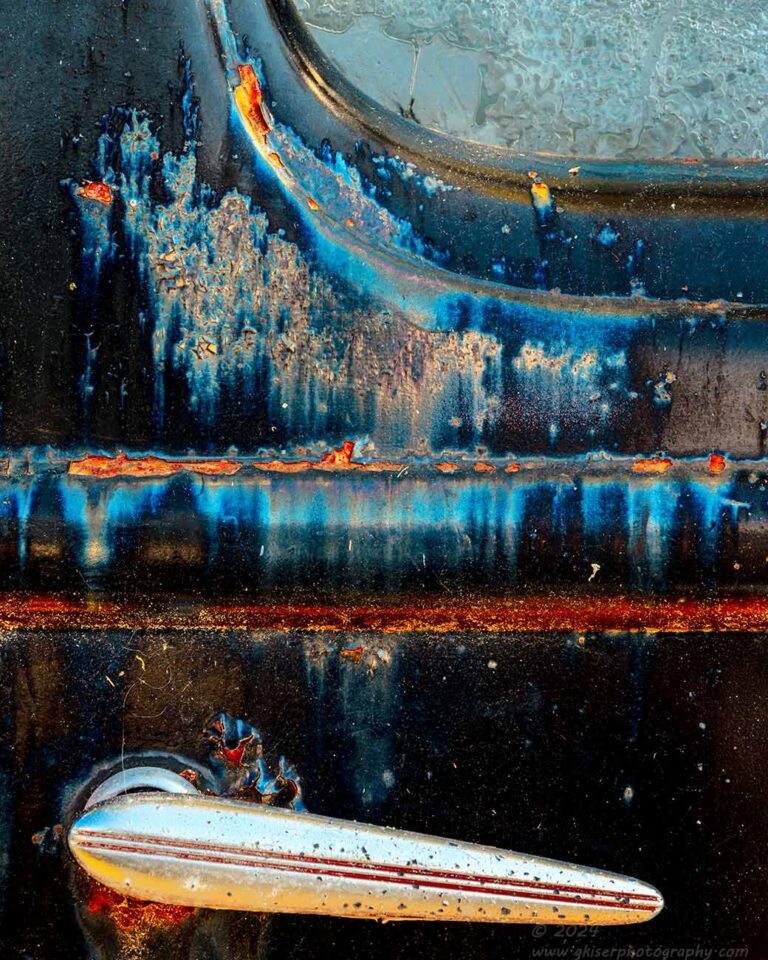
I continued to look at the car for other bits and pieces that I could photograph. I found an area at the leading edge of the rear passenger side door that had some great patina as well as that oily look to the paint below the rust. The door handle still had the red pinstripes along its length which I found interesting and liked that they tied in with the rust. I started to work out a composition that included both door handles as they were close by (suicide doors) but remembered trying that a couple of years ago with no success at all. I started to reduce the number of elements in the frame and ended up with the one handle, the body line with the rust and a bit of the window to balance the frame.
This more direct version of the composition felt much better than the one that included several other elements. I adjusted the polarizer to get the best effect on the rust and runoff before making the exposure. I had to admit that it looked quite good in image review even considering the fact that I have all the contrast and saturation dialed down in the camera in order to get a more accurate histogram. This was one that I felt would be better flipped horizontally when I shot it because I wanted the door handle to point from left to right while the window was in the upper right corner as opposed to the upper left where it could trap the eyes upon entering the frame.
What do you think about the flipping of images? Do you even notice that they have been unless I’ve told you? Can you tell that they are reading better after being flipped? I’ve talked about this trick in several different forums from in person mentoring, to workshops, to my video tutorials and each time it seems to be one of those “aha moments” that opens up a lot of possibilities. It is very easy as long as there is nothing in the frame that would give the manipulation away like text, or something else recognizable to the audience. Absent those exceptions, a flipped image should be considered a viable option in editing for the purposes of a better visual flow.
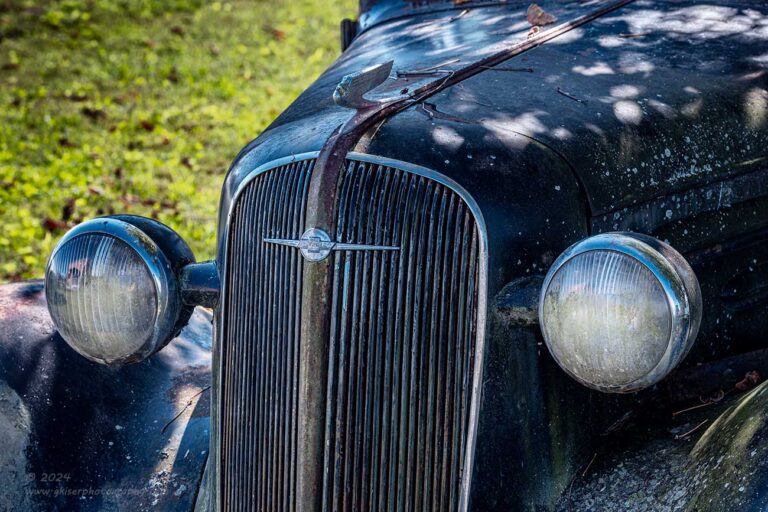
It was time to turn my attention back to the front of the car once again. The grill is one of the unique parts of this car and an element that I wanted to highlight as much as I could. The concept for this composition came from the headlights and the hood ornament forming a triangle that framed the bowtie on the grill. I went with a horizontal composition to add to the visual tension and make the frame a bit more interesting. The dappled light on the hood gave interest to the black paint which I appreciated, and the grass gave a bit of contrast to the scene. Had the sky been different, I might have been able to get down low and get a very different shot here, but I didn’t want to get a bunch of bright sky in the frame when the car was mostly in the shadows. It was hard enough dealing with the grass which was in the full sunlight.
I went back and forth with how I wanted this photo to be presented. I really did want a lot of these to be in black and white since the car was black to begin with. As I was doing the edits though, I found that the color edits made more sense in most of the photos. This was one of them because of the limited colors in the scene. By moving the black tones from blue to cyan helped to bring the colors into a decent harmony here and a different type of contrast was available that would have been missed with a black and white presentation. On the other hand, I knew that black and white would also have some benefits, so that is how I did the other version of this composition.

When I was setting this up in camera, I changed the crop to a 1:1 square and thought that it looked pretty good that way. I knew that if I wanted to extend the frame a little bit, it would be vertically, so that is how I had the camera set up. In case you didn’t know, if you are shooting square, it doesn’t matter if the camera is horizontal or vertical, but the direction you choose will determine with way the frame can grow and which directions you can move the square to adjust the framing. Since I went with the camera vertically, I was able to change my mind in post and move to a 4:5 crop which fit the composition a bit better. I just knew that I didn’t want something in the realm of the native 3:2 or 5:7 as that would be too long of a frame. The 4:5 worked very well.
I also decided to make this one black and white even though the color version worked so well on the horizontal composition. The primary difference here was that the grassy section would have thrown the entire composition off balance as there was very little color throughout the remaining vast majority of the frame. By ditching the color, I was able to concentrate on the shapes within the frame that drew the attention to the grill and headlights which was what I wanted to happen. The decision for color and black and white goes much deeper into things than just a rendering of color. Color will dictate how a photo is read and could actually distract from the reason behind the photo. You can see that in the previous two examples and how your eyes explore them both.
By this time, I was starting to get a little tired and the heat of the day was starting up. I went back to the same fender that I had started off photographing, but went at the opposite direction to see if I could get a workable composition. I still loved the flow of the fender and really enjoyed the super saturated color of the wheels surrounded by the whitewall tires. The trick was going to be figuring out the primary focus of the photo and then making the composition work with that reason.
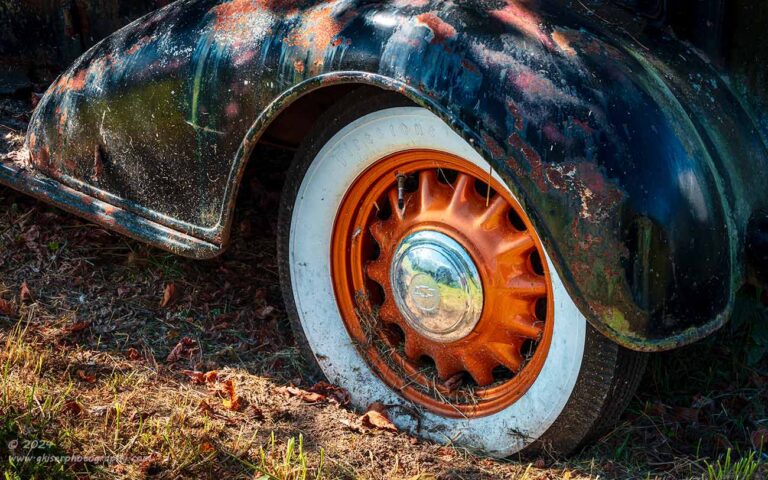
Ironically, it turned out to be the whitewall tire that caused me the most grief with this photo. The general rule of thumb with photographing wheels is that the fender doesn’t cut the outer edge of the wheel. It is fine to cut into the tire though. However, with the thick whitewall, the rule actually extended to the white section of the tire and the composition looked funny with a white sliver running between the fender and the wheel. If I extended the distance out by moving lower and to the left, I could get the whole whitewall, and it would become the wheel in essence. That altered the perspective and angle on the car and the composition wasn’t as interesting though.
After some time working out all the options, I ended up positioning the edge of the wheel right at the fender effectively cutting the whitewall out at that precise area. This kept the visual lines of the wheel intact while the whitewall was treated as the tire where I didn’t need the complete circle intact. By not having the white sliver between the body and the wheel, there were no distractions, and the composition worked as intended. To eliminate the headlight, I cropped in close to the top of the fender and used the natural shadows to provide the top edge with a bit of closing in effect. It was a composition that I think I had tried a couple of years ago but never liked how it turned out. This time, I am pretty happy with it, and glad to have it in my collection.
That was pretty much the end of the day. I had shot a total of 39 frames at this one location and really thought that I was going to be lucky to get a half dozen keepers out of that. The edits all came very quick, and I loved more and more of them as I went. I ended up with a bit over 25% for a hit rate which I think is spectacular considering how long it has been since I’ve photographed on instinct alone. It is safe to say that I was 100% back in the saddle for this trek from the planning phase to the editing afterwards. It was like old times, and nothing felt like a chore at all. It all started with a deep desire to get out and photograph something, anything. This turned into just going out with nothing really in mind and just letting inspiration direct my course. In a perfect world, this is how photography will always be, but I know there are ups and downs in any creative endeavor. The most recent downturn has been one of the longer ones that I have endured that didn’t result in selling my camera gear. I’m glad that it seems to be over now. Hopefully, this will mean that I will be doing more and more treks as we get into my favorite time of year for photography.
Thank you for joining me for this trek and I hope that you have enjoyed the photos. Don’t forget that I offer prints of all the photos that you see here in the blog as well as in the galleries on this website. There is no better way of enjoying my work than to see it in its intended form. It is also a great way of supporting my efforts as a photographer and allowing me to go out on more treks. If you are a photographer and wanting to up your game, I do offer mentorships as well as many different forms of tutorials. I would love to talk with you about where you want your photography to go and help you get there.
Until next time….