Wednesday, August 30, 2023
So, long story short…What I had planned for today fell apart. I didn’t get a single photo that I intended to capture when I left the house. Am I frustrated? Not in the least. Did I come home with nothing in the camera? Absolutely not! Would I consider this failed trek a success? You betcha!
Now that I’ve got your attention, I want to share with you what the original plan was, and how it came to be. You see, I have been paying attention to the weather for the past few days now. I had to plan mowing the yard around what was supposed to be a week of rain. I got that done on the last dry day that we had, and since then have been expecting washout days. As is the case with weather forecasts though, things were not quite as expected. The rain that was supposed to settle in, never really showed up. Sure, we had some passing showers and storms, but a large part of the days had been dry. The rain that we did get came down hard and fast though. I managed to slip out a few days ago and get a quick trek into Lenoir, where I got a photo of a sign that I have been toying with for years. It was not a large scale trek, but it was nice to get out one last time for the month of August. At least that was what I was expecting with the rain lasting into September.
As I was watching the cloudy and dry days passing by, I started to get the urge to go out and do some photography, but each time I started to work up a plan, the bottom would fall out and I saw no reason to go out in the rain. However, looking ahead in the forecast, Wednesday was supposed to be cloudy, but dry all day. Looking at the cloud app, I could see that the clouds were all going to be high altitude ones with just a few middle and lower altitudes mixed in for good measure. I wasn’t seeing fantastic conditions for photos involving the sky, but the lighting that was produced through those high clouds should be nice and diffused making for some great light for so much of what I like to photograph.
As Tuesday evening approached, I started to work out a plan. The clouds were looking really good around the area of Linville, and there was a good chance of fog as well. I love working with the fog and seeing the possibility of even light, I started to think about doing some waterfall photography. While this is a type of photography that used to be my main subject, I’ve relaxed a lot with photographing waterfalls over the recent years. They just require too much travel at this point because I have worked most of the waterfalls that are close by many times over. Finding something new is a little more time consuming than I am really looking for considering there is just not that much I can do differently with these subjects. However, I do realize that I need to keep my skills up, and I still enjoy shooting a waterfall from time to time.
With the weather promising fog through most of the morning around the area of Linville, it seemed only logical to head to Linville Falls for the morning. The last time I was here, I think I was preparing for a mentorship session and needed to remember how to photograph a waterfall. As I look back on the blog, that was over two years ago. There was a time when I would go to Linville Falls several times a year, so it is a little surprising that I would have been away for so long. One place that I really wanted to photograph was Duggar’s Creek Falls which I’ve tried time and time again to capture, but just haven’t quite hit the mark with the compositions. It is a very unique waterfall off on the side of the parking area and there is pretty much only one way to shoot it. The variation comes from lens choice and exactly where you stand in the stream. My hopes were that the fog would add some ambiance to the scene and the recent heavy rains would add to the water flow to make the waterfall stand out a bit more in the cavern. Once I finished with that, I was going to head over to the basin overlook to capture a foggy overhead shot of Linville Falls. Those were the shots that I had in mind, and the weather was looking very favorable for both of them.
The nice thing about foggy and cloudy days is that I don’t have to get up too early, and I’m all for that. I knew that Toni was going to be getting up really early to go to work and my plan was to gradually wake up as she was getting ready. As long as I left by 7:30 in the morning I would be in good shape for the fog based on the forecast. We turned in early, and she had a clock set for 4:30. When it rang, I wasn’t even thinking about waking up. I just rolled back over and went back to sleep. As luck would have it, she had only hit the snooze before getting up. The next thing I knew the alarm was ringing once again. I woke up enough to turn it off, but at this point, I was pretty much awake.
I rolled over and checked the weather apps and saw that things were still pretty much the same. I pondered the math real quick, and figured I would go ahead and get up to get ready to roll out. With fog, the earlier you can get there, the better off you will be. After a little breakfast and getting my morning office work done, I was ready to load the camera up in the truck and start towards Linville Falls. As I was leaving the garage, I could see that it was actually raining a little bit. This had not showed in the forecast but is not uncommon with foggy mornings. The main thing was the fog was looking good, and I expected it to only get thicker as I went into the mountains.
For the most part, the fog remained about like it started out. This was not a problem at all, and I welcomed whatever fog I could get. The rain did stop as I got into the town of Linville. I had avoided the Blue Ridge Parkway for simplicity and decided to take US221 nearly all the way to the falls. As I was driving, I spotted an old building off on the left that had an icebox by the front door. It struck me as rather beautiful, but the light was too dim on it at this point to make a photograph. I made a quick mental note about it and planned on coming back home this way to see if I could do an isolation on the icebox or something. I considered this a bad omen actually, because I needed to be in the frame of mind to capture a waterfall, but here I was seeing decay imagery and getting a little excited about that, while not really focusing on my intended subject for the day.
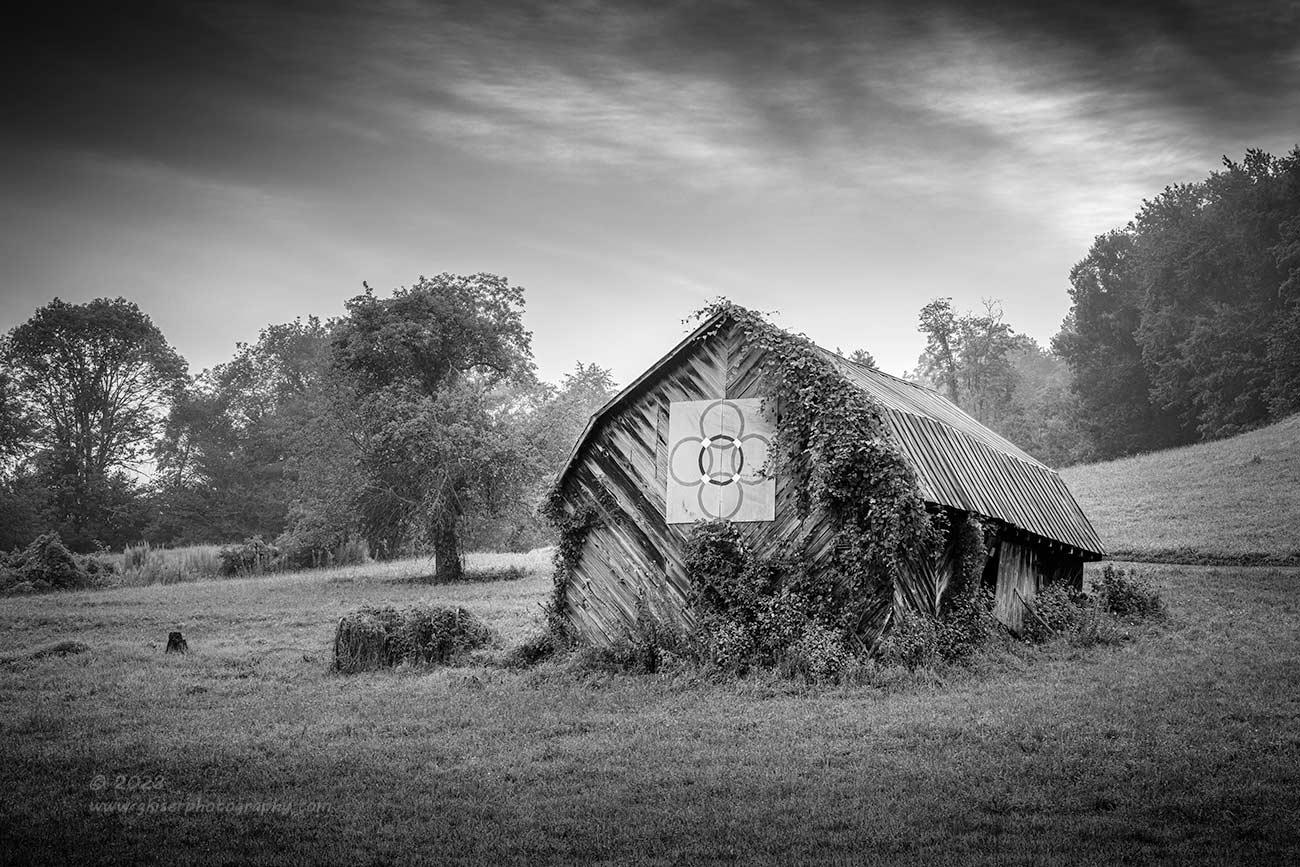
I just accepted the thought, and continued on with my trip. I would get a photo there on the way back, but first, I needed to get my feet wet, figuratively and literally. A few more miles down the road, I saw a couple of old barns off on the left. The first one wasn’t all that great, but the second one had a barn quilt on it, and vines growing along the face of it. Even more impressive was the fact that the barn was kind of off on its own. Well, at a certain angle, the other two buildings couldn’t be seen, and I could place a tree right beside of it for a bit of visual balance. The fog in the background was really nice as well. OK, this subject wasn’t going to wait for the waterfalls. In order to capture it with the fog, I was going to need to stop now. I got turned around and did my best to pull off the road. The shoulder was steep, and just in case, I put the 4Runner in 4WD and pulled off the road. The angle that I parked at was rather extreme, and I was glad that I had sliders on the side that I could step on to get out of the truck. It was a long way down to the road, and since I was about a foot out in the roadway, I had my flashers on which is something that I very rarely have to do.
There wasn’t much reason to stay here long, so I didn’t mind being out in the road a bit. I grabbed the camera out of the bag and fitted the telephoto lens to it knowing that I was going to need the reach to get the framing that I was after. After extending the tripod, I mounted the camera to the ballhead and framed up my shot. Once I got the rough composition in place, I retrieved my Color Combo Polarizer and the filter holder to remove the glare from the roof. I also slid in a 3-stop soft edge ND Grad to control the exposure in the sky. That did the trick and my histogram looked nearly perfect, although still a little dark in the shadows. I would have no problem bringing those shadows back up in post, and since there wasn’t a lot of color going on here, I was pretty sure that I was going to be working this as a black and white image when I got back home.
I started off with a very tight composition focusing on the barn and the tree but felt that I was leaving too much on the table. The last couple of shutter releases were a bit wider in scope and allowed me to include more of the background which felt like a better composition. This seemed the way to go, and it allowed me to get enough of the sky in that I was hoping that I could bring out some detail in it. The only real detail was kind of far up in the sky away from the horizon, and that tighter composition didn’t really give me the room to take advantage of what detail there was.
The stop might have been 15 minutes from start to finish which was more than enough to get the first photos of the day in the bag. I was sure that I had a keeper in what I had just shot, and that was a welcome accomplishment for the day. I just hoped that I would have similar luck with my intended subjects around Linville Falls. I loaded everything back in the truck and finished up my route. It wasn’t but a few more miles down the road that I pulled into the parking lot for Linville Falls. It felt like just yesterday that I had been here but there wasn’t the excitement that I usually felt when arriving. This had me kind of worried, but there was no sense in dwelling on it. The best course of action was to get out and start hiking. I was sure that the mood would hit when I started to see the water.
I knew the path to take from the parking lot and I was pretty sure that it was one of the least traveled ones there. It certainly was going to be empty this morning because I was the only vehicle in the parking lot other than rangers. This is how I love to find my shooting destinations, and I was thankful that school was back in session which kept the weekdays a little less….people-y. The hike was simple but I couldn’t help but notice that there was no fog at all anywhere to be seen. Everything was really crisp and fresh which was not quite what I had expected. It was still very pretty, but that atmosphere that I had been wanting was completely absent. I could hear the rushing of the water, so at least there was a real good possibility that I was going to find a healthy water flow coming down between the rocks. That would make up for the lack of fog, and I could work with that.
When I got to the bridge, I paused about halfway across it to look at Duggar’s Creek Falls expecting to see lots of water pouring down. Well, the waterfall was but a trickle just as it normally is. There were three distinct forms with the falling water, and it looked no different than other times I had photographed it. No fog, less than exciting water flow…This was not what I wanted. I pondered for a second about turning around and going elsewhere in the park, or even going back out in search of old barns. I decided against it, almost for no other reason than I was here, might as well go below and look at things critically. That was just what I did, and in a minute or so, I was below the bridge standing in the water looking at the wimpy waterfall in front of me. There was just nothing that I could do to make it look more appealing. That was a shame!
I pondered my situation and looked around to see if there was any other subject that might be willing to be photographed. Nope, nothing. This waterfall was a one-angle wonder, and there wasn’t anything else around that caught my eye. I knew that there were more drops downstream and there was one that I had tried to get years ago but couldn’t find a safe way to get to it. It was a few steps away from where I was, so I moved down that way to check it out. The water flow looked really good here, but I saw no way to get down to the lower level so that I could photograph it. Well, gravity would have helped me out here for sure, but the idea was not to fall, slip, or slide. I had done that enough at Hawksbill recently and didn’t want to press my luck with not breaking things. I knew that I could access the lower portion of the stream from the roadway and maybe rock hop to where I needed to be, although I knew that there were a few different level changes to accomplish that. It was worth trying though.
I worked my way back up to the bridge and back out to the parking lot. I walked towards the road until I found another trail cut through which I didn’t remember being there. Knowing the rough direction I was needing to be walking in, the trail seemed to be a good start. I went down that trail to see where it would lead. As I had hoped, it came out at the stream, and I could see the cascades that I was wanting to photograph from this access point. I wasn’t in a place to be able to photograph it though as there was another drop and a lot of downed trees in the way. I needed to get closer, but closer was going to be a little tedious.
Weighing my options, I figured that this was going to be the best course of action and started picking my foot placements as I worked through the fallen trees and up the slick rocks. The flashbacks from Hawksbill came rushing into my head and there were a few times that I just stopped in my tracks and considered returning to the trail. Looking ahead, I only had about 25 feet left to rock hop through and that was about half the distance I would have to cover to return. Yeah, I knew that I was going to have to make the return trip no matter what, but being so close to a position where I could make photographs was a very effective carrot at the end of a stick. I carefully continued on with the plan, and eventually found myself at the base of the cascade, right where I wanted to be. The only problem was, there wasn’t a balanced photo from where I was standing.

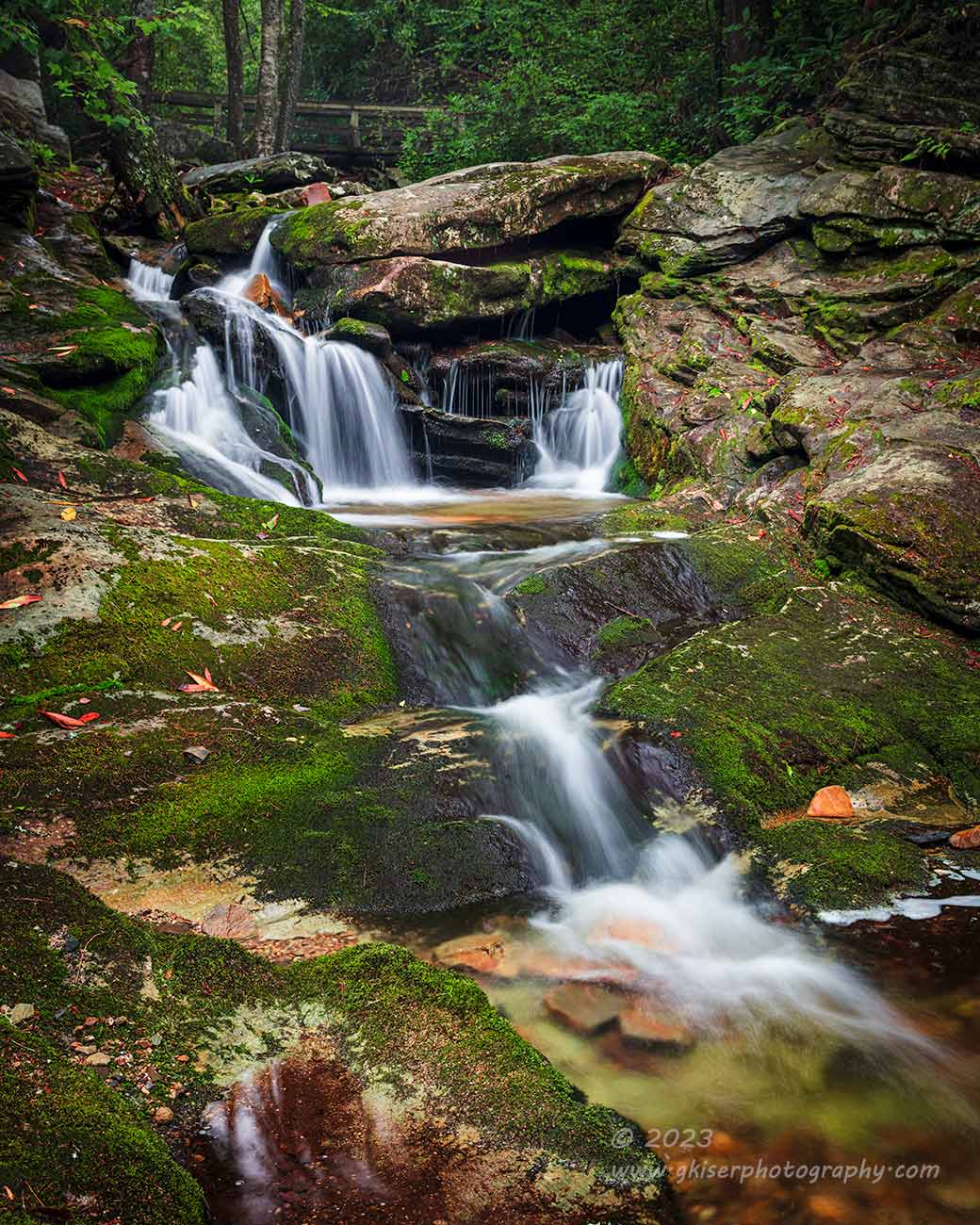
There was a section that had three distinct cascades dropping into a pool and then coming down to a single cascade. From where I was standing, the lower drop was on the same side as the two closer cascades above. That put too much visual weight on the side of the photo, and it wasn’t going to look good at all. The only way I could make it better was to shift my position to the left quite a bit which would put the lower section into a diagonal position to the upper and push the weight to the opposite side to balance the composition out. This was simpler said that done unfortunately, but I had made it this far and wasn’t quite ready to work my way back down the obstacle course to the trail. I pondered things for a bit, and finally realized that I was going to have to do a stream crossing at this point. I had my waterfall boots on which gave me a moderate amount of protection from the water, but I still wasn’t convinced that I was going to be able to effectively cross over and find a good place to set up. As I was debating with myself, my feet started moving.
One of the best uses for a tripod is as a hiking pole. I extended one of the legs and used it to test the depth of the water, firmness of the ground, and used it to provide me a bit of stability as I crossed over. It wasn’t as bad as I thought it would be, and before I knew it, I was on the opposite side of the stream standing on a mossy rock with my bag perched on a relatively flat part of the wall to my left. The angles were better from over on this side, and for the first time I could see a composition developing before me. I took a minute to catch my breath as I studied the scene and planned how I was going to shoot it. It was simple enough, and I saw it first as a vertical shot. I pulled out the camera and fitted the 24-70mm lens as well as the polarizer which is a must have for waterfall photography.
I started to play around with tripod positioning until I got the shot that I was aiming for. I then played with the exposure to try and find the right shutter speed for the water. What I found was a single second was sufficient for this overall shot as it gave the most pleasing look to each cascade and helped smooth out the water surface. The final image felt really good, but it wasn’t quite what I was hoping for. I wasn’t sure if this was me just taking a long time to get in the right frame of mind, or if there was a better composition to be had. I had no problem working through this waterfall because I had never photographed it before, and after taking so much energy to get to it, I didn’t want to miss any possibilities.
While a vertical shot seemed the most logical, I wanted to try a horizontal one as well. I flipped the camera on its L bracket, back to landscape orientation and started to reframe the waterfall. Things weren’t lining up just right from the position that I was in, so I started to move the camera to the left and the right as well as changing the height of the camera. Eventually, I landed on a position that seemed to work and I fine-tuned that composition before starting to make exposures once again.
As I started to make exposures, I quickly saw that for some reason the 1-second shutter speed that I had been using wasn’t looking right with this composition. I fiddled with the setting and found that the shutter speed that I wanted was actually 0.6 of a second. In the interest of keeping the depth of field that I had, I had to boost the ISO which was already at ISO500, up to ISO800. This is something that I don’t like to do but have found that the image quality is still quite good in good light at this level. I knew that I would be able to deal with any noise in post without any issue. The new shutter speed looked really good here, and I grabbed several variations on the composition.
I was feeling much better about this waterfall and really started to appreciate the fact that I had found a way to get into position to photograph it after all these years. There was still something nagging me though. It was a feeling like I was missing something here, and there was a stronger composition to be had. I played with the camera position and orientation for a while looking for that hidden composition. It wasn’t revealing itself to me though. Everything that I tried was too closely related to what I had already shot. I did realize that there was a chance that this one would read better if flipped left to right in the final version to allow the eyes to track through the image a little easier. I actually did this on the first composition, as well as the one that I finally ended up seeing after much too long looking for it.
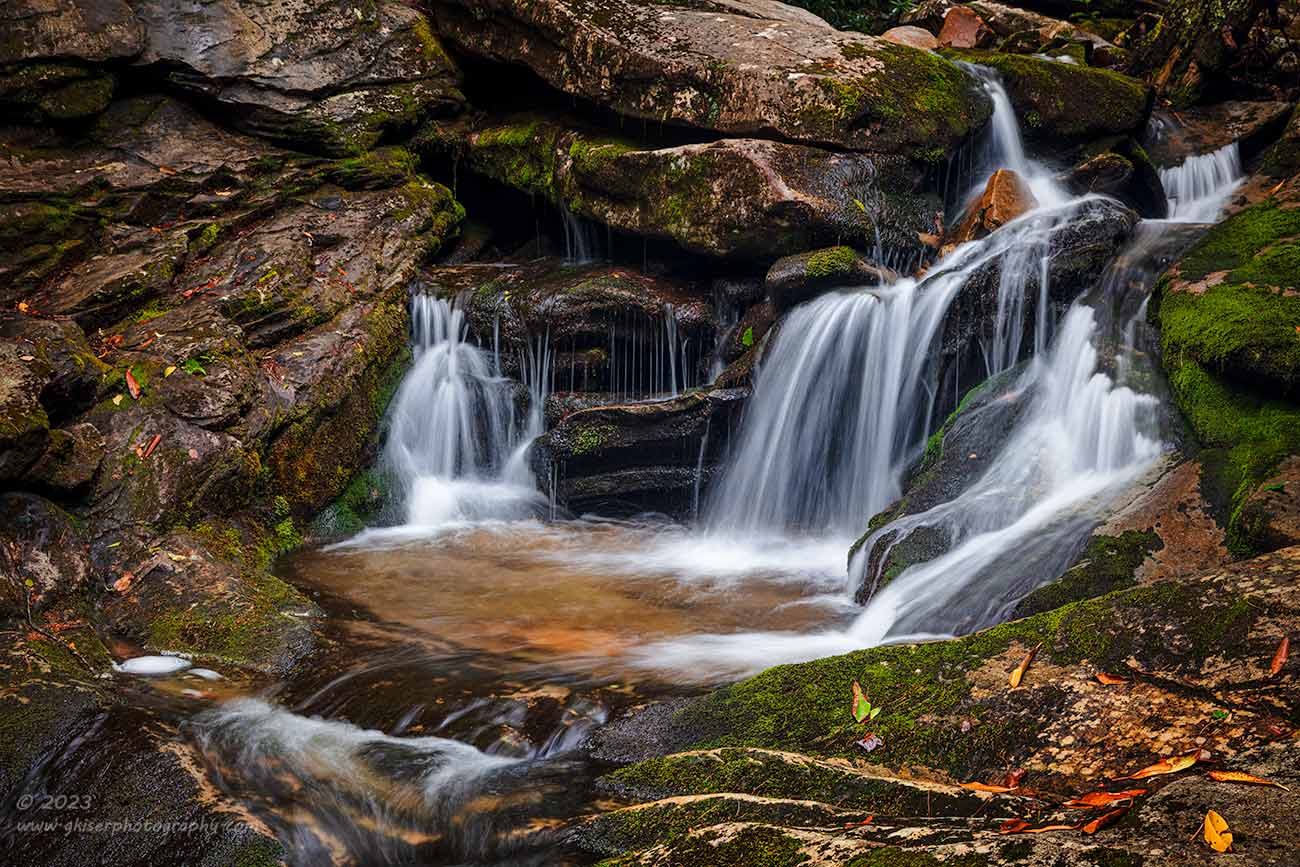
The answer to the compositional questions was to get in closer and omit the lower cascade while just focusing on the three sister drops at the pool. I had been back and forth enough on the rocks at this point that I was pretty confident about where to step and how to move. Leaving the camera on the tripod, I started to advance on the higher section and worked my way in about 10 feet closer to that top drop. I then started to feel out the composition.
Almost immediately, it came together in the viewfinder. There were just a few little tweaks that I had to work through to get the composition where I wanted it. Once I was there, I started to make exposures and realized that a half second was the way to go with this composition. The ISO was left at 800 as I didn’t need quite the depth of field that I had before. This composition was one of my early favorites of the day and what I felt was the proper way of capturing this waterfall. I worked it for a while with some variations to exposure and composition until I was sure that I had it right. Once I was exhausted of ideas for this location, I carefully went back to my bag which was still sitting on the wall below. I packed up the camera and put the bag on my back.
At this point, I started to look back down the obstacle course I had been through to get here. Going downhill is always harder on slick surfaces so I wasn’t really looking forward to this return trip. I looked back up the hill along the side of the waterfall I had just photographed. I knew that if I could make it over that ridge, I would be right back to where I was when I was looking at Duggar’s Creek Falls. It was simpler, shorter, but much steeper with fewer traction points. Since it would be a matter of climbing rather than sliding downhill, I thought that it would be the easier route overall. I started planning my foot placement as I slowly approached the slope.
Things went surprisingly well until I was in the last third of the journey. At this point, I only had one grippy place for a foot, and nothing else to hold onto. There was nowhere left to place a foot, and without anything to hold onto, I was kind of stuck. I looked back behind me and realized that going down was going to be just as difficult as continuing the uphill progress. Effectively, I was trapped at this point. I could neither up nor down without a real risk of slipping and falling into the water. I was pretty sure that the Lowepro bag would protect my camera from a fall, although I really didn’t want to test that again. It was the almost certainty of landing in the water that worried me the most as the bag would not be waterproof under water.
I stayed there in the most awkward position for what had to be five minutes, but it felt like 30. I weighed my options and figured out where the highest risk of loss would be. I was still glad that I had been able to photograph this waterfall, but the joy was wearing off. What I concluded was, I would rather fall face first, keeping my bag above me rather than fall backwards onto the bag. This meant that I was going to need to continue my way up the hill for the next maybe eight feet or so. The only way to do this safely was to get on my hands and knees.
I started to get into the crawling position, but that one foot that was on the grippy rock started to slip when the weight began to shift off of it. I could feel my hands slipping as well as my other foot. I quickly put pressure back on that grippy foot and re-evaluated my situation. I knew that I wasn’t going to need an airlift, but the chances of staying dry and unbruised were starting to look slim. I went with the only idea that I had and that was to quickly transition to both knees, all toes, and both hands. It was either going to work, or I would be in a slide down to the bottom of the falls. If that happened, I would at least be back where I could navigate to the trail I had entered from. The only question was going to be if my gear would survive.
I held my breath and dropped to six points of contact on the wet rock. There was a little slide, but my skin gripped well enough. The progress forward started again, and in a minute or two, I had reached an area that I could stand up again. I was dry, unbruised, and holding onto a tree. Life was good again. I shimmied up to the landing where I had been a while before and then worked my way back to the bridge and the trail. I felt accomplished for sure, and I was so happy that I didn’t go for a swim. I’m pretty sure that I won’t be getting into that position again, and I was glad that I had spent so much time working the compositions while I was there.
As I walked over the bridge, I took a last look at Duggar’s Creek Falls and wondered why the water flow was so minimal considering that it was flowing great just downstream. The answer eluded me, but the fact was, there wasn’t enough water to photograph the waterfall that I had initially wanted to get. I pondered my next option as I had planned on going to the basin overlook for the next set of photos. I was sure that Linville Falls was looking amazing with the high water, but there was no fog to be had which was a big part of what I wanted to capture. I really saw no reason to make that hike and considered my other options.
I could always go back to the truck and head out looking for either landscape subjects or some more barns. There was that old building with the icebox out front that I wanted to shoot as well. When I got to the parking lot, the sky was looking really boring and that took the desire for landscapes away pretty quickly. The light was still flat, so I thought that I might go to the upper falls section because there are some sections of the sluice leading to the main falls that I still wanted to explore a bit more than I had in the past. The lighting was looking good for that, and I was interested to see what the water levels looked like there.
As I got to the other side of the visitor’s center and started on the trail, I noticed that the sun was starting to cast shadows. I looked up and the clouds were starting to thin out. This is the risk with high altitude clouds and I was hoping that they would thicken up again when I got to the next location. The more I hiked though, the brighter the sun became. It was looking like this was going to be the end of it for me. At least I had a bunch of photos from the impromptu session below Duggar’s Creek. That made it worth coming out here and if I had to leave now, I wouldn’t be that upset. Since I was here, and the hike was short, I might as well see what things were looking like.
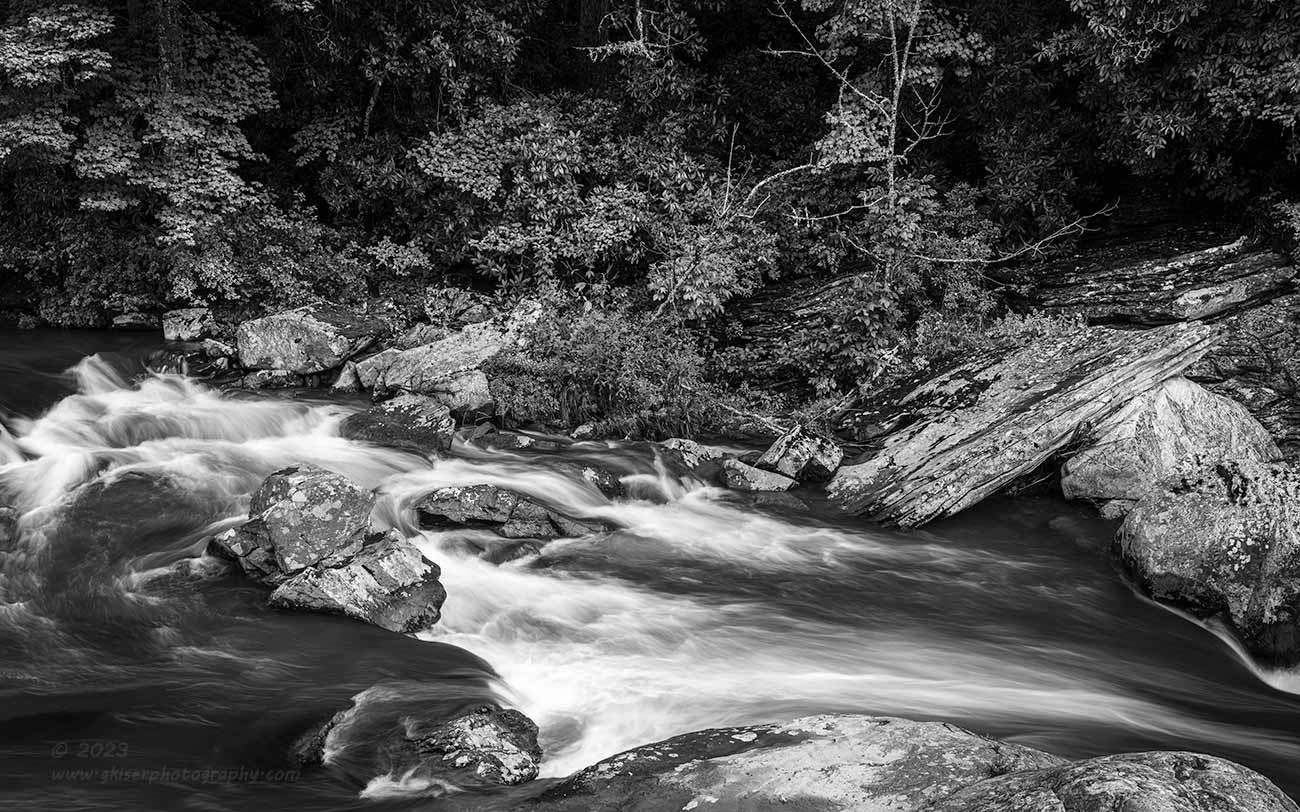
When I came out on the overlook for the upper falls, I was thrilled to see that the water levels were up quite a bit, and the soil had been churned up in the water adding to the colors that were visible. I moved over to the area that I wanted to work with but saw a problem before I could even see the water. There were two very large trees that had fallen into the pathway for the water. The two substantial trunks blocked not one, but two different compositions leaving me once again without a plan of action. The sun was bright and causing exposure issues over much of the area, especially the upper falls on the other side of the overlook. The only area that was in the shade was the section of the stream that linked the upper and lower parts of the waterfall system. It was this area that had some of the best rapids and white water which was a positive for sure. I just had to figure out a composition that I could start working with.
This was kind of a slow process, but eventually I started to see some compositions jumping out at me. My first thought was a panoramic view of the stream, but that idea quickly changed because stitching the images together might prove problematic with the ever-changing lighting and the fact that the white water was not going to match up perfectly with each exposure. Fortunately though, I have plenty of megapixels in my sensor which allows me to crop an image without really hurting the resolution as long as I don’t get carried away. Cropping to a 16:9 aspect ratio was not a problem and that was what I started out doing. This would allow me to see the scene as a panoramic scene, but since I was shooting in RAW, I would have the entire image to work with in post, and I knew that there was a good chance that I would go with a 16:10 ratio which is not available in the camera.
In order to get the right composition, I selected my standard lens once again as well as the polarizer. This would give me a moderate wide-angle view which I would be able to use in this situation. I started to frame up the shot and tried to find the most interesting parts to capture. A problem that I ran into was which white balance to set. While this wasn’t a huge issue, I do like to have it set most accurately so that I could have a very accurate histogram for my exposure. I knew that it was going to be somewhere between cloudy and shade based on what the sky was doing, but the colors were so flat in my current picture style that I really couldn’t tell much of a difference. I wanted to shift into the landscape style briefly to evaluate the colors which is something that I typically do. That gave me a better understanding of the white balance that was needed, and I was able to set it to shade for the most accurate representation. When I went back to shift they style back to my custom settings, I visited the monochrome setting briefly to see what this would look like as a black and white image. I was hooked when I saw it in the LCD and decided that I was going to look at doing these in black and white when I got home.
Having got everything set up, I started to make some test exposures to see what shutter speeds looked the best. I worked with everything from 1.3 seconds down to 1/10 of a second. I started out at a half second for the first part of the series and went to 1/5 of a second for most of the following ones. ISO levels stayed relatively low for these even though the scenes were in the shade. There was a good bit of light bouncing into the scene from the side of the stream that I was standing on.
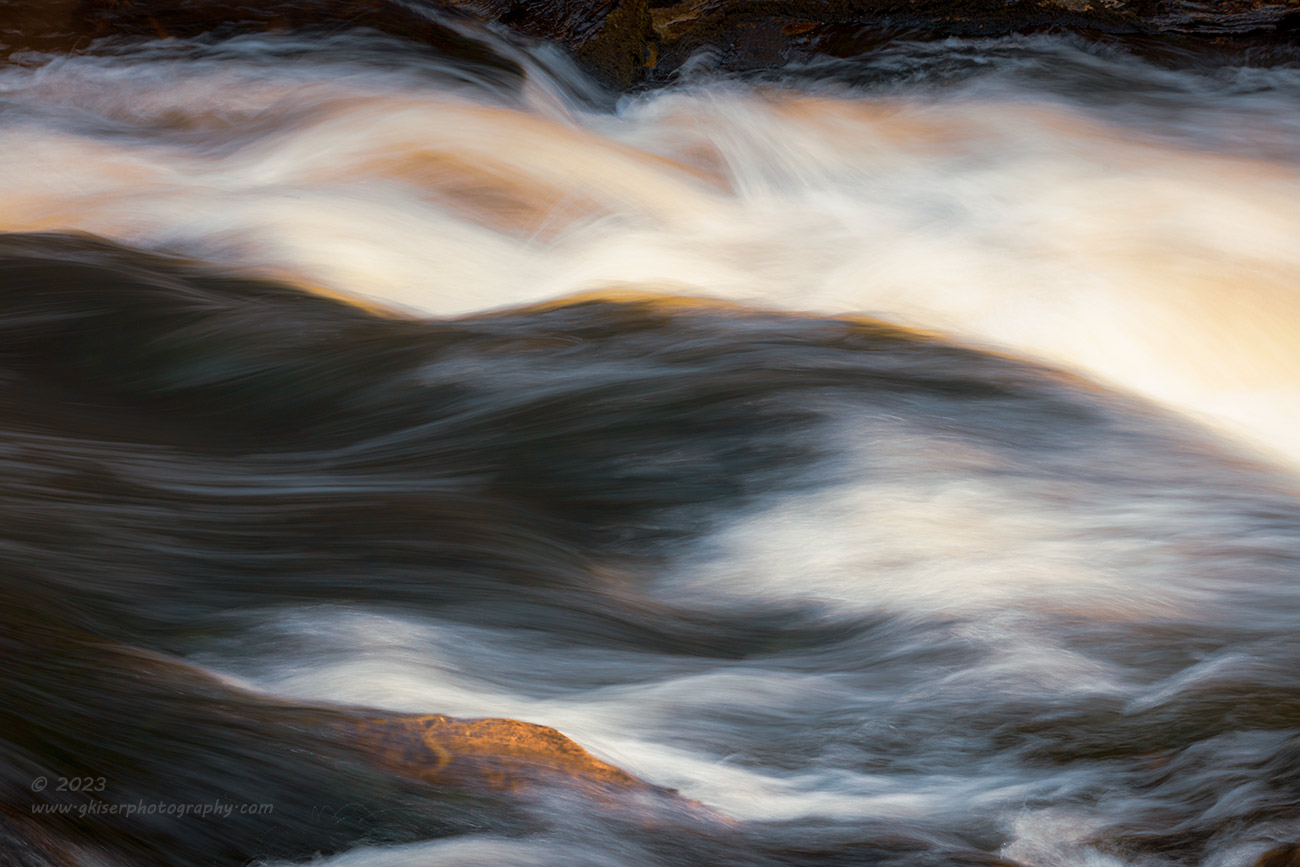
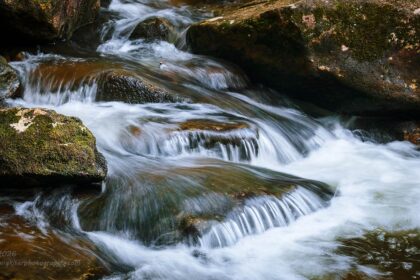
As I started to get comfortable with this section of the water, I started to look for some tighter isolations. There was one area that was just on the edge of one of the fallen trees that I always enjoy working. I decided to give it a try since the water had some new colors to it from the last few times I had shot here. I was going to need to switch my lens over to the telephoto one though because this was a very tight isolation. The switch was really simple thanks to the filter holder I use since the polarizer just clips onto that holder. Once I had the right lens on the camera, I started to figure out the composition. Usually, I will include the lower section of the wall so that there is something static in the frame since most of it is in motion. I also shot a few that omitted the wall for the most part and focused mainly on the moving water. This proved to be a very difficult decision to make when culling because I liked both variations quite a bit. In the end, I opted for the one that had the camera elevated as high as I could get it to eliminate the wall altogether.
I guess I made the right choice because when I showed Toni the final images, this was her favorite of the group. I’ve said it many times before, if I get an approval from her on an image, it is almost guaranteed to do well with any audience. I was happy to have that confirmation on my selection and really liked how it turned out. For the edit, I embraced the colors of the scene and went with an artistic color profile that brought out the oranges of the rocks and the churned-up soil as well as introducing some blues into the water which I though looked great. The result is an image that is well balanced in compositional elements as well as color.
Being familiar with this composition, I probably stayed with it a lot longer than I should have. I wanted to make sure that I got it right, but after a while, I realized that there was no sense in continuing with the same concept. It was time to move on. Since I had a different lens attached from when I started, I wanted to see how the first composition would look with a bit of a tighter crop to it. I moved the camera slightly and rotated it around the first section that I had worked. I went with a similar composition, but probably framed up half as much of the scene with the long lens. I liked this just as much, and I saw some great potential here.
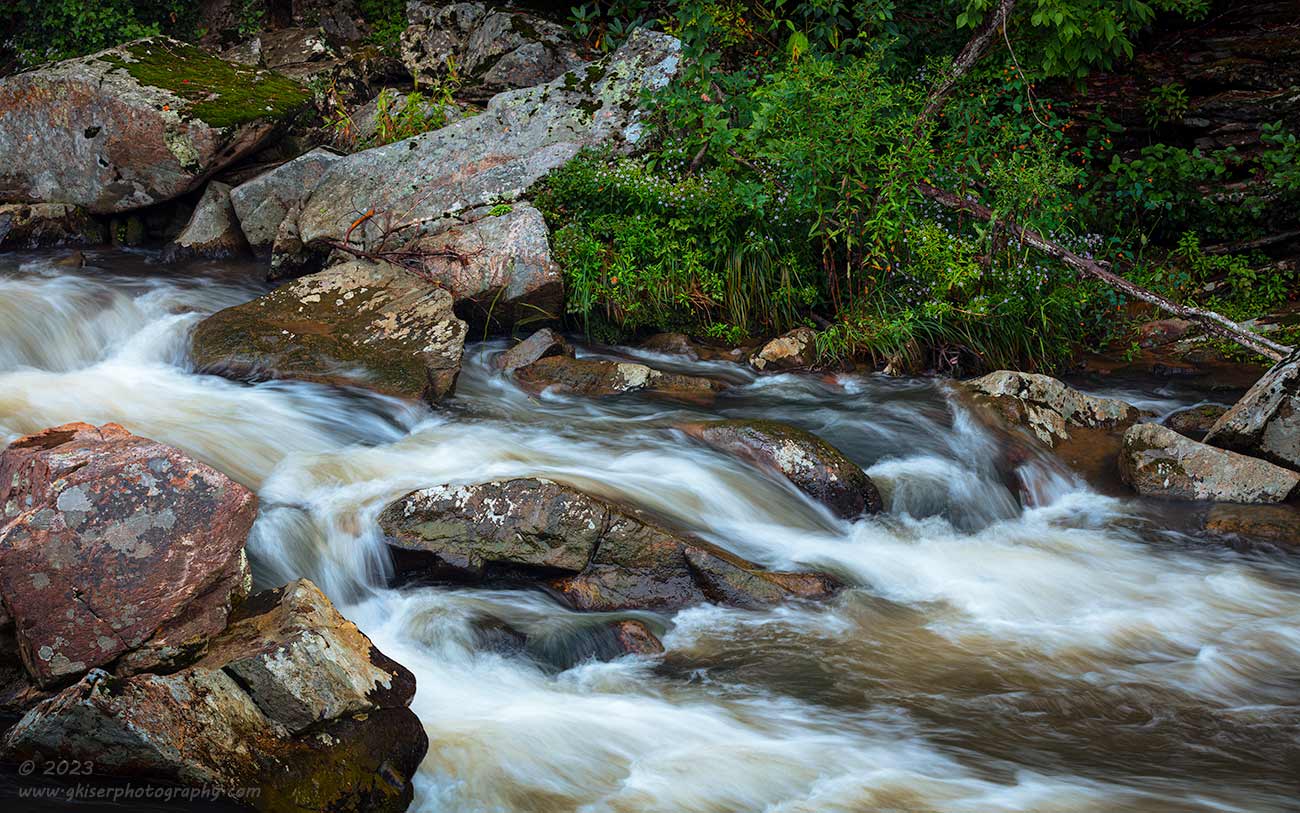
Since I was shooting with a longer focal length, I knew that the shutter speed would be much faster than what I had used initially. I ended up keeping the speed the same as my previous isolation at 1/5 of a second. This looked to provide the right show of motion in the water for what I was after. The light had changed on the scene and the colors were really popping, even in the dull picture style showing in my live view. I worked through this scene quicker than I had done before because I understood it much better this time around.
The biggest tweak that I made to the camera was to elevate the tripod as far as it would go so that I could get as much separation as possible between the rocks on the lower portion. This was important because it helped the visual tracking of the eyes in my opinion to have that pathway cleared of all obstructions. I shot several exposures here because the texture of the water was changing with each press of the button thanks to the relatively quick shutter speed. I knew that this was among the fastest that I had shot this section at, and I was excited to see how it was going to turn out when I got the images home.
As it turned out, I had two sets of similar compositions but shot at very different focal lengths. There were some differences between them in how they looked that caused me to keep several from each set in my first round of culling. As I was closing in on the final images that I was going to edit, I got it down to one from each set. I saw that the colors were much more impactful on the tighter composition, while the textures were a little more interesting on the wider one. I remembered seeing the first one in a black and white picture style and thought that I would edit it that way and leave the second one as a color image to take advantage of the brighter colors since the light was shining a bit brighter at that point. The choice worked out well and provided me with two very different images of the same section of the water.
I had spent a lot of time working that section and had done so with two lenses. I had to call it quits at some point, and I finally gave up figuring that I had the best that I was able to get by that point. I shifted my attention to other areas to see if there was something else that I could work while I was standing here. Of course, I started to look at the twin upper falls as I always do. I have come to realize that these are pretty much a standard composition shot no matter what you do, and I’ve grown a little bored with them over the years. However, I noticed that there have been some changes to the overlook side of the water since the last time I had shot here.
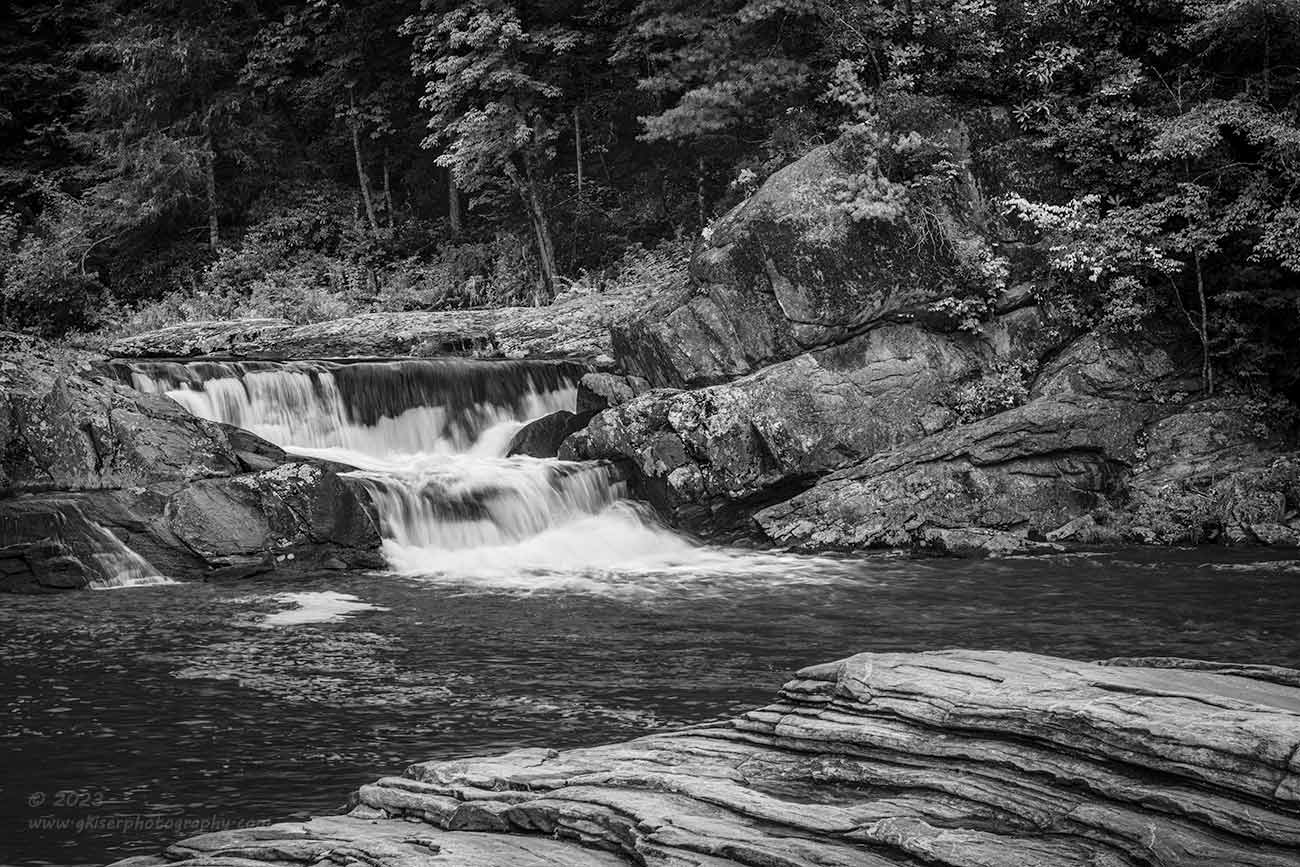
Years ago, the overlook used to stretch out to the edge of the shore, but after a flood a few years ago, that fence had been damaged and they pulled the barrier back quite a bit. The remnants of the fence had been left at the edge which prevented a composition from including the shore as a foreground. I noticed that this time, that was not the case, and the shoreline was clear of any fence material. There were two fallen trees lounging atop the rocks though. This caused me a little difficulty in figuring out a composition with either of the falls. Honestly, I wasn’t stressing this shot at all because I have captured these two waterfalls many times over the years and didn’t really see much difference I could make now.
It just didn’t sit right with me to let the missing fence go to waste though. I stayed and pondered this for much longer than I would have normally. What I determined was the better composition was for the waterfall to the right, but that was the least interesting waterfall. The one to the left was much better, but the composition wasn’t going to read nearly as well. I liked the leading lines that the foreground brought into play, but I was going to have to get an extreme angle to capture that. By doing that, the photo was very tight on the left side which made it difficult for my eyes to enter the frame. It hit me at that point that I was going to need to flip it horizontally. This is very easy to do in the landscape because there is usually nothing indicating right from left. I got the angle I needed and set the shot up with the long lens still attached.
What I ended up doing was putting the tripod on the corner of the fence at the far end of the overlook and elevating it to the maximum height it would go. This put the camera well above my head and I was having a very hard time seeing what I needed to on the back. I ended up climbing up on the fence support so that I could see the camera. It was an interesting balancing act which was kind of difficult to do shifting between looking at the camera and then at the waterfall in the distance. There are times I swear that I suffer from Vertigo, and this was one of those times. I didn’t fall, but I really got unsteady a few times. I made a handful of exposures and hopped back down to the ground. I pulled the camera down to see what I had captured and was satisfied that I had what I needed.
When I got this set home, I started to look at the frames and found that color played absolutely no part in the composition. The main players were the textures and contrasts between light and dark. This made the choice to go with black and white a very simple task. The more I worked the image, the more I liked how all the tones were coming together. The horizontal flip did exactly what I wanted it to do, and by the end of it, I was really happy with how it looked. I think that this was the first and only time I’ve successfully been able to get the layered rock as a foreground for this cascade. The fact that I almost dismissed it doesn’t escape me. It is just another reason why I like to return to places many times. There is always a fresh composition waiting for you, and once you eliminate the easy ones, you start to see the more difficult ones which usually make the better photos.
This wrapped up my time with Linville Falls. The sun was starting to be a little too bright at this point, and I had done enough long exposures for the day. I was ready to hit the road and see if I could do anything with that icebox I had seen on the way up to the falls. The irony of it all was that as I was hiking back to the truck, the sun started to fade, and the clouds came back once again. I didn’t have any thoughts of continuing here though. The other locations that I could shoot would not provide the images that I would want to capture, with the existing conditions. I had done all I wanted to do with moving water for the day and had plenty of photographs to go through when I got home. It had been a great day, and there was still one more stop that I wanted to make before heading home. It wasn’t too far away, and I was ready to see if there was something that I could do with it.
I really didn’t remember much about the scene, only that there was an old icebox next to a door in a recessed part of a building. I hadn’t been able to look at it in detail as I was passing it by earlier, so all I knew to do was look for this small detail on the right side of the road. It wasn’t many miles from Linville Falls, so I was watching for it the minute I passed the barn which had started the day off just after sunrise. As I was driving, I thought I had to have missed it because this seemed much longer of a trip than I recalled after seeing it. I just kept plugging along and hoping.
Eventually, I saw something that rang a bell in my memory. I slowed down and saw the ice box. It was in front of an old brick building that used to be a gas station based on the sign over the island where the pumps used to be. I quickly pulled off into the parking area and moved the truck out of the way since there were some large windows I was going to have to deal with. Before I turned the truck off, I surveyed the scene. What I had been planning for wasn’t going to happen. There wasn’t a good isolation shot of the icebox and the front of the store as my mind had considered hours before. However, the entire building fit the bill for a decay subject, and the island out front told the story of the building. The icebox became less and less interesting to me as I looked at the entire story of the place.

I wasn’t quite sure how I was going to photograph this building, but I knew that there was a photograph to be had here. I turned off the truck and went back to get my camera with the 24-70mm lens attached as well as a polarizer. I moved around the parking lot maintaining a quarter view of the building while using the larger section to block a white building in the background beyond the trees. I used a tree behind the sign and the lights to give good separation for the brighter bits of that element. From this angle, I was able to mask the 55-gallon trashcan that contained 67 gallons of empty aluminum cans. I set the tripod down pretty low, but not so low as to create terrible converging verticals.
Once I had the composition figured out, I looked at the exposure and found that the sky was going to cause me problems. I needed to get control of that part of the exposure and for that I decided to go with a 2-stop hard edge ND Grad. I didn’t like the idea of using a hard edge here, but for the small sliver of sky that was the problem, I wouldn’t have been able to get a soft edge to affect all that I needed it to. As a compromise, I used just a 2-stop which would be easier to blend in during post than a 3-stop. That gave me just enough reduction in the exposure of the sky to be able to boost the shadows sufficiently for the anticipated outcome. I say this all the time, when it comes to decisions that you make during the capture portion of a photograph, shoot it for how you intend to edit the image. That was what I was doing. I was giving myself the right exposure to allow me to have plenty of information across the luminance range knowing that I would be able to finesse it in post later. This is by no means a case of fixing it in post, I’m treating the image file as the raw material for the image that I am going to create later on.
The planning paid off and allowed me to have this photograph which was very easy to work with in Lightroom. The edit didn’t take long at all, and the end result was just as I had planned it. The hardest part of this photograph was waiting for the traffic to clear in the road because every passing vehicle caused a reflection to show in the windows which was a distraction for me. I think I shot four images from this angle to make sure that I had clear windows which they all turned out to be clear. I also moved around to two other locations to capture different angles on the building just in case this first idea didn’t work out.
As luck would have it, the first idea was the best and that was the composition that I went with. The other two angles were flatter and didn’t have the same excitement and depth that the first one did. The last one that I shot was also right down at the ground which caused some pretty distracting converging verticals. Had I fixed that aspect of the composition, I would have made it even more boring than it already was. The trick here was the quarter view that showed the depth of the building, even though most of the side wall was obscured by the growing vegetation.
This was another image that seemed to trip the same storyline as the Exxon sign that I had just shot over the previous weekend. Maybe it is a sign of me getting old and that I am reading more and more news articles. I don’t remember a time when I leaned so heavily on current events for the stories that I wanted to share with my photos. Yet, here we are once again looking at the inevitable extinction of gas stations as we know them. Photographs like this also fit nicely in with other gas station photos from decades ago where the pumps are still showing prices of less than a dollar a gallon. Here we see a price of $3.19 a gallon which indicates that this one is a much more recent business having folded. It is the little clues like that which make these fun photographs to look at and imagine a time when there was activity here.
After spending about 20 minutes here, I figured that I had the images that I needed to tell the story. I happened to think back on how the day had gone. I had 94 photographs in the camera but had not shot a single frame that I had left the house intending to photograph. Here I was at a scene that I had spotted on the way up and had failed to create the image that I thought I would. I would normally be really down on myself and would be hoping that the alternate photographs that I ended up getting would be passable at least. This time was not one of those days though. I was thrilled with what I had photographed since that first barn I had stopped at. Sure, I had nothing that I had intended, but the reality of it was everything that I had planned on shooting, I had done variations on before. This was never going to be a standout trek, just a chance to get out and work some scenes in the fog. I had turned that practice session into a very fruitful day behind the camera with what I was pretty sure was going to be some really unique photographs.
It really was time to call it a day though. I had already gotten a text message indicating that one of the clients from a recent headshot session had changed their mind on what photograph they wanted to use. They were wanting the smiling one rather than the serious one which meant that I was going to have to get home and do a quick edit on the alternate image and get that submitted to the client. Fortunately, it was going to be a matter of copying and pasting the edit from one to the other since they were exactly the same with the exception of the expression. It wouldn’t take long, but I wanted to have it done by the close of business because I hate to make my clients wait on me.
I was about an hour from home, and I still needed to get gas before parking the truck. I would have grabbed some at the gas station I had just visited, but I couldn’t find a functioning pump. I was going to have to visit one a bit more….active. Based on the prices in Linville and Boone, I was going to need to get it close to home as well. The first station that I stopped at had pumps that were not in working order, but not quite photographic material yet. I went to my alternate station in North Wilkesboro and found gas nearly as cheap as the station I had just photographed. With a full tank, I was ready to head home and get that headshot edited and submitted.
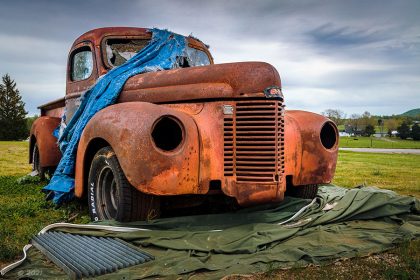
Well, as I was traveling down the road, on the way home, I passed by a scene that I have been by maybe 300 times…or more. It is a scene that Toni had mentioned to me shortly after moving out here because there is an old truck parked in front of a house that she knew I would like to photograph. It is one that certainly fits what I like, but the background doesn’t work for it. There is also an old CJ-5 beside the vacant house which is now completely overgrown and not visible. It was neither of these subjects that I was struck by on this drive. Nope, it was the boat that was parked on the side of the property that caught my eye.
This is not the first time that I’ve looked at this boat. I have a soft spot for boats parked in tall grass with evidence of neglect. Most of the time though, the setting isn’t all that great, or the boat still looks usable. I’ve tried to make a composition of this boat many times in the past, but never been able to get the elements to work together to tell the story. The tall grass around the boat was something new this time. This yard is usually mowed more frequently, but for whatever reason, this time it wasn’t. I considered what I had seen as I kept driving down the road and realized that there was a composition there which had not been there previously. There were two trees that arched into the frame that I was pretty sure I would be able to put on either side of the boat which would make the composition work. The tall grass was that element that I needed to show neglect and there were other clues for decay as well. I quickly got turned around and made another drive-by to make sure that I wasn’t missing anything. Nope, it was all looking good, so I did another U-turn and pulled off onto the shoulder of the road.

While this house is very obviously vacant, it was right across from another house, and I wasn’t sure where the owner was. I wasn’t going to be going into the yard beyond that easement from the roadway, so I didn’t want to spend the time knocking on doors. I just figured that I could get the shot and be gone before anyone would really notice. I went around and grabbed the camera with the 24-70mm lens as well as the polarizer. I brought it around to the front of the truck where I knew the composition was. I placed the camera at about waist height and got the composition dialed in. Once I did that, I worked on the exposure. The sky was causing me issues, but there was really no way of dealing with it in terms of using filters because the trees were a valuable part of the composition, and I couldn’t have them darkened by a grad filter. The breeze was going to make it nearly impossible to do an HDR blend, so that left me with exposing to the right as my only option. This left the boat in the shadows, but the histogram was showing that I was going to have enough information to work with to get the right exposure in both the highlights and shadows.
I shot a couple of quick exposures to get everything finally set and looked at the final image. It lacked something, and it took me a minute to figure out what that something was. The grass wasn’t looking nearly as tall as I wanted it to, and the trees were move vertical than I wanted them. I knew what needed to be done to fix both of those problems. I dropped the camera down to about knee height. This brought the tall grasses up to the top of the hull and the perspective distortion amplified the angle of the trees on either side. This was going to work very well now.
I made more exposures as the breeze calmed down and I made sure that I was protecting my highlights. After my last exposure, I had a grand total of 100 photographs on the memory cards. Not wanting to push my luck any further, I packed up my gear and headed back to the house. Once I got home, I knocked out that headshot which turned out to be a little more complex than I had thought. One of the reasons that we hadn’t used that one in the first place was there were two places where his hair wasn’t quite right. This was actually still a light testing shot and we hadn’t looked at fixing cosmetic issues just yet. After a quick trip into Photoshop for a bit of retouching the new headshot was ready to be delivered.
I could now look at the images from today and hoped to have seven keepers out of the 100 frames. After I was done culling, I had eleven images that I wanted to see edited. Of those, ten of them made the final cut which was quite amazing to me. There were a number of black and white photos that turned out really nice. The last of them was the boat photo that I ended the day off with. This one just felt right as a black and white frame because color really didn’t help to tell the story. In fact, the color got in the way as it was the contrast between light and dark that really established the elements. The textures made for a wonderful frame for the smooth hull of the boat and the best way to show off texture and tonality is in black and white. Nearly half of the day’s images were done in black and white which makes me very happy. I love seeing my photographs without color when they can be successful in that presentation. I really feel that each of these are special and deserved to be done without color.
I appreciate you for sticking with me for this very lengthy blog entry. I guess I am making up for the last one that was so quick. There was a lot to this trek, considering that nothing that I had planned on actually happened. This was an exercise in adapting and reacting to what was in front of me. When it comes to defining a professional photographer compared to an enthusiast, it isn’t how much money they make. The difference comes down to being able to drop back and punt when things don’t go your way. The more experience a photographer has, the easier they can figure out alternate plans on the fly and continue with the task at hand.
If you have enjoyed the alternate photos that I came up with today and would like a print, I would love to talk with you further about getting you matched up. You can also order stock sizes directly from this website. There is truly no better way to enjoy photography whether it is mine or someone else’s, than to see it in its tangible form. There are just too many variables with computer monitors, or personal devices to be assured that you are seeing a piece in the way that the photographer intended. By purchasing a print, you are not only helping fund my treks, but you are also telling me in a very profound way that you enjoy my work and value my art. It goes further than you can imagine to helping me continue on this course I have set for myself.
Also, if you are a photographer and would like to add to your own toolbox so that you can make these creative pivots during your outings, consider signing up for a mentorship session with me. I have everything from simple image critiques to hourly sessions either virtual or in-person. For those that want to really get into their photography, I also offer a long-term advanced membership program which can be molded to your exact needs over weeks or months. No matter what you choose, I pride myself in offering a lot of bang for your buck. Give me a call and let’s see if I will be a good fit for your needs. The consultation is free, and I usually offer a lot of free advice during that conversation.
In just a few hours, my next Behind the Camera will be published, and I hope to see you back here for that. I’ll be covering a topic that is near and dear to my heart and it revolves around those photographers that tend to look at photography as a seasonal gig rather than getting out there and working it all year. Summer is my least favorite time of the year to be a photographer, yet you can see from this trek that I have been able to work a lot of different types of scenes and get really strong photographs. It’s just a matter of training yourself to see how to work within the different seasons or conditions.
Until next time….

Remember to use the code KISER10 to get 10% off your purchase