Wednesday, July 19, 2023
I love it when I can introduce somebody to the beauty that is decay and rust. That is just what I did on this trek that was mainly a mentorship session with a predominantly waterfall photography. I’ll get into more detail here in a minute, but I wanted to share with you a bit of a failure first. I went out several days ago to the area of Union Grove with the intention of shooting an old Ford that I have been trying to get several times now. The day started kind of early because I was trying to take advantage of the clouds before the rain came in. Once again, I was met with what appeared to be nobody home at any of the houses around the car. I kept trolling through the area in hopes that I would see some sort of action, which I eventually did. It was a tractor entering the field where the car was parked. I made contact with the operator and found out which house I needed to go to in order to find the owner. I even found out that I needed to go to the back door. Things were looking up.
On the way to the house, I passed another couple and stopped to talk to them to see if perhaps they were the owners. They weren’t, but they knew the owner and directed me to the same house. I was so excited that I was about to be able to photograph the car. I knocked on the back door and heard a lot of dogs barking which was a good sign. They are better than a doorbell. I waited for a few minutes with no response from the inside. Thinking maybe they were on the other side of the house, I moved to the front door and tried again. No barking on this side, and no other sounds either. I went back to the back door and knocked once more with the same response. Figuring that they were out, I went to the truck and grabbed a business card which I wrote a note on to leave in the door. I sadly left the area and hoped that I would be getting a phone call shortly.
So that I could react to the owner calling, I stayed in the general area and hunted for another target of opportunity. To make a long story short, I ended up driving 140 miles that day and never once pulled the camera out. I didn’t find anything else worth photographing which happens occasionally when I go out on these rural road trips. It really isn’t all glamor as a photographer and there is no such thing as a sure thing when it comes to finding subjects to photograph. It wasn’t a wasted trip though as I did some pretty in-depth scouting of the area which I had not done previously. I now knew what all was there and had a good idea that I didn’t need to revisit the area unless I heard from the owner. That hasn’t happened yet, so I am prepared to forget that location at this point.
The following days were not good weather-wise for photography, so I stuck to close to home and took care of things around here. I’ve got the next Behind the Camera all finished up and ready for August 1st, and the yard has been taken care of after a good bit of rain. The rest of the time has been spent preparing for a trip to brand new location that I have never shot before. I’m not going to ruin the surprise of where we are going and when but keep an eye out for at least one new blog entry in the near future with hopefully a good many new images being shared.
One other thing that I have been working on is getting ready for a mentoring session with one of my long-term clients. I actually met him during a Waterfall Workshop in 2020, if memory serves. Since this time, he has joined me for a couple of workshops as well as some mentoring sessions. The time spent with him as been primarily based around waterfalls which is his first love in photography. There was another time when we worked with some general landscape photographs which was a bit of a change for him. This time, he had come to me looking for a bit of an introduction to a completely different kind of photography. Wanting to broaden his horizons, he wanted to give decay subjects a chance, with a specific focus on rust. Well, that is right up my alley, and I had the perfect place to take him.

When it comes to teaching decay photography and rusty vehicles, the biggest hurdle for me is finding a location where I have subjects to photograph without spending the time driving to various different locations. I like to spend the time actually shooting rather than going from place to place. Fortunately, I have run across a perfect spot for this in my travels over the years. What started as a quick long-distance grab shot, in the rain of a big White Firetruck has turned into a wonderful connection to one of the nicest guys I know. I’ve been back many a time, and this is the same location that I host the Decay Workshops. It is perfect because there are so many examples of rusty vehicles as well as functional rat rods. It is just a natural location, and there is no problem filling an entire day with different subjects and ways of shooting them.
For the mentorship, we wanted to cover the different ways of capturing rust and talk about the best practices in this type of photography. He wanted to see some examples of how I put images together and see my workflow as well as working on compositions himself. It was looking like quite a fun day and an opportunity for me to get my camera out as well. This is not something that I normally do during a mentorship session, but I’m happy to demonstrate how I work if it will be beneficial to the client.
Leading up to the timeframe when we were looking at doing the session, we ended up dialing it down to the 18th and the 19th. As we got closer, I started to look at the weather apps and found that the sky was looking mostly clear on the 18th, with some decent clouds on the 19th. I confirmed with the shop owner that we were good for the 19th and that became the date that we put in the books. This is one of the benefits of doing a mentorship session here as opposed to a workshop. There is a lot more flexibility with weather in a One-on-One session compared to setting a date six months in advance and hoping that the weather works out.
As it turned out, the weather kept on changing throughout the day on Tuesday to the point that I had two different forecasts for the following day. One was showing rain the morning while the other was showing rain at lunchtime. I had to make a choice and went with the more probably choice of the rain coming in at noon. We decided to meet at 8am which was a bit of a haul for Bob who lives out near Asheville. He had about twice the distance to cover as I did, which I kind of hated for him, but I knew of no better location closer to him for this session.
It was pretty easy for me to get up at 5:45 and have a leisurely breakfast before getting on the road at 6:45 with the intention of getting there between 7:30 and 7:45 because I hate for the clients to beat me to the location. I thought that I was certainly going to accomplish that until I entered Yadkinville and received a text from Bob who said that he was there and parked across the street. Well drat, I was still about 15 minutes away which meant that I was late, even though I was going to get there right when I planned to. I should have known better because he did the same thing to me at Linville Falls a couple of years ago. At any rate, I knew he was at the right place and we would be able to get started about 30 minutes ahead of time which was good.
The only thing that really wasn’t going as planned was the weather. It wasn’t raining as I had hoped would happen, but the clouds that were supposed to be overhead were not really materializing. There was a dense overcast which was largely due to the smoke from the Canadian wildfires, but no good clouds to offer texture to the sky. I guess I should be happy that it wasn’t raining, and the sun wasn’t overly bright either. It was going to be a good day, and this type of photography isn’t as dependent on an interesting sky. It is much more about light diffusion than anything.

When I showed up, I found Bob right where he said he would be. I got parked and went over to welcome him to this slice of rusty goodness. After we got him parked a little closer to the shop, we decided to do a quick walkthrough of the property without the gear to get a feel for the location. I took that opportunity to point out the different subjects that I really liked working with and went through some of the considerations that I go through in building compositions. It was during this time that I tried to ease his transition into decay photography by comparing it to waterfall photography. It was a comparison that I had come up with on the way out here. It made perfect sense, that just like waterfalls, you would start off with an overall establishing shot and then work into the isolations as you picked out lines, curves, and textures that interested you. When I shared this bit of information, it seemed to click right away, and Bob understood the basics of this type of photography without even pulling the camera out. I thanked him for coming out and bid him a good day since my job was done.
Well, he didn’t let me off the hook that easily. There were plenty more questions to work through and we still needed to get some practical exercises out of the way before we could call it a day. After we finished walking the property, we went back to the two 4Runners (he has impeccable taste) and grabbed our gear. If this were a workshop, I would start us off with the area that would showcase what I am wanting to teach to begin with, but since there wasn’t so much of a lesson plan in place for the day, I let Bob decide where to start off at.
It kind of surprised me that he chose to go with Old Stitch which was sitting in the parking lot out front of the shop. It has been here for quite some time even though it does run and drive. If you have been following me for a while, you have seen this rat rod Chevrolet a time or two in the blog. I truly do love this truck, but I have never been a fan of where it has been parked for so long in the front parking lot. There was just no real way to get a good overall shot of it sitting there, and I’ve done quite a few isolations of it over the previous years. I guess I just kind of forgot about it, but Bob was all over wanting to work this truck. When I started to get him to formulate what he liked about the truck, it was the details that seemed to grab his attention more than the overall truck. It made sense looking back over the day because it turns out Bob is really big on the isolations with rusty decay and gravitated to those rather than the full vehicles through most of the day. This is just part of what I try to establish during my mentorship sessions.

His first composition was one on the passenger side of the truck that featured the door art, the fender detail, and the gas filler neck. It was actually a well seen grouping of elements and one that I hadn’t really considered before. There were some fine-tuning issues that needed to be addressed when it came to edge patrol and the visual pathway through the image. As I helped work those concerns out, I became rather enamored with the composition and felt that I had added enough influence to the composition that I was now invested in it. This was the first shot that I pulled my own camera out for. It was easier for me to show some of the concepts that I was talking about rather than trying to guide the process. I’ll hand it to Bob, that he did come up with a fantastic compositional idea and I’m glad that we worked through it like we did. I’m very happy with how my version came out and it seemed that Bob was equally as happy with his take on the scene.
While Bob was working on other ideas and getting his feet wet in the rusty waters rather than the white waters, I started looking around Old Stitch to see if there were any other compositions that I might want to shoot. The light was actually pretty good despite there being very few clouds in the sky. I just did what I was telling Bob to do and walk around until something jumped out at me. That something was a tear in the hood that had been stitched together. I had photographed this feature before, but since that time, there had been another detail welded onto the fender which worked well as an opposing element for the tear.
I switched lenses from my standard glass to the telephoto which allowed me to compress the scene a bit more. I framed the composition up paying attention to the positioning of the two main elements while letting the fender extension run through the lower part of the scene for a bit of added visual tension. The upper portion of the photo was reserved for the slight bit of color that was shining through the rust. The hint of cool tones gave the image the right bit of contrast and it all seemed to work out better than the first time I had shot it.
Now, for those of you paying attention and are familiar with the previous image I shot here, you are probably noticing that something isn’t right with this one. That difference that you are seeing is the fact that the composition has been flipped horizontally. This was done to make the image read better left to right. The new cross that was welded onto the fender was more effective on the left side pointing up to the wound on the hood. This could only happen with the orientation of the photo flipped left to right. It created an image that was much easier read as we are looking at it. The lack of any true scale to the image gives it a little bit of an abstract quality in that you really don’t know what you are looking at and since there is nothing in the photo that would indicate a “correct” left to right, I felt it was only proper to flip the image. What do you think?

As Bob and I worked the truck in unison, I realized that he was looking hard at the back of the cab. I went over to see what he was working on. He really enjoyed the fact that this rear window was lining up with a GMC pickup in front with a similar shaped rear window. It made for an interesting concept, and we talked through the options here. Ultimately, things didn’t really work out because in order to capture all the elements that he wanted, there would be too many distractions added into the scene. However, while talking through the options, I started to contemplate a different take on the concept. My idea was to come in from the side and focus on one of the exhaust pipes and the single rear window which would frame the steering wheel. It was an odd idea, but I wanted to see how it would pan out. While Bob worked on fleshing out the idea, I decided to bring my camera over and see just how well I could make the concept work.
I didn’t change anything at all with the camera and kept the telephoto lens attached along with the polarizer. I worked on getting the framing and composition right which was a bit trickier than I had figured. Before long though, I had the composition set as how I had described it. It showcased the stitched welds, the pipe, and the window with the steering wheel giving that last bit of information in the composition. For this one, I had planned on it being in color, but when I started to edit it, it really felt like a black and white image because of the different textures and brightness values that were present. If you will remember from my last Behind the Camera, there are times when the decision to go black and white comes during the editing stage. There are also times when I plan a black and white shot which is what happened next.

As I continued to survey every inch of Stitch and talked to Bob about options, I became rather struck by the tire tread on the rear dual wheels. The tread pattern on the tires was very agricultural in nature with large lugs and plenty of room between them. Keeping in mind that the tires are all black, I was seeing how the sun was creating shadows in the tread while highlighting some of the lugs. I immediately thought about doing this as a black and white composition going for a very high contrast treatment, much like I would do if photographing sand dunes. Of course, there are not many sand dunes in Yadkin County, so this was going to have to do.
I selected the black and white picture style on the camera to help me visualize the composition. I then started to frame up different photos focusing on the area between the two tires. This gave me the maximum shadow area, as well as the most depth to the scene. I shot both horizontal and vertical images with large degrees of success based on the LCD. It was the first time I had done something quite like this and I was liking it. It felt very much abstract, but also recognizable at the same time. I knew how I was going to edit these images and I just had fun capturing them. In fact, come to think about it, I was having more fun working these details on Old Stitch than I had in a long time.
If I’m being totally honest, and I always try to do that in the blog, this is one of the reasons that I love doing workshops and mentoring photographers. It might sound like I use it as an opportunity to “steal” ideas on compositions, but that isn’t true at all. The compositions that I might emulate are ones that I have put in a substantial effort in creating and feel that a large portion of the composition is mine. What I am talking about is when I put myself in the shoes of other photographers, I tend to start to look at the world as they do. It gets me out of ruts many times and introduces me to alternative perspectives that I might not have come up with myself. This is not to say that I lack a creative vision, far from it actually. It takes a very vivid creative vision to see the world as another might and compose in that manner. Essentially, this is why photographers sign up for workshops and other educational experiences. They are looking for alternatives to how they might typically work. How snobby would it sound if I were to tell you that the learning can only work in a single direction. The implication would be that I know it all and can learn nothing from the students. I find that idea silly and have always learned as much from my students as I have taught them. Every photographer out there has different ways of looking at things and different ideas on how to capture them. I really enjoy learning different points of view and trying to incorporate those into what I do. It keeps my work fresh, and keeps me learning which is the most important thing.

As Bob and I made our rounds on Stitch, Dean pulled up and we had the chance to talk to him about all his different projects. It is always great to hear about what is in the shop and get a chance to see crazy creations like a late ’50’s Ford pickup truck that had been grafted onto the front of a late model Mustang with a Coyote engine. The dash and interior fit right into the cab of the truck, and the grill of the Mustang was going to be grafted onto the front of this truck. It sounds like an erector set faux pas, but to see it, you would be left wondering why Ford didn’t create this in the first place. I am really hoping that I get the chance to photograph it when it is all done. Dean, if you are reading this, I just need an hour to get down that way, give me a yell when it’s done!
When we got done checking out the shop and seeing the projects, it was back out to Stitch. It always amazes me how long folks will stay at the first station when we are here. No matter what that station is, it is always hours before we move onto the next one. We were right on track with Stitch and even though neither of us had shot an overall composition, we had been with the details for a couple of hours at this point. We weren’t quite done either. There were a couple more angles that Bob wanted to play with, and I wanted to try and do a variation on the theme from the passenger’s side door art. Now that I was on the driver’s side, I wanted to play with the light in a different direction and capture a composition from the front to rear using the pronounced fender as my foreground.
In order to do this, I needed to keep the telephoto lens in place to keep the fender from appearing larger than it needed to be. The longer focal length allowed me to change the relative scale to a more accurate representation. The composition came together well, but I wasn’t sold that this was going to work all that well at all. The fender seemed too dominant, even at the longer focal length. I only shot two frames here because I didn’t think it was going to work out. Even when I got the RAW images home, it just lacked something and didn’t feel quite right. It was one of the last images that I edited from the day and from an early direction, I chose to go black and white because I didn’t think that it had quite the punch that the first image of the day had. While I started to go through the edit, I found a lot of satisfaction from the different B&W profiles and landed on one that had the right contrasts built in. I added to the contrast and did a good deal of dodging and burning to land on this final image.
Now, normally I don’t like rusty images as black and white because the rust tones are usually quite important to the overall composition. In this case, however, it was the lack of color that helped to tell the story of the Grim Reaper on the door. The lack of color added a certain goth quality to the image that I really liked. I spent some extra time dodging and burning to bring out all the tones that I wanted to and ended up with this one. In a strange turn of events, I like this black and white version better than the color one which I was rather fond of from the beginning.
It was shortly after this that Bob and I decided that Old Stitch needed some rest. We had been bothering him for several hours at this point. There was still plenty of great stuff to work with and we were running out of time to look at those other options. We collected our gear, and I had Bob choose the next area to work with. He picked the old rat rod that was parked in front of the old family home. I’ve shot this car many times and have found it the quintessential rat rod in form. I had no intention of working this scene since I have so many from this very car. I started to ask Bob what he liked about the scene and we started to put together a composition based on what he was liking.
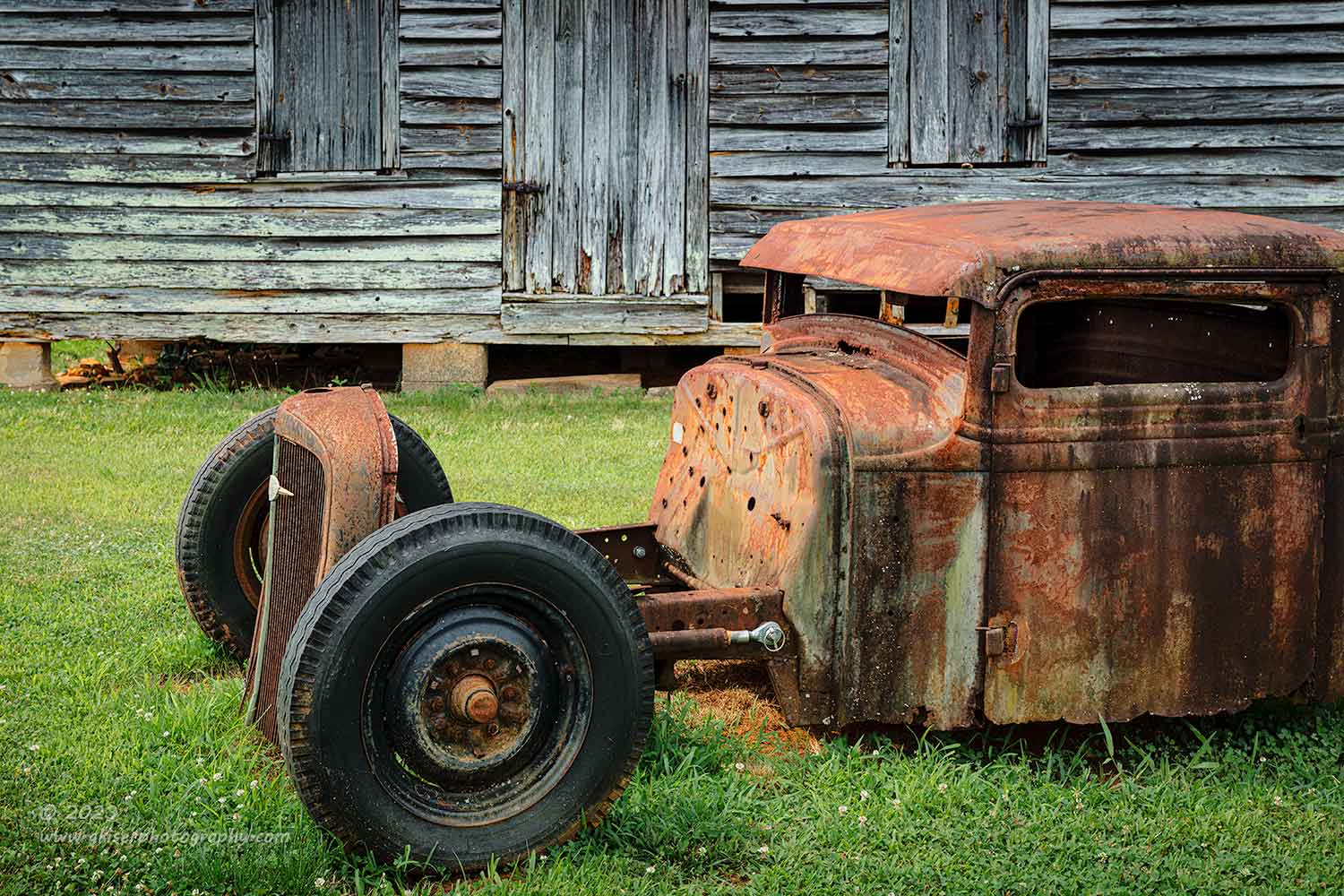
The sky was pretty much without detail at this point which eliminated a lot of my go to compositions and while I was listening to what Bob was interested in, I started to have an interesting idea about doing a creative crop on the car. Those of you who are familiar with this subject will remember that the rear wheels are from an S-10 and wrapped in whitewalls. This was not part of the car as the rear axle was switched out years ago and these were the wheels that were attached. I’ve never been a fan of these wheels, and for the first time saw a reason to crop them out. In order to eliminate the distractions in the background, I suggested that we use the house as a background from side to side. This became a great example of how to use focal length to change the scaling between the foreground and the background. I worked with Bob to get the right focal length and to position the car with the proper nose room to the front. As I was working through this with him, I became invested in the composition and started to really like how it was working out. As I did before, I pulled out my camera and started to work on my own version. I went with a bit wider of a focal length than Bob had used just to give the car a bit more presence in the frame, but otherwise I did the same things with the composition.
The end result turned out really nice with the way that the doors and windows frame the shape of the car. Thanks to the cooler tones of the wood, I had a great color contrast going in the scene, so I was pretty sure that I was going to be processing this one in color. Even though there is no engine, fenders, or hood, this car has a ton of character and I know how special the house is to Dean which makes it special to me as well. I’m really glad that I suggested this crop of the car because it really worked with the angle that Bob had wanted to shoot the car from. It allowed me to get rid of the parts that I never really cared for, while concentrating on the areas that I find quite interesting like the lowered stance and the chopped passenger compartment. Even the missing engine is a point of interest for me with this car. It made for a great grab shot before we moved on to the next subject.
When we finished up with the rat rod, Bob wanted to move to the Oldsmobile Delta 88 that was parked beside the barn. I love working with this car and many of you have seen it before. Just think about the sneer from the bent hood and fenders. This is a very difficult car to photograph because of where it is situated. There is a barn right next to it, a front clip from a Chevrolet behind it, and a Toyota on a flatbed on the passenger side, along with another barn in the background. As I have come to realize with Bob, he went for the isolation first and foremost and started to work the rear quarter. This is a great area to work with this car because most of the unique features are in that area. As I expected, he had some difficulties putting a composition together. I know how hard it was for me to figure this out, and I’ve seen many struggle with it during workshops here. It is almost a given that you will scratch your head with this car, which is part of what makes it so much fun to work with from my point of view.

I helped Bob out with several different variations on this part of the car and I could see everything clicking with him as he started to come up with his own compositions one after another. I think that working this car made him a bit hungry because he decided to take a break and get an apple for a quick snack. While he was going to his truck, I grabbed my camera and brought it around to the driver’s door where the glass had been knocked out. As you probably know, I have a bit of a struggle with interior photographs. I have a hard time seeing the compositions when it comes to shooting through a door. Because of this, when I have the opportunity to try and make a composition, I’ll usually give it an exposure or two. That is what I did here with the Olds. My driving reason for the attempt was the speedometer and gauge cluster. There was something really interesting about how it looked.
I knew that the light wasn’t really on my side as what I was wanting to photograph was in deep shadow compared to the rest of the car. However, the clouds and smoke in the sky seemed to take a lot of the harshness out of the light. I found that by elevating the camera, I minimized the exterior through the windshield as well as allowing more of the steering wheel to be included. This allowed me to overexpose the image a tad to get the shadow detail where I needed it. The end result was exposed in such a way that I felt confident that I could process the image without having to resort to multiple exposures and blending.
I had started with the composition as a horizontal composition but decided that a vertical one might work a bit better. By including the door handle, there was a bit more of the storyline included and it felt more welcoming to the viewer. I overshot the image top to bottom with the intention of cropping it down to a 5:7 aspect ratio as I will typically do with verticals. This gives me the ability to include more side to side while keeping the top and bottom crop points the same. As it turned out, I did choose to use this version, but cropped it down to a 4:5 aspect ratio to bring even more attention to the cockpit. While this is nothing like what I would like to be able to create, I can say that I am happy with how it turned out and think that it fits my vision of the driver’s seat.
This was the last image that I created because Bob was getting a little tired and I needed to make sure that we covered everything that he was wanting to talk about. The easiest way for me to do that is to allow him to work through compositions while I shadow and make suggestions as I see areas that could be improved on. Plus, when we got to the other side and started to work with a couple of the trucks behind the barn, we ran into a kitten that wanted to be included in the fun. Since Bob was allergic, and I didn’t want the kitten rubbing up on the tripod creating an unsteady image, I entertained it and held it for a while. It brought back memories from a trek to Hanging Rock 15 years ago or so. I had been photographing Tory’s Falls when I ran into a cat that adopted me and followed me along the trail. While I was working the waterfall, it curled up in my camera bag and napped while I worked. I ended up naming the car Trekker since I was on a trek. I spent a couple of hours with that cat before hiking back to the truck. During that return hike, the cat followed me until it found something in the woods that it wanted for lunch. The hunter instinct won out and it left me alone on the trail. I’ve thought about that cat many times since, and it seems that the spirit of that cat has arrived in this little kitten that just attached itself to us.
At any rate, after another hour or so working the last couple of subjects for the day, we decided to call it quits. Bob still had to drive back to Asheville, and it was getting rather warm. I made sure that there were no questions or clarifications that needed to be made and we went to the shop to tell Dean that we were leaving. I should also mention that while we were out there, Dean came up with two places that I had not been to that had subjects that I might like to photograph. One of them was a friend of his, and he talked to him on the phone and pretty much got permission for me to go out and shoot a couple of his cars. Finding these decay subjects is not always easy, but if you make the right contacts, the subjects tend to find you quicker than you can locate them.
I hope that you enjoyed today’s hybrid trek. My intention wasn’t to get images for myself, and that is evident in that I only shot 31 frames during the day. Normally, I would have been around 150 for the location and light, but 31 got accomplished what I needed done. I was able to show how I worked through a scene, and I came up with better examples of what I was saying than trying to describe the composition. It also gave me a chance to stretch my own creativity by experiencing the place through different eyes. I learned a lot, and I hope that I was able to teach as much or more. From the early postings on Facebook, I think I have succeeded in that quest and Bob has found a new love for a subject that he had never really considered before.
If you are interested in learning more about decay photography, or other photographic topics, remember that I do offer mentorships both by the hour and a more intense Advanced Mentorship that includes 25 hours of structured time to be spent how you think it will be most beneficial. I really enjoy the one-on-one nature of this type of learning, and it gives a much better opportunity to learn specific things when compared to a workshop. No matter what method you choose to learn, if you decide to trust my methods, you find that I’m very student centered and will dedicate my time to your needs instead of having you watch what I do as I find photos for my own portfolio. Contact me to find out what options are best suited for you in your journey.
If all goes to plan, the next blog entry that you will read should have some landscape photos from a slightly different type of landscape than you are used to seeing. This is a trip that has been a long time coming, and I’m excited to explore a new place with new scenery. I’m just hoping that I can made use of the light that I’m given during my time there. I hope to see you back here soon reading through my newest adventure.
Until next time….

Remember to use the code KISER10 to get 10% off your purchase