Saturday, April 4, 2026
Did I find my barns? If you aren’t sure about what barns I’m referring to, you might want to catch up with chapter 2 real quick before we get rolling with this installment. In my quest to kill a little time before the sun was in the right part of the sky, I started to roam around to look for a nice barn or maybe an old house to photograph. The sky was looking great, but the sun was still very directional which limited the directions that I could shoot in. It really didn’t matter that much because I wasn’t finding anything that visually interested me during my cruise. Knowing that I had several pretty decent images from the last stop, I decided that I would just head home and would reevaluate the clouds later in the day.
As I got closer to home, I decided to go through North Wilkesboro just to check on a particular shop that does restorations. They typically have a few older cars tucked away behind the building and I’ve seen a few new ones showing up in the past. Since they aren’t there on the weekends, I knew I wouldn’t be in the way and figured that I might be able to get a shot or two from here before going home.
When I arrived, I could see that there were some changes in the cars that they had, but nothing was really jumping out at me for photos. The sun was still fully out, and I was about to call it quits when I spotted the Apache sitting in a group of other vehicles by the bay door. It had a wonderful patina on it, and I could already see some compositions that I was interested in capturing with it. After parking the truck, I got out and walked around the truck to check it out critically.
With the way that the truck was positioned and the compositions that I was wanting, I chose to fit the wide-angle lens to the camera. This wasn’t for getting grand views of the truck because there were none to capture. I was looking for that distortion that I thought would make the photos more interesting. With everything put together, I moved over to the front of the truck on the side with the sunlight which was the best side for rust. I knew that I was going to focus on the headlights because that was a defining element of the truck. It took a little while before I got the feeling for how this lens was working with the truck and found it to be rather difficult because of the surroundings.
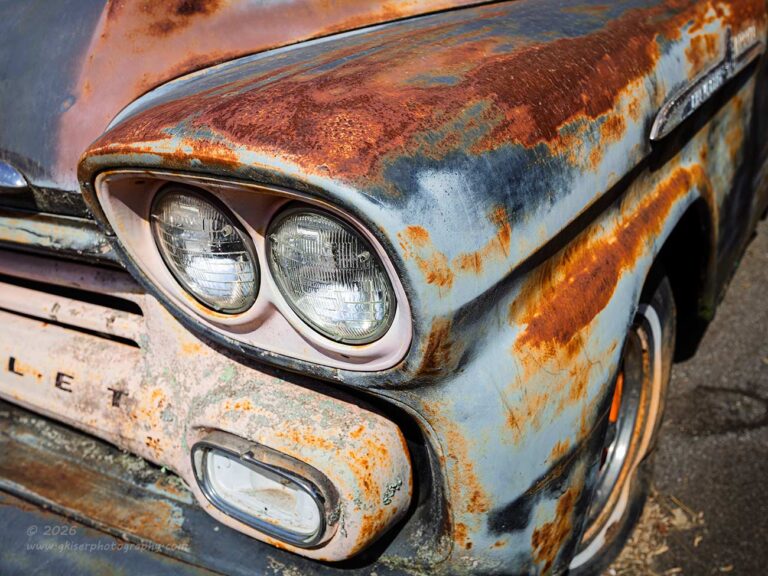
Before giving up on the wide-angle lens, I did manage to get one composition to work out where the distortion worked in my favor to show off the headlights. Of course, in hindsight, I could have captured this same view with the standard lens since it was shot at 32mm. That was about as wide as I could get without showing distractions around the truck. Because of this and the fact that none of the other compositions I had in mind really lent themselves to this lens, I went back to the truck and swapped out to the standard zoom once again. It was just the right tool for the job in this situation. I could have just as easily gone to the telephoto lens, but with the curves and bulges on this truck, I wanted to keep away from the flattening effect of the longer lens.
The focal length choices really do make a difference with how the photos show. The curves are much more accentuated with the wider end of the range and even into the standard range of focal lengths. That was where I wanted to be, but there wasn’t enough space to really get into the wider end of things. The standard zoom was a good midground that worked for what I was wanting to capture with this truck while allowing me a close in working distance to it.
Of course, that close in working distance caused some other issues for me. That was primarily the shadows that I cast while setting shots up. It seemed that most of the compositions that I was interested in put the sun directly behind me which then caused me to show up as a very detailed shadow on the truck. With every composition that I shot, I had to keep this in mind and make sure that none of me was showing up in the frame. This was a particularly rough issue when shooting wider which was another reason for the switch back to the standard zoom. There were some clouds in the sky, but they were seeming to be staying away from the sun as they had been doing earlier as well. It wasn’t looking good at all for going out to the other car that I needed full clouds for.

After all the trouble that I had with my original lens choice, I found that the compositions came much easier with the standard zoom attached. The first place that I went was the hood where I found a nice section of rust and patina. I didn’t need the headlights here at all and just wanted to use the panel lines and the body contours to establish the composition while the colors and textures filled the space. This is the kind of abstract image that I love doing, especially on a sunny day when the colors are even more saturated. As I explored the area that I was wanting to work with, I found that the deeper rust on the fender gave an effect much like a natural vignette which framed a section of the photograph perfectly. This allowed me to use the contours of the hood as some diagonal components with that mixture of warm and cool tones to really balance things out.
It is photos like this which I find fascinating because you just can’t tell what kind of vehicle or even subject you are looking at. The only information that you have is shape, texture, and color. That creates its own narrative which has nothing at all to do with the subject being photographed. This is the kind of abstract that I am wanting to work more with this year. It all just started coming together with this truck which I was drawn to because of the colors and the patina. Of course, I really liked the Apache style as well, but it offered so much more beyond the design elements of the truck.
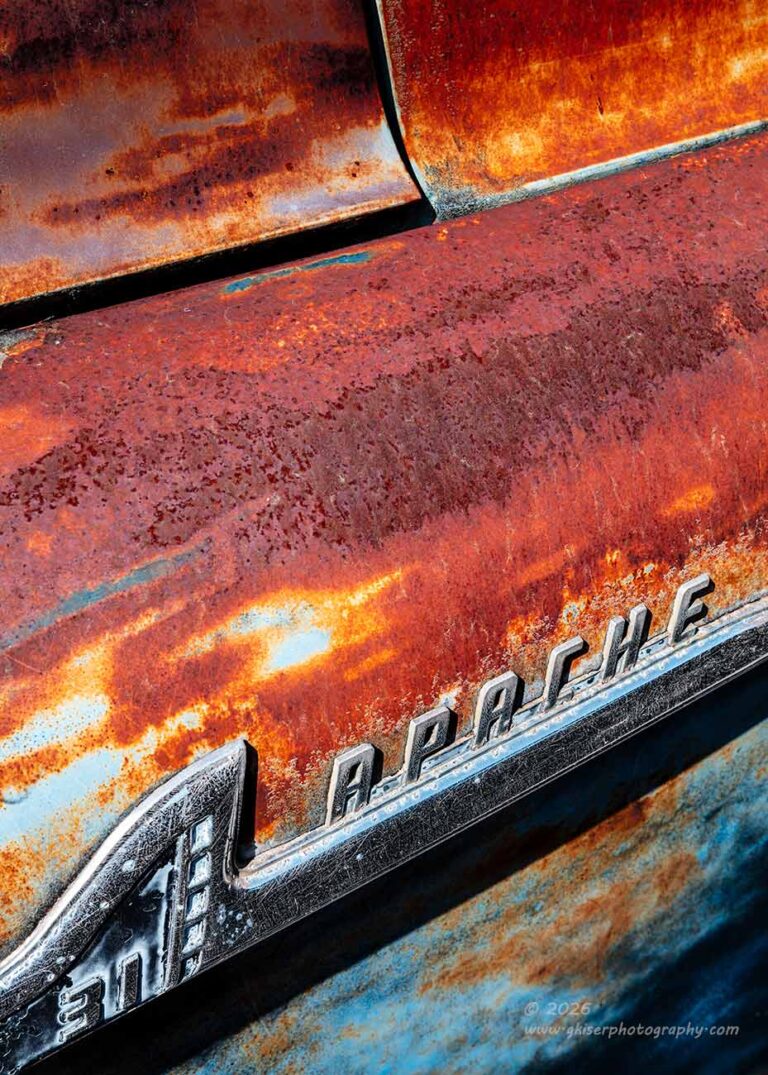
I was now firmly into looking for those abstract views of the truck. This was much easier to work with than trying to get a full shot or even broad detail photos. It was the colors and textures that I was looking for more and more. The emblem on the side of the hood captured my attention next. While I have photographed this particular emblem on another truck, I did it as an emblem shot. I had a different idea for this one because of how it all looked. There was a large swath of warm toned rust above the emblem while the area below it was less rusty and showed more of the blue paint. There was also a very hard shadow just below the emblem from the sun that added another layer of division between the sections of the photograph. I just needed to figure out how to compose this to make it work out.
In the past, I would have framed up a fairly straight on shot of the emblem, but that seemed like a boring way of doing it this time. I also saw no need to include the entire length of the emblem that included “Chevrolet,” “31,” and “Apache” through each section. The Chevrolet portion was the largest and that was the easiest to do without. I liked the sail around the number which denoted a short bed if I’m not mistaken. The Apache nameplate said more about this truck than anything else which prompted me to keep that as well. I then worked out a composition that had the emblem proceeding diagonally through the lower portion of the frame. It was lower than the typical lower third because I didn’t want this to be that stagnant of a composition. By placing it much lower, I turned this element into a leading line into the composition rather than a visual anchor. It matched up with the panel lines at the top of the frame for a bit of symmetry to keep things from being too heavy at the bottom. The touch of blue created a triangle at the lower right which went along with the sail around the “31.” The shapes were all working together and the visual weight of the entire scene just looked amazing.
When I was first photographing this scene, I liked what I was seeing in the viewfinder but wasn’t sold on whether or not the image work actually work. During the culling I still had my doubts about it but decided to go ahead and process it anyway to see how it looked. It was one of the last ones that I did because I wasn’t all that excited about it. Now that it is done and I’ve had some time to live with it, I am beyond happy with it. It works better than I had imagined which only happens occasionally. I don’t think that this falls into the category of a significant image or anything, but it is one that I think will remain a favorite of mine for quite some time. It was also a chance to learn a bit more about how to manage colors within a frame as just the hint of blue at the bottom really set the warmer tones off perfectly. Maybe it is a more significant image than I gave it credit for being.
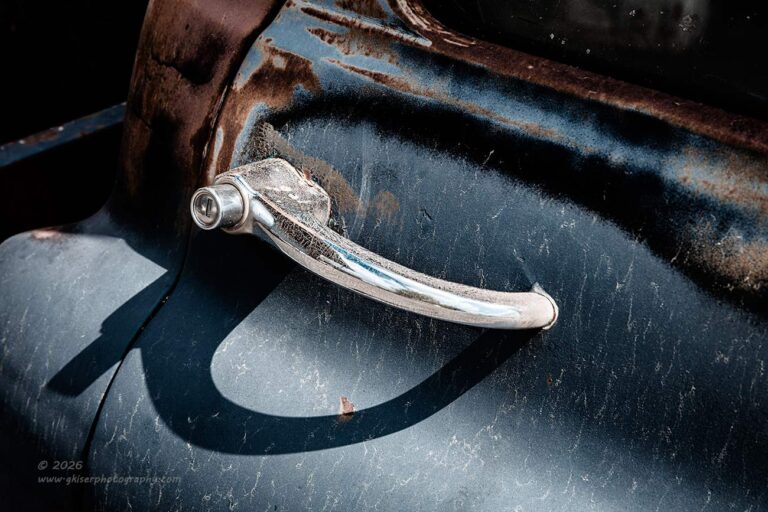
As I was getting a bit more comfortable with photographing the Apache, I decided to abandon the sunny side and move to the side that was in the shade. I wanted to do this for some more dimension using the shadows. Everything on the driver’s side was bathed in light which flattened things out a little bit. Moving to the passenger side, I was met with a more uniform color with much less patina and rust. At first, I didn’t really like this setup and debated going back to where the textures were on the other side. I debated this with myself for a minute or two and decided that I would forego the better rust for the better light. The scene that really sold it for me was the area around the passenger door handle. With the sun nearly at the noon position in the sky, even the shadowed side was getting some top down light. This produced shadows under things like the handle as well as leaving the vertical surfaces in shade with the curves getting the light.
I saw the shadows under the door handle and the way that the light was playing on the different curves of the truck. I knew that there was a photo to be had here, but I needed to find it. I started off with a very simple composition with the handle and the shadow. It was fine, but boring. I changed the angles and found a better one with me positioned slightly forward and above. I grabbed a quick test shot and examined it. I was showing up in the door handle, and the photo was still a bit overly simplistic with the handle and shadow filling the frame. I needed to incorporate the power of “and” into this photo to bring in more interest. I opened up the zoom a bit and included the darkness of the bed as well as the lower part of the window. I had the shadow stretch out to the lower left of the frame while the handle was roughly centered. The visual weight of the handle was placed right at the upper left third while the narrower part was diagonally pointed near the lower right third. The use of light and shadow then came into play as a balancing element to the scene to keep things from looking static with the main anchor roughly in the center of the frame.
This was looking pretty effective in the viewfinder and even in the test photos that were underexposed to deepen the shadows. The real issue was the fact that yours truly was right there front and center in the chrome of the door handle. Once I had the whole shot figured out, I had to figure out what to do with me. There was no moving the camera, but that was easy enough to remove in post. The problem was the big guy behind the camera. With the sun shining brightly, I was worried that the polarizer would create lens flare since it was set out past the front of the lens. I normally shade the filter when the sun is out to keep those flares from happening. To do that, I need to be close to the camera. I wasn’t able to do that, so I fired off a test shot with nothing shielding the filter so I could zoom in and look for lens flare. Thankfully, I saw none while looking and decided that I could scoot out of the way using the self timer on the camera.
With the 2-second timer set, I pressed the trigger and ran off to the left out of the scene. I then checked to see how that worked. I was gone from where I had been, but now I could see me over to the left even clearer. I tried again running off to the right and in front of the truck to use it to mask me. That worked out and I shot one more just to make sure that I had a shot without any flare. It was the last of the six attempts at this composition that actually worked out. After doing a quick remove of the camera and tripod, there was no evidence of me in the scene which was how I wanted it. I dialed in a good bit more contrast to the scene to really accentuate the curves of the body and the image just came together brilliantly. It was one of my favorites from the day and I really appreciated what the sun provided in terms of added visual interest through the shadows and highlights.

With the primer surfaces giving off a blue hue, I started to look for areas of rust on this side. They were much fewer in number, but there were still some rusted areas to work with. Of course, I also wanted to find these areas in sections of the truck that had some highlight and shadow details as well as some body lines. What I found that worked out for me was the area at the rear corner of the hood where it joined up with the cowl and the fender. What drew me here was the fact that the scene was divided up into quadrants with the warm and cool tones diagonally opposed. This just seemed like a very effective way of showing the contrasts while keeping a visual balance.
I worked on framing up an image that satisfied what I liked about the scene and in a way that made the most sense within a photograph. I liked the diagonal component from positioning the camera above and to the rear. This gave an uplifting and dramatic flow to the image. It also allowed me to have a small section in the upper left to be lit by the sun before falling into shadow further down the panel. This balanced out nicely with the lower right which had the opposite lighting happening with the brighter surface fading into a small triangle of shadow further down the fender. This visual interest in light gave a balance from the upper left to the lower right in much the same way that the rusty sections balanced the image from the lower left to the upper right. There was total balance and agreement across the entire image in all directions. It worked very well, but there was one other element that I needed to focus on.
That last element was the transition in shadow from where the hood was slightly raised. With the intensity of the sun varying slightly as thin clouds passed over, that shadow had a harder line at times while the rest of the image was pretty stable. I ended up shooting four different frames as the shadows changed before I was satisfied that I had the right combination of lighting. It turned out that the second frame that I shot was the best with not quite the hardest light, but close. That was the little detail that I thought elevated this image slightly above the others in the series.
At this point, I was pretty sure that I was done with the Apache. I had gotten a lot of really strong shots with it so far, but there were other vehicles on the property that I was interested in as well. The ones that really drew my attention were two DeSotos that were parked in a little ravine to the side of the parking lot. I had photographed them both before, though they are difficult to capture considering their location. This time the vegetation was too grown up around them, and I wasn’t able to get a clear shot of anything. I tried to get an abstract on the side of one of them, but that just looked like a snapshot with no soul, so I tossed it.
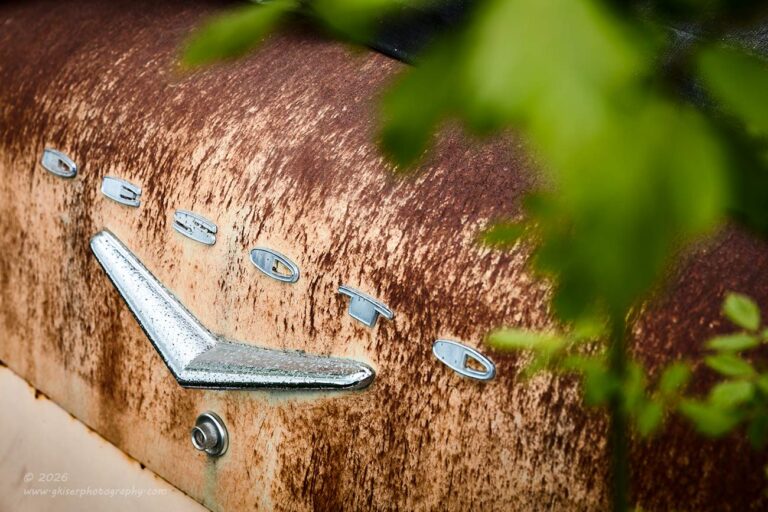
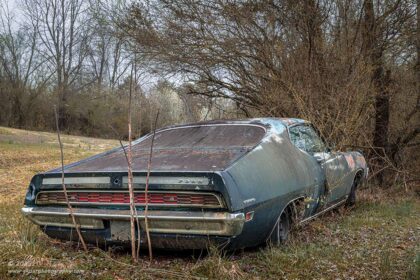
On that same car, the rear of the car was exposed, and I could actually get to it for a shot. The trunk was visible and that trunk had all the necessary chrome bits to define the car. I started off looking at it like I had on many other cars before where I would concentrate on getting a straight on shot of the emblems. I actually captured one frame like this and thought that it would work as a black and white. It didn’t feel quite right though, and I ended up tossing that after an attempt was made at processing the image.
I didn’t stop with that expected composition though. I wanted to add some interest and see if I could elevate this little detail by making the composition a bit more exciting. I moved off to the left and got an angle on it that I knew would work. The problem that I realized after setting up the shot was that the lower finish panel had to patina or rust on it which made it kind of throw the balance off. There was also a black tarp over the rear window which was draped over the trunk as well. This just didn’t flow with the image. There was also the matter of the colors of the scene. The car had a very pink hue that I didn’t like and from this angle that color dominated the scene.
I needed something to balance out that color and the answer came from the vegetation that I had been trying to avoid. I moved over to the other side and used the weeds as a framing element for the emblems on the trunk. The green worked well with the pink, or salmon tones on the car and it provided a nice visual block for the tarp, while giving a smoother texture in the upper right that balanced with the smooth textures of the finish panel. I had found my balance to the image, and I really liked what I was seeing.
When I got the images into post, I threw away most of the DeSoto photos because they just didn’t feel considered at all. I ended up working the two images of the trunk emblems with the first one being the straight on shot. I tried several different things with that image but in the end decided that the smooth finisher just didn’t do any favors to it at all. It didn’t work in black and white like I had suspected and I didn’t like it in color because of the hue of the paint.
The last one that I looked at was the one that used the weeds as a framing foreground. This one had the most promise out of all of them and was the only one that I was excited about while in the field. I started to work through it but decided that I didn’t like the salmon pink color at all, and the image didn’t work in black and white at all because the context of the weeds was lost. As a last-ditch effort, I started to play with the color calibration and shifted the tones of the salmon color to a more beige color. This seemed to work out better, and I liked the color palette that was showing up in the frame at this point. It worked with the rust as well as the green leaves. The chrome was desaturated to make it stand out a bit more for some contrast and all of a sudden, I really liked what I was seeing.
I worked the colors pretty hard in this one, but considering the very low number of DeSotos I will run into in my life, I figured that this one was worth saving through the shift in color. Had this been a Chevy or a Ford, I would have passed on this image knowing that I had several others in my collection as well as being able to shoot more in the future. I think I can count the number of DeSotos I’ve shot over the last decade on one hand which makes this a very rare opportunity for a photo.
You know, as I’m typing this out, I am really regretting not seeing that other composition through that I started out with. One thing that I didn’t try with it was shifting the colors to something more pleasing. With that in mind, I decided to take a quick break from typing and go back into Lightroom to see what would happen if I coped some of the adjustments that I made with the photo above and used that as a starting point.
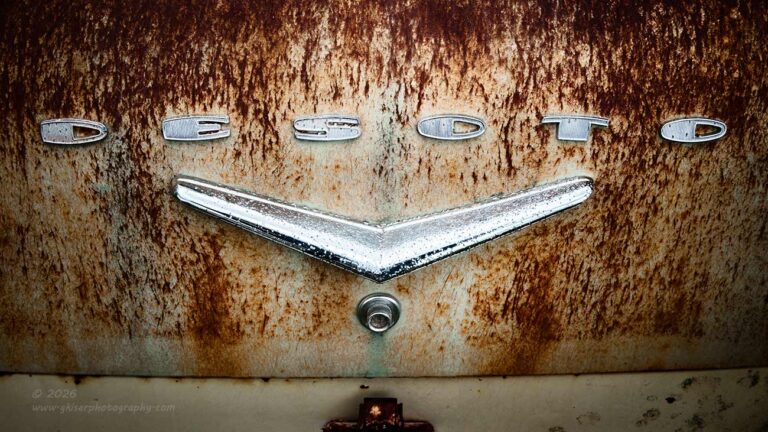
After only about ten minutes or so, I had landed on an edit that I actually kind of liked with this one. The colors were now working much better overall, and I used many of the same tricks that I used in the previous one to get the letters to show up a bit more than they would otherwise. The color shift was the best aspect of this edit and the one thing that kept the photo from causing a nauseating reaction when looking at it. The beige tones and the rusty bits just work so much better together in my opinion. The crop was also an aspect that I changed up from what I had shot. It was originally shot as a 16:9 crop which I still have, but since I had shot it in RAW, I still had the full image to pull from, so I shifted the framing slightly. The difference is that the tag holder that appears at the bottom edge is no longer an element all to itself. The original had placed it higher in the frame allowing for more to be seen beneath it. Since I didn’t really care for the finisher, I reduced the weight of that and cropped the tag holder leaving just enough to frame the lower edge with that dark element. This has the benefit of giving that blank section a reason to be there while keeping it minimally invasive to the overall photo.
It isn’t my favorite photo and still ranks kind of low on the whole spectrum, but I do think that I talked myself into why it needed to be included in the set of photos from the day. Had it been a more frequently seen car, I would have skipped this one for sure. Since it was a pretty rare example, I felt that it did deserve to be included after all. What do you think, did I make the right choice with this one or was it better left on the cutting room floor?
Out of six compositions that I shot of the two DeSotos, these were the only two that survived. The others really lacked soul and were just not worth the time to process. The cars were just in too difficult of a spot to really work with. The ’30’s model Chevrolet that I have enjoyed photographing in the past was no longer on the property which is where I would have gone next. The other cars that were situated in that side area were all too new to be of interest for me with the exception of a Ford truck that I had shot several years ago with the tree in the background. This time, I was looking at it with the metal building behind it remembering the time that I had shot the old Chevy with the siding as a backdrop for an isolation of the hood. Now I was kind of thinking about using that building as a backdrop for the truck.
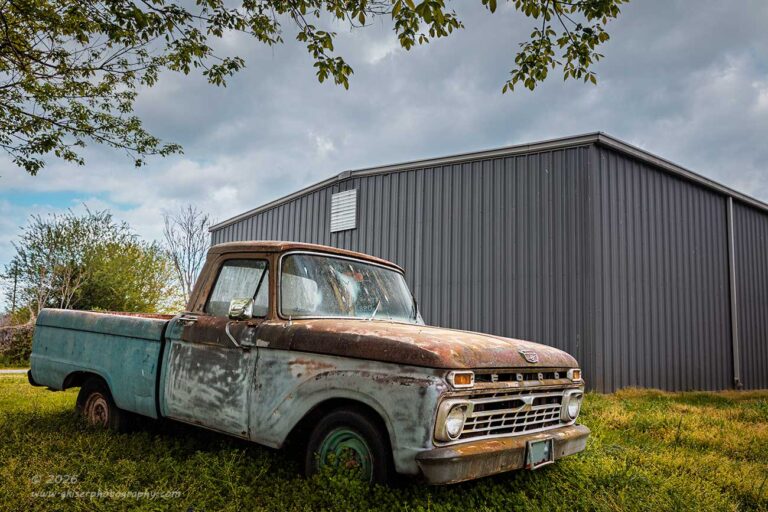
The clouds were starting to finally cover the sun and that gave me much more diffused lighting which proved to be a very good thing with this truck sitting underneath the tree. I looked around the scene to see how I would want to get the photograph built in terms of composition. I liked the sky overhead with the clouds and the touch of blue poking out. The building matched the general hue of the clouds and somehow seemed to fit within the composition. The flat light really seemed to work nicely here with there still being some shadows under the truck, but the sides were all nicely illuminated.
I decided to go for an overall view of the truck to get an establishing shot of it. Once again, I wanted to go wide, but the size of the building wouldn’t allow me to go too wide unless I wanted to see beyond the building on the right side which I didn’t. As it turned out, 31mm was about as wide as I could go without causing other issues. This was well within the range of the standard zoom that I was still using, so I happily kept that on. There was a bit of the composition dance going on as I played with how the framing looked and what I was able to eliminate from the background. The only thing left was to time the shots when there was no traffic going by on the road behind the truck. You can’t see it from this angle, but there was a major road just beyond the scene and it was nothing to capture two or three cars in the frame as they passed by.
This took a bit of luck as every time I pressed the button I would get a car entering from a blind spot into the frame. The one that turned out the best was the third of seven frames that I captured. There were slight composition changes as I proceeded, but it was that original one that seemed to work the best and maintained the best focus on the truck. I was very thankful for the diffused lighting for this and wouldn’t have even attempted the shot without it. It allowed me to get the detail in the truck even though it was in the shade while keeping the background exposed in a similar fashion. Sometimes the most important part of the composition is the way that the light is used.
That brought my frame count to 32 for this location over about 35 minutes of time. I was working quickly but not out of need. That was just the tempo that felt right. For the most part, each composition was coming together pretty quickly which I always appreciate. Getting into that groove is always a fun experience because it allows me to put everything else out of my mind and fully concentrate on the task at hand. This is where photography becomes very much a Zen state for me and a chance to relax and forget about stresses and problems.
There does come a time when the creative energy just flatlines and I had reached that point for the day. Originally, I had wanted to go out and photograph the Chevy that I had found a few weeks ago, but I wasn’t really wanting to get started with another location at this point. The clouds were looking pretty good, but according to the forecast there was rain coming in about an hour. The last think I wanted to do was waste the ask to get onto the property and have to cut it short due to rain. I didn’t think that I had anything to worry with in regard to the cars getting moved from that location but the sting of missing out on the car that started this trek was still very fresh. Regardless, I was done for the day.
Over the course of two locations, I had shot a total of 80 frames in various lighting conditions. Of those 80 frames, I ended up keeping a total of 21 images, two of which happened after starting the blog. It was a great day, and I ended up with so many more photos than I could have imagined when I started out earlier that morning. I was planning on having five or six new photos from the one car if I was lucky, so this was a very nice surprise to look back on.
I do hope that you have enjoyed this trek and the photos that I came back with. None of them were planned, but that is the benefit of making plans not to fail when going out with the camera. There are always things that can be photographed. The trick is to roll with the punches and always have alternate ideas in place. I’ll probably do a Behind the Camera on that topic in the future because it is a major part of how I work as a photographer. It is where most photographers fall down because when it comes to working outside, you are really at the mercy of the conditions and finding what you think you will find.
At any rate, I’m going to wrap this up now and call it a day. There are several sunny days ahead so I’ll probably be pretty quiet for a while, but after this trek, I’ve got a bunch of new photos to look over and examine to see what I can learn from them.
Until next time…