Saturday, April 4, 2026
For a little more than two weeks now, I’ve been watching the weather to see if I could get a favorable day to go out and photograph what appears to be a Chrysler from the early ’40’s that I spotted while Toni and I were out in the Miata. I’ve been back a couple of times to scout it in different light, but neither time worked out to photograph it. The first time, it was fully in the shade of the building with everything around it being quite bright from the sunlight in the afternoon. The next time I went out there, it was the morning and there should have been some clouds in the sky, but those clouds had burned off after I photographed the old house that I started out with. This time, the car was in full sun and had way too many highlights on it to be able to work with. There were also a couple of road tractors parked around it which would cause some compositional issues for me. Neither time worked out and I found other things to photograph.
The weather for this morning was looking promising around 9am with some clouds coming through the area, but when I woke up to check the weather, those clouds were no longer in the forecast. In fact, it was showing clear skies outside at a little after 7am. I did go ahead and get up at that point and started to do my morning routine as I was looking outside. Maybe it was that the sun wasn’t fully up, but it really looked cloudy outside to me. The brighter it got, the more I was for certain that there was a good cloud cover overhead. The hourly forecasts that I rely on were not showing that kind of overcast at all which made it uncertain as to how long it was going to last.
After I finished up with breakfast, I felt that I needed to make a decision on going out or not. It was still looking nice and cloudy with a wonderful light falling on the landscape. I hated to waste this even if I only had a short amount of time to work. I went ahead and put my socks and shoes on before loading up the truck with the camera gear. I was on my way a little before 9am and arrived about 15 minutes later. The light was looking great when I got onto the road where the car was parked. As long as I could get permission, I was pretty certain that I was going to be able to do some pretty cool photographs of the car.
The only problem was the car was no longer there. The two road tractors were there, but the little Chrysler was completely absent. I slowed and looked all around the house and into the backyard to see if maybe they had moved it. There was no sign of the car at all. I would be lying if I said I wasn’t disappointed that the car was gone. But at the same time, I have to say that these are the things that I expect to happen with this type of subject. I try to act quickly when I find something new, especially if it is something that I haven’t seen there before. I know that it is usually only a matter of time before the car gets pulled into a shop for a restoration, or hauled off for junk, or sold, or any number of other reasons for a car to be moved from where it sits.
Fortunately, my luck is usually better than this, but it shows how important it is to photograph these things as soon as you can. I could have maybe done something with it on one of the other days, but I would have been limited and didn’t want to waste the ask. Now, I will never have the chance to work the car again, at least in that location.
With the light still looking good, I had to figure out something else to shoot. There was the Chevy that I had found based on a tip not long ago, but this was another one that was going to require permission to access. Ideally, it would be photographed in the afternoon and with some pretty thick clouds to keep the light as diffused as possible. That was not quite the conditions that I had at hand, and I felt that it wouldn’t really work out all that well just yet. Now, if I found something to work with for a couple of hours, I might be able to squeeze that Chevy in before calling it a day. It was just a matter of finding something else to shoot in the meantime.

There was a car that I had seen in passing when turning on the main road that I had meant to go back to before. It wasn’t all that impressive and wasn’t in a great location which made it easy to forget about on the last couple of times that I was out there. It looked like a Ford Galaxie, but I wasn’t positive about that. It was tucked in between two other cars at a car lot which meant that I was going to have limited options on how to shoot it. It was close by, and I had good light, so there was no time like the present to stop and see if I could get something to work with it.
When I pulled into the parking lot, it appeared that the business was open from the signs, so I parked out of the way and went to the door to see if they minded me taking some photos. The door was locked and there was no sign of anyone inside. With this being a business and there being no barriers in place, I had no problem working with the car without permission as long as I stayed in full view of the world. Because of the tight quarters, I didn’t go with the wide-angle lens, and I opted to avoid the telephoto lens. I chose the standard zoom because it gave me the option of going moderately wide and moderately telephoto while being able to work close in with the car. I figured that this would give me the best of both worlds and if I needed something beyond what that lens would offer, I could easily switch out to one of the other ones.
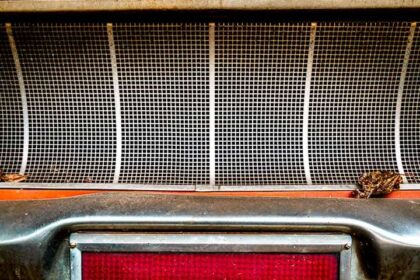
Once the camera was built, I moved back over to the car and started to look for compositions. The grill was the first thing that really caught my eye. I’ve always enjoyed the repeating pattern that these Galaxies use with the grill. The question was what else I was going to want to include in the composition. This is where that power of “and” comes into play. The grill provided a repeating pattern and the ability to show depth, but it wasn’t a focal point. For that, the grill emblem was selected because it was prominently displayed on that grill. There was a need for a framing element to the image which became the hood which had a lovely patina on it. To include the hood, I needed to bring in the FORD lettering which dictated the length of the composition. This forced my hand to include one of the driver’s side headlights as another framing element. I didn’t go with both of them because that would have forced me to shoot past the car and include the neighboring vehicle as well. The lower portion was framed by the bumper, and the carriage bolts defined that space quite well with their own contribution to the framing of the scene.
Now that I had everything figured out as far as the framing went, I got the depth of field figured out which is to say that I wanted everything in focus. This was because of the FORD lettering on the hood which I felt all needed to be sharp. I didn’t mind at all because the details of the grill needed to be in focus as well. The whole composition came together pretty quickly after that I was able to get the opening shot captured. I wasn’t sure if this was the best way to capture the grill, so I dialed in a tighter crop for the next photo that turned into the preferred photo from this concept.
As I was culling through the images, the opening frame, the only one that I did of the majority of the grill was eliminated after the first round. I much preferred the later shot of the grill emblem and that was how it remained until I began this blog. It was only then that I remembered that opening frame and decided to give it another look. Since I had done the latter one in black and white, I chose to focus on this one in color. It slowly came together as I started the processing. The more I worked with it, the more I liked it and actually started to see the photo that I had imagined when I had trained the camera on the composition. After a few minutes, I had an image that I was actually quite happy with and decided to add it into the collection of keepers.
So, this opening image is one that I had dismissed early on and only come back to it well after all of the edits were finished. I had thought it was just a warming up exposure, but as it turns out, it was actually a pretty strong image that worked in the ways that I wanted it to. Once again, I’ve proven to myself that first impressions during culling aren’t necessarily the best gauge of how good a photo can be.

Now that we have that revisited image discussion out of the way, we can get back to the trek. As I stated, I wanted to get a little more intimate with the grill emblem, so I repositioned the camera with it being lower and got in much closer to the car. The biggest thing that I needed to watch out for was the lettering at the top of the hood. By shooting lower, I was able to avoid those and get a very clean composition of the emblem. Because there wasn’t much color on the badge, and only a sliver of the hood was included, it made perfect sense to go with black and white for this photo.
I really liked the absence of color with this one because it really focused the attention on the patterns of the grill which was my main motivator in working on this composition. It had a much more direct feel to it, and that is why I chose it over the broader composition in the early rounds of culling. Now that I look back on both of the photos, I can see that even though they came from the same place conceptually, they both tell very different stories.
With two keepers and only three frames in, I guess you could say that I was already on a roll. This car might not have seemed like much from the road, but the important parts of it were plainly visible which made for a bit of ease in working isolations with the details. Having captured the grill, it was time to look more of the car over to see what might interest me about other areas of it. With the car being black, I was looking for areas of chrome trim for the extra contrast and defining shapes. I wasn’t really seeing much in the way of color on the car and there wasn’t that much rust on it either.

With this car being mostly complete, there were plenty of emblems, trim, and chrome bits to work with. The next thing that really caught my attention was the Galaxie nameplate on the front fender. With the moldings still in place on the side, I saw an opportunity to capture something rather interesting with this simple fender badge. By interesting, I was not referring to that straight on shot that I have done for so long when it comes to emblems. I was looking at getting a bit of perspective distortion with the moldings. Even though I wasn’t shooting with my wide-angle lens, I was still thinking about seeing through a wide-angle lens. This means that there will be distortion in lines and by going wide, I would have the parallel lines essentially opening up around the emblem which I felt would add all sorts of drama.
Now, if I went too wide, I would start including parts of the windows in the shot which I wanted to avoid, which meant that a moderate wide-angle was all I was going to need. The standard zoom was the perfect choice for this job. The next part of the puzzle was how I wanted this one presented. With the black paint and chrome, there wasn’t much color at all with the exception of the gold tones on the badge. That wasn’t enough to make it worth my while to do this as a color image, so I knew from the beginning that this was going to be done in black and white.
The next question was framing the composition. I didn’t care for the scope of the 3:2 aspect ratio because in order to omit the windows, I lost a lot of the perceived length that was introduced by the perspective distortion. In order to capitalize on that aspect, I chose to crop the image as a 16:9 aspect ratio in camera. This allowed me to frame the image as I wanted it without having to guess. Since pretty much everything in the frame was a straight line, I chose to bring in the wheel arch as a contrasting curve that was just visible thanks to the light on the arch. That aspect also kept the image balanced with a point of interest filling the otherwise empty space in the lower left. That space is now just negative space and helps define the rest of the image which I really liked.
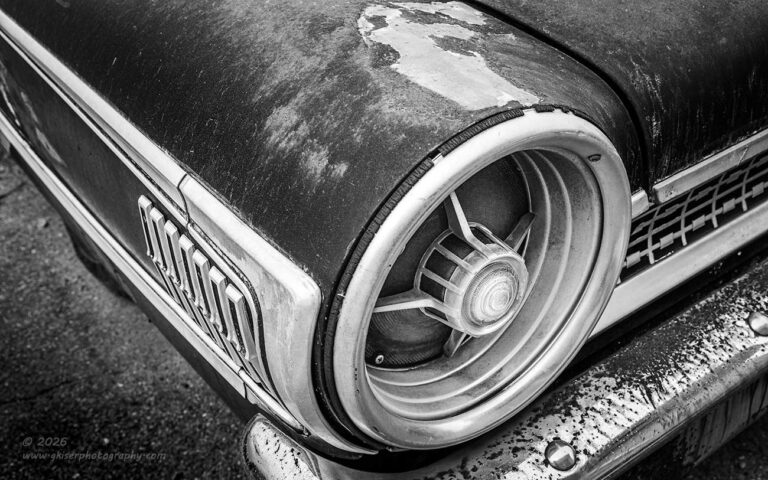
Going along with the same concept in composition, I moved to the back of the car where I knew I would find a very interesting taillight housing. I wasn’t really surprised to find that everything was intact with the light since the car had appeared to be relatively complete from first sight. There were a few more colors present from this angle, but I liked the idea of doing this one as a black and white also. There was just something about the way that the chrome and the patina contrasted that really worked for me. Even the area of rust above the quarter panel came through as a very light tone that matched the chrome.
To keep the energy within the frame with the absence of color, I wanted to capture this from a bit higher than I had done the other composition. This brought more diagonals into play with the composition while still showing off the details of the taillight and the molding detail on the side. The bumper and the trim that matched the grill formed a second leading line with the side molding to point to the light housing. This is a composition that I have done before, but it always works quite well. There are occasions I like it in color though, but this was not one of those times. Black cars just seem to work better in black and white images, especially when there is chrome or other brightwork that is involved.

There are always exceptions to that idea though. It was this next composition that I shot that proves that. I had already shot the fender emblem, but I was now looking at it from an elevated position and from the rear of the car rather than the front. This wasn’t an unfamiliar composition either as I have shot it many times. What I liked about it in this case was the contrast from the moldings that provided a really punchy set of diagonals. The emblem itself did have that gold tone to it which worked well with the black paint that was picking up the blue in the sky. That was not enough to make me think color, but there was one other element that I saw from this angle that worked well. That was the rusty wheel which introduced a larger element with warm tones. That rust allowed the gold in the emblem to make more sense and provided some color balance to the expanse of cooler tones from the paint on the car.
With all of this in mind, I decided that this was going to be a color image and framed it up accordingly. It was important that I include the wheel, but I had to be careful what else I included because if I got the whole tire, that left an awkward bright spot in front unless I included the front of the fender which then started to take the emphasis away from the fender badge. I chose to crop the image through the tire, leaving the white wall to complete the concept of a circle around the wheel. This was done to make sure that I had a contrast to the straight lines that dominated the scene. The whitewall also provided a frame within a frame for the rusty wheel that was so instrumental for this concept of a composition.
I shot a total of three frames with this composition with the last one being the keeper. At this point, I had only shot 13 frames of the car, and out of those you can see five keepers already. I think that it is safe to say that I was having a good time at this point. It was nice to just immerse myself in creating these photographs and with all that has been on my mind over the past week, I was really surprised to see that I was in a flow state already. Everything was just falling into place for me, and I was finding that I didn’t have to put much thought into any of this.

While I was standing there at the driver’s door, I was looking inside of the car and noticed that the seat was ripped, and the foam was showing with some very rusty colored tones. That aspect was quite interesting for me, and I wanted to capture a photo of it. It didn’t make any sense to just get a photo of the seat through the window though. I probably could have opened up the door, but that goes against my personal rule of not to change the scene by touching the subjects. Instead, I looked for a way of making the inclusion of the window make sense.
There was an interesting patina on the door above the body molding that added some texture. This bridged the area between the window and the door handle which became a nice focal point for me. By including both of those aspects, I thought that I could give context to the seat and complete the story. The framing was all that I had left to figure out. By going horizontal, I was including far too much of the scene and the seat was getting lost. Choosing to go with a vertical composition allowed me to concentrate more on the handle and the seat which I liked. I had to be very careful with how much of the scene in included which ultimately meant that I filled the upper third with the window and seat while the lower third contained the handle and the two moldings. I didn’t really like the fact that the middle of the image was essentially negative space, but the patina helped out here with some form of interest in the frame.
The entire composition seemed to come together and make sense. I did shoot three frames of this composition, but the one that I liked the best was the first one. I had to move things around a few times trying to change how the reflection of the Nissan parked next to it was shown in the glass. The polarizer minimized it well, but the door handle was still very visible in the image. I moved the camera around to try and get it to disguise itself with the other items inside of the car. It just so happened that the best look for this was that first frame.
While shooting this composition, a car pulled up with the driver looking intently at me. I was pretty familiar with this kind of situation and knew this was going to be the property owner. I waved at him as he drove by to get parked. When he opened the door, I said hello as I walked over towards him. We engaged in a bit of conversation, and it turned out that this wasn’t the owner after all. He was just there to see what was new on the lot. He was very nice and after he went on his way, I went back to working out the composition that I had been working with.

Now that my attention was on the interior of the car, I started to look at the dash. The car had a red interior that was rather unique in my experience. I really liked how the color showed up in the light and the black paint on the exterior was showing a blue tone which contrasted so perfectly with the interior. Without thinking about it, I moved the camera into position and framed up a shot that I liked. It might have been 30 seconds before I had my first exposure of the dash, but looking at it, I didn’t like it all that much. The framing was off, and I didn’t like that the left gauge was bisected by the vent window. There was a bit of thought that went into play and several different compositions framed up to get things positioned better within the frame.
The one that I ended up liking the best was the last of four which included a portion of the roof which created a much more complete frame to the image. The camera was situated so that the important gauges were all visible as was the shifter on the console. That one felt right, and that was the one that I ended up keeping out of them all. It was still the color contrast that I loved the most with this composition and that alone elevates this to one of my favorite interior shots that I’ve done in recent years. There was just so much visual pop to this one and I think that it commands attention from the viewer.
With that, I had spent about 33 minutes working this car with 22 frames captured. If I’m being honest, I would suspect that that would be about where I would expect to be with the car that I had intended to shoot. It had been a good day, and I was satisfied with what I had captured. Before I left, I wanted to make one last round of the car to make sure that I hadn’t missed anything that I might want to photograph. While I was walking around, the gentleman returned and we started talking once again. He said that there were other cars in the back and said that one was another Galaxie in similar condition or worse, and possibly a Dodge. He wasn’t able to get around to it to confirm, but that was due to his knees, not the environment.
I expressed my thanks for the information but felt that going behind of the business might be pushing my luck a bit without getting permission. This was when he said that he was related to the business owner and didn’t think that there would be a problem with me going back there for some more photographs. I was willing to take that as permission and after we concluded our conversation, I locked up my truck and walked around the building to see what was there.
If you are interested in what I found, you will need to join me back here tomorrow for the next chapter in the day as well as the photos that I captured. I should have it published in the morning sometime, so keep your eyes out for the next entry.
Until then….