Monday, June 1, 2026
You might be getting confused with all of the back-to-back blog entries coming at you. I do apologize for the daily emails, but I am trying to get back in the swing of things after several weeks of just not doing much in the way of photography. I’m sure you are looking for a part 2, or maybe chapter 2 with this one, but I’m not doing the typical blog series with this trek. I started the blogging process yesterday with the background on how this trek all started out with a VW Bug that I had captured once before. That would technically be the “part 1” to this series, but since this trek took place over two different counties with three different subjects, I just decided to just treat each subject as their own blog. That makes it much easier to find the details on later and makes it a little quicker for you to go through the individual blogs rather than sifting through the entire experience all in one sitting.
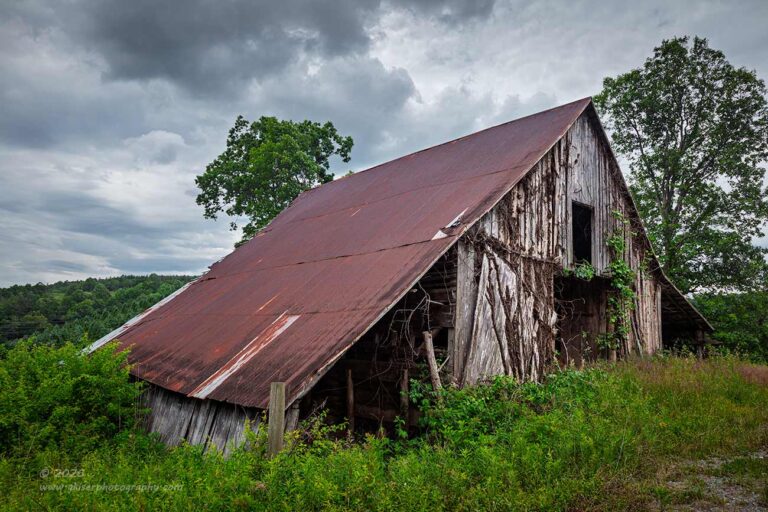
I have already gone through the scouting phase of this trek in the previous blog while I was out driving the Miata. Now that I had the camera with me, I was back tracking that route to start photographing the scenes that I had spotted. The next one on the list was a barn right at the edge of Ashe County as the road crossed into Alleghany County. I had photographed this barn four years ago on kind of a whim. The conditions were difficult to work with at the time, and I was having a hard time getting a composition together because of some clutter that was there at the start of the barn. Probably the biggest hurdle that I had with it was the fact that the face of the barn had been covered with vines. This kept most of the character of the barn hidden and all I could see was the long, slanted roof that stretched from the ground to the top of the roof.
Looking back on the image, I did a really good job with it considering all the factors that I had to overcome. This time, when I had passed it in the Miata, the vines were gone from the front of the barn, the clutter had been removed, and the parking area was clear. The clouds had the promise of looking pretty good later in the afternoon and the lighting was much more diffused over the scene. In many ways I was actually looking forward to working with this barn more than the VW that I had just photographed. It was the first time I had really seen what the barn looked like since the face was fully visible now.
It didn’t take me too long to get to the barn after I finished up with the VW, and the sky was looking really great by the time that I got there. There was something critically different from when I had passed it by earlier in the day though. There was a pickup truck parked really close to the barn which had not been there just a couple of hours before. I really thought that it was going to create too many compositional issues for me, but I felt that I owed it to myself to really look at the scene to see just how much room I had to work with. With much of my excitement dashed, I parked my truck out of the way and got out to look closer at the barn.
I could hear talking in the field just beyond the barn and realized that there were workers in the tree farm below the barn. There was another similar truck down there with them, so I figured that the truck belonged to them. They didn’t seem to care that I was up here looking at the barn, so I just continued on with what I was doing. The truck was close to the barn, but not nearly as close as it had appeared. I would be able to get angled shots on the barn easy enough with a wide-angle lens working from both sides. It was going to be the straight on composition that I would have difficulties with because of the truck. While the long roof panels were not quite my favorite aspect of the barn, they were a defining element and something that I didn’t mind capturing with a little more visual weight.
I knew that the images that I was about to capture would give that roof a lot of weight because I was going to have to use a wide-angle lens because of the working distance that I would have. I would also have to work from the corners which would make the roof sections closest to me much larger in relation to the rest of the barn. These are all characteristics of the wide-angle lens, and I was seeing how it was all going to come together before I even opened up the camera bag. This is part of the payoff for spending so much time with the lens during the first half of the year. I’m really glad that I have that experience under my belt because it was coming in very handy at the moment.
Feeling confident with my lens choice, I built the camera up and added a polarizer to keep the glare on the roof down to a minimum. It was now time to find that right angle and distance from the barn to make the image work the way I was hoping it would. I started off to the right side of the barn which gave me a bit more room around the truck and also put a couple of trees in a pretty good location in the composition. There was a fence post that I would use as a foreground, though it was almost attached to the barn in reality.
I got everything framed up and really studied the image for a while. It was reading a little awkwardly because of the tree. I could fix it by cropping in closer to the tree so that the eyes would jump over it easier. The problem with that was that it threw the balance of the composition off. I needed to have a bit more tree on that side to give the right balance to the sloping roof. My other fix for it was to flip the image horizontally in post. That was what I ended up doing, and that also had the slight benefit of giving the composition a bit more excitement as the slope of the roof now went up rather than going down which is good for a more relaxing composition. With the wide angle, I wanted to keep as much visual excitement as I could which matched the focal length.

The next composition that I chose was from the other side of the barn. This was the side that I had shot from before, but this time it was much easier as I wasn’t balancing on steel beams with the tripod perched on those same beams. The truck wasn’t a problem at all, and it was parked far enough away to give me plenty of room with this lens. I was also seeing a much more dramatic sky from this side which I really liked.
The sky gave me the idea to make this a black and white photo which would really capitalize on the contrasts in the image. This would benefit not only the sky, but the face of the barn with the weathered wood that was now visible. The long roof seemed to help bring the eyes up to the clouds while the apex of the roof pulled the eyes back down to look at the textures of the face of the barn. The trees that were to the left gave the perfect balance to the image without creating a visual blockade as they had done in the previous composition. Just having a slim section of the trees here was the key, and there was still good balance to the image.
The breeze was starting to cause me issues at this point though, and I was having to really work the exposure choices to keep the shutter speed as fast as I needed to freeze the motion. I would have loved to have done a long exposure for the sky, but I didn’t want to blur the vegetation since it was taking up so much of the foreground. If it had been field of tall grasses, that could have looked really good, but having defined tree limbs blurred really bothers me, and the bushes that have some nice texture to balance out with the smoother roof, needed to remain full of that texture. This was just not the scene for a long exposure unfortunately.
I played around with several other compositions around the barn using the wide-angle lens, but most of them were very close to the two that you see here, and I felt that these were the strongest ones of the bunch. I had this very strong feeling that there was more to the barn than just the overall images that I was shooting. Could there be some isolations or abstracts that I could shoot? I started to look at the barn in a little more detail to see what I liked about it.
There were two areas that I liked in terms of small details. The first was the vegetation that was growing on the left side of the main doorway. The vibrant greens looked great against the weathered wood siding. I also liked that there were two different openings to the barn here. The other aspect that I was drawn to was on the other side of the doorway where the door had slid off of the track. It was hanging there diagonally and the remaining mount to the slide looked like a horseshoe. There were dormant vines that were stuck to the door that created a very interesting pattern.

I started to take the camera around to these areas so that I could look through the viewfinder to see what these areas looked like isolated from the rest of the barn. I realized pretty quickly that this was not the lens to use for this purpose because it was just showing too much. There was no benefit to the perspective that it brought to the scene since I was looking at a fairly flat subject. It was the telephoto lens that was going to be a much better choice for this kind of work, so I went back to the truck and swapped out the lens.
Now, that I could really pick out the details, I went back to the barn and started with the vegetation which I had liked the best through the wide-angle lens. With a much more concise view of the scene, I was finding the concept to be much stronger than I had originally thought. The composition that I landed on was a bit of an abstract that focused on a long section of vine as well as a smaller section that was growing between the two doorways. I framed the image in a way that captured lots of shadowed areas for some mystery and for defining the dimension of the scene. I felt that including the interior of the barn here would give more visual interest and create a bit more story behind the actual barn. The way that I put it all together left questions and gave it an abstract feel because you just can’t see enough of the structure to really understand what you are looking at.
The end result of that process brought together a photo that I really like for the uniqueness of it in my catalog of images. It is simple, yet complex at the same time. I really like the vibrant greens against the wood, and the overall composition has a flow to it that feels natural even though it is made up of random shapes with the frame. It is interesting in all of the right ways, and I’m really happy that I took the time to work this composition out.
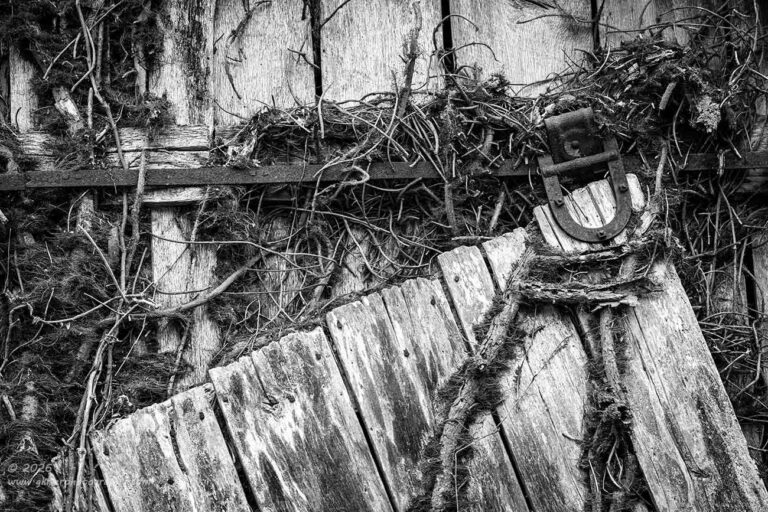
This left me with the hanging door that was off to the other side of the barn. This portion had really interested me, but I had to work out what aspects that I liked about it before I could successfully get a photo of it. There were a few different aspects that I enjoyed here with the first and primary one being that the vines had become entrenched on the siding of the barn. They made great patterns and textures to look at while adding a level of contrast to the weathered wood. Second, I found that the hanger for the door was shaped very much like a horseshoe and was positioned in the fashion of luck. Finally, I was captivated by the angles that the hanging door created with the vertical slats now diagonal against the horizontal door slide and the vertical lines of the wall siding. It was just that bit of juxtaposition that I find so enjoyable in photographs. Those were the aspects that I wanted to capture in a photo, but I needed to figure out how to properly organize it all within a frame.
I felt that this was going to be a very strong case for a black and white photo, so I switched the camera over to B&W mode to get a better understanding of how things were going to look. I could see the contrast coming into play just by doing this simple trick. I wanted to have the visual anchor on the door hanger since that seemed to be the intersection of all the different aspects of the photo. The camera was already in the horizontal orientation from the last composition and that was how I first started to view the scene. I kind of liked the emphasis being on the sliding apparatus and it threw a bit of visual tension into the frame looking at it horizontally. I just kind of worked the framing through the zoom of the lens and found something that felt right.
I looked at the image in the review and started to make very small changes in positioning of the elements within the frame as well as finding darker areas for a bit of natural vignetting. This process took three different exposures until I landed on the one that you see here which I felt was the strongest of the three. I really do like how this one turned out, and it motivated me to explore more of the scene before I left it.

One of the aspects that I hadn’t captured in the horizontal framing was the fact that the vines formed some very distinct lines against the wooden door. I knew that I wanted to capture that aspect as well, so I rotated the camera to a vertical orientation and then started back with the hunting for a proper frame for the image. Once again, all of the visual pathways brought the eyes back to that U shaped hanger that I used so dominantly in the other composition. This time, it was equally as important but took up much less visual space. Most of the frame was dedicated to the vines creeping up the side of the door. Once again, the diagonals brought an undeniable energy to the scene. This was also going to be a black and white image for all the same reasons that the previous one had been.
Unlike the last composition, it was the first of the three images that I shot of this one that turned into the keeper. I just had it right with the first try on this one. While both of the images focus on different aspects of the door, I really like them both and see them being a well-matched pairing on a wall. Art like this makes for a great conversation starter which is why it works so well hanging proudly on a wall. If this sounds like something that you might be interested in, I do make and sell prints of all of my photos. You get to choose the size and media for the print although I am happy to help you choose as I have plenty of experience with the different options that are offered.
Once I was finished with the photos of the doorway, I was pretty much done with the barn. I had worked it from both sides and had been able to get some detail and abstract shots of it. It was far more productive than the last time I had been here when I only got the one composition. The difference was that the vines were no longer covering the face of the barn which gave a lot more to work with. It really looks like a completely different structure with the absence of the vines.
As I am finishing up this blog entry, I am finding myself going back through the images that I captured while I was there. One that had struck me during two rounds of culling was talking to me again. I had decided on a similar composition to actually get processed because of a few little details that I preferred in that one. Ultimately, I ended up flipping the image so it read differently and you can see that photo as the opener for this entry. Now that I am looking back through the photos, the alternate which was shot right before I moved to the detail shots was looking a little different. With the other image flipped horizontally, it had a fundamentally different look when compared to the other version which was a slightly different angle with some extra breathing room around the trees.
It was that breathing room that created the difference that I was now liking in the original orientation from when I captured the image. It was enough that I wanted to see what I could do with it through the course of processing. I just started to go through my workflow and slowly the photo started to come together in a way that I hadn’t really expected. I liked it a lot more than I had originally thought, and it was good enough to become a keeper for this bunch of photos.

With this photo added in, that brings me to a total of six photos from this barn out of 27 exposures. The higher exposure count was mostly due to the breeze and trying to make sure that I had everything frozen since the vines and brush in the foreground were important aspects to the photo. Even with the multiple attempts, this was a very successful stop and even though there was a truck parked near the barn that wasn’t there when I first saw it, I didn’t have any real problems getting the compositions to work out in my favor. This will always be a very unique barn to photograph and the parts that I used to see as a hinderance actually define its beauty. I think that the lush greens that surrounded the barn really allowed that rusty tin roof to shine in the composition while in the colder months it might have been too overbearing for the frame.
Thank you for joining me and I hope that you have enjoyed this segment of the trek. I’m still not quite done yet, but I was finished with Ashe County at this point. Just a short distance down the road was the beginning of Alleghany County and my next stop. Stick around and I’ll have that blog finished up by tomorrow morning.
Until then….