Thursday, June 25, 2026
And just like that we are back once again. This is kind of a part two that completes the blog that I published yesterday from the Grandview Overlook off of the Blue Ridge Parkway. I probably could have gone ahead and just added this part of the trek into that blog entry because the total number of photos was still very manageable from a blogging standpoint. However, I really needed to get the yard cut yesterday afternoon and I realized that the two portions of the trek were broken up into two very different subjects as well as geographical locations. With all of that in mind, I decided to break up the day a little bit and keep the first blog very short with the hopes that more would take the time to read it. This brings us to the second part of the blog from yesterday and I’m glad that you are here.
Before we get started, I would like to share a word from our sponsor. That sponsor is….me…because neither this website nor this blog is sponsored by anyone. When it comes to photography, you are in the right place. Greg Kiser Photography has grown through the twenty-some years that I have been doing this craft. I’m your source for unique wall art in the form of prints, whether it be on photo paper, fine art cotton rag, canvas, or metal. I have worked with art galleries in the past to provide their clients with different landscapes around North Carolina, and I also work with clients direct with person to person sales. As each piece is printed to order, you can choose size and media to fit your space and your aesthetic. Maybe you are looking for a photographer to capture something specific, whether it be a scene that is special to you, or possibly a portrait of yourself or a loved one, I also do commissioned work for my clients. This falls under my people photography, which includes portraits, professional headshots, maternity photos, creative sessions, and boudoir photography. Not only do a have a full studio located in Purlear, NC (Wilkes County), I can also travel to locations that work better for the session concept. My business model is not just set up to capture images for my clients and my own portfolio; I also offer a full educational experience for those that would like to take part in my mentorship programs. This is a student centered approach to teaching photography where I don’t just tell you what I do with a camera. I want to listen to your history and what photography means to you so that we can tailor an approach to maximize your ability to capture your visions. It is a very holistic approach that looks at you as a person before you as a photographer. There are many options available from basic image critiques all the way up to advanced mentorships that will take place over a longer period of time. No matter what you want to choose, these mentorships always start out with a free, no obligation consultation to make sure that we are a good fit for each other. That is when we will discuss the type of program that fits your needs the best. Whatever you might be interested in in the realm of photography, you will likely find it here at Greg Kiser Photography.
I would like to thank me for sponsoring this blog entry, and with that out of the way, I would like to get right back into the action. When we last left off, I had finished up photographing a little scene with a gated fence that brought your eyes out to a majestic mountain in the distance. The sky was still holding onto some of the color from morning, but it was fading out with thicker clouds rolling in. Even though there was no rain in the forecast and the clouds were supposed to be clearing off shortly after 10am, it was looking like rain. There was a certain atmosphere in the air with the high humidity and the soft textures of the clouds. There was a bit of fog or haze in the air as well which just added to the unique look of the land. I didn’t see much potential for landscape photos from the Parkway, at least not the section that I was in currently. This was calling for a scene that had more of a rural vibe to it. I still wasn’t really looking for old cars, but I thought that an old barn would probably look pretty good in this light with the mood that was being brought into the game.
If the weather forecast was right, I was looking at only a short time before the sun came back out and things changed up again. I needed to find something close, but I had nothing at all in mind. I was coming up to the Hwy 16 exit off of the Parkway and I knew that Ashe County was always good for providing rural scenes. I even have a few favorite locations out that way, but I wasn’t looking to capture more familiar scenes. After working two areas on the Parkway that I was really familiar with, I wanted something new and unique to photograph. That meant a certain amount of driving around and looking.
After exiting the Parkway, I started looking for roads that I had not been on or at least hadn’t remembered traveling on before. It was a few turns before I found just that road, but I was now looking at new and different scenes. The light was great and the weather was looking fantastic, but none of the scenes were speaking to me. I wasn’t sure exactly what I was looking for, but I wasn’t seeing it, at least not just yet. I kept driving and hoping that I would spot something that would prompt me to pick up the camera again this morning.
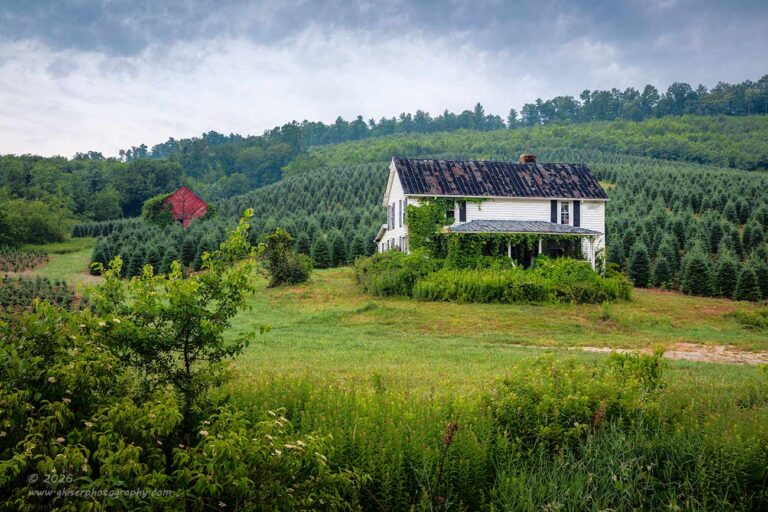
As I was driving, I spotted a large white house off to the right which had a lot of vegetation grown up around the front porch. The closer I got, the less interested I became with it because it was a pretty basic house with much of the main interest covered up by the vegetation. It was situated among a farm of Christmas Trees which is a pretty normal view in this area, but it didn’t really add that much interest for me. When I got past the house, I could see that the other side was covered by more of that vegetation and that there was a red barn off in the distance behind the house which was practically overgrown with vines while sitting behind many of the pines. I continued driving, but played the scene back in my head a few more times to see if there was something there that I liked.
The more I thought about it, the more I realized that I had the opportunity to get the sky in the photo which had some interest in all directions. It was soft and subtle, but there was texture in the clouds. The patterns of the trees added some visual interest and texture around the house and that texture would work well with the smoother texture in the sky for a bit of juxtaposition. The red barn offered a lot of interest for me sitting in the lush green of the trees. The vegetation covering the porch of the house added to its story and fit into the decay theme of my photography. I realized that the scene didn’t really offer a single wonderful subject like I had been looking for, but at the same time, it offered a collection of elements that told a story that I found interesting. The story was compelling enough for me to get turned around to give this spot a second look.
When I got back to it, I saw that the house was on the other side of a stream with a small wooden bridge that connected it to the shoulder of the road. In order to photograph the house, I was going to have to be able to photograph over the vegetation that was growing on the bank of the stream. There were a few places that I could get a clear view of the house from that level which was significantly lower than the roadway. I pulled into the driveway and parked just to the side of it before crossing the bridge. I looked around and saw no signs indicating that I wasn’t allowed to be here. There wasn’t a gate or fence there at the bridge, though I didn’t want to drive over the bridge and push my luck to that extent. Everything that I was seeing told me that I was able to be here unless told to leave. It was worth the chance and with my truck parked in the open and with my plans involving being in full view of the roadway I felt comfortable in getting out to photograph this house and barn.

When I got out of the truck, I got the camera built with standard zoom lens attached. Sure, I probably could have done more with the wide-angle and the telephoto lens, but I was looking for efficiency in getting the shots so that I wasn’t here too long. The standard zoom offered me more flexibility out of a single lens, and it was one that I would be able to work with much quicker while still getting a variety of focal lengths to work with. Unlike earlier in the day, I added the polarizer because the morning dew was heavy here and I was seeing a lot of glare on the grass and the roof of the house which had not been an issue with the earlier photos. With the camera built, I walked along the stream to see where the best angles were going to be to capture the house. I found a couple of spots that I could work with and started to frame up compositions.
One of the first ones that I worked on was a view that had both the house and the barn. I would have preferred to have gotten a better angle on the barn, but if I went too far off to the left, I created too much distance between it and the house which created a void between two connected elements. The vines were also growing up along the left side of the barn which obscured the view and color of the structure. In order to capture both the barn and the house in a single frame, I needed to position myself roughly straight-on to the barn which put the house at a good angle from me. The final part of the puzzle came from how to best deal with the tall vegetation which was creeping into the frame in places. I decided to keep one tall bush in the frame which I placed below the red barn. This added a bit of visual weight to the left of the photo while also pointing to the barn. In many ways the bush was now cradling the barn much as the vegetation in front of the house was doing that same role for the house.
I liked the composition and started making exposures here. There were a few different variations with the camera being moved around just a little bit with different elevations being used. After I was pretty sure that I had what I wanted here, I moved to other areas and tried to get some different views of both of the structures separately, as well as having them both together in the frame. None of these were working out any better, so I had to wonder if I was done here with probably just a single photo captured that would be a keeper. I knew that there was more to be offered from this location, but I was going to have to cross the bridge and get closer to the property.
Once again, I looked all around to see if there were any signs, or even evidence that the bridge is normally blocked off. Not seeing anything, I decided to cross the bridge, while still staying in full view of the road. I told myself that I would not venture any further into the property than the closest field of new trees. Beyond that felt more like the curtilage of the property and I held that to a different standard in terms of me being there. I was seeing some pretty strong compositional ideas now that I was closer to the structures and set out to make some more photos.
I still had the standard lens on, and that was still the best bet for working quickly which was what I needed more than anything. It seemed to make the most sense to work with the house as a single subject next. It was the largest and the easiest to access from a compositional standpoint. I chose to work from the left side of the house as that side had more of the vegetation visible which added to the story of its decay. The other side was a bit more interesting, but the background wasn’t all that wonderful, and it was lacking that decay concept which I was after. The problem that I had with the view from the left was the power lines in the background and how they went through the trees at the top of the hill. I wasn’t looking to go through a lot of hoops to remove the lines, and with how dominant they were, I didn’t really think that would have been a good idea anyway.
Instead, I decided to get a view of the house that just filled the frame and eliminated the power lines in the background. I felt that this would be a good option for a black and white presentation because it was showing the character of the house more than how it occupied the space. This is one of those factors that I take into consideration when choosing color or black and white. Color is great to show how something occupies a space and to give it a sense of familiarity. Black and white on the other hand is much more adept at forcing the viewer to look further into the frame and experience different aspects that have nothing at all to do with the location. It is a chance to see more of the personality of the subject, and that was what I was after with this overall shot of the house.
Working that composition went pretty quickly and I was able to get a good angle on the house while avoiding the power lines in the background. I used the wider angle end of the zoom lens which was well in the range of what the wide-angle would have offered, but it did keep the perspective distortion down which I wasn’t really wanting to introduce for this one. It was just a pretty direct composition to showcase the house with all the detail that if had to offer. The other benefit from this lens was that I decided to work a single frame capture of the red barn as well which was going to push me much further into the telephoto range of the lens between 60-70mm. I would not have been able to do this with the wide-angle lens, and I would have had to go back out to the truck and swap lenses. This would have interrupted the creative flow and it wasn’t worth all that.
Now, I hear your suggestion to bring the camera bag with me so that I could change lenses easier and quicker. You would be correct with that suggestion, but in this situation, I was in a gray area when it comes to being on the property. I looked much less suspicious holding a camera and tripod that showed what I was doing and showed that I was taking it seriously. If I had a backpack that was fairly large, it might look as though I would be looking to steal something. If questioned about being there, I didn’t want anyone to have any reason to doubt what was in my bag, and I really didn’t want to pull everything out of this bag to prove anything. These are the things that I think about when I am working around the different properties that I do. I try to keep everything above board and be very obvious about what I am doing. It has worked well for me all these years and I don’t intend to change up anything now.
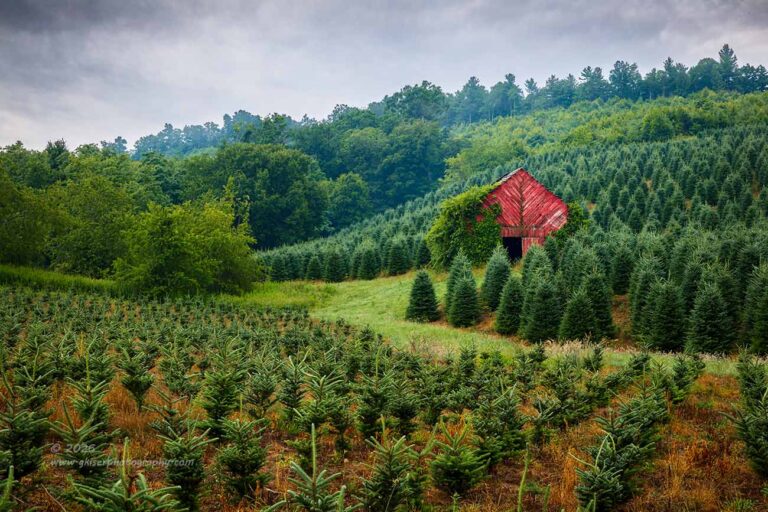
With my attention on the red barn, I started to look at the angles that were available to me. It was looking like once again a straight on shot was going to be the best. I think that the best angle on the barn itself was from the right, but the house was in the way of that shot. From the left, the vines obstructed the view too much which left that straight on shot where the geometrical aspect of the barn was most impressive against the green of the surrounding area. Since I was capturing the barn with very little dimension added to it by use of angles, I started to look at adding depth through the use of the setting.
This was where the overall story of the location started to come into play again. Remember, this was not a location where the subjects were all that strong by themselves, but the overall look added so much to the story. This barn was tucked in the midst of a Christmas Tree farm which offered a level of pattern to the composition as well as some wonderful greens to balance out the red of the barn. I just had to figure out the best way of organizing all of the aspects of the scene into a single photograph. This took a bit of time as I was compelled to shoot over the nearest group of trees that also happened to be rather short.
I really wanted everything to line up in a way that directed the eyes where to go within the frame. This was a very important aspect for me as the main subject was actually quite small in the entire frame. I needed to make sure that the eyes found it and gave it the attention that I was after. The color really helped out here as it was the warmest saturated color in the scene, and the one that stood out the most. By framing it within the voids of the fields, I was able to give it even more importance. In the end, the composition that I chose to be the keeper seemed to check all the boxes to keep the eyes where they needed to be while keeping the overall mood and atmosphere intact. The more I look at this one, the more I really like how it turned out.
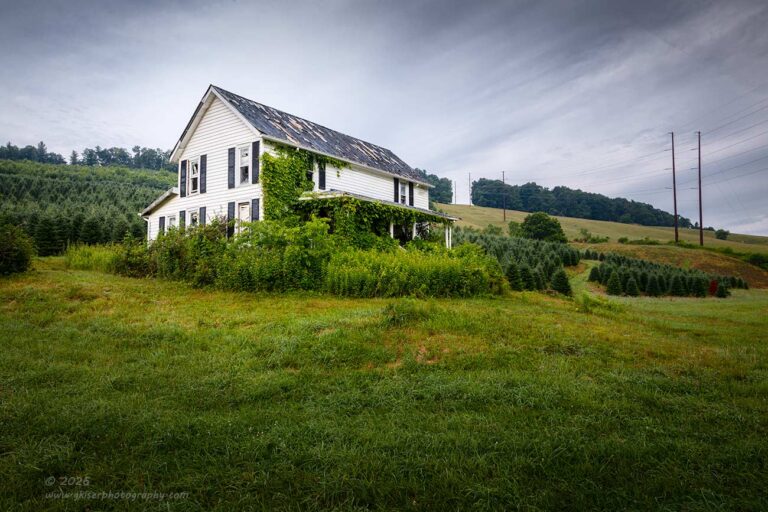
By this point, I was pretty happy with all that I had captured of the scene and wanted to do one last walk around to see if there was something that I missed. I looked at both sides of the property but kept coming back to the left side of the house. I had liked the direct view of the house but really missed showing it in its environment as I had done with the little barn. There was a lot of context to the area that I felt added to the story and kept the photos from being just a basic photo of a house or a barn. The problem was I just don’t like power lines, and I was looking at a double row of them with poles to match. They were unique poles which were kind of interesting and they did offer another element to the photo to balance out the house. In concept, the idea worked to keep them in the shot. Realistically, they were going to create too many compromises to remove in post, although I was sure that I would be able to do so if needed.
After working through the compromises that I was willing to do for this photo, I started getting the actual composition figured out. By allowing the power lines to be included, I was able to work a better angle on the house while backing up from it to show more of the scene. I liked the sky, but I decided to place the house higher in the frame for a bit more visual importance. This reduced the amount of sky in the frame, but with the way that the clouds were stretched across the sky, there was more of a sense of drama to the sky with it holding only around a third of the frame. It all seemed to come together nicely, and I liked what I was seeing on the back of the camera. I wasn’t really able to see the detail of the power lines though, so I was going to have to wait until I viewed it on the computer to really decide if I liked it.
Since you have seen the photo that I was working on, you know that it worked enough to be a keeper and it actually became the thumbnail for this entry. Considering the compromises that I had to make with the power lines, I am really quite happy with how this one came together. The sky actually has that feeling of a long exposure even though the shutter speed was a fraction of a second. I love skies that have this kind of texture but usually to get them I have to sacrifice movement in vegetation which I find distracting. This particular moment just provided me with a visual likeness of that long exposure where I would have wanted it while keeping everything else sharp. I guess that was my reward for accepting the power lines in the shot.
With that composition, I found myself at the end of ideas for this property. I had shot way more than I suspected that I would and my total frame count for the day was now at 73 with three different series of frames for panoramas being included in that count. It had been a productive day considering that I had gone out just for a sunrise. The weather provided a mood that I had not expected after the sun came up which prompted a slight pivot in my goals for the day. I’m glad that I responded to the weather conditions that I had and think that I maximized both segments of the day. Of those 73 frames that I had captured, I ended up keeping seven which I’m very happy with.
Thank you for joining me on this trek and I hope that you have enjoyed the photos. There is a little more time in the month, but I don’t know if I’ll be able to get back out again before July. However, keep your eyes out for the next Behind the Camera which will come out on the first. I’ll be talking about whether composition or light is the most important part of a photograph. Stick around to see what I think that answer it. It might surprise you.
Until then…