Tuesday, July 2, 2024
I’m sure that everyone is at least familiar with the title of Thomas Wolfe’s book You Can’t Go Home Again, which I can remember being assigned to read in school. Whether I did or not is something that I don’t really recall, but I did take the test at the end. I know enough about it to understand the title and the interpretations that were explored in the pages. I don’t really think about that book in my normal course of thoughts, and it didn’t really enter my brain until I was really looking at the photo that I had shot yesterday and was trying to come up with a title for it. The process for naming most of my photos is to look at the photo and really understand what it is saying to me, and what parts are important. There was a lot to go through with this photo, and I had a wide variety of emotions that went along with it.
For those that have had the chance to see me do a presentation on “Self-Awareness Through Photography“, you will know that for me photography is much more than just photos. It is a way of examining what I am currently going through, and also a way in which I can take the reins of how I am made to feel by these events. Many times over, photography has given me the lifeline to pull myself out of all kinds of depressions and emotional confusions. I put all of what I have said and thought on that topic to use yesterday and worked through a lot of what I have been dealing with over the past few months. This trek will certainly not be one that is multiple parts and doesn’t even have a large number of photos. Those things have been pretty regular here lately, but not this time. In fact, I’ll cut to the chase and say that I shot a total of 26 frames at the one location I stopped at yesterday and those 26 exposures yielded only a single keeper. Ironically, it was the very first frame that I shot. How in the world did just a single photo give me the ability to reach inside of my head and start to pull myself out of this creative funk? Well, let’s take a look at the day and see how this worked out.
Things have actually started to calm down here at home and I have become pretty well caught up on all the chores that I have been needing to get done. Of course, just when things were starting to ease up, I got news during my last trek that there was a whole new issue going on. While this issue wasn’t directly affecting Toni or me, we were going to have to take an active role in working through a sale of a house and the procurement of another residence for our daughter. This was not going to be easy, but it needed to happen pretty quickly which brought the stress levels way up there once again. As I’ve discussed, stress is one of those things that really gets in the way of creativity and can bring any creative paths to a halt. As I shared in my last Behind the Camera, I was just starting to come out of a creative funk and was looking to do some of my own photography once again. This most recent gut punch came at the worst time for my creativity because it derailed what I had gradually been able to put back on track.
I was now at that point where the momentum was pretty much gone. I didn’t have any other client shoots on the horizon to think about and ponder, and I had no mental energy to be creative for the sake of being creative. I was content reading a book and watching a new series on Netflix. I recognized the shift in kinetic energy and knew all too well that an object at rest will stay at rest, just as easily as an object in motion will stay in motion. There was no more motion to pull me through whether I felt like it or not. I was as good as a beached whale at this point and knew that the only recourse was to make myself get out there and get back in motion so that I could continue on that path.
Well, Summer is my least favorite time for photography because I hate to be hot. This Summer is already unseasonably hot which kind of makes me want to stay inside a lot more than be outside. The lack of rain that we have had is also having some negative effects. While I don’t really care for the solid green of the season, I dislike the dull green and early browning of the leaves even more. The drought conditions were causing the colors to be very ugly to my eyes. Add to that, there have been very few days with good clouds in the sky, so the sunlight is very harsh from early in the day until late in the evening thanks to the extremely long daylight hours. Forcing myself to get out in these conditions which I just don’t see as favorable was going to be a hard sell when I could just as easily read, watch TV, and get things in motion for the move. The phrase “an object at rest will stay at rest” just kept repeating in my head. I needed motion, and that was going to take some energy, but that energy would continue through to subsequent creative treks.
Looking at the weather, there was going to be clear sun all day until the later afternoon when some thin high clouds were going to come into the area. They weren’t going to do much for the light but would potentially make for the possibility of a good sunset. I looked around the different areas to try and get a sense for how the clouds were going to behave. I found that my best opportunity was going to be heading up to the Blue Ridge Parkway for a bit of a sunset shoot over the mountains. Ultimately, I chose to return to Beacon Heights which is an easy hike with a proven composition for a colorful sky. I wasn’t as excited as I expected to be about this but felt that this was what I was going to need to get myself back on track. The thought of doing a landscape seemed to be serene and calming which my mind needed. I could see the composition in my head but that was probably due in large part to the fact that I have a pano of that location mounted on the wall in the living room.
There was no need to get out there too early because I didn’t want to wait under harsh light for two hours or more waiting for the softer light of sunset. I knew I would get frustrated and move on, which made it more beneficial to wait until closer to sunset to leave. This is part of why I hate the Summer months. The light doesn’t get good until later in the evening when my old body is getting ready to wind down from the day. Nope, I was looking at leaving around 6pm or so to drive an hour away, to hike about 15 minutes to the summit. Even then, I would have another hour to wait for when I was hoping that the light would be good. It would be well after 10pm when I got back home which is nearly my bedtime.
A little after 5pm, I decided that if I didn’t get up and go, I wasn’t going to leave. I jumped up and told Toni that I was headed out. I grabbed my socks and shoes and went down to the truck. She noticed that even though I was going through the motions, it really didn’t appear that I was “feeling it” and said that I should just stay home. I wanted to, but I knew that tomorrow this task would be even harder, and the day after harder yet. I had to do this or face the reality that I might not be able to get back on track without some major effort.
When I got out of the canopy that is the tree cover of our yard, I was happy to see some really beautiful clouds and it was the kind of light that I liked working with. It continued to look promising until I started climbing the mountain into Watauga County. The clouds were thinning, and the sky was getting more and more hazy. Looking to the West, there was really nothing at all in the sky near the horizon and the compositions that I had in mind were very much dependent on clouds in the sky. The closer I got on the Parkway to Beacon Heights, the worse the sky looked. The lighting quality was getting terrible, and the sky was getting very boring. I kept thinking about how I would deal with this for my planned subject matter. Essentially, I was going to have a boring sky, not great light without the clouds for a bit of color and the foliage across the mountains was going to be a burnt green with tinges of brown. Essentially, this was not going to be a particularly pretty photo, and certainly no better than several I already had from this location.
By the time I made it to Cone Manor, I wasn’t feeling doing a landscape at all. I wasn’t feeling inspired by what I was seeing up to this point and really felt like I was going to be disappointed when I got to Beacon Heights. The amount of traffic on the road also indicated that there was a good chance that I was going to be sharing the summit with a lot of different people which was going to limit my options for compositions. I just wasn’t enjoying being out and around this many people which after thinking about it some more, indicated that I probably wasn’t really wanting to shoot a grand landscape either. What I had in mind was an open view with bright colors and warm sunlight streaking across the edges of the mountains. This had nothing at all to do with how I was feeling, and for me to capture something like that, I was going to have to connect with the scene a whole lot better than I was able to in my current frame of mind. I needed something more intimate, something more introspective. I needed to capture how I was feeling rather than just a pretty photo.
There was even a little voice in my head repeating something that I had heard several times over the past year or so. Landscape photographers are generally hobbyists and while the photos are very pretty, they tend to all look the same after a while. As I have mentioned, when I am in creative slumps like I am currently, I usually come out of them and become a stronger photographer because I strive to do something much better than I have in the past. I want to create something more meaningful than just a pretty photo. What I had left the house for was just another pretty photo, and something that anyone with a camera and a little bit of practice can capture. What I was really wanting was something new and meaningful to be in front of my lens. I wanted to create a statement piece that made the viewer feel something and become invested in the photo.
There was nothing on the Parkway for me knowing that was my creative direction. I turned around and exited onto US 321 through Blowing Rock which I took down the mountain into Lenoir. Don’t ask me why I chose that route because the reasonings all happened on the way down the mountain after the direction had been decided on. My first stop was a repair shop which occasionally has some interesting old classics. There was nothing there this time, so I was able to just keep on descending the mountain. I was noticing that the clouds were getting much better as I dropped down into the Yadkin Valley. There was another location off on the right side of the road which had an old tractor and old Ford truck beside a building that I had shot before. Nothing much had changed there, but the light wasn’t right which meant that I just kept on driving. I knew of a VW bug by a shop on the other side of the road which I stopped at. The bug was great, but had all sorts of yard art around it, as well as other clutter that didn’t add to the story blocking some key angles.
Nothing was working out on this trek, and I was starting to feel that anxiety which I despise because it turns into a low-grade panic that I can’t find anything to shoot. I can think back to those times when I am “on” and can find photos just about anywhere I look. This wasn’t one of those times and I had to continually remind myself that I was out of practice in finding scenes to shoot. It was about 6:30 now, and I had a bit less than an hour and a half of good light to find something. I was close to an old Fairlane that I have been trying to shoot for nearly a year now. It was behind a business where everyone worked offsite which made it nearly impossible to get permission as they had never returned my calls. I was hoping that someone would be there when I went by.
Nope, the lot was completely empty and no signs of any life in the building. Guess I can check that one off my list as well. Just as I was about to give up, I looked over to my left and caught a view of what looked to be an old house tucked into the woods on a side street. I got the truck turned around and went back to check it out. I was surprised that I had never seen this little house before because it was visible from the street without too much issue. However, I was usually coming in the opposite direction which masked it well enough.
The house was boarded up which I didn’t really care for, but there was something about it that spoke to me, and I was connecting to it in a way that I hadn’t been able to do with a subject in quite some time. There was also a really cool looking tree a short distance from the house and an old country church between them. The church didn’t interest me because it was in decent shape and offered no real story for me to capture. The tree and the house did interest me, and there was even a stream on the side of the road with some rapids that might make for something interesting. I had an hour until sunset at this point, and this was the first scene that remotely looked workable. My only choice was to stop here and see what I could do.
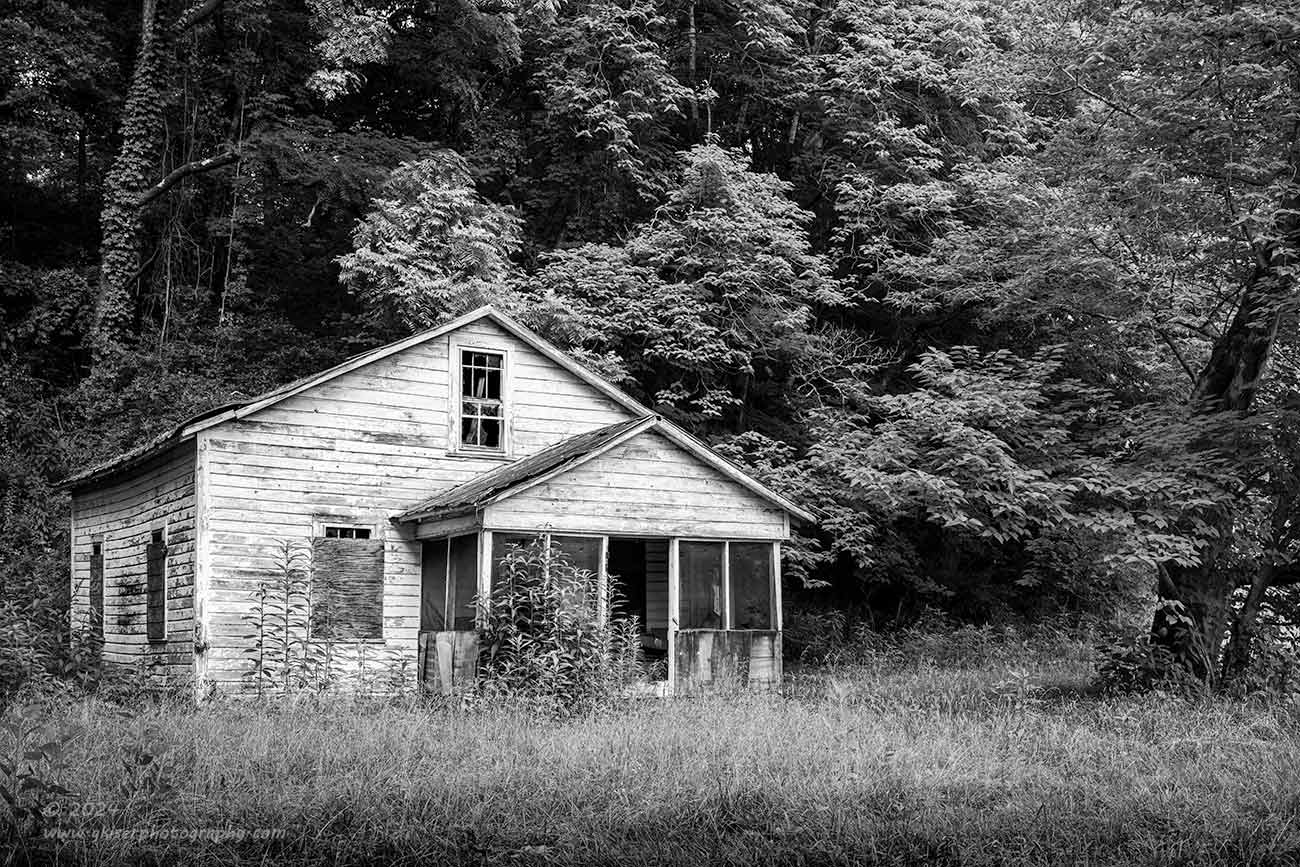
I walked around the house for a bit to get to know it. The weathering on it was great, and I liked the shape of the roof with how the front porch was isolated from the rest of the house. There was an addition on the right side, which was interesting, but that side was largely blocked by a large tree. The best angle on the house was from the front left corner. I started to work out a composition which worked with the angles on the house that I liked. One thing that I wanted to capture was the line of the roof on the right side of the porch matched up with the main roof for simplicity. This also helped to draw more attention to the smaller porch roof section that framed the one visible window. There were weeds that were partially blocking the main entrance, so I had to try and keep that as open as possible. Not wanting to center the house in the frame, I had to find something else to balance the scene. That element came in from the tree that blocked the view from the right. Now, it provided a dark structure to the right that framed the image and gave a bit of balance to the house. I liked the textures of the leaves so I placed the house lower in the frame allowing the leaves to give texture above filling the negative space with another point of interest.
The composition felt good to me, even if a little expected. I twisted the polarizer to get the desired effect in the foliage and the tin roof before getting the exposure set. I fired off a test frame and everything looked good to me. There was no need for another shot of this composition. I then went into the process of fine tuning the composition as well as the location of the camera. Ultimately, I landed on a vertical composition that included a portion of the sky above which had some passing clouds moving by. This composition called for a 2-stop soft ND grad to control the exposure in the clouds compared to the house. I really liked how this was looking in the image review, so I stuck with this composition and shot several variations with the clouds passing by. After 24 frames shot of the house, I decided that I had everything that I needed from this subject.
I went over to the tree that I had seen which had a bit of sunlight glinting off of the trunk and set up a quick composition. I shot two frames with slightly different exposures but didn’t really like the deep shadow that most of the tree had been placed in. I tried for a different angle, but nothing else worked to tell the story of that tree. After the two frames, I gave up on the tree and moved to the stream. I looked to see how things were looking with the polarizer engaged. I liked what I was seeing, but the most interesting portion of the stream had a fallen branch covering the frothy water which was going to ruin the composition. I gave up on this before even trying for a photo. I looked around one last time for anything else that might have caught my eye, but not finding anything I was back on the road once again.
There were a couple more locations that I checked on during the trip back home, but nothing else jumped out at me. Essentially, I had shot one subject with one basic composition. If I was lucky, I would two photos, but only if the tree turned out usable. It felt like a letdown after so many of my recent treks, but I had reminded myself that I wasn’t just looking for pretty photos this time, I was looking for something with meaning. This one house had resonated with me, and there had to be a reason for that. This started an evening of reflection, and ultimately a quick editing session (compared to the 12 hours I had spent on the last client shoot’s edits) where I tried to decide what that connection had been. Why was this an important photo for me?
Last night I kept thinking that so many of my recent photography sessions have been dealing with portraiture, and photographing subjects that mean something to the clients. I had not been spending my time looking for those artistic images on the level that I was so used to. There is a huge difference between photographing for yourself and photographing for others. I am very thankful for those times that I get to photograph for others because that usually means money in my pocket, but photography has always been a deeply personal thing for me. I needed to get back to that aspect of it which is where my creativity begins.
While I had started this trek with the intention of photographing a landscape, that was just not what I was needing to express. Yes, it was how I got my start in photography, but when I really found my own visual language and my creative voice, it was in the realm of the decay subject. A couple of years ago I was able to identify why I liked decay so much, and why I felt that my photography needed to move more in that direction. It goes along with that statement that I mentioned earlier in this blog entry about landscape photographers being largely hobbyists. That is not meant as a negative at all, but just punctuates why I wanted to shift to decay in the first place. There are just too many very talented landscape photographers out there, and I am just part of the noise when I and engaging in that genre of creativity. Through decay, I am creating more unique images which also have more of a story to tell. It is through these decay photographs that I feel at home.
Looking at the old house that I chose to photograph, the boarded-up windows were originally seen as something that I didn’t like, but I photographed them anyway. In hindsight, they were actually quite appropriate for how I was feeling. Here I was trying to reconnect with a type of photography that has defined me for years now which I had been neglecting for a while as I concentrated more on my portraiture. Now that I was trying to do some photography just for me, I was meeting many creative obstacles. These were the windows which were boarded up. Even the weeds at the door made entry more difficult in a figurative sense as I did not attempt to enter, or even get close to the house. There was an open door, and a window that you could see through, so I had a way to get back home to my decay work, but I had to have a specific aim in a manner of speaking. I couldn’t just enter at any point.
Even the compositions that I shot were telling of why this house was important. As I mentioned, this was the first frame that I shot. It was the safe shot with one primary element that had a framing element for balance on the right. The house fell in line with the golden spiral rule of composition which I have come to love over the past year or so. The other compositions got more and more complex where I added other elements and eventually brought in the sky and the clouds. One of my hallmarks, at least as I see it, is that I have very minimal compositions most of the time. I am very direct with what my main subject is, and I try to communicate that clearly. I do try to go for more complex compositions from time to time, but my creative base is that simplicity, that clarity of vision. When looking at the other 23 variations on the composition, I found them too confusing, and it looked like I was trying too hard. It was that first image, the simple and clear view that resonated with me. It was just as simple as the compositions that I had started out with where I tried to move the main subject off to one of the intersecting lines in the rule of thirds. Of course, I now have a better understanding of visual balance and can much more successfully accomplish this simplistic compositional method.
Here I was, looking at the chosen image to edit and realizing that in many ways, I was going back to my roots with decay photography. So many times, we think that as we get stronger in our creative pursuits that we need to abandon the more rudimentary things that we once did. I see this a lot with photographers that I see on YouTube. They are always trying to outdo their previous shoots and they incorporate more and more into their photographs. Don’t get me wrong, I am always impressed with what they come up with, but there does get to be a point where the tricks overpower the subject. For instance, I have seen this a lot with portrait photography, and specifically boudoir photography as I have been learning both. The trends are to have such complex sets with so many elements and then to use low key lighting to hide things in the shadows. The end result is that the person that you are photographing gets hidden in the plethora of visual elements. While this “look” is all the rage right now, after seeing a dozen or so images from the same photographer with different subjects, you realize that the photos are all the same and that the person is such a small detail in the frame that they are inconsequential and even unrecognizable in many circumstances.
I can’t think of a single time that I would want such a complex image that the main subject gets lost to the viewer. The goal should never be “whoa, look at what that photographer did there!”. The point of the photograph should always be the subject and the story that you are wanting to convey. I’ve been debating that concept for a while now as I am dialing in my personal style on portraiture. I’ve found that the more I do to a set, or the more I include in a scene, the less impact that the main subject has, and I feel that I’m doing a disservice to the person I am photographing. My photography has always been about clarity of vision and defining the subject. When working with a model recently, I found much more visual success in the photos that had a much simpler set than the one that I had contemplated and built up for months. The afterthought gray backdrop, black floor, with a chair offered so much with so very little. The same was showing true with this house. The more I tried to bring in other elements, the more disjointed the scene appeared, and the less attention was placed on the house.
As a creative, it is good to grow and try new things. It is good to evaluate those things and choose which ones get to stay in your bag of tools. It is also a good thing to remember that simplicity can also be the right tool for the job and there is nothing at all wrong with going back to the basics. Not everything needs to have eight seasons, with 90-some episodes. A more effective and engaging presentation might just be a two-hour movie without all the fluff.
This trek was a frustrating one for me because I had to get myself back in motion and thinking as a creative. I then had a very hard time in working within the conditions that I had, and even finding the right kind of subject to photograph. After finding that subject, I struggled with how to make a meaningful photo of it, and then tried to find something else to capture without success. After 100 miles driven, over three hours away from home, I had a single photo to show for it. It was what that photo showed to me that was the most important part. It helped me identify a lot of what I had been thinking about creatively for quite a while. It fueled that creativity which was my ultimate goal, and it also put some things in perspective for me that I think will go a long way towards improving my photography from here on out, in both this realm as well as in my portraiture. In short, even a creative can go back home and revisit the basics.
I hope that you have enjoyed this trek and the photo. Remember, if the photo speaks to you and you would like a print, I would love to make that happen. You can order some sizes directly from the gallery store, or you can contact me to discuss different print options as special orders. If you don’t have room for a print, consider clicking the “Donate” button at the bottom of this blog entry and making a small donation to show your support of my art and the struggles that go along with it. It is these donations and print sales that help fund these treks as they are not client driven.
Stay tuned as I hopefully will be able to get out a bit more and get more photos as I build that creative steam up once again. This was a good start, and I really hope that I can fan that flame throughout the month.
Until next time.