Tuesday, March 10, 2026
Yeah, this wasn’t quite a planned trek, but it was a successful one. It all started a couple of days ago when I got an email from Models 1st Management. Yes, you heard me right, a management company for models had send me an email wondering if I would be available to do a session for one of their models. I’m as surprised as you are about that, but that inquiry has moved very quickly into the planning stages of a session that is loosely scheduled for the weekend of the 21st of this month. Essentially, they have a new model, named Jackson, that is needing some portfolio images, and he is located in Charlotte, NC, which is about 1:45 Southeast of here. I’ve done plenty of work with clients in Charlotte both here and there, so this wasn’t anything way out of the ordinary in that respect. What made this so different was that an agency was contacting me to do the shoot which hasn’t happened to me yet, especially considering that the main offices are in New York and LA. I’m sure that the little town of Purlear tucked away in Wilkes County, NC is not even a thought to them. However, here we are.
The plan for the shoot was to be a city theme for Jackson, which I find a little overdone, but that was what they were wanting. At first they were wanting me to go into Charlotte to do the shoot, which I could have done, but it would have taken me at least two trips down there as I would have needed to scout the location in time to have a shoot plan for the actual session. Then there was the travel time which would have me on the road for more than eight hours easy without traffic over the course of two different trips. That would suck up a lot of time and create the need for a full third day of processing of the images.
After discussing that timeline and the associated costs, now based on a day rate, they changed their mind and went with my suggestion that I do the shoot closer to home where I was very familiar with the locations and where the potential shots would be. They were good with that, and after talking with Jackson, he is fully onboard with my idea because he was wanting something a little different than the standard city setting that is just used so much for male models. He even wanted to have a rural flare to it all, so you can imagine how well we got along on the phone call. I was all set and already had ideas of where I wanted to go with Jackson to get the photos that the agency, he, and I would be happy with. I just needed to do a quick scouting trip to check the areas for the specific spots that I would want to work.
There were two areas that came to mind for the vibe that I was going to need to go for. The first was the community college which has some more modern architecture and taller buildings to work with. The other just happened to be one of my favorite areas for photo walks, which is downtown North Wilkesboro. It will work well enough for what the agency wants and will be perfect for what Jackson and I are wanting to capture. My plan was to go out and check these spots out over the weekend since we will be shooting the following weekend. I wanted to get an idea of how the spaces looked with the amount of traffic that I would actually be dealing with. That left today open up for other things.
Looking at the weather, there wasn’t going to be much in the way of clouds through most of the day and it was going to be hot. I could take the Miata out for another ride in the warm, but I had just been out with it yesterday. The better idea was to go to Winston to work on Sierra’s house now that it was no longer cold and covered in snow and ice. Ironically, at 80 degrees, it was going to be a pretty warm day for gutter work. As it turned out, she had other things going on and to keep from overcomplicating her day, I took a rain check on the repairs for another time. That left the day pretty well open at that point.
When I was all done with my morning routine at the computer, I started to look at what I was going to do for the day. I didn’t feel like sitting down and watching TV with such a nice day, so I decided to go and scout the two spots to get some rough ideas of what I was going to want to use. That meant a quick drive through the college as classes were in session with the parking lot kind of full. I could then drive through Wilkesboro to see if there was anything there that might work out for us while I was driving into North Wilkesboro. Once there, I planned on getting out on foot and doing some walking. That sounded like a great opportunity for a quick photo walk of sorts. Hey, I was going to be out there looking at things creatively, so I might as well bring the camera with me in case anything jumped out as a photo possibility.
It was getting close to the middle of the day which is when most photographers would rather come inside and take a break rather than create photos, especially on a sunny day like today. While I see the logic in that mode of operation, I don’t usually pay attention to that. The direct harsh light of midday works well with some subjects and what I was going to be working with happens to be one of them. Just as with any time of day, you have to take into consideration where the sun is when it comes to creating compositions. If you can understand how the light works, you can still create great photos even when the sun is high in the sky, and there are times when that is the best light to use on a subject. I do plan on doing a Behind the Camera on that very topic one of these months.
At any rate, I was wanting to have another chance at a photo walk because the last one that I did was way too short, and I got too cold to want to stay out there much longer than I did. You might recall that I ended up seeing snow flurries at the end of that trek. Funny that was only like two weeks ago, and here we are looking at highs in the 80’s for today. In addition to giving that photo walk a bit more of a try, I also wanted to work more on seeing things in terms of abstract details as well as isolated stories within the whole. These are things that I can work on very easily doing a photo walk because I have the time to really look at things like light, texture, form, and shapes as I am strolling along.
When I got out there, I parked down in the main public parking lot which is a very different from where I normally start. I didn’t want to follow my same steps as I usually do because I would end up photographing the same things over and over again. This time, I wanted to do things a bit different and by starting on the lower end of the area I was forcing myself to see things in a much different order. As I am typing this, I am already seeing the irony of things and how they actually turned out.
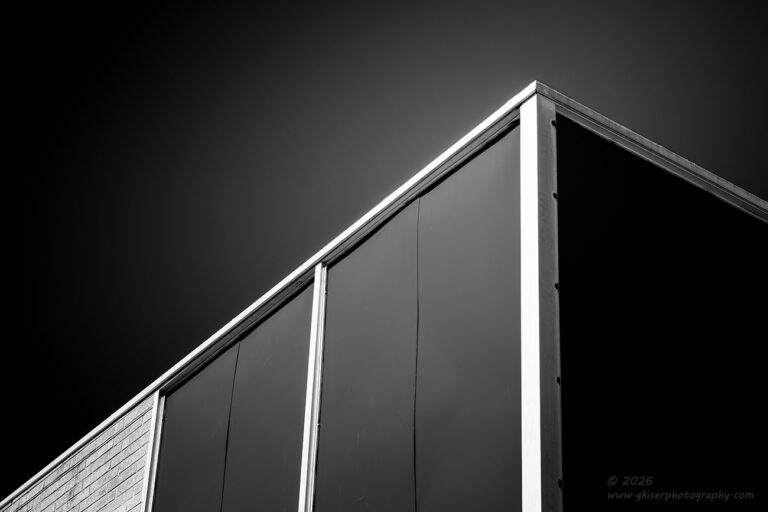
I walked through town and went down all the alleys and looked at all the stores. I was seeing nothing that jumped out at me. I ended up right around where I normally start out and continued beyond that point up to the Post Office at the top of the hill. There was something that struck me about how the very block shaped building was looking under the slightly cloudy sky. I could see some possibilities with the building doing some architectural photos of it. With that in mind I climbed the stairs and got to the same level as the building. That was when I loaded up the long lens on the camera and started to frame a composition that I liked of the corner of the roof. It looked nice in the camera with the clouds right over the large panels that made the roof section. While it looked good, it was also boring and didn’t really capture what I was hoping it would.
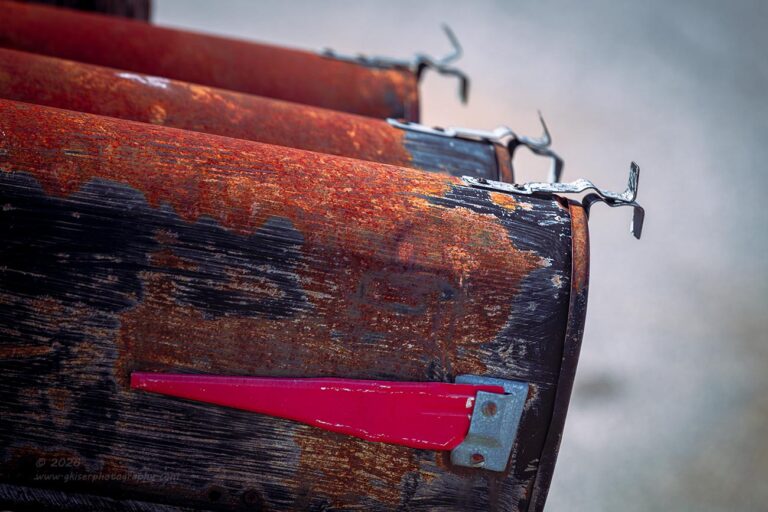
I moved in closer to get a different angle on the building and tried again. Still, it wasn’t quite working out. I started to look around to see if there was anything else that I could capture here while I tried to work through the composition in my head with the building. The only thing that I saw that interested me was a trio of mailboxes in front of a house. The mailboxes were all the same shape and color with the same patina on the top of them. The leading one had the red flag folded down and the color seemed to work well with the rust. I liked that there were three of the mailboxes in a row and I started to form up a composition featuring the repeating patterns. I resisted the urge to capture the entire mailbox and even the post that they were mounted to. That was too much in the photo and I really did need to learn to reduce my compositions to just what interested me at the time. That was the flag and how it matched up to the rust as well as the fact that there were three of the units in a row.
That was just how I composed the image and I kept the camera elevated enough to where each of the mailboxes could be seen in the frame. The clips that held the door in place were given their own spaces to exist while the flag was pretty well framed within the mailbox itself. I played around with the depth of field so that I could get the right look for the image with just enough in focus while leaving all the background very blurred for simplicity. This felt good to me, and I was pretty sure that I finally had one in the can.
This was when I turned my attention once again on the building that I had started to photograph. I found a new spot to stand in and found that the shape of the building was much better from this angle. The brick wall took up less room in the frame which I didn’t like as I was using that for color balance. This was important because the sky was blue, and the three sections of paneling that I was including was also blue. It was that pale yellow that was needed to give a little bit of color balance. Seeing how small the brick section had become and the lack of clouds, I started to think that there was just entirely too much blue in the scene, but at the same time, I really liked the composition. After thinking about this briefly, I decided that I would do this as a black and white composition dealing with the shapes created by the brighter parts of the framework as well as the bricks. I didn’t need to switch the camera over to black and white mode because I could easily see how this was going to look in my imagination since there were only two colors present in the scene to begin with.
I was starting to feel like I was getting in the mode of capturing images at this point. I was far from being in a flow state, but I was starting to see creatively. Essentially, I had been here long enough to be able to hear how the location wanted to be photographed. Since I had made it to the top of town, I needed to start my way back down the hill and start to find other areas to photograph as well as finding areas that I wanted to use for the photo session coming up. When I made it to the bottom of the stairs, I found a view that interested me and I started to try and figure out how to capture it with the camera. No matter what I did, nothing was working and I wasn’t liking how it was photographing at all.
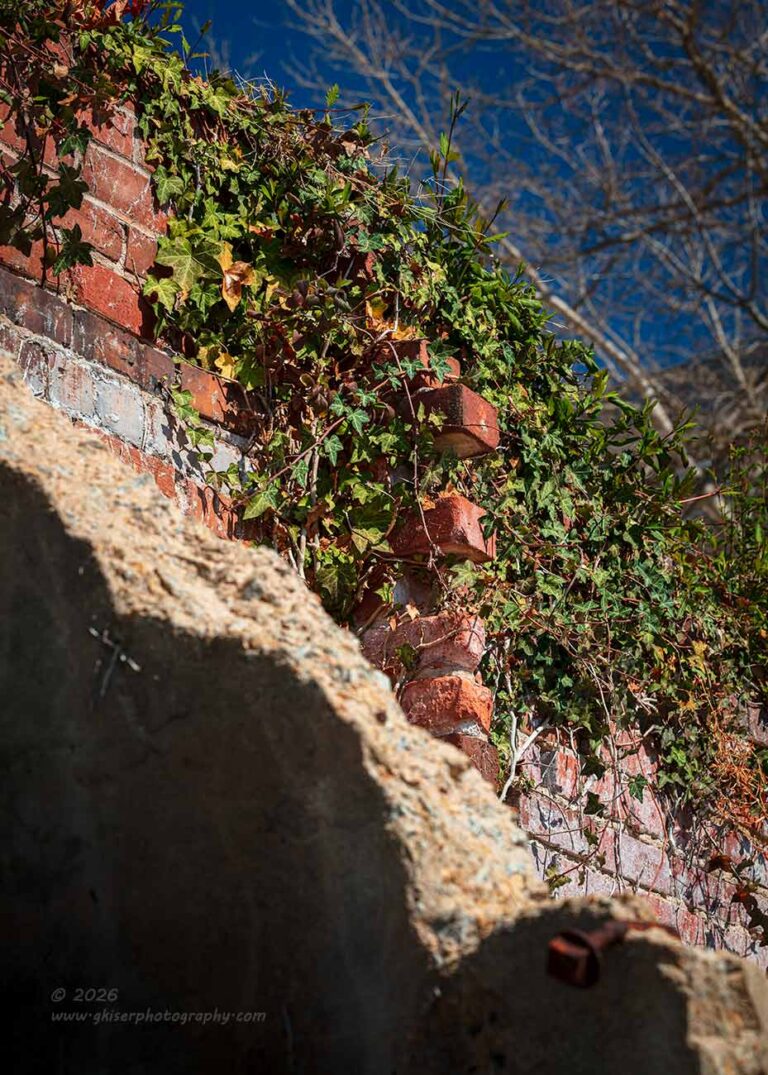
Since that wasn’t working out, there had to be an alternative in the area that would work. I looked all around and found what was left of a structure up on the hill. It was just a little off to the side of the stairs that I had just walked down. I had seen this before driving through town but never had really thought about photographing it. When it saw it now, things appeared to be a good bit different than what I had seen in the past. There were vines and other vegetation that was growing around the shattered foundation of the structure. I loved the green tones on the red bricks and found great enjoyment in the story of nature reclaiming the landscape once again. This was going to be my next photo; I just needed to figure out how I was going to capture it.
I made my way back up to the spot where the scene was and found that it was just off of a small roadway that gave excellent access to it. I started off working with the left side of the scene which had a broken concrete wall that provided a fantastic foreground element for me. The part that really interested me was a section of bricks that were protruding through the rest of the wall and the wall of vines. This was the real interesting part, but I didn’t need to isolate it too much because the surroundings were the story of it. I worked several different compositions and ended up on the one that you see here.
What I liked about this composition was the fact that the wall in the foreground was very dark and in shadows. You could just make out a rusty bolt that was exposed and bent on the lower chuck of that wall. The broken part of the wall was bathed in light to give depth which brought your eyes into the main part of the scene with some additional shadows defining the shapes of the bricks. The green vegetation contrasted perfectly with the color of the bricks and even the textures were great contrasts. The upper right of the photo was a section of sky with the skeletal tree breaking up the color. The cool blue once again provided a great color contrast for the scene while the tree provided a complimenting texture for the rest of the photo.
There really was a lot going on with this composition, but it worked very well to my eyes. It was not something that I necessarily would have seen several months ago, but now that I am really working on learning different ways of seeing, I’m getting better at seeing these types of compositions that might have more of an abstract feel to them than that of a landscape. It would appear that I am finally starting to get over that hump in seeing these types of compositions a bit easier than before. I know that I started to build this composition without thinking too much about it, and only when I had the basics in place, did I start to really think through the compositional parameters that I was choosing which led to this result.
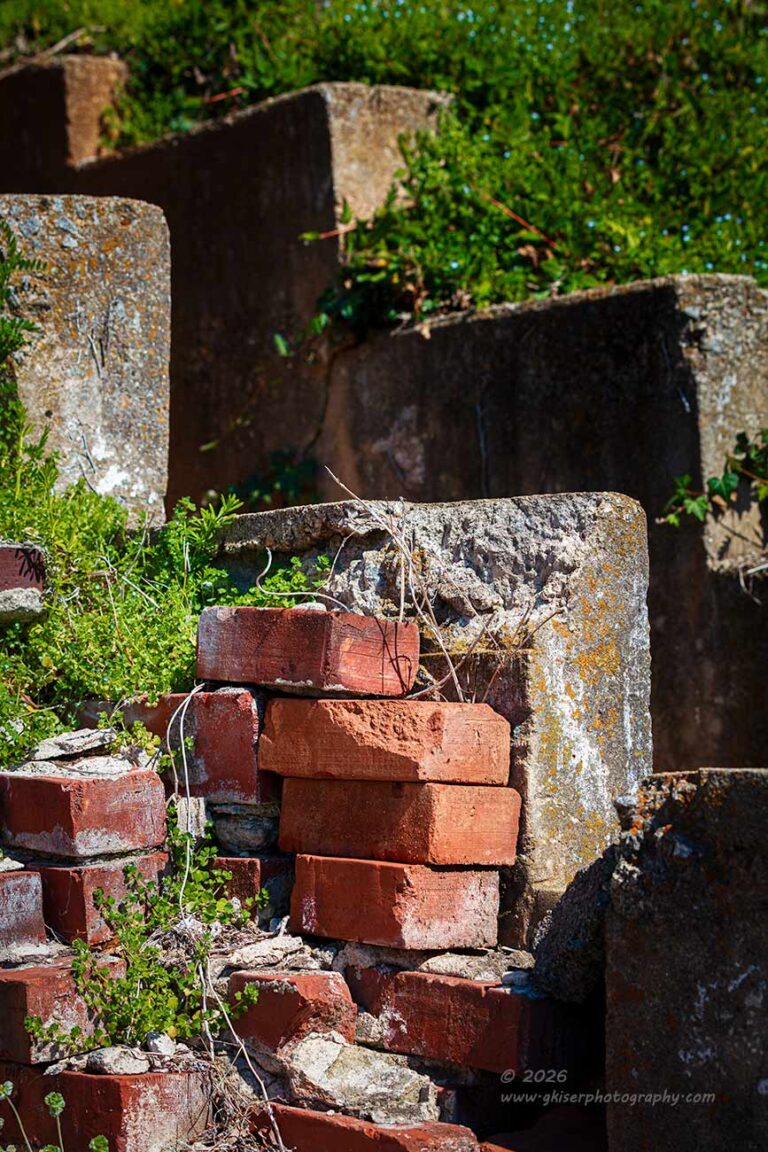
There was still more to the structure that I was finding very interesting though. One of the primary other places happened to be on the opposite side of it. On this side, there had been a staircase at one time right next to the structure. Everything was falling in and the greenery was growing where it had no business growing. Of course, that set the stage for something wonderfully interesting in my book. I started to move the camera around to get the right framing of what I was seeing. When I got to that point where I saw several “S curves” developing, I dropped the legs of the tripod and started to dial in the composition to really make it work.
This didn’t take long at all. I was able to get the basic composition down really quickly after that point. The only sticking point that I had to deal with was how wide to make it knowing that I was going to be cropping this one down to either a 5:7 or a 4:5 aspect ratio in post. This is something that I always plan to do with my vertical compositions because I really don’t think that the native 3:2 aspect ratio is a comfortable ratio to view a vertical photograph. It is one of those things that I learned after years of photography and now when I look back on some of my older photos, I cringe at the crops with the verticals because I understand something now that I never considered back then. I think that it has vastly improved my vertical photography since making that little cropping change.
With this composition, I once again had the light on my side. Keep in mind that it was exactly 12:27pm (the clock had been set correctly when the time changed over the weekend) when most photographers gripe about the light being unflattering. You can surely see that I still had directional light and the subject happens to work very well with the existing light. There really is no bad light, only compositions that don’t adequately utilize the light that is present.
This is as good a time as any to remind everyone that it takes three aspects to make a good photo. You need an interesting subject, good light, and a strong composition. If you nail all three, you have a stellar photograph, if you get two of them checked off, you have a good photograph. If you only have one of those aspects, the photograph will likely not be that good at all. In this case, I had a lackluster subject because there isn’t really one defined in the frame. However, the light is good and creates that chiaroscuro lighting pattern, light to dark, to light again. The composition takes advantage of that lighting pattern and creates a visual pathway through the image. In the end, I have great light and a strong composition which should yield a pretty decent image. What do you think about it?
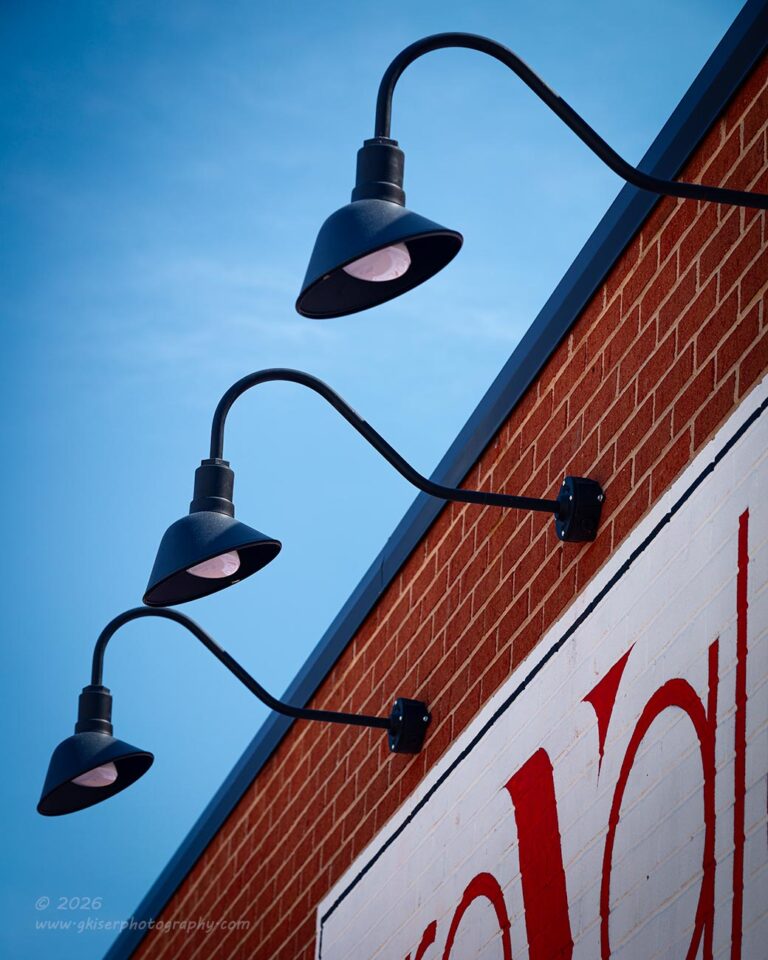
When I was satisfied with the little overgrown ruins, I started to move back into the main portion of town. I was feeling much better in the creative sense than I was when I started the walk. I was now seeing things that interested me and I was seeing frames around many of the scenes. While scoping out one building for the upcoming model shoot, I was excited about the repeating patterns for that use but didn’t see a photo there to be had today. However, there were three lights that were mounted to the wall above my head and above the business name which was painted onto the building. There was something that I liked about what I was seeing. The lamps gave me a group of three main subjects while the wall of red bricks contrasted nicely with the blue sky. An additional contrast was seen between the blank sky and the texture and lines of the bricks. To keep the red from being overbearing in the image, I chose to include part of the sign for the white color and the curves of the red lettering that matched up with the curve of the lamps. I included only a portion of the sign which didn’t give enough view to really understand what the words were. I just needed it for color and shape which it provided well enough.
As if the things that I had been photographing up to this point weren’t confusing enough for folks walking by, here I was standing beside of a building with the camera pointed into the sky at nothing all that specific. I wasn’t just shooting a single frame either. I had the camera on a tripod, and I was constantly moving the whole rig until I had happy with how things looked. Then I was firing off a shot every now and then just in case I could get no better. All the while looking up at what appeared to be nothing to those that were walking by me. I’m sure I was just thought of as another one of those “odd” individuals in Wilkes County.
When I was finally satisfied that I had everything captured with the one building, I started to move through town once again. I knew of a building that I had tried to shoot a few years ago that had some great colors on it, but at the time, I was photographing it wrong. Well, not really wrong because there really isn’t much “wrong” that you can do in photography short of leaving the lens cap on. Doing something wrong because it makes for a better photograph is certainly permitted and often rewarded. What I did just didn’t work out at all and left me with a very bland image for the colors that were present. If memory serves, I shot the scene pretty well squared up to the building so that all the right angles were right and everything was as the architect had planned. It wasn’t so much wrong as it was boring, which for my purposes was wrong.
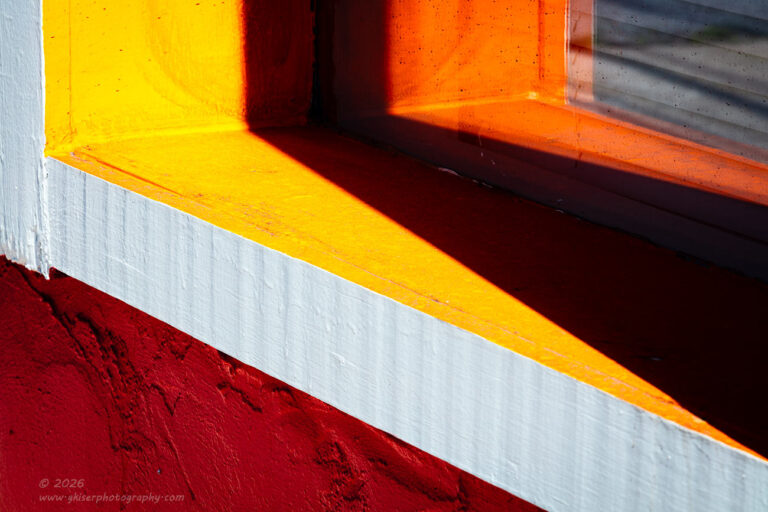
Now that your head is spinning about right and wrong, let’s just say I didn’t like the photos that I had shot previously and wanted to give it another try now that I had new tools in my creative box as well as a better understanding of lighting. Here we go again with the subject, lighting, and composition thing that I just talked about. The subject that I wanted to shoot once I found the building was the colors. The lighting was still very much the middle of the day when most photographers would have stayed home. However, the direction of the lighting gave me a beautiful shadow that created a new shape as well as a third color in the reflection showing in the window. The orange that was introduced was right between the yellow and the red that the building was painted in. The last aspect that I had to work with, and the only one that I had control over was the composition. I went with a very abstract view of this window rather than the squared off composition I had done before.
This time, I was relying on diagonals, converging points that made triangles, contrasts that provided deep shadows, and being close enough to show off the different textures. There was so much going on with this composition when I was all done with it. It had excitement, tension, drama, and a very exciting feeling that went along with it. This new attempt at a photo was miles away different than the first attempt and I think exponentially better than that first attempt. In my opinion, I managed to create a photo that included a strong subject, great lighting, and a winning composition. Because of that, I really think that this is one of the best images of the day and is going to be in the running for one of my top 12 significant images for 2026 I am pretty sure.
Whether or not this image makes that list, there is no denying that the improvement on how I saw the scene is significant over the attempt from just a few years ago. This is what I am hoping to teach myself as I look to improve on seeing unique compositions in unexpected places. I do believe that this is one of those abstract images that I have been after for so long. Abstract in this case goes a little bit deeper than how I have defined it in the past. The photo that you see here is no longer of a window. It is a photo of colors and shapes based on dimension and lighting. In other words, what you are seeing as a photograph has little to do with what the photo is of, and much more to do with how I actually saw the scene at the time.
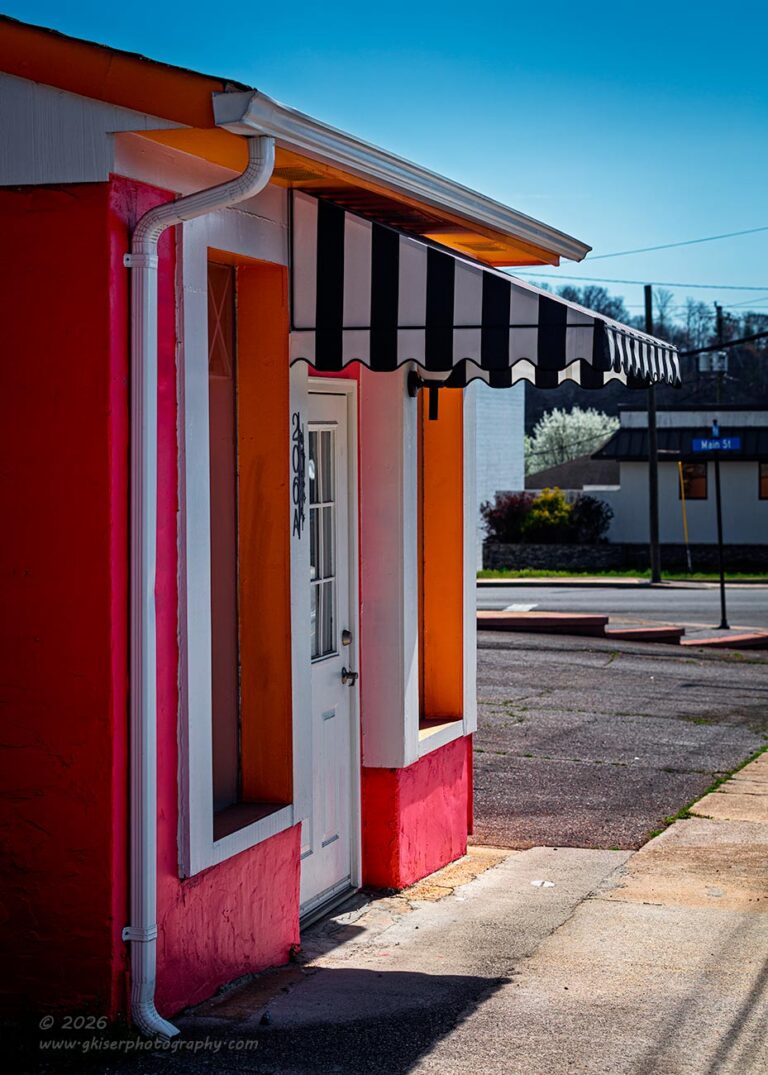
Feeling pretty good about this last photo, I decided to look at the building from the other side and see what I could do with the light that was hitting it from that direction. There wasn’t nearly as much visual interest to the building as a whole from either side, but I did kind of like the way the light was hitting it from the left side. This also gave me the chance to include part of the surroundings which would let me establish a location for the building. That location even included a street sign which happened to be done in blue which contrasted nicely with the warm tones of the building. The background was also in shadow which was largely blue as well that helped to balance things out overall.
I wasn’t sure if I was going to be able to get into position with the long lens but felt that was the right choice to keep from including the intersection in the frame which would have overcomplicated the entire photograph. By using the telephoto lens and getting further away, I would be able to include much less of the background while focusing the attention on the building. I was able to find that spot that was not too far out in the street. This allowed me to get everything that I wanted in the frame and have everything scaled as I wanted it. The biggest thing now was waiting until traffic was out of the frame.
I had done so much planning for this photo when the time came to press the button on the remote, all I had to do was confirm that there were no cars in the frame before moving the camera. There was nothing else that I needed to do to tweak this photo. I really do love when I am able to get everything right with a single press of the shutter. It does make things much quicker and more efficient. It also makes it easier to cull the images because I’m not looking at a half dozen of the same photo with small adjustments made between frames.
By this point, I had been out on my photo walk for about an hour. In that time, I had shot a total of 30 frames which was pretty good considering the lackluster start that I had for the day. I felt that I was just getting warmed up, but how much more would I be able to photograph out here? I mean, I have been on photo walks through this town more times than I can count as well as teaching workshops here. How much could possibly be left that I hadn’t photographed in the past? You will have to wait until tomorrow for the answer to that question. I will say that there are more photos to come, and I do believe that I ended up seeing several scenes that I had never really paid any attention to.
I’ll see you back here tomorrow with another chapter and the conclusion of the day.
Until then…