Tuesday, September 2, 2025
To me, it feels like forever since I’ve been out with the camera when in actuality it has been less than a week. You might remember my adventure that included barns, trucks and trains in a single morning. That was a day that I just set out to shoot a truck and you see where that got me. Well, since that point, I have been talking to several different clients about upcoming portrait shoots. It is so nice to be working the portrait angle of photography once again. I’ve got a lot of different sessions coming up from a boudoir shoot later this month, a creative session based around the theme of a puppet, there will also be a portrait shoot where I am going to try and capture a very heroic story through a series of photos, and then there is a maternity shoot that will happen in October. I’ve been getting my mind wrapped around these shoots and getting some props and supplies that will be needed for them. In short, I’ve been very busy with my photography over the last week even though you haven’t seen much from me here in the blog. I’ll remind everyone that this blog is pretty much dedicated to my landscape and decay work, and I won’t be regularly sharing my people photography here. If you are interested in what I’m doing on that end, the best way is to check out my Facebook Page under Greg Kiser Portraits.
Now that I’ve covered what I’ve been up to for the last several days, we can get into this trek. I almost titled it “The Plus One Rule” because that is pretty much exactly what has happened. You might recall a very lengthy trek several weeks ago just around the corner from our house. When I started to talk with the owner of the property that I ended up spending the most time at, I had won him over with my charm and personality. Well, maybe not so much that as I came across as a genuine person when I was talking with him. Anyway, he shared with me some areas that I might find some other great examples of the old cars that I liked to shoot. They were all in and around Taylorsville where I have spent a good deal of time scouting around and taking photographs through the years. Some of the places he mentioned I was very familiar with and had shot them over the course of several years. There were others that I was not familiar with, and I took some mental notes of the locations so that I could get back out there and get some more new subjects in my portfolio. This is what I love about working decay subjects and talking with property owners. Just seeing one car had turned into many cars, a multi-part blog entry, and leads on other cars in a different county.
The plan had been to wait until winter when the brush wasn’t so grown up because that is a much better time to explore new areas since I can see from the road better. It was also looking like that was going to be the case with all that I have coming up here in very short order. I’ve also got a landscape workshop that will be going on October 18th which will also take some time away. There are slots open if you are interested in joining me.
As I got done with all that I could do to plan on some things for the upcoming shoots and workshops, I contemplated sitting and resting for a bit but decided that I was filled with a lot of creative energy and needed to get that in use somehow. The weather was not looking great outside as I sat in my chair upstairs. I could see bright sun and no clouds. Looking at the weather, the clouds might start coming in around lunchtime, but they were going to be kind of spread out. At least they were supposed to be low level clouds which are interesting to look at. It appeared that the better chances for clouds were to the South.
Not having a real good idea of a plan of action, I decided that I would just go in the direction of the clouds and see where they took me. There was one location that I needed to go and check out that might be a potential spot for one of the portrait sessions. It would take about the right amount of time to check that out before the clouds started to come in and if it was good to shoot as a subject on its own, I could stick around until the clouds came in and get that shot. If not, I would be free to travel and look for something else to shoot. There was no reason to find anything fantastic to work because I didn’t really want a lot of photos to deal with when I got home. I just wanted to get out and exercise my eye in reality rather than in concept as I have been planning shoots for several days, but not working the camera.

I loaded up the camera in the truck and headed out to one of the parks here in Wilkesboro to check out the tip on the location. I wasn’t sure what I was going to find and hadn’t been able to find anything about it online. The way it was described to me, I was figuring that it was going to be heavily marked with No Trespassing signs, but I wanted to try and figure out who the owner was in order to ask for permission and see if it was a possible location. When I got to the park, I started up the trail that was supposed to take me to the building. It was actually shorter than I had expected, but before I could see any buildings at all, I saw a state sign indicating No Trespassing. I tried to peek around the corner to see if I could at least see the building, but there was no sign of it anywhere. I pulled out the GPS and looked at the map to see if I could get an idea where the building was in relation to my location. I saw no structures nearby, but there was a lot of tree cover which was probably blocking it. There were what appeared to be houses beyond the area I was expecting the building to be, but nothing that I could use to get a better look.
Not wanting to get arrested, I turned around and went back to the truck with a few more clues in my back pocket about the location. I was now free to go wherever the clouds took me. When I got back out on the main road, I could tell that the clouds were better looking to the South which would put them over Alexander County. This was where I had been given the tips about the old cars. It seemed like a good time to go and scout things out. The clouds would make it possible to shoot a few frames potentially and would work great for barns if I located anything like that along the way. It was going to be one of those treks where I had little to no expectations of what I was going to get but was keeping my mind open to just about anything.
The drive down was quite interesting, and I spotted a Ford Fairlane that I considered shooting at a location that I had shot before, but this was a new addition. After pondering the options for a few minutes, I decided that the light wasn’t all that great, and the setting wasn’t one that I particularly liked. I might come back to it another time because as we well know, my treks usually end up sparking other ones shortly after.
There were a couple of other locations that had a little bit of promise, but I wasn’t liking them for what I was wanting to get into today. I just kept on driving and hoping that something would really jump out at me as being unique and special. The sky was looking good, but the light was kind of harsh in most directions. It was the middle of the day which is a time when most photographers will take a break or just stay at home. For me, I’ve found that if I can find the right subject, the harsh light of midday can actually work quite well for my decay photography. The typical golden hour times tend to be kind of boring and expected while setting a mood that doesn’t quite fit the subjects. I just needed to find a scene that was in a direction that would work with the light that was falling.
The more I drove, the closer I got to one of the roads that I had been told about. At this point, I just made it a point to get to that road so that I could see what it had to offer. It was right on the edge of Taylorsville and when I turned onto the road, I recognized it from another trek a few years back. I remembered seeing many of the buildings and houses along the way. Shortly after pulling onto the road, I spotted a line of old cars along some trees that I remembered stopping to look at years ago. I had decided that it wasn’t worth getting permission at the time, though I am not 100% sure why that was. This time, I was looking at the cars which were parked in a tight line and there was an RV next to one of them. I wasn’t exactly sure what kind of cars I was looking at, but they looked like Fords from the rear pillar shape. As I drove by, I considered the possibilities and decided that the light wasn’t great on them at this point and there needed to be some clouds above which for the moment there were very few.
I continued on down the road and spotted a really interesting car mounted to the roof of a shed that caught my eye. I slowed and looked around but really saw nothing else that piqued my interest on the property. A short while later, I spotted what looked like a bunch of cars behind some trees, but they were well in the woods, and the light was much too harsh for even considering those. That was pretty much the last bit of interest that I saw on the road and when I finally reached the end of it, I turned around to look at the three areas once again to see if there was anything that I could do with them, or could come up with a plan for another day with different weather.
I slowed where the large number of cars was situated and I was pretty sure that I saw several VW Bugs along the side of the property, but it was hard to tell through the trees. The shadows were very deep, and I just couldn’t get a clear view of them. It was something that I wanted to come back and check out at another time though, so I made a mental note of that Plus One for this trek. When I got to the shed with the mounted car on top, I confirmed that there was really nothing that I would want to do with that scene at all. It was interesting, but the contents of the shed were not really supported by the car on top of it, so I wasn’t able to make a cohesive composition there.
It was when I got to the first property that I had seen on the road with the Fords along the side of the yard that I pulled into the driveway and looked closer at them. Now that I was able to really see them, there were two Ford Thunderbirds lined up together. The beige one was kind of by itself, though close to a Dodge Caravan behind it, and the Blue Thunderbird in front of it. Beside the blue Thunderbird was an RV. There were other cars behind the Caravan, and there were a couple of cars by the house, one of which was under a car cover. There was also a blue Chrysler in the main driveway that was the right era for me, but there was no rust or significant aging to the paint. I could see motion over by a Honda Van and decided that since they were out, I might as well see if they would mind if I shot a few photos of the Thunderbirds.

I introduced myself and learned that they were trying to get the van to start but were having issues with that task. Despite dealing with the problem, they were happy to let me get some photos of the cars and even offered to move things out of the way. Of course, I refused that help because I much prefer to leave things the way that I spotted them. For me, that is their natural state and anything that changes in the scene becomes a form of staging the photos. I just made sure that my truck wasn’t in the way and grabbed my gear to go over to the two Fords.
This was where things got kind of interesting. At first, I really didn’t see much that interested me now that I was looking at them in person. The cars were close enough together that getting overall compositions was going to be difficult, and I wasn’t really seeing details that really appealed to me. I was here, so that meant that I needed to slow down and take my time to work the scene. I walked around both cars and looked at the things that each had to offer. The patina on the beige car was terrific, but the blue car was in much better shape. It was the beige one that drew most of my interest, but the lines weren’t really offering much in terms of isolations. As I walked around them both, I started to see some separation between the beige car and the surrounding cars if I used a long enough focal length.
That was the key to getting started, so I mounted the telephoto lens and got some distance from the car. It was nearly a profile shot, but I kept inching to the right until I had a bit more angle on the car while just cropping out the bumper of the van behind it. The framing worked better than I thought that it would, and I shot a test shot as the sun was shining down on the car. This caused some clipping that I didn’t see in the histogram because of the specularity of the highlights. I dialed the exposure back slightly and fixed that issue just as the clouds started to cover the sun. This allowed me to bring the exposure back up a little bit to counter the fact that the car was kind of in the shadows. It was only the top of the car that was really getting light, and when the sun was out in force, the contrast between the top and the side of the car was a bit much for my liking. However, I decided that when the clouds covered the sun slightly, I had nice sculpting on the car from the top down lighting, but not overly contrasty which I liked.
I ended up shooting seven frames with this composition under different lighting conditions. After culling through them, I landed on one with a bit more sunlight and one that was more evenly lit. My plan was to process both with the sunny one being in color while the more subtle lighting was going to be done in black and white. It is worth mentioning that I did the black and white image first off during the processing portion of the day. I never returned to the sunnier one which I had planned on doing in color because there was one that I liked better which was shot later on.
I couldn’t help but notice that shooting from this direction was causing me issues with the back lighting. The lighter color on the car helped the exposure in many ways but hurt it significantly in other ways. The clouds were looking better over my shoulder, so I decided to see if I could get anything at all from the driver’s side of the Thunderbird looking out to the more interesting sky rather than the trees. This would give me more depth to the frame and likely a better photo.
I tried some blended compositions that included more than an isolation but still didn’t include the entire car. With the working distance that I had available to me thanks to the trees, I wasn’t able to get the telephoto lens to perform as well as I would have wanted. I made the decision to pull that one off and replace it with the standard zoom which would allow me a bit more flexibility for framing. I would just have to be extra careful about the chrome to make sure that I didn’t appear in a cameo.
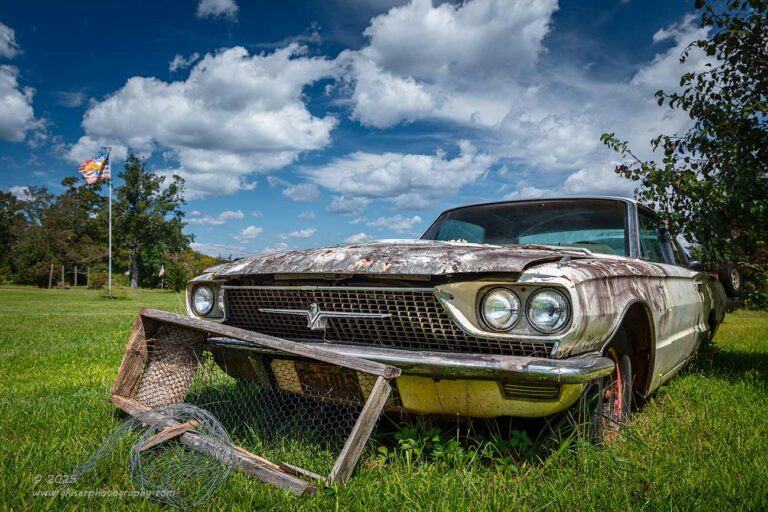
The standard zoom opened up some really interesting framing options and I quickly decided to try for a full shot of the car from this angle. The van behind it was the biggest problem I had to deal with and that was handled by getting the camera low to the ground and in kind of close to the car. This blocked the van completely from view, but I was left with the spare tire of a Geo Tracker which was parked behind the van. The only way that I could get rid of that was to shoot this car from straight on which didn’t appeal to me. I wanted to show the side of the car and that was going to give me part of the depth of the scene. I also wanted to include the American Flags that were flying in the background which meant that I was needing to shoot from something of an angle to the car. After what seemed like five minutes, I found a compromise that I could deal with when it came to the placement of the Geo in the background. It was pretty much just the spare tire, and it was in the shadows. I could do some local editing on it to reduce its impact in the scene and remove it as a distraction when placed like it was. The rest of the frame worked out pretty well.
What I really liked about this view was the fact that the portion of the chicken coop was very dominant in the frame this way. I liked it here because it told more of the story of the car. It provided a bit of extra texture to the frame, and the chicken wire had a very similar pattern to the grill which didn’t go unnoticed by this photographer. Once I got everything dialed in, I shot a series of six frames as the clouds moved overhead, and the light changed on the car. I was also trying to time the flag to be stretched out showing the detail on it. It was the last frame of the six where the clouds made the most sense and helped to frame the car within the composition, while the flag was relatively full. These kinds of details often force more frames than would otherwise be needed. After waiting for the clouds, it was a matter of timing the exposure to match the flag which took some doing to get it in the right shape and not too blurred.
After spending that much time with the horizontal composition, I decided to flip the camera and go back to the hybrid approach to the composition that I had started off with when using the telephoto lens. I concentrated on the front corner of the car, eliminating the chicken coop in favor of anchoring the photo with the headlights and rusty wheel. I just concentrated on a portion of the car and let the rest of the frame be filled by the sky which was looking really nice at this point.

I had a lot of this composition figured out thanks to the time that I had spent with the horizontal version, so this should have gone quicker. However, the flag was causing me some difficulties in the vertical format. I thought that I wanted it to be flying similarly as the horizontal frame had been. In the first several attempts, I found that the balance looked wrong with the flag flying like that since the wind was pushing the flag to the left and out of the frame. I tried a few other positions of the flag and eventually decided that it made more sense for it to be in a more resting position around the pole. This gave a better shape to the left portion of the frame, but now I wanted to have the flag draped in a way that would make it obvious as to what it was. This meant that the stars needed to occupy a nice portion at the top and the stripes needed to flow below them. While this seems like a natural look for a flag at rest, I was having to catch it between the breeze blowing it. There were several where I got it close, but it was blurred.
Because of this, I shot a series of eight frames with this composition. The last one turned into the keeper of the series. When we look back at my more recent treks, it is kind of unreal to have only three keepers after having shot a total of 21 frames. My hit rate has been much higher than this recently, but I haven’t had to deal with the breeze and changing light quite like I was dealing with here which forces you to shoot a lot of frames that will never see the light of day. I was getting the photos that I was wanting, so that was all that mattered to me.
Now that I had a good choice of more encompassing compositions, I started to look for some isolations that might work. I had turned up nothing during my initial walk around the car, but now that I had been here for a little while, I had been able to pay attention to the car and listen to it to see how it wanted to be photographed. It wasn’t really the emblems that were drawing me in with this car like I normally would have been. With this body style, and since it was duplicated between the two cars, I was considering the shapes of both of the cars determining things like lighting and patina to help me decide which car got the attention for a given isolation.
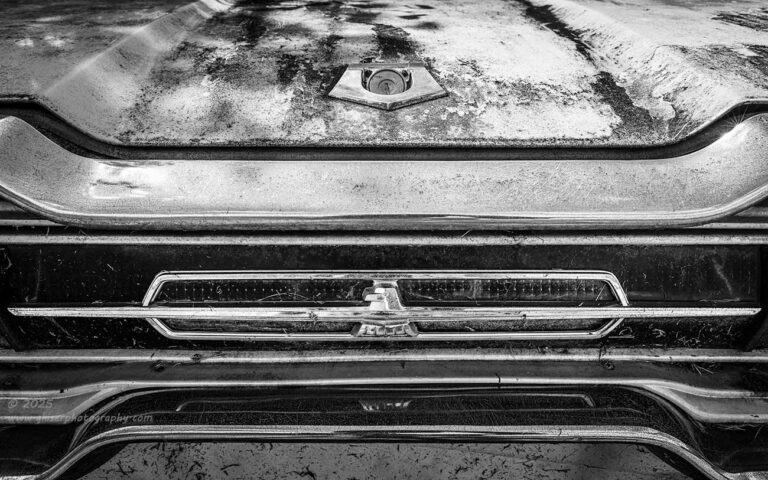
The first thing that came to mind was the taillight panel of the car. This is something that is very distinctive about the Thunderbird, and I’ve photographed them from the rear before with varying degrees of success. My thought this time was to get down low and shoot the outstretched Thunderbird which is positioned in the reverse lamp. This would be framed by the bumper which was split and had a narrowed section where the emblem was. The insets fed into the body lines of the trunk and allowed for a tag to fit below the bumper. It was an interesting shape to me, and I wanted to capture this as an abstract of sorts. The choice was made to work with the beige car first for this concept because the patina on the truck was better.
I worked on framing up the composition as I thought it would work best. I had to pay particular attention to the keyhole in the truck to really make this work because it was going to have to be in the frame. I ended up stretching the frame to the sides pretty far to get the curves in the chrome that I wanted along with the lines of the trunk. I wasn’t able to elevate the camera as I wanted to do because of the reflection that showed in the chrome. By keeping the camera low and in line with the emblem, I avoided a recognizable reflection and kept the focus on the shape of that chrome above all else. Because the sun was changing in intensity so much, I ended up shooting four frames with exactly the same composition, but I would jog the shutter speed to match the light intensity. It was the last of the four frames that turned out to be a keeper, but honestly when I was shooting this, I thought that the contrast was too extensive to work out. I figured that these last four frames would be a write off, so I didn’t spend any more time with this composition before I moved onto the next idea.

That next idea was a typical front corner shot of the blue Thunderbird on the driver’s side. This was the side with the better light, and the original wheel cover was fixed to the wheel which made this an interesting photo. I framed it up and found the right balance before shooting a single frame. That single frame looked as good as I could have asked for and I left it at that. Ironically, that single frame that I was kind of confident about turned out to be a trashed image after two rounds of culling. There was just not enough interest in the blue paint for me, and the shapes were not bold enough to keep my attention. In short, it was a boring image which is why you aren’t seeing it in this blog.
While I was on the driver’s side of the blue car, I started to look at the A pillar which is an area that I’ve shot on a similar Thunderbird before with great success. I wasn’t able to get that kind of composition to work out with this car though. However, I was kind of impressed with the interior of the car and felt that this might be a chance to capture a shot of the steering wheel similar to how I had done with the Chrysler New Yorker not that long ago. I worked out a framing that I liked which showed off the inside and dialed the polarizer in a way that that cut through the glare on the glass. Then I waited for the clouds to dull the sun so that I could get a more even exposure. This took a total of three attempts before I got the light diffused enough to give me plenty of shadow detail to work with inside of the car.
While you might think that the processing was all about boosting the shadows and pulling back the highlights, you might be surprised that I only did a little of that. Most of the processing of this image is due to the color profile that I applied to it. I used one of my favorite ones that desaturates the colors but leans into the blues quite a bit. I then worked the individual color channels for saturation to bring up the colors where I wanted them to be. There was just a little bit of shadow and highlight work that was left to be done to get the right balance in the frame. By the time it was all said and done, I really liked how it turned out and the abundance of blue worked out great with that color profile that I chose.
I was starting to find my rhythm with this blue Thunderbird and started to walk around it a little bit to see what I might have missed before. One of the first places that I stopped was the rear of the car where I started to look at the same composition that I had done of the taillight of the beige car before. There were a couple of differences here that were worth noting. In the bright sunlight, the dark blue paint would be less likely to clip in the highlights like the significantly lighter beige car. This would leave the chrome to be the highlight which was fine with me as we are used to seeing specular highlights in chrome. The next feature that drew me in was the fact that the taillight lens was in much better shape on this car showing off more of the red tone. This contrasted nicely with the blue paint and the reflected blue tones in the chrome. The final difference was that this car had a tag affixed to the rear valance. The tag was a faded yellow/orange color which again contrasted very nicely with the blue paint.

I knew how this composition worked, so I got the camera into a very similar location and made sure that I was square to the rear of the car. After getting everything dialed in, I just waited for the sun to do its thing and provide some different lighting to work with. There was a total of four frames that I shot on this composition and all of them felt better than the earlier attempt on the lighter car. The one that won out was the last of the series because the clouds had covered the sun pretty significantly allowing me to really pull out the color in the taillight lens which was rather important for this one. I had already made the decision that this one was going to be in color since I had colors that worked so well together in the frame. This was the biggest difference between this car and the beige one because there really wasn’t that much importance assigned to the colors on that car. In fact, the colors were insignificant in comparison to the textures and shapes that I was capturing.
It was because of those two very distinct qualities between the two cars that I decided to look at them as a black and white and then a color image during the culling stages. The first attempts turned out stronger than I had anticipated and there was one that kept getting selected for the next rounds of culling as did the last of the four frames of the blue car. It was the last of each group that made it through the culling to the processing portion of the day. This is why I usually cull from the last to the first. It makes the process much simpler because logic would dictate that the stronger images are towards the end of the series because after you nail the concept, you move onto something else. This is the case more often than not for me.
Things were picking up and my hit rate was doing much better at this point. Of course, I wasn’t sure how it was going at the time, but looking back, I had shot 33 frames up to this point and of those 33, I had six keepers which is right in with my new norm for hit rates. It had been a slow start, but things were really starting to come together at this point. Of course, you never pat yourself on the back until the deed is done. Things were about to fall off the rails with this next composition.
I was feeling pretty confident at this point and decided that I would try another overall shot of the beige car with the wider lens. I thought that I could possibly squeeze out its own space even with a wide-angle lens. I went back to the passenger side and got at roughly the same angle that I had shot before, only closer. I checked to see where I was in relation to the minivan behind the Ford. It was fully in the frame and actually overlapping the rear of the car. I had to move to the left more to give it space. This reduced the angle on the car creating more of a profile shot which I wanted to avoid. I wasn’t ready to give up on this one just yet, so I kept working the angles and tried to get as much of the front corner included without having the van poke its nose into the frame to the rear.
Once I got all of that figured out, I had a composition that I liked, but it was suffering from the same issue that the first set of photos had. The light color of the car was creating some clipped highlights on the top surfaces while the side was getting much darker than I wanted. While I had been setting this shot up, the sun had been behind the clouds, and the lighting had looked pretty good. It took me long enough to work out the composition that the clouds left the sun, and I was looking at a scene with too much contrast. I recall having a conversation with myself that I had spent a very long time getting this composition to work, so I wasn’t going to give up on it without a fight.

There were several test images shot to determine how far I could push the exposure until the clouds clipped. This would give me more shadow detail in the car. However, there was still too much in the dark for my liking. I could pull it out in post, but I needed the scene to look realistic and not over processed. Because of what I was after, I set into a routine of getting a photo every time the light changed in hopes that something would work out. It is safe to say that I shot the most frames of this scene out of everything that I photographed. There was a total of 14 frames that were exposed as the sun did different things. Occasionally, the clouds would really cover the sun and the exposure actually got dark. Those were the time times when I would slow the shutter by a couple of clicks to get more overall brightness, yet at those times I was fortunate to not have bright clouds in the frame that were clipping.
During all of this, I thought about using a grad filter, but that was going to cause exposure issues with the trees and wouldn’t really provide a realistic appearance to the image. The same could be said for and HDR blend, but the trees would be exposed correctly in that situation. The issue would be the movement in the trees which would cause ghosting and lots of artifacts that would have to be dealt with in post. My default response will always be to spend the time in the field to get it right, which was what I ended up doing.
It was all that time spent that brought me to the keeper of the series which happened to be number 12 out of the 14 frames. This was the one that had the best mixture of lighting and positioning of the clouds above. It wasn’t perfect, but it achieved all that I had hoped when I had set the frame up. Because I had spent so much time on this one, I decided to process it before I did the overall that I had shot earlier in the day which was going to be the color image. I had started out with the black and white when I was starting with the processing but had left the color composition till later. Having the sky in the wider angle shot seemed to be a nice addition and one that I wanted to explore more than having the car completely backed by trees.
The more I worked through the image, the more I started to like it. There were some issues with color tones because I was dealing with sunlight and shadow in the same photo while both were exposed to be seen in the final image. That difference in color temperature caused a bit of difficulty, but in the end, I managed to get the overall look of the photo to be exactly what I was after when I started out framing the composition. Had I not had a good cloud come over the sun to diffuse it like it did, I don’t think that this photo would have been possible, especially in color.
I was pretty sure that I was done at this point. I had photographed both Thunderbirds and had gotten way more out of them than I had hoped. I looked around one more time and since the light was a bit better than it had been earlier, I went back to the taillights on the beige Thunderbird and tried that once more with no better success. This brought my frame count to 48 which ended up yielding seven keepers. This certainly wasn’t a bad day at all, and I was very happy with how it had all turned out.

It was during this stage that the son came out and spoke with me about a John Deere tractor from the ’50’s that apparently is one of only two in existence. It is situated not too far from here in a pole barn and he was happy to let me shoot it. The minute that he said pole barn, I knew that today wasn’t going to be the day for that with the sunlight. However, on a cloudy day, that would probably work out pretty well. I got his number and agreed to let him know when I was coming back out this way so he could show me the tractor and let me get some photos of it. Here we were again with that “plus one” concept that I learned so well as a police officer. If you aren’t familiar with the terms, it means when you find one, there is likely another. I had found a 240Z a couple of weeks ago that turned into a property full of Mopar cars from the ’60’s and ’70’s. It had led to a tip that brought me out to Taylorsville where I found this property. Now I was looking at another property to shoot the next time I was out this way.
But wait…there’s more!!
He also started talking about what was under the car cover next to the RV which I had seen at the start of this session. I knew it was small but hadn’t really paid much attention to it. He let me know that it was an MGB that was in pretty good shape and was still on the road occasionally. He offered to remove the cover from it so that I could get a few photos of it. I told him that I didn’t want him to go through any trouble on my account and that I didn’t really like for the vehicles to be disturbed when I was shooting them. He assured me that he was going to have to remove the cover anyway as he was cleaning things out around that side of the house. Since he was going to be doing it anyway, I said that I would stick around to take a look at it and possibly photograph it.
He started to pull the cover off of it to reveal the tarp that was over the convertible top which was obviously leaking at some point. He pulled that off and we found the rear window to have fallen in. The car was in pretty amazing shape with very little rust and a beautiful orange paintjob on it. It didn’t really fit my definition of decay, but as you well know, I have a soft spot in my heart for these old roadsters thanks to my time with the Miata. Because of that, I tried really hard to find something to shoot on this car. I started out with the rear quarter panel and the wheel which had some weeds growing up around it. It was something that showed off the decay aspect, or at least the neglect that I like to see for photos. It wasn’t much, but it was a start.
After I shot two frames for the quarter panel, I moved to the trunk lid where the MG badge was still affixed along with the MGB letter above it. I started out composing it from pretty much directly behind the car but found that to be boring. I moved over to the left and worked that angle for three exposures as I worked to eliminate the highlights in the chrome. I tried different framing, but none of them really worked out. I then moved to the other side which allowed the sun to hit differently as it was now backlit. This worked better and created more contrast. Two more frames and I had my keeper for the emblem and one that I like pretty well.
It was now time to move to the front of the car and look to see if there was anything else that I wanted to shoot. I did notice that this car was a right-hand drive car which was pretty neat. The non-US lineage of the car was apparent when I got to the front because it didn’t have the thick bumpers that the American cars were saddled with. The simple chrome bumper was much more stylish than the crash bumpers that were regulated around this time. It wasn’t the bumper that I wanted to capture at this point though. It was the badge on the grill that I wanted to see through the camera. I started to look at the angles to see what would work out. Everything that I thought to try was boring and expected. I moved over to the side and things got worse. When I moved even further, I saw something that I kind of liked and dropped the legs of the tripod as I worked through the composition to make it better.
It was one that was going to have to have a limited depth of field because there was a lot of different shapes and colors in the background which were not really important, but I needed that space to be there. In many ways, most of the frame was negative space, but if it was in focus, it would become a distraction. I found the appropriate aperture and turned the distractions into beautiful shapes and colors to frame the badge along with the sliver of the hood which completed the color balance to the image. The cooler tones came from the chrome that reflected the sky above and the grass just beyond the car.
It took a total of four frames to get this all worked out into a composition and exposure that I really loved. This was one of those crazy ideas that actually worked out pretty well for me. It was the first shot of the MG that I felt really good about, but I wasn’t quite done with it just yet. I still wanted to get the front bumper in a composition. I just had to figure out how to do just that. Since I was at the front of the car already, I just started looking at the different sides to see where I might get the best look for a photo.

The sun was lighting up the driver’s side….make that passenger side for this car, so that was where I started to put forth most of my energy. I found that the wheel and tire on that side were full of spider webs which I thought really added to the overall look of neglect that I was having to lean on since there wasn’t much rust on this car at all. Of course, I liked the headlights since they reminded me of the early Datsun Z cars. The tall grass finished up the look as it was covering parts of the wheel as well as the bumper and lower valance. I just had to figure out where to have the edges of the frame for the composition. The right side was pretty easy since there was a post for the carport there going through the fender. Just inside of the front of the car I had another post to deal with as well as a Corvette which would block the full view of the front of the car. Since I was only concentrating on a corner, there was no real need for the windshield, so I kept the top of the frame right below the glass including enough of the hood to establish the shape of the fender.
The way that I was wanting to do this wasn’t working in either vertical or horizontal compositions. I decided to do a square crop in camera to see how that worked out. It actually came out pretty well with the edges of the frame pretty much where I needed them to be. Now that I had that worked out, I worked on the depth of field so that I was able to get the details in the webs as well as the body of the car. This only took two frames with the second one being the keeper from this set. That brought me to 61 exposures for the day over the course of 50 minutes. Of those 61 frames I ended up processing a total of 10 of the images which I think turned out pretty well. It isn’t the same hit rate that I have been having here recently, but I’m certainly not going to complain considering this was more of a scouting trek than one where I was expecting to get a lot of photos.
As you can see, this simple scouting trek turned into something a bit more involved. Here I am at 11:36pm typing away at this blog from a trek that was started about 12 hours ago. I would be happily finishing up with this entry except for the fact that while typing about the MG, I couldn’t help but think about the quarter panel shot that I spoke about earlier. I wasn’t all that impressed with the photos and hadn’t bothered to process either of the quarter panel shots. The difference between the two had been the height of the camera with the second one bit a touch lower to change up the perspective on the image.
The more I thought about the photo while typing, the more I realized that what I didn’t like about it was the color balance. I had looked at it as a black and white when debating on processing it but had really been attached to the orange which made the black and white look less than ideal in my eyes. Now that I had processed three other images of the car with the colors intact, I was less involved with the orange and better able to look at the photo from a compositional standpoint.
Remember when I said that I almost titled this entry “The Plus One Rule?” Well, here we go with one more reason that I should have used that title. This was an addition to the blog that was decided about 30 minutes ago, so it was well after having started this entry. So, without any further ado, because it is getting late, here is the most recent “plus one” from the trek.

I ended up using a profile that added just the right amount of contrast to the colors in the scene and then fine-tuned those relationships through several other modules in the develop modules. The end result has a lot more contrast built in than what the color image showed. The balance has been restored with the luminance values covering more of the zones and the brighter areas being the areas that I want your attention to be focused on. The orange was just too much for this composition and that was what turned me off from it, but I was still emotionally attached to the color which made it difficult to see beyond it. I guess I was sleepy enough that the color no longer mattered to me and I was able to really focus on the composition which was stronger than I had given it credit for.
Now, we have an official eleven keepers from the 61 frames that were shot during the day. I’m still quite happy with that, and if you are thinking that I am just trying to get as many keepers as I can from a trek, that is not the case. I actually aimed for six out of this one, but I liked them all so much that I just had to include them, even the last addition which just took a slightly different frame of mind to fully appreciate. I hope that you have enjoyed the photos as much as I have.
Thank you for joining me on this kind of short trek with a lot of action once I got rolling. I’ll be back out there again and will hopefully find a really old John Deere to work with and I’ll try to get access to the property with all the old cars scattered around. I’m not quite sure what all is out there, but I have a feeling that there is rust there, and with that rust I’ll find some compositions if given the chance. In the meantime, consider ordering a print to support my treks and this type of photography. That is pretty much the only way I earn anything directly through these treks. It isn’t like when I am doing portrait work where there is income built into the session. In those sessions, I have a client already and just the session will bring in some income with product sales being more on top of that. There are no built-in clients for treks like the one I’ve been talking about. You are the potential client because you have read through this with interest and have enjoyed the photos that I have shared. It is you that has the best chance for becoming the client for this type of trek, and you can show your support while getting a one-of-a-kind piece of art to hang on the wall. Let’s give these photos a chance to live outside of a digital format and give you a conversation starter for your next guests to enjoy.
Until next time…


