Thursday, August 28, 2025
And just like that, I’m back with another trek. Well, actually this one is kind of a continuation from the one that I did Tuesday morning. You might remember that I went out specifically for two locations but was only able to work one of them. The second was going to need permission to access the property as deeply as I was needing to. I ended up finding a bonus location a bit further up the road towards Booneville to finish out the day. When I got home, I got the photos edited and then ended up taking a break to go visit Dad and get the Miata out for a nice drive in the unseasonably cool temperatures. Of course, that meant that I had a bunch of bugs on the car and that had to be taken care of yesterday morning before a scheduled call with a client of mine. When I got done with all of that, I decided to call the business once again where the truck was located since it was now during business hours.
There was no answer yet again and I started to wonder about how I was going to find anyone there to talk to. I left a message this time and explained what I was looking to do. I went on about my day figuring that I wasn’t going to hear back anytime soon. Surprisingly enough, right when I sat down to eat some dinner, the phone rang, and I picked it up expecting a John Smith from US Medicare to be calling me to check on my chronic back pain. I don’t recall exactly how the call started off, but I realized quickly that this was a legitimate call, so I swallowed the bite that was in my mouth so I could talk with him. It turned out to be the owner of the business and he explained that he had been out of town. Now that he was back, he was checking his messages and found the one from me. He asked me to further explain what I was wanting to do, which I did. He was happy to let me photograph the truck and even offered to move it from where it was sitting. As we all know, I like to shoot things where they sit and I’m just not a fan of moving things around. It really can mess up the scene and change things that just can’t be changed back.
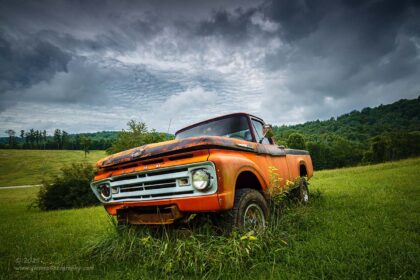
He went on to tell me a bit about the truck and its history. It was the truck that he had learned to drive in and had been purchased when it was brand new. Over the years it had changed hands and left the family. He had recently run into the current owner who had it sitting in a field for the last 20 years or so. Because of the history with the truck, he bought it back and it has been sitting in the yard behind his shop ever since. I love hearing stories like this one. While he said that it will probably never be back on the road, I’m thrilled that it has ended up in the care of someone that really appreciates the old truck and has a special connection to it. Of course, this fueled my desire to photograph it even more, and I made sure that I would be able to get out there before the business was opened up at 9am.
The reason that I wanted to get out there so early was that the truck was facing East and I wanted to get the sunlight on the truck while it was still kind of low to the horizon. I wasn’t wanting much sun, but the directional light from a clouded sun would be perfect for this scene. The issue that I was having with it was the building that was behind the truck, beyond the trees. There was another metal building off to the other side of the truck behind the trees as well. This made both of my favorite angles from the front of the truck rather difficult to work out. My only hope was to be able to get in close and use a wide-angle lens to get the shot. I wasn’t sure if I would be able to make it happen since I hadn’t been able to get close enough to the truck to check it out.
Now that I had permission and had been granted the ability to get out there before he opened, I just needed to find the right weather to give it a try. I pulled up the forecast and found that Thursday was going to be cloudy with low clouds in the morning with clearing in the afternoon. Friday was going to be clear all day. I had an appointment on Saturday, and I wasn’t wanting to plan out a trek much beyond Saturday because I just didn’t know what was going to be happening that far out. It was looking like Thursday was going to be the day to give it a try.

I had the clock set for 5:30 so that I could be on my way out there around 6:30 which would put me at the location a little after sunrise. Everything was going to plan, and I got there just when I expected to. The clouds were a bit denser than I was expecting which kind of killed the directional light that I was after, but the light that was on the truck was nice and even. I parked kind of close so that I could leave my bag on the tailgate to keep it dry since the grass was full of dew. I went ahead and grabbed the camera with the wide-angle lens because I knew that one would give me the best flexibility for how I was going to have to frame the photo. A added a polarizer as I always do and walked down to the truck.
Before I even started to look through the camera, I checked out both angles on the truck to see what was going to look the best. It appeared to be easier to block the business when shooting from the driver’s side, and it looked to be just barely possible to get the whole building behind the Dodge. Now, I started to look at the scope that I wanted to shoot. I didn’t want to just fill the frame with the truck, although that would work if I ran out of options. I really wanted to include something else with the truck to give the eyes something to explore.
The answer came kind of quickly in the form of a gaggle of trees growing out of the same patch of ground off to the left of the truck. The trunks looked like fingers growing out of the ground and they were just the kind of visual interest that I wanted to include in the frame. This allowed me to open up the photo to include a branch that had some lighter green leaves and seed pods. This kind of pointed to the truck and kept the visual pathway continuing around the frame. I really liked the composition, so I started to figure out where the camera needed to be positioned in order to capture these three elements while blocking the building behind the trees. There was also a red truck that I was just now seeing that I had to deal with as well, but it was more than likely going to be easier to obscure than the larger building next to it.
I went ahead and set up the tripod without extending any of the legs to start with. I moved forwards and backwards to find where the size of the truck would work for masking the large building. I finally found the combination of focal length, position, and perspective to get me close to accomplishing my goal. The camera was too high though, so I spread out the legs to drop it just a tad more. That did the trick, and I found that the composition was looking just like I had envisioned it. Now it was time to set up the exposure and work out all the little details with how I wanted things to appear.

When I started to dial in the exposure, I found that there was a lot of clipping going on in the sky beyond the trees. To get that under control, I was going to have to greatly underexpose the rest of the image which I didn’t like the idea of. Nothing was moving, but I still saw too many chances for an HDR blending to fail. I decided to grab a 2-stop grad from the truck to control the upper half of the image and allow me to expose the truck a bit brighter to retain more detail. That seemed to do the trick, and I fired off my first exposure of the day.
Normally that first shot is more of a test frame than anything. I use it to check the edges and depth of field as well as checking for any clipping in the highlights that I might have missed with the histogram. I went through all of those checks and determined that everything was pretty much great, but I wasn’t really liking the perspective on the truck. I needed to move back a little and change the focal length so that the truck wasn’t as distorted. I managed to do that and still keep the building masked behind the truck. That was where I shot the next eight frames as the light changed with the rising sun. I just knew that I had the image that I wanted in that first series of nine shots and thought that the winner was going to be one of the last ones.

Boy, was I wrong about that! When I got the photos home and started to look, I was doing my culling from the last to the first shots done. I had picked out a couple of that series of eight frames and then when I came to the first one which I had thought was the wrong perspective, I absolutely loved how it looked on the large screen. That was the one that I ended up using, so the recomposing and subsequent frames were all for nought. That is the way that it goes sometimes and I’m not in the least upset about it. I’m just glad that I took that one test photo because that was without a doubt the best one.
Once I was happy with the initial composition, I decided to start working the details of the truck. There wasn’t much need to keep the wide lens attached, so I went back to the truck and ditched the grad filter and swapped out my lens for the standard zoom. No….wait a minute. I started to do that and then decided that I wanted to use the telephoto lens instead. I mounted that one on the camera along with the polarizer and went back to work with the truck.

Surprisingly though, I was having a hard time finding areas that really appealed to me. That caused me to kick myself just a little bit because I had just finished writing my upcoming Behind the Camera which is all about working a subject. I should have been much more prepared for this after that thought process, yet here I was struggling to find an isolation. The reason was that I had spent so much time thinking about that overall photo that I was able to jump into it without much thought. Now I was having to slow down and listen to the landscape (or truck in this case) to see how it wanted to be shot.
I remember seeing the badge on the door that said Custom. I’ve seen this badge on both Fords and Chevys in the past and now I’m seeing it on a Dodge. Whenever I see one, I do try and get a composition around it because a door emblem like that is kind of cool for the period. The better light was on the driver’s side, but that side had a missing mirror which looked kind of odd for how I would normally shoot this kind of subject. The passenger side had a broken mirror which might have worked well, but the light was not nearly as good on that side. In photography, you go with the better light over most other determining factors, so I moved over to the driver’s side and started to look at what I had to work with.
After a minute or so, I decided that I would go with kind of an abstract look at the scene which included the emblem and the pedestal for the mirror. I would shoot it at an angle that gave a diagonal line going up through the frame for a bit of added excitement. I needed to figure out what to do with the window area because that was going to have to be included, it was just a matter of how much. The seat was a dark material and with the light color on the outside of the truck, I was thinking that the contrast would allow me to keep the interior pretty much black. This was good for simplifying the scene, but it was going to be all too easy to create empty space that served no purpose. I had to be careful about that and include just enough to make for visual tension and therefore having it become negative space. The stepdown from the vent window was a very important aspect to this shape as it defined it as something important rather than it just being a straight line at the top of the door. With the darkness taking up approximately the top third of the frame, I felt that the balance was right where it needed to be and I shot the image.
The first shot showed a bit more clipping than I would have wanted, so I dropped the shutter a third of a stop and fired off a second one. That one had no clipping that I wasn’t expecting, and I felt that it was the winner of the two. When shooting chrome, I expect a certain amount of clipping in the highlights and that was what I had with that second frame. That was the one that turned into the keeper, so I was now looking at eleven frames having been shot and my keepers were the first and the eleventh. Nice way to bookend things, but at least I was getting back in the swing of things where my stronger images were later in the series.
I decided at this point to go back to the passenger side and work with the fender which was quite a bit more interesting than the driver’s side. The light wasn’t as good, but the quality of the fender and wheel made up for it. I worked really hard finding a good flow to this composition that included the arch of the fender and the wheel. I must have tried a half dozen variations before I found one that I liked enough to shoot. The exposure worked out well, and I didn’t see any way to improve on it. When I got home, that one frame didn’t make it through all the culling stages and ended up being cut because it was just boring and no better than similar ones that I had shot of other trucks.

The next composition that I tried was around the rear of the bed where there was a bit of stylish molding that framed a marker light very nicely. I started to form up a composition and found something that I liked pretty well. I shot that one and then recomposed slightly to change the angle of the molding and went with a second frame. Out of the two, the one that went to the next stage of culling was the second frame, but it lost out to a composition that I shot a bit later in the morning when it came to the images that I wanted to edit. I’ll come back to that one here in a bit, so let’s put a pin in this composition for now.
I wasn’t sold on the molding and light shot on the bed, so I moved up to the driver’s door where there was a good view of the interior and dash. I tried to figure out a way to get the Custom emblem in the frame, but that wasn’t going to work because it would force me to include far too much of the truck for what I was aiming for. I wanted the photo to center around the steering wheel and the dash more than anything. I found a composition that used the vent window as a bit of a frame for the upper left of the image to keep the eyes from wanting to leave through the bright areas above the dash. I liked it, but it didn’t quite feel right. I did shoot two frames with different focus points before I tightened up the composition and just omitted the vent window all together. In the camera, I liked this much more, and I shot four more frames with different focus points, and I had to back down on the exposure for one of the frames.
Ironically enough, it was the first of those six images that was the keeper. I decided that my idea for the vent window was spot on and really helped the photo come together. The other ones that looked better in the camera had that fatal flaw of releasing the eyes out of that upper left corner. Not only that, but the steering wheel also felt very crowded in the frame created by the window opening. I really needed to have more headroom above it which was only possible by including the vent window as I had done originally. At least one of them worked out pretty well, and for that I am happy that I spent some time with this composition.
From here, I turned my attention to the front of the truck and the dominant DODGE letters running along the front of the hood. I started out with a straight on shot of the lettering with the grill beneath it. I tried a couple of different variations with different visual weights being applied to the hood and the grill, but nothing really seemed like it was working all that well. It seemed just too boring. It wasn’t that I hadn’t thought about doing this from an angle already, I had just figured that this one needed to be done straight on. However, not really liking the outcome, I moved off to the left and changed up the angle of the shot to add a diagonal component as well as throwing the letters into the left side of the frame to introduce the entire frame which led to the headlight on the driver’s side. The grill was still present, and it shared the same diagonal for that visual excitement. Even better was the fact that I was able to include the debris that had been falling from the trees over time. This added a very nice texture to the hood and that was more visual interest.
To capitalize on the textures and the contrast with the grille and the patina, I chose to do this as a black and white image, and I think that it worked out very well since the color of the truck wasn’t really working well filling up that specific bit of the frame. The image felt very heavy on the top with the silver grill and white bumper taking up more of the frame.
It was at this point that I moved back to the passenger side bedside and started to look at that same composition that I had done with the driver’s side. It seemed to read better from this side, and the light was improving now that the sun was coming up. I shot an additional two frames on this side and really liked the fact that the red marker light was still red on this side. It had long since faded on the other side which made the colors a little less appealing. I was sure that one of these was going to be the better option for a keeper.
Remember that pin I asked you to put in the account from the day? Well, as I was going through the edits, I had picked the second one of these to look at further and tried to process it two times. The first time I went with color because of the red in the light. That didn’t’ work at all. The next time, I went with black and white, but that seemed to fall short as well. I ended up trashing this composition and it never did get a full edit done to it.
It wasn’t until I was typing out this blog that I started to think about the first attempt at the bedside and wondered what it would look like in black and white. I didn’t have the red lens to worry with, and it was fundamentally different because of the reading direction. I took a break from the blog and went back into Lightroom and started to figure out what color profile might work in black and white. I found one that was kind of high contrast and then I enhanced that contrast in the scene with some curves and dodging and burning. The more I did to the image the more I started to like it. It was reading fine left to right, and the contrast set a mood that just wasn’t possible with the other side. After about 15 minutes of working on it, I exported it and dropped it into the blog in the order in which it had been shot since I had already started talking about the composition. Once again, it seems that going back through the images saved another one. I’m starting to think this is another benefit for me doing the blogs, because I slow down and start thinking about each photo individually and about what I was thinking when I shot it. Sometimes it gives me a different perspective on an image as we have seen several times here recently.

As I mentioned, the sun was starting to come out a bit more and that meant different light from when I had first started out in the morning. Figuring that I was pretty happy with the isolations that I had shot up to this point, I decided to give the overall composition another try. I went back to the truck and grabbed the wide-angle lens once again. The light was such that I didn’t think that I was going to need a grad filter this time. I went back to the spot where I had been happy with the composition and perspective the first time and framed up a very similar shot. The sun was making the truck look better, but the angle of the sun was causing a shadow to fall across most of the truck with highlights on the back of the bed. There were also highlights on the cluster of trees to the left which I liked. I ended up waiting for the clouds to move around so that I could get a good mix of light on the trees, and reduced highlights on the bed of the truck.
I stuck with this composition for seven frames, and it was that last one that I saw pass through two rounds of culling. When it came time to start the edits, I decided that the first image of the day was the one that I wanted to process first and when I was done with it, I didn’t see anything at all that the last of this composition would have made better. I had gone through two different series of photos of this view of the truck and when it all came down to it, it was the very first frame that I had shot which turned into the keeper out of all of them. I never would have seen that coming.
I now had the wide-angle lens on the camera, and I was still looking for another isolation to work with. I contemplated switching out the lens to either the standard lens or the telephoto once again but felt that I might be at the end of the isolations. There was no sense in changing out lenses without knowing what I was going to shoot. Oddly enough, I ended up back at the front of the truck looking at the DODGE letters and the grill. With the lens that was on the camera, I had an idea to do something similar to what I had done with the Ford 600 tractor earlier in the week.
For the idea to work, I needed to flip the camera into a vertical orientation, and I got in really close to the nose of the truck. I found out where on the grill I wanted to set the frame of the image and gave it just enough headroom at the top of the cab. The letters and everything stayed as symmetrical as I could manage. I limited the depth of field so that the glass and background weren’t too distracting for the letters and the debris on the hood. These were the areas that I wanted to focus on for the image.
I only shot one frame because I was pretty sure that I was going to be happy with that one, which I was when I got home. I wasn’t done with the truck though. Now that I had the camera vertical, I thought about getting a different composition with just the cab of the truck under the tree. I found the spot where that would work best and fired off three exposures of that concept followed by an additional seven with the entire truck in the frame. I thought that these were going to be pretty solid as well which was why I spent so much time with them. In the end, it was still that first shot of the day that was the strongest out of all of the establishing shots that I made of the truck.

At this point, I had shot 43 frames, and I was pretty sure that I was done with the truck. The sun was now hitting the truck strange because of the shadow of the building which I had misjudged during my planning phase. It was fine though because I had plenty of photos to work through. I wasn’t really looking for a lot of photos, just a few from the truck so that the owner would have plenty to choose from if he wanted a free print as thanks for allowing me to photograph it.
It was time to give one last look around to see if there was anything else I wanted to shoot. I looked up and the sky was amazing with the clouds showing some really nice contrast with blue sections of sky showing through. There was nothing that I could do with the truck, but there was a small wooden shed behind the neighbor’s house that was missing most of its paint which appealed to me. You know, because the paint was appealing off? OK, maybe I’m getting sleepy and ready to be done typing. There was a clothesline to the side of it and nothing overly distracting beyond it. It might just work under the sky for a black and white shot.
Because I was wanting to get a lot of the sky in the shot, I was happy to leave the wide-angle lens attached. I just flipped it vertically again and got into position on the side of the driveway that went between the properties. I actually wanted to get the driveway in the shot because of the color of the gravel which would help to frame the building and balance with the sky. Once I found the right composition, I fired off three exposures and thought that I was onto something good here. It wasn’t quite right though, and it took a second to find the answer.
As I was pondering the scene, I was looking at the sky and I realized that the clouds were moving at a pretty good pace across the sky from the far left to the near right. I also realized that I could feel no breeze, and I confirmed that the trees were not moving at all. This is a set of circumstances that just doesn’t happen that often here, so I decided to jump on the opportunity for a long exposure. I try to avoid those when the trees are moving because I don’t really like the blur. I wasn’t seeing that as a problem this time, so I looked at the shutter speed of 1/8 of a second and then pulled out the IR/ND app and found that with a 10-stop filter, I could get two minutes’ worth of exposure. That would work beautifully for this scene.
After I ran to the truck and grabbed that 10-stop filter, I slid it into the holder and blocked off the viewfinder. The timer was set for two minutes, and I fired off a test exposure. When it was done, I really liked the result. The motion was right, the exposure was right, but there was a cloud that had streaked in an odd direction that was a distraction. I waited a minute or two for that to move out of the frame and made another exposure. That one turned out nearly perfect and I felt that was the keeper from this set. Just in case though, I waited a minute more and fired off one more frame as a safety in case something looked odd in the edit.
It was that last frame which I started off editing but decided that there was an area of clouds that were a bit too bright and ended up being a distraction. I went back to that second frame and did the same edit on that one with much better results. That was the one that turned out to be the keeper for the day. I had now shot 49 frames at this location which wasn’t too bad considering I had almost written it off when I wasn’t able to locate anyone initially. I’m so glad that the owner called me back and gave me that last bit of umph to come back out here and give it a try.
There was still good light to be had, and the clouds were still looking great. I wanted to shoot some more, so I loaded the truck back up and set back out on the road. I figured that I would swing by the shop in Booneville where the Chrysler was sitting and see if I could do anything with it. It wasn’t an idea subject, and the location was rough to work with, but I knew that I could get permission to shoot there, and I had seen great success there previously. It wasn’t far away and was essentially on the way home anyway.

As I was going up the main road into Booneville, I spotted some clues that would indicate the potential for some good subjects down a side road. I got turned around and started down that road. I passed a really nice barn, but it was in a location that would be nearly impossible to photograph so I just kept going knowing that I was in a good area to find something. Just around the bend, I could see an unmistakable rusted roof and continued in that direction. When I got closer, I could see that it was a barn, and it was mostly covered by trees. I didn’t like the scene because it lacked depth because of the trees right behind it. I wasn’t even really watching it at this point, but when I started to get right next to it, the background opened up and the trees started to become a framing element for the barn.
The best part was that the clouds were looking just as good as they had for the last barn. I thought about it for about a quarter of a mile and decided that it was worth stopping for. I got turned around and pulled off the road beside the barn. I got out and grabbed the camera with the standard zoom which would give me the right focal length for the distance that I was having to shoot this from. I clipped on the polarizer and went over to where I thought the best angle was going to be.
Once I got the composition set and the exposure, I fired off three frames as I fine-tuned where the highlights were being clipped. I also started to see where the composition needed to be adjusted slightly for a better balance. I did that adjustment and went back to making an additional three exposures. I was pretty happy with what I had and started to look at the frame to see if there were any improvements that I could make. Once again, I noticed that there was no breeze and no motion in the trees, but the sky was moving along nicely. The difference here was that there were more clouds in the sky and less blue which was going to create a problem if I used the same long exposure as before. The result would be a muddy sky. However, I did want to do another long exposure here, so I checked my shutter speed. It was a full stop faster than what I had been shooting at the other barn. That meant that changing nothing at all, I would be at a minute exposure for this barn. That might be just what I was wanting to see.
It didn’t take but a second to grab the 10-stop once again and slide it into the holder. After blocking off the viewfinder, I used the live view to confirm focus and set the timer to a minute. I then shot a string of six images with that minute long exposure. The clouds would change rapidly in the scene, and I wanted to make sure that I got a good pattern that ultimately helped the overall composition. It was the fourth in that series that had the best visual balance and patterns in the sky. That is the one that became the keeper.
While I had fully intended to convert one of the short exposures to black and white, I felt that the long exposure in color was so much better than the shorter exposure that I just trashed the initial shots here in favor of the one that really hit a home run for me. I don’t get a lot of opportunities to do long exposures, so getting to do two in a single day was pretty special. I’m glad that one of each turned into a keeper for me. I might look back at the others for a conversion to black and white at another time, but for now, I am very happy with the color images and how the sky looks.
I was satisfied with how this location had turned out and figured it was time to head on home. I did stop by the shop and even pulled into the parking lot to see if there was any reason to ask for permission to shoot any of the cars. It was a busy day for them it appeared and there was a lot going on in the parking lot. The cars that were interesting to me were not really going to yield many isolations and there was no chance for an overall shot of any of them. The sun was also coming in pretty strong which was causing other issues with the cars that I would want to shoot. The interesting parts were partially shaded by the shelter that they were parked under, and that left other portions out in the harsh sunlight. It wasn’t a good scenario, so I decided to head on home to see what I had gotten from the two locations that I had worked.

My route home took me through Elkin which I go through several different times through the month. I wanted to kind of scout a location that had been mentioned by a prospective client for a shoot which was on the main street through town. That put me in the mode of looking for photographic opportunities. When I entered into town, I could see the two yellow locomotives parked by the town square as they had been for probably the past month or so. I had not photographed these yellow engines before, but had shot blue former CSX trains, and even a red and white one. The yellow was different, and I had dismissed it because of the new amphitheater which had been built and the fact that there was now a lot more visual clutter to deal with. However, I was still liking the sky which made me want to get out and do something with the train.
Before I could deal with that, I needed to go by the theater and check out the potential for the concept that was being discussed. Pretty quickly, I decided that I didn’t really like the idea all that much and it seemed like a pretty expected shot. Now that I had considered that, I moved back around to where the train was and pulled into a parking place where I could look a bit better. There were two engines attached to each other at the tails. They both looked like possibly former Union Pacific Railroad locomotives but had been rebadged for the Yadkin Valley Railroad much like the CSX engines I had shot before.
The one in the front, or in the direction that I would normally shoot a train was kind of a plane looking paint scheme while the one in the back had a nice American Flag painted on the side. Visually, it was more interesting, but I had never really shot one of the locomotives from this side of the amphitheater before. After I came to terms with embracing the buildings behind the train, I decided to get a closer look to see what I could do.
When I got there, I noticed that there was surveying going on. Not knowing if they were employees of the railroad company, I made sure not to get too close to the tracks. In order to ensure that I didn’t I looked for something where I could use my telephoto lens. I found a really nice composition that included a small patch of trees on the right to frame the engine along with the larger trees on the left which led the eyes to the buildings in the background. I worked this composition out as a vertical and then as a horizontal composition for a total of five frames. I thought that I was going to like the vertical best, but the horizontal one won out after the culling came to an end. It was a nice establishing shot and I’m really glad that I decided to shoot the train with the long lens which I hadn’t done here before with the exception of some isolations.

Feeling more comfortable and realizing that I wasn’t garnering any attention from the surveyors, I decided to get in a bit closer, but still well off to the side of the tracks. For this, I swapped out my lens for the standard zoom with the same polarizer. I wanted to get a good shot of the side, so I moved to the retaining wall for the amphitheater and found a good spot that showed just enough of the side of the locomotive without including too much of the city to the left. Once I was happy with the composition, I fired off four frames as I was trying to make sure that I had no traffic moving in the scene. The lighting was pretty stable, so there wasn’t much to worry about there.
The issue that I had with the composition was that it really looked like the flag was getting lost in the overall view of the train. I wanted to get a better angle on the flag, even if that meant including more of the city in the background. I moved further down the side of the track until I found a spot where the city wasn’t as intrusive at the front of the engine. I worked on framing up a composition and found one I liked. After the first frame, I noticed that the sun was coming out which caused the yellow train to glow against the clouds above it. I fired off a second frame and saw that the light was getting better. I dropped the exposure a third of a stop and fired off one last frame and loved how the train looked with the light on it.
Because of how good this looked in the sunlight, I went back to the original position and started to get a roughly similar composition going quickly from where I had just been. Of course, as luck would have it, the sun dipped behind the clouds before I was able to get a shot. This allowed me more time to fine tune the composition. What I ended up doing was going a bit wider than I had at first and framing it a bit differently. I was pretty sure that I was going to like this framing better than the first one. I just needed the sun to come into play and make the train glow again.

I had the composition all set up and found myself waiting for the sun to hit. Looking up at the sky, I could tell that there was an opening coming up soon with the clouds, so I was happy to just patiently wait for the light to hit. When it started to go off, I started to make exposures with some slight changes to the exposure based on the lighting. The composition was working well with the train lighting up because there was another rail car in the extreme background, but it was kind of lost in the shadows. It was positioned right next to the cross arm which was just a little detail at the edge of the composition that provided a frame for the image. The focal point was that train and it just kept getting better and better as the light increased.
There were a total of seven frames dedicated to this composition as the light changed. It was the fifth in that series that turned into the keeper largely because of how the clouds were appearing. I had thought about doing a long exposure here as well because the sky was moving at the same rate as before. The difference, however, was that there was now a slight breeze and the trees were moving. Even worse, there was motion around the train, and I was having to time my exposures for when there were no traffic or people visible. There was no way to do this with a minute or two exposure time, so I was happy with the normal exposure time.
When I got done with this composition, I had shot 80 frames since the beginning of the day. I think I’ve outlined each and every one of them, so you know where I was spending the time. If you have been keeping track, you will notice that I spent a lot of time working with the establishing composition for the Dodge truck. That would have been expected under most normal conditions with the keeper being one of the last shots made. It is very rare to spend that much time on a composition and end up choosing the first image which was determined to be a failed test shot to get the day rolling. I’m not saying that it hasn’t happened this way before, but it is rare for me to hit the keeper that early on and still continue to try long after the fact.
Of those 80 photos, I started off with ten keepers which was pretty darn good for the day. As you recall, during the writing of this blog, I ended up editing one additional photo bringing that total to eleven keepers added to the collection. It was more than a successful day, and I’m really glad that I set out this morning for what I realistically figured was going to be a one or two image kind of day. It did start out kind of slow and that was looking very likely. However, as I got into the groove of things, you can see how it all just took off.
Thank you all for joining me on this trek. I do hope that you have enjoyed the account of the day as well as the photos. Remember, there is no better way to enjoy photography than in the printed form. If any of these photos speak to you, I would love to help match you up with your very own piece of unique wall art. Not only do you get a high-quality piece of art to display proudly, but you are also showing your support of my work and helping to fund future treks. This is a great way of making sure that I can continue doing this kind of photography. This counts as a working day for me, and I’ve spent 15 hours so far with a bit of a dinner break with Toni a few hours ago. This is all done as a labor of love because as they say…this blog is brought to you by….me. The only way that I get paid for this time is through print sales, so you can see how important those are to me. If you don’t have the space for a print, I am set up to receive “tips” in the form of the “Donate” button at the bottom of this entry and of the website. It is kind of like buying me a cup of coffee or maybe buying my lunch. If you are feeling froggish, we can look at it like you are buying me a Lamborghini. Whatever amount you think is suitable, you can drop in the tip jar. It is very much appreciated and will also go a long way to funding these treks.
My day is coming to an end, and it is about time to head to bed. I’m going to wrap this one up and get the notifications out to your emails. At least for those who are subscribed to the blog. If you aren’t it only takes a moment to subscribe and then you will get notifications each time I publish a blog. Outside of technical difficulties, you will never miss another new entry, or the new photos that go along with them.
Until next time….