Saturday, April 6, 2024
After many months of preparation and planning, the first ever Art of Decay Workshop has happened. You might recall that I announced this workshop in the closing days of 2023, with the intention of doing things a bit different than I have for the regular decay workshop that is held at the same location. I realized that I was spending a lot of time focusing on how to capture photographs that captured the scene as well as the entire vehicle. While this is incredibly useful considering the challenges that face a decay photographer in the environment that these subjects are usually found, it really limited the number of subjects that we could work during the day. Of course, there would be time dedicated to talking about detail shots and how to select isolations, but this was a very small portion of the day.
The more I thought about it, the more I realized that when I shoot at Outlawed Restorations, I was progressively spending more time working the details of the vehicles rather than the overall views as I once had. This was largely due to the fact that not too much really changes and I was shooting the same photos over and over each time I was out there. The detail shots allowed me a lot more flexibility in what I shot and how I approached the session. In many ways, shooting the details made it like a new adventure every time I visited which was really exciting for me.
Last summer, I had the opportunity to do a half day mentorship session with a friend of mine. We’ll just call him Bob…cause that’s his name. Bob does a lot of waterfall photography which is how we originally met. I was conducting a waterfall workshop at Hanging Rock State Park back in 2020 and he was one of the two participants that signed up. He was just getting started in photography at the time and was starting his education. Since that time, he has come back for a mentorship session at Linville Falls, a landscape workshop at Stone Mountain, as well as that rusty introduction to decay photography. Apparently, he is a glutton for punishment because when I released the Art of Decay workshop, he started talking to me about it and whether or not it would be different enough from our mentorship to justify attending. After we talked about it, he decided to sign up.
The really interesting part is that it was his mentorship session at the location that prompted me to really rethink how I did the workshop. Knowing Bob enjoys working with textures, that was what we ended up focusing on for most of the day. It cemented my idea that when you start focusing on the detail shots, the number of compositional possibilities become nearly endless. We really only worked about three cars for the time we were out there which barely scratched the surface, but he got a bunch of different photos from the time. As I evaluated that experience, I started to see the value in changing the focus of the workshop. It would be a little more technical to go through the process, but the payoff would be a lot of very different photographs and a different way of reading a scene. The other benefit was that shooting details can be done under a wider variety of conditions which is very important for a workshop when the day is planned months in advance with no consideration for the weather.

I pushed the workshop as best I could after I released it hoping to have a full group of eight with me. I knew that the type of photos that we would be going for would benefit from a lot of different eyes giving input. That is one of the things that I really enjoy about putting on these workshops. There is no way that any one person can see every possible composition, so the more personalities that are there, the better chance we all will have of seeing everything possible.
The sign-up process was going pretty good for a time. I had talked to a gentleman by the name of Mike around the end of last year about some questions that he had and was interested in a mentorship with me. After talking with him on the phone, I was able to answer the questions well enough that a paid mentorship wasn’t required. What he was interested in learning was a little difficult to do in a mentorship session and I didn’t feel right charging him for the answers I was able to provide. It was a very enjoyable conversation though and it apparently made an impression on him as well because he was next on the list to sign up for the upcoming workshop which applied to his chosen genre of photography. It was also around this time that one of my other mentorship clients expressed an interest in attending, which would have been his second time to this location. There was another veteran of several of my workshops which also wanted to attend. Just like that I had four participants in place for this brand new workshop and I couldn’t have been happier.
I continued to put the word out about the workshop, but the sign-ups started to fade off and it was seeming like the total count was going to remain at four. About a month before the workshop, I received word from Dave that he was going to be receiving a literary award on the same day of the workshop and would not be able to attend both. As he is an accomplished writer, there was no question that he should skip the workshop and go to the ceremony. I hate that he missed the day, but I am really happy for his achievement. We were now down to three, which wasn’t bad at all.
However, through most of the winter, John has been having some issues from an injury. It was seeming like things were going to be healing up nicely around the first of the year, but there were some setbacks unfortunately. As I was sending out the preliminary emails with handouts and some more details on the itinerary, I checked on him to see how he was feeling. He was still hopeful, but it was starting to look unlikely that he would be able to attend. Within a week or two from the workshop he called it and regrettably withdrew from the workshop. This left two participants which was enough to do the workshop but wouldn’t be as beneficial I thought. Nevertheless, the show must go on, and I was still very excited about this workshop to see how it panned out in practice.

One of the new things that I chose to do with this workshop was a video conference a couple of days before it started. This was to give everyone a chance to introduce themselves and talk a little about how the workshop would progress through the day. Surprisingly, that went off without a hitch and I could tell that the three of us would be getting along fantastically through the day. With everything pretty much decided and the introductions all done, we all focused on the morning of the workshop which would begin bright and early on Saturday at 8am.
My first goal of the day was to beat Bob because he is usually very early, and usually earlier than I am. While that isn’t a problem, I try to get to places before my clients do to welcome them as it just seems much more professional than the alternative. To be sure I beat him, it was 7:15 when I rolled in. My first goal was met because nobody else was there. This gave me a chance to walk the property to see what we were going to have to work with. One of the first things that I noticed was that Old Stitch had been moved from the parking lot onto the yard by the old White firetruck. That might present some opportunities, so I walked over there to check that out. The first thing that I noticed was that the grass was growing through the grated running boards, and I thought that was just the coolest thing. One thing I can say about Dean, other than he is about the nicest guy around, is that he knows what I like in my photography. Whenever I do a workshop here, he leaves the grass and weeds up around the cars for that natural appearance which I certainly do appreciate. That grass growing up through the running boards was something that I felt that I was going to need to photograph before the day was out. It wasn’t ready just yet because the sun hadn’t hit it and things were a little flat for the moment.
While I was looking at Stitch, I began to notice that there were no great angles to get an overall of the truck. I was interested in doing that because it had been a while since I have been able to shoot the whole truck with it being in the parking lot for so long. It wasn’t much better here unfortunately as there were other vehicles, barns and buildings all around it. It was going to be very difficult to get a clean view of the truck which is what I was looking to do. I was going to have to think about all the options as the day went on because I had to focus on putting on a workshop at this point.
The rest of the walk around the property didn’t really yield any surprises or major changes to the landscape. What I did realize was that I might have a problem. After looking at Stitch, I was realizing that I was having a very hard time coming up with compositional ideas. It wasn’t just with Stitch; it was with everything. This worried me greatly because the whole workshop was geared around looking at things creatively and going beyond the snapshot. If I couldn’t deliver on that, the workshop would be a failure in my eyes…not that I put myself under any pressure. I tried to get inspired by going to compositions that I had done recently which I hoped would spark that creativity. It didn’t. This was the point where I started to deny the anxiety building up in my head because I knew that would kill any chance of creativity as the day went on. I was going to have to push through and was counting on these cars telling me how they wanted to be photographed.
Mike was the first participant to arrive with Bob coming in maybe a minute later. For the first time Bob was the last to show up. If I were a betting man, that probably killed him to the core, but he knew that I wanted to get there first so I think he threw me a bone by showing up just a few minutes early. Anyway, we were all there and with the introductions done online a couple of days ago, we were off on our walk around the property.
Actually, this was another change from my usual way of doing the workshops here as we normally have our cameras with us as we walk around. This time, I wanted them to just walk and experience what was there. This was as much for them as it was for me because I still wasn’t hearing how this location wanted to be photographed. The gamble worked because as we walked around to get a feel for what was here, I started to feed off of their energy and my creativity started to escalate. The relief I felt was substantial, and by the time we were done with the walk, I was as ready to go as they were. We went back to grab their cameras while I left mine in the truck. I never host a workshop with the intention of shooting my own photos, and even though I was feeling creative, this was not the time to work on my photographs.
Bob and Mike helped me choose which areas to go to first because of their reactions from the walk. Unfortunately, the sun had changed on the scene that Mike had observed early on in the walk. It didn’t have that same quality that he had liked previously so we continued on to a Chevy truck behind of another barn that Bob had spotted a potential composition with. The light was still about the same on the truck and we began looking at the composition he had in mind. It because a great opportunity to talk about how the mind sees things through a filter that the camera doesn’t possess. Almost as a textbook example of why this is important Bob started to show the elements inside of the cab, through the door window that had caught his attention. I totally saw what he liked about the scene, but there was a rod from the sun visor that was hanging down near the steering wheel that he was wanting to include. The sun was casting a shadow from the rod on the fender, sitting on the seat, which he wanted to include because of the shadow from the steering wheel. After he was done explaining the composition that he saw, I pointed out that one rod, and the shadow that was cast. He hadn’t seen it at all while working through the composition.
It was a fantastic time to describe that our minds will filter out visual information that is unimportant to us while allowing us to focus on the parts of a scene that are of interest. It is a wonderful feature of being human because it allows us to see things in complex environments that might be a threat, or something we want to observe more of. However, the camera doesn’t have the ability and it will capture everything that is in the frame. In this situation, there were several elements that would serve to be distractions to the scene as a whole.
This started a very good introductory conversation about how to avoid distractions in a composition and the hierarchy of visual information in a photo which will lead the eye around. To illustrate that point, I moved to the hood ornament on the same truck and talked about placement within the composition to dictate where the eyes would go within the frame. This brought about a discussion on how to incorporate a background into the overall composition as well as the difference that focal length will make to the scale of the elements. We had been going for about an hour and none of us had shot a photo yet. I hated that the actual photography was being delayed, but the topics that we were discussing would create a baseline of information that we would grow on for the rest of the day. I just had to keep telling myself that my workshops were not about shooting a bunch of photos, but learning new ways of seeing, and how to more effectively photograph those scenes.
As we slowly got started photographing the truck that I had been using as a demonstration piece for the foundation I was laying, I quickly saw another opportunity for a bit of education. With one of the cameras out, I noticed that the white balance was set to auto which is not something I recommend. This opened the door to setting the camera up for the best possible RAW capture which included setting a neutral picture style and further customizing it to give a more accurate histogram for the actual RAW file that was being created. We went one step further and talked about the depth of field preview button can be used as an exposure tool along with the histogram which was something that I have just recently learned thanks to a mentorship session with John.
Once again, the actual capturing of images was delayed by another teaching opportunity, but both Bob and Mike were set up for success with their cameras. Bob even made mention that what we had just covered was worth the price of admission. That made me feel great and I was confident that there would be much more that he would be exposed to during the day which would over-deliver on the expectations. Nothing makes me happier than seeing those ah-ha moments during workshops when a simple tip or trick connects with a photographer, and they see a chance to be just a bit better than they were. Those are the moments that I live for, and that really hit home when much later in the day Bob asked if I was having fun. I think there was a bit of sarcasm in his voice because I had not shot a single photo, or even turned on my camera. Instead, I had been bouncing back and forth between the both of them answering questions and helping where I could. Without even thinking about it, I said I was having a blast, and I meant it. I wouldn’t have been bothered a bit had I left without shooting a single frame. I was in my happy place sharing my passion for photography with two very receptive photographers. I couldn’t have asked for anything better.
I spent a good deal of time watching and talking with Mike who I had limited knowledge about since this was the first time we had worked together. Contrary to Bob, I didn’t know how Mike viewed the word and I wanted to really get a feeling for how he liked to create compositions so I could guide him within his style as opposed to just showing him how I would shoot something. For those that attend my educational experiences, it becomes obvious that I try to take into account how each individual sees a scene, and what parts of a scene excite them. At times, this makes it more difficult on me because I might have to completely change up how I would typically form a composition in order to help them out most effectively. The hidden benefit of that is that I also learn new ways of seeing things that I might not have thought about before. I’ve always said that I get as much out of the workshops as the clients do because we each have valuable information based on our own methods.

The day continued on at a very reasonable pace. It was nice in a way to only have a couple of folks in attendance because it allowed me to go off script a little more often and alter the plans to adapt to what they were wanting to do without having to take into account the needs of a large group. We moved through the different stations, and I realized for the first time just how wonderful this new format actually was. Not only did concentrating on the details open up a plethora of new subjects, but I could also skip most of the subjects that had become the bread and butter of the workshops in favor of the new ones. What this means in actuality is that I could do a two-day workshop in the field here without overlapping subjects should I want to try that in the future.
Something else that I did differently this time was in relation to the legalities of how to photograph these subjects while on private property. Normally, I will go through how to find the subjects and when permission is needed, but I haven’t really spent much time on how to ask for that permission. Coincidentally, a good portion of what Mike and I had talked about on the phone several months back had to do with that very topic. After Bob’s introduction to decay, he also had some questions and concerns about how to go about asking for permission. I saw this as a great opportunity to do a practical exercise where we would actually go through the process with me being the property owner.
I didn’t know how this was going to work in actuality, but I felt that it was going to be a great demonstration with real-time feedback on things like body language, things said, and just the overall potential of “the ask.” We ended up doing two different scenarios where I put them into conversations that I felt they would probably get into based on their stature and presence. They both did very well, and we were able to talk about some issues that turned up which cleared up a lot of questions about how to proceed with getting the permission. I also shared stories about how I have seen more firearms being pointed in my general direction as a photographer than I ever thought about as a police officer. I really liked how this went and plan on incorporating it into future workshops dealing with decay photography.
With lunch and the acting class finished up, we were back at it behind the cameras. Mine was still waiting patiently in the back of the truck and I was starting to think that I wasn’t going to get any time to work on photos myself. It wasn’t really bothering me, but I was noticing that as the day progressed, I was feeling very creative and was itching to try some compositions that I had pointed out or assisted with. I know how this can go at this particular location because the last time I felt this way after a workshop, I was back a couple of days later to scratch that itch. The fact remained that I was here for Mike and Bob, not for me so if I had to come back on another day, that would be fine.
Shortly after lunch, Bob let me know that he was going to have to roll out a bit early since he was having to travel a good distance to get home. With that in mind, I kind of skipped ahead in the day and put him on one of my favorite rat rods on the property called Old Rusty. This car has been in front of my camera many times over the years, and it is one that offers a bunch of great isolations. I had planned on it being the last vehicle that we worked so that everyone could put all they had learned to use with the car. Bob was going to have about an hour with it and that would have to be enough. We left Mike working on the subject that he was currently with, and I took Bob over and started to get his mind working on the potential compositions with this very unique subject.
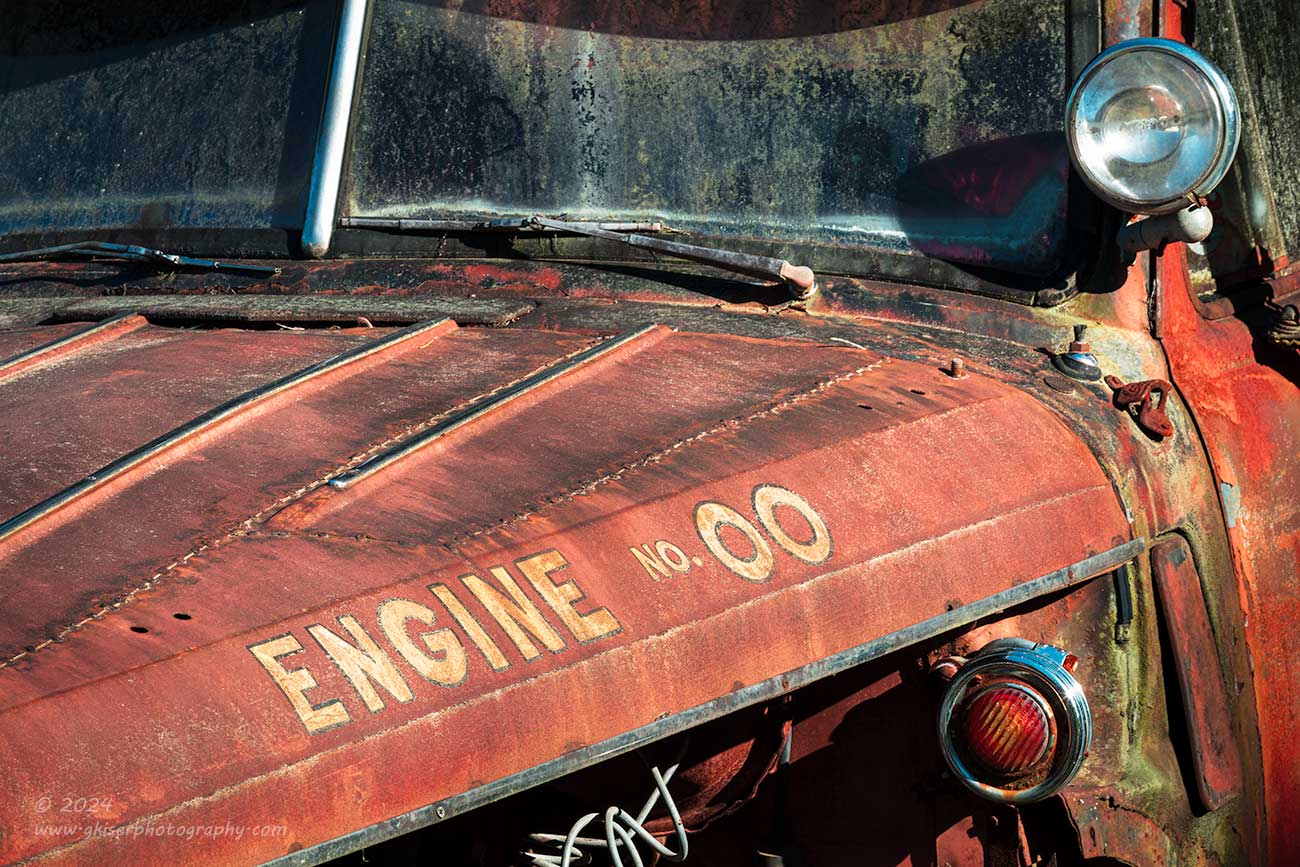
We did a detailed walk around where he pointed out areas of interest so that I knew where he would want to build compositions. One of the areas was on the hood where the text “Engine No 00” was painted in yellow. I knew exactly why this appealed to him as it has jumped out to me many times as well. In the past, I liked it as a part of the overall composition of this subject, but in light of the workshop, we wanted to figure out an isolation with it. I started to describe an option here that included some triangles, diagonals, and some framing elements that seemed to connect with Bob. I was actually starting to see it all come together which put it on my list of compositions that I wanted to try as well when I had the time.
After discussing some of the other points of interest on the rat rod, I left Bob to his own devices and went back to check on Mike. He was wrapping up with a Plymouth off on the side of the property which was giving him a very hard time compositionally. What he was trying had been a scene that had been discussed earlier which involved a very small opening in the broken glass and parts of the dash. It was a very difficult shot to compose and even to frame up. This turned into an exercise in focal lengths as we tried to get the broken glass to frame a bit of the dash. We were both about to give up on the composition, but I wanted to try something really quick.
I wrestled with the camera and tripod to try and get it into the position that I felt would give the best chance and found that there was no way to get the framing right as Mike had intended. However, as I was messing around with the framing and camera position, I found an alternate composition that built on what he was trying for. We worked that composition out and Mike liked how it was turning out. It kind of surprised me as I really thought that was a lost cause. I think that Mike was right to stick with it as long as he did. I wouldn’t have, but he was rewarded with at least a workable exposure which might turn into a keeper.
By this point in the day Mike was starting to really impress me. I was getting a feeling for how he saw things, and I was starting to get an idea of some of the things that stood in his way as well. I could tell that he was passionate about his photography and was really wanting to improve with it. That confirmed a lot of what I had suspected when I talked to him several months ago. He was really putting in the work and making very thoughtful decisions with his compositions. He was also quick to utilize the tricks that I was sharing so that they became second nature to him. One of those tricks, I had forgotten that we talked about, and he said that he had used that trick on one of his compositions to check the background. It took me a moment to even realize what trick he was talking about, but he reminded me through the conversation. It gave me a really big smile that he had thought to use that particular tip in a different situation. I just love having an impact on photographers whether it be something big or something little like that.

Once he had conquered the daunting Plymouth composition, we rejoined Bob over at Old Rusty. He was starting to wind down a bit as he had worked through all of his compositions. It was now time for Mike to do the walk around and describe what aspects he liked about the car. He hit on a few of the same things that Bob did but had a list that was largely his own. I helped give some pointers to how the compositions would work as I had with Bob and let him get started with his photos.
While Mike worked on those, I took Bob to one last subject on his way back to his truck. This was a GMC which I have photographed in several different stages since 2017 when I first visited this property. It has been sitting in the parking lot in front of the business for a few years now and on a workshop a while back one of the participants had worked through an idea for a composition that included the mirror photographed against the hood while reflecting the color of the door. She had a great idea and I helped to fine tune that idea for what I considered the best photograph of the day that I saw from the participants. Her composition haunted me, and still does. I’ve since tried it two different times on this truck as I made tweaks to make the composition my own. The first attempt turned into one of the most significant images of 2022. It was actually the number two spot and I still really like how it turned out. There were some issues with it that I wanted to address as far as separation of lines, so I shot a different version of it at the beginning of this year which I liked even better.
Now that I had the composition worked out, I felt confident enough in it to share the idea. In my opinion this is a wonderful example of how to position elements within a frame as there are several different planes that are involved. This allows for a lot of flexibility and scaling for the elements based on focal length and camera placement. We worked through the composition and Bob made some exposures wrapping up his time with this workshop. As I am writing this blog, he has already started to post many of his photos online and I’m quite impressed with what he has come up with. There is a noticeable improvement from his first venture into decay photography which makes me very happy. Seeing progress like this is always a big plus in my book.

Having bid Bob a farewell and safe travels, I was back with Mike once again who was finishing up with Old Rusty. We discussed a few more details about this subject and Mike elected to change gears a bit. Since his personal project is working with abandoned houses and other structures, he had a particular interest in the barns that were on the property. Since the later hours of the workshop were reserved for basically “free time” to work on specific subjects that the participants wanted to, I felt this was a great time for Mike to do some work with the barns.
We went back to the area where he had found a point of interest in the morning light and started to look at the surrounding details of the barn which needed the light of the afternoon sun to really stand out. We discussed the compositional possibilities of several areas of the barn, and he said that he had this part under control. I made sure that he knew I was available for any questions or concerns and asked if he minded if I grabbed my camera to go shoot Stitch real quick. He didn’t have a problem with that, and I went to get my camera for the first time during the day. I had been on the property since 7:15, and it was now 3:30. I was tired, but I could still feel the creativity bubbling up within me. I knew that I wanted to get a photo of at least the grass growing through the running boards, but I still hadn’t figured out a composition that would work effectively here.
My first attempt was from the rear quarter on the driver’s side because that was where the sun was. I used the dual rear wheels as a foreground of sorts which went along the door and running board to the rear of the front fender. The flow of the composition worked, and I liked how it was shaping up. It wasn’t quite there, so I moved to the front to see if I could do something similar but from the other direction. I shot a single frame here that didn’t really work in my opinion. I then went back to the rear corner once again, but changed the focal length which altered the scale of the elements within the frame. That was looking much better, and I moved things around slightly until I had the edges all cleaned up making for a simple composition.
I felt great about that first photo and decided to move in closer to get a very detailed shot of the grass growing through the grate. There was a bit of position work that I had to do in order to get the angle that worked the best, but I finally landed on something that I thought would work. Unfortunately, it looked much better on the camera than it did on the computer. The photo fell apart on the larger screen, and I didn’t like it at all. That modified composition that I had started out with was a definite win though and I was really glad that I had the opportunity to capture it.
At this point, I had the realization that Stitch was the same body style of truck that I had shown Bob. Now that I had a real good understanding of how this composition worked, I decided to try it on Stitch for the first time. The colors were different, but there were other attributes that I thought would look great with this composition. Those welded stitches on the top of the widened fender made for a bit of extra interest, and the mirror was positioned a bit different to show a different type of reflection for more interest since it wasn’t reflecting the complementary color like the GMC did.
It only took a moment to get the camera in position because I had just worked this composition out a few minutes ago for Bob and it was all still very fresh in my head. I chose to make it a vertical even though I can do it in both orientations. The reason for that was that I wanted to get as much of the stitched fender as I could since it brought in a bit of unique detail that was only present on this truck. With the truck being positioned slightly different to the sun compared to the GMC, the shadow was in a different place, but it worked out just as well for the image as a whole. It was exciting to use this composition on another subject, especially one that I come to love over the years.
Not wanting to neglect Mike, I called it a day with Stitch and went to check on him. He had moved down to another portion of the property to work with some other subjects, and I checked with him to make sure that there were no questions. I wanted to stay kind of close by, so I moved my attention to the Plymouth where we had worked so hard on the broken window composition. I spent a little bit of time trying to get Mike’s idea to work using the telephoto lens, but it became a losing battle very quickly. In order to keep my sanity intact, I abandoned this composition happy in the thought that Mike had at least gotten one composition here that he kind of liked.
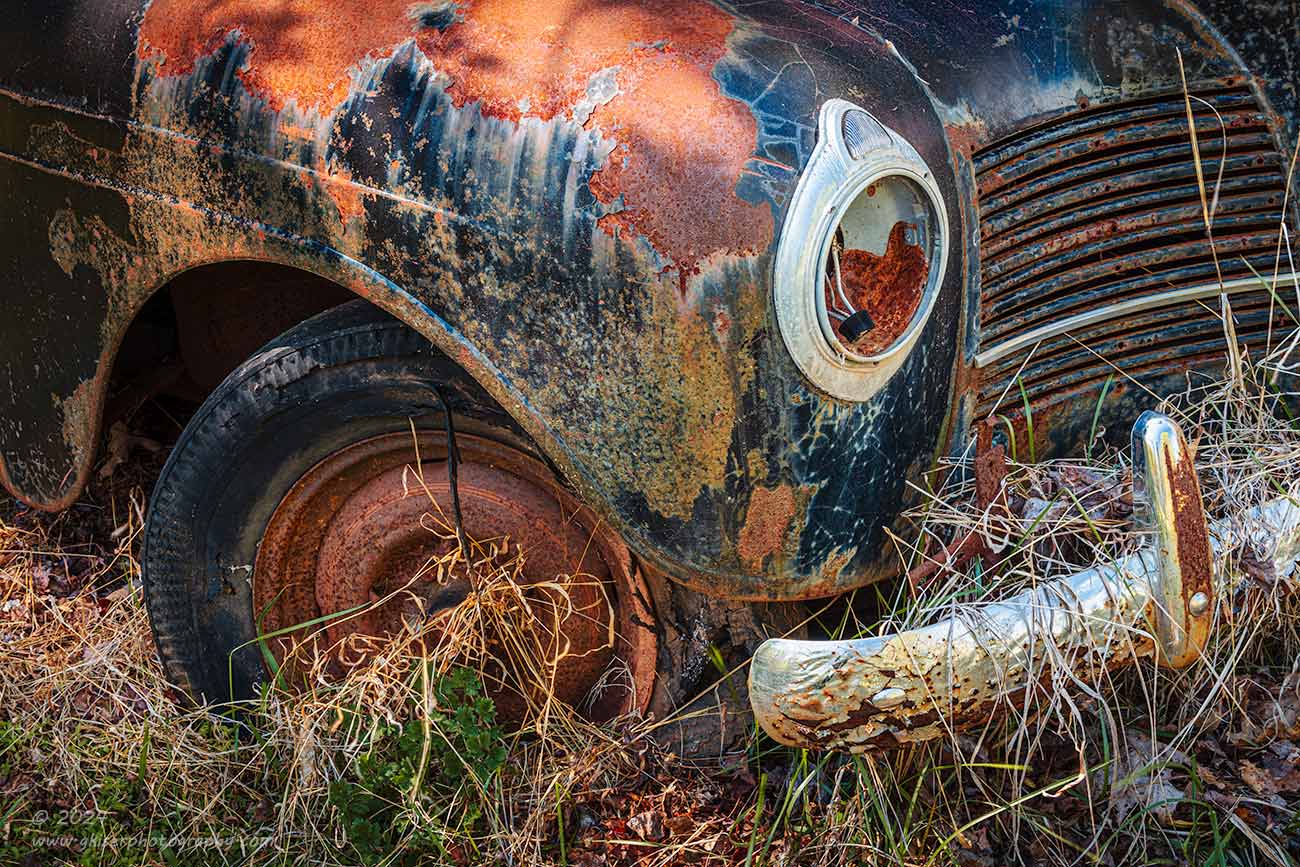
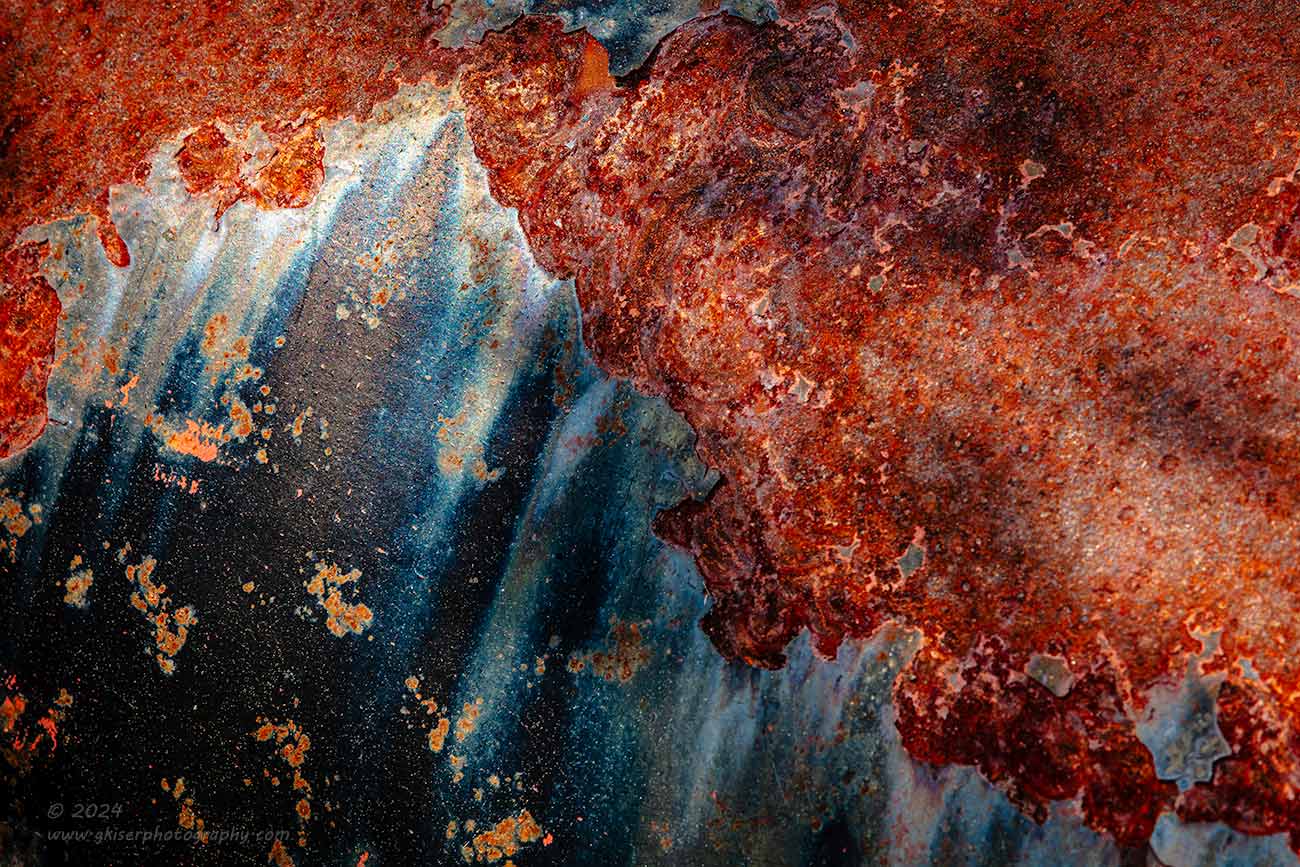
I wasn’t ready to leave that car though because I really liked how the dead grass was enveloping the bumper and the wheel. I had talked through this composition earlier and felt that it was looking really good in the afternoon sunlight. The composition was framed up quickly and I fired off a few shots with slightly different framings paying attention to the breeze and the motion in the grass. There wasn’t much to play with here, so I didn’t linger on that composition. Instead, I moved my attention to the fender where I had pointed out earlier how the paint had gotten an oily look to it from the fading and wearing away. The rust that surrounded the paint had a great texture to it, and with the paint showing almost a cyan hue in the sunlight, I decided that I wanted to get a few shots before I left. I don’t know if Bob or Mike tried this composition, but it was one that really spoke to me, and I had wished that I was able to shoot it earlier. The sunlight was a little less helpful to the scene now, but not by much.
I worked out two variations of the composition as a vertical and horizontal framing because the way that the paint was framed had a lot of impact on how I saw the scene. I liked them both, and even did full edits on the best from each framing which appear earlier in this blog. Having gotten to photograph this textured abstract I know that I was on the right track to point it out as a potential subject. There are times when abstract photos don’t turn out as good as you think they might when you first see them. This one exceeded my predictions which is why I have no problems with keeping two of the related compositions.

I wasn’t interested in doing any deep dives for compositions on any of the vehicles which could end up being very time consuming. I had to keep in mind that I needed to be available for Mike, but at the same time was feeling that I needed to take advantage of the fact that there was just one person in attendance at this stage which was designed to be solo time from the beginning. Normally, I would have been going between several people and checking on them, but I only had one charge at this point which left me with extra time.
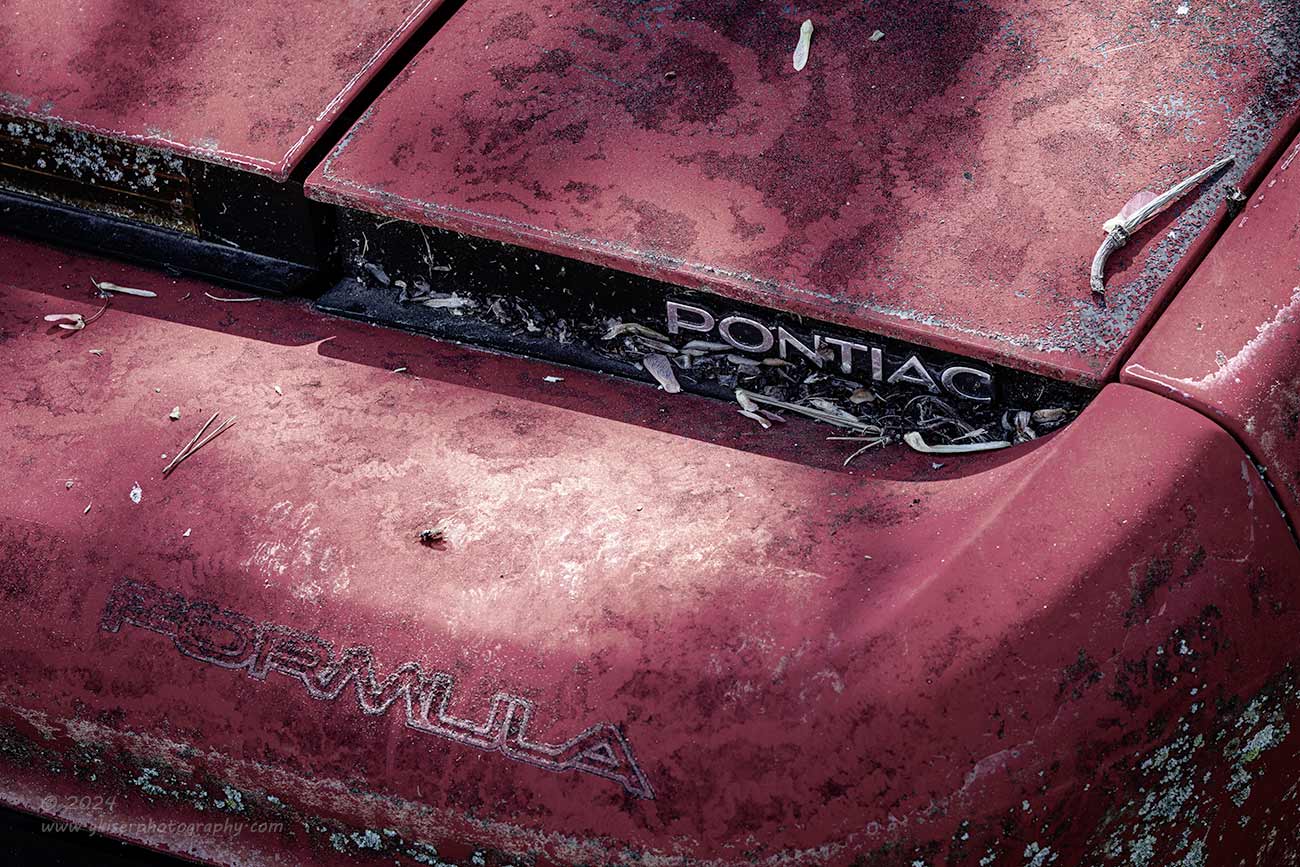
With that in mind, I stopped at the red Firebird that has been the bane of my existence here for many years. For the longest time, it was parked right next to a truck that I loved to photograph because it had a tree trunk growing around the rear bumper. It was very hard to get a composition which didn’t include this bright red Pontiac and even made it a teaching point in a number of the workshops that I had done here. Now the truck was gone, the Firebird wasn’t seen to be in the way of something more photogenic. Oddly enough, in a surprise twist I started to really like the look of this car. There wasn’t the rust that you would find on an early model Firebird, but there were aspects of it which showed decay on this F-body from the late 80’s.
I made a quick once over to see what I liked about the car in this light and found that the headlight door on the driver’s side was the point of interest that I liked the best. The Pontiac emblem was still present on the headlight cover piece, and you could still make out “Formula” on the bumper. I framed up a quick composition here and worked out the exposure. I shot three slightly different variations on that corner taking into account how much of the black strip on the bumper that I included as well as how the sunlight appeared. When I got the photos home, I liked the overall look of the third example the best and as I started to edit it found a bonus that I had missed during the capture and the culling. Right in the brightest part of the headlight recess on the bumper was a fly. It was sharp and positioned well in the frame. I could have easily cloned him out, but I decided that I liked that little detail right there. It is hard to see at screen resolution, but in print there will be no problem picking him out and seeing the detail in the wings.
There was no need in spending a lot of time with the Firebird as I knew there wasn’t much there that I wanted to photograph. Instead, I went over to the White firetruck which has been on the short list for a rat rod restomod. I’ve photographed this truck many, many times, but each time I come here, and it is still sitting here I see as a gift. I didn’t want to let that gift go, so I decided I would do something with it. The problem was that I have shot just about every angle of this truck over the years. I definitely didn’t want to do an overall composition of it because there wasn’t anything substantially different from any other time I have been here. It was taking me a long time to pick out something to photograph on it, and what I ultimately decided on was the gauge cluster for the pump on the side. The last time I photographed this was the first time I ever visited the property. It was a decent photograph, but nothing to write home about. I wasn’t sure if I could do any better this time, but the patina had increased quite a bit which had me thinking that it was worth the try.
The composition was a simple vertical one just as I had done years ago. The only problem that I had was the fact that I was wearing a neon yellow shirt which was causing some colorful reflections in the chrome. To rectify that, I used the remote release and moved well clear of the area as I made the exposures. All that was for nothing though because when I got the image into Lightroom, I saw it immediately as a black and white presentation so the colors from my shirt would have been immaterial no matter how much they showed up. Thanks to the heavier patina and some new editing techniques, I was able to get a much improved photograph from what I had shot originally. The resolving power of the 5DS R helped quite a bit here as well as the detail within the gauges was incredible.
One area that I had spotted during my morning walk which had sparked some interest was a collection of white fire hoses stored in a shelf on the side of the barn behind the firetruck. I liked the way the light had been sculpting the hoses during the morning but hadn’t really seen a composition. Now the light was different and coming from overhead which changed things. Out of curiosity, I went over to the hoses and started to look around them for a composition. I ended up finding something that I thought would work well and I framed up the shot. I had dialed in a bit of visual tension by giving the bottom section more visual weight, but upon looking at it in review decided that I didn’t like it. I went with a more balanced composition and tried it again. This was better, but now it was boring to look at. Since it was a very tight crop and had an abstract flavor to it, I decided to see what it would look like rotated over to a vertical. That did the trick and really made the composition work well. I was pretty sure that I would edit it rotated vertical, and that was just what I did.
By this time, it was about 4:30 and Mike came up to me and said that he was done for the day. We did a quick wrap up from the workshop and I made sure that all his questions were answered. Before he left, we went out to the parking lot so I could show him that one composition with the GMC that I had demonstrated for Bob earlier. That didn’t take long, and I bid farewell to Mike after thanking him for choosing my workshop to be his first ever. Essentially the workshop was over at this point, and I was now able to focus on getting photos for myself. The only problem was, I was getting tired.
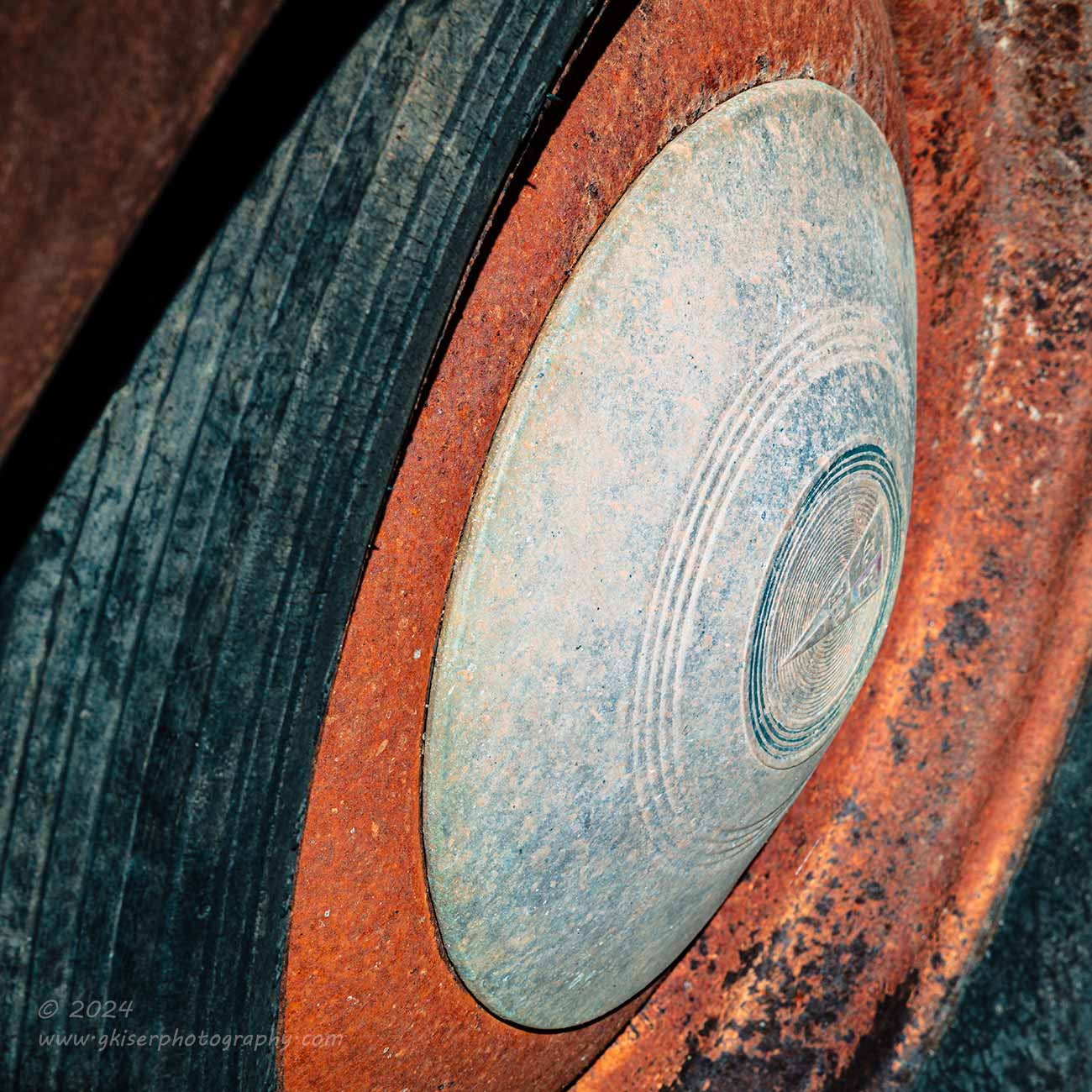
Right in front of the GMC was the Hudson Hornet that was a new addition to the property. This car is nothing but slab sides and a very uniform patina with very little trim in place. I’ve struggle with making an image of this car and decided that I was going to make something work here today since I have been doing nothing but working the details of the different cars. The only point of interest that I could find was the front right wheel that still had the half mood hubcap attached. I started to build out the composition from there until I had something that worked. The resulting image was kind of an abstract as it just included slices of arches around the hubcap. I wasn’t sure if it would work or not, but it did make it to the editing stage. The more I worked with it, the more I liked it for how quirky the image looked.
As I was finishing up with that, Dean was headed home and suggested that I open the door on the Hudson and try for a dash shot since he knows interior shots are my nemesis. I had to muscle the door open but managed to make it happen. The dash was beautiful and arguably the best part of the car. The sunlight wasn’t working with me though, and I wasn’t having any luck finding a composition that I really liked. While I was struggling with that Mike came back up to me because he wanted to show me a zine that he had produced to illustrate what his vision is for the properties that he is trying to photograph.
In case you have missed this bit of information over the years, I have been very interested in putting together a book of my photography. There are a lot of concerns that I have with a project of this magnitude and have recently entertained the idea of doing a zine. A zine is a short form book in soft cover laid out kind of like a magazine. Because of that interest, I was really looking forward to seeing what Mike had done with his. I confirmed that he had done it through Blurb and put it together in Lightroom as I had been researching previously. This example felt really nice with just the right amount of smoothness on the front and rear covers. The photos inside of it were all black and white with the exception of the last image which was in color. I thought that was an interesting choice and it really worked with the feel of the whole thing.
While I started out wanting to see the quality of construction of the zine to see if I would be happy with it if used as a product of my own, I quickly put my own needs aside and became enveloped in the photos that Mike had chosen to include. I recognized many of the locations and had shot a number of them myself which helped me to know what he was dealing with in his own compositions. More importantly, I saw that he had done a spectacular job at organizing the photos to have a cohesive look through the zine and the editing was very uniform throughout. As I looked through each page and each photo, I started to understand Mike’s visual language better than I had through the day. This was mainly because he was shooting slightly outside of his comfort zone with the old rusty cars. Seeing portions of his passion project brought new light to how he saw the world. I understood what he was showing without a single word on the page. Everything that I had been talking about during the workshop about communicating the purpose of your photo through the image alone was showing up in each of his photos. I was honestly impressed with what he had put together from a photographer’s standpoint. I was even jealous of how well the zine had come together from the perspective of someone who has researched the process in hopes of one day doing something similar. It was a humbling moment seeing his work in that form, and looking as good as it did, that he had chosen to learn more about photography from me. There was a bit of a Wayne and Garth moment as I chanted “I’m not worthy.”
After I tried to share accurately how much I loved what he had done with the zine, we wrapped up once again with plans made for a workshop image review next weekend where we will present three of our images to talk about online. That was pretty much the official end of the first day of the workshop. It had been a long one, but I felt that it was probably the most successful one I have done in regard to the number of ah-ha moments that were had. I really felt like I gave more beneficial information during this day than I ever have in the past which makes me feel awesome. It was that charge from the feeling of success that fueled me for a few more photos before I was ready to head home.
The first place I went after Mike was rolling down the road was behind the old panel truck that has been sitting on the side of the building now for many years. During my morning walk, I had gone behind it to see what it looked like back there and found that the paint was starting to peel in a very interesting way around the hinges on the rear door. It was something that interested me from a texture standpoint and I wanted to see if I could make a composition out of it. Things were very tight back there and I was quite literally with my back against the wall to get the right angle while far enough away for the focus to work. The composition was trickier than I thought it would be because of how close to the edge some of the elements happened to be. In the end, I managed to get a composition that I thought was framed very effectively which showed exactly what I wanted to show.

From there, I decided to head over to Old Rusty and try that composition that I had talked through with Bob earlier. It was a bit more difficult to work out than I had suspected because of how close the elements were by the edge of the windshield. I kept working with it until I had a composition that I thought worked based on how I had explained it. After so much fiddling with it, I didn’t see any need in shooting any more frames of this composition as I thought it was as good as it was going to get. My main purpose was to get something to present to both of them during our image review that would be of a subject that they had shot. It wasn’t a competition, just a chance to see how individual choices can affect an image. I can sit up on a high horse and say this could be better or this changed, but if I’m not willing to put my own work where my mouth is, my opinions aren’t really valid when it comes to evaluating other photographs.
I walked around Old Rusty a couple of more times to see if there was anything else that I wanted to get before leaving. The light was not good on the areas that I was interested in, so I eventually decided to leave Rusty with just that one photo captured. I wasn’t worried about it though as I had spent quite a bit of time with this one the last time I was out here. I was getting really tired and hungry which meant that I was needing to think about heading home.
As I was walking back to the truck, I passed by Stitch one last time and remembered all the success that I have had with this truck over the years and even earlier this afternoon. Almost as a challenge, I started to look around it to see if there was a way that I could get an overall environmental shot of it without undue distractions being added into the frame. Walking around, I was only able to find one angle from the front passenger side that offered a potential composition. The lighting was coming from well to the right which put the side into shadow, but the front of the truck was very well lit. By getting very low with the camera, I was able to block the view of Old Rusty in the background leaving just the old house and a portion of the barn on either side of Stitch. There was a beautiful tree positioned behind the scene, but the sky was opened up on the left side which I didn’t like. The whole composition felt like it could go either way with being a success or a total failure.
I got the exposure set the way I thought it would work best and fired off one shot. The scene was overly contrasty, and I didn’t like it at all in the camera. It wasn’t anything that I could fix with a filter, it was just a product of poor lighting at this time of the day. I didn’t waste another frame on Stitch and was happy with the success that I had seen earlier. That was my 40th frame shot in an hour and a half. It wasn’t much, but it was a lot more than I had expected to shoot. Any photos are a bonus for me on a workshop, but to have time to get all that I had was amazing. I wouldn’t have been able to do that if there had been more participants. With the weather conditions like they were, I couldn’t have asked for anything better which really made me want to get some photos while I was there. Thankfully I was able to do just that without negatively affecting anyone’s experience from the day.
The final count for keepers from those 40 frames turned out to be an even dozen photos. The last of that dozen was the photo that I had been so disappointed with from Stitch. As it turned out the composition was strong, and the contrast wasn’t as bad as I had thought. I decided to edit it in black and white because I could get away with a bright sky easier that way and there really wasn’t anything that the color was adding to the scene. As I played with the contrast and built it up the way that I wanted, the photo became quite good, and I was really impressed with it. By the time I was finished with the edit, I was thrilled with it and didn’t even see anything that I would have wanted to do differently if I had gone with another frame. It was the perfect end to a perfect workshop.
Thank you all for joining me for this blended in trek to a very involved workshop. If you would like to attend a workshop with me, I have another coming up at the end of April where we will be covering how to photograph the everyday sights that you take for granted. There are still spaces available and it promises to be another educational experience just like this workshop. Also, if you are interested in any prints from today’s trek, don’t forget that I offer prints through the gallery store, or you can contact me directly for special sizes and media. I also have some openings for mentorships should you want to further your photography in a one-on-one fashion.
Until next time…


