Tuesday, May 9, 2023
Well, it’s true. Sometimes you just gotta do it, and this was one of those times. What was it I felt like had to be done. Well, there was a list actually. The list started with going out for a landscape shoot on an evening when I really wasn’t seeing much potential in the conditions. Then I chose a spot where nothing at all was happening and committed to a composition that showed very little promise. Then I shot a sunset in the wrong direction aiming for black and white. Once the light was done, I moved in for isolations and then cheated the colors a bit to pull out every bit of drama in the sky that I could. Why did I go through all of this on an evening when I really hadn’t planned on going out at all? Let’s go back to the beginning, shall we?
I’ve really been getting back into my landscape roots over the last six weeks or so. The number of treks that I have been taking have increased quite a bit thanks to a much wider availability of landscape locations to choose from when compared to finding old cars and barns. I’ve actually surprised myself with doing a lot of these shoots at the edges of the day to capture the colors in the sky. This is something that I would do on occasion, but I typically would go for the moodier landscapes under thicker clouds. As it stands right now, I’m really enjoying getting that magic hour sunlight on the scene for a bit of variety in my work. It all started out with a sunrise at Doughton Park, and has brought me to sunsets along the Blue Ridge Parkway which is something that I’m usually back at home for. I’ve been so into getting some dramatic colors in my landscapes that I have pushed the envelope with my post processing a time or two which has taught me a lot of new techniques when it comes to capturing what my heart sees.
With my most recent trek just a few days earlier, I would normally be quite content to settle down and wait for something really good to come along. That is easier said than done with landscapes because each trek has a limited potential for new images unlike when I am out shooting decay subjects for several hours during the day. Those treks can easily yield a dozen new photos, while I will only get a handful of good images when I am working with 30 minutes to an hour of light. These treks are generally quicker and produce fewer images, so it benefits me greatly to go out much more often in order to capture more subjects. I was itching to get out again and work some more scenes so come Monday, I started to look at the weather forecasts. We were under most cloudy skies during the day on Monday which got me thinking about waterfalls. I pulled out the book and started to browse different waterfalls hoping to get inspired to shoot one of them. I wasn’t able to find anything that would work for the time of day that it was. Most of the waterfalls that I was finding would take over three hours to get to, which would put me at the wrong part of the day. Reluctantly, I gave up on waterfalls for that day and started to look at the weather on Tuesday. There was supposed to be a mix of clouds and sun during the day, but that wasn’t going to work for waterfalls which need a pretty much solid overcast day for how I like to shoot them. The way the clouds were spaced out during the day kind of kept me from entertaining any treks since the morning clouds were going to be thin and low.
As the day progressed on, I found myself working on next month’s Behind the Camera and getting it roughly finished up. The topic had me kind of bummed out and feeling like photography wasn’t quite the emotional highlight that it should be. Recognizing that I needed to get out there and counter the negative stuff that I had been thinking about, I considered going out for an afternoon with the camera. The weather was still looking a bit too clear for my liking and I kind of forgot about it until I went out to check the mail around 5pm. Looking up at the sky, the clouds were actually looking pretty decent, and I could see potential for a sunset shoot if the sky held. I went back in and looked at the forecast. The clouds were going to be very much hit and miss through the rest of the day. It was looking like the area of Boone was going to see about 50% cloud cover in the lower altitudes. This is usually not something that I like to shoot at sunrise or sunset because the clouds rarely pick up the colors of the sun. However, I was happy with getting the warm sunlight on the landscape with a blue sky as well. It was something that I usually don’t do, but in this situation, it made sense. I had a location picked out that would benefit from that kind of lighting and it wasn’t too far from the house.
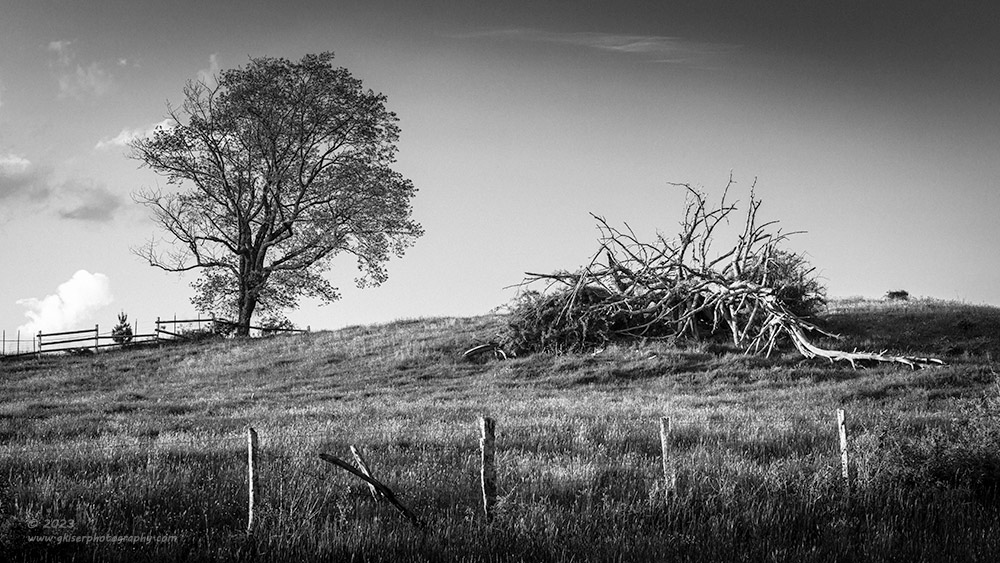
I had stumbled upon this little scene a few years ago, and since that time, I have shot it many times in all kinds of conditions. What I love about it is that there are two trees situated on a hill. One of the trees is fallen and looks very skeletal while the other tree is still standing behind an old broken fence. It speaks to my love of decay subjects, but is still very much a landscape with only a small portion of the scene being man made. I’ve done this as a panorama which you will notice I’ve been shooting a lot of lately, as well as shooting the trees individually. I know that this location works better at sunset because of how the sun rakes across the scene, so it made sense to consider it for this evening’s shoot.
I ended up leaving at about 6:30 which would get me at the location by a little after 7. All the way up there I was looking at a single section of clouds and I was hoping that I would be lucky enough to have them in my frame. The rest of the sky was pretty much blue and not all that interesting. Unlike decay subjects, landscapes really depend on the sky and the light to come to life. I was wondering if this was going to be a wasted attempt or if I would actually get lucky by the time the sun went down. I had my basic compositions figured out so there wasn’t much left to do but get there and see if the light worked with me or against me.
When I arrived, I could see that the sunlight on the landscape was looking good, but the sky was absolutely clear and blue which wasn’t ideal at all. Since the sky wasn’t playing a big part, I decided to alter my compositional idea a bit by setting up on the opposite side of the road in order to get the fence included in the frame. This was the first time that I had tried to do this variation on the composition, and I thought that the standard lens would be the best choice for the framing. I built the camera with the 24-70mm lens and went to the area where I was planning on shooting. I had to get kind of high up on the embankment to get the camera high enough to have the fence below the fallen tree. I looked through the viewfinder and found that I had to zoom into 70mm to get the crop that I wanted. I could go a bit narrower as well which meant that this was not the right lens. I went back to the truck and got my 70-200mm lens to which I attached a polarizer to deepen the sky a bit.
As I was getting the camera all put together, I started to think about this lens choice. In the past, I used the 24-70mm most of the time and would rarely use the longer lens unless I was trying to get an isolation. So far, looking back over the landscape treks that I have done to this point, the 70-200mm has been my primary lens for everything that I have shot. If you will recall, last year I had a similar epiphany while shooting old cars. The long lens had been my least used zoom for many years and it seemed that I was slowly realizing what it could do, and now I was having a similar realization with my landscape images. No matter what you have in your bag, lens choice is always a very important creative decision that can greatly affect your images. I was looking at things quite a bit differently these days than I have in the past.
With the camera built, I went over to the area that I had picked out and got things set up. I had plenty of time to fiddle with the composition and position of the camera since the sky was just overly boring. When I got it all put together, the last thing that I did was to change the aspect ratio to a 16:9 which would keep the main points of interest in the frame while eliminating much of the boring sky and the grass that added very little interest below the fence. It was a cheater panorama, but from this angle, I could very easily include the two elements that that I needed within a single frame. Looking around, there were nice clouds behind me and to the West where the sun was. I was seeing very little chance of the clouds coming into the frame I was planning on shooting. Normally, I would have left the location in search of something else, but I felt the need to commit to this and see it through. I considered doing this as a black and white composition which would allow me to add a bit of interest to the sky through a gradient while focusing on the light that was falling on the landscape. I checked the preview by switching the profile to black and white. I liked it and could see some potential in it when I added a red filter to the mix.
I stuck with this composition for a good long while as the light changed. When it started to break up on the field that was when it was most interesting, and I shot a number of photos of the scene like this. I wasn’t sure which frame was going to give me the best light, so I tried with each change that I saw. As it was getting good, the sun started to dip behind the clouds that I was wishing were in my frame. I rattled off a handful of exposures as the sun was in and out, but eventually it was gone from view behind the clouds. I still liked the composition, but without the light on the landscape, the fence made no sense. With no clouds in the sky, I didn’t really see a reason to move in closer to get isolations of each tree, but something told me to give it a try.

I picked up the camera and crossed the road to the fence which had been my foreground interest. About this time, the clouds started to move across the sky, and I saw my opportunity. There was a long sliver of a cloud, and it was making its way to the trees. I started off with the tall tree and framed up a shot that I liked. As the cloud came through, I realized that the composition wouldn’t work because of how the cloud seemed to cut through the tree instead of enhancing it. Since it was going to the right and was similar in shape to the fallen tree, I saw an opportunity to change my composition over to that fallen tree. I got the composition set up and waited for the cloud to come over. As it was approaching, I could see that the sun was starting to create a warm glow on the cloud. It wasn’t much, but there was a little color to work with. It got more pronounced as it moved into position. I fired off quite a few frames in hopes that I would be able to choose the best position for the one to edit.
Every once in a while, I would get lucky, and the sun would also highlight the fallen tree and give a little extra saturation to the grass. Things were finally starting to look up for me. I was just hoping that I could make use of the colors that I was seeing in the sky. I had taken off the polarizer by this point because it wasn’t really doing anything for the sky at this angle and with a slight breeze, I was trying to keep my shutter speed as fast as possible without introducing the noise a higher ISO would cause. I knew that when it came to processing this image, I was going to be asking a lot from Lightroom and wanted to start off with the cleanest image possible. There was a lot of contrast between the sky and the ground which I was going to have to work with quite a bit. I thought about adding an ND Grad, but I didn’t want to darken the tree any since that was going to be a main subject that needed the presence of the brightness.
When it came to editing this file, I started off with a rather bland photo. I could see a bit of warmth in the clouds, but it was very faint. I used a lot of the tricks that I had figured out after a sunset at Doughton Park recently. I didn’t have to go nearly as far with this image, which was nice, but I did work some magic with the curves and then did a good bit with the color grading to get it all to work together. In the end, I ended up with something that was closely related to the scene the camera captured but was seasoned heavily with how I saw it. The thought had crossed my mind early in the session that I might try to do a composite image where I kept the well-lit landscape and added the sky from a later time when the colors were getting decent. This would have been more image manipulation than I would have really been comfortable with so I’m very happy that I was able to get this sky over this landscape in a single image. It seems much more plausible to work with an existing sky than to blend two images from different times together.

As the thin cloud came across the scene, it was followed by a much broader cloud which was more of what I had been hoping for since the beginning. I saw my opportunity to go back to the standing tree once again to take advantage of this larger cloud. I framed up the shot that I had in mind and started making exposures. The colors were a bit better by this point, but they still weren’t overly vibrant. I was just hoping that I would have enough to work with in post. After a few tweaks of the composition, I knew that the sky was going to be a very important part of the image because I had created a very close crop around the tree which left the sky as the second biggest element to the scene. The sky was going to mean success or failure of this one and I was all in on making it work.
When I got this image home, I went through many of the same things that I had done for the last photo. I took the subtle colors of the scene and enriched them while keeping the ideals of color theory intact. To be quite honest, this one took longer to finesse but required less steps than the other one. Many of the things that I did to them were the same, but they were done quite a bit differently which makes the edits unique to them both. It was these images that I can look back on and really be appreciative that I went out at all. Not only did I end up with some colorful sunset images, but I was also able to put some of my new skills to work again which helped me improve on those concepts.
As I was shooting this last bit of light, I noticed that the colors were fading and there was a very large empty place in the sky coming into the frame at the left side. You can see it starting in the above photograph, but as it moved across the scene, it got bigger and I started to lose the detail in the sky that I was really wanting to capture. The answer to that problem was a simple recomposing of the scene. I moved the camera to the left about 12 feet and shifted the tree’s placement in the frame to the left side. This effectively eliminated the growing empty spot in the sky and I was still able to capture interesting compositions with the clouds.

I continued until the light was finished and decided to call it quits. The last composition that you see here had a great sky, but there was no color to it at all. The light was largely blue because the sun had pretty much hidden behind the clouds to the left. Since there was no color, I decided to make this composition black and white like I had done with the first one of the evening. Taking the colors out of the frame allowed the story to come from the textures of the tree and the clouds, while the very dominant tree structure gave the viewer a visual anchor to rest their eyes on. While the other composition had been about the colors in the sky, this one was about the tree. They say very different things, and I have no problem at all having them both represented in my collection.
When the sun had gone down, I had a total of 80 frames on the memory cards and was feeling pretty good that I had three images that were worth editing. I just didn’t know how they were going to turn out and didn’t know how excited I should be about them. All the way home, I pondered what I had shot and really couldn’t visualize what I was going to have after the edits. Having no clear vision in mind, it was much easier to wait until the next day to do the edits after the real memory of the evening faded leaving only what my heart had seen. When I woke up, I was down in the studio going through the images and was actually quite happy with 20 out of the 80. These were whittled down to four that you see here. They represent about a 5% hit rate, but when it comes to changing light and moving clouds, my hit rate always falls off significantly. It all comes down to the minor details between the images.
I hope that you have enjoyed this trek and resulting photos as much as I have. It is a lesson for me which supports what Toni keeps telling me. I don’t have to wait for the conditions to be absolutely perfect, sometimes it is just a matter of being there to witness what happens. I do like to stack the odds in my favor, but I do recognize that I tend to stay with the same types of conditions when I do that which prevents me from capturing photos like these. I am really trying to do some different things with my landscape photos this year which I am already seeing benefits to in my portfolio. If you are liking what you are seeing, please consider purchasing a print or two. It is a great way to show your support of what I do, and it really helps finance more of these treks.
If you would like to learn more about landscape photography, I do offer mentorship programs in several different levels. At the introductory end, I offer image critiques with lots of helpful suggestions. You can also opt for in-person sessions where we work through capturing and or editing images on an hourly basis. The top choice is an advanced mentorship program where we will spend a lot of time together as you learn many different aspects of photography. If you are interested in something that is not mentioned in the different levels, I am happy to build a personalized experience for you. My main goal is to get you closer to your aspirations behind a camera.
It might be a little while before I get back here since the siding job is going to be getting started here in the next day or so. That will likely be a two-week job, and I have an engagement session booked this weekend in Low Gap, NC. I’m looking forward to doing some portraiture after a lengthy break from it, but I’m also looking forward to getting back out in the landscape very soon.
Until next time….

Remember to use the code KISER10 to get 10% off your purchase