Saturday, March 14, 2026
If you’ve been following along with the recent blogs, you will know that I am preparing for a model shoot coming up in a week. I spoke about it on the last trek that I did into North Wilkesboro as a scouting trip. That was only one of the locations that I wanted to look at for the session with the other one being the community college out here. Of course, when I went out last, there was too much foot traffic and classes going on at the school to have a worthwhile scouting trip then. I knew that I was going to have to wait for the weekend which would give me a better idea of what I was going to be looking at since the session is scheduled for either Saturday or Sunday. I also wanted to go out on a day with a good bit of sun so that I could really see how the light was looking across the areas so that I could determine what time of day was going to be best for the session.
Now that the weekend was here and the sky was relatively clear, I decided to head out this morning for a quick walk around campus to see what I could find that might work for some photos for Jackson. I didn’t want to get out there too early because I needed the sun to be able to get into the areas between the buildings more than it would during the typical golden hour timeframes. While I do like the light during golden hour, it is the “in” thing to do with photography and I like for my work to stand out a bit more than that which means that I will go out during times that other photographers might just plan on staying at home. The idea was to be out there from 10am until shortly after noon to get an idea of where the sun was going to hit and when that was going to happen.
The morning started off a little later than planned, but not by much. I was on my way shortly after 10 which would get me to the school in time to work through the noon hour and have the sun switch sides. Of course, since I was going to be out there thinking creatively, I decided to take the camera just as I had with my walk through North Wilkesboro. That had turned into a very successful trek with lots of new photos added. I wasn’t sure if this was going to be the same, or if I would get any photos at all. The things that I was looking for were places that I could work with when I had a model with me, and I was also looking for some abstract shots and possibly some architectural compositions. Having been out here several times before, I wanted to make sure that I was seeing things in new ways and experimenting with focal lengths as much as I could. In short, this was going to be a day of experimenting between finding those little areas that I could work with next week.
When I arrived, I grabbed my gear and just started to walk around to see what the light was doing. I could see that for the most part, the directions that I would want to have Jackson looking in were going to be into the sun. This meant that more than likely, I would want to move this session to the afternoon or make sure that it is on a day with some clouds. I don’t want to make Jackson uncomfortable by looking into the sun. By waiting until later in the day, the sun would act more like a rim light which would work better for both of us. It would also allow us to work in the shadows more for some very nice and even light thanks to the light bouncing up from the walkways.
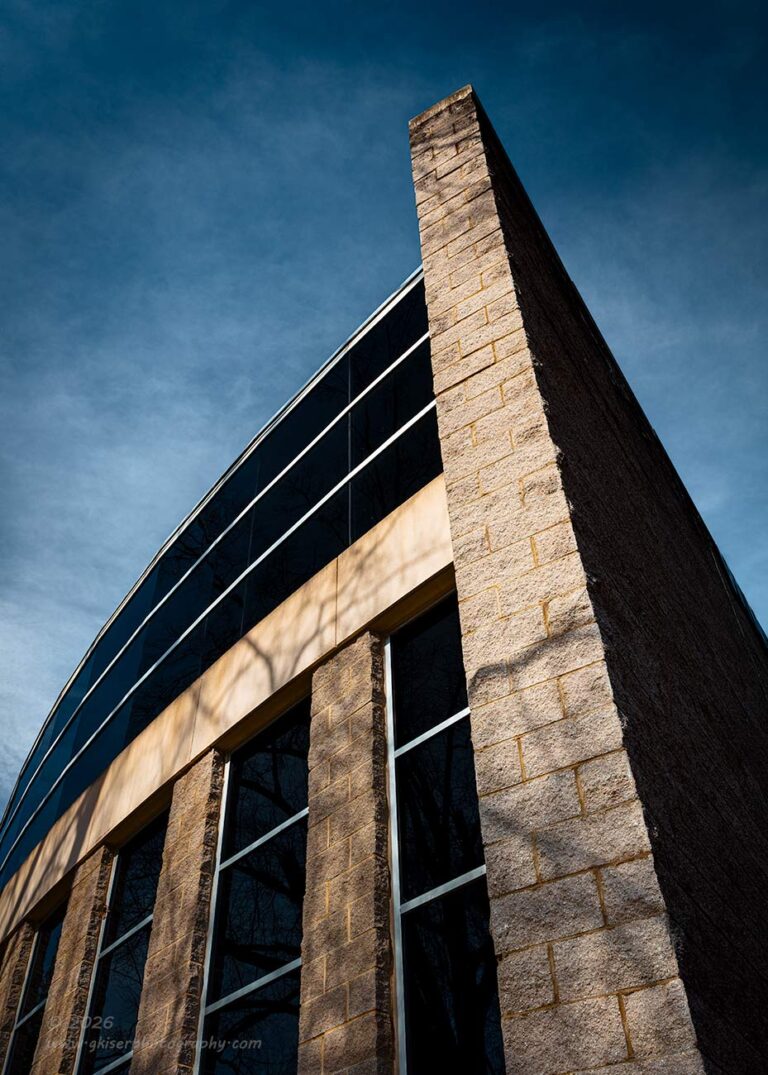
While I spent a good bit of time looking at the scene through a future lens, I was also looking at how things were looking in the existing lighting. One of the first areas that drew my attention was the corner of one of the buildings near the visitor parking area. This building is one that I had worked around and looked at before. It had a beautiful curve to one side while it was flat on the other. The two sides came together at a single corner which made for a very interesting shape. I remembered trying to work this before, but I was trying to do it without introducing any perspective distortion. Since one of the things that I was working on happened to be learning to see better through a wide-angle lens, I decided to give this a try with that approach.
Now, I didn’t fit the 16-35mm lens because I really didn’t need that much on the wide end at all. There was a tree that was encroaching from the side that if I went too wide, would be introduced into the frame. I didn’t want that to happen, so I figured I would start with the 24-70mm lens. This got me in the ballpark of what I wanted, but I wasn’t quite getting the drama that I was hoping for. I played around with the angles and decided that the problem was I just wasn’t close enough to the building. I moved up probably 10ft from where I had started and had to adjust the ballhead to give me enough rise on the camera. After I got all of that worked out I started to work the composition out and found that this was the spot that I should have started from.
Something that I have learned since trying to get better with the wide-angle lens is that I usually start off looking for the composition much further back than I should. I’m so used to working with the standard focal lengths that I default to that working distance. I’m getting better at moving in closer, but I just missed that step altogether this time. At least it was an easy fix, and I had yet to fire off a single exposure. Now that I was in the right area, I started making some photos, but I kept getting parts of the tree into the shot which I didn’t care for.
I continuously moved around and even got closer before I landed on a composition where there were only a few twigs that entered into the frame from the left. This wasn’t bad and I knew that those would be easily removed in post. That became the first keeper of the day and I was really excited about it in the field. I had already decided that it was going to be black and white though I shot it in color to make sure that I had the full range of tonal values captured thanks to my custom picture style that I use for maximum dynamic range in RAW. It wasn’t until I got the image home and really started to look at the colors that I found out that the two primary colors in the scene were wonderfully complimentary. With that in mind, I leaned into that color palette and processed the photo in full color which became a rather impressive composition to start the day off.
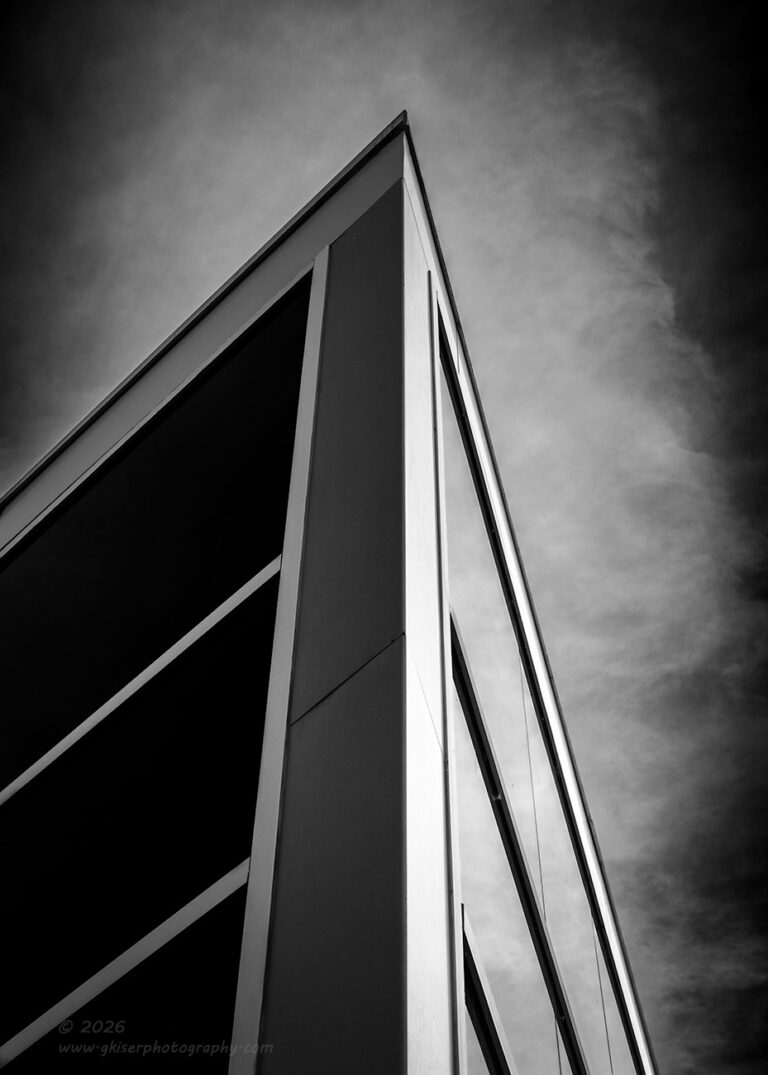
When I was finished with that first composition, I continued my walk around campus looking for other things that might catch my attention. It was a couple of buildings away that I found my next point of interest. This was yet another building corner, but one that I had not worked on before. What drew me to this one was the fact that the sun was on one side while the other side was in the shadows. Both sides had walls of windows which introduced frames against the dark glass. There was a really cool inverse property between the sides in terms of light and dark. Just above the building was some more thin clouds. They were not moving all that quickly, and since they were so thin, there wasn’t enough structure to allow me to make a compelling long exposure. For this, I felt that the contrast in textures from smooth to detailed would work in my favor.
As I did with the previous composition, I got in close and aimed the camera almost straight up. This time, I was shooting narrower at 55mm as opposed to 30mm as I had been with the previous composition. There was just no reason to go wider with the amount of the building that I was wanting to capture. For me, the most important part was the fact that I got exactly three rows of windows in the composition. This is that rule of odds that I love so much at work. Had I gone wider, the focus would have changed in the photo, and I would have introduced a fourth row of glass which would start to look static and boring. The three rows, on the other hand, added to the drama and excitement of the image. The light did the rest for me.
Now, this image was one that I started out processing in color, but with a twist. I leaned into the blue tones that were present in the composition. It was coming out as a monochromatic photo with different luminance values with the blues. I liked it, but it just seemed wrong to me, and I wasn’t able to get the contrasts that I really wanted to show up. Not convinced that I had made the right choice, I looked for a black and white profile that seemed to work better. Once I found the one that gave me the contrast within the blues that I wanted, I started to really work through the contrast adjustments to arrive at this photo. It is a little more expected than the blue toned version, but I think that I like it more. The focus is on the tonal shifts from side to side such as the frames around the glass that is bright on the dark side and dark on the light side. These are the things that I wanted to be at the forefront of the viewer’s mind when the image was being looked at. Black and white did that much more efficiently than the color image did.
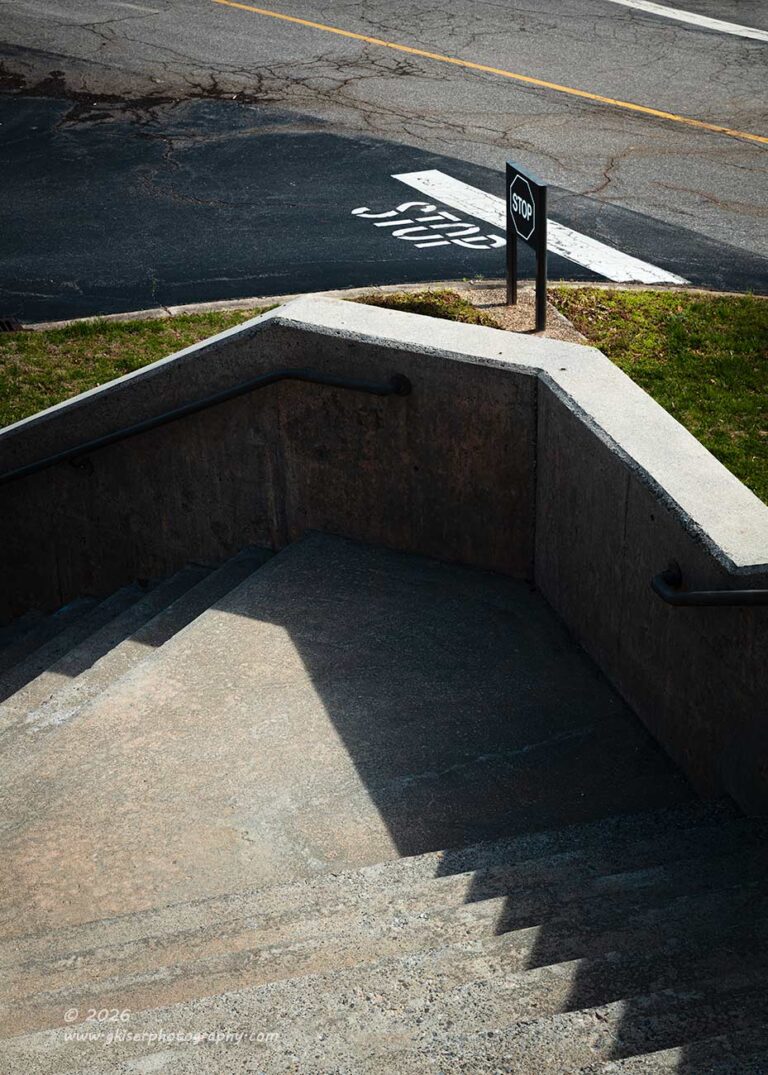
I was starting to get in the swing of things at this point and was now up at the upper level of campus. This was an area that I had recently discovered as being quite good at producing good scenes for me. I didn’t want to revisit the same compositions that I had in the past so that meant looking at things in very different ways. Instead of looking at the stairs from the bottom as I had done in the past, I began looking at the tops of the stairs looking down. I was looking for things like interesting lines and shadows. On the last staircase that I passed by on one of the buildings, I found some interesting curves in the stairs and started to work out a composition with that concept.
The more I worked it, the more awkward that it became. I tried so many different positions and even focal lengths but wasn’t able to get anything to provide an interesting composition from an abstract point of view. The photo needed something else as a visual anchor. There was nothing at all around this scene except for the intersection with a stop sign. That isn’t a good element for a photo like this. Or so I thought.
The more I looked at the scene beyond the stairs, the more I was starting to compare the lines that were present in both portions. There were actually quite a many similarities between the two sections and I was even seeing the possibility of creating some triangles between the two sections as well as extending lines from one to the other. It is the details like that which link two dissimilar sections of a photograph so that they can be enjoyed as a single image. With that in mind, I started to work on the composition by getting everything lined up. This involved getting the camera kind of high in the air which made it hard to really see what I was doing. Somehow, I managed to get it all to work out, and everything just fell into place.
This is one of those photographs that is really not something anyone would expect from me, but here I was trying to teach myself different ways of seeing scenes. This was certainly an exercise in just that discipline. It isn’t a favorite photo from the day, but it is one that makes me look at it and examine the parts that really do work as well as things that I might want to do differently next time. If nothing else, I have successfully linked two very different scenes into a single photo based on geometry. That was definitely worth the price of admission right there.

I’ll admit, I was starting to feel kind of confident in trying new things after that last attempt. While I failed to really find anything else in that section of campus, I started working my way back down to the courtyard between the main buildings. This is an area where I had spent a good bit of time over the years and knew that there were some interesting compositions to be had here. One of the buildings had really interested me on a previous visit, but the actual photo didn’t really hit the mark that I had wanted for it. I remembered that I had spent most of the time that day with the telephoto lens and had been trying to get details.
What I was seeing this time was a chance at going a good bit wider and capturing more of the layers of the building. I still didn’t want to get the 16-35mm lens out, though I figured that it would probably work. Since I had the 24-70mm still attached, I just went with that one to see if I needed more range beyond that 24mm end. After I found the area that I wanted to work with, I started to play with the focal lengths and my distance to the subject. As with the first building that I had shot in the day, I was looking at a tree that wanted to enter into the frame from the left. This was not something that I really wanted to deal with, so I tried everything that I could to avoid having it enter the frame. It was only possible when I was looking at a rather mild distortion on the building. It was so mild that it almost looked accidental. Not wanting to have the composition look that way, I opted for a more pronounced distortion and a bit of the tree entering in at the left which I figured I would remove in post easy enough.
The polarizer allowed me to darken the windows so that they were nice simple blocks in the composition. Again, I looked to include five rows of the windows to the right while the one section had a predetermined three windows present. The sky was entering in at the top left which I didn’t mind at all because with the polarizer in full effect, the blue was going very dark and I knew that I was going to do this as a black and white image, pushing the blue to nearly black. The sky was just another shape that matched the tonality of the windows for balance within the frame.
I probably did more fine tuning of this composition than any of the others, but I was working on so many different things that were all dependent on camera positioning. I needed the relationship between all elements to be just right while not making things look strange. This was going to be a study of shapes and the second that the shapes because nauseating, the composition would fail. It really was a balancing act to get things to come together just right for this one.
The time spent with it paid off and it became one of my favorites from the day. Toni was surprised that I even liked it at all because of how the lines and angles all came out with that distortion. This is not something that I would normally have gone for, but because I was taking the time to get the perspective just right without looking accidental, or over the top, I was able to come about this perspective that worked well for me. There is no hiding the fact that the verticals are distorted, and since I shot the composition looking for that distortion, it makes me happy to see. Whether or not others will like this image has yet to be seen, but regardless, I absolutely love how it turned out. Even the processing with the high contrast approach really fits the end result.
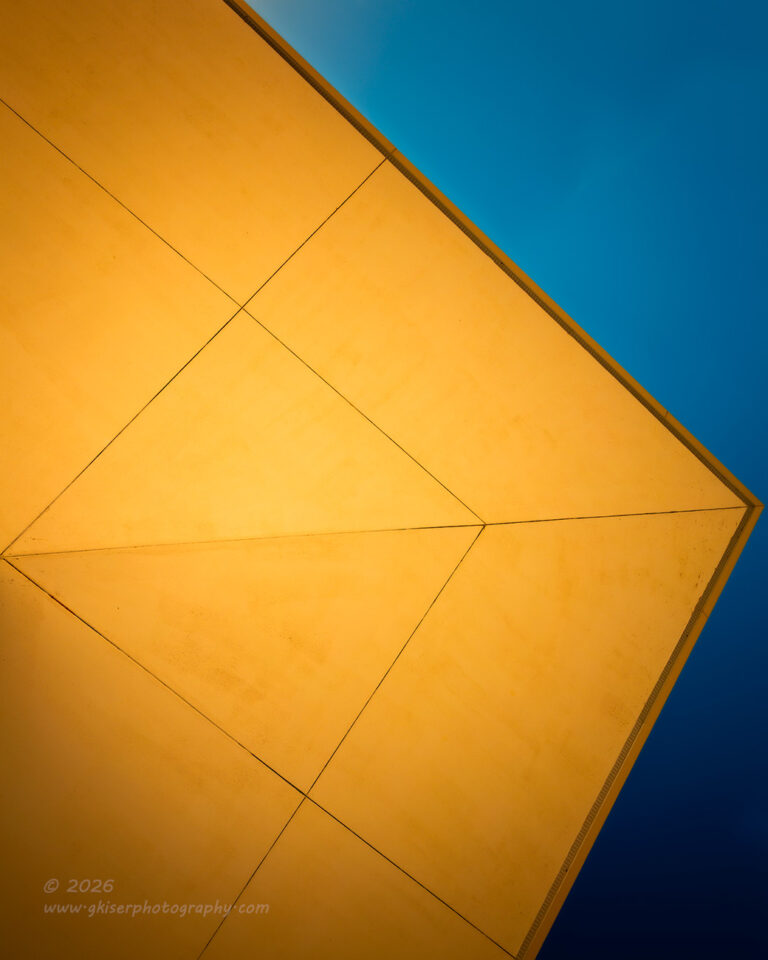
Not wanting to be done with this building, I spent some time looking around to see if there was anything else that I might want to photograph around it. The large overhang of the roof was the most dominant feature and something that I kept coming back to. I liked the panel lines that were visible on the surface of the underhang and saw some semblance of symmetry with it. Almost as if on a dare, I pointed the camera nearly straight up, trying to avoid the bright sun that was coming in from the left. I worked on the positioning until I was happy with how the shapes were all showing up. Since it was sunny and I was shooting under the roof of the building, I switched the white balance to shade out of habit before shooting. I didn’t give it much thought until I got the image home and looked at it in Lightroom.
I hadn’t really determined what I was going to do with the image up to this point. I wasn’t sure I was going to do anything with it actually. However, when I saw the warmer tones of the panels against the blue sky thanks to the white balance, I knew what I was going to need to do with this one. It was going to be done in full color, and I was going to really bring out the warm tones in the building to make this a two-color composition that focused on shapes rather than subject. Essentially, what I was photographing didn’t matter, it was only how I saw it that mattered. This is kind of the definition of abstract, and I really leaned into that idea with this photo.
After doing a careful crop and a 90-degree rotation, I really pushed the colors so that I had two very rich hues contrasting with each other. The panel lines added another layer to the shapes within this image and the fact that I wasn’t exactly symmetrical with the composition allowed me to shift the center of the frame with the bias to the lower portion with the heavier blues. This gave the composition a very solid foundation and it all just came together so well.
This is another one of those images that I absolutely love while I wasn’t convinced the concept would even work when I was shooting it. I am really interested to see what happens after I have had a chance to live with the image for a little while. I’m hoping that I will love it more and more the longer that it is in my collection. I do tend to really like these simple images that are more abstract in nature, and it would thrill me to no end to have it in the most significant list of 2026. Only time will tell how that goal works out.
I’m going to take a quick break here because I had pretty much done my full rounds of the campus at this point. I had a good idea of where I wanted to shoot next week and knew the lighting that I was going to want to work with. I had also shot 22 frames by this point in the day. The rest of my walk was looking for some more abstract details to shoot and trying to find different ways of seeing along the way. You will have to wait until tomorrow to see how that part of the trek went. There are some very different images yet to come, so watch for that next blog coming tomorrow at some point.
Until then….


