Saturday, September 24, 2022
Welcome back for this continuation of a trek from this past weekend. If you are just now joining us, you can catch up by reading the first half of this adventure into Taylorsville. I have been experiencing some glitches with the subscriptions to the blog, so hopefully you are getting a notification on this entry, but I’m betting you didn’t get one yesterday with part 1. I hope that is all sorted out by the time I publish this final installment on what has become a rather fruitful trek.
As we left things, I had just left the location with the bus that I had been having so much fun with. I had spent quite a while there capturing all of the different subjects, but I was still feeling creative, and the sky was still looking good. My goal for the day was to work my way down near Hickory to scout some locations that Toni had found for me recently. I drove through Taylorsville and then came out on the other side as I continued down Hwy 16. I eventually got into an area that I was pretty sure I hadn’t been before and started to really look around. It wasn’t long before I found the first place on my list which was a shop of some sort that had some yard art out front. It had caught my eye because it was suspended on a steep embankment. I wasn’t sure that there was a composition here, but I wanted to check it out.
As I drove by, I wasn’t convinced of what I had to work with, but I got turned around to check it out again. When I got in close, I could see that the business had painted their logo on the door along with their phone number. That kind of ruined this for me as I don’t really like photographing billboards for businesses regardless of what they use to display the information. I did see some interesting subjects in the parking lot at the top of the embankment, so I pulled into the driveway. The gate was open, so I continued up to the shop. When I got up there, I saw at least three subjects that I might be interested in photographing. I wasn’t going to be able to get overall shots of them, but isolations were possible. I drove up to the front door that had a sign on it indicating that they were open. I tried to open the door, but it was locked. I knocked on it and listened for movement. There was no sign of life inside and looking around I saw no movement there either. I suspected that they forgot to pull the sign in when they closed up shop on Friday, but I wasn’t sure. Looking at the locations of the subjects I wanted to photograph I didn’t really feel comfortable trying them because I would be concealed from view which makes my activities look very sketchy. I did see an interesting building on a road behind the shop and decided that I would go check that out instead of remaining here.
The road was easy to get to turning out of the main entrance of the shop. It was a dead-end road and didn’t take but a second to get to the end where the building was. It wasn’t quite as nice up close as I had hoped for, and it really looked like someplace that I shouldn’t be at. Not wanting to push my luck, I decided to abandon that location and go and search for more subjects. With two potential locations so close to each other, I decided that I would kind of stay in this area and see what else I could find.
I drove around for a while and just got lost on the back roads. I was impressed with the potential out here and I’ll certainly be back, but for right now, nothing was jumping out at me. Creatively, I have found that no matter how good the subject is, if I’m not motivated to create something with it, there is no sense in stopping. I wanted something to speak to me, and that just wasn’t happening yet. I continued driving around going down all sorts of back roads in search of that certain something. I wasn’t really paying attention to the time, but it was feeling like I had been driving for hours. Every once in a while, I would come upon a road that I had been on it other travels, but that was hit and miss for the most part.
I was largely in a new area and trying to get the rhythm understood. What I mean by that is I have to gain an understanding of the area to know what I might find there. It isn’t quite as simple as finding a barn means you are in the country, or finding an old car means you are in an area where that is likely. I have to understand how to read the community to know what might be around the next bend. As I spent more and more time driving, I was getting better at knowing where to turn and I was finding more and more potential. The problem wasn’t lack of subjects out here, it was the lack of motivation. I was looking for a story to capture and something beyond just a pretty scene.
After roughly two hours of driving around, I was about to hang it up and head home as I was starting to get hungry. I found myself on a road that I recognized and knew that it was going to take me to one of the other main roads which ultimately would put me back in Taylorsville. I also knew that there were several locations along this road that I had spotted during my first time out here doing a commissioned shoot for a client. I saw one of those locations and pulled off into the parking lot. There was an old F Body Camaro parked on the side in the brush that interested me, but again there was no story here just yet. The car didn’t have quite enough decay on it for my tastes, and there wasn’t anything around it to tell the story I wanted to tell. I got back out on the road and continued on for a bit more. I then passed a small parking area that had a lot of old cars deep in the woods. I could see a Studebaker peeking out from one of the garages, and a few Chevys from the ’60’s as well lining the trees. As I was pondering that location, I passed the side lot where there were probably 20 old cars that I had seen many times before. There were several there that captured my attention, and for once, I had an idea of the story that I wanted to tell with them. The weather was right for the mood I wanted. Judging from the location, I figured that the house I had just passed probably was where I would find the owner. I got turned around and went back to the one house that was beside the Studebaker.
The house looked occupied, but I wasn’t sure if anyone was at home. There was a vehicle out front that looked to be currently driven so I parked and went to the front door. I could hear music inside which was a good sign. I knocked on the door and waited. I heard nothing but the chickens that were around the side of the house. As I tried to look in the window to see any signs of movement, I happened to catch a reflection of what looked like a person leaned over the front of a truck off in the large parking area. I turned around and was able to confirm that it was probably a person, but there was no movement that I could see.
I walked over, and about halfway there, I saw the subject stand up from leaning into the engine compartment. So I didn’t scare him I called out to him to let him know I was there. I was still about 40 feet away at the time. I got closer and introduced myself and explained why I was there. He was a very nice man and said that he had no problems with me photographing anything that I wanted. Feeling very lucky, I asked if the property on the other side of the house was his as well. Sadly, he said it belonged to another family and he didn’t think they were home. That kind of took the wind out of my sails because I really wanted to photograph some of the vehicles in that lot. Having the permission for this side was something that I wasn’t going to pass up though.

There were a few cars on this side that were interesting to me. That Studebaker was the first one that had caught my eye and that was where I wanted to start. It was not in the best of locations, but I knew that I would be able to work some isolations on it if nothing else. I grabbed my bag and tripod because I just didn’t know what I was going to be needing. I started off with the 24-70mm lens and a polarizer because that is the combination that generally works the best for me in these situations. I started off with the front of the Studebaker since I knew I wanted to do something with that bullet nose.
As I got closer to it, I saw the problem that I was going to have with it. The chrome was in too good a shape. This is the reason that I don’t like photographing new cars. Everything reflects in the smooth surfaces. With rust, nothing reflects at all and that makes life easy for me. Not wanting to give up on this great opportunity, I plopped the camera down where I thought it should be and looked for the reflection. As it turns out, the tripod was right at the tip of the bullet, but it was so small that you really couldn’t see it. Seeing me was a completely different story though, but I had an idea. I got the composition set up and everything dialed in to arrange the elements as I wanted them. I set the camera to a 2 second timer and clicked the remote as I ran off to the left. The shutter activated and I came back to check out the end result. I loved the composition, but as I zoomed in, I could see me running off to the left in the bullet. I was bigger on the broadside of that chrome bit, so that wasn’t going to work. I needed to get further away. I tried it again and came back to look. I was further away from the car, but I was even bigger because now I was reflecting in the large chrome bezel which stretched me out too much. I went back and looked at things once again and realized that if the tripod was so small at the point of the bullet situated about six feet away, I could run further away from the car in this same direction. I would still be visible, but so small that you wouldn’t see me. I tried that option and came back to look. I couldn’t see me at all in the LCD which was a good indication that I might be invisible in the reflection at that distance. I was satisfied with the photo, and started to look for other isolations.

Of course, with me right at the front of the car, the hood ornament caught my attention. It was a small element in my original composition, but I wanted to give it a chance to shine on its own. What I loved about it was the fact that the clear plastic was cracked with age that added a whole different texture to the scene. The fact that the chrome was all pitted was a benefit because I wasn’t going to need to run away from this composition. I spend a little time working out the composition and found that a vertical orientation was the one that I wanted. After I made that decision, the actual image came together very quickly because I have done similar compositions many times before.
Once I was satisfied that I had that composition done, I turned my attention to the headlights of the Studebaker. There were some good compositions to be had here, but I kept running into problems with reflections since the bezels of the headlights were in such good shape. Other ideas that I had ran into issues with the background and I was just starting to realize that this car was harder to photograph that I had originally thought. I felt that I needed to take a break from this car for a bit and let it simmer in the background. I wanted to try some different compositions with something else. I looked around and found that the next car that spoke to me was a Bel Air that was parked over to my side. It had a Chevy Sedan parked next to it on one side, and a Chevy Luv pickup on the other side. The car was a large four door boat and there was no way to get an overall composition of this car. I was going to have to focus on the details, which fortunately I do love the fin details on the back of these cars.

What I found that I liked was the transition in color from the blue greens to the reddish oranges at the rear driver’s corner. The taillight had a very unique shape to it, and it flowed with the fin coming off of the quarter panel. The last little detail that I liked was the City Chevrolet dealer badge with the leaf stuck inside. The story here was all about dichotomies and it fascinated me. I had the color contrasts, the futuristic design of the car which was now in a state of decay. I even had the word “city” with a bit of the country wedged in and covering part of the word. This scene said a lot to me, and I was excited about capturing it.
I was still using my standard 24-70mm lens which happened to work well for this composition. I just had to figure out how best to organize the elements within the scene. It all came down to how high up the camera was positioned, and what angle I was shooting at. I had to be aware of the bumper which was still very reflective and was showing off my camera all too well. If I had moved back further, I would have lost the perspective that I was after. My only choice here was to crop in close to eliminate most of the bumper, leaving just enough to counter the bit of chrome on the fin that I was including to show that shape. I only had to shoot two frames because once I had the composition set, I loved it. The second frame was just a safety frame in case there was a bug or something that I missed in the first one.
Knowing that I was having so much trouble with reflections with the two cars that I was trying to photograph, I decided to swap out my lens for my telephoto lens. It would allow me to get further away from my subjects and hopefully eliminate the reflections. I made that quick switch and started again with the Studebaker. I tried a similar composition to what I had done earlier, but those left me feeling kind of empty because I needed the perspective of the wider focal length. I went back to the Bel Air and tried a similar approach to the taillight, but with incorporating the bumper and the entire quarter panel. This wasn’t bad, but I wasn’t convinced it was going to work. When I got that one back home, it made it through three rounds of culling, but ultimately got trashed because the image was just not inspiring enough. It looked too much like a snapshot and didn’t tell the story as effectively as the first taillight that I had shot.

Using the long lens in tight quarters take a little getting used to, but I decided to stick with it because I had used it to great advantage not too long ago in a similar situation. I started to really look at the compression possible with this lens and started to think how it would make things look. I went back to the Studebaker once again and went for an angle shot of the front of the car. I was able to get the lens to work for me by eliminating much of the background and making the distance between the subject and the large white car appear further so I could give my subject some breathing room in the frame. I fumbled around with this composition for a bit and finally landed on something that I liked which eliminated most of the clutter that I had been concerned about. I used the depth of field to my advantage by trying to concentrate the focus on the car and not the background. This was all looking pretty good in the image review, and I was satisfied with this composition. I was also happy that I had changed up the lens to the long one.
I spent some more time looking for other isolations that I could pick out with the telephoto but didn’t find anything that jumped out at me. I once again turned my attention to the other cars in the parking lot. There were a couple of trucks that I liked, but the owner was still working on one of them. There was no way I was going to tell him to stop what he was doing so I could work on a photo. I also didn’t want to bother him by doing my work too close to where he was working. That pretty much left the Bel Air once again to work with. Armed with the long lens, I turned my attention to the front of the car for a change. It was not nearly as dynamic as the rear, but the colors were looking good, and I liked the trim against the patina.

Since I love headlights on these old cars, that was what I gravitated towards for this next composition. It was all the chrome around the headlights that really set the lights off, so that was what I wanted to focus on. I pulled a trick from the Ford Tractor that I had shot a couple of hours before and chose to do a very tight crop to get several elements into a single photograph. Essentially, I cropped on all four sides, while including a bit of the ground. I positioned the camera so that I could take advantage of the diagonals that I could capture. I paid attention to the bumper reflection, but found that with the long lens, I was far enough away that the reflection didn’t come into play. I could sense that I was getting comfortable with this lens again and started to play around with different ideas.

Not wanting to just duplicate the previous composition on the other side, I chose to try something a little different for the next composition. If you have been following my work for any length of time now, you are well aware of how I view headlights. They are typically the visual anchor of my images, but there is no rule stating that has to be the case every time. I chose to work a completely different type of composition this time. I was focusing on the hood ornament, and the line of bullets on the grill paying attention the missing one that helped draw attention to that hood ornament. The headlights were more of a framing element, and I actually let them go blurry as I wanted the background to be very soft for this one. As I was shooting this composition it dawned on me that the overall patina was pretty much uniform and really wasn’t taking up too much room. The dominant color was that of the chrome, while the ground and the patina shared a similar tone. I realized that the colors didn’t really make much of a difference, and the color actually pulled more attention to the ground since it was the same color as the hood in the opposite corner. By removing the color, I was able to focus on the lighter areas which happened to be the parts that I wanted to concentrate on. I made the decision while shooting this that it was going to be done in black and white. I stood by that choice at the time of edit and couldn’t be happier with it.

I was starting to get in the groove at this point and I felt like I could do some really creative things with this car. As I mentioned, the colors spoke to me with the paint and the rust being rather complementary in hue. I started to look for shapes and curves that would make an interesting photo. That was when I realized that this generation of car was all about lines and angles, not so much curves. There was really only one place where I could get the curves that I was after and that was the A pillar that was still pretty angular. I pondered the passenger side as it was the side that I had room to work, and the colors were the best here anyway. I started to align the elements that I liked and realized that I was going to have to get the camera up pretty high to make it work. Fortunately, my tripod allows me to get that altitude without too much problem. The issue that I run into was being able to see what I’m shooting. At that height, I can’t use the viewfinder to compose, and the LCD is covered in glare making it difficult to see detail.
I knew that there were several things that I wanted to capture in the photo though. I wanted the corner of the roof because that was where I was getting my color from. I wanted the A pillar for more of that color, and the curve that blended into the other curve of the windshield. The panel line for the door gave another curve, which brought your eyes down to the Bel Air emblem on the fender. The Fender trim was going to be the roadblock to keep the eyes from leaving and to add just a little punch to the badge. that was my rough concept and I played with the angles in an attempt to arrive at that recipe.
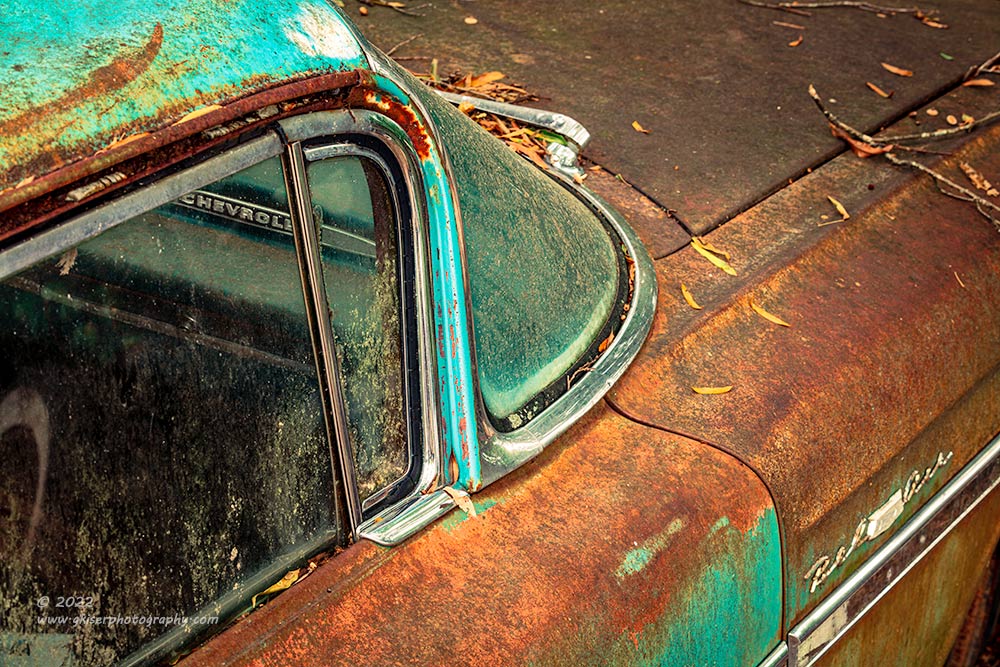
I ended up shooting five frames of this composition and made subtle changes each time. I would pull the camera down from the tripod since I could just place it back on the ballhead without changing anything compositionally. It would give me an idea on the image review of changes that I needed to make. Something that I realized after the first three compositions was that I could make out the Chevrolet badging on the dash which I though was important. I worked on positioning the camera in a way that would capture that badge while keeping all of the other elements in place. It was just very small adjustments that I needed to make, and I was able to get it done despite the glare on the live view from the camera angle. I’ll admit that using the R5 here would have been beneficial because the screen articulates and would allow me to see comfortably at this angle. That wasn’t the camera that I had with me though, so I just did what I always do in these situations and tried to see it the best that I can from my tip toes.
The end result was pretty much what I had imagined. I wished that I could have gotten the entire Chevrolet emblem in the shot, but that would have forced me to lose part of the roof because the angle of the camera would have been reduced. Losing the color which was a primary consideration for the composition wasn’t an option for me. I got enough of the badge that the viewer’s mind will subconsciously complete the text and it isn’t a distraction in my mind. The textures and colors all work together beautifully, and I love how the lines and curves all go together. this is one of those images that really stands out for me from this trek and I’m glad I felt squirrely enough to try it.
By this point, the light was fading on me. My shutter speed on this last composition was eight seconds which wasn’t a problem since nothing was moving, but it is an indication of how much the light had dropped at this point. All of the cars here were under the trees so everything was in the shade making it that much worse on me. I knew that I was going to have to call it day pretty soon, but I still had more in me. I just needed to find the right subject.

I was really happy with the use of lines and curves on the Bel Air, and I wanted to try something similar with the Studebaker. I went back over to it and looked at what I had to work with. I found a great deal of interest on the passenger door with the mirror and the way that the vent window was broken. The textures of the patina captured my attention as well. This was going to be the content of the next photograph, I just had to figure out the right composition for it. That took some doing because there were a lot of unrelated elements that had to flow together to tell the story. I had a lot of questions about how I wanted to crop the image, and as I’ve mentioned before, I don’t like cropping after the fact. I looked at where I could place the edges to have them look intentional and give enough indication of what was beyond to allow the mind to fill in the blanks, but not enough so as to be a distraction to the purpose of the composition. It became a game of camera movement to get the right balance of everything while connecting the top of the mirror to the Base of the cracks in the glass so that they became related objects. even with all of that planning, the composition that I liked the best that had the most aesthetically pleasing relationships between objects, still needed to be cropped in slightly to arrive at the best composition. I had done this through the rule of thirds but decided that it fit the Golden Spiral better and for that to work, I needed to pull it in from the sides and the bottom a bit. This gave a much more direct composition and one that had a better flow overall. The little bit that I cropped equaled about what I would give up doing a 16:9 crop on a landscape which is negligible for this camera in terms of overall resolution.
The exposure time on this composition was 10 seconds at f/16 and that told me that the light was failing at this point. I made a quick look around to see if there was anything else that I wanted to capture before packing it all up. I was satisfied and felt really good about stopping here. I got things put away and went to thank the owner once again. He reminded me that there were a lot of cars next door, and that the owner should be home by now. Had it not been for the failing light, I would have gone over there, but told him that it would have to wait for another day. It was 5:45 at this point and I was still looking at about an hour’s drive to get home.
I had shot a total of 101 frames during the day from the two locations. I was thinking that I had about 10 images that were going to be keepers as I looked back on the day. When I whittled them down to 20 to do edits on, I was nothing short of amazed. I went through the edits and gradually eliminated another four of the images from that collection which left me with a total of 16 for the day that I thought were the strongest examples shot. While technically speaking, I didn’t shoot any new locations, this was the first time I have been able to get permission after spotting them around two years before. There are a lot of places like these that I pass by occasionally and consider possibilities or try and talk with owners. It is really exciting when I can actually try my hand at photographing the locations when the conditions line up to where the owners are home and are feeling generous.
I’m not sure what will come next as far as treks, but I am pretty confident that I’ll be happy resting that creative side of me for a while. This one has been a very exhausting trek and I need to recharge that creative side of my brain at this point. I’m also starting to put in some creative planning on a half day portrait session that I’m doing early next month where I am going to have to tell a visual story throughout the morning. I also have another portrait session coming up at the end of the month that will need to have the studio built up for. Of course, Fall Colors are right around the corner, and I plan on getting out to capture those as much as I can while avoiding the masses that will be on the Blue Ridge Parkway. Honestly, the social media draw to the NC mountains is kind of souring me on the Fall season for photography. I just don’t care to be a part of a mass destination where everyone is getting the same photos. I would much prefer finding little locations off the beaten path that nobody cares about to find my photos. Being unique is more powerful than photographing the “best” locations. At least that is how I see it.
Don’t forget that in November, I have my decay workshop in East Bend, NC. This very popular workshop is at about half capacity right now and is a wonderful learning experience for any photographer looking to increase their knowledge about capturing these old vehicles. You will spend the day capturing your own images at a place where I’ve already secured permission while having full access to my skills. I’ll do some group teaching and lots of individual assistance as we progress through the day. I’ll be there for you, not for my photography. Get signed up today to ensure that your spot is reserved. I’ll be sending out the initial email in the next few weeks. I hope to see you there.
Also, keep in mind that if any of these images speak to you, and you would like a print, I would love to discuss the options with you. You can order stock sizes through the website here, or you can talk to me directly to discuss larger sizes or media such as canvas or metal. There is just no better way to enjoy photography than to be able to hold a print in your hand. It is also a great way to support me while I go out and capture these scenes and then write about the experience afterwards. I am not a high-volume print maker so you can rest assured that you will have a unique piece of artwork to display in your home or business.
I hope that you have enjoyed this two-part trek. If you missed the first part of it, you can catch up here. I could have done it all as a single blog entry, but that would have taken so long to type out, and even longer to read through. I figured that this way you could take a break between the chapters to enjoy the different photos.
Until next time….

Remember to use the code KISER10 to get 10% off your purchase