Friday, February 9, 2024
Throughout January, I stayed really busy with some very successful treks. The routine was, I would go out in the hopes of getting a photo or two, and I would come back with over 20 of them. While this creates a situation where I have to spend a lot of time editing and blogging about the trek, it is not a bad problem to have by any stretch. I embrace it when things are that kind of easy because I know that there are times when things will get harder, and the photos won’t come quite as fast. With us about a week into February, I think it is safe to say that things might be slowing down for me, at least in terms of capturing new photos. Today’s trek was one of the hardest that I have had in quite some time. The odd thing is, there was really no reason for it to be this kind of difficult.
Like several of my recent treks, this one kind of sprang up at the last minute. I’ve been rather busy with working on mentorships with several different clients, doing a nine-piece print delivery to a local dentist’s office, and talking to the Community College about helping with the continuing education program in the area of photography. It has been an incredibly busy first week of a month, but that really was a welcomed change after such a slow year on the business front in 2023. The tradeoff for being that kind of busy is that I have very little time for my own personal projects, and when I do have the time, it is not the easiest to get in the creative mindset.
This morning was my meeting at the college which was early enough that I was going to have a good bit of time during the day to go out for some photos if the weather cooperated. Sure enough, the clouds were looking pretty good with some subtle texture in them and the light that was being produced was of a quality that I like to work with. I had my camera with me and had already thought about two different locations that I could go and shoot. I wasn’t necessarily chomping at the bit to get out and find photographs, but I knew that I needed to take advantage of the time and the weather. That was probably my first mistake since I was basing my decision to get out with the camera based on convenience rather than a creative drive.
My rough plan was to head out to Winston-Salem and visit Salem Lake which has provided some very good photos over the years. I’ve been wanting to do some long exposure work for a while now, and I thought that would offer a good opportunity. My alternate plan was to stop off in East Bend to check out a property that had been recommended to me last month. I had the contact information for the owner, but had no way of knowing what was on the property since nothing was visible from the road.
I headed off to Salem Lake considering the shots that I was wanting to work on. I was particularly interested in capturing the base of the pier with some isolations showing the textures of the wood with the smooth water filling negative space. I was also hoping to find a few boats on the bank of the lake with an interesting sky above. The compositional ideas I had in mind were variations on ones that I had tried in the past which I thought would be improvements.
When I arrived, there wasn’t much going on and the parking lot was mostly empty. I did see some boats on the shore which was great. I grabbed my gear and walked down to the water. I checked out the boats first since the sky was looking good at this point. My first reaction to the boats was that they were not all that interesting the way that they were sitting. The more I looked, the less I liked them. There wasn’t a good composition to be had with them, so I moved over the pier where I had some ideas on how to work the different areas. Well, when I got there, the clouds were reflecting too brightly in the water and there was no good light on the pier which made for a very contrasty look. The pier was also closed off due to repairs and there was a small crew working on it. This prevented me from accessing the pier and going to the far end as I had planned. As a last ditch, I walked over to the area where there were a good many boats being stored by the parking lot hoping to find something interesting there. No such luck.
I came to the conclusion that the light wasn’t good here. In fact, you could say that the light was ugly. I had very poor subject matter, and no workable compositions. Based on my formula for a good photo, there was no chance for getting something worthwhile as I would need at least two out of three when it came to subject, light, and composition. Not wanting to waste time, I cut my losses and headed back to the truck in order to try out my alternate plan.
I almost called the property owner from the parking lot, but I got to thinking about the quality of the light. That made me hesitant to commit to shooting at this point. My plan was to head out that way and see what the mood was when I got there. It seemed like a good plan, and it would give me the opportunity to think about how I would approach this location since I had no idea what it would bring. The more I thought about the possibilities, the more I started to think that this was not the day to try something new sight unseen. I could feel that my creative energy was low and if I used up my ask on a day like today, there was a good chance that I would miss out on a lot of great potential photos. By the time I was driving by the property looking for a simple clue as to what was there, I had convinced myself to hold off yet again on making contact with the owner.
I was now 0 for 2 and had exhausted my planned locations without even turning the camera on. This is not a foreign concept by any stretch, and it happens plenty of times. I wasn’t frustrated as I normally would be, but I was a little concerned that I felt so apathetic towards creating new photographs. There was no pressure to create, but yet I felt that I really should be able to do something with the weather that happening. The light had softened a bit as the clouds had gotten darker, and I recognized this as a light that I could very easily work with. It was just a matter of being able to find something that inspired me to make a photo.
I drove around for a while and made it up to Hwy 67 which was another familiar route. I stayed around this road for a while exploring side streets here and there with no real success. Every now and again, I would come across something that had a bit of interest to it, but in short order I would dismiss the subject for one reason or another. I could tell that I was actively trying to get in my own way by putting a negative spin on everything that caught my eye. Having recognized that, I tried to keep a more open mind to what I was looking at.

Eventually, I made my way into Jonesville, right at the edge of Yadkin County. I have been through here several times on this particular road which has always interested me for the old buildings that fill the sides of the road. In a way, this is a decay photographer’s paradise because so many of the storefronts have been left vacant and are in states of disrepair. I had never found anything that I wanted to photograph here though which kind of surprised me. As I drove through town, I figured since I was having an off day, I would try to find something to just get the camera out on. It didn’t have to be perfect and didn’t have to be anything that I would normally photograph. I just wanted to feel the camera in my hand and go through the steps of making an image.
As I went through town, I made it to an intersection where I spotted a Cadillac sitting next to a service station of sorts. I could tell that the business was closed, and the car looked like it had been left there some time ago. The paint was faded and peeling off in places, but there was a sun shield in the windshield that I thought was kind of humorous considering. I processed the scene in my head as I drove by and decided that it might make a good photograph. I got turned around and checked the scene out again. This time, I saw the small building behind the car which also looked to fit the abandoned theme of what I was seeing. The car wasn’t showing any rust, and it was a much newer car than I would typically photograph which kind of put me off, but I needed to look at it again before I moved onto a different scene.
Once I got turned around on the cross street and looked at the scene again, I could tell that the light was actually really good on the scene (there was one box checked), and I could see a decent composition between the two buildings (which checked another box). The subject matter wasn’t terrible, but it was not as strong as I would have liked, but I still had two of the three ingredients which would indicate a decent photograph. With that in mind, I pulled into the parking lot and looked for any signs that would prevent me from being on the property. I saw none, and with it being right in the middle of town, I didn’t feel like it would be seen as a covert activity.
I got out of the truck and went to the far corner of the property to look at the composition a bit closer. There was one angle that worked particularly well which included the side of the service station and the front of the building to the rear. If I played it right, the car would be slightly off center adding to the visual tension in the photograph. There was a large tree behind the nearest building which helped link the scene to the sky which was looking good as well. The beginnings of a composition were taking shape and that made me very happy.
I grabbed the camera with the standard zoom attached since I was going to be working in kind of close to the car while wanting to include a lot of the surroundings. The tripod was set up roughly where I had been standing to spot the composition and I mounted the camera to it. From here, it was a game of moving around inch by inch until everything lined up the way that I wanted it to. I shot an exposure and found that things were looking pretty good, but I was going to need to deal with some perspective distortion at 35mm. I opened up the lens to 33mm which gave me more room around the edges so I could correct the verticals, and I elevated the camera slightly to reduce the converging verticals. The second exposure was made with the intention of cropping in to correct the perspective on the buildings much like I would have done with a tilt-shift lens.
Because there was a bit of traffic on the street, I shot a safety image with the same composition just in case I had gotten any passing reflections in the glass. After I did that, I started to experiment with different compositions for a bit. They were all variations on the same theme but were cropped closer in to focus on the car more. None of them felt all that great, so there were not a lot extra frames made. When I got home and started to look at the different variations in detail, I liked the first concept the best as I thought it told the story better. Having the little building in the background really helped out and most of the secondary compositions cropped that building down to a single window. I liked the fact that I could see the top of the main building which had been slightly cropped in the subsequent frames.
The photo that you see above tells the story with three elements. As mentioned, the car doesn’t seem to be in too bad a state of decay when you first look at it. It is far from show quality, but it is not something that you would really look at all that closely. However, the building that it is parked next to shows quite a bit of age in the shingles. Tucked away on the side of the building is some clutter that would indicate that the business is no longer in use. These clues augment the state of the car and help build that part of the story. It is the small building in the background that really completes the story though with the faded and peeling paint. The scene is of subtle decay which is not something that I am usually photographing. Truth be told, I probably wouldn’t have photographed it this time had it not been for that sun shade. I’m not sure how long it has been in that car, but it was discolored from sitting there so long. This was yet another clue to the neglect aspect of the story, and I think just seeing something in place to protect the interior when the exterior was well beyond help was humorous. It was one of those images that was just quirky enough to make it into the keeper pile from the day.
I had an image in the can from today and that was better than I had thought would happen a short time earlier. As I had been working on the front of the building where the Cadillac was, I had seen a Chevy truck on the side parked next to the neighboring building. It was much too new for me to photograph being a late 2000’s model, but I could see that there were other cars behind the building. Since my truck was parked out front and nobody had seemed to care that I was here, I decided to see what was back there.
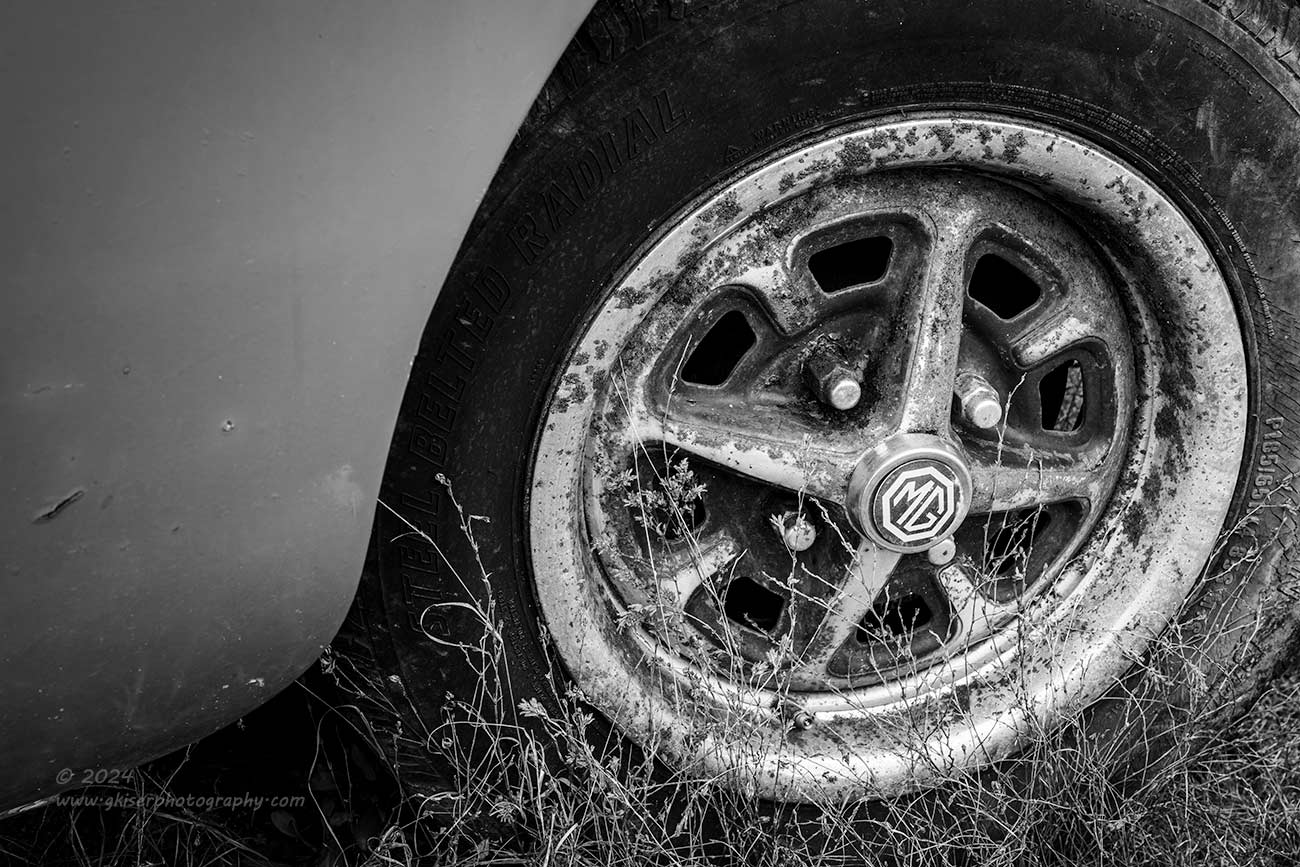
As I rounded the corner, I saw a red MG convertible sitting there with a white tarp stretched out under the vinyl top. It had the big crash bumpers on it which I don’t care for, but there was something about it that I felt I had to photograph. I knew that I was probably pushing it by being behind the business, but again, there were no signs in place indicating that I couldn’t be there. I had come to terms with leaving quickly if anyone came by to say that I wasn’t welcomed here. With that in mind, I started trying to find a composition that I liked on the car. There wasn’t much rust on it except for the wheels. That was the part of the car that I dialed in on initially. With the car being red, I had to be very careful about doing isolations on it because the red would overpower the photo quickly. Since I have been working on black and white photography for the last little bit, I felt that this was going to be a good time to utilize that technique.
I found a wheel where the center cap was close to being positioned right side up along with some brush going over the wheel to show the neglect aspect. It was the passenger front wheel that met the criteria I was looking for. I started working out a composition but found that this was quite hard to do since there was really no detail in the fender to fill the space. I didn’t want the image to have empty space, I needed it to be negative space which is entirely different. I tried a wide frame that included the molding above the wheel arch, but that became too complicated causing the focus to shift from the wheel to the fender. This brought about empty space. By moving in closer and cropping out a lot of the fender, I was left with the wheel and tire being the focal point which is what I liked. By cropping in even closer and cutting three edges off of the tire, I was able to dial in the focal point to the wheel itself.
To create the visual tension in the frame, I allowed the trailing edge of the fender to fill the left third. There was a scratch which fell in just the right place to allow me to use it as a framing element to define the space which was utilized as negative space. When I got the image home and started to edit it, I did go with a black and white presentation of it, but worked the tones in a way where the fender was about two zones darker than the wheel which pushed the attention to the wheel even more so. The overall balance of the photograph looked fantastic, and it showcased exactly what I was after.
After shooting three variations of that composition, I moved on to capturing the front corner with the headlight. This composition is a tried and true one that I have used many times. However, in this situation, it just wasn’t working at all. The chunky plastic bumper was messing up the lines of the composition too much. I moved around to the back left corner and worked a composition on that tire as well as the back corner of the car. Neither of those were successful either. I was figuring that I had gotten all I could with this car and started to head back to the truck.
Before I did though, I wanted to see if there was a way to capture the entire car. There was something about it with that tarp that really interested me. Usually, a tarp over a car will be an instant killer for me because it ruins the lines. In this case, however, the tarp was under the convertible top which allowed the lines to remain. The wheels were turned slightly to the passenger side which made a shot from the driver’s side front corner the best angle for the image. The problem was the building in the background, the driveway immediately to the right of the building that now housed my 4Runner, and the bright yellow tractor to the left. There was also a large, rusted oil tank on the back of the building that was going to prove a distraction.
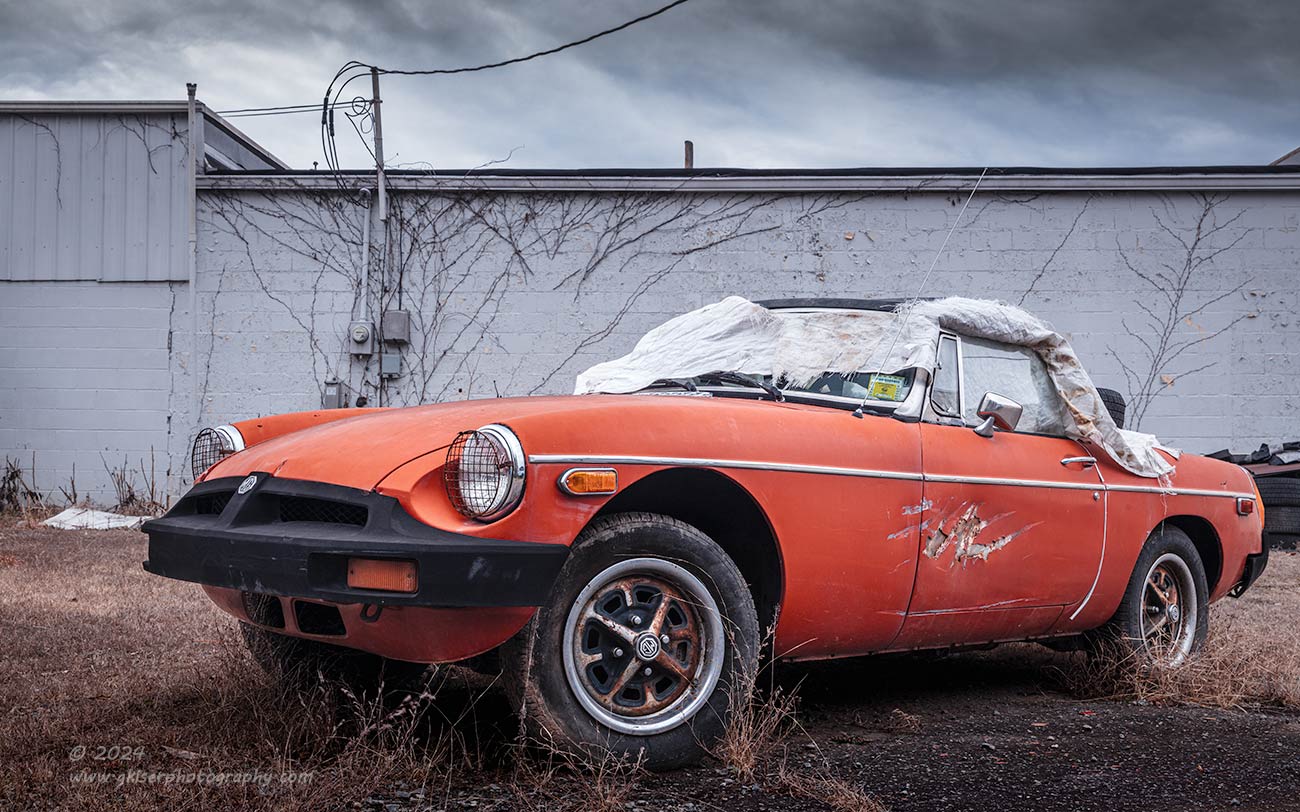
In short, I didn’t think that the composition was going to work. However, the light was great, and I really liked the sky over the building. It was also about this time that I noticed that the wall of the building had vines growing up that added to the visual interest and again showed another part of the story of neglect and abandonment. I could frame a shot that would eliminate the tractor and the driveway, but that left me with the oil tank that came right over the line of the hood and was a similar color to the car. If that tank was included in the composition, it would be a huge distraction from the shape of the car. The only way that I could possibly avoid this was by putting the camera very low and close to the car. This is a technique that I use all the time to mask distractions and it works very well. I just wasn’t sure that I could get the camera low enough while maintaining the right perspective on the car.
The only way to see was to get the camera in position. I placed it roughly where I thought it was going to need to be in order to get the framing right on the left and right sides. Once I got that dialed in, I started to work on the height of the camera. By spreading out the legs of the tripod, I was able to get the camera low enough so that the tank was covered, but the car looked odd with the unflattering angle. I raised the camera to where the car looked good, but that allowed the tank to creep above the hood. I dropped it ever so slightly and move in a bit closer. This got the perspective that I wanted with the tank completely obscured. A quick tweak of the focal length to correct for the new position and I was ready to make an exposure.
I shot two frames just to make sure that the breeze didn’t bother the weeds too much. That was it, I had made 14 exposures from this location which wasn’t many at all. I was thinking that I might get lucky with a single keeper out of the batch which would be more than enough. I never guessed that I would end up with three keepers from the day. The biggest surprise was the last photo of the day. Many times, I have started photographing the entire vehicle only to decide that those photos were expected and kind of boring. It is only after I move in close and start to shoot the isolations that I start to see the really good photo develop. This one was the opposite. I had dismissed the overall composition early on because of all the distractions in every direction. I didn’t think that the building offered anything upon first glace either. After being less than impressed with the detail shots, I created this photo which is my favorite from the day by far.
It was the first one that I edited, and it happened to be in black and white. I liked the ability to emphasize the sky as well as make the car brighter in relation to the building. The entire edit went fairly quick, and I thought that it looked really good the way I worked it out. However, it seemed that I was missing something to help draw the attention to the car. I didn’t like the red color on the car because it was too intense which was why I chose to process it as a black and white but having that warm color would sure pull the eyes into the scene.
With that in mind, I duplicated the image and processed it as a color photo this time. The first step was choosing the right color profile which was going to be key to the success of the image. I landed on one of the Vintage profiles which I thought looked very good for the composition I was looking at. The second step was to tweak the red of the car to make it more orange to go with a bluish tinted background. This was accomplished through color calibration along with some minor tweaks in the color mixer. The resulting color palette was much more pleasing to the eyes and made a bit more of a visual impact compared to the black and white version.
The final presentation of this photo really made the car stand out while the clouds set a dramatic mood. The tarp begs a lot of questions as do the stone guards on the headlights. It is just one of those photographs that really like looking at. Of course, that is the goal with all of my photos, but there are just some that demand a bit more attention than others. I think it is also a testament to the fact that I was off my game today. I should have seen this composition much earlier than I did, but instead I went right into the detail shots which proved to be less than engaging. I was about to miss out on this completely and would have left without it had I not paused for a minute to look. I think that it goes to show that sometimes it takes a bit of time to really hear how the subject wants to be photographed. That connection was made after about 20 minutes of working this subject. I’m glad I lingered long enough to allow the idea into my head.
Thank you for joining me on this trek. It seems like a quick one, but I drove over 160 miles in total to arrive at this location. It really was worth it though because I did get some photography done and have several new images to add to the collection. I hope that you like them as well, and if you do, don’t forget that I offer prints of all my photos. You can order standard sizes through the website, or you can contact me about larger sizes or specific media like canvas or metal. No matter what you choose, you will be getting a print that represents exactly what I envisioned for the photograph and is not dependent on how your viewing screen is calibrated. There really is no better way to enjoy photography than in print form.
If you would like to improve your own photography, consider signing up for a mentorship program as I have several levels to meet most needs. The options can also be customized for your specific needs as I like to tailor the offerings to each individual. If you are not close to me, we can always do a virtual mentorship which has most of the same benefits as an in-person mentorship. Let’s talk about what options will best suit you. Also keep in mind that I have two workshops coming up in the Spring. The first one is the Art of Decay workshop which is already at 50% capacity. If you are considering signing up for it, don’t hesitate. This has consistently been one of my most popular locations for a workshop. If you are looking for something a bit shorter in duration, I have another one in late April that teaches you to find beauty in the mundane. Either way, you can’t go wrong and for the first time I have designed these workshops with a form of image review after the fact so we can continue to learn even after the photos are shot.
I just realized that it is just 9pm. How exciting to be able to go on a trek, process the images, complete the blog, and it not be the middle of the night, or the next day. I could get used to this kind of timeline for my personal work in photography. I hope to have more treks like this in the future. I’m also hoping to get some new images next week in Williamsburg, VA, if the weather works out for me. I’m not sure what I’ll be photographing, but I’m going to be giving it a try.
Until next time….