Thursday, November 9, 2023
When you think of the Blue Ridge Parkway, there are likely two photos that come to mind. The first is the Linn Cove Viaduct as photographed from that rock, usually in the Fall. The second photo is of the Mabry Mill which might be the most photographed grist mill of all times (I don’t know if that will stand up to the fact checkers or not). It would seem that each state got an iconic scene for tourists and photographers to photograph along the 469 miles of roadway which I guess is a good thing. For me, the problem is that these locations are so often photographed that anything that I can do with them is just adding to the noise of all the rest of the photographs out there. Will anything I shoot actually stand out from the crowd? I seriously doubt it, so I have pretty much stopped trying to shoot these locations in favor of finding my own voice. So, how did I end up back at Mabry Mill on this Autumn morning?
Well, you see, it all started because I have a terrible sense of holidays and when things might be opened or closed. For months, I have been working on getting one of my mentorship clients out to Hart’s Square in Vale, NC to photograph a wide variety of historic cabins and buildings. Based on the way the land was situated, we decided that it was probably going to be best to go at the end of peak leaf season so that the crowds would be reduced, and we would have a better chance of getting some compositions without a lot of people in the frame. We were also looking for an overcast day so that the highlights and shadows under the canopy wouldn’t be too terrible. For the most part, the days have been pretty much clear with no cloudy days for the past several weeks. With the leaves finally gone for the most part, I was really hoping for a cloudy day before it started to get too cold. That day was looking like Friday, and I contacted John to see if he would be available for the day. He was, but reminded me that it was a holiday, and that the location might not be opened for business.
Sure enough, Hart’s Square was closed for Veteran’s Day which meant that the one cloudy day was now out of the question. I was prepared to let it go and just try to come up with another day to head out there while I used Friday as a day for some of my own photography. Not long after I started to make that decision, John got back to me with a suggestion to try the Bunker Hill Covered Bridge or Murray’s Mill which was kind of in the same location as the original concept.
I know…I’m not saying anything at all about Mabry Mill, and you are really wondering how I ended up here. I’m getting to it, I promise.
I was familiar with both locations and knew that there were some issues with them both from a photography standpoint. I didn’t want to push John away from them if he had a specific idea in mind for wanting to go, so I asked what his expectations were. I figured that this was a valuable part of being a mentor because I needed to know why he was wanting to work those locations. Fortunately, he didn’t have any specific concept in mind, and I shared some of my concerns with him. I followed his idea up with a suggestion of my own taking into consideration the historical aspects of both places. This is where the Mabry Mill came into play. It was a location that we had not thought to do before, and since everyone and their brother with a camera, cell phone, or sketch pad has an image of this place, I figured that John needed the experience. He agreed and I started to check the weather for the area to make sure that it would work out.
Friday was looking like solid rain while much further South was still just going to be cloudy. Thursday, however, was looking decent with partly cloudy skies. With the open canopy, I wasn’t too worried about blocking all of the sunlight, it was more important to have some variable lighting which the forecast was indicating that we would have. John was able to meet me out there for a good part of the day, but he would have to head back home shortly after lunch for a meeting. With that, we booked the trip and I started to get my mind wrapped around how I was going to present the location to him and have him photograph it.
The plan was pretty simple. We were going to meet up there around 8:30 in the morning to give us plenty of time before he was going to have to call it a day, and to take advantage of the morning cloud cover which was scheduled to break up around midday. The mill was just under two hours away from home, so I left around 6:30 with the hopes of getting there before John. I hate having my clients beat me to a location because I feel like such a slacker when that happens. If I played my cards right, I would have enough time to maybe get a photo in either on the way there, or once I got there before I had to start working.
The sky was really amazing the entire way up into Virginia. It was kind of a surprise sunrise based on the way the clouds were supposed to be coming in. There wasn’t a way to take advantage of the sky because I just wasn’t in the right kind of area to capture a sunrise. Instead, I just enjoyed the show as I drove Northeast. The trip went quickly, and I did see some potential along the way, but nothing that would prompt me to pull off the road and get the camera out just yet. I might be returning to the area in the future to work some of these locations. Since I didn’t stop, I arrived at the mill around 8:10 or so under partly cloudy skies. The lighting looked good, but there was nothing really special about what I was seeing. I mean I have seen it many times both as a photographer and as a cyclist. I debated about even getting my camera because I didn’t think that I was going to do much in the way of photography here since my main goal was to teach. I did have some time to kill before John showed up, and I figured that I would at least capture something that I could process with my new skills considering it had been a number of years since I’ve visited the mill.
I went ahead and grabbed the camera and started over to the mill. I wanted to stay close to the parking lot in case John pulled in early, so that meant that I was pretty much going to work with the mill itself rather than maybe some of the other subjects deeper into the property. I found myself looking at the mill and seeing all the thousands of photos that pop up every day which just really took the wind out of my sails for even trying anything with this subject. I just had to tell myself that I was getting myself ready to work through compositions with John and I wanted to have another chance at editing this subject.
I know you are thinking why I don’t just go back and revisit the old files that I have and edit from those. The answer is not really all that simple. You see, I don’t have any photos of this location with the 5DS R, as they are all with the 5D Mk3, or Mk2. Also, I would much rather shoot it as it appears today so that the image is truly current. I also didn’t think that I had anything from this time of year which would make something unique in my collection if not for the collection of the internet images. I just enjoy the photography more than the editing, so if I’m going to edit a photo, I would like it to be a new one that benefits from everything that I currently know. This should make for an easier edit if nothing else.
I just had to pick a spot to set the camera up. You can seriously just about see the dead spots in the grass from previous photographers setting up for just a handful of angles that work really well. It truly is a matter of stand here, point the camera there, and push the button. It’s all been done before, and I don’t like that aspect of this type of photography. But…I was going to get a new image this morning and in order to do that, I stood where Chris, Heather, Daisy, Malcom, and Bob had stood probably within the last three days. I got the camera positioned in a way that satisfied my requirements for a composition and started to look at the exposure values. I added a polarizer but didn’t fully engage it because I wanted a lot of the reflection to remain in the water while toning down the glare just a tad. From there, I added a 2-stop soft edge ND Grad to take the bite out of the sky so that I could keep the lower half exposed the way I wanted. That gave me the exposure balance that I wanted for the scene.

I started making photographs as the sunlight changed. The benefit of a partly cloudy day is that there is almost an endless variety of lighting that can be had. I just had to capture the variations that I thought would work the best. I would jog the shutter as needed when the lighting changed, but I left everything else the same. I was also paying attention to the breeze and getting exposures when the wind was calm so that I could capitalize on the reflection in the pond. There were some nice clouds overhead, but I didn’t have much sky included in the frame because it would cause the mill to get lost within the frame.
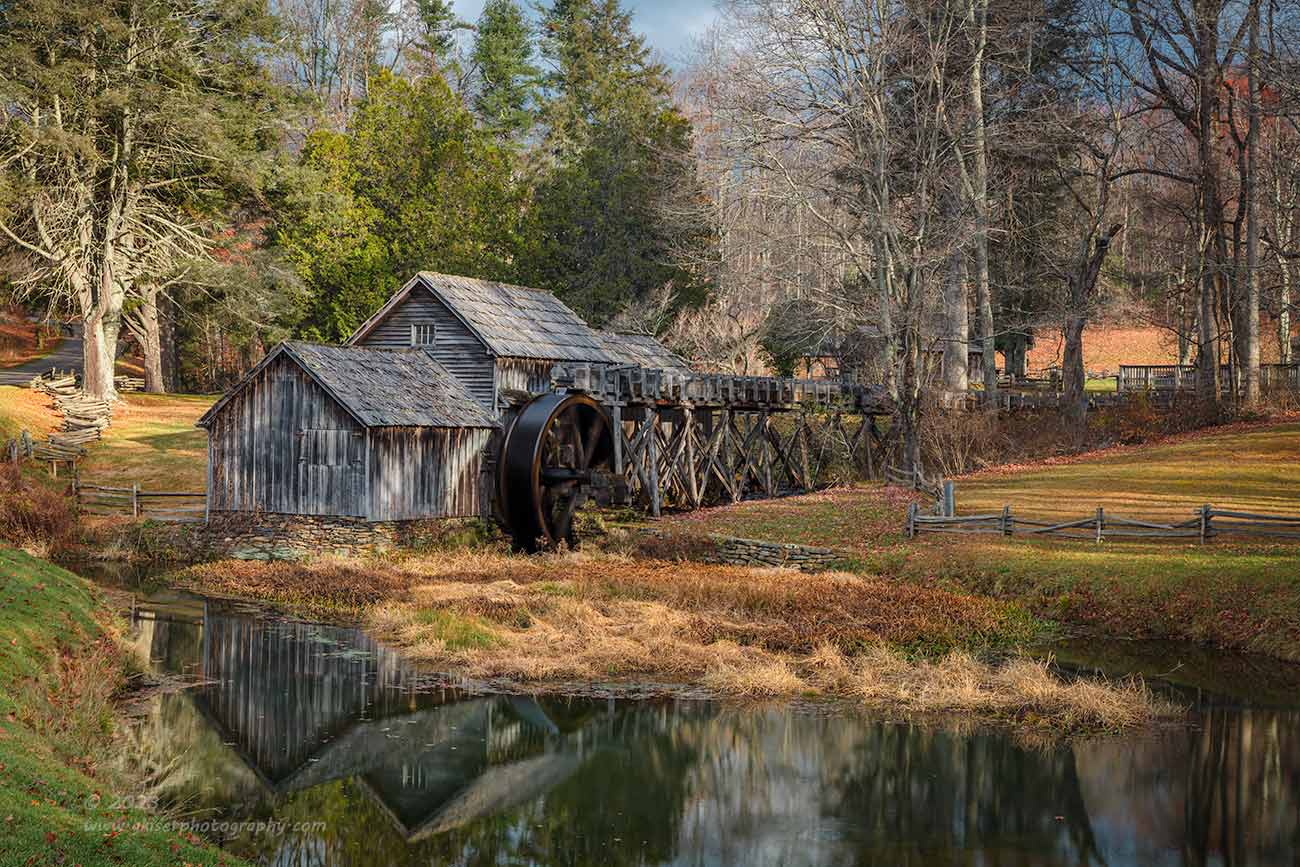
I was actually capturing a lot more of the scene than I would normally because the trees were bare, and the water trough was showing quite nicely alongside the mill. Usually, I try to keep this composition very simple and just focus on the mill itself, but my gut told me to go wider and capture more of the surroundings to tell more of the story. In hindsight, I am so glad that I made that choice because the image has a presence that the others haven’t had. I actually really like the one that I decided to keep, and I’m so glad that I decided to stand there and point the camera over there. The lighting in this particular frame gave a presence to the tree on the lefthand side which helped to frame the mill within the frame. The reflection was good and complete balancing out the bottom of the frame.
For those purists that want everything to fall into the rule of thirds, I really didn’t pay much attention to any rules with this photo. My main goal was a visual balance. The way to achieve that was to have the mill roughly centered top to bottom, but well off to the left framed by two dominant trees. The trough continued behind the mill giving a great indication of depth the same way that the Parkway provided on the left side of the frame. The reflection filled the area beneath the mill, and I was able to frame the image in a way that eliminated the nearest shoreline which I didn’t think helped the image at all. The touch of sky at the top was just enough to set a sense of scale for the environment and to provide some cool tones to balance with the wooden tones throughout the image.
As I suspected, the edit went very smoothly, and I was really impressed with the quality of the final photograph. I made use of several new features that had been added to Lightroom since the last time I edited one of these mill images. Looking back on several of the older photos, I can see how my level of maturity has improved when it comes to color handling. The same can be said for the way I composed the scene and the care I took with the motion of the water wheel which was captured at a half second. This actually took some effort to arrive at because I wanted to show the motion of the wheel since it was actually spinning today, but I didn’t want it overly blurred so that the spokes got lost. Again, this is a testimony to my maturity as a photographer because once upon a time, I was happy with several seconds that just blurred it all.
After shooting a total of 15 frames of the mill with lucky number 11 making the cut, I felt that I had plenty to work with. I packed the camera up and decided to wait for John. As I moved back to the parking lot, I saw him pulling in right on time. Moments later we were off and running on what became a five-hour session. We discussed what aspects he liked the best about the mill and started to work from the grand scene. We figured out whether he wanted a clear shot of the mill, or if he was looking for some foreground interest which would come in the form of the fence and the rhododendron bush at the established overlook. Of course, the bush was not in bloom, and was actually missing a large portion of the leaves. He opted for the wider open view similar to what I had shot to begin with. He talked me through what he wanted in the composition and we arrived at where he needed to stand. I believe that Erin, Samuel, Melinda, and another John had stood in that spot in the last couple of days. But this is what we have to deal with when photographing a scene like Mabry Mill. The idea is no longer to come up with a unique photo, but it becomes a challenge to yourself to create something better than you have done before. I had achieved that goal earlier, and since John had never seriously photographed the mill before, I was just looking to set the bar very high for him so he would have a lofty goal for his next time here.
We ended up with an interesting conversation about the difference between vertical and horizontal orientations here. This wasn’t something that I had planned, but the opportunity presented itself when he was using his phone to figure out his composition (pro tip right there). I noticed that he was using it vertically and started to inquire as to why he was doing that. His logic was sound since he was wanting to minimize the elements on either side of the mill. The tradeoff was that he was getting either a lot of sky (not a problem), or a lot of the grass (boring grass). We talked about what the orientation of the frame said about the elements in the frame. The mill became secondary to the environment in a vertical orientation, while a horizontal one would spotlight the shape of the mill within the landscape and put more attention on that. Neither was wrong, but I needed him to make the decision after full consideration.
He ended up starting with a horizontal composition and worked through some different angles as he fine tuned the photo. The sun was starting to become a problem at this point and when we got to the part of the discussion on shutter speed for the water wheel, he had a different concern than I did an hour earlier or so. It was just too bright to get to a half second exposure, so we had the opportunity to learn how to use ND filters which had not come up in any of our sessions. We used a 5-stop Mor Slo which allowed him to get to that needed shutter speed and allowed wiggle room to try a variety of exposure settings to see what he preferred since I never claim to be the final word on an artistic choice.
Once he arrived at an exposure that he liked, we made sure that he got the shot that he was after with the camera positioned horizontally. Then I reminded him that he wanted to try it vertically as well. He flipped the camera and started to frame up a vertical shot. This proved more difficult than he had envisioned because of where the mill needed to be placed in the frame. He struggled with it for a while and decided that he much preferred the horizontal frame better.
Not wanting to miss out on a teaching moment, I saw this as a good time to talk about square crops and how they really work well to calm a scene. With a reflection as an element, it was another good opportunity to split the scene top and bottom, while using the square crop to balance it all. He tried that and really liked how it was looking. I’m thinking that will be his favorite composition out of all that we shot there. I’ll admit, how he dialed in his composition into that square really looked good and I thought about bringing the camera out once again and getting a similar shot, but I had already spent time getting a composition that has been captured many times over. I was happy to let John have this one.
From there, we went in close to the water wheel. Originally, I had planned on getting some intimate shots of the wheel like I had done a while back, but that became very impossible with the wheel rolling. There were other opportunities to work on though, so we spent some time exploring those. It made me very happy to find more opportunities for John to do some long exposures with some of the water runoff from the trough. Sadly, I don’t think that the lighting was going to let it work as I had hoped. With other’s wanting to get photos of the wheel, it was time to move on to something else more productive. I knew of several points of interest behind the mill that should provide some opportunities.
I let John work around the area and find things that interested him. He ended up gravitating towards one building that was nestled in some trees that I recalled getting some isolation shots of years ago. The building was interesting with the way it was framed by the trees, and it had some nice textures with the wood and stone. We both liked the window, and we started working on a way to photograph it. John was a bit more motivated to work it than I was, so I offered some suggestions before leaving him to get a composition that he liked. I went around and looked for something a bit more suited for a photo, but really didn’t find anything other than a wagon wheel that I had spotted on the way back to this section.
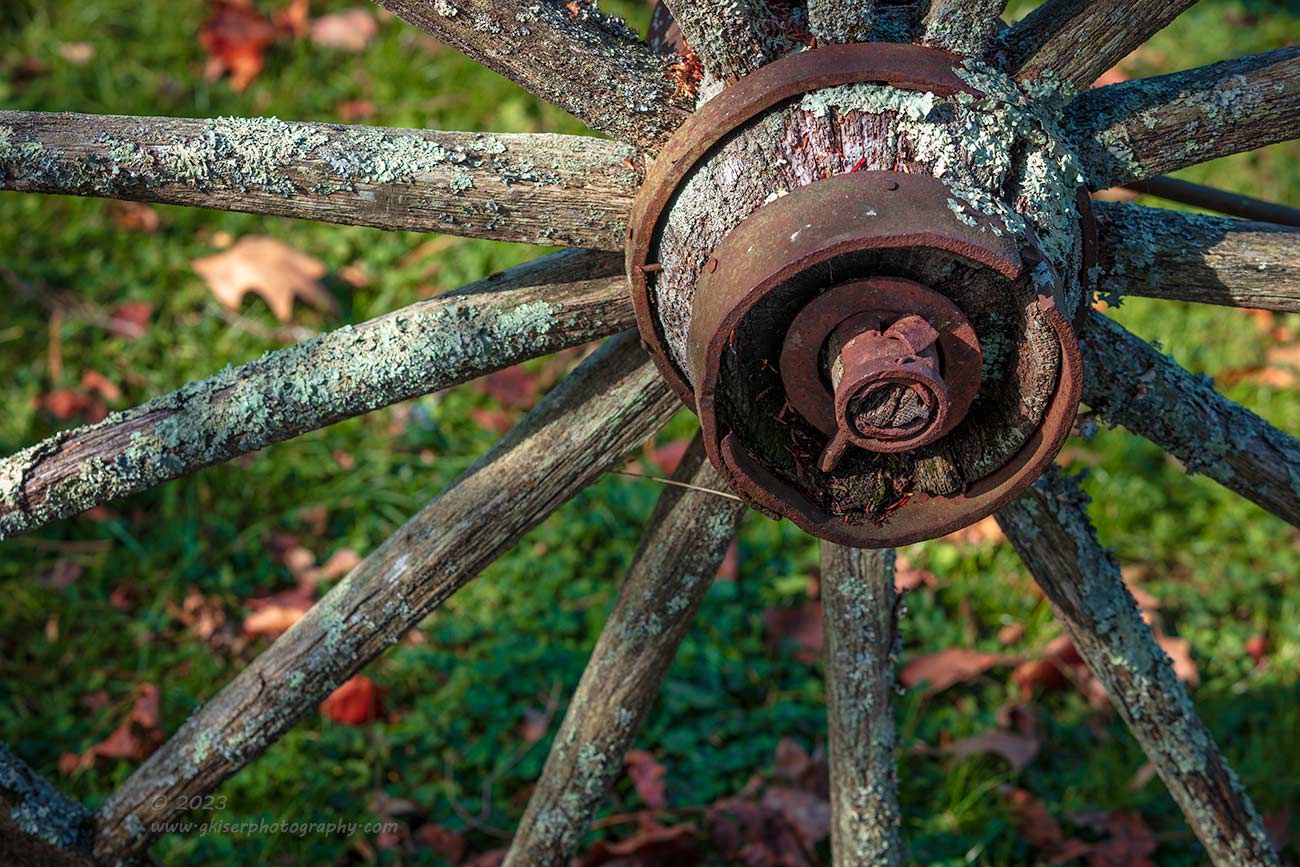
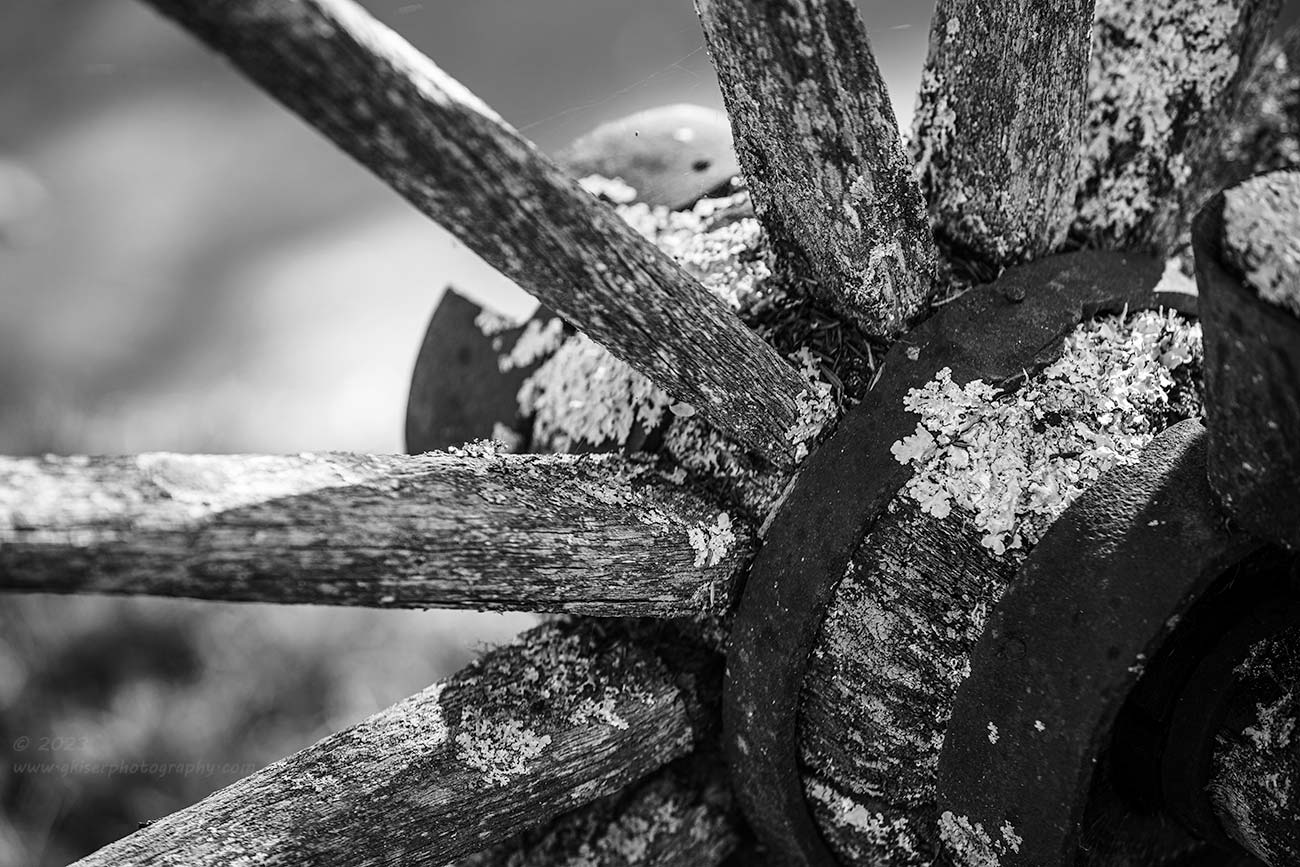
I rejoined John and continued helping him work through the composition on the building and eventually we moved on to another wagon which had some lichen on the wheels that John found interesting. There was more texture here than the wheel I had spotted, and I started to get interested in this one too as we worked through some compositional ideas. Once he was good and started, I checked with the other wagon once more and determined that the one John was working on was a better option. I returned and started to find my own compositions. I used this as an opportunity to showcase how to shoot details instead of getting the whole object in the frame. We both agreed that the hub was the most interesting element and that was what we both focused out attention on.
As you can see, I ended up with several different compositions from two different wheels. I’ve always had a thing for wagon wheels and find them visually quite interesting. I tried a lot of different angles but made sure that I worked it from as many as I could figure out. Surprisingly, I even found a way to work out a composition from the back side of the wheel which I think turned into one of my favorites from this subject. As John and I discussed, doing these isolations prompted more questions than they answered. If the photo works as planned, this will leave the viewer looking deeper into the image to try and determine the rest of the story rather than seeing an entire wagon wheel with the wagon and scenery included in the frame. What do you think after looking at these three photos? Was I successful in my goal?
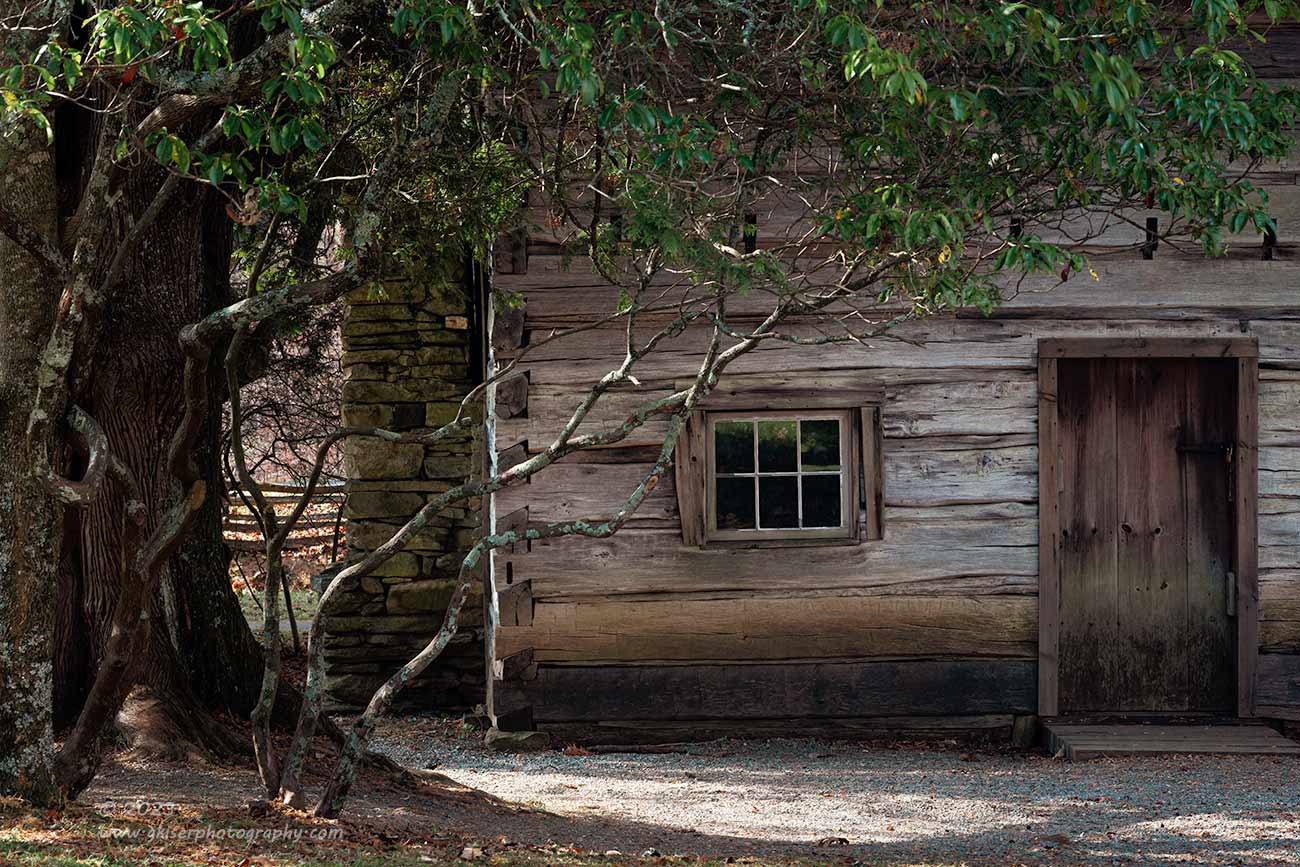
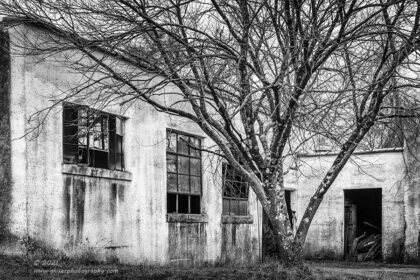
After spending a good deal of time with the wagon, I again turned my attention to the building that John had been working on. While he was finishing up with the wagon, I started to explore my concept of a composition, but from further away and through a longer lens. It still wasn’t ideal, and I wasn’t sure that it was a successful composition, but I shot it anyway. The reason that I did was that even after some time had passed, there was still something interesting about how the trees were shaped at the corner, not to mention how the leaves framed the window and door so well. I just had to wait on the clouds to cover the sun enough to take the highlights away from the scene while still leaving a bit of sun on the gravel to show depth to the scene.
I ended up shooting seven frames of the building which was a lot for something that I really wasn’t sure if I even liked. Even after editing it and looking at it now, I’m not convinced. I still see the elements that drew me in originally, but… I just don’t know. Had I not been out there trying to see things through John’s eyes, I probably would not have even spotted this scene as a potential photograph. That has happened several times before, and when I went back to shoot based on the concept, I have ended up really liking the resulting images. Maybe in time this will join those ranks. I’m glad I stuck with it and got to this point with the concept though.
When we both got done here, I took him over to one last place that I thought would make a good shot for him based on what he likes to photograph. We worked through that scene and it was time to hit the road. He wanted to shoot a church a few miles South on the Parkway and still needed to get home kind of soon. We got there and worked through the scene while he got a number of photographs while learning some tricks in stacking several filters to arrive at a good exposure. When he was done there, I was done for the day. It had been a very long one indeed and while I had thought I would go out on my own for some more photos, I was out of gas and needed to head back.
I had shot a total of 45 frames which was a lot considering most of my time was spent guiding and teaching. Of those, I ended up with these five keepers. I think that the best of the bunch happens to be the first one that shows the mill, but that is probably the reason that so many people take photos of it. You can quite literally point the camera in the general direction of the mill and come away with a pretty decent shot. I don’t pretend that this photo is any better than even the average photos of this location, but I think that I have done better than my previous attempts which is a good enough reason to have spent time shooting it once again.
Something that I read a while back rings true here. When faced with the often-photographed locations (like Mabry Mill or the Linn Cove Viaduct) go ahead and shoot the expected composition, but don’t stop there. Continue working the area in an attempt to find something that hasn’t been done before. With every shot, try to either improve on your own work, or try to make something that is truly special in the larger realm. Just keep things in perspective and know that the most important thing is that you improve over what you were able to do yesterday. I’m really happy that I have achieved that goal with the mill today, and it is that much sweeter that I have introduced a new photographer to this little treasure so that he can start improving on his own photography.
If you are interested in doing a mentorship with me, I offer several different levels of service from quick image critiques to hourly sessions, and even advanced mentorships that cover many hours of instruction. I have several different price points to meet your budget and am happy to custom build a package to suit your needs. All you need to do to get started is to contact me for a free consultation to see if we are a good fit, and if I can provide what you are in need of. With the holidays right around the corner, I’m happy to work out a gift certificate if you would like to gift a photography education to somebody. It would also help me to remember that there is a holiday coming up. I’m here to help you achieve your photographic goals.
Thank you for joining me on this trek to a well photographed location. I’m possibly going to try and go out again tomorrow if the weather turns out to be any good. I don’t know where I am going to go as of yet though, so it might be a surprise for all of us.
See you next time…

Remember to use the code KISER10 to get 10% off your purchase