Tuesday, January 3, 2023
It would seem that I am off to a running start for the new year. Just hours into the year I was out on a trek in North Wilkesboro with the old Forester Nu-way building which I had shot before. Of course, that trek came right on the heels of my yearly review installment of my Behind the Camera. If that wasn’t enough, just a couple of days before the end of 2022, I was out in Jonesville with a quick photo shoot of a new property that I had found recently. It is actually that last trek of 2022 that gets us started with this one. You will recall that I spoke to a property owner and got permission to photograph on his property, but he was reluctant to give me permission for his sister’s property across the street. I had hoped to have had a phone call from her by this point, but I had not heard anything at all. Most of the time, I would just take that as an indication that I was just not meant to get on the property, and I would leave it alone until I was out that way again and I would give it another try. I just couldn’t do that with this property. There is a scene that involves an old Volvo and a Ford Fairlane that I just really want to capture. I haven’t been able to shake the thought of it since I first found it when I was going out for a mentoring session before Christmas.
I had pretty much taken Monday off for a bit of a rest after a full week of activity but saw that the weather was going to be cloudy through most of the day on Tuesday. That got me thinking about where I might want to go for photos. Of course, that Volvo was haunting my thoughts and I could think of no other location that I might want to go. It wasn’t far away, and since there was going to be clouds all day, I didn’t need to get an early start so there was no need to set any alarm to get up. I did make the mistake of getting to bed kind of late which threw me off for the morning. When I started to wake up, I heard the clock in the living room chime for a half-past the hour. Looking at the window, it appeared to be too light for 7:30, so I figured it was probably 8:30. I could sleep a little longer without any problems. As I dozed, Toni woke me up and said that it was 10 o’clock. I was hoping that she was kidding, but somehow, I knew that that was probably right. I had slept in a lot longer than I had intended which kind of threw me off a bit. I went ahead and got up to get ready to roll out.
I got my morning stuff done in the studio real quickly and loaded my camera up in the truck. I was on the road by 11 which was actually my goal for the day. It was roughly a 30-minute trip out to Jonesville, and the location that I had been salivating over for weeks now. Halfway there the sky started to clear up and I started to think that I was going to be out of luck for the light that I was after. I kept on going with the hopes that the light quality would at least be good enough. When I arrived, I figured that I would start off at the house where the sister lived and see if she was home. I knocked, but there was no answer. Some of the decorations had been taken down so I knew that she had been home at least. I went back to the truck and headed across the street to the property owner I had talked to before. I saw him outside working on a car, so I pulled into the driveway.
He recognized me and we started chatting. I asked if he had gotten a chance to talk with his sister yet. He informed me that he had seen her, but it had slipped his mind to ask her to call me. With that bit of information, I asked if he had by chance had a change of heart about giving permission to access her property. He was still hesitant to do that, so I asked if he would give me her number since I was out there again, and the light was actually really good. He advised that she didn’t like to give her number out. Seeing that there was going to be no way of getting any headway, I confirmed that he still had one of my cards and he was still planning on giving her my number. He said he would see her again this weekend and would give it to her then. That would have to be good enough because there was really nothing else that I could do to get on the property at this point.
Sadly, I went back to the truck and pulled back out into the road and started driving. I had no destination at this point and decided to just drive around to see what I could find. There was a lot of potential out in the area, and I knew that if I looked hard enough, I would find something interesting to shoot. I was glad that I had already gotten that first image of the year out of the way though because I would be feeling a lot of pressure to get something if I hadn’t. I was still feeling kind of pressured because I didn’t have any alternate plans, and I was looking at some really good weather since the clouds had thickened back up nicely. In fact, it was starting to look like it was going to rain any moment, but the hourly still was showing it starting well after dark.
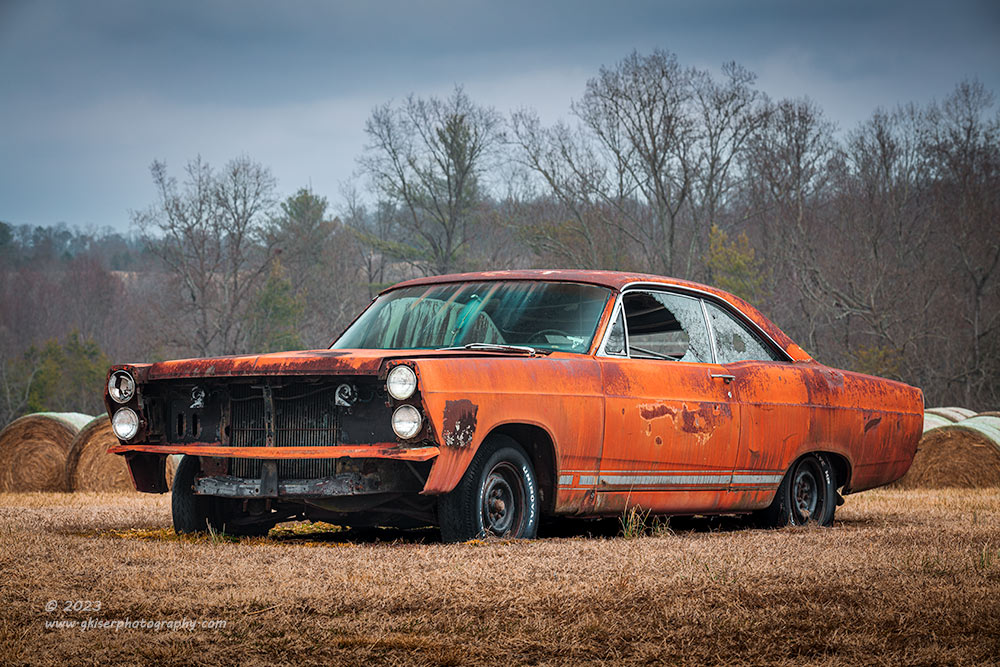
I don’t remember the road that I ended up on because I was turning down lots of roads that I had never been on before. As I came around a bend, I saw an orange Ford that caught my eye. It was not in the best location, but I loved the car which made me slow down and look closer. There were hay bales behind it that I really liked, but there was a house in the distance to the left along with the edge of a barbed wire fence which wasn’t all that pretty. To the right was an inoperable Suburban and a swing set to the right of the last hay bale. The sky was also not all that interesting overhead. All of these negatives were going to cause me problems in setting up a photo, but the car was just too awesome to pass up. I got turned around and pulled into the shop lot where the car was parked and saw that there was a driveway to a house attached. Since it didn’t appear that anyone was at the shop, I just drove down the driveway to the house.
When I got there, I walked to the front door and rang the bell. It was a nice long bell so I knew that if anyone was at home, they would have heard me. I waited for a couple of minutes to give them time to get to the door, but nobody ever came. I saw no signs of anyone being home, so I just went back to the truck and backed out of the long driveway. There was still no activity at the shop, and I didn’t feel comfortable treating this like a commercial location since it was attached to a house. The car was far enough off of the road that I would have to be well into the property to get in as close as I normally would like. I wasn’t going to be able to do that.
But the car was just too good.
I went back out on the road and looked at the car critically for the first time. All of the issues that I had with it would be worse the closer that I got. My best tool for capturing this car was going to be my long lens at a distance so I could eliminate the background distractions. As luck would have it, there was an abandoned house across the street with a driveway I could pull into. The house wasn’t interesting to me at all, so I wasn’t planning on shooting it, but I knew that I wouldn’t be in anyone’s way at the end of the driveway to the house. I got out and started to look at the scene to get an idea of how I wanted to shoot it.
The easiest composition was from the passenger’s side because I would be able to isolate the car and have the trees as a backdrop. The sky wouldn’t be an issue. It was a relatively simple composition, but the passenger side wasn’t nearly as interesting as the driver’s side. There was more moss growing on the passenger side that really muted the orange color, and the windows were all in one piece. The driver’s side on the other hand was brighter and had two broken windows that added to the visual interest of the scene. I was torn as to which side to work with.
I grabbed my camera with the 70-200mm attached. It seemed to give me a great field of view from the opposite side of the road. I worked on the angle and composition for the passenger side first since that was going to be the easiest to work with. I tried some compositions from both sides of the road but couldn’t really find one that excited me. To get a little more compression out of the scene, I went back to the truck and grabbed my 2.0X teleconverter and used it to give me a 400mm reach. I was able to work further back than before which helped to compress the background to where I needed it. I finally landed on a composition that I liked, and I got a few images of that before moving to the driver’s side.
I left the camera built the same way and started to work out compositions. This side was much more difficult because I was shooting past a Suburban, a dumpster and a swing set on the right side of the frame and a house just on the other side of the corner of a barbed wire fence with a tree stump nearby to the left of the car. Including any of those items in the frame would create a huge distraction for the car. I wanted to keep the scene simple with the car and the hay bales as my main subjects. The trees would be the background and I was unfortunately going to have to include the sky which wasn’t really wanting to do.
I worked through a lot of variations on where I had the camera, but I kept coming back to a spot where I was shooting at less than 200mm which meant that my teleconverter was not serving any purpose after all. I pulled that out and took it back to the truck. While I was there, I grabbed a 3-stop ND grad to just take a little of the exposure out of the sky. I slid that in and went back to work with a composition that I wanted. I was getting there, but I wasn’t quite ready to commit to anything just yet. I kept making small adjustments to change the relative position of the hay at the rear of the car. As I was doing that, the clouds were starting to part behind me and that put some extra light on the car which it needed. With a bit of texture coming into the sky, I really didn’t need the grad filter anymore, so I pulled it out and ran it back to the truck. I was now back to just the polarizer and the 70-200mm lens which made things very simple. The histogram was looking really good, and I finally had a composition that I liked. I stuck with it as the sky changed for a few minutes and rattled off a number of exposures.
After about 10 minutes of working this composition, I was pretty sure that I had something that would work out. It hit me that had I gotten permission to enter the property that I wouldn’t have bene able to get this composition and might not have even tried it as I would have been in closer working with a wide-angle lens trying to mask problem areas with the car. I’m not convinced that I would have gotten anything any better than what I had shot from across the road. At any rate, I had two different compositions of this car that I liked now. I was satisfied and ready to move on to find something else.
You will notice that there is only one photo of the car here and that is because it was the stronger composition of the two sides by far. The other one was just a little too simple and seemed quite boring. This one had much more depth and visual tension to it. The character of the car came out much better from this side as well which was a main goal of mine when I stopped to consider the photographic potential here. I was happy, but still wanted more from the day since this was still not as good as what I had envisioned with the Volvo from the first location I had stopped at.
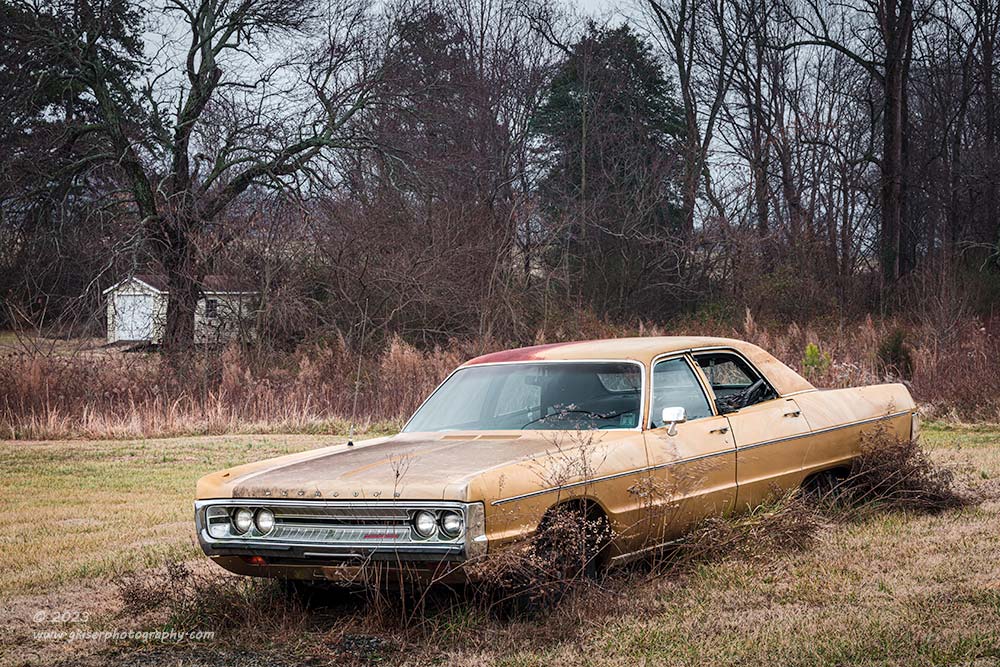
It was maybe another 15 minutes of driving before I stumbled onto my next subject. This one was right off of I-77 and just seemed to be completely out of place. I saw a Plymouth sitting behind a store in a fairly large lot all by itself. The car wasn’t all that beautiful and there wasn’t much rust on it, so I wasn’t sure what caught my eye other than the fact that it was all alone. Sometimes, I just being isolated from the surroundings will present a less than desirable subject as a good photographic opportunity. I went ahead and pulled off on the side of the road to see what I could do with it.
The car was really unattractive, and the color blended in with the surroundings almost too well. If I were to shoot from the passenger’s side, I would have the rear of the store up on a hill as my background which was not an option. If I shot it from the driver’s side, there was a small outbuilding in the distance that would end up being included. At first, I didn’t like the idea, but as I looked at the scene, there was a large tree with just enough definition to it that I could see an opposing element to the scene. It would be positioned just about right in the frame, and if I used my long lens once again, I could reduce the distance between them and have that tree and out outbuilding become part of the story of the car. It was worth a try.
I went back to the truck and grabbed my camera and long lens. Of course, I had my polarizer attached to control the glare on the glass and some of the metal. I worked on finding the right place to put the camera as well as the right elevation. It was that last part that proved to be the most difficult. I wanted to have the camera up high to reduce the amount of sky that was in the photo. However, that presented a problem as I lost the structure of the tree and then that reduced the weight of that secondary element which ended up creating negative space that didn’t make sense. I had to drop the camera a bit to get more of the tree which gave me more of the sky as well. I felt that it was a good tradeoff for the sake of the whole image because having that tree structure in the frame was quite important to the photo.
The next issue that I had to worry about was the breeze. It was blowing the weeds all over the place and causing me all kinds of issues with blur. I boosted the ISO by a stop and that reduced the blur that I was seeing. I would just take shots when the breeze would die down a bit hoping that I would get everything frozen. Ironically, the frame that I ended up editing was one where one batch of weeds were actually in motion. It was one of the few where that happened, but I decided that I really liked the effect since that was a tall weed that was going right through the rear-view mirror in most frames. With this one, that one weed was blown forward and blurred making it all but invisible. The rest of the weeds were still and sharp so having the one weed that was a distraction moved and blurred was actually a good thing. It was an unintended result, but one that I was happy that I had to choose from.
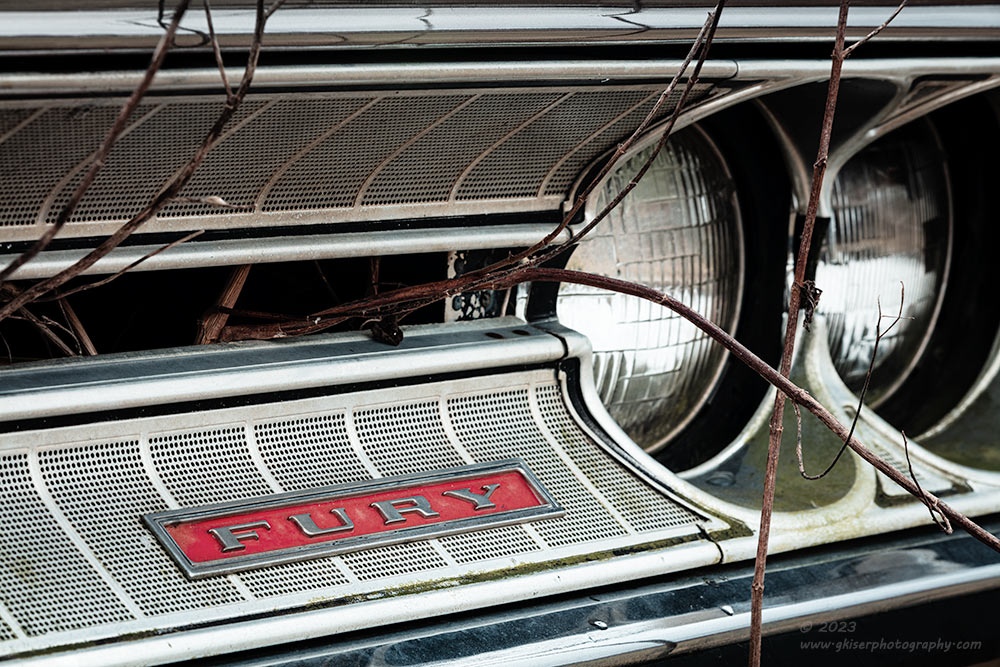
I was still kind of confused as to why I was drawn to this 4door car from one of the less than stellar periods in automotive history. I had the overall shot that I wanted and thought that it was going to turn out pretty good despite having a subject that wasn’t exactly beautiful. There had to be something else here that I wasn’t seeing consciously. As I looked the car over, there was one detail that I found to be interesting and that was a red badge on the grill. At the distance I was from the car, I couldn’t make out what it said, but looking through the camera I had been able to see that it was the “Fury” nameplate. That red had caught my eyes before I had noticed that the car had too many doors on it. Since I was here, and that badge was catching my eyes, I decided to figure out if there was a way to capture it in a photo.
Looking around, there was really no reason why I couldn’t approach the car. It was kind of close to the road, not associated with any particular property with the exception of the shop on top of the hill. There was nothing here to indicate that they didn’t want anyone on the property, so I just moved in a little closer. I was focusing my attention on the grille at the point where the nameplate was affixed. I started working it from the headlight side but didn’t like how that was looking at all. I then moved over to the other side of the badge and started to place it in the foreground with the headlights relegated to a secondary element. This almost immediately worked out better. I loved how it all came together, especially with the weeds growing through the grill and in front of the headlights. This was the composition that I was getting excited about. This was why I had stopped, but I didn’t know it until this point.
I played with the composition for a while as I tried to decide just what needed to be included and what needed to be omitted. I was stressing over the smallest details, but that is when I am most interested in the photographic process. I love making small and subtle adjustments that nobody will even notice in the final image because when I look at the image after the fact, I can tell why I placed everything where I did in the scene. This was one of those compositions and I knew that it was going to be a really wonderful photograph when I was done with it.
I probably fiddled with this composition for about 15 minutes before I had landed on the shot that I knew was going to be the one. Looking at the image review, there was nothing else that I could see that needed to be improved on, or potentially changed. It was perfect as it was, and I loved it already. This one is probably the favorite from the day up to this point and very possibly the favorite out of all of the images that I shot. It was definitely worth stopping to work the ugly duckling Plymouth for this isolation shot.
I was feeling pretty good at this point and was wanting more subjects to photograph. I got the camera loaded back into the truck and off I went once again. I had no idea where I was, but just kept driving around. Eventually, I made it to 67 which I was very familiar with. I started crisscrossing that road taking all of the side streets to the North and South. Some of them I had been on before and I saw several subjects that I had photographed previously. I also saw a lot of new areas and found a lot of potential, but nothing was jumping out at me. The weather was starting to change up again. One minute it looked like it was going to clear up and the next it looked like it was going to start pouring. I just rolled with it and decided that I was going to keep on looking to try and find something else to photograph.

I probably drove around for an hour or so before I decided to start back in the direction of home. I knew that Bus 21 would eventually end me up in Elkin and that was familiar territory for me, so I just stayed on that road until I got there. As I was entering downtown Elkin, I recalled an old railroad trestle that I had been eyeing for a couple of years. I had yet to really figure out a good composition for it but knew that it needed to be shot in the winter when it was more visible. Since I had time, and the light was good, I decided to go and check it out. I took the side roads through town that would lead me right to the trestle.
When I got there, I wasn’t all that impressed with it, which has been the case many times that I have driven by. The one redeeming quality was that the sky was looking really nice above it. The light was nice and even and I did like the rust on the steel. It was just a very odd composition that I was seeing. I was tired of driving at this point, so I decided that I would get out and at least give it a shot or two now that I was here. I got the camera out and fitted the 16-35mm lens because everything that I could think of for a composition was going to be done with a wide-angle lens. I added a polarizer but didn’t bother with a grad filter. I knew that the trestle would be well into the sky, and I needed to keep the exposure right on the metal more than anything. If I couldn’t get the exposure right without a Grad, I would do an HDR blend, or just forget it if the wind was too much for that. I wasn’t all that committed to the photograph because after two years of looking if it was going to produce a great photo, I would have tried it long before now.
I hate when I’m wrong!
I worked both sides of the bridge and tried all kinds of different compositions. Nothing was really working for me. The best light was on the left side of the trestle which had the worst background, and the composition read the wrong way. For anything on this side to work, I was going to have to flip the composition horizontally so that it read better left to right. The exposure was also not all that easy to get right because most of what I wanted detail in was down in the shadows while I was protecting the highlights of the sky. The wind was too strong to bother with an HDR blend as there would be no way to get the weeds and trees to line up between multiple exposures. I did take solace in the fact that I was planning on making this a black and white image. The idea for that came from the fact that looking through the live view, I saw no color, only bright and dark areas which seemed to ask for a black and white presentation.
The nice thing about black and white is I can take a very high contrast scene and really make it pop without worrying about pushing the pixels too far. A little noise in a black and white photo is pretty much just grain and I can live with that. It would give me a chance to focus more on the structure and texture of the elements of the scene as well. There was no need for color in this photograph.
I hate when I’m wrong!!
OK, so when I got home and started to look at the images from the trestle, I was actually amazed at how photogenic this thing was. I loved how the photos were looking straight out of camera even if they were a bit too contrasty for my tastes. I found the best of the bunch from that initial round and started to process it in black and white. I flipped the image like I knew I needed to and that worked perfectly to let it read correctly. I did a full edit in black and white and found that the photo worked well but lacked something. No matter what I did to the tonality of the scene, it just didn’t resonate with me. I went back to the color profiles to look for a different black and white profile but happened to see one of the color ones. It was not one that I would usually use, but the colors looked really good on the scene and even with the extreme processing that had been done for the black and white, the quality of the image was still very much intact.
I went through and converted it to the Landscape profile and worked on some of the colors to arrive at this photograph. It was not what I had envisioned when I started the scene, but I have to admit that I really like how it looks. The photo reads well and has a lot of texture with the steel that showcases the decay aspect that I love. I won’t say that this is a great photograph, but it is so much better than what I thought would have been possible at this location. I really should have stopped here much earlier and tried this out. I’ll just tell myself that I didn’t have the knowledge base to really make it work out like I have this time. Yeah, we will go with that. I just needed to grow as a photographer before I could tackle this subject.
Well, I must have grown a bit while I was out here, because I still wasn’t satisfied with what I had. I felt that I was onto something good, but that I hadn’t quite gotten there yet. My battery was about dead, so I had to go back to the truck to swap it out. While I was there, I considered the possibility of using my 14mm prime. I had been at the 16mm end and found that it wasn’t quite enough, and I ended up working between 20-24mm instead for most of the compositions that I had been working on. One compositional idea that I had just wasn’t possible, even at 16mm and that was including the stop arm at the rail crossing. I might be able to get it with that 14mm, and I figured that I might as well give it a try. I do love working with that lens and I don’t get to use it nearly as much as I would like.

I went back across the street and started to estimate where I needed to be with the camera. I already had the camera flipped onto its side for a vertical composition, so I just looked through the viewfinder. This is one of those really nice things about a DSLR when compared to a mirrorless camera. Here I was with the camera totally off looking through the viewfinder which is looking through the lens to see what my composition was going to look like. I was able to get the camera in the right spot and have a really good starting point for a composition without even turning it on. Now that I had the rough location to start with, I turned the camera on to get an idea about the exposure. I set the aperture to f/13 (manual aperture ring) and started to look at the light meter to gauge the exposure of the scene. This is a little trickier than using the histogram which I can’t use with this lens. I was able to get the exposure dialed in and confirmed through the histogram during the image review. I started to look at the image review in detail and decided to make a few adjustments to the composition.
I made those adjustments and really thought that I had wasted my time here because the contrast of the scene made me want to do this as a black and white image but having the cross arm and stop lights made me really want to see this in color knowing that the reds would balance out very well with the blue tones in the sky. I only shot a handful of this composition because I was sure that it wasn’t going to work out the way that I wanted it to. With that, I was pretty much done for the day. I was tired and ready to head home, or at least start that way and keep a look out for other targets of opportunity.
While I was on the way home, I decided to stop by a house on 268 that had a couple of Chevy Bel Airs in a car port which I had tried to shoot a few weeks ago. When I got there, there was a new car in the driveway, so I was pretty sure that they were home. However, I was looking at the cars and just wasn’t seeing the potential that I had in the past. Not wanting to waste an ask during a time when I wasn’t feeling the photograph, I decided to save it for another time when I was motivated to capture the cars. I could feel the dip in my creativity at this point, and I think it was mostly because I was feeling very defeated from the railroad trestle that I had just photographed. I just didn’t think that I had anything worthwhile captured for all of the work that I had put into the photos.
I hate when I’m wrong….except when I am wrong about messing something up. I don’t mind it in those cases.
That was pretty much the end to my day. I had shot 85 frames, most of which were duplicates for different sky positions. I was pretty sure that I had three photos in the bag with a possible two or three others that might make the cut. I regretted that I wasn’t able to photograph the location in Jonesville like I had intended, but in the grand scheme of things, the day actually turned out pretty good. When I started to cull the images, I ended up with the three that I was pretty confident in from the two cars. I also picked two from the trestle that I thought had potential. By the time I had finished editing the photos some three hours later, I had two photos from the tracks that I really liked and thought that they had captured the essence of the scene quite well. In fact, it was that 14mm shot that I had dismissed as a failure early on that has turned out to possibly be a favorite from the day. It is a close call between this and the grill photo for a top spot. Time will tell which one will remain a favorite, but I have to give credit to that super-wide perspective for making a very dramatic composition that just has a lot of excitement built into the composition.
I thank you for joining me on this second trek of 2023. I hope that you enjoyed the trip as well as the photos. Remember, there is just no better way to enjoy a photograph than in its intended form which is hardly ever on a computer screen or handheld device. Every time I photograph a scene, I am intending it to be seen and appreciated on some form of photographic media. The colors are all done with that end use in mind as well as the overall tonal range. Printed versions of my photographs are where they shine, and I love making prints of my images. If any of these speak to you on that level, I would love to talk to you about matching you up with a fine art print of the photograph. Not only would you be receiving a piece of unique wall art, but you would also be supporting my photography and allowing me to continue with my treks.
If you are wanting to learn how to be a photographer, check out my newly released workshops for the first half of 2023. I’ve got a trio of workshops designed to simplify things like finding the right exposure, building a composition, and how to focus for the depth of field that you want. I’ll have other workshops released for the second half of the year later on, but these are a great place to start if you are wanting to learn the fundamentals, or just want to make sure that you are being as effective as possible with your creative choices. Also, don’t forget that I do offer one-on-one instruction in the form of mentorships. You can sign up for hourly sessions, or we can embark on a much more intensive long-term mentoring program. Whatever you decide will work best for you, I am here to help you become a better photographer.
Until next time….

Remember to use the code KISER10 to get 10% off your purchase