Wednesday, November 2, 2022
OK, this one was not my fault. I fully blame Don Kimmer for messaging me on Facebook the other day. He was asking me if I knew about the place in West Jefferson where there were three or four old road tractors. As we talked, I thought that I knew the location that he was mentioning, but the further we went, the more I realized that I wasn’t sure about what he was talking about. He gave me great directions to get there, and from the directions I’m sure I would have seen them, but the description wasn’t ringing a bell. He even sent over a photo that he grabbed of the location, and it didn’t look familiar at all to me. I was left feeling very intrigued about the location and decided that the next cloudy day that I had, I would head out there and check it out.
That was yesterday.
Yesterday I was getting recovered from a portrait shoot that I had done on Saturday which involved a print delivery on Sunday. I had about 16 hours invested in the session and quite frankly, my creativity was tapped. The session had gone amazingly well considering I didn’t have the normal planning time beforehand. It was kind of a case of winging the whole thing, but it went off without a hitch. What had started as a contract shoot for a single portrait of a Pastor for his church along with a family portrait with him and his wife, turned into a three-hour shoot that yielded 36 edited images for review. The whole session was just so much fun that it felt like it was only an hour or so. When everything was all wrapped up from that shoot, I just wanted to relax and ponder what was next. Well, Don’s messages had gotten me interested in these trucks and as luck would have it, Wednesday’s weather was looking cloudy for most of the morning with passing showers in the afternoon. It was going to be good light for the trucks from the photo that I had seen of them.
Since Toni was going to clinicals early, I had her wake me up when she was leaving the house. That gave me time to get downstairs and get my morning social media posting done and take care of some business matters before the sun came up. Right around sunrise, the clouds started to come into the sky according to the weather and that meant that I was going to have good light for the trucks. I grabbed my camera and even remembered the tripod that usually lives in the 4Runner, but I had it out for the portrait session. I set my course North on Hwy 16 into Ashe County.

I was reasonably familiar with the area that I was headed, and I was sure that I had been there before. A couple of turns off of Hwy 16 and I was on the road where the trucks were supposed to be. I had been here before and remember several of the barns that I passed. None of them were striking me as photo worthy though. I was really curious about the location with the trucks because I just knew that I had been here several times before. It was only a couple of miles until I reached the area and found the trucks. They were just as described, but I’m still not sure that I remember seeing them here before. I guess it is possible that I saw them and dismissed them because to be fair, there was not a lot of options in terms of an overall composition, and there wasn’t much interesting around them. Depending on my mood when I saw them, and what I was looking for I could see this scene not really grabbing my interest.
This time was a little different because I had seen a photo of the group and knew that there wasn’t going to be much in the way of an overall composition. However, I had seen some isolations that I would be interested in trying. That was where my head was at this time, and the fact that the overall scene wasn’t great didn’t faze me. I pulled off into the large gravel parking lot and pondered my options for a minute before I turned the truck off. I wanted to make sure that there were no signs preventing me from being here, and I wanted to make sure that the trucks were going to work out like I had previsualized. I saw no signs, and there was one truck that really stood out to me for its patina. It happened to be the blue truck that was parked at the edge which made it much easier to work with. It looked like everything was a go and I would be able to get some photography knocked out this morning.

I moved the truck out of the way so that I had plenty of room to work before I grabbed my camera with the standard lens attached. Of course, I added a polarizer to help with saturation and contrast before finding my first composition. I had already done a quick walk around to see where my points of interest were. I went ahead and decided to go for the low hanging fruit first by framing up a composition that included all of the elder bobtails. I placed the blue Kenworth in that main position in the frame and let the other trucks frame that one. There was a trailer that I didn’t really care for parked right next to the trucks, but there was nothing that I could do about it. An interesting thing about elements that you just can’t do anything with. You are left with two options, forget the composition, or deal with it. I chose to deal with it and incorporated it into the frame to where it made the least impact. The sky wasn’t all that great, but the soft gradient of the low clouds seemed to suit the scene, so I was happy to include the sky along with the bare trees that shot up behind the trucks.
This seems like a very simple composition to shoot, and I guess the composition was pretty simple to come up with. The difficulty came from the exposure. While the sky wasn’t bright at all, it was a good deal brighter than the trucks that I was photographing, and I could see some exposure problems rearing their head. The easiest thing to do here would have been to add an ND Grad, but with the evergreen trees to the right taking up so much of the frame, I hated to darken them down that much. That would have been extra work in post to get the exposure right on those trees after the fact. I could have shot an HDR series, but I was afraid that the limbs would move enough to cause ghosting between the images. In the end, I opted for the wing and prayer approach and just underexposed the entire scene to protect the sky. The trucks were all in shadow at this point, but I felt that I would be able to pull them out easy enough in Lightroom.
This was not a case of fixing it in post mind you. No, I was shooting the scene for how I intended to edit it. The exposure settings on the camera just gave me the raw materials needed to fully realize the photograph that I was seeing. There is a huge difference in shooting this way and shooting carelessly while relying on software to fix your problems. I knew that I had just enough information in the shadows to recover the detail with better results than if I had used a filter to accomplish the same thing. I didn’t have any extra wiggle room here though, so I needed to get the image as bright as I could make it which meant going until there was just a hint of clipping in the sky. That was what I did, and it worked fantastically. When I brought the image into Lightroom and started to edit it, everything just fell together seamlessly which was what I was hoping for with the way that I shot it.

With the first shot in the bag, I started to look for my isolations. This was going to be where I was going to spend most of my time with these trucks. I considered switching out to my telephoto lens since I have had such good luck with it recently, but I decided to leave my standard lens mounted for a bit longer. I worked my way around the Blue Kenworth because that was the one that interested me the most out of the group. I ended up lingering around the step board on the driver’s side. I found the colors of the patina particularly interesting there, and there was a canister right behind the fender that added a bit of visual interest for me as well. I tried several different ways of photographing this portion, but nothing I was doing was working. I realized that I was trying to be too precise with it and decided to let the diagonals flow instead of trying to get the perspective exact. Once I freed my mind from the straight lines, I was able to see this in a whole new light. The composition just fell together beautifully with great lines and shapes. I was even able to get the door decal in the frame which I thought was important to the composition.
I was starting to feel the creative juices flowing at this point. I had two compositions in the bag, and I was feeling pretty good about things. I started to work my way around the truck some more and spent some time up at the front focusing on the hood emblem and the headlights. I found that the side of the hood with the air box was particularly interesting because of the color contrasts so I spent some time there, but with only moderate success. I was having a hard time lining up the elements the way that I was wanting them. Ultimately, I decided to give the front of the truck a break as I tried some other compositions.

I went around to the other Kenworths which were behind the blue one. These were not as interesting from a patina standpoint, but they did offer some interesting lines and curves. As I was looking for something to focus on, I found a Colorado license plate on the front of one of the trucks. There was just a hint of blue to it which I thought was a nice element considering the truck as a whole was largely a rusty red color. The tag gave a little color contrast for the scene, and I thought that it would make for a good photo if I could get a composition figured out.
Getting that composition figured out was harder than I had thought. I bounced around between shooting a square image and a native 3:2 aspect ratio. I tried different crops as well as including different elements. I even went so far as to include the cab and the sky in the frame. Nothing was really working for me, but I couldn’t help but think that there was something here that I just hadn’t seen yet so I kept on trying. Eventually, I landed on a square crop that I liked, and I shot that. Fortunately, I was shooting in RAW because when I got home I wanted to tweak the framing just a little bit which was easy to do with a RAW image cropped in camera. Not only did I tweak the framing, I changed the aspect ratio to a 4:5 crop which really suited the isolation. I also chose a color profile that greatly desaturated the colors to make the warm tones a little less dominant to the scene.
That had been a very hard composition to work with and I started to think that it might just be the lens choice that was causing my issues. I decided to go back to the 4Runner and grab my telephoto lens to see if that would make any changes. The swap only took a few seconds, and I was back at it again. I chose to go back to the front of the blue Kenworth again where I had seen very little success with the 24-70mm lens. I was anxious to try it with the longer 70-200mm. The first corner I framed up was the passenger side fender and headlight where I had really liked the color contrast.

I went back to the basic composition that I had started with a few minutes before. I then started to back up and try the longer end of the lens until I found the right focal length. The sweet spot was 125mm and I was liking what I was seeing. I just had to work on the side to side positioning as well as the height of the camera. I needed to make sure that I had the headlight placed logically in the composition, the air box in the right spot and for balance, I wanted to keep the Kenworth emblem in a good location around the upper right to form a “V” of interest, or a triangle. When I finally landed on the right composition, I shot a few frames with different depth of field to give me some options when I got home to look at the image on the computer.
Now that I was happy with that composition, I moved back to the hood ornament which I had tried to shoot previously. The composition never really came together for me, but now that I had the long lens, I found the sweet spot at 110mm. At that focal length, the scale of the cab to the front of the hood was much better. I just had to play with the camera position so that I could isolate the steering wheel while keeping the hood ornament isolated in the portion of the cab which was in shadow. The key to this image was the grill which had been painted red at some point. That red helped to balance out the overall blue tones of the image and I thought it helped bring more interest to the rust that was poking through that blue paint. I also wanted to include what was left of the Kenworth emblem to balance out the KW stamping on the hood ornament. There was a fan hanging from the top of the cab that helped balance out the round emblem and the arch of the steering wheel. There were just so many elements here that worked together which was why I really wanted to make this composition work. I had just been using the wrong lens before as the telephoto made all the difference in the world.
At this point, I was pretty sure that I had all that I really wanted from this location. I was figuring that conservatively, I had about three keepers so far. I was quite happy with that prospect actually, so I had no problem going back to the 4Runner and heading on down the road. I remembered when I was first arriving that there was an old International pickup on a flatbed on the other side of one of the van trailers. I really liked the truck, but I wasn’t sure if there was a photo to be had of it though. I figured it wouldn’t hurt to check it out before I left though. I looked over to see if I could access it from where I was, or if I was going to have to go around the long way. It looked like I would be better off going the long way around, but as I was pondering, I happened to see a livestock trailer that caught my eye.
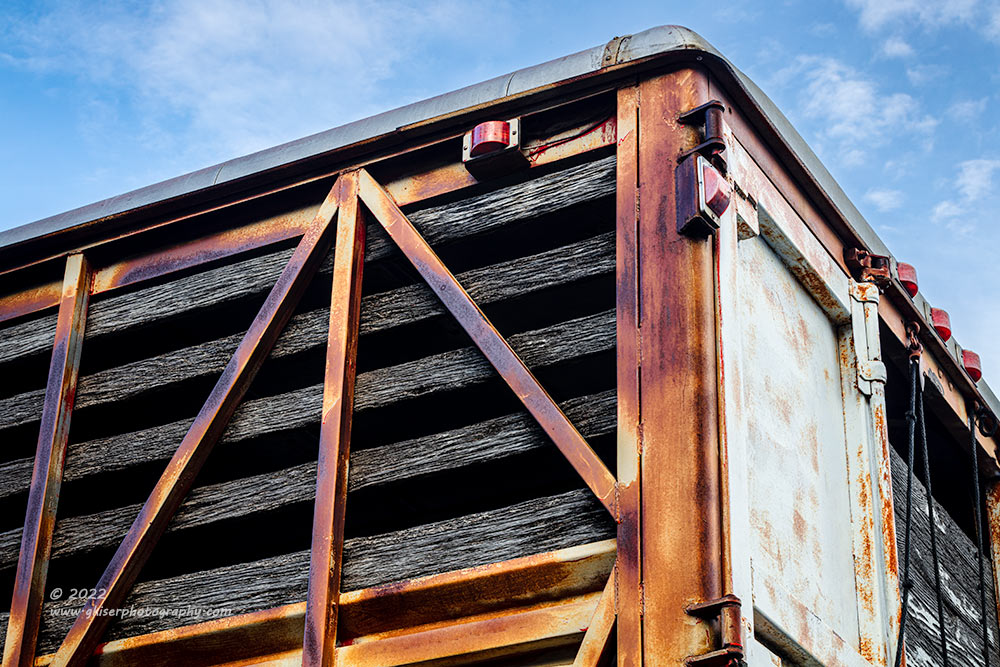
I don’t usually both with photographing trailers because they are usually just giant rectangles without a lot of visual interest to them. This one was a little different and it caught my eye for several reasons. First of all, the sky was starting to clear off and the blue was really looking nice against the rust of the trailer. There was more to the trailer than rusty metal too, which I loved. The wooden slats added a texture and another contrasting hue to the rust which I liked. The metal beams were done as triangles which I am always searching for which was another design element that I loved. Finally, the white door on the back of the trailer worked with the clouds above. All that was left was figuring out a composition.
I tried to get something that captured the entire rear of the trailer which happened to be sitting on a flatbed trailer, but that didn’t really work well. I was going to need to do an isolation to make this work, so I decided to concentrate on the back corner of the trailer where all of the interest was for me. I focused on the triangles with the rusted metal and wood, along with that white door. I made sure to include the marker lights to give a clue as to what you were looking at, and I used the hinge as a lower framing element for the composition. I stayed in kind of close to accentuate the angle of the trailer to bring in yet another set of diagonal lines. By putting the apex near the top frame, I added two more triangles to the mix which was very welcomed. It was an odd composition and not one that I would normally do, but I liked how it turned out.

When I was done with the trailer, I walked around the other enclosed van trailer and started to work with the International. Of course, I was unable to get up to it, and I wasn’t able to shoot on the same plane that the truck was on, but that actually made it easier to get a perspective that was a little unusual by staying on the ground well below the flatbed that the truck was secured to. Finding a composition was not going to be easy from this angle, but I decided that I wanted to include the wheel and the emblem on the side of the hood. The fender also introduced a great shape that I wanted to capture as well. If I got too close, I was going to be shooting just about into the sun with nothing to block it on top of the hood. I was forced to back up away from the truck so that the livestock trailer filled the space in front of the truck while the box trailer to the side took care of the light spillage from on top of the hood.
I decided to make this composition all about metal and there was no vegetation included at all. Everywhere you looked there was aged metal except for the flat tire which added just a bit of character to the image. The colors were perfect for balance here with reds, yellows, oranges, and blues. All I had to do was find the right ratio to represent each of the colors while maintaining a pleasing composition. That part was actually easier than I had suspected it would be. Before long, I had the shot in the bag and the fact that the truck was surrounded by rusty metal gave it an industrial feeling that I kind of enjoyed. It might have been that I had been smelling old diesel fuel for about an hour or so by this point. I had really started to feel at home here and there was just something about the eerie quiet and the stench of old fuel that just really put me in the mood to capture these images.
Even though I was fully involved in the photography at this point, I also knew that I had worked the scene as well as I thought I could. It was time to head onto something else and by looking at the clouds thinning out overhead, I was thinking that it wasn’t going to be something else out here. I checked the weather real quick and found that the clouds were going to be moving out of the area and ironically there was rain predicted in the very near future. I wasn’t wild about being in the rain, or under the clear skies, so I was happy to pack it in and consider my next option. The weather was still showing clouding at the bottom of the mountain, back in Wilkes so that was where I was headed.

Before I got on my way, I considered what I could potentially shoot. I thought of a couple of barns which I had not yet shot as possibilities, but I also remembered that John was wanting to get back out to the location that we had been to recently so that we could work the other barn on the property. I went ahead and sent him a text to let him know that I was going to be back in the area soon and we could go out there if he was free. There wasn’t an answer right away, so I went ahead and started my way back down the mountain figuring that I would stop by a barn on Hwy 16 I had seen many times, and dismissed it as a photographic opportunity just as many times. The last time I had driven by, it hit me a little different. I don’t know if it is starting to show more signs of age, or I’m just starting to appreciate it more for what it is. Either way, I had the want to photograph it, and today was going to be a good day with the clouds.
It was only about 30 minutes before I got to the barn, and I drove by slowly looking to see what kind of compositions I could come up with. I still wasn’t sold that this would be a good subject, but I wanted to give it a try anyway. I pulled off on the shoulder which provided plenty of room for me to get out of traffic. I grabbed the camera with the 24-70mm lens attached along with the polarizer. I started to find my angles and worked a position that omitted the electric fence around the property. I had to worry with a gray wagon behind the barn, a swing set frame to the right as well as a trailer to the right. I bounced around several different locations trying to get the right composition that minimized all the problematic stuff.
As I was getting all that worked out, John got back to me and he let me know that he was going to be tied up until around 12:30. There was a chance I would still be out at that time so we made plans to possibly meet up at that point for another mentoring session. With a couple of hours to kill, I went back to trying to figure out the composition on this barn. I tried some square crops which were very good at eliminating the visual clutter but left me with a stagnant composition. I kept trying different things and ended up shooting about 10 frames here, none of which I was terribly excited about.
When I got these images home, I ended up going with one of the early ones that included the wagon on the left side of the frame which I did some content aware healing with. I had composed the scene so that the swing set was hidden behind a tree to the right, and the trailer was stuffed behind the smaller trees so as not to be a distraction. It was the best combination of composition and minimizing the distractions. In subsequent attempts, I had done better at getting rid of the distractions, but at the expense of the composition. I’m glad that I went with the stronger composition in this case.

After those ten or so attempts on the barn, I decided that win or lose, I had all that I was going to get from this location. I still had time to kill before John was going to be ready, so I headed down to Hwy 268. Just a few days ago while Toni and I went to dinner, I had seen a barn on the side of the road that I had never seen before. This surprised me since I had been up and down this road many times over the last couple of years. During the Summer, I’m sure that it is fully covered by leaves on the trees, so it is understandable that I didn’t see it then, but I’ve been through two Winters here where I should have been able to see it. At any rate, I had just caught it out of the side of my eye passing by and went for another look. The barn was well into the trees and there were no clear compositions of it. However, I thought it would be worth a try because I liked a challenge.
It wasn’t far from where I had been working on that other barn, so I just continued down 16 and ended up on 268 close to where the barn was. I was looking for it and still almost missed it because of how deep in the woods it was. I was really doubting that I was going to be able to make this work, but I still wanted to try it. I found a nearby parking lot to park in because there wasn’t enough shoulder to park on. I made the quick walk back to the barn with all my gear because I just wasn’t sure what was going to be needed.
When I got there, I worked my way in closer to the barn and found that there was a fence just at the edge of the clearing. I figured that I would be fine as long as I stayed on the outside of that fence. I was maybe 20 feet from the road which was a little deeper than I like to be without permission, but there were no cars at the house next to the barn, and I was staying on the outside of the fence. I fitted my standard lens and started to find a composition that would work. The more I played around with the camera placement, the more I realized that I wasn’t able to go as wide as I needed to in order to undercut the large horizontal branch that was just above the roof.
I swapped out to my 16-35mm lens and moved in a bit closer. I had to pay particular attention to where the fence post was in relation to the tree, while making sure that the front of the barn remained opened to view. I used an odd shaped tree to the far right to frame the scene while letting the barn disappear slightly behind some of the smaller trees that were growing up around it. I was relying on the red color of the siding to make it stand out in the woods. The tin roof had turned green from age which did me no favors in terms of visually separating the barn from the background. To make matters worse, I was seeing some very dim lighting which was exacerbated by the polarizer that I had mounted to add a bit of contrast to the scene. Under the canopy, I was looking at shutter speeds of roughly 2-4 seconds which normally wouldn’t be a problem, but there was a breeze that was causing the vegetation to blow around. I ended up using an ISO of 400 to get the shutter speed down to a half second most of the time. Occasionally, I would be able to get away with ISO 200 and a second shutter speed which was what happened with the image here.
I wasn’t sure how this barn was going to turn out, but I was glad that I had given it a try. Not seeing any other worthwhile compositions, I packed the camera back up and made the short walk back to the truck. I took a slow ride through Wilkesboro and North Wilkesboro looking for anything of interest to photograph while I was waiting on the time to tick by. I took a slide trip down Congo Rd where there were a couple of scenes that I was wanting to photograph, but still didn’t see a photo that I liked. I just drove aimlessly for a while looking for something to shoot until it was time to meet with John.

He actually finished up a little early and he texted me that he was on the way. I got there a couple of minutes before he arrived and grabbed my gear. When he got there, we set off down the trail to the barn deeper in the woods. We did the normal thing of figuring out what he wanted to shoot, and we talked about the different ways of composing the image. Once he was situated on a creative path, I went over to the center section of the barn where I found something that was interesting. There were three openings with the top one giving a great view of the opposite side where the siding was all falling off. I liked the silhouette effect and decided that I would try and figure out a composition there while John was working on a door at the corner of the barn.
Since there were a lot of trees in front of this barn, I wanted to get in close to avoid them. In order to get the composition that I was after, I was going to need to go very wide. I had just the tool for that, and I have been itching to use it for a while now. I happily mounted my Rokinon 14mm and started the dance of the prime lens. Without a zoom ring, my feet became the framing tool. I moved around forward and backward, left and right until I had the right framing for the image I had in mind. This lens is fully manual from focus to aperture, so I had to dial everything in on the lens and then get the shutter figured out through the light meter since I don’t get a live view histogram with this lens.
A couple of quick tweaks to the composition and I was feeling pretty good about the shot. I went over to help John with his composition and offered a few suggestions to help out. In the end, we both decided that the concept wasn’t all that great, and he was ready to move onto something different. He took me around to the opposite corner where there was a horse drawn rake tucked into the barn. We looked at ideas there for compositions and when we had decided on a few, we went back to get his camera. I didn’t want to confuse the issue for him, but I also wanted him to see the composition that I had been working on. We talked it through, and he decided that he wanted to try that before he moved to the other side. We worked that section of the barn from two different places and ultimately decided that he would go with a longer focal length and try to capture the complete structure of the barn. I helped him figure out where to set up and we talked it through. Once he was comfortable with how to proceed, I decided to move around to the opposite side where the Cadillac was parked. I was looking forward to capturing the fins on the back of the car because they make for great compositions all by themselves.

Before I started to work with the fins though, I wanted to see if I could get anything with the instrument panel since the door had been removed. I knew that visual access would be easy for this one. The hard part was going to be the lighting though. It was dark outside due to the clouds, and this car was deep in the barn with no real light on it at all. I had a hard time framing up the shot because I was doing it in basically night conditions. I ended up working with shutter speeds of 30 seconds and having to limit my depth of field to keep the shutter speed in that realm. I could have gone for a minute or longer, but I was really trying to get keep my live view working in exposure simulation mode to use the histogram for the highlights.
It appeared to be working and the exposures were looking good. About the time I had reached an exposure that liked, John came by to see what I was doing. I gave him the quick rundown of what I was trying for, and then we went to check on his composition. He had come up with a working composition that just needed a couple of minor tweaks which we talked through and did. Once he was feeling comfortable with the overall composition, he was ready to move over to the other side of the barn from where I was working to get an isolation of the metal seat of the rake. Since we had talked at length about that, I left him to his own devices to get that one set up and I went back to the Cadillac.

I wanted to get an image that showed the environment that the car was in as well as the condition of the car. As I mentioned, the car was basically in the dark while the very diffused and cloudy light on the outside of the barn was spilling through the siding very bright in comparison. There was just too much dynamic range to get a shot of this while keeping detail in the car and the highlights. It was a shot that I felt strongly about making, so I decided to commit to a composition and do an HDR series of shots. Once I had the composition set up, I made a 30 second exposure to get the shadows and the dark parts of the scene. I then sped the shutter up by two stops to get the bright parts and realized that I was still clipping a good many, so I went with another stop of light reduction which got detail where I needed it in the highlights. I wasn’t sure how this was going to turn out because none of the single images were well enough exposed to get an idea of how it was going to look.
When I got the image home and blended the three frames, it still looked very dark and murky. It wasn’t until I started moving the sliders and squeezing out every bit of the scene’s dynamic range did I start to see the image developing as I had hoped. The gradations of tones were perfect, and it all just came together so well. As with the previous image, I decided to go black and white because there was only one color present here and that was dust. I didn’t care for the beige monochromatic appearance, so I just pulled all the color out and went with black and white. I think it suited both images quite well and I was very happy with how things went on these.
At this point, John was getting set up for his composition in the doorway at the left side of the frame on my last image. I decided to move to the back of the car and work with the fins. I tried with the standard lens without success. I swapped to the long lens and tried again with no better results. It was starting to rain at this point, and I went through a few more attempts before John came over to see how I was doing. There wasn’t much to tell here because it just wasn’t working out. I put my gear in the barn out of the rain and we walked back over to his side. We talked about some alternatives to his composition and why color was working better than black and white for his shot. As we worked through all the different possibilities, the rain started falling harder. We decided that it was time to call it a day. We had been at it for around three hours at this point, and that was usually a good stopping point for us.
We got things all packed up and made the quick walk back to our vehicles. A quick discussion on depth of field and focus planes and we called it a day. I had been at it since around 8:30 this morning and it was now a little after 3:30. I had shot 98 images through the day which was pretty good considering I spent a lot of the day driving and a portion of it teaching. I was thinking that I had about six or so images that would be keepers. When I culled through the bunch, I was shocked to see 20 something images make it through the first culling. After a second cut, I had them down to 12 and those were the 12 that I ended up keeping. It was a little better than 10% for a hit rate but considering how many “experiments” I did with compositions that was pretty awesome. It had been a great day!
I hope that you have enjoyed this trek. You might also be looking at these images a little differently than you once did if you have read my latest issue of Behind the Camera. If any of these images are speaking to you, I would love to hear from you and help get you matched up with a print. There is just nothing better than holding a photograph in your hand knowing that this is the exact way that the photographer wanted the image to appear. There is no confusion over how the monitor or device is showing the colors or brightness. It is just as intended.
If you are interested in learning more about this type of photography, I invite you to sign up for my Decay Workshop which is happening in a little over a week from now. There are still two more slots available for it. If you would prefer a more one on one approach, I can do that as well. I’m currently booked with advanced mentorships, but I can still schedule you in for hourly sessions where can cover exactly what you are interested in learning. This is the best way to learn because you get to learn at your own pace and learn in the way that benefits you the best. Contact me so that we can discuss options and see if I’m a good fit for what you are wanting to accomplish.
Until next time….

Remember to use the code KISER10 to get 10% off your purchase