Saturday, May 20, 2023
Welcome back! It seems like I was just sitting here typing out a lengthy blog entry. Oh wait, I was. For those that missed my late-night ramblings, you can catch up with my morning at Thunder Hill here. Now, if you are like Toni, you are scratching your head at the titles of these blogs. Normally, I would come up with a catchy title and just go with a part 1, part 2, and a part 3. Yes, you read that right, we are going to have another blog after this one as well. I could have gone with that titling recipe, but the entire day seemed like two different treks and there was just no sense in trying to get them all mixed in together. The first part of the day was on the Blue Ridge Parkway for landscape photography. Of course, you read about how wet my feet got during the morning. I think they are just about to fully dry out 24 hours after I left the Parkway. The second part of the day was in Hays, outside of North Wilkesboro and dealt with decay photography exclusively. Oh, and the biggest difference was that I was walking on basically dry ground, so my feet were able to get dried out. Since when I was coming up with titles, my feet were still feeling the effects, I decided to go with an aviation term that I was familiar with when pilots crossed a coastline. When flying over the ocean, it is referred to as “feet wet” while when they fly over terrain, it is referred to as “feet dry.” It was a simple, but effective way of identifying the two major portions of this very busy morning.
When we last spoke, shortly after midnight this morning, I was driving East after leaving the Parkway. I had decided that I was going to head out to a property that belonged to the owner of the company that is doing the remodel on the exterior of the house. Being a car nut, he had quite a few of his parts cars and a collection of derelict vehicles behind his shop. The way that I located it was when I was researching the company and saw the business address. When the map came up with the satellite view activated, I saw the little dots all around the building that I knew to old cars. A lot of how I find these subjects is based on that satellite view so I have gotten very good at identifying the clues of good sites. As I was getting to know the guys with the company and they were getting to know me, the topic of my photography came up and I mentioned that it looked like the shop was someplace I needed to visit for photos. My assumptions about what was there were confirmed and I was invited to come by and get a few images.
Of course, one thing led to another, and I ended up not making it out there except to scout for ideas. The two times that I made it out there, I didn’t see the potential that I would have wanted. Other times, I got distracted by other subjects that I found like an old Torino. Shortly after that, I finally got the permission that I needed to photograph a Buick that I had been watching for a couple of years. That brought me in contact with another car which was at a salvage yard close by that turned into a full day’s trek on another occasion. This brought us into Springtime, and I started to concentrate on landscapes once again. From the end of March, all through April I was back and forth to the mountains doing the type of photography that got me started nearly 20 years ago. I was having a blast and didn’t miss the decay aspect of my photography as much as I had thought that I might. It wasn’t a conscious decision to choose one over the other, I was just in a creative zone that pushed me towards the landscape over rust and decay.
In the back of my head, I was still trying to figure out some possible compositions with the cars in shop yard. It all kind of came to a head when the crew showed up a little over a week ago and started work on the house. Of course, we talked about me going out there and shooting some photos again and it got me thinking. I really needed to get out there and really look at things to see what was there. I was not going to really get a good idea of what was available by looking from the road. Since I had the invitation, it wasn’t like I was going to be attempting an ask without having a formulated reason to do so which is something I try to avoid.
When I got down to the base of the mountain after my morning in the fog, the clouds were just too awesome to pass up. There was a heavy overcast from low clouds which gave all kinds of texture. These were perfect for the mood that I liked to give my decay photography subjects and it only made sense to carry on with the morning and head out to Hays. I was really wishing that I had some dry socks and shoes to wear, but that was going to have to wait until I got home in a couple of hours or so. I had another destination in mind and was anxious to get there.
If you will recall, I already had a total of 117 frames on the camera which is about what I get on a good day’s trek. The thought of starting a whole different direction with my photography kind of felt like a week long trip to the coast where I will usually shoot about 300 frames. The thought of culling all of those and then editing the keepers seemed a bit daunting to be sure. However, I was assuming that I had some keepers from the landscape shoot and would get some good ones from my next location. There was every chance that I would only come away with a couple of photos from both places. If there were a lot of them, I could just break things up like a beach trip where I edit one day at a time and do a blog entry related to each one. Yes, I realized that I was getting ahead of myself figuring out what I was going to do with all the photos when I wasn’t 100% sure that I was going to have anything worth keeping. The goal at this point was to create new images and hope that something worked out for me.
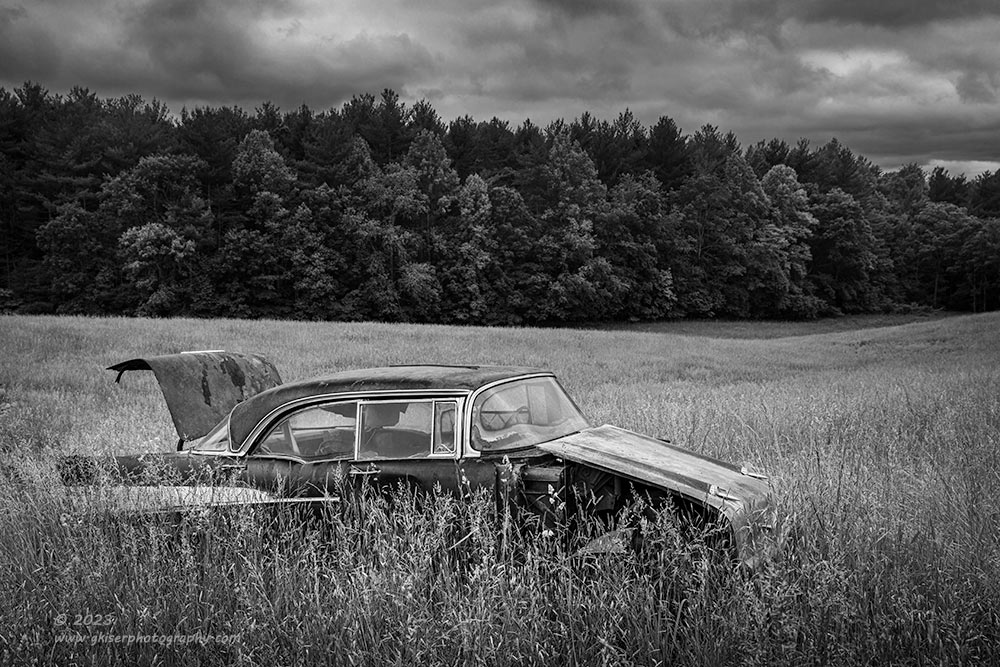
When I arrived at the shop, I quickly noticed that the grass had grown up really tall since the last time I was there. This is one of the aspects of doing decay photography in the warmer months that I don’t care for. It isn’t that I am worried about snakes, although I do keep an eye out for them. My main concern is that the vegetation tends to overgrow the cars all too quickly. There have been times when between the late Spring and early Fall a vehicle can be completely hidden from view. With photography being a line-of-sight artform, I kind of needed my subjects to be visible. Looking into the property from the road, I saw a single ’57 Bel Air off to itself that I had considered shooting during my other visits. I had been turned off because the front clip was largely missing leaving a hood slanted down to the ground. It just didn’t flow like I would have wanted which made me less interested in shooting this car. The rest of the subjects that I could see from the road appeared to be jammed in together which would make them very difficult to work with. Now that the grass was much higher, I saw an opportunity to work with the ’57 which hadn’t been possible before. The grass was taking the emphasis away from the missing fenders and the drooping hood started to make sense along with the open trunk. In a way, it looked like a pinewood derby car.
I sent a quick text to make sure that I was still OK to enter the property and got confirmation as I was walking over to the Chevy. Now things weren’t as easy here as I might have indicated because a short distance from the rear of the car was a late model Ford Crown Victoria which I didn’t want in the photo. Beyond that was another car from the late 70’s which I didn’t want either. The only way to avoid those was to shoot the Chevy almost broadside. I could get a little bit of an angle on it, but not much. I was then faced with three power lines running through the trees in the background. I considered shooting under the lines by using a panoramic approach but decided that I really wanted to get the sky included in the shot. I started to figure out the boarders of the shot and realized that in order to get the angle that would look best with the car, I was going to have to really cut the frame close on the left side. To keep the proportions right with just enough nose room, I started to see the framing develop. It was going to be a good time to use my 24-70mm lens because my eyes were showing me a good scaling through the scene, and I didn’t want to mess with that much.
I grabbed the camera and set it up on the tripod with the standard lens and a polarizer attached. I got the scene framed up as I had previsualized it and started to tweak it slightly to make sure that everything was located within the frame correctly. The light was perfect on the scene and there was very little breeze which meant that I didn’t have to worry about the grass blowing in the wind since I was already shooting at 1/15 of a second. The photo was actually quite easy to shoot once I got everything dialed in. I did play with the depth of field a bit because I wanted to have the background trees slightly blurred to make it easier to eliminate the three power lines. I’ve said it many times before during my workshops and mentorship sessions…”shoot it for how you intend to process it.” By having the trees go soft, the removal of the lines would not be nearly as time consuming, and the detail in the trees was in no way important to the image. The only textures that I was really wanting to get was the texture from the tall grasses contrasting with the smooth textures of the metal and glass.
When I was finally satisfied with the first composition of the day, I had shot only five frames but knew that I had a winner already. It was now time to move along through the field to see what I wanted to shoot next. Beside the Crown Vic, was an Oldsmobile Super 88 which I loved, but couldn’t figure out how to shoot it without including the Ford, or some other distractions. I reluctantly moved past it in search of some lower hanging fruit. While decay photography has been my focus for most of the previous year, the intensive time I’ve spent working with landscapes has dulled my creative edge a little bit. This was to be expected and would take a few compositions to get back in the swing of things again. I accepted this and chose to take it slow as I started to work through the area.
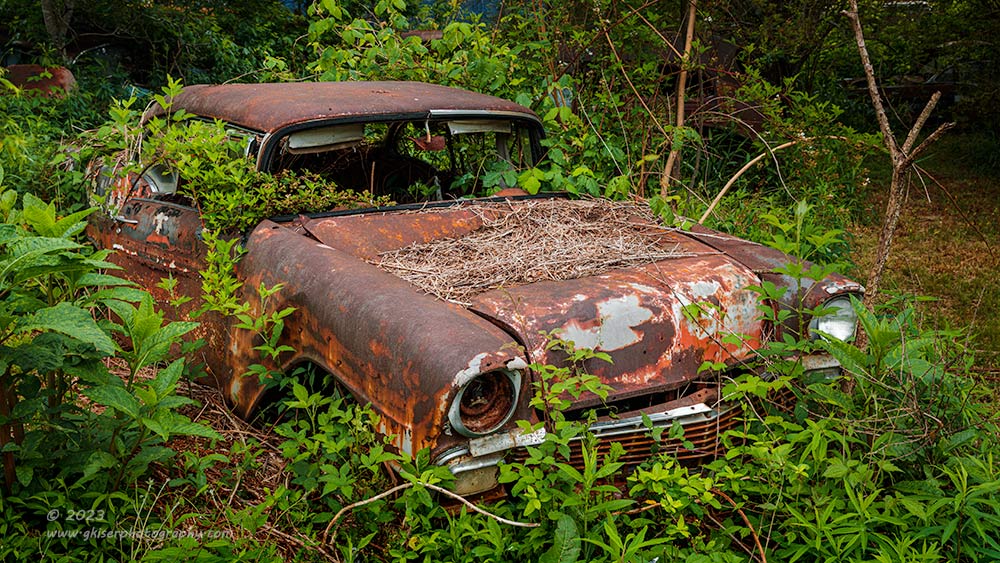
I ended up behind the shop where there were so many more vehicles than I had anticipated from the satellite imagery. He had a little bit of everything back here and seemed to be well stocked on the Tri-5 bodies which will always be a fun subject to photograph. I found one that was slightly apart from the rest of the cars. I felt that there was enough room to work with around it, so I stared to plan out a composition. Since the background was filled with an old school bus and a blue trailer, I had to take that into consideration. Since they were elevated, I decided to shoot the car from a higher point of view to remove a good portion of the distracting background. This also allowed me to fill the frame with the car in a nice diagonal orientation. The composition was looking rather simple, but so many times it is the simple composition that is the most effective. My main goal of getting rid of the distractions in the background was nearly complete though. The little bit that was left would be simple to deal with in post with a bit of desaturation and burning. Again, I was shooting for how I intended to edit the photo which made me feel pretty confident about how this one was turning out. I ended up shooting four frames here and the one that I thought was the best was the first of the bunch. The other tweaks didn’t work right for the perspective I was after.

It was still early in the session, but I was already feeling a bit more confident about capturing the rusty subjects again. Having reminded myself about the power of camera altitude, I turned my attention back to the Olds that I had just walked by. I looked at the scene and saw a beautiful sky above the scene and knew that this was the direction that I wanted to go with. There were several points of distraction in the scene that I wanted to deal with. For instance, there was a building behind the car at the edge of the field. There was the ’57 Chevy that I had started off photographing closer to the fence in the background. There was the gate that I had come through with a power pole just on the other side of the road with the power lines stretching across the width of the photo. Of course, the biggest problem was the Crown Vic which was parked just a few feet from the Olds.
I took some time to consider my options. The first one that I worked with was the Ford because that would ruin the photo quicker than anything else. I moved in close and leaned down to see what the chances would be of covering the car with the Oldsmobile. I found that it would be possible as long as the camera was low enough, and I was close enough to the car to make the Olds much larger in relation. For this, I knew that my only choice for a lens was going to be my 16-35 which I swapped in to replace the standard lens. I kept the polarizer attached as I started to work out the composition. When using a wide-angle lens, the composition takes on a number of hurdles to figure out. I was now including everything from the building to the left to a tree that was right next to a truck on the right side of the frame. Everything in the background was present in the photo, but in order to make the Ford go away, this was my only chance.
I started to work out the positioning of the camera and found that I could cover the more colorful areas of the building with some of the tall weeds around the Olds. This allowed me to use the building successfully as a bookend for the composition without it being a distraction. Instead of just having it there, I gave it a job. The same thing happened with the tree to the right. By putting it right at the edge of the frame, I was able to avoid including the truck to the right side, and I now was able to make sense of the floating limb that was above the car. One thing that I can’t stand is a limb that just seems to come out of nowhere into a photograph. By including the trunk, I grounded the limb and it made sense as a compositional piece which happened to be diagonal from the Olds for a bit of visual tension in the photograph.
I was left with the Chevy which I wanted to be separated from the Olds visually, but I was unable to get that to happen while keeping what I thought were more important relationships in place. By elevating the camera slightly, I was able to get most of the structure of the car visible behind the Olds so that it was no longer a distraction. Any higher would have allowed me to break it free from the Olds, but then the tan Ford would have entered into the photo which would have been much worse. The only remaining thing that I had to deal with was the power pole and the lines associated with it. I noticed that the base of the pole was now lined up with a wooden post to the fence which would make cloning it out much easier. The lines were in open sky, so I figured removing in them in post would be simple enough.
With all of the compositional fine tuning, when I was ready to make the first exposure things were pretty much dialed in. The only thing that was left was to drop in a 3-stop grad filter to take the bite out of the sky and make the histogram look happier. I made one shot and checked it all. Everything looked great and I saw no reason to change anything. Just in case though, I shot a safety exposure, so I had two to look at when I got home. It turns out that safety exposure saved the day because there was a bug that flew across the frame in the first one. There was no way to see it on the LCD review, but it was a big smear on the computer screen. The safety image was clean so that was the one that I used.
While in the field, I wasn’t convinced that this photo was going to work, so I decided to come in closer and isolate the Olds from everything else in the background. The composition was much simpler, but after spending some time working the edit on the grander scene, the isolation just looked like a snapshot. There was really nothing at all special about the photo and since I had already completed the edit on the first concept, I was ruined for anything else. This first composition was actually one of my favorites from the whole day and I just loved how it turned out with the tree included.
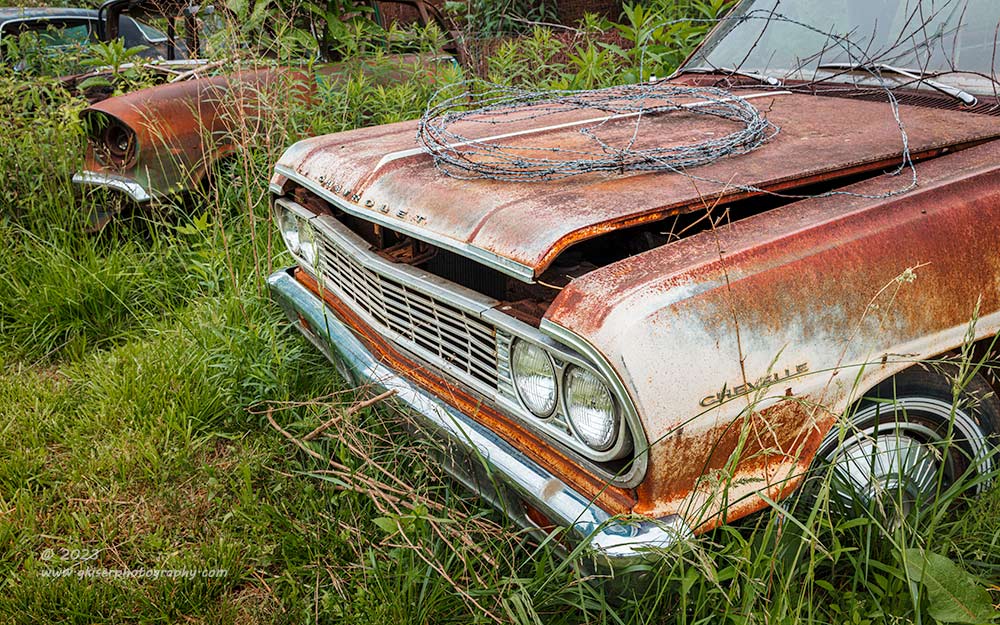
I picked up the camera and started to move through the back row of cars to see what I could find next. There was a lot to choose from, but everything seemed to be in really close together which made finding meaningful compositions very difficult. When I came to the other side of the building, I saw yet another Tri-5 Chevy next to a mid ’60’s Chevelle with a roll of barbed wire on the hood. The barbed wire and the patina of the car made for an interesting subject with the green grass, but I was hard pressed to find a good composition. There was a large truck behind the Chevelle, and the Chevy was sitting really close with a late ’70’s Camaro on the other side of it. I pondered my options for a while before settling on a possible composition.
I played my favorite game of what I liked and what I didn’t like about the scene. What I liked was the color of the Chevelle with the grass, the barbed wire, and the fender emblem that said Chevelle. The hubcap was also a point of interest that went with the headlights and brightwork. What I didn’t like was the box truck behind the car, and the Camaro on the other side of the Tri-5. The Tri-5 itself was interesting, but only for the recognizable fender that was sticking through the weeds. Those answers started to formulate the composition that I was after which gave me a starting point when I had been out of ideas for a capture. The first thing that I did was to switch out the lens to my 24-70mm once again and kept the polarizer attached. I decided to make a close crop on the car using that hubcap as kind of a corner element. I would cut the windshield in half so that I could keep the wipers and give context to the hood and fender. The front of the car would be at an angle that would point to the Chevy on the other side which would be cropped in to just show the fender. I then played with the elevation of the camera to arrive at the right sweeping diagonal through the frame to keep the eyes moving.
I ended up shooting six frames with this composition as I watched the wind moving the weeds. As I was checking to see if I got a frame with everything frozen, I realized that there was a long weed that was going right through the Chevelle emblem. Since this was something that I liked, I wanted to highlight it, not block it. I raised the camera maybe a half inch to keep the relationship the same between the two cars, but to drop the long weed below the emblem. There were still weeds that were going through the emblem, but I could deal with the vertical intrusion better than a lateral one. This tweak did the trick and I just had to wait for a lull in the breeze before taking one last shot that ended up being the keeper from this set.
Since the protruding fender had interested me with the neighboring car, I went over there and started to work out a composition with the fender. I ended up shooting two frames of this, but when I got home, I realized that there was really no substance to it. The fender was a much better supporting element for the Chevelle than it was a main subject for a photo. This is another part of photography that I talk about from time to time. Just because something is interesting doesn’t mean that it can carry the weight of a photograph all by itself. Even interesting subjects are sometimes better supporting players in a composition. It is your job as the photographer to understand that and to make the right call with your photos.
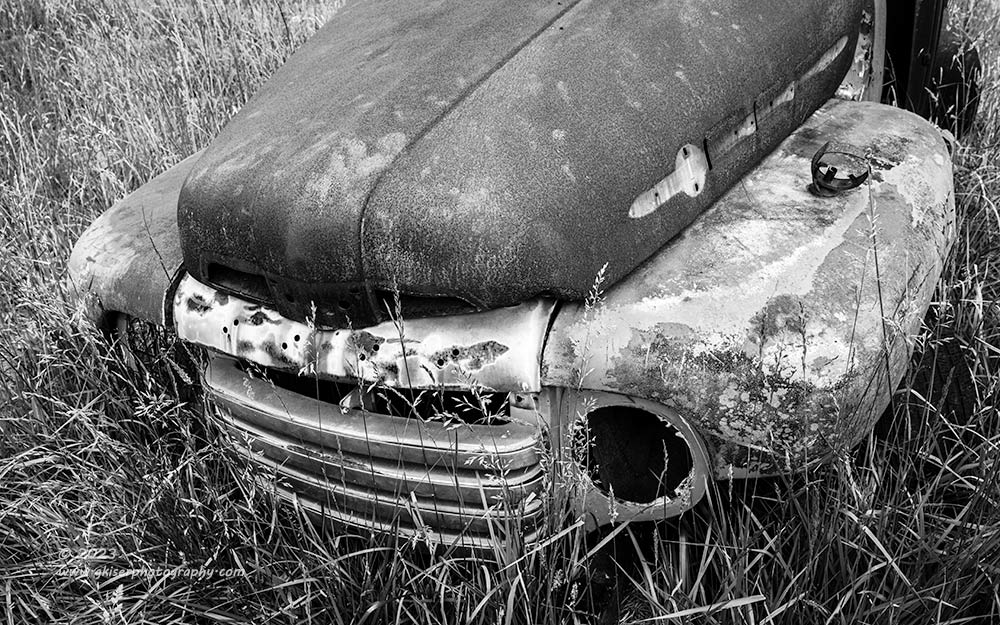
My next stop on my walkthrough of the property was back up to the fence near where I was parked. There was an old and tired Ford which was grounded near an old firetruck and some other farming equipment. The way it was laying in the tall grass without wheels, or a bumper caught my eye. The shape of this Ford was pleasing, and I have photographed a number of this generation before. As with the Chevelle, the background didn’t do this truck any favors which meant that I was going to have to get creative with the composition. I recalled one of my favorite compositions with this shaped Ford which I did many years ago and thought that this would be a good time to do something similar.
Since the truck looked quite a bit different with the headlights not dangling there and the chrome grille, I wasn’t convinced that shooting this the exact same way would be the answer. I just took the general idea as a starting point and began to work through the angles that fit the subject that I was working with. I determined that the best side for this was the driver’s side because there was an intact headlight bucket that was prominent as well as the partial marker light on the fender. The grill seemed to take too much emphasis from the rest of the truck since it was still chrome and very bright compared to the patina on the rest of the truck. The back half of the truck was missing, and I had to deal with the distractions around the truck which meant that I was going to avoid the cab altogether and just focus on the front clip which was where I found most of the interest. I worked the camera around and changed the altitude several different times until I had something that I was comfortable with.
I made that first exposure and thought that it was probably great as is, but I wanted to push the envelope a bit more to see if I could improve on it. I shot two more variations on the composition but decided that neither of them was any better than the original one. That was the one that I chose to edit and share here. It started out being a color image, but as I was going through the edit, I found that the grill took too much attention away from the rest of the truck. In order to remove that distraction, I went with a black and white presentation where I could reduce the visual impact of the grill much easier. This photo became all about texture and shadows. It is very similar to the composition that I started out with from 2019, but this one presents in a whole different way without the use of color. I am very glad that I stopped and tried a quick composition here because the end result is one that I really like, and it turned out better than I had expected.
From here, I moved over to a heavy-duty GMC truck which was right next to the fence. The patina of the truck interested me, but it was just a cab and there was nothing around it to help tell the story. The only chance that I had was to work isolations with it. Of course, I went to the passenger side and framed up my now famous composition of the cowl vent, fender, and hood. It looked fine, but really no different than any other time I have shot this same composition. After two attempts at it, I decided that there was no reason to try this if I wasn’t relatively certain that I could improve on what I had already done. I abandoned this truck after looking around for anything else that might have caught my eye.
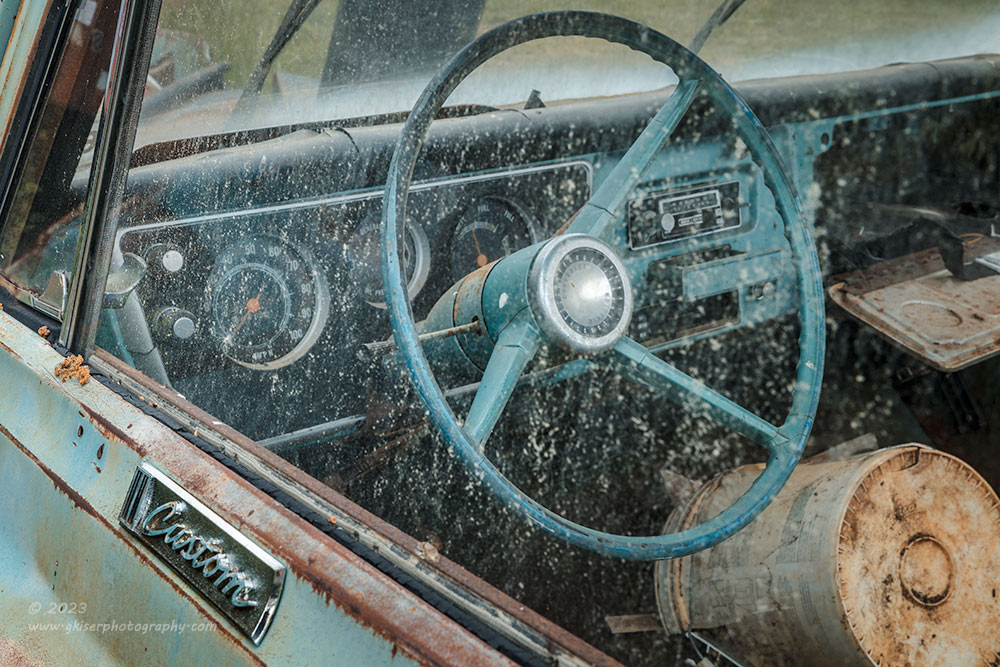
The next subject that I stopped at was a Custom Cab pickup with the emblem on the door right below the window. I can’t explain why, but these emblems are so addictive to me with how they are right below the window. I am always struggling with how to make a composition work around that badging, and I guess it is that challenge that keeps me coming back time after time. Just like normal, I started to work through a composition by figuring out what I wanted to include. Looking into the truck, I saw an old bucket and the glove box was open. A sane person would have seen these things as elements that had no purpose in a photo. In my creative zone, I saw a series of circles throughout the interior of the cab. The knobs, gauges, steering wheel, horn pad, and stamped cup holder on the glove box door were all circles of various sizes which linked the entire dash from left to right. The bucket could be seen as three different circles as well with the opening, the base, and the smaller circle within the base. There was a theme going on here and I know that the human eye likes repeating patterns in photos.
It was the circle theme that took the emphasis with this photo, but I still wanted to include that Custom emblem on the door. I took the camera and started to move it around the side of the truck looking for a pleasing organization within the cab. When I finally found something that I liked, I got the tripod mounted and started to fine tune things. Not only did I have to worry about the shapes inside of the cab, I also had to keep in mind what was beyond the windshield since I was wanting to include the entire steering wheel as a circle. I needed to be aware of the pillar and how it went through the upper left corner as well as where I cropped the frame on the right side. I ended up taking two images with the same composition. The only difference was that I wanted a bit more definition to the door emblem, so I moved myself into position where my body was reflected in the edge of the emblem giving it a black line for a bit more dimension. That was the only difference between the two and I ended up liking that very small detail which turned out to be the image that was edited.
I was feeling pretty confident about this photo, and that was really all that I found interesting with the truck. I grabbed my gear and started to walk around a bit more. I wasn’t really seeing much else that interested me on this side part of the yard, so I went back to the second row behind the shop. This was where most of the oldest cars were located. I found a bunch of Ford Rancheros that I would have loved to photograph, but they were so deeply buried in weeds and parked right on top of each other that there was no way of getting a good photo of any of them. I did see a Chevy Apache parked right next to a GMC pickup that really caught my eye. They were close together, but each truck had a personality and were relatively intact. I just had to figure out how best to shoot them.

Since I was coming at them from the Apache side, I had to take notice of how the fender emblem was pointing towards the GMC. The colors on the Chevy had a cooler look since the paint had been blue at one point. The GMC was orange and rusty which contrasted to the hues that the Chevy offered up. I started figuring out a way to capture what I was liking about this scene which wasn’t all that easy. There was a lot of distracting elements all around these two trucks from buildings to other vehicles to a very bright sky. The clouds were still looking great, but since I was well into the shaded portion of the property, any portion of the sky was going to be an exposure issue for me.
I decided to concentrate my efforts on the fronts of both trucks which would allow me to get the colors that I needed along with the fender emblem that pointed to the other truck. This was important because it was that emblem that linked the two trucks compositionally speaking. I started to move the camera around to see how things were lining up and I began to get closer and closer to the right relationship between the two trucks. When I had it figured out, I planted the tripod and started to work on the overall crop of the scene. I was cropping in very close on the top, bottom and right-hand side due to the avoidance of distractions. The idea was to keep these crops from looking like accidents which would make them a distraction as well. I chose where my breathing room needed to be and really worked the framing out to what I felt was perfection. I kept the edge close to the GMC on the left, but to keep things balanced, even that crop was close, although there was a bit of a buffer between the truck and the frame just to take into account the nose room needed within the frame to keep it from feeling cramped.
I shot three exposures here taking into account the breeze. They were all set up the same, but two of them were safety captures. I’m glad that I did that third one because that was the one that I ended up keeping because nothing was moving in the frame at 1/5 of a second at ISO200.
I know that at some point, somebody is going to tell me about the new feature in Lightroom that is a very effective noise reducer. I’ve already had plenty of folks tell me about different plugins that deal with noise very well, and I know that noise reduction is commonplace these days. I do work with noise reduction in Lightroom, but I do it through the basic slider manually. No matter what noise reduction you use, you are removing detail from the edges and then having to add that detail back. I’ve found that the less noise reduction that is needed, the better quality image you will end up with. I always shoot for how I want to edit, and part of that is to get the cleanest image possible to start with. For me, that means keeping the ISO below 800 with the DSLR. The noise at these levels is easy to deal with in post without hurting overall sharpness. For times when I need to shoot at a higher ISO, like natural light portraits, I will happily go to my EOS R5 which produces a much cleaner image at higher ISO values. For now, I’m satisfied with the DSLR on a tripod for what I am shooting in this situation.
As you can see, we are coming to the end of this blog entry. This seems odd since I was just getting started on two trucks that I was pretty excited about. Normally, I would have done more with them and we would still be reading through the rest of the blog. Well, I’ve talked about seven new photos here already and I know you are wanting a little intermission after about 5800 words. I actually need a little bit of a break anyway since I started typing this first thing in the morning after typing the last blog last night and into the morning. My fingers are feeling a little numb at this point from all the typing that I have been doing. In fact, I have been sitting here at the computer since about 2pm yesterday afternoon and I’m looking at the time which is nearing 12:45 now. My only break has been to stop for dinner yesterday and about 8 hours of sleep last night. I’m due another break from the computer now and will return with the last part of this fairly epic adventure later on today, or tomorrow morning.
In the meantime, consider ordering a print of your favorite image from the day. There is no better way to enjoy a photograph than to hold it in a physical form with the colors and luminance that the photographer intended. You have no idea how much monitors can vary between computers and other devices. I have gone through a lot of trouble to color calibrate my system so that what I see on my monitor is what I am able to produce on the printer, and from my print shop which is also color calibrated. The prints also turn out so much nicer than a monitor can display them. When you buy a print, you are really supporting my photography and the business that I have put together around that photography. It helps to fund adventures like this which bring about more photos, and more blogs. In short, you are allowing me to continue to create when you support my business.
Also, if my little insights into creating a photograph interest you and you feel that I might be able to help you with your own photography, consider hiring me as a mentor. Teaching photography is something that I love to do, and I really think that I have a knack for it. I have several different levels of instruction available from simple image critiques to sessions by the hour, and a long-term arrangement where we can cover an endless number of topics at your convenience. If something like this interests you, give me a call and we can do a free consultation to build a program that best suits your needs.
Thank you for joining me so far on this trek and I do hope that you have enjoyed the photos up to this point. I still have a good many to share with you, so stick around and keep your eyes out for the next blog entry that will finish things up.
Until then….

Remember to use the code KISER10 to get 10% off your purchase